



 By
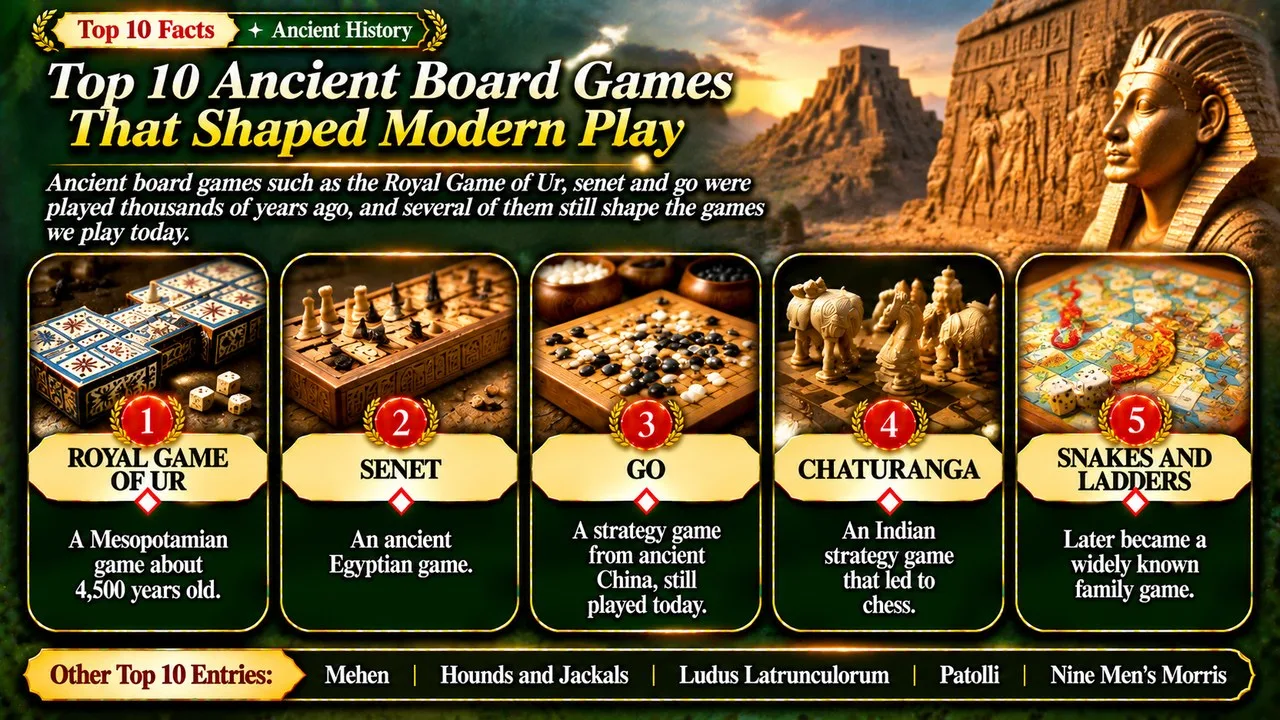
Ancient board games such as the Royal Game of Ur, senet and go were played thousands of years ago, and several of them still shape the games we play today.
People have played board games for at least 5,000 years. Boards and counters turn up in royal tombs, army forts and temple floors, and they show that our ancestors loved races, battles and games of pure chance as much as we do [2]. Some of these games vanished and had to be rebuilt from clay tablets and tomb paintings; others never stopped being played at all.
This Finepedia guide, written in November 2026, takes its topic from a Listverse list about early board games and their modern descendants [19], but the selection, order and wording are our own. We kept eight of its games and added go and chaturanga, two ancient games with an unbroken link to the present. Each entry is backed by museum collections, archaeology or encyclopaedias, and we have flagged where the rules or dates are still disputed. The list starts with the world's oldest playable board game and ends with a game that is still sold on the back of draughts boards.
Key Facts
This table sums up all ten games, where they come from and what they led to.
Ancient Board Games at a Glance
| Rank | Name | Origin | Oldest evidence | Notable fact |
|---|---|---|---|---|
| 1 | Royal Game of Ur | Mesopotamia (Iraq) | Board of about 2600 to 2400 BC | Rules survive on a 177 BC tablet |
| 2 | Senet | Ancient Egypt | Possible boards about 3100 BC | 30 squares in three rows of ten |
| 3 | Go | China | Over 2,500 years old | 361 points on a 19 by 19 grid |
| 4 | Chaturanga | India | About the 6th century AD | Common ancestor of chess |
| 5 | Mehen | Ancient Egypt | About 3000 BC | Board shaped like a coiled snake |
| 6 | Hounds and Jackals | Egypt and the Near East | About 2000 BC | Also called 58 holes |
| 7 | Ludus Latrunculorum | Roman Empire | Mentioned by Varro (116 to 27 BC) | Played with glass soldiers |
| 8 | Patolli | Mesoamerica | Teotihuacan era | Played with beans as dice |
| 9 | Snakes and Ladders | India | Oldest board from 17th-century Mewar | Ladders for virtue, snakes for vice |
| 10 | Nine Men's Morris | Roman Empire and Europe | At least Roman times | Perfect play ends in a draw |
1. Royal Game of Ur
The Royal Game of Ur is a race game for two players that was first played in ancient Mesopotamia in the early third millennium BC [1]. It takes its name from the Royal Cemetery at Ur in southern Iraq, which the English archaeologist Sir Leonard Woolley excavated between 1922 and 1934 [1]. One of the boards he found, now in the British Museum, dates from about 2600 to 2400 BC and is often called the oldest playable board game in the world [1][2].
Each player races seven pieces along a track of 20 squares and off the board before the opponent [1]. We know how it was played because a Babylonian scribe wrote the rules on a clay tablet in 177 BC. In the early 1980s British Museum curator Irving Finkel translated that tablet and rebuilt the rules [1][2]. The tablet also links certain squares to fortunes, such as finding a friend or drinking fine beer [1].
Boards have been found as far away as Crete and Sri Lanka, and the Jewish community of Kochi in India kept playing a version called asha until the 1950s [1]. Its age, reach and recovered rules put the game of Ur in first place.
2. Senet
Senet, whose name means passing, is one of the oldest board games known. Fragments of possible senet boards come from burials of about 3100 BC, and the first clear painting of the game appears in the tomb of the official Hesy, from about 2620 BC [3][2]. It stayed popular in Egypt for some 2,000 years before falling out of use in the Roman period [3].
The board has 30 squares set out in three rows of ten. Two players race their pieces to the end, using throwing sticks or knucklebones instead of dice [2][3]. Some boards have plain squares, while others carry hieroglyphs that seem to mark special rules [2]. Because no rulebook survives, modern versions are only educated guesses [3].
Senet was also part of Egyptian religion. Chapter 17 of the Book of the Dead mentions it, and the game came to be seen as a journey of the soul into the afterlife [3]. Queen Nefertari is shown playing it, and Tutankhamun was buried with sets [3][2]. That mix of play and belief makes senet the most famous game of ancient Egypt.
Related: Cleopatra's Tomb: History, Theories and the Search at Taposiris Magna
3. Go
Go, known as weiqi in China and baduk in Korea, is a two-player game in which each side places black or white stones to fence off more territory than the other [5]. Chinese players had it over 2,500 years ago, and no other board game is thought to have been played so long without a break [5].
The rules are simple. Players take turns placing stones on the intersections of a grid, and a stone or group surrounded on all sides is captured [5]. The standard board has 19 by 19 lines, making 361 points, while beginners often use smaller boards. A 2016 survey for the International Go Federation counted over 46 million people who know the game and over 20 million current players, most of them in East Asia [5].
Go also became a landmark for computing. In March 2016 the Google DeepMind program AlphaGo beat Lee Sedol, winner of 18 world titles, by four games to one in Seoul [6]. A game this old that still challenges the best human and machine players earns a place near the top.
4. Chaturanga
Chaturanga is an ancient Indian strategy game and, in the view of most chess historians, the common ancestor of chess and its Asian cousins, including xiangqi in China, janggi in Korea and shogi in Japan [7]. The earliest clear references come from northern India in the Gupta era, around the 6th century AD [7][8]. A work by the poet Banabhatta from about AD 625 contains the earliest known use of the name [7].
The word means having four limbs, and it referred to the four divisions of an Indian army: elephants, chariots, cavalry and foot soldiers [7]. Those became pieces on the board, the ancestors of the modern bishop, rook, knight and pawn. Not every rule is known for certain; historians still argue about how the elephant moved [7].
From India the game travelled to Persia, where it became chatrang, and then to the Arab world as shatranj, which carried it on to Europe [7][8]. A curator's exhibit from Hyderabad's Salar Jung Museum notes that chess, born in India during the Gupta dynasty, is now played in 172 countries [8]. Few inventions have travelled further.
5. Mehen
Mehen is an Egyptian game named after a snake god. It was played from about 3000 BC until about 2300 BC, when the Old Kingdom drew to a close [4][2]. Its round board is carved like a coiled serpent whose body is divided into segments, with the head at the centre [2].
Related: Top 10 Oldest Surviving Buildings on Earth
Players appear to have raced their pieces from the tail to the head and back again, and the game used lion-shaped pieces. As many as six players may have taken part [2]. A mehen board is pictured in the tomb of Hesy-Ra, and its name first appears in the tomb of Rahotep, but no scenes or boards survive from later periods, so the game seems to have been forgotten in Egypt after the Old Kingdom [4].
It lived on longer abroad. Mehen boards have been found in Cyprus, sometimes carved on one side of a stone with a senet board on the other; those from Sotira Kaminoudhia, about 2250 BC, are the oldest double-sided game boards known [4]. The rules are lost, but the spiral race still survives in African games such as hyena [2].
6. Hounds and Jackals
Hounds and jackals is the modern name for an ancient Egyptian race game played with pegs in holes. Howard Carter, later famous for finding Tutankhamun, uncovered one complete set in 1910 with Lord Carnarvon in a tomb at Thebes dating to the reign of Amenemhat IV of the 12th Dynasty [9][10]. That set now belongs to the Met in New York [9][10].
The board has 58 holes, 29 for each player, so game historians often call it fifty-eight holes, a name first used by Flinders Petrie [9][10]. Each player has five sticks topped with the heads of either dogs or jackals [9]. The game appeared in Egypt around 2000 BC and was most popular in the Middle Kingdom [9].
More than 60 examples have since been found across Egypt, Mesopotamia, the Levant, Anatolia and beyond, and some scholars now wonder whether it began outside Egypt [9]. Found in so many lands, it ranks among the best-known games of the Bronze Age [9].
7. Ludus Latrunculorum
Ludus latrunculorum, or latrunculi, was a two-player strategy game played across the Roman Empire. Its name means the game of brigands or soldiers, and it is usually compared to draughts or chess because it was a game of military tactics [11]. The Roman writer Varro, who lived from 116 to 27 BC, is the first to mention it, comparing its grid to a table of word endings [11].
A Roman poem from the 1st century AD, the Laus Pisonis, gives the fullest picture: wars are fought by "a soldiery of glass", with white counters trapping black ones and black trapping white [11]. Players appear to have captured a piece by surrounding it between two of their own [11]. Because so little was written down, every modern version of the rules is a reconstruction [11].
Related: Top 10 Legendary Pyramids Around the World
Archaeology shows how popular it was. At the Roman fort of Vindolanda near Hadrian's Wall, latrunculi was the most common game, and the site holds the largest collection of gaming boards found in Roman Britain [12]. Simple grids scratched on stone or tile made it easy to play anywhere a soldier had spare time.
8. Patolli
Patolli ranks among the earliest recorded games of the Americas, played by commoners and nobles across pre-Columbian Mesoamerica [13]. Versions were played at Teotihuacan, by the Toltecs and the Maya, and above all by the Aztecs. Spanish chroniclers reported that the ruler Moctezuma liked to watch his nobles play at court [13].
The Aztec board was a cross-shaped track painted on a mat, so a game could start wherever the mat was rolled out. Players moved pebbles according to throws of dried beans marked on one side, which served as dice [14]. Crowds gathered to watch, and a bean that landed on its edge caused special excitement [14].
Above all, patolli was a gambling game. Players staked goods, and sometimes much more, on the result [13][14]. After the conquest, Spanish colonial authorities actively suppressed the cross-shaped game, although related track games survived in parts of Mexico [13]. Its blend of luck, ritual and betting gives the Americas a place on this list.
9. Snakes and Ladders
Snakes and ladders began in India as a game of moral teaching known as Moksha Patam or gyan chaupar, the game of knowledge [15][16]. Players moved up a board towards spiritual liberation; ladders stood for virtues that lifted the player higher, while snakes stood for vices that sent them sliding back [15]. Because the game used only dice, it stressed destiny rather than skill [15].
The oldest surviving board comes from 17th-century Mewar in Rajasthan [16]. Designs varied widely. Hindu boards most often had 72 squares, while Jain boards from Gujarat and Rajasthan had 84, and the game was especially popular during the Jain festival of Paryushan [16].
Related: Top 10 Lost Cities That Were Rediscovered
The game reached Britain in the 1890s, where its religious meaning gave way to a simple race for children on a numbered grid [15]. In the United States it was sold from 1943 by the Milton Bradley Company as Chutes and Ladders [15]. Few games have changed so much in meaning while keeping the same basic shape.
10. Nine Men's Morris
Nine men's morris is a two-player strategy game that dates back at least to the Roman Empire [17]. In English it has also been called mill, merels and merrills, and in North America it is sometimes printed on the back of draughts boards [17]. Some older books claimed boards were cut into the roof of an Egyptian temple at Kurna around 1400 BC, but scholars now doubt that date, as some of the carvings include Coptic crosses and are much later [17][18].
The board has 24 points arranged on three nested squares joined by lines. Each player has nine pieces, or men, and tries to form a mill, three in a row, which allows them to remove one of the opponent's men [17]. A player wins by reducing the other side to two men or leaving them with no legal move [17].
The game has been fully analysed by computer, and with perfect play from both sides it always ends in a draw [17]. Played in Roman times and still sold today, it closes our list as one of the longest-lived strategy games in Europe.
Conclusion
From the race tracks of Ur and Egypt to the battle grids of Rome and India, these ten games show that the basic ideas of modern play are very old. Racing, capturing, surrounding and trusting to luck all appear thousands of years ago, and games such as go, chess and snakes and ladders link us directly to the people who first played them [2][5][7].
Many ancient rules are lost and must be rebuilt from tablets, poems and paintings, which is why museums still argue over how some of these games worked. For more history, see Top 10 Books That Changed the World and Top 10 Prehistoric Cave Art Masterpieces.
- ^ [1] "Royal Game of Ur". Wikipedia. Wikipedia
- ^ [2] "Top 10 historical board games". British Museum. British Museum blog
- ^ [3] "Senet". Wikipedia. Wikipedia
- ^ [4] "Mehen (game)". Wikipedia. Wikipedia
- ^ [5] "Go (game)". Wikipedia. Wikipedia
- ^ [6] "AlphaGo". Google DeepMind. Google DeepMind
- ^ [7] "Chaturanga". Wikipedia. Wikipedia
- ^ [8] "A Game of Thrones: How Chess Conquered the World". Salar Jung Museum on Google Arts and Culture. Google Arts and Culture
- ^ [9] "Hounds and jackals". Wikipedia. Wikipedia
- ^ [10] "Game of Hounds and Jackals". The Metropolitan Museum of Art. The Met
- ^ [11] "Ludus latrunculorum". Wikipedia. Wikipedia
- ^ [12] "Playing games at Vindolanda". The Vindolanda Trust. Vindolanda Trust
- ^ [13] "Patolli". Wikipedia. Wikipedia
- ^ [14] "Gambling and patolli, the Aztecs' favourite game". Mexicolore. Mexicolore
- ^ [15] "Snakes and ladders". Wikipedia. Wikipedia
- ^ [16] "Gyan Chaupar". MAP Academy. MAP Academy
- ^ [17] "Nine men's morris". Wikipedia. Wikipedia
- ^ [18] "Some Misconceptions About Ancient Roman Games". Board Game Studies Journal. Board Game Studies Journal
- ^ [19] "10 Ancient Board Games That Inspired Modern Games". Listverse. Topic reference on Listverse





















Discussion
Log in with