




Top 10 Chemical Reactions That Shaped the Modern World
 By Dhiraj Sharma · Published
Share Post
Loading…
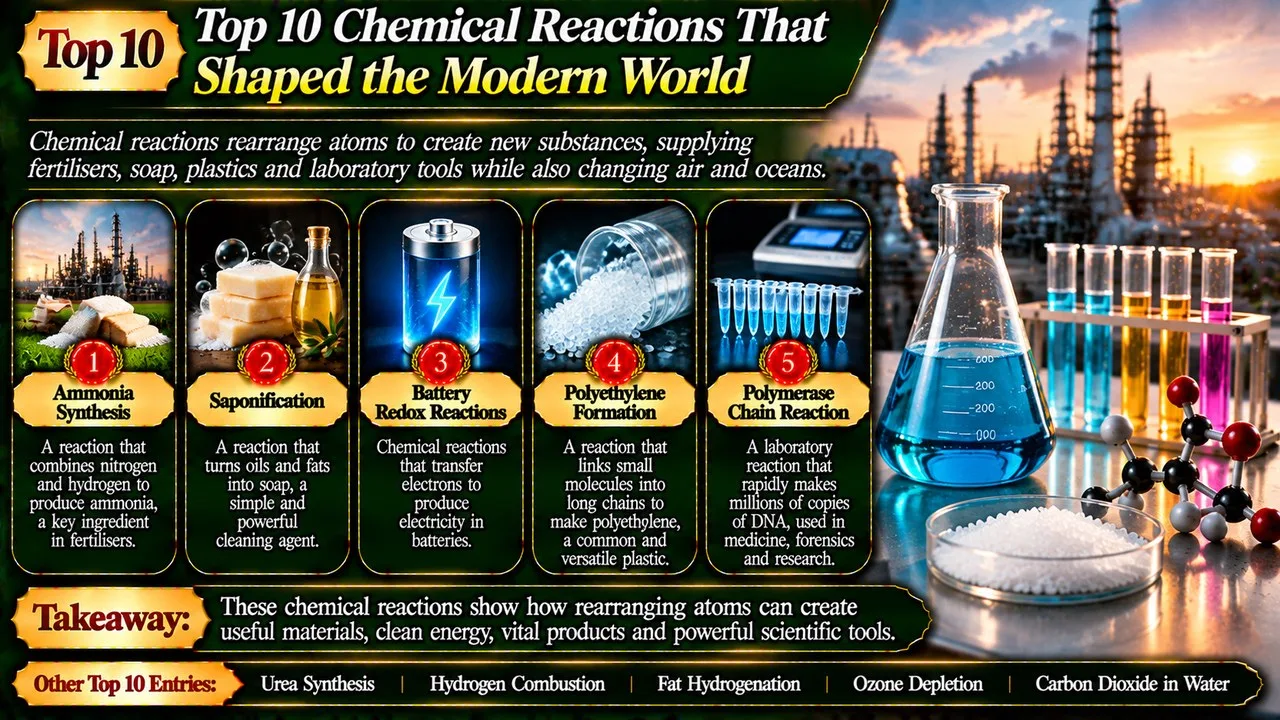
Chemical reactions rearrange atoms to create new substances, supplying fertilisers, soap, plastics and laboratory tools while also changing air and oceans.
A chemical reaction can occur in a factory, a laboratory tube or high above the clouds. The same underlying rules apply: atoms are rearranged, bonds change and energy is transferred. Some transformations became useful industries; others forced society to confront the unintended consequences of those industries.
This November 2026 guide adapts Listverse's influential-reactions topic [21]. We retain its broad selection but reorder it by practical reach, scientific influence and environmental significance. Some entries are families of related reactions or repeated laboratory steps, not a single universal equation. This explains their importance; it is not practical guidance. Hazardous gases, corrosive chemicals and industrial pressures require specialist facilities.
Key Facts
The table summarises each entry; the order reflects the editorial criteria above, not a universal measure of value.
Chemical Reactions That Shaped the Modern World at a Glance
| Rank | Name | Context | Main feature | Notable point |
|---|---|---|---|---|
| 1 | Ammonia Synthesis | Fertiliser manufacture | Nitrogen and hydrogen form ammonia | Makes atmospheric nitrogen useful to crops |
| 2 | Saponification | Cleaning | Fats react with alkali | Produces soap and glycerol |
| 3 | Battery Redox Reactions | Electrical power | Paired electron-transfer changes | Chemical energy supplies a current |
| 4 | Polyethylene Formation | Materials | Ethylene joins into long chains | Creates versatile plastics |
| 5 | Urea Synthesis | Organic chemistry | Ammonium cyanate becomes urea | Challenged a boundary between life and chemistry |
| 6 | Polymerase Chain Reaction | Molecular biology | Enzymes repeatedly copy chosen DNA | Small samples become easier to study |
| 7 | Hydrogen Combustion | Combustion research | Hydrogen reacts with oxygen | Water is formed rather than destroyed |
| 8 | Fat Hydrogenation | Food manufacturing | Hydrogen changes unsaturated fats | Alters texture and melting behaviour |
| 9 | Ozone Depletion | Atmospheric chemistry | Catalytic loss of ozone | Connects pollutants with ultraviolet exposure |
| 10 | Carbon Dioxide in Water | Ocean chemistry | Dissolved gas changes acidity | Links air emissions with seawater changes |
1. Ammonia Synthesis
The Haber-Bosch process combines atmospheric nitrogen with hydrogen to produce ammonia. Plants need nitrogen, but most cannot use the nitrogen gas around them directly. Converting it into a form from which fertilisers can be made changed the scale of agricultural production. Fritz Haber developed the laboratory approach, and Carl Bosch helped turn it into a workable industrial operation [1][2].
The reaction needs a carefully chosen compromise. Higher pressure favours ammonia formation, while temperature affects both the balance of products and the speed at which they appear. A catalyst, traditionally based largely on iron, helps the reaction proceed at a useful rate. Industrial success therefore required more than knowing which gases to combine; engineers had to handle heat, pressure, materials and repeated circulation safely [1][2].
First place reflects its reach into farming and industry. The benefits carry costs: hydrogen production and operating conditions require resources, while poorly managed fertiliser can pollute. A useful reaction can reshape food production without being an uncomplicated success. Its responsibilities extend beyond the factory and into the fields it supplies.
2. Saponification
Saponification is the reaction that turns fats or oils and an alkali into soap, with glycerol also formed when ordinary triglycerides are used. A greasy starting material can thus become part of a product that helps remove grease. The apparent reversal makes sense once the product is understood as a different chemical substance, not merely oil mixed with an abrasive ingredient [3][4].
Soap molecules have regions that interact differently with water and with oily material. In washing, this helps oily dirt disperse into water so that it can be carried away. Sodium and potassium salts of fatty acids are familiar examples, though not every cleaning product sold in a supermarket is soap in this chemical sense. Synthetic detergents can perform similar jobs using other molecular structures [3][4].
Related: Top 10 Most Bizarre Phobias: Strange Fears That Exist
Its ranking reflects everyday cleaning, not a claim that soap alone created public health. Water, sanitation and good practice also matter. Finished substances differ from their raw materials: corrosive alkalis can become part of a useful product. That transformation is no reason to handle concentrated ingredients casually or improvise manufacturing.
3. Battery Redox Reactions
A battery supplies electricity through linked oxidation and reduction reactions. Oxidation releases electrons, while reduction accepts them. By separating the reacting regions and providing an external conducting path, a cell can send electrons through a useful circuit instead of allowing the chemical change to release its energy only where the materials meet [5][6].
Alessandro Volta's pile established that a chemical arrangement could provide a continuing current, helping open a new field of electrical experimentation. Later cells improved the materials, stability and practicality of the idea. A battery is therefore not one fixed pair of substances: different designs use different reactions, while sharing the principle of coordinated electron transfer [5][6].
Its reach extends from experiments to portable devices. Rechargeable cells must allow useful reversal when energy is supplied from outside, but they still age and need suitable handling. Third place recognises a bridge between changing matter and directed electrical power: chemistry makes it possible to carry useful energy away from a fixed generator.
4. Polyethylene Formation
Polyethylene forms when ethylene molecules join into long chains. A small gaseous molecule becomes part of a large polymer whose behaviour depends on chain length, branching and the way chains pack together. This is why the same broad material family can provide a flexible film for wrapping and a stiffer bottle for household products [7][8].
Industrial development involved more than making the first sample. Different catalysts and reaction conditions allowed manufacturers to influence the resulting structure. Low-density and high-density forms do not merely differ because one contains more colour or filler; their molecular organisation helps determine flexibility, strength and other useful properties. A change at the scale of individual bonds can therefore alter the feel of an everyday object [7][8].
Light weight and easy shaping made polyethylene widely useful. Durability also creates difficulties when waste escapes collection or cannot be recycled effectively. Assembling a useful molecular chain does not supply an end-of-life plan. This entry ranks for changing manufacture while showing why a material’s story continues long after production.
5. Urea Synthesis
In 1828 Friedrich Wohler reported making urea from ammonium cyanate. Urea was already known as a substance associated with animal metabolism. Producing it from materials regarded as inorganic challenged the belief that substances from living things necessarily required a special life force for their formation. The result became a landmark in the history of organic chemistry [9][10].
Related: Top 10 Facts About Dogs
The popular version sometimes makes the experiment sound like a single decisive blow that instantly ended every form of vitalism. Historical change was less tidy: ideas about life and chemistry developed through further work and debate. The real achievement needs no exaggerated instant revolution. It demonstrated a specific transformation and encouraged chemists to reconsider the boundaries they had drawn between categories of substance [9][10].
Modern urea manufacture commonly starts with ammonia and carbon dioxide, not the historical laboratory route. Its ranking recognises a change in scientific expectations as well as a useful product. Origin does not determine chemical identity: controlled manufacture can yield the same molecule that occurs within a living organism.
6. Polymerase Chain Reaction
The polymerase chain reaction, usually abbreviated to PCR, repeatedly copies a chosen stretch of DNA. Short primers help identify the target, and an enzyme builds new DNA strands. Successive rounds can amplify a tiny starting sample until there is enough material for closer examination. It is a controlled sequence of molecular reactions, not a machine that reads an entire genome by itself [11][12].
Heating separates the paired DNA strands, cooling allows primers to attach, and an extension step gives the enzyme conditions in which it can copy. Repetition is the crucial idea: copies become templates in later rounds. The practical method depends on selecting suitable primers and conditions, and on avoiding contamination that could make a result misleading [11][12].
PCR supports genetics, infection testing and forensic work, but amplified material still needs interpretation. Detecting a sequence does not answer every question about its source or biological significance. Sixth place recognises a change of scale: careful chemistry makes tiny samples easier to investigate, provided contamination is controlled and the right question is asked.
7. Hydrogen Combustion
Hydrogen reacts with oxygen to form water and release energy. That simple statement once carried a major conceptual surprise: water, long treated as an elemental substance in older traditions, could be understood as a compound. Work by investigators including Henry Cavendish and Antoine Lavoisier helped connect experiments on gases with a new account of combustion and chemical composition [13][14].
Related: Top 10 Tallest Buildings in the World
The reaction does not make matter disappear into heat. The atoms remain, rearranged into water molecules, while energy is transferred. This distinction is fundamental to chemistry and helps explain why tracking masses and products mattered so much to early experimental work. A flame is an observable event; a balanced account of what enters and leaves is a deeper explanation [13][14].
The reaction also matters in fuel use. Calling hydrogen automatically clean overlooks how it is produced; burning it in air can involve additional products. Its ranking joins historical discovery with modern energy debate. A useful reaction where a fuel is consumed is only part of assessing its wider environmental consequences.
8. Fat Hydrogenation
Hydrogenation adds hydrogen to suitable unsaturated bonds, changing the structure and behaviour of an oil or fat. In food manufacture it has been used to make liquid oils firmer and to alter their melting properties. A catalyst helps the process occur at a practical rate, allowing chemistry to influence texture as well as the way a product stores [15][16].
Partial hydrogenation can also rearrange some remaining double bonds into the trans configuration. That is why hydrogenation appears in discussions of industrial trans fats and cardiovascular health. Partial and complete hydrogenation should not be treated as identical processes, and a product's nutritional character cannot be inferred from the word hydrogen alone. The molecular arrangement matters [15][16].
It links factory chemistry to everyday texture: whether a spread is soft, firm or melting. Manufacturing benefits must also be weighed against health evidence. Eighth place recognises both influence and caution. The useful question concerns actual molecular changes and their effects, not whether a process name sounds natural or artificial.
9. Ozone Depletion
Ozone in the stratosphere absorbs much of the Sun's harmful ultraviolet radiation. Certain long-lived manufactured compounds can reach that region and release chlorine or bromine when broken apart by energetic light. Those atoms can participate in catalytic reaction cycles that convert ozone into ordinary oxygen, weakening a protective feature of the atmosphere [17][18].
Catalytic is the important word. An atom involved in the cycle can be regenerated and take part again, so its effect is not limited to destroying one ozone molecule and then becoming permanently harmless. Conditions over Antarctica intensify particular reactions, helping explain the seasonal ozone hole. The phrase does not mean that all the air above the continent has literally vanished [17][18].
Related: 10 Sikh Gurus: The Pillars of Sikhism Who Shaped Faith, Equality, Courage, and Humanity
The discovery linked ordinary industrial substances with distant atmospheric effects, prompting measurements, laboratory research and international action. Ninth place recognises an unintended reaction rather than a useful product. Persistence and transport can move chemicals into settings where their behaviour changes; immediate harmlessness near the ground is not the whole story.
10. Carbon Dioxide in Water
When carbon dioxide dissolves in water, chemical equilibria connect it with carbonic acid and dissolved ions. In seawater, additional carbon dioxide can increase hydrogen-ion availability and change the balance among carbonate and bicarbonate. This is the chemical basis of ocean acidification, a process linked to the ocean's absorption of atmospheric carbon dioxide [19][20].
Acidification does not require the ocean to become an acid in the everyday sense. Seawater can remain alkaline while becoming less alkaline than before. The direction of change is what the term identifies. Altered carbonate availability matters to organisms that build calcium-carbonate structures, though the biological effects vary with species, place and surrounding conditions [19][20].
Carbonated drinks offer a familiar comparison, but a beverage and a changing ocean pose different questions. This entry closes the list by connecting invisible gas exchange with measurable water chemistry. Air emissions affect more than air: water, organisms and minerals participate in the consequences, making the wider context essential.
Conclusion
These reactions reshaped farming, cleaning, materials, electricity and biological research. Others exposed environmental effects that were difficult to see until scientists connected laboratory mechanisms with measurements in the wider world. Chemical power is neither a guarantee of progress nor a reason for alarm on its own; its value depends on context and careful use.
For the human side of discovery, explore Top 10 Accidental Inventions That Changed Everyday Life. The atmosphere offers further examples in Top 10 Rare Cloud Formations and How They Form. Both guides reinforce a useful habit: understand the mechanism before accepting the most dramatic version of a story.
- ^ [1] "Ammonia synthesis". Wikipedia. Read
- ^ [2] "Ammonia synthesis". Britannica. Read
- ^ [3] "Saponification". Wikipedia. Read
- ^ [4] "Soap and detergent". Britannica. Read
- ^ [5] "Battery redox reactions". Wikipedia. Read
- ^ [6] "Battery". Britannica. Read
- ^ [7] "Polyethylene formation". Wikipedia. Read
- ^ [8] "Polyethylene formation". Britannica. Read
- ^ [9] "Urea synthesis". Wikipedia. Read
- ^ [10] "Urea synthesis". Britannica. Read
- ^ [11] "Polymerase chain reaction". Wikipedia. Read
- ^ [12] "Polymerase chain reaction". US National Human Genome Research Institute. Read
- ^ [13] "Hydrogen combustion". Wikipedia. Read
- ^ [14] "Hydrogen combustion". Britannica. Read
- ^ [15] "Fat hydrogenation". Wikipedia. Read
- ^ [16] "Fat hydrogenation". Britannica. Read
- ^ [17] "Ozone depletion". Wikipedia. Read
- ^ [18] "Ozone depletion". US Environmental Protection Agency. Read
- ^ [19] "Carbon dioxide in water". Wikipedia. Read
- ^ [20] "Carbon dioxide in water". NOAA. Read
- ^ [21] "Topic inspiration: Chemical Reactions That Shaped the Modern World". Listverse. Read



















Discussion
Log in with