





Top 10 Calendars That Changed How People Count Time
 By Dhiraj Sharma · Published
Share Post
Loading…
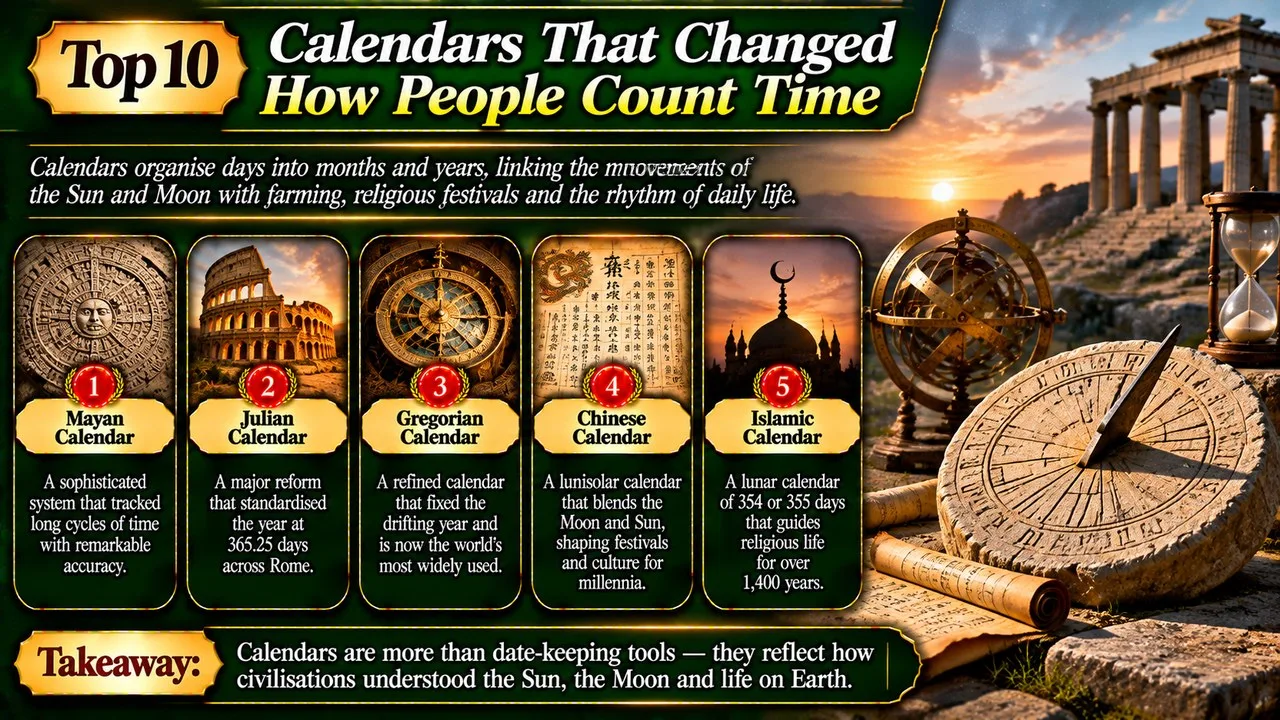
Calendars organise days into months and years, linking the movements of the Sun and Moon with farming, religious festivals and the rhythm of daily life.
A date can look perfectly ordinary until someone asks which calendar it belongs to. A new year might begin with a new moon, an autumn equinox or the anniversary of a political upheaval. Months can follow the Moon, the seasons, or a deliberately tidy pattern that makes accounts easier to compare.
This guide, prepared in November 2026, adapts a Listverse topic about historical calendars [21]. Our order weighs cultural reach, historical influence and the distinctness of each approach, rather than treating one tradition as more advanced than another. Six selections remain from the reference; four better-documented comparisons replace its other entries. The emphasis is on how calendars work, not on converting a particular date.
Key Facts
The table summarises each entry; the order reflects the editorial criteria above, not a universal measure of value.
Calendars That Changed How People Count Time at a Glance
| Rank | Name | Context | Main feature | Notable point |
|---|---|---|---|---|
| 1 | Gregorian Calendar | Global civil use | Solar | Revised leap-year rule |
| 2 | Julian Calendar | Roman world and later churches | Solar | Regular fourth-year leap day |
| 3 | Chinese Calendar | China and cultural diaspora | Lunisolar | Intercalary months |
| 4 | Hebrew Calendar | Jewish communities | Lunisolar | Religious dates and a calculated cycle |
| 5 | Islamic Calendar | Muslim communities | Lunar | Months move through the seasons |
| 6 | Maya Calendar | Mesoamerica | Interlocking cycles | Ritual and civil counts coexist |
| 7 | Egyptian Civil Calendar | Ancient Egypt | Civil year | Five days beyond the ordinary months |
| 8 | Ethiopian Calendar | Ethiopia | Solar | A short final month |
| 9 | French Republican Calendar | Revolutionary France | Solar reform | Ten-day divisions replace weeks |
| 10 | International Fixed Calendar | Calendar reform movement | Fixed-month proposal | Identical four-week months |
1. Gregorian Calendar
The Gregorian calendar is the familiar civil calendar used internationally, but it began as a correction to an older Roman arrangement. Pope Gregory XIII introduced the reform in 1582 because the calendar inherited from Julius Caesar was gradually losing alignment with the seasons. That drift mattered particularly to church authorities calculating Easter. Adoption was uneven: Catholic countries led the change, while other states retained their previous dates for much longer [1][2].
The key adjustment concerns leap years. A year divisible by four normally gains an extra day, but a century year does not unless it can also be divided by 400. That is why 2000 qualified while 1900 did not [22]. The rule brings the average year closer to the seasonal year without changing the familiar sequence of months [1][2].
Its first place reflects coordination rather than perfection. A shared civil date helps people compare records across borders, yet months remain unequal and weekdays vary. Other calendars can still guide worship and community life. One count may organise official paperwork while another gives a date its cultural meaning.
2. Julian Calendar
Julius Caesar's reform replaced a Roman calendar whose months had become badly detached from the seasons. The Julian calendar began in 45 BC [23] and established an ordinary year of 365 days, with an additional day at regular four-year intervals. Its structure, shaped with astronomical advice, was far more predictable than the earlier reliance on decisions about inserting extra months [3][4].
That regularity was its great strength and its eventual weakness. The seasonal year is slightly shorter than 365 and a quarter days. A small annual excess therefore accumulated across centuries, causing an equinox to occur on an earlier calendar date. The Gregorian reform addressed that discrepancy by reducing the frequency of leap days. It did not replace the underlying idea of a solar civil year [3][4].
Related: Top 10 Most Bizarre Phobias: Strange Fears That Exist
The Julian calendar matters beyond being a predecessor. Historians must identify which reckoning an old date follows before comparing events across countries. Some Christian traditions also retain it for religious observances. The resulting differences remind readers that a calendar reform changes how a day is labelled, not the day itself.
3. Chinese Calendar
The traditional Chinese calendar follows both lunar months and the solar year. Months begin around the astronomical new moon, while additional months keep the sequence from drifting permanently away from the seasons. This makes it lunisolar, rather than simply lunar. Its workings connect close observation of the sky with the practical need to keep seasonal festivals in roughly the right part of the year [5][6].
A familiar feature is the cycle of animal names, but that is only part of the calendar's organisation. The repeating animals combine with another sequence to name years within a larger cycle. Solar terms divide the seasonal year and help determine where an intercalary month belongs. It is not enough to insert a spare month at an arbitrary interval and assume the dates will remain correct [5][6].
The calendar still shapes celebrations alongside Gregorian civil dating. It ranks highly for joining lunar observation with seasonal needs. A festival that moves on a Western calendar may still follow a precise rule of its own; apparent irregularity often means the observer is looking through the wrong calendrical framework.
4. Hebrew Calendar
The Hebrew calendar links lunar months with a solar framework, allowing Jewish holidays to remain connected to their customary seasons. Its established arithmetic cycle adds an extra month in seven years out of every nineteen. Without those insertions, festivals tied to particular seasons would gradually travel through the entire year, as happens in a purely lunar calendar [7][8].
The added month is associated with Adar, rather than being placed randomly in the year. Month lengths and postponement rules also help determine the arrangement of particular years. These details make the calendar more intricate than a repeated pattern of alternating short and long months. A Jewish calendar date conventionally begins at sunset, so its boundary differs from the midnight boundary familiar in civil diaries [7][8].
Its significance joins calculation with communal observance. The calendar sets a shared rhythm of fasts, festivals and rest. An additional month can preserve that seasonal pattern rather than disrupt it. Counting months alone is therefore not enough to understand why one year differs in length from the next.
5. Islamic Calendar
The Islamic calendar is lunar. Its months follow the Moon, and its ordinary year is shorter than the solar year. Twelve lunar months therefore do not keep Ramadan, the pilgrimage season or other religious dates in one fixed season. Instead, their Gregorian dates move earlier over successive years, carrying observances through different lengths of daylight and different climates [9][10].
Related: Top 10 Facts About Dogs
The Hijri era is associated with the migration of Muhammad and the early Muslim community from Mecca to Medina in AD 622. Communities do not all determine the start of a month in exactly the same way. Actual crescent sightings, local decisions and calculated calendars can produce differences, so a predicted date is not always the same as a confirmed religious announcement [9][10].
This calendar is sometimes judged against a task it was not designed to perform: fixing months to agricultural seasons. Its distinctiveness lies in maintaining lunar succession without seasonal correction months. Its enduring reach makes the difference between lunar and lunisolar reckoning especially clear. Neither is a mistaken version of the other.
6. Maya Calendar
Maya timekeeping combined several counts rather than relying on one repeating year. A 260-day ritual count worked alongside a 365-day civil count. Their paired positions recur after a larger interval commonly called the Calendar Round. A separate Long Count could distinguish dates across far longer spans, allowing rulers and record keepers to place events within an extended chronology [11][12].
The civil count grouped most days into eighteen periods of twenty days, followed by five additional days. The ritual count combined a sequence of numbers with named days. These were interacting cycles, not a single calendar that simply ran out of space. Different counts answered different questions about ceremonies, anniversaries and the recording of historical events [11][12].
Modern catastrophe claims about 2012 confused a Long Count boundary with time ending. Completing a cycle does not prevent counting from continuing. Maya calendars rank here for mathematical sophistication and cultural reach, not an invented apocalypse. They also belong to living Indigenous traditions, rather than a civilisation that simply vanished.
7. Egyptian Civil Calendar
Ancient Egypt's civil calendar offered a strikingly orderly year. It had twelve months, each containing thirty days, followed by five further days outside the ordinary months. That made 365 days in all. Its regular divisions suited record keeping in a state where agriculture, royal administration and religious observance required people to coordinate activity across the Nile valley [13][14].
Related: Top 10 Tallest Buildings in the World
The original civil arrangement lacked the recurring leap day needed to keep its dates aligned with the seasonal year. Over time, a named month could therefore move through different seasons. Egyptian life also involved lunar reckoning and attention to astronomical signs, so it would be misleading to assume that one civil count exhausted the whole country's understanding of time [13][14].
It ranks here because neatness and astronomical accuracy are different achievements. Equal months could help account keepers even while the year drifted relative to the Sun. The structure also helps explain later calendars with regular thirty-day months and additional days: an unusual-looking design could offer very practical administrative advantages.
8. Ethiopian Calendar
The Ethiopian calendar has twelve full months of thirty days and a short thirteenth month. That final period contains five days in an ordinary year and six in a leap year. It follows a solar pattern related to the Coptic tradition, while the numbering of years rests on a different calculation of the Christian era from the one used in the Gregorian calendar [15][16].
This is why an Ethiopian year number can appear several years behind a Gregorian one without implying that anyone is literally living in the past. Both calendars identify the same continuous passage of days; they count from different starting assumptions and place the new year differently. The short final month is not an emergency repair but a normal part of the design [15][16].
Its place recognises a calendar embedded in cultural life, not a discarded experiment. Calling it a Gregorian calendar with an extra month misses its arithmetic and historical relationships. A year number is a convention; when comparing records, the essential first question is which convention the writer intended to follow.
9. French Republican Calendar
Revolutionary France attempted to make time reflect a new political order. The Republican calendar was adopted in 1793, with its era beginning at the proclamation of the republic in 1792. Its year contained twelve months of thirty days, followed by complementary days. The names of the months evoked weather, farming and the seasonal character of the French countryside [17][18].
Within each month, ten-day divisions replaced the customary seven-day week. This was not a cosmetic renaming: it changed the expected rhythm of work, rest and public life. The reform also stood beside experiments with decimal time, although the calendar and the division of the day were distinct proposals. A person could understand one without accepting the other [17][18].
Related: 10 Sikh Gurus: The Pillars of Sikhism Who Shaped Faith, Equality, Courage, and Humanity
Gregorian dating returned in 1806. Historians nevertheless encounter Republican dates throughout revolutionary records. The experiment ranks ninth for its ambition to replace inherited habits with a rational plan. Its difficulty was not merely astronomical calculation, but persuading society to abandon routines reaching far beyond the page of a printed calendar.
10. International Fixed Calendar
Cotsworth's proposed reform used thirteen equal months, each with twenty-eight days. Its extra month, Sol, sat between June and July. Thirteen groups of four weeks produce 364 days, so a further year day was placed outside the weekly sequence; leap years required another extra day. This offered a calendar in which ordinary dates could retain the same weekdays every year [19][20].
Moses Cotsworth developed the proposal as a practical reform, and George Eastman became a prominent supporter. The attraction for business was clear: months of equal length make certain comparisons easier. A monthly total would no longer reflect the accidental advantage of having more working days than the month beside it. That tidy accounting promise distinguished it from reforms driven mainly by religion or revolution [19][20].
Placing days outside the weekly sequence could disrupt uninterrupted religious observance. Contracts and anniversaries also needed agreed treatment. The proposal closes the list because elegant arithmetic did not ensure acceptance: a calendar could be perfectly regular on paper yet awkward to fit into the social world it hoped to organise.
Conclusion
These calendars reveal different priorities: alignment with the seasons, attention to the Moon, continuity of religious practice, political identity and convenient accounting. Their differences are not evidence that people could not agree on the sky. They show that the same astronomical rhythms can be organised to serve several human purposes.
For another view of shared time, read Top 10 Famous Clock Towers Around the World. The cultural habits preserved in Top 10 Ancient Board Games That Shaped Modern Play offer a useful parallel: familiar routines can outlast the institutions that first created them. Understanding a calendar begins by asking what its users needed it to do.
- ^ [1] "Gregorian calendar". Wikipedia. Read
- ^ [2] "Gregorian calendar". Britannica. Read
- ^ [3] "Julian calendar". Wikipedia. Read
- ^ [4] "Julian calendar". Britannica. Read
- ^ [5] "Chinese calendar". Wikipedia. Read
- ^ [6] "Chinese calendar". timeanddate.com. Read
- ^ [7] "Hebrew calendar". Wikipedia. Read
- ^ [8] "Hebrew calendar". timeanddate.com. Read
- ^ [9] "Islamic calendar". Wikipedia. Read
- ^ [10] "Islamic calendar". timeanddate.com. Read
- ^ [11] "Maya calendar". Wikipedia. Read
- ^ [12] "Maya calendar". Britannica. Read
- ^ [13] "Egyptian civil calendar". Wikipedia. Read
- ^ [14] "Egyptian civil calendar". Britannica. Read
- ^ [15] "Ethiopian calendar". Wikipedia. Read
- ^ [16] "Ethiopian calendar". timeanddate.com. Read
- ^ [17] "French Republican calendar". Wikipedia. Read
- ^ [18] "French Republican calendar". Britannica. Read
- ^ [19] "International Fixed Calendar". Wikipedia. Read
- ^ [20] "Moses B. Cotsworth". Yorkshire Philosophical Society. Read
- ^ [21] "Topic inspiration: Calendars That Changed How People Count Time". Listverse. Read
- ^ [22] "Gregorian leap-year rules". timeanddate.com. Read
- ^ [23] "The Julian calendar". timeanddate.com. Read























Discussion
Log in with