



Top 10 Writing Traditions That Changed Human Communication
 By Dhiraj Sharma · Published
Share Post
Loading…
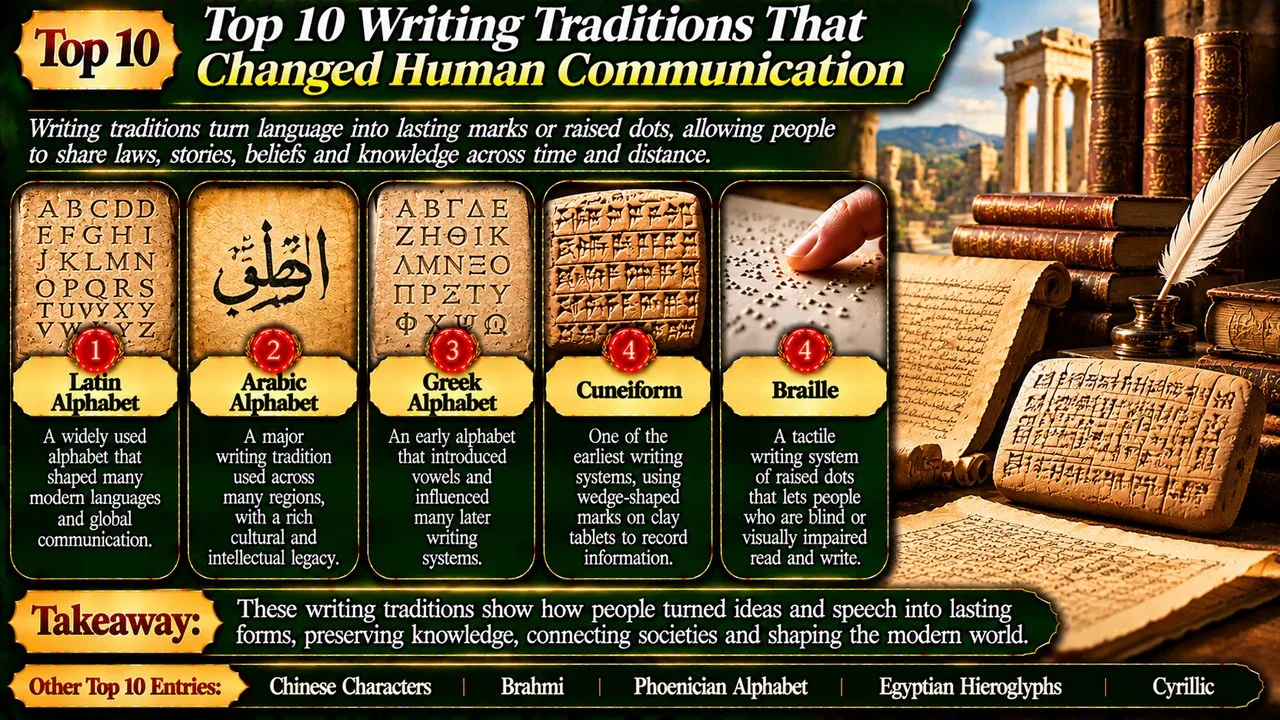
Writing traditions turn language into lasting marks or raised dots, allowing people to share laws, stories, beliefs and knowledge across time and distance.
A letter is not the only way to make speech visible. Some traditions arrange signs around consonants, others combine sound and meaning, and tactile reading makes sight unnecessary. Each solution reflects the languages, materials and readers it served. A character is not automatically a picture, nor does an alphabet necessarily assign a separate letter to every sound.
This list ranks ten traditions by their cultural reach, influence on later writing and distinctive approach to representing language. It is a comparative history, not a ladder from primitive to advanced. Closely related branches appear separately where their later influence warrants it; uncertain origin dates and changing user totals are deliberately left out.
Key Facts
These ten entries highlight contrasting features and contexts.
Writing Traditions That Changed Human Communication at a Glance
| Rank | Name | Context | Main feature | Notable point |
|---|---|---|---|---|
| 1 | Latin Alphabet | Rome | Letters | Wide adaptation |
| 2 | Chinese Characters | China | Meaning and sound | Long continuity |
| 3 | Arabic Alphabet | West Asia | Connected letters | Many adaptations |
| 4 | Brahmi | South Asia | Vowel marks | Large family |
| 5 | Greek Alphabet | Greece | Vowel letters | Influential descendants |
| 6 | Phoenician Alphabet | Mediterranean | Consonant letters | Trade connections |
| 7 | Cuneiform | Mesopotamia | Wedge marks | Many languages |
| 8 | Egyptian Hieroglyphs | Egypt | Mixed signs | Sound and meaning |
| 9 | Cyrillic | Eastern Europe | Adapted letters | Language diversity |
| 10 | Braille | France | Raised dots | Tactile literacy |
1. Latin Alphabet
The Latin alphabet began as a way to write the language of ancient Rome. Its ancestry runs through the Etruscan and Greek alphabets, rather than beginning with the familiar English letter set. Roman expansion carried Latin writing across much of Europe, where monuments, official records and everyday notes helped establish its public presence. Later religious learning and printing gave it further routes into new languages. [1] [11]
The letters did not remain frozen. The distinctions between I and J, and between U and V, emerged over a long period, while W joined the wider family later. Languages adapted the available shapes with accents, extra letters and combinations. Sharing an alphabet therefore does not mean that English, Vietnamese and Turkish spell sounds in the same way. The local conventions still have to be learned. [1] [11]
Its leading position here reflects adaptability and reach, not an inherent advantage over every alternative. The history of these letters includes education, trade, colonial power and voluntary reform. A familiar printed page carries traces of all those processes, even when its reader notices only the words.
2. Chinese Characters
Chinese characters usually connect a written form with a meaningful unit of language. They are not simply miniature pictures that any observer can understand. Many combine an element associated with meaning and another associated with pronunciation. This mixture helps explain both the expressive flexibility of the tradition and why learning it requires more than recognising drawings of visible objects. [2] [12]
Early surviving examples include the oracle bones of the Shang period, used for divination. Later brush writing, official standardisation and printing altered the appearance of characters without breaking the tradition. Chinese writing also influenced neighbouring cultures. Japanese kanji draw on that inheritance, but their readings and grammatical setting are not identical to those of written Chinese. Adaptation is part of the history, rather than evidence that the languages are interchangeable. [2] [12]
The entry ranks highly for continuity and regional influence. Traditional and simplified forms also show that long survival does not imply an absence of change. A character on a contemporary sign belongs to an evolving practice, shaped by institutions and ordinary readers as well as by celebrated calligraphers.
Related: Top 10 Things That Existed While Woolly Mammoths Were Still Alive
3. Arabic Alphabet
The Arabic alphabet developed from the Nabataean writing tradition and is conventionally written from right to left. Its basic Arabic inventory has 28 letters. Many letters take different shapes according to their position in a word, so recognising their connected forms is an essential part of reading. Dots distinguish otherwise similar shapes, while additional marks can help indicate vowels. [3] [13]
It is often called an abjad because consonants have a central role in its organisation. That label should not suggest that vowels are irrelevant or never represented. Long vowels can be written with letters, and short-vowel marks are important in particular kinds of text. The spread of Islam gave Arabic writing a wide cultural setting, while adaptations enabled languages such as Persian and Urdu to represent sounds absent from Arabic. [3] [13]
Its place reflects both a lasting literary tradition and the flexibility of connected lettering. Calligraphy is an important artistic expression of that history, but the same alphabet also serves ordinary correspondence and practical records. Decorative beauty and daily utility are not competing explanations for its endurance.
4. Brahmi
Brahmi is a major ancestor of writing traditions across South and Southeast Asia. It appears in a developed form in the third century BC, notably in the edicts associated with Ashoka. A consonant sign normally carries an inherent vowel, which can be changed with an added mark. Independent vowel forms also exist. This organisation differs from simply placing separate consonant and vowel letters in a row. [4] [14]
The term abugida is useful for this approach, although readers should not mistake a technical category for a single unchanging alphabet. Brahmi developed regional forms, and its descendants acquired their own shapes and conventions. Devanagari, Bengali and many other modern forms belong to this wider historical family. Their visual differences can conceal connections that become clearer when older letter shapes are compared. [4] [14]
Its ranking recognises a broad family tree rather than a claim that all Asian writing has one origin. The earliest influences on Brahmi remain debated. The securely attested material is enough to establish its importance without turning a contested ancestry into a settled story about one inventor or one moment.
5. Greek Alphabet
The Greek alphabet adapted earlier Phoenician letters to the needs of Greek speech. A particularly consequential change was the regular use of letters for vowels as well as consonants. Signs associated with sounds that Greek did not need could be reassigned. That was a practical linguistic adaptation, not merely a change in handwriting or an ornamental variation on borrowed shapes. [5] [15]
Related: Top 25 Interesting Facts About the Solar System
Early Greek communities used local variants. The alphabet later became more standardised, while writing direction and letter forms also changed. The classical and modern alphabets share a recognisable ancestry, but pronunciation has not remained identical. Nor should the alphabet be confused with Linear B, the earlier syllabic writing used for Mycenaean Greek. Different ways of writing the same language can belong to very different historical settings. [5] [15]
Greek earns its position through the importance of that vowel representation and the influence of its descendants. Latin and Cyrillic both owe part of their history to Greek forms. Scientific notation gives many Greek letters another role, but those familiar symbols are only a small part of a living literary alphabet.
6. Phoenician Alphabet
Phoenician merchants helped spread a compact consonantal alphabet across the Mediterranean. Its 22 letters were generally written from right to left. Compared with traditions that required large sign inventories, this offered a relatively limited collection of shapes, although readers still needed language knowledge and local conventions to turn those marks into meaningful words. The alphabet did not remove the need for education. [6] [16]
Phoenician writing grew from earlier alphabetic practices rather than appearing fully formed without ancestry. Its travels mattered as much as its structure. Ports and trading communities brought people into contact, giving other language groups opportunities to borrow and alter letters. Greek adaptation was especially consequential, while Aramaic became another influential branch of the broader alphabetic family. These relationships involved change, not perfect copying across the centuries. [6] [16]
The entry belongs here because transmission can be as historically important as invention. A useful convention becomes much more influential when it crosses linguistic boundaries. Phoenician writing makes that process visible, while cautioning against the appealing but inaccurate idea that every form of writing descends from one universal alphabet.
7. Cuneiform
Cuneiform is identified by wedge-like impressions, often pressed into clay with a reed stylus. It developed from earlier record keeping in southern Mesopotamia and was first associated with Sumerian. The shapes are not a language in themselves. Different communities adapted cuneiform to write Akkadian, Hittite and other languages, just as a modern alphabet can serve more than one tongue. [7] [17]
Related: Top 10 Mythical Creatures in World Mythology - That Inspired Myths Across Civilizations (unchanged)
Its signs could represent words or syllables, and their interpretation depended on context and learned conventions. Surviving tablets preserve accounts, letters, scholarship and literature. This range matters: an ancient archive is not only a collection of royal boasts. Even a record of grain or a business dispute can reveal how people organised work, established obligations and dealt with one another in daily life. [7] [17]
Cuneiform ranks for the depth of the record it left and the breadth of its adoption. Its clay medium also shapes what historians can recover. Durable fragments give a rich view of certain activities, but preservation is selective; the survival of a tablet is not proof that every voice enjoyed equal access to writing.
8. Egyptian Hieroglyphs
Egyptian hieroglyphs combine recognisable pictures with signs that convey sounds and others that clarify meaning. Reading them is therefore not the same as identifying a sequence of illustrated objects. A bird or an eye can have a linguistic function beyond naming the thing depicted. Understanding that mixture was central to recovering the written Egyptian language after its ancient reading traditions had faded. [8]
The monumental forms familiar from temples were not the only writing used in Egypt. More flowing hieratic and later demotic forms suited other materials and purposes. Monumental lettering and practical record keeping belonged to related but distinct contexts. Royal and religious texts are particularly visible, yet the wider written culture also served administration, letters, accounts and learning. The best-known surviving objects offer only part of that varied picture. [8]
Hieroglyphs earn a place for their long cultural importance and their contribution to the wider history of alphabetic writing. Their beauty can make them look purely decorative to a modern visitor. In fact, the balance between sound, meaning and visual form is precisely what makes them such a useful comparison with other traditions.
9. Cyrillic
Cyrillic developed in the Bulgarian cultural world through scholars connected with the earlier work of Cyril and Methodius. Its name honours Cyril, but that does not establish that he personally designed the later alphabet. Glagolitic, associated with the brothers' mission, is a different alphabet. Keeping those distinctions clear prevents a complex history of scholarship and adaptation from becoming a misleading single-inventor tale. [9]
Related: Top 25 Interesting Facts About the Universe
Greek letter forms supplied much of the foundation, with additional signs meeting the needs of Slavic speech. Later communities adapted Cyrillic for further languages, including non-Slavic ones. Russian, Bulgarian and Serbian do not all use an identical inventory or identical spelling conventions. The resemblance of letters across neighbouring alphabets can therefore help a learner recognise their history while still causing confusion about their sounds. [9]
The entry illustrates how religious translation can have lasting effects on education and public life. It also shows that an alphabet can be shared without erasing linguistic differences. Cyrillic belongs here as a flexible family of national traditions, rather than as a synonym for one country or one language.
10. Braille
Braille makes written language available through touch. Louis Braille developed his approach in France after encountering Charles Barbier's raised-dot notation. The familiar cell has six dot positions, arranged in two columns. Different combinations can represent letters, punctuation and other information, while the precise conventions depend on the language and the kind of material being read. It is a writing code, not a separate spoken language. [10] [18]
Braille's work was published in 1829, and he also addressed musical notation. Modern reading can use embossed paper or refreshable displays, whose moving pins present changing text. Digital technology has therefore not simply displaced tactile literacy. It can provide another way to access it. Reading and writing skills remain distinct from listening to spoken information, whether that voice belongs to another person or a device. [10] [18]
Its inclusion changes the terms of the comparison. Writing need not be visible to be precise, expressive and independently usable. Braille's importance is not measured only by the size of its readership, but by the access it gives to spelling, notation, study and private reading without reliance on sight.
Conclusion
These traditions show how people have matched lasting marks to changing languages and readers. Borrowing, reform and accessibility matter as much as a famous origin. Their histories connect naturally with influential books, while ancient board games offer another view of knowledge passed through shared conventions. Neither writing nor play travels unchanged: each community inherits a framework and makes it useful in its own setting.
- ^ [1] "Latin Alphabet". Wikipedia. Read
- ^ [2] "Chinese Characters". Wikipedia. Read
- ^ [3] "Arabic Alphabet". Wikipedia. Read
- ^ [4] "Brahmi". Wikipedia. Read
- ^ [5] "Greek Alphabet". Wikipedia. Read
- ^ [6] "Phoenician Alphabet". Wikipedia. Read
- ^ [7] "Cuneiform". Wikipedia. Read
- ^ [8] "Egyptian Hieroglyphs". Wikipedia. Read
- ^ [9] "Cyrillic". Wikipedia. Read
- ^ [10] "Braille". Wikipedia. Read
- ^ [11] "Latin Alphabet". Encyclopaedia Britannica. Read
- ^ [12] "Chinese writing". Encyclopaedia Britannica. Read
- ^ [13] "Arabic Alphabet". Encyclopaedia Britannica. Read
- ^ [14] "Brahmi". Encyclopaedia Britannica. Read
- ^ [15] "Greek Alphabet". Encyclopaedia Britannica. Read
- ^ [16] "Phoenician Alphabet". Encyclopaedia Britannica. Read
- ^ [17] "Cuneiform". Encyclopaedia Britannica. Read
- ^ [18] "Louis Braille". Encyclopaedia Britannica. Read





















Discussion
Log in with