





Top 10 Unusual Measurement Units and What They Mean
 By Dhiraj Sharma · Published
Share Post
Loading…
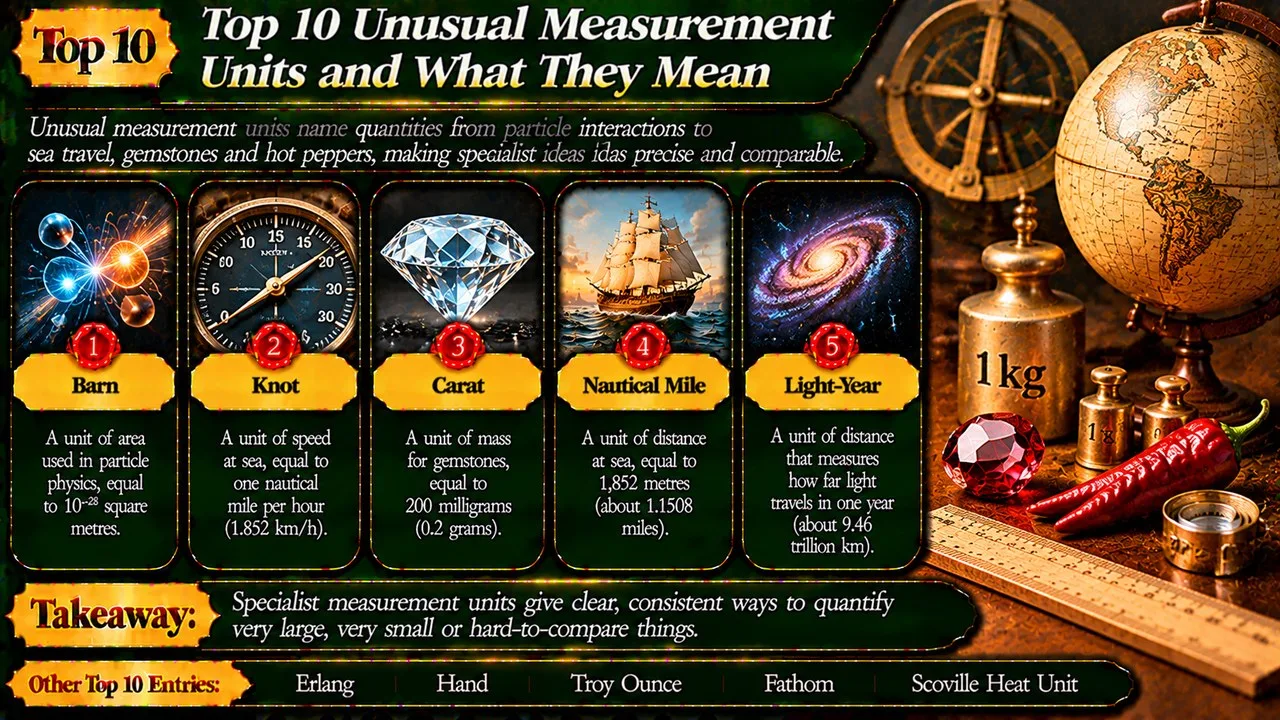
Unusual measurement units name quantities from particle interactions to sea travel, gemstones and hot peppers, making specialist ideas precise and comparable.
A unit can be unfamiliar without being a joke. Some preserve an older trade, others solve a technical problem, and a few use a familiar word in an unexpected way. The important questions are what is being measured, how the unit is defined and whether an older name still refers to a variable human-scale estimate.
This order favours useful definitions, contrasting kinds of quantity and clear historical connections. The Listverse units topic provides the starting point [20], while more securely documented examples replace several playful or misleading comparisons. Exact definitions are separated from approximations. None of these units becomes more accurate simply because its name sounds scientific, and related-looking names do not guarantee that they measure the same thing.
Key Facts
These ten entries highlight contrasting features and contexts.
Unusual Measurement Units and What They Mean at a Glance
| Rank | Name | Context | Main feature | Notable point |
|---|---|---|---|---|
| 1 | Barn | Area | Interaction likelihood | Not event count |
| 2 | Erlang | Traffic | Occupied capacity | Duration matters |
| 3 | Knot | Speed | Nautical miles per hour | Not distance |
| 4 | Hand | Length | Four inches | Special notation |
| 5 | Carat | Mass | 200 milligrams | Not gold purity |
| 6 | Troy Ounce | Mass | 480 grains | Precious metals |
| 7 | Nautical Mile | Distance | 1,852 metres | Fixed standard |
| 8 | Fathom | Length | Six feet | Depth tradition |
| 9 | Scoville Heat Unit | Pungency | Pepper heat | Not temperature |
| 10 | Light-Year | Distance | Light travel | Not duration |
1. Barn
A barn is a unit of area used in nuclear and particle physics. One barn equals ten to the minus twenty-eight square metres. It commonly expresses a cross section, a quantity that helps describe the likelihood of a particular interaction. The area language is useful, but the value should not be mistaken for a simple photographable outline of a particle sitting like a small solid target in space. [1] [19]
Cross sections depend on the process being studied and, often, on the energy involved. A larger value means an interaction is more probable under the stated conditions, not that a detector has automatically recorded that many events. Related inverse-area units appear in discussions of accumulated collision data, where they answer a different question from the cross section of one particular process. [1] [19]
It leads the list because a homely word carries a precise technical meaning. The barn connects area with probability in a way that ordinary experience does not make obvious. Keeping the quantity distinct from a raw event count prevents a colourful name from obscuring the actual physics being reported.
2. Erlang
The erlang measures traffic intensity in communications. One erlang corresponds to the average occupation of one resource continuously during the observation interval. It does not count individual calls without regard to duration. A few long calls and many short calls can contribute the same total occupied time, making this a more useful measure of demand than a simple tally of how often a telephone rings. [2] [11]
The unit honours Agner Krarup Erlang, whose work helped establish the mathematical study of telephone traffic. Planners use traffic estimates to consider how much capacity a service needs. An average does not guarantee that demand arrives evenly, however. Calls can cluster, so a model must account for the possibility that several people need service at once. [2] [11]
Its rank reflects a hidden quantity behind an ordinary experience: waiting for a connection or for someone to answer. The erlang is not a measure of audio quality or internet speed. It describes use over time, showing how a specialist unit can make an everyday inconvenience into a question that can be analysed.
Related: Top 10 Most Bizarre Phobias: Strange Fears That Exist
3. Knot
A knot is a speed of one nautical mile per hour. It is not a distance, and adding per hour after knots would repeat the time element incorrectly. The unit is used in maritime and aviation contexts, where the related nautical mile fits established navigational practice. A speed stated in knots can be converted into other units, but its definition remains tied to that particular distance over time. [3] [12]
The name recalls older methods of estimating a vessel's speed with a log line marked by knots. Counting the marks passing during a timed interval linked a practical shipboard action with a numerical result. Modern instruments do not need to repeat that procedure to report the same unit. [3] [12]
It ranks highly for exposing a common category mistake. Saying how far a ship travelled requires a distance; saying how quickly it travelled requires a distance divided by time. The knot packages that second relationship in one word, making concise communication possible only when the speaker and listener understand what the word already contains.
4. Hand
The hand is used for measuring the height of horses. In its standard modern form, one hand equals four inches, or 10.16 centimetres. The measurement is usually taken at the withers rather than at the top of the head, whose position can change. A unit rooted in a part of the human body therefore survives within a clearly specified practical convention rather than an estimate based on each measurer's palm. [4] [13]
Its written notation can surprise readers accustomed to decimals. A horse recorded as 15.2 hands is fifteen hands and two inches, not fifteen and two tenths of a hand. The digit after the point records remaining inches within a four-inch unit. Treating it as an ordinary decimal would change the result, even though the notation looks superficially familiar on a sale notice or breed record. [4] [13]
The hand earns its place through that combination of a fixed definition and an unusual way of writing it. Familiar arithmetic habits are not enough without knowing the convention. It also illustrates a wider point: an old body-based name can remain in use after the unit itself has become independent of individual bodies.
5. Carat
A metric carat is a mass of 200 milligrams, used for gemstones and pearls. It does not measure a gem's physical dimensions or guarantee its quality. Stones with different densities can have the same mass and different apparent sizes. Cut, clarity and other characteristics also affect how a particular gem looks and is valued, so the carat figure answers only one part of a buyer's question. [5] [14]
Related: Top 10 Facts About Dogs
The name is historically connected with carob seeds and older weighing practices. That ancestry should not be expanded into the claim that every seed naturally weighs exactly the modern carat. A fixed trade unit is a human standard, not a discovery that living seeds all have identical mass. Older local conventions also varied before the metric definition supplied a common reference for modern use. [5] [14]
Its rank reflects the need to distinguish related terms. Carat mass is not the same quantity as the karat scale used for gold purity in some English-speaking countries. A number attached to a jewel can refer to weight or composition, and the resemblance of the words makes it especially important to identify which claim is being made.
6. Troy Ounce
The troy ounce belongs to a weighing tradition used especially for precious metals. It contains 480 grains and is not the same as the ordinary avoirdupois ounce used in many everyday contexts. A quoted gold price per ounce can therefore be misunderstood if the unit is silently treated as an interchangeable word for any ounce. [6] [15]
Within troy weight, a pennyweight contains 24 grains and a troy ounce contains 20 pennyweights. A troy pound has twelve troy ounces, unlike the sixteen-ounce everyday pound. These relationships show why swapping labels halfway through a calculation produces an error even when every multiplication is performed correctly. The names are familiar, but the groupings differ, and the units have to be kept consistent from the beginning. [6] [15]
It earns a place for revealing the hidden qualification inside a routine market quotation. Precision requires more than printing several decimal places. The reader must know which ounce is intended and whether a figure describes mass, purity or price. Historical vocabulary can remain commercially important long after its original trading setting has changed.
7. Nautical Mile
The international nautical mile is exactly 1,852 metres. It is a distance unit, unlike the knot, which expresses speed. Its historical connection with latitude makes it well suited to navigation, but the modern fixed definition should not be confused with claiming that every minute of latitude on the real Earth has precisely the same length. The Earth's shape makes that older geographic relationship an approximation. [7] [16]
Related: Top 10 Tallest Buildings in the World
Different national definitions existed before the common international value became established. A chart, instrument and calculation need compatible units if a route is to be interpreted correctly. The familiar land mile is a different distance, so silently substituting one for the other changes the scale of a journey. Naming the unit is part of reporting a distance, not an optional detail that can be omitted once the number sounds plausible. [7] [16]
It ranks for showing standardisation at work. The history explains the choice, while the definition supports consistent use. Keeping those roles separate avoids both a false claim of perfect geographic equality and needless uncertainty about the modern unit.
8. Fathom
A fathom is a length conventionally equal to six feet. Its name is associated with the span of outstretched arms, but the fixed unit is not redefined for each person's reach. It is especially familiar in maritime depth measurement, where older sounding methods used marked lines to determine how far the bottom lay below the surface. The term therefore connects bodily scale with a practical seafaring task. [8] [17]
A modern instrument can report a depth in fathoms without lowering a line, just as a vessel can report knots without counting knots in a rope. Historical practices also varied, so a statement about an old local fathom should be checked against its context rather than automatically assigned the modern conventional value. The same word can preserve both a standard and a more complicated earlier history. [8] [17]
Its place reflects the persistence of useful language after a tool changes. To fathom something also means to understand it deeply, carrying the image of measuring depth into ordinary speech. That figurative use is not a technical definition, but it shows how an occupation's vocabulary can become familiar far beyond the people who originally used it.
9. Scoville Heat Unit
Scoville heat units express the pungency associated with chilli peppers and capsaicinoids. They do not measure the temperature of the food. Wilbur Scoville's original approach relied on tasting diluted samples until their heat was no longer detected. The method turned a sensory response into a comparative scale, but tasters and preparation could affect the result, making it different from measuring length with a fixed physical standard. [9]
Related: 10 Sikh Gurus: The Pillars of Sikhism Who Shaped Faith, Equality, Courage, and Humanity
Modern analytical methods can measure capsaicinoid content and relate it to the familiar heat scale. That improves consistency, although pepper varieties and individual samples still differ. A published value should not be treated as a promise that every fruit carrying the same name will feel identical to every person. Growing conditions, preparation and the particular material tested can matter alongside the measurement method. [9]
It ranks for making the distinction between sensation and chemical measurement especially clear. The unit translates something people feel into a number, but the number does not erase variation in experience. There is also no need to invoke a changing record for the hottest pepper: understanding what the scale measures is more durable knowledge than a leaderboard.
10. Light-Year
A light-year measures distance, despite having year in its name. It is the distance travelled by light in a vacuum during a year, approximately 9.46 trillion kilometres. The unit makes stellar distances easier to express without writing an unwieldy number of ordinary kilometres. It does not tell us how long a spacecraft would take to complete a journey, since the craft would travel at its own speed. [10] [18]
Light also takes time to bring information to an observer. Looking at a distant star means seeing light that began its journey earlier, so distance and the age of the arriving information become connected. That relationship does not turn the light-year into a duration. The same distinction appears when a road's length is separated from the time required to drive it, though the cosmic scale makes the naming easier to misread. [10] [18]
It closes the list because a familiar word can conceal the wrong category of quantity. Once distance and time are kept separate, a light-year becomes a straightforward conversion rather than a mysterious measure, giving astronomy a compact language for a very large physical scale.
Conclusion
These units work because people agree on definitions and keep different quantities distinct. Their histories connect with ways of counting time, while space missions show why careful measurement matters far from everyday experience. A useful number always needs context: area is not an event count, mass is not purity, and distance is not speed. Learning the unit can be more important than remembering the most impressive figure attached to it.
- ^ [1] "Barn". Wikipedia. Read
- ^ [2] "Erlang". Wikipedia. Read
- ^ [3] "Knot". Wikipedia. Read
- ^ [4] "Hand". Wikipedia. Read
- ^ [5] "Carat". Wikipedia. Read
- ^ [6] "Troy Ounce". Wikipedia. Read
- ^ [7] "Nautical Mile". Wikipedia. Read
- ^ [8] "Fathom". Wikipedia. Read
- ^ [9] "Scoville Heat Unit". Wikipedia. Read
- ^ [10] "Light-Year". Wikipedia. Read
- ^ [11] "What Is an Erlang?". Erlang.com. Read
- ^ [12] "Knot". Encyclopaedia Britannica. Read
- ^ [13] "Hand". Encyclopaedia Britannica. Read
- ^ [14] "Carat". Encyclopaedia Britannica. Read
- ^ [15] "Troy Weight". Encyclopaedia Britannica. Read
- ^ [16] "Nautical Mile". Encyclopaedia Britannica. Read
- ^ [17] "Fathom". Encyclopaedia Britannica. Read
- ^ [18] "What Is a Light-Year?". NASA. Read
- ^ [19] "Barn". CERN Open Data Portal. Read
- ^ [20] "Topic inspiration: Unusual Measurement Units and What They Mean". Listverse. Read
























Discussion
Log in with