









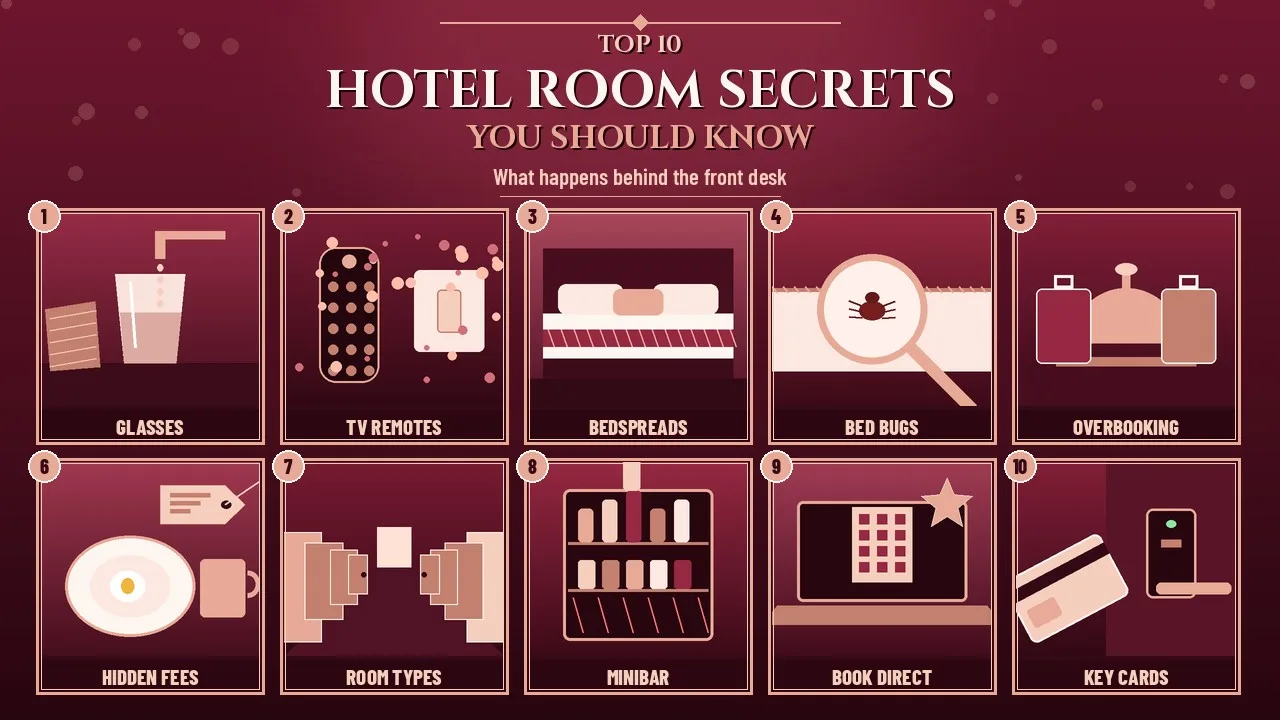
Hotel room secrets you should know include rinsed-only glasses, germ-heavy TV remotes, overbooking, minibar sensors and extra fees hidden in the room rate.
Most hotel stays go smoothly, and the vast majority of housekeepers and front-desk staff work hard to make every room safe and comfortable. Even so, the hospitality business runs on tight schedules, revenue targets and systems that guests rarely see. Knowing how those systems work helps you protect your health, your money and your sleep without becoming paranoid about every pillow.
This Finepedia guide explains ten things hotels do not usually advertise. Each entry covers what actually happens behind the scenes, why the industry works that way, and a simple step you can take as a guest. Hygiene findings come from published microbiology research and televised undercover investigations, booking and billing points come from hotel-chain policies and trade reporting, and claims that could not be verified have been left out.
How We Chose These Hotel Room Secrets
Plenty of hotel horror stories circulate online, but many are single anecdotes or urban legends. To make this list, each secret had to pass three tests:
- Evidence: it is backed by a scientific study, a documented investigation, a published hotel policy or reputable trade reporting, rather than one viral post.
- Relevance: it affects ordinary travellers in mid-range and luxury properties, not just a handful of badly run motels.
- Usefulness: there is something practical a guest can do about it, whether that is wiping a surface, asking a question at check-in or booking a different way.
The list is ordered roughly by how directly each secret touches your health first, then your wallet, and finally your peace of mind. One popular fear, that your key card stores your credit-card number, is included precisely because the evidence shows it is largely a myth.
Hotel Room Secrets at a Glance
| Rank | Secret | What it affects | Quick fix |
|---|---|---|---|
| 1 | Drinking glasses may only be rinsed and wiped | Hygiene | Ask for sealed or freshly washed glassware, or rinse with hot water |
| 2 | TV remotes and light switches carry heavy bacteria loads | Hygiene | Wipe high-touch surfaces with a disinfectant wipe |
| 3 | Decorative throws and bedspreads are washed less often than sheets | Hygiene | Fold away runners and throws before using the bed |
| 4 | Bed bugs turn up in hotels of every star rating | Health and comfort | Inspect seams and headboard, keep luggage on the rack |
| 5 | Hotels overbook and sometimes walk guests | Your booking | Arrive early, join the loyalty scheme, know the walk policy |
| 6 | Free breakfast and resort fees are priced into the stay | Your budget | Compare the total price, not the headline rate |
| 7 | Rooms in the same category are not identical | Comfort | Make specific requests politely at booking and check-in |
| 8 | Minibar sensors can bill you for lifting an item | Your bill | Do not move items you do not want; check the bill |
| 9 | Booking direct often brings better perks | Value | Compare the hotel website with third-party sites |
| 10 | Your key card almost never holds your card details | Privacy | Hand keys back or keep them; there is little data to steal |
1. Drinking Glasses May Only Be Rinsed and Wiped
| Attribute | Details |
|---|---|
| What happens | Some housekeepers clean used glasses in the room instead of sending them to a dishwasher |
| Evidence | US television hidden-camera investigations in 2007 and 2008 |
| Risk | Germs and residues from the previous guest, or from cleaning cloths |
| Where it occurs | Reported at budget and upscale properties alike |
| Guest fix | Request fresh glassware, use sealed cups, or rinse with hot water |
Origins and History
The sparkling tumbler on the bathroom counter looks spotless, but looks can mislead. In late 2007 and early 2008, several American television news teams placed hidden cameras in hotel rooms to see how glasses were cleaned between guests. The footage showed housekeepers rinsing glasses in the bathroom sink, spraying them with general cleaning products and drying them with towels, sometimes the same towels used on other surfaces.
An ABC News investigation reported this kind of shortcut at 11 of the 15 hotels it filmed. Other local stations ran similar tests with comparable results, and the stories spread widely because they featured well-known chains rather than obscure motels.
Key Features
- Proper practice is to remove used glasses to a commercial dishwasher, where high water temperatures sanitise them, and replace them with clean ones.
- Cleaning glasses in the room saves time on a tight schedule, which is the main reason the shortcut happens.
- A paper cap or "sanitised" label on top of a glass does not prove it went through a dishwasher.
- Coffee mugs and ice buckets can be affected by the same shortcut.
Significance
Shared drinking vessels can transfer cold viruses, stomach bugs and other infections. The risk for a healthy adult is usually low, but it rises for young children, older travellers and anyone with a weakened immune system. The investigations pushed several hotel groups to retrain staff and switch to sealed disposable cups or dishwasher-only rules.
Interesting Facts
- Some hotels now provide glasses wrapped in plastic that are marked as washed in a central kitchen.
- Room-service glassware generally comes from the kitchen dishwasher, so it is often a safer choice.
- Carrying a reusable bottle or collapsible cup solves the problem entirely.
2. TV Remotes and Light Switches Carry Heavy Bacteria Loads
| Attribute | Details |
|---|---|
| What happens | High-touch items are often skipped or only lightly wiped during room turnover |
| Evidence | University of Houston-led study presented to the American Society for Microbiology in 2012 |
| Most contaminated items | Main light switch, TV remote, bathroom sink, toilet and housekeeping-cart sponges and mops |
| Least contaminated items | Bed headboard, curtain rod and bathroom door handle |
| Guest fix | Wipe switches, remotes and phone keypads when you arrive |
Origins and History
In 2012, researchers led by Katie Kirsch of the University of Houston, working with colleagues from Purdue University and the University of South Carolina, swabbed surfaces in nine hotel rooms across Texas, Indiana and South Carolina. They measured both total aerobic bacteria and coliform bacteria, a group that indicates faecal contamination, and presented the findings at the 2012 General Meeting of the American Society for Microbiology.
The results surprised many travellers. Alongside the toilet and sink, which were expected to be dirty, the main light switch and the TV remote were among the most contaminated surfaces. According to NBC News coverage of the study, the main light switch averaged about 112.7 colony-forming units of aerobic bacteria per square centimetre and the remote about 67.6, far above the 5 units often suggested as a hospital cleanliness benchmark.
Key Features
- The main light switch also recorded the highest level of faecal bacteria in the study.
- Sponges and mops from housekeeping carts carried some of the heaviest contamination, raising the risk of germs being carried from room to room.
- A follow-up paper in the Journal of Environmental Health concluded that a room that looks clean is not a reliable sign that it is microbiologically clean.
- The researchers noted that bacteria counts do not prove a surface will make anyone ill, but they are a dependable indicator of overall cleanliness.
Significance
The study was small, so it does not rank every hotel in the world. Its value lies in showing where cleaning routines fall short: housekeepers focus on what guests can see, such as made beds and shiny taps, while small objects that everyone handles get less attention. Many hotels responded by adding remotes and switches to cleaning checklists, and some now bag remotes or use wipe-clean designs.
Interesting Facts
- The telephone keypad also recorded measurable contamination in the same study.
- The team framed its work as a first step towards applying a food-safety style hazard analysis system to hotel rooms.
- A small pack of disinfectant wipes is one of the cheapest travel-health purchases you can make.
3. Decorative Throws and Bedspreads Are Washed Less Often Than Sheets
| Attribute | Details |
|---|---|
| What happens | Sheets and pillowcases are changed between guests, but heavy decorative layers follow a slower laundry cycle at many properties |
| Items affected | Bed runners, decorative throws, cushions and some older-style bedspreads |
| Industry shift | Many chains moved to white duvets with removable covers from the late 1990s onwards |
| Risk | Dust, spills and skin contact from earlier guests |
| Guest fix | Remove runners and cushions, sleep under the freshly laundered layers |
Origins and History
For decades, many hotel beds were topped with thick patterned bedspreads designed to hide stains and survive years of use. Because they were bulky and expensive to launder, they were washed far less frequently than the sheets underneath. Former housekeepers and hotel managers have described this pattern in numerous interviews over the years.
The picture began to change in 1999, when Westin introduced its all-white Heavenly Bed and sparked what the trade press called the "bed wars". Rival chains followed with crisp white duvets inside removable covers, which can be stripped and laundered like sheets. White linen also makes stains obvious, which encourages more frequent washing.
Key Features
- Sheets, pillowcases and towels are normally replaced for every new guest at reputable hotels.
- Decorative bed runners and scatter cushions are often treated as furnishings rather than linen, so their washing schedule varies widely.
- Duvet covers are usually laundered between guests, while the duvet insert itself is cleaned on a longer cycle.
- Upholstered headboards, armchairs and curtains are deep-cleaned periodically rather than daily.
Significance
This is less a scandal than a matter of practicality, but it explains why many experienced travellers fold away the runner and cushions as soon as they arrive. The modern shift to white, removable bedding shows how guest expectations can change an entire industry once people understand what was happening.
Interesting Facts
- Patterned bedspreads were popular partly because busy designs disguised marks between washes.
- Some eco-friendly programmes invite multi-night guests to skip daily linen changes, but fresh linen for each new guest remains standard.
- If bedding looks or smells unclean, the front desk will normally replace it immediately on request.
4. Bed Bugs Turn Up in Hotels of Every Star Rating
| Attribute | Details |
|---|---|
| What they are | Small, flat, reddish-brown insects about the size of an apple seed that feed on blood at night |
| Where they hide | Mattress seams and piping, box springs, bed frames, behind headboards and in upholstered furniture |
| Signs | Rusty stains, dark pepper-like spots, pale shed skins and tiny eggs |
| Who is at risk | Any hotel, from budget to five-star, because bugs travel in guests' luggage |
| Guest fix | Inspect the bed with a torch and keep luggage on an inspected rack |
Origins and History
Bed bugs were rare in many developed countries for decades after the mid-twentieth century, but they made a dramatic comeback from the late 1990s. Increased international travel and resistance to common insecticides are among the reasons pest-control experts give for the resurgence. Hotels, with their constant turnover of guests and luggage, are natural stopping points for these hitchhiking insects.
A clean, expensive room is not immune. Bed bugs do not feed on dirt; they feed on people, so a luxury suite with a steady stream of travellers can pick them up as easily as a hostel dormitory. That is why reputable hotels run inspection programmes and call in specialists at the first report.
Key Features
- The US Environmental Protection Agency advises travellers to check the mattress seams, box spring, bed frame and the back of the headboard before sleeping.
- Luggage should go on a luggage rack that you have inspected, kept away from the bed, rather than on the bed or floor.
- Bed bugs do not jump or fly, but they crawl quickly and can squeeze into a gap as thin as a credit card.
- After a trip, washing clothes and then drying them on a hot setting kills bed bugs more reliably than washing alone.
Significance
Bed bugs are not known to spread disease, but their bites can cause itchy welts, poor sleep and considerable anxiety. The real danger is carrying them home, where an infestation can be expensive and stressful to remove. A two-minute inspection on arrival is the single most effective defence.
Interesting Facts
- Adult bed bugs measure roughly a quarter to three-eighths of an inch, about 6 to 9 millimetres, according to the EPA.
- Leaving your suitcase in the bathroom or bathtub while you inspect the room is a common recommendation, because these surfaces offer few hiding places.
- If you spot signs, report them straight away and ask for a room that is not next to, above or below the affected one.
5. Hotels Overbook and Sometimes Walk Guests
| Attribute | Details |
|---|---|
| What happens | Hotels sell more rooms than they have, expecting some cancellations and no-shows |
| Industry term | Walking a guest, meaning sending them to another hotel |
| Typical policy | A comparable nearby room, transport and the first night paid by the original hotel |
| Who is most at risk | Late arrivals, one-night stays and guests booked through third-party sites |
| Guest fix | Arrive earlier, join the loyalty programme and ask about the walk policy if you are moved |
Origins and History
Like airlines, hotels lose money every time a reserved room sits empty because a guest cancels late or simply does not show up. Revenue managers therefore forecast how many bookings will fall through on a given night and sell slightly more rooms than physically exist. Most nights the maths works. When it does not, someone with a confirmed reservation finds there is no room at the inn.
The industry calls this walking a guest. Travel Weekly has quoted the American Hotel and Lodging Association describing the general practice as arranging a comparable room at another hotel, transporting the guest there and sometimes adding other amenities. Major groups such as Marriott and IHG have publicly stated that they pay for the first night at the alternative hotel.
Key Features
- Hotels can also become oversold when guests extend their stay unexpectedly or when bad weather strands travellers.
- Research on hotel walk policies has found that loyalty members, multi-night guests and corporate accounts are often protected, while single-night leisure bookings are more likely to be moved.
- Third-party bookings carry commissions for the hotel, which can make them a lower priority when a walk is unavoidable.
- Better forecasting and stricter cancellation rules have reduced walks, but they still happen on busy nights.
Significance
Being walked late at night after a long journey is stressful, especially if you have a meeting or event near the original hotel. Knowing the practice exists lets you respond calmly: ask where you are being sent, who pays for the night and transport, and whether you can return to the original hotel the next day.
Interesting Facts
- Some hotels pre-arrange rooms at nearby partner properties on nights when they expect to oversell.
- Guests who are walked often receive a courtesy upgrade when they return to the original hotel.
- Calling ahead on the day of arrival to confirm a late check-in can reduce the chance of being moved.
6. Free Breakfast and Resort Fees Are Priced Into the Stay
| Attribute | Details |
|---|---|
| What happens | Complimentary extras are funded through the room rate, and some hotels add mandatory nightly fees |
| Common fees | Resort, destination, amenity or facility fees, often covering Wi-Fi, pools or gyms |
| Regulation | A US Federal Trade Commission rule effective 12 May 2025 requires short-term lodging to show the total price upfront |
| Risk | The headline nightly rate can understate what you actually pay |
| Guest fix | Compare the full price including taxes and mandatory fees |
Origins and History
A free breakfast is a marketing promise, not a gift. The cost of eggs, coffee and staff is built into the room price, which is why a hotel that includes breakfast may charge more than a similar property nearby that does not. That can still be good value, but it means "complimentary" should be read as "included".
Mandatory resort fees became widespread in tourist hubs such as Las Vegas and Florida from the late 1990s and 2000s. Because they were often added only at the final booking step, travellers comparing headline prices could be misled. After years of complaints, the US Federal Trade Commission adopted a rule on unfair or deceptive fees that took effect on 12 May 2025, requiring hotels and short-term rental sites to display the total price, including mandatory fees, upfront.
Key Features
- Breakfast-included rates are usually priced so that the hotel recovers the cost across all guests, whether or not they eat.
- Resort fees can cover services you may never use, such as pool towels, newspapers or fitness classes.
- Rules outside the United States differ, so travellers should still check the final price before paying.
- Room-only rates can be cheaper if you prefer to eat at local cafes.
Significance
Understanding how extras are priced helps you compare hotels fairly. A slightly higher rate with breakfast and no resort fee can work out cheaper than a lower headline price with mandatory charges added later. Always compare the total for your whole stay, including taxes.
Interesting Facts
- Parking is often charged separately and is not always covered by fee rules, so check it in city-centre hotels.
- Some loyalty programmes waive resort fees on award nights booked with points.
- Asking at check-in what a mandatory fee includes can uncover perks such as free drinks or late check-out.
7. Rooms in the Same Category Are Not Identical
| Attribute | Details |
|---|---|
| What happens | Rooms sold under one category can differ in view, floor, noise level and layout |
| Who decides | The front desk or the hotel's property management system assigns specific rooms |
| Common differences | Distance from lifts and ice machines, street noise, balcony size, recent renovation |
| Upgrade chances | Better on quiet nights and for loyalty members |
| Guest fix | Make clear, polite requests and ask to move if a room is unsuitable |
Origins and History
Hotels sell rooms by category, such as standard king, deluxe twin or sea-view suite, but the building itself is rarely uniform. Two "deluxe" rooms might sit on different floors, face different directions or have been renovated years apart. When you book, you are buying a category, not a specific room number, and the actual assignment is often made shortly before arrival.
That flexibility helps hotels manage occupancy, but it also means guests who say nothing may receive whatever room is left. Staff can usually accommodate reasonable requests, such as a higher floor or a room away from the lifts, if they know about them early.
Key Features
- Rooms near lifts, ice machines, service doors and bars tend to be noisier.
- Higher floors are often quieter and may have better views, but some travellers prefer lower floors for easier access.
- Accessible rooms are reserved for guests who need them, so they are not handed out as upgrades on busy nights.
- If a room has a problem, such as a broken air conditioner or a smell of smoke, most hotels will move you when another room is available.
Significance
A small request can transform a stay. Asking politely at booking, repeating the request at check-in and being flexible about timing gives the front desk the information and goodwill it needs. It also explains why two guests on the same rate can describe the same hotel very differently in reviews.
Interesting Facts
- Arriving later in the day can sometimes bring a better room if no-shows free up space, though it also raises the risk of being walked on a full night.
- Celebrating a birthday or anniversary is worth mentioning; some hotels add small touches when they know.
- Loyalty elite tiers often include written upgrade benefits subject to availability.
8. Minibar Sensors Can Bill You for Lifting an Item
| Attribute | Details |
|---|---|
| What happens | Automated minibars and snack trays detect when an item is removed and post a charge to your bill |
| Technology | Weight sensors, load cells or optical sensors linked to the hotel's billing system |
| Typical delay | Often about 30 to 60 seconds before a charge posts, though some systems are faster |
| Risk | Being billed for something you only picked up to read the label |
| Guest fix | Avoid moving items, and check the bill before you leave |
Origins and History
Hotels have long struggled with guests who drink a bottle from the minibar and quietly refill it with water. Automatic minibars were designed to end that problem. A patent filed in the late 1980s already described a minibar standing on load cells that recorded the change in weight when a bottle was removed and charged the guest's account through the hotel computer.
Modern systems use weight pads under each item or infrared beams that detect movement. Many include a short grace period so that a guest can lift an item, look at it and put it back. Reporting by US newspapers in 2014 found guests at major chains being charged for snacks they had moved but never eaten.
Key Features
- Some systems wait around 60 seconds before posting a charge, while others are set to only a few seconds.
- Placing your own food or drinks inside a sensor-equipped fridge can trigger charges for the items you displaced.
- Many hotels will remove an incorrect charge if you explain at check-out.
- A few hotels now ask staff to verify that an item was actually opened before billing.
Significance
Minibar charges are among the most disputed items on hotel bills. Knowing that the fridge may be watching helps you avoid accidental fees and gives you confidence to question a charge you did not make. If you need fridge space for medicine or baby milk, ask the front desk for an empty fridge.
Interesting Facts
- A warning card on top of the minibar is usually the clue that it is automated.
- Minibar prices are typically several times what the same item costs in a nearby shop.
- Some hotels have replaced minibars with free bottled water and an on-demand ordering service.
9. Booking Direct Often Brings Better Perks
| Attribute | Details |
|---|---|
| What happens | Hotels pay online travel agencies a commission on each booking made through them |
| Commission level | Commonly around 15 to 30 percent of the booking value, according to industry estimates |
| Direct perks | Loyalty points, elite benefits, flexible rates and member-only prices |
| Third-party strengths | Easy comparison, bundled packages and sometimes lower prepaid prices |
| Guest fix | Compare both channels, then contact the hotel before booking |
Origins and History
Online travel agencies such as Expedia and Booking.com transformed how people find hotels, giving travellers instant comparison across thousands of properties. Hotels pay for that exposure through commission on every reservation, and industry analyses estimate typical rates at roughly 15 to 30 percent, depending on the platform and market.
Because a direct booking costs the hotel less, many chains reward guests who book on their own websites or apps. Large loyalty programmes generally award points and honour elite benefits only on qualifying direct bookings, and some offer member-only rates that are lower than the public price.
Key Features
- Direct bookings make it easier to change dates or add requests, because the reservation sits in the hotel's own system.
- Third-party bookings can be a better deal for package holidays that bundle flights and rooms.
- Some hotels will match a lower price you find elsewhere if you call or email them.
- Loyalty status can give priority during overbooking and better chances of an upgrade.
Significance
There is no single cheapest channel for every trip, but understanding the commission system explains why hotels push you towards booking direct. A few minutes spent comparing prices and perks can deliver free breakfast, late check-out or points worth a future night.
Interesting Facts
- Metasearch sites compare prices across agencies and hotel websites in one place.
- Prepaid non-refundable rates are usually cheapest but carry the most risk if your plans change.
- Corporate and government rates often require proof of eligibility at check-in.
10. Your Key Card Almost Never Holds Your Card Details
| Attribute | Details |
|---|---|
| What it stores | Usually a room number or lock code, check-in and check-out dates and a guest account code |
| What it does not store | Name, address and full credit-card number, in normal system designs |
| Evidence | A Computerworld test of 100 hotel key cards from US properties in 2006 |
| Where payment data lives | The hotel's property management system, not the card |
| Guest fix | Return or keep the card as you prefer; there is little personal data on it |
Origins and History
For years, emails and social media posts have warned that hotel key cards store your name, home address and credit-card number, and that thieves can read them after you check out. The warning gained traction in the mid-2000s after an IT professional claimed he had found personal details on cards from several hotels.
Computerworld decided to test the claim. Its staff gathered 100 key cards from a wide variety of US hotels, from budget motels to luxury resorts, and read them with standard and specialised equipment. Most readable data consisted of unintelligible codes, and no names, addresses or full card numbers were found. In one case a card held the last four digits of the payment card used for the room.
Key Features
- According to industry experts quoted by Computerworld, most key cards hold only a room number, a departure date and a folio code.
- When you charge a meal to your room, the restaurant uses the folio code to find your account in the hotel's management system; the payment details stay there.
- Door-lock data is usually encrypted and stored in a proprietary format.
- Many hotels now use digital keys on smartphones, which work in a similar way.
Significance
This myth-busting entry matters because worry about the wrong risk can distract from the right ones. Your key card is not a serious privacy threat, but leaving a room door propped open or announcing your room number aloud at the front desk can be. Use the deadbolt and security latch, and ask staff to write your room number down rather than say it.
Interesting Facts
- Key cards are re-encoded for each new guest, which overwrites the previous data.
- A demagnetised card, often caused by a phone or magnetic clasp, is the most common reason cards stop working.
- Hotels collect cards mainly to reuse them and reduce plastic waste.
Practical Checklist for Your Next Hotel Stay
| When | What to do | Why it helps |
|---|---|---|
| Before booking | Compare the total price on the hotel site and on agencies | Exposes resort fees and direct-booking perks |
| Before booking | Join the free loyalty programme | Points, member rates and protection from walks |
| At check-in | Make room requests and confirm what mandatory fees cover | Better room and fewer billing surprises |
| On arrival in the room | Inspect the bed and headboard, use the luggage rack | Stops bed bugs coming home with you |
| On arrival in the room | Wipe the remote, light switches and phone | Reduces contact with the dirtiest surfaces |
| During the stay | Avoid moving minibar items you do not want | Prevents automatic charges |
| At check-out | Read the bill line by line | Catches minibar errors and duplicate fees |
Frequently Asked Questions
What are the most shocking hotel room secrets?
The most surprising are that some glasses are only rinsed and wiped in the room, that TV remotes and light switches can carry more bacteria than expected, that hotels routinely overbook, and that minibar sensors may bill you for simply lifting an item. Most have simple fixes once you know about them.
Are hotel drinking glasses safe to use?
Usually, but not always. Undercover investigations in 2007 and 2008 filmed housekeepers rinsing and towel-drying glasses instead of sending them to a dishwasher. To be safe, ask for freshly washed glassware from the kitchen, use sealed disposable cups or carry your own bottle, and rinse any glass with hot water before use.
What is the dirtiest thing in a hotel room?
In a 2012 University of Houston-led study, the main light switch and TV remote were among the most contaminated surfaces, alongside the toilet and bathroom sink. Sponges and mops on housekeeping carts were also heavily contaminated. Wiping switches, remotes and phone keypads with a disinfectant wipe on arrival greatly reduces your exposure.
What happens if a hotel overbooks my room?
Most reputable hotels will "walk" you to a comparable nearby hotel, pay for the first night and arrange transport. Ask for these terms clearly, keep receipts and request a return to the original hotel the next day if you wish. Loyalty members and guests who booked direct are often less likely to be moved.
Do hotel key cards store personal information?
Generally no. A Computerworld test of 100 key cards found no names, addresses or full credit-card numbers. Cards normally store a room or lock code, stay dates and a guest account number, while payment details stay in the hotel's computer system. You can return the card at check-out or keep it without much privacy risk.
How can I check a hotel room for bed bugs?
Leave your bags in the bathroom, then use a torch to check mattress seams, the box spring, bed frame and behind the headboard. Look for live insects, rusty stains, dark spots and shed skins. Keep luggage on an inspected rack away from the bed, and tell staff immediately if you see any signs.
Is it cheaper to book a hotel directly?
Not always, but it often brings extra value. Hotels pay agencies a commission, so many offer member rates, loyalty points, flexible changes or perks for direct bookings. Compare the total price including taxes and fees on both the hotel website and agency sites before deciding, and remember that package deals can sometimes be cheaper.
Conclusion
These hotel room secrets you should know are not reasons to avoid hotels; they are reasons to stay a little smarter. Rinsed glasses, germ-heavy remotes, slow-washed throws and hitchhiking bed bugs all have quick fixes, from a hot-water rinse to a two-minute inspection with a torch. On the business side, overbooking, priced-in extras, room assignments, minibar sensors and booking commissions all follow a clear logic once you can see it.
The key card myth is a useful reminder that not every scary story is true, so it pays to rely on evidence rather than rumour. For more rankings and practical lists, browse Finepedia's Top 10 Facts collection (https://finepedia.com/category/top-10-facts), or plan your next trip with the guide to the most Instagrammable places to visit (https://finepedia.com/post/most-instagrammable-places-to-visit-top-10) and the overview of the most dangerous tourist destinations in the world (https://finepedia.com/post/most-dangerous-tourist-destinations-in-the-world-top-10).
- American Society for Microbiology via EurekAlert: The most contaminated surfaces in hotel rooms (2012) – https://www.eurekalert.org/news-releases/922575
- NBC News: Germiest hot spots in hotels? TV remote, light switch, study finds – https://www.nbcnews.com/health/health-news/germiest-hot-spots-hotels-tv-remote-light-switch-study-finds-flna1c6434843
- Journal of Environmental Health (National Environmental Health Association): How Clean Are Hotel Rooms? – https://neha.org/sites/default/files/jeh/JEH7-8.15-Feature-How-Clean-Are-Hotel-Rooms-P1.pdf
- ABC News: Undercover investigation into dirty hotel drinking glasses – https://abcnews.com/GMA/BusinessTravel/story?id=4277067&page=1
- US Environmental Protection Agency: Bed bugs, tips for travel – https://www.epa.gov/bedbugs/tips-travel
- US Environmental Protection Agency: How to find bed bugs – https://www.epa.gov/bedbugs/how-find-bed-bugs
- Travel Weekly: Hotels unlikely to change overbooking policies – https://www.travelweekly.com/Travel-News/Hotel-News/Hotels-unlikely-to-change-overbooking-policies
- US Federal Trade Commission: Rule on Unfair or Deceptive Fees – https://www.ftc.gov/business-guidance/resources/rule-unfair-or-deceptive-fees-frequently-asked-questions
- Google Patents: US4891755A, system for detecting removal of items from a hotel minibar – https://patents.google.com/patent/US4891755A/en
- Cape Cod Times: Minibar sensors charge for items moved but not consumed (2014) – https://www.capecodtimes.com/story/business/2014/09/19/minibar-sensors-charge-for-items/36024648007/
- Cloudbeds: Guide to OTA commission rates – https://www.cloudbeds.com/online-travel-agencies/commissions/
- Computerworld: It's just the key to your room, and Testing the card keys – https://www.computerworld.com/article/1700354/it-s-just-the-key-to-your-room.html

















Log in with