




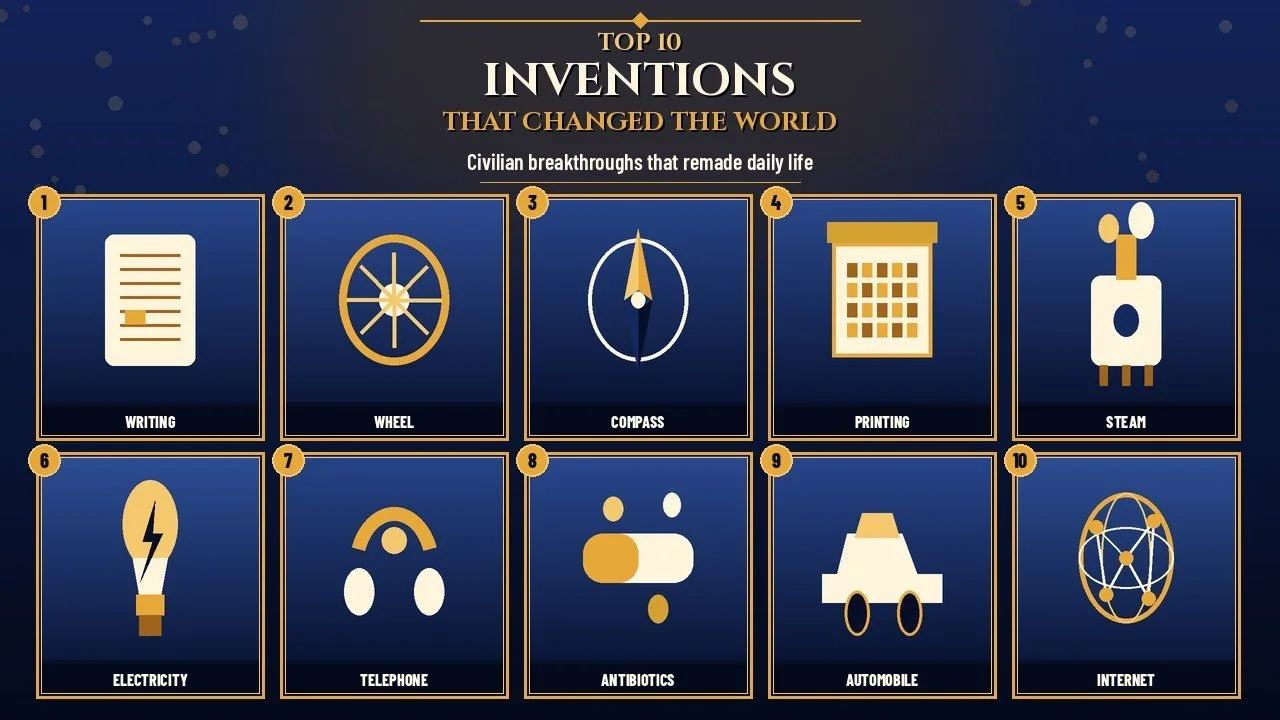
Inventions that changed the world — from writing and the wheel to antibiotics and the internet — remade how people communicate, travel, heal and build.
This Finepedia Top 10 focuses on civilian, world-changing breakthroughs rather than weapons. A related Finepedia guide covers inventions that changed warfare (https://finepedia.com/post/10-inventions-that-changed-warfare-from-chariots-to-drone); that list stays on battlefields. Here the lens is everyday life: how people record knowledge, move goods, navigate oceans, share ideas, power factories, speak across distance, survive infection, travel by road and connect globally.
Selection criteria were fourfold. First, lasting civil impact: the invention had to reshape how large populations live, work or learn, not only how armies fight. Second, enabling power: each item unlocked further tools (wheels enable carts and mills; electricity enables motors and networks). Third, verifiable history: dates, places and attributions follow widely accepted scholarship, with contested claims labelled as contested. Fourth, chronological spread: the list runs from deep antiquity to the late twentieth century so readers see continuity, not a single modern cluster.
The order is roughly chronological by the moment each invention became transformative at scale, not by the earliest possible prototype. Writing systems appear before the wheel because durable record-keeping organised cities and trade long before wheeled transport. The internet closes the list because packet networks and the web completed a communication arc that began with writing and printing. Where inventors are disputed (telephone, electrical systems), the article notes the dispute instead of picking a single hero story.
Ten Inventions That Changed the World at a Glance
| Rank | Invention | Era of wide impact | Key place / people | Why it matters |
|---|---|---|---|---|
| 1 | Writing systems | c. 3200 BCE onward | Mesopotamia, Egypt, China, Mesoamerica | Durable records, law, science and administration |
| 2 | Wheel | c. 3500–3000 BCE | Mesopotamia / Eurasian steppe contexts | Transport, milling, machinery foundations |
| 3 | Magnetic compass | Song China, then global seas | China; later Europe and Indian Ocean trade | Reliable navigation beyond coastlines |
| 4 | Movable-type printing | c. 1440s Europe (earlier East Asia) | Johannes Gutenberg and predecessors | Mass literacy and rapid idea spread |
| 5 | Steam engine | 18th–19th centuries | Newcomen; Watt and industrial Britain | Mechanised industry and powered transport |
| 6 | Electrical power systems | 19th–early 20th centuries | Faraday; Edison, Westinghouse, Tesla era | Light, motors, grids and electronics base |
| 7 | Telephone | 1870s onward | Bell and contested rivals | Instant voice across distance |
| 8 | Antibiotics | 1928 discovery; wartime scale-up | Fleming; Florey, Chain and industry | Bacterial infection treated at population scale |
| 9 | Automobile | Late 19th–20th centuries | Benz; Ford mass production | Personal and freight mobility by road |
| 10 | Internet | ARPANET to WWW, 1960s–1990s | Researchers; Berners-Lee (WWW) | Global information and commerce network |
For more Top 10 Facts lists on Finepedia, see the category hub (https://finepedia.com/category/top-10-facts). Readers who like place rankings may also enjoy the most walkable cities in the world (https://finepedia.com/post/most-walkable-cities-in-the-world-top-10) and the most famous trees in the world (https://finepedia.com/post/most-famous-trees-in-the-world-top-10).
1. Writing Systems
| Attribute | Details |
|---|---|
| Earliest clear systems | Proto-cuneiform in Mesopotamia and early hieroglyphs in Egypt, late 4th millennium BCE |
| Independent traditions | Also include Chinese characters and Mesoamerican scripts |
| Core function | Store speech, accounts, law and knowledge beyond living memory |
| Civil impact | Cities, tax systems, contracts, science and literature become scalable |
| Modern link | Alphabets, scripts and digital text all descend from this idea |
Origins and History
Writing did not appear overnight as literature. The best-documented early path runs through accounting: clay tokens, seal impressions and then proto-cuneiform tablets in southern Mesopotamia tracked grain, livestock and labour. By the late fourth millennium BCE, signs could represent words and syllables well enough for administration. Egypt developed hieroglyphic writing in a similar chronological window, with monumental and administrative uses. China and Mesoamerica later produced independent writing traditions, showing that the need to freeze information across time and distance arose more than once.
Phonetic alphabets and abjads (such as early Northwest Semitic scripts) later compressed writing into fewer signs that learners could master faster than large logographic sets. That compression mattered for wider literacy, though full popular literacy waited for cheap paper, printing and schooling. Across eras, writing turned oral societies into ones that could keep laws, debts, maps, medical recipes and histories intact after the original speakers died.
Key Features
- Separates knowledge from a single human memory, so institutions outlast individuals.
- Enables contracts, taxes and property records that large states need to function.
- Supports cumulative science: later scholars can check, correct and extend earlier notes.
- Spreads religion, literature and technical manuals across regions and centuries.
- Underpins every later information invention on this list, from printing to the internet.
Significance
Without writing, complex economies stall at the scale of face-to-face trust. Writing made empires governable, markets enforceable and scholarship cumulative. It is the quietest item on many popular invention lists, yet every spreadsheet, passport and scientific paper still depends on the same leap: turn fleeting speech into durable marks. When people ask which inventions that changed the world came first, writing belongs near the top of any civilian ranking.
Interesting Facts
- Many early tablets are receipts and ration lists, not poems — bureaucracy came before bestsellers.
- Some scripts remain undeciphered or only partly readable, reminding us how fragile transmission can be.
- Paper (China) and later cheap pulp paper multiplied writing's reach long before digital screens.
- Spelling reform debates still show that writing systems are living social tools, not finished fossils.
- Digital encoding (Unicode) is a modern layer on top of the same ancient problem: represent human language for machines and networks.
2. Wheel
| Attribute | Details |
|---|---|
| Approximate early evidence | Wheeled vehicles in Mesopotamia and nearby regions, c. 3500–3000 BCE |
| Inventor | Unknown; no single named inventor in reliable sources |
| Early uses | Carts for goods; later pottery wheels and mechanical applications |
| Geographic note | Evidence clusters in Eurasia; not every ancient culture adopted wheeled transport early |
| Modern link | Bearings, gears, turbines and vehicles still rely on rotational mechanics |
Origins and History
The wheel's origin is prehistoric and anonymous. Archaeological evidence for wheeled vehicles appears in the fourth millennium BCE in Mesopotamia and related Eurasian contexts, often linked to solid wooden disc wheels before spoked designs lightened chariots and carts. Pottery wheels, which use the same rotational idea for craft production, appear in overlapping early horizons. What matters historically is not a mythical first inventor but the combination of axle, wheel and draft animals or human push that cut the cost of moving heavy loads over land.
Adoption was uneven. Dense forests, steep terrain or societies organised around pack animals and waterways sometimes delayed wheeled transport. Where roads, draft animals and flat corridors existed, carts changed logistics: harvests moved farther, armies and traders carried more, and settlements could specialise because surplus could travel. Over centuries the wheel migrated from solid discs to spoked forms and into machinery — water wheels, millstones driven by rotation, and eventually industrial gearing.
Key Features
- Converts sliding friction into rolling motion, lowering energy needed to move loads.
- Pairs with axles, bearings and later gears to build complex machines.
- Scales from handcarts to rail wheels and aircraft landing gear.
- Enables urban supply chains that cannot rely only on rivers.
- Remains foundational even when engines replace animals as the power source.
Significance
Popular lists often call the wheel the greatest invention because almost every land vehicle still uses it. For world history, its deeper role is economic: cheaper overland transport lets regions specialise and cities grow beyond what local foot porters can feed. Later inventions such as the automobile and railway locomotive are, in one sense, new power plants attached to refined wheels. The wheel is therefore both ancient artefact and permanent engineering principle.
Interesting Facts
- Early wheels were often solid wood; spoked wheels came later and reduced weight for speed.
- The potter's wheel may be as transformative for craft as the cart wheel was for freight.
- Some well-known ancient civilisations used sophisticated engineering yet lagged in wheeled road transport for local reasons.
- Ball bearings and pneumatic tyres are modern refinements of the same rolling idea.
- Metaphorically, reinventing the wheel warns against ignoring prior art — itself a testament to the invention's fame.
3. Magnetic Compass
| Attribute | Details |
|---|---|
| Early development | Lodestone and magnetised needle traditions in China; navigational use clear by Song dynasty |
| Global maritime boom | Spreads into Indian Ocean and European Atlantic navigation in later medieval centuries |
| Core principle | Aligns with Earth's magnetic field to give a direction reference |
| Civil impact | Open-ocean routes, long-distance trade and age of exploration logistics |
| Modern link | Magnetic sensors still aid navigation; GPS is a later layer, not a full replacement in all contexts |
Origins and History
Chinese scholars and craftspeople knew magnetite's attractive and directional properties centuries before compasses steered ocean fleets. By the Song period, magnetised needles in water or on pivots were used for orientation, including ritual and then practical navigation. Knowledge of the compass moved through Afro-Eurasian trade and scholarly networks. European and Indian Ocean mariners adopted and adapted compass navigation in the later Middle Ages, pairing it with portolan charts, dead reckoning and eventually better longitude methods.
The compass did not invent exploration alone — ships, sails, finance and political ambition mattered — but it reduced the terror of losing sight of land. Coastal hopping could give way to more direct open-water legs. That shift thickened trade in spices, textiles, metals and ideas, and it also enabled colonial expansion with all of its documented human costs. For a civilian invention list, the compass is the tool that made the ocean a road rather than a wall.
Key Features
- Provides a portable north-south reference independent of landmarks.
- Works day and night, unlike celestial fixes that need clear skies and skill.
- Integrates with charts and later chronometers into full navigation systems.
- Supports surveying and mining orientation on land as well as at sea.
- Remains a backup when electronic systems fail.
Significance
Globalisation's early chapters were written with wet compasses and dry compasses as much as with cannon. Reliable bearing made long-haul shipping economically rational, which rearranged what people ate, wore and believed across continents. Compared with the warfare-focused sister article on Finepedia, this compass story stays on trade winds and merchant cargo, not naval gunnery — yet the same tool served both merchant and warship.
Interesting Facts
- Early Chinese south-pointing devices and geomantic uses preceded purely maritime framing in some texts.
- Magnetic declination (the gap between magnetic and true north) forced navigators to learn corrections.
- Liquid-filled binnacles later damped ship motion so needles stayed readable in rough seas.
- Airport runways and hiking markers still assume people understand cardinal directions the compass taught at scale.
- Smartphone magnetometers are tiny heirs of the lodestone tradition.
4. Printing Press (Movable Type)
| Attribute | Details |
|---|---|
| East Asian precedents | Ceramic and metal movable type in China and Korea before European adoption |
| European breakthrough | Johannes Gutenberg's metal movable-type system, Mainz, c. 1440s |
| Famous early product | Gutenberg Bible and rapid spread of presses across Europe |
| Civil impact | Cheaper books, pamphlets, maps and scientific exchange |
| Modern link | Mass media, publishing industries and the expectation of identical copies |
Origins and History
Woodblock printing and movable type existed in East Asia before Gutenberg. Korea's metal type and Chinese experiments showed that rearranging characters could beat carving a whole page for every new text. Europe's mid-fifteenth-century leap combined durable metal type, oil-based ink, a adapted press mechanism and a growing market for books among clergy, scholars and merchants. Within decades, presses operated in major European cities. Print runs made identical copies available far from the author's desk.
The Reformation, scientific correspondence and vernacular literature all rode this infrastructure. Authorities tried to license and censor presses because pamphlets moved faster than messengers. Literacy rose unevenly, but the cost of a book fell relative to hand-copied manuscripts, pulling reading beyond palace and monastery walls. Newspapers and later industrial rotary presses extended the same logic into daily mass communication.
Key Features
- Produces many identical copies, reducing transcription error and cost per reader.
- Separates composition (setting type) from impression (pressing inked type to paper).
- Scales from religious texts to science, law, fiction and political argument.
- Creates public spheres where strangers share the same printed reference.
- Sets cultural expectations that digital publishing still inherits: edition, page, citation.
Significance
If writing stores knowledge, printing multiplies it. Historians still debate how much print caused the scientific revolution versus how much it amplified trends already underway, but few deny the acceleration. For inventions that changed the world, movable-type printing is the bridge between scribal culture and modern media. It also pairs naturally with Finepedia's history category interests: the same centuries that remade European book culture remade maps, missions and markets.
Interesting Facts
- A single press could outproduce a room of copyists, collapsing manuscript scarcity.
- Typefounding and punchcutting were skilled crafts; early printers were industrial designers as much as scholars.
- Censorship indexes and licensing laws are backhanded proof of print's political power.
- Steam-powered and rotary presses in the nineteenth century turned print into true mass media.
- The phrase print culture still describes habits — footnotes, editions, errata — born in ink.
5. Steam Engine
| Attribute | Details |
|---|---|
| Early practical engines | Thomas Newcomen's atmospheric engine for mines, early 18th century |
| Efficiency leap | James Watt's separate condenser and later rotary improvements |
| Peak civil role | Factories, steamboats, railways in the 19th century |
| Energy source | Heat from burning fuel boils water; expanding steam does work |
| Modern link | Thermal power plants and turbines still convert heat to motion or electricity |
Origins and History
Mining districts needed to pump water out of deep shafts. Newcomen's engine did that job in the early 1700s, inefficiently but usefully. Watt's partnership improvements, including the separate condenser, cut fuel waste and made steam attractive for mills. Rotary motion adaptations let engines drive factory shafts, not only pumps. Coupled with coal, iron and capital, steam powered the Industrial Revolution's classic phase in Britain and then across industrialising regions.
Railways and steamships compressed distance for goods and people. Factory time replaced task time for many workers, with social upheaval that reformers, unions and novelists documented. Steam did not invent industry alone — waterpower, textiles machinery and finance mattered — but it freed factories from riverside sites and ships from pure wind dependence. Later internal combustion and electric motors took many roles, yet the thermal engine lineage remains central to electricity generation.
Key Features
- Converts heat into mechanical work on demand, independent of river flow or wind.
- Scales from mine pumps to locomotive boilers and marine engines.
- Enables concentrated factory production and continental freight railways.
- Creates new labour regimes, urban growth and fossil-fuel dependence.
- Teaches thermodynamics in practice: efficiency limits still govern power plants.
Significance
Steam remade landscapes: rail towns, coal ports, mill cities. It also remade expectations of speed — schedules, timetables, and the idea that distance is mainly a cost in hours. On a list of inventions that changed the world, steam is the hinge between agrarian energy limits and fossil-powered modernity. Readers comparing civil versus military tech can note that the same century produced industrial artillery and battleships; this article keeps the focus on mills, rails and steam packets.
Interesting Facts
- Early engines were so inefficient that they often stood next to coal mines where fuel was cheapest.
- Watt's business model included royalties based on fuel saved versus Newcomen engines.
- High-pressure steam later enabled lighter locomotives but raised explosion risks that safety rules had to address.
- Triple-expansion marine engines stretched more work from the same steam before turbines took over.
- Phrases like full steam ahead entered everyday language from this technology.
6. Electrical Power Systems
| Attribute | Details |
|---|---|
| Scientific base | Electromagnetic induction (Faraday and others, 1830s) |
| Commercial lighting and power | Late 19th-century urban systems; Edison, Westinghouse and peers |
| Current wars context | AC vs DC distribution debates; polyphase AC enabled long-distance transmission |
| Civil impact | Lighting, motors, appliances, electrified industry and homes |
| Modern link | Grids remain the backbone for digital devices and clean-energy transitions |
Origins and History
Static electricity toys and laboratory sparks long predated useful power. Michael Faraday's demonstration that a changing magnetic field induces electric current gave inventors a generative principle for dynamos and transformers. Through the mid-to-late nineteenth century, engineers turned that principle into generators, arc lights, incandescent bulbs, motors and distribution networks. Thomas Edison's direct-current utility model lit city blocks; George Westinghouse and allies pushed alternating current for longer-distance transmission, with Nikola Tesla's polyphase ideas among the technical pillars. Popular history often simplifies this into a cartoon rivalry; engineering reality was a crowded field of patents, financiers and city contracts.
Electrification rolled out unevenly: first dense urban cores and factories, later rural lines through public programmes in many countries. Once sockets existed, a cascade of appliances followed — irons, radios, refrigerators, then electronics. Twentieth-century grids tied regions together, making electricity a shared infrastructure like roads and water. Twenty-first-century debates about renewables and storage still assume that wire-delivered power is the default energy interface for ordinary life.
Key Features
- Moves energy quietly through wires to motors and lights at the point of use.
- Separates generation site (dam, plant, wind farm) from consumption site (home, factory).
- Supports precision control compared with belting every machine to one steam shaft.
- Enables telecommunications and computing hardware that need stable current.
- Scales from village microgrids to continental interconnections.
Significance
Electricity is less a single gadget than a platform invention. It turned night into usable time, cut indoor smoke from lamps, and let industries place machines where workers and transport demanded rather than where a river wheel sat. Among inventions that changed the world, electrical power is the reason later entries — telephone networks, computers, the internet — have energy to run. Accurate history shares credit across scientists and engineers instead of crowning one household name.
Interesting Facts
- Early city lighting was often arc light on streets before domestic incandescent bulbs spread.
- Transformers let AC step voltage up for transmission and down for safe local use.
- Household electrification statistics are a standard way historians measure twentieth-century living standards.
- Blackouts reveal how many invisible systems — water pumps, hospitals, cold chains — assume continuous power.
- Measurement units (volt, ampere, watt, farad) memorialise the international research community behind the grid.
7. Telephone
| Attribute | Details |
|---|---|
| Landmark US patent era | Alexander Graham Bell, 1876 patent; rivals and priority disputes documented |
| Contested history | Other inventors (notably Elisha Gray and earlier experimenters) appear in fair accounts |
| Network effect | Value grows as switchboards and later automatic exchanges connect more subscribers |
| Civil impact | Instant voice for business, families, emergency services and journalism |
| Modern link | Mobile phones and VoIP continue the same job with radio and packet networks |
Origins and History
The telephone sits in a crowded nineteenth-century field of telegraph improvement and acoustic experiments. Alexander Graham Bell's 1876 patent is the usual textbook milestone in the United States, yet historians still discuss parallel work by Elisha Gray and earlier speech-transmission experiments elsewhere. Fair popular writing flags the dispute instead of erasing it. What followed the patent fights mattered as much as the first call: exchange switchboards, copper networks, long-distance amplifiers and eventually automatic dialling turned a novelty into infrastructure.
Twentieth-century telephony reshaped work (orders placed by voice), family life (distance felt smaller) and public safety (direct lines to help). Mid-century microwave links and undersea cables globalised voice. Late-century mobile cellular systems untethered the handset, and internet telephony folded voice into data. The social habit — expect to speak with someone far away within seconds — began with the wired telephone.
Key Features
- Converts sound to electrical signals and back with enough fidelity for conversation.
- Requires directory systems, numbering plans and interconnection agreements between operators.
- Creates real-time coordination impossible by letter and slower than needed by telegraph alone for many tasks.
- Supports emergency calling norms that cities now treat as basic services.
- Evolves into smartphones that still place voice beside data apps.
Significance
Telegraphy already sent coded text fast; the telephone added the human voice, with emotion, negotiation and clarity for people who never learned Morse. Business headquarters could manage distant branches more tightly. For inventions that changed the world, the telephone is the hinge between message and conversation at planetary distance. Mobile networks later merged this habit with computing, but the expectation of live remote speech is a telephone legacy.
Interesting Facts
- Early subscribers often shared party lines, with privacy norms that seem alien today.
- Women operators were central to manual switchboard eras in many countries.
- Area codes and country codes are political as well as technical maps of the network.
- The phrase the line is busy entered culture from scarce circuit capacity.
- Modern regulators still wrestle with interconnection — a problem as old as rival telephone companies.
8. Antibiotics
| Attribute | Details |
|---|---|
| Landmark observation | Alexander Fleming notices penicillin activity, 1928 |
| Clinical scale-up | Howard Florey, Ernst Chain and teams develop usable therapy; WWII production surge |
| Drug class | Chemicals that kill or stop bacteria (distinct from antivirals) |
| Civil impact | Sharp drops in deaths from many bacterial infections when access exists |
| Modern challenge | Antimicrobial resistance from overuse and agricultural misuse |
Origins and History
Folk mould remedies existed in various cultures, but modern antibiotic medicine has a clear scientific arc. In 1928 Alexander Fleming observed that a Penicillium mould inhibited staphylococcal growth on a culture plate. The observation did not immediately yield a stable, mass-produced drug. In the late 1930s and early 1940s, Oxford researchers including Howard Florey and Ernst Chain purified and tested penicillin, and wartime industrial partnerships scaled manufacturing. Sulfa drugs and later antibiotic classes (streptomycin and many others) expanded the arsenal against tuberculosis and other bacterial diseases.
Life expectancy and surgery safety changed where antibiotics were available: previously lethal wound infections and childbirth fever became treatable more often. Public health still needed sanitation and vaccines; antibiotics were not a substitute for clean water. By the late twentieth century, resistance warned that bacterial evolution could outpace drug discovery. Stewardship — using the right drug only when needed — is now part of the invention's unfinished story.
Key Features
- Targets bacterial cells or processes enough to clear infection while aiming to spare the patient.
- Enables complex surgery and cancer chemotherapy by controlling secondary infection risk.
- Comes in many classes with different spectra and side-effect profiles.
- Loses power when misuse selects for resistant strains.
- Depends on regulation, cold chains and diagnosis — not only on laboratory genius.
Significance
Few inventions that changed the world show benefit as personally as antibiotics: a child with bacterial pneumonia, a worker with septic injury, a mother after complicated delivery. The gains are measurable in mortality statistics for the mid-twentieth century in countries with access. Ethical history also notes unequal access and the continuing resistance crisis. This entry stays firmly medical and civilian, distinct from bioweapon narratives.
Interesting Facts
- Fleming shared the 1945 Nobel Prize in Physiology or Medicine with Florey and Chain.
- Early penicillin was so scarce that urine recycling recovered drug from treated patients in some wartime settings.
- Soil microbiology later yielded many antibiotic classes beyond penicillin.
- Viral infections do not respond to antibiotics — a key public-education point that still needs repeating.
- New antibiotic discovery slowed for decades while resistance climbed, prompting renewed research pushes.
9. Automobile
| Attribute | Details |
|---|---|
| Early practical car | Karl Benz's Motorwagen, 1885–1886 era, among pioneering designs |
| Mass affordability | Henry Ford's moving assembly line and Model T era democratised ownership in the US and influenced others |
| Propulsion | Mainly internal combustion through the 20th century; EVs rising in the 21st |
| Civil impact | Personal mobility, trucking logistics, suburban form, road economies |
| Modern link | Still central to freight and passenger travel; climate and city design debates ongoing |
Origins and History
Nineteenth-century inventors tried steam and electric road vehicles before petrol engines dominated. Karl Benz's three-wheeled Motorwagen of the mid-1880s is a standard milestone for the practical automobile, with parallel work by peers such as Gottlieb Daimler. Early cars were luxury toys. Henry Ford's process innovations before and during the Model T years — standardised parts, higher wages in a famous 1914 move, and assembly-line speed — cut prices and raised output, making car ownership plausible for more working families in the United States and inspiring manufacturers elsewhere.
Roads, petrol stations, traffic laws and suburbs co-evolved with the car. Trucking reorganised retail supply. Tourism by road created roadside cultures. The same system produced congestion, crashes and air pollution that cities still manage. Twenty-first-century electric vehicles reuse the automobile form factor while changing the energy story back toward grids (see electrical power above). Autonomous driving remains incomplete as of 2026, so human-driven cars still define the category for this ranking.
Key Features
- Offers door-to-door travel without fixed rail timetables.
- Scales from private cars to buses and heavy freight trucks on the same road networks.
- Demands public investment in pavement, signalling and fuel or charging infrastructure.
- Reshapes land use toward lower density where policy allows sprawl.
- Creates global industries in steel, glass, electronics and software for vehicles.
Significance
The automobile turned distance into a personal schedule. It weakened some rail passenger markets, strengthened others for freight, and became a symbol of freedom in advertising even as it locked households into fuel and insurance costs. On Finepedia's civilian list of inventions that changed the world, the car sits beside the wheel and steam engine as a mobility stack: ancient rolling idea, industrial power, then personalised motor transport. Urban readers comparing lifestyle rankings may also like Finepedia's walkable cities guide, which measures places that work well even when cars are not the default.
Interesting Facts
- Early motorists often faced hostile local rules; motoring clubs lobbied for road improvements.
- Number plates, driving licences and traffic lights are social inventions paired with the machine.
- Container trucks and just-in-time logistics depend on reliable road freight as much as on ships.
- Crash safety improved through seat belts, crumple zones and later electronic aids after decades of rising injury tolls.
- Car culture varies widely: dense Asian and European cities often pair autos with strong transit, unlike car-first sprawl regions.
10. Internet
| Attribute | Details |
|---|---|
| Packet network roots | ARPANET and related research networks from the late 1960s |
| Core protocols | TCP/IP becomes the internetworking standard |
| Web layer | Tim Berners-Lee's World Wide Web, early 1990s, makes linking mainstream |
| Civil impact | Global publishing, commerce, remote work, social media and cloud services |
| Modern link | Still expanding via mobile broadband, satellites and local access fights |
Origins and History
The internet is a system of networks, not a single gadget. US Defense-funded and academic research in the 1960s and 1970s built packet-switched networks such as ARPANET so computers could share resources robustly. TCP/IP protocols let dissimilar networks interconnect — the literal inter-net. Email and file transfer proved useful long before consumer browsers. In 1989–1991 Tim Berners-Lee proposed and demonstrated the World Wide Web at CERN: URLs, HTTP and HTML let ordinary users click through a web of documents. Commercial ISPs, browsers and search engines in the 1990s pulled hundreds of millions online.
Twenty-first-century mobile data made the network continuous rather than desk-bound. Streaming, cloud software, online payments and remote collaboration became normal for those with access. The same pipes carry misinformation, crime and surveillance risks that societies still regulate unevenly. As of 2026 the internet remains the fastest-evolving item on this list, but its foundational idea — open internetworking plus easy linking — is already historical.
Key Features
- Routes data in packets that can take varied paths, improving resilience.
- Separates physical wires from application layers so email, web and video can share infrastructure.
- Lowers publishing costs toward near zero compared with print runs.
- Enables real-time global markets and remote teams.
- Raises governance questions about access, privacy, speech and platform power.
Significance
Writing stored knowledge; printing multiplied it; telephony carried voice; the internet carries all media at once and lets recipients become publishers. Among inventions that changed the world, it compresses the previous information stack into one always-on layer. Commerce, education, entertainment and politics now assume connectivity the way twentieth-century cities assumed electricity. The digital divide shows the invention's impact negatively too: offline populations miss services designed only for the network.
Interesting Facts
- Early networks numbered hosts in the dozens; today's address systems needed IPv6 to expand.
- The web is one application on the internet — alongside email, VPNs and countless APIs.
- Content delivery networks quietly cache popular files near users to keep video watchable.
- Undersea fibre cables, not satellites alone, still carry the bulk of intercontinental traffic.
- Domain names and DNS form a human-readable map on top of numeric addresses.
How These Inventions Compare
| Invention | Primary domain | Approx. centuries to global reach | Depends on earlier items? |
|---|---|---|---|
| Writing systems | Information | Millennia of gradual spread | Spoken language, durable media |
| Wheel | Transport / mechanics | Regional for ages; global with modern vehicles | Roads or flat routes; axles |
| Compass | Navigation | Centuries via maritime trade | Magnetic materials; charts help |
| Printing | Information | Decades across early modern Europe, then global | Writing, paper, ink, presses |
| Steam engine | Energy / industry | About one century of industrial spread | Metallurgy, fuel, capital |
| Electrical power | Energy platform | Roughly half a century for rich-city cores; longer for full coverage | Generators, wires, regulation |
| Telephone | Communication | Decades for national networks; longer for universal service | Electricity, copper, exchanges |
| Antibiotics | Medicine | Wartime years to wide hospital use where supply existed | Labs, industry, cold chain |
| Automobile | Transport | Decades for mass ownership in leading markets | Wheel, engines, oil, roads |
| Internet | Information / commerce | About three decades from research net to mass web | Electricity, computers, telecom |
Frequently Asked Questions
What counts as an invention that changed the world?
For this list, an invention qualifies if it permanently altered how large numbers of civilians communicate, travel, produce, navigate or heal. Purely military systems belong on Finepedia's warfare inventions article instead. Scientific discoveries count when they become usable technologies, as with electricity and antibiotics.
Why is writing ranked above the wheel?
Both are ancient and foundational. Writing is ranked first here because durable records organise law, tax and science even in societies that moved goods mainly by water or pack animal. The wheel transformed land transport and machinery, but administration and cumulative knowledge lean first on writing.
Who invented the telephone?
Alexander Graham Bell holds the famous 1876 US patent often taught in schools, yet historians document competing claims and parallel experiments, including work associated with Elisha Gray. Responsible summaries present the dispute rather than a single uncomplicated hero narrative.
Did Gutenberg invent printing?
Gutenberg commercialised metal movable-type printing in Europe in the mid-1400s with huge consequences for Western book culture. Movable type and printing existed earlier in East Asia. Crediting Gutenberg for the European breakout is fair; calling him the sole global inventor of printing is not.
Why include antibiotics but not vaccines?
Vaccines also changed the world. This Top 10 caps at ten civilian milestones and already covers information, energy and transport pillars. Antibiotics represent the antibacterial drug revolution with a clear Fleming-to-industrial timeline; vaccines remain essential public health technology covered better in dedicated medical lists.
Is the internet the same as the World Wide Web?
No. The internet is the global network of networks using protocols such as TCP/IP. The Web is a linking and document system invented by Tim Berners-Lee that runs on top of the internet. Email and many apps use the internet without being the Web.
How is this different from Finepedia's warfare inventions list?
That companion article ranks tools such as chariots, gunpowder, tanks, radar, nuclear weapons and drones for their effect on combat. This article excludes that focus on purpose. A few technologies (electronics, navigation) have dual uses, but the stories here emphasise trade, homes, medicine and civilian industry.
Conclusion
The inventions that changed the world on this list form a relay rather than a museum of isolated gadgets. Writing made knowledge durable; printing multiplied it; telephony and the internet delivered it at the speed of light. The wheel, compass, steam engine and automobile shrank distance for goods and people. Electrical power lit the stage on which modern devices run. Antibiotics extended the lives of the audiences. Together they explain why daily life in 2026 would be unrecognisable to someone from 1500 — and why responsible history still argues over credit, access and unintended costs.
If you want the military counterpart, read Finepedia's guide to inventions that changed warfare (https://finepedia.com/post/10-inventions-that-changed-warfare-from-chariots-to-drone). For other global rankings in a civilian key, try the happiest countries in the world (https://finepedia.com/post/happiest-countries-in-the-world-top-10-ranked-2026) and the most dangerous tourist destinations in the world (https://finepedia.com/post/most-dangerous-tourist-destinations-in-the-world-top-10). History keeps inventing; these ten remain the load-bearing beams.
- Britannica — articles on writing, wheel, compass, printing, steam engine, telephone, automobile, penicillin/antibiotics, and Internet/World Wide Web (encyclopedic overviews for dates and attributions)
- Academic and museum summaries of Gutenberg and East Asian movable type (for fair printing history)
- Standard histories of Faraday-era electromagnetism and late-19th-century electric utilities (Edison/Westinghouse/Tesla context without single-hero simplification)
- Nobel Prize materials on Fleming, Florey and Chain (penicillin)
- ARPANET/TCP-IP and CERN Web historical notes (internet vs Web distinction)
- Reference topic scope only (not wording): 10mosttoday.com August 2020 inventions list (local ref.html / ref.txt)
- Related Finepedia (different angle): https://finepedia.com/post/10-inventions-that-changed-warfare-from-chariots-to-drone



















Log in with