










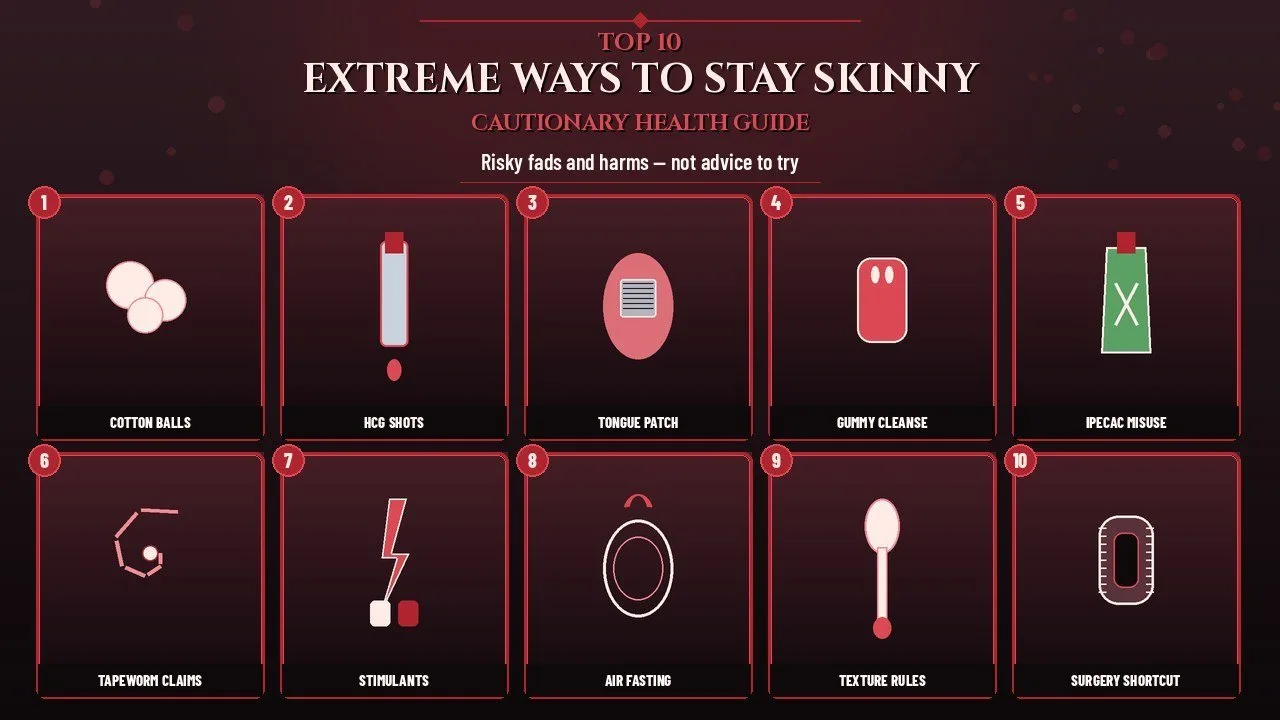
Extreme ways people try to stay skinny often involve dangerous fads, unproven hormones and eating-disorder behaviours that can cause lasting harm.
This Finepedia Top 10 is an awareness guide, not a how-to. It ranks risky methods people have tried in the hope of rapid thinness, from indigestible fillers and hormone products to outdated surgeries treated as shortcuts. None of these approaches is recommended for cosmetic weight loss. Several are classic warning signs of disordered eating. If you or someone you know is using non-food items, forced vomiting, laxative abuse or extreme starvation to control weight, contact a licensed clinician or an eating-disorder helpline rather than trying to "push through" alone.
Selection criteria were fourfold. First, documented harm: each item appears in medical reporting, regulator warnings or peer-reviewed discussion as unsafe or ineffective for healthy weight goals. Second, cultural visibility: the method has been promoted online, in clinics chasing quick results, or in historical fad literature. Third, originality of angle: the list is ordered by type of risk (foreign bodies, hormones, purging, parasites, stimulants, starvation framing, extreme restriction, surgery misuse), not by the order of any single reference site. Fourth, clarity for readers: each section explains what the claim was, why it is dangerous, and what evidence-based care looks like instead.
Safe, sustainable weight management rests on balanced eating, movement you can keep, sleep and, when needed, medical or psychological care. Finepedia's related guides on the most unhealthy foods (https://finepedia.com/post/most-unhealthy-foods-top-10-to-limit-and-better-swaps) and keto diet risks (https://finepedia.com/post/keto-diet-risks-10-reasons-it-may-not-be-for-you) cover everyday nutrition trade-offs. Physical symptoms of anxiety (https://finepedia.com/post/physical-symptoms-of-anxiety-top-10-signs-explained) often overlap with the stress that fuels extreme dieting.
Extreme Ways People Try to Stay Skinny at a Glance
| Rank | Method | Core claim | Main documented risks | Evidence stance |
|---|---|---|---|---|
| 1 | Cotton ball diet | Indigestible fibres create fullness on almost no calories | Bezoars, intestinal obstruction, choking, malnutrition | Dangerous disordered eating; never advised |
| 2 | HCG hormone products | Pregnancy hormone plus ~500 kcal/day "resets" fat | Electrolyte imbalance, gallstones, arrhythmia risk; no extra fat-loss effect | FDA warns; HCG not approved for weight loss |
| 3 | Tongue patch | Sewn mesh makes solids painful; forces liquids | Infection, swelling, speech issues, very-low-calorie harm | Extreme procedural fad; not standard care |
| 4 | Maltitol gummy "cleanse" | Sugar-free sweets as a laxative flush | Severe diarrhoea, dehydration, electrolyte loss | Misuse of a food additive; not a diet |
| 5 | Ipecac syrup misuse | Forced vomiting after meals | Cardiomyopathy, muscle weakness, electrolyte chaos | Linked to bulimia; emergency risk |
| 6 | Tapeworm diet claims | Intestinal parasites "eat your food" | Parasitic disease, organ complications, unreliable products | Historical myth and black-market danger |
| 7 | Stimulant misuse | Amphetamines or illicit drugs suppress appetite | Addiction, heart events, psychosis, death | Never a legitimate skinny strategy |
| 8 | Extreme "air" fasting claims | Smell or "live on air" instead of eating | Starvation, organ failure, death | Breatharianism-adjacent; medical emergency |
| 9 | Extreme texture restriction | Only spoonable or liquid foods for weeks | Nutrient gaps, muscle loss, binge rebound | Fad restriction without clinical oversight |
| 10 | Bariatric surgery as vanity shortcut | Stapling or banding for thinness without medical need | Surgical complications; lifelong diet rules | Legitimate only for indicated obesity under specialists |
For more Top 10 Facts lists, see the category hub (https://finepedia.com/category/top-10-facts).
1. Cotton Ball Diet
| Attribute | Details |
|---|---|
| What people claim | Soak cosmetic cotton or rayon balls and swallow them to feel full while eating almost nothing |
| Why it spreads | Social media "hacks" frame indigestible filler as a low-effort skinny trick |
| Core medical problem | Fibres are not food; they can form a bezoar and block the gut |
| Typical harm signals | Abdominal pain, vomiting, inability to pass stool or gas, choking |
| Clinical framing | A form of disordered eating / non-food ingestion, not a diet plan |
Origins and History
The cotton ball diet circulated especially among teens and young adults on social platforms in the early 2010s. Posts promised satiety from juice-soaked cotton without calories. Clinics and youth health centres publicly warned that store-bought "cotton" balls are often rayon or chemically processed fibres never meant to be swallowed.
Unlike a structured meal plan, the behaviour is closer to pica or other non-nutritive ingestion patterns seen in eating disorders. Weight that drops on this fad is starvation weight, not healthier body composition. Any short-term scale change comes with a real chance of emergency surgery.
Key Risks
- Indigestible mass in the stomach or intestines (bezoar) that may need surgical removal.
- Intestinal obstruction: food and fluid cannot pass; untreated cases can kill gut tissue and cause infection.
- Choking or aspiration if fibres enter the airway.
- Malnutrition because the body receives almost no protein, fat, vitamins or minerals.
- Psychological reinforcement of using fear and fullness tricks instead of eating.
Why It Is Not a Weight Solution
Fullness without nutrition is a medical red flag, not a lifestyle tip. Youth health organisations state plainly that cotton is not a food substitute. Evidence-based care focuses on restoring regular meals, treating underlying body-image distress, and ruling out medical complications. Anyone who has swallowed non-food fibres and develops severe belly pain, repeated vomiting or inability to pass gas should seek emergency care.
Interesting Facts
- Many "cotton" balls are synthetic rayon, which makes the obstruction risk worse, not safer.
- Feeling temporarily full after swallowing filler does not mean digestion is working; it can mean a blockage is forming.
- Clinicians treat this pattern as disordered eating, not as a quirky diet to "try once."
- Sustainable fullness comes from fibre-rich real foods (vegetables, legumes, whole grains), not foreign objects.
- Early help for eating-disorder thoughts greatly improves recovery odds compared with waiting for a crisis.
2. HCG Hormone Injections and Drops
| Attribute | Details |
|---|---|
| What people claim | Human chorionic gonadotropin (HCG) plus a ~500-calorie diet melts fat preferentially |
| Historical origin | Popularised from A.T.W. Simeons' mid-20th-century protocol |
| Regulator position | FDA: HCG is not approved for weight loss; homeopathic HCG products have drawn warning letters |
| What actually causes loss | Severe calorie restriction, not a proven hormone fat-burning effect |
| Main medical risks | Gallstones, electrolyte imbalance, arrhythmias, nutrient deficits on very-low-calorie diets |
Origins and History
HCG is a hormone produced in pregnancy. Prescription HCG has approved uses in fertility and certain hormonal treatments. Decades ago, some clinics paired HCG injections with near-starvation menus and claimed preferential fat loss from hips and thighs. Meta-analyses of controlled trials found no reliable evidence that HCG outperforms placebo for weight loss, hunger reduction or "spot" fat redistribution.
In the 2010s and beyond, over-the-counter drops, pellets and sprays labelled "homeopathic HCG" flooded online stores. The U.S. Food and Drug Administration has repeatedly advised consumers to avoid HCG weight-loss products and has acted against firms making illegal weight-loss claims. Mayo Clinic and other major health systems summarise the same conclusion: the diet is not safe for routine use, and any scale drop comes from eating far too little.
Key Risks
- Very-low-calorie intake (often advertised near 500 kcal/day) without specialist supervision.
- Gallstone formation, electrolyte imbalance and heart rhythm problems associated with crash diets.
- Misuse of a prescription hormone outside approved indications.
- Unregulated "homeopathic" products that the FDA has not evaluated for safety or effectiveness.
- Rebound weight gain and disordered eating patterns after the crash phase ends.
Why It Is Not a Weight Solution
Controlled research and regulator labelling agree: HCG does not add meaningful fat loss beyond caloric restriction alone. Trading a week of dizziness and nutrient debt for temporary water and tissue loss is the opposite of durable health. People who want medical weight management should discuss evidence-based options (nutrition counselling, approved medications when indicated, supervised programmes) with a licensed clinician — not buy pregnancy-hormone drops online.
Interesting Facts
- Prescription HCG labels have long stated there is no substantial evidence it increases weight loss beyond diet alone.
- The FDA and FTC have issued joint warning letters over OTC HCG products marketed for slimness.
- Meta-analysis work scoring trial quality found little support for HCG as an obesity adjunct.
- Clinics sometimes sell the hormone as a "reset"; the reset is simply undereating.
- Fertility uses of HCG are unrelated to cosmetic skinny goals and require medical oversight.
3. Tongue Patch Procedure
| Attribute | Details |
|---|---|
| What people claim | A mesh patch sewn to the tongue makes chewing solids too painful, forcing a liquid diet |
| Where it surfaced | Aesthetic clinics; widely reported fad in Venezuela and U.S. media coverage around 2009–2013 |
| Mechanism of loss | Extreme calorie cut from liquids only, not a metabolic miracle |
| Local risks | Infection, swelling, speech difficulty, tissue injury, airway concern if swelling is severe |
| Systemic risks | Same harms as any unsupervised very-low-calorie liquid phase |
Origins and History
Media reports described a postage-stamp-sized abrasive mesh secured with stitches to the tongue so that solid food becomes painful. Promoters framed it as willpower in a suture: patients "could not cheat" for about a month. Coverage from TIME and U.S. news outlets highlighted Venezuelan clinic popularity and U.S. plastic-surgery marketing. Independent clinicians warned about infection, nerve injury, scarring and the absence of rigorous safety testing compared with established treatments.
Any weight change during the patched month tracks the liquid calorie limit, typically advertised in the very-low range. When the patch comes out, appetite and old habits return unless underlying behaviour and nutrition are addressed — which stitching a foreign material into the tongue does not teach.
Key Risks
- Infection or inflammatory reaction around sutures and mesh.
- Tongue swelling that can threaten the airway in severe cases.
- Speech and sleep disruption while the patch is in place.
- Nutrient deficits, gallstones and muscle loss from prolonged very-low-calorie liquids.
- No proven long-term advantage over supervised nutrition change without oral implants.
Why It Is Not a Weight Solution
Pain as a diet coach is a cruel and unstable strategy. Standard obesity care uses behavioural support, medical evaluation and, when appropriate, proven procedures with clear indications — not oral mesh for cosmetic thinness. Readers should treat tongue-patch marketing as a cautionary tale about body-image pressure, not as inspiration.
Interesting Facts
- Promoters compared the idea to older jaw-wiring approaches that also forced liquids through pain or mechanical block.
- Speech difficulty was a common patient complaint in news interviews.
- Nutritionists in affected countries publicly opposed the malla lingual as medically unsound.
- Short-term scale drops do not equal lasting health or body-image recovery.
- Removing the patch does not remove the social pressure that drove someone to accept stitches in the tongue.
4. Maltitol Gummy "Cleanse"
| Attribute | Details |
|---|---|
| What people claim | Sugar-free gummies with maltitol (sometimes marketed via "lycasin" lore) flush the body for rapid slimness |
| Real chemistry | Sugar alcohols such as maltitol draw water into the gut and can cause osmotic diarrhoea |
| Famous cultural echo | Viral stories of accidental overeating of sugar-free sweets and extreme bathroom urgency |
| Main harms | Dehydration, cramping, electrolyte loss, dependence on purging behaviours |
| Clinical framing | Laxative misuse, a recognised eating-disorder behaviour when used for weight control |
Origins and History
Sugar-free confectionery sweetened with sugar alcohols can cause gas and diarrhoea when eaten in quantity — a fact manufacturers often label. Internet "cleanse" culture flipped that side effect into a feature: eat a pile of gummies, purge through the bowel, call it detox. That framing confuses temporary water and stool loss with fat loss. It also normalises using the toilet as a weight tool, which overlaps with bulimia-spectrum behaviours.
Health educators stress that laxative effects do not selectively remove calories already absorbed higher in the gut. What leaves quickly is fluid and content from the lower bowel, which rebounds as soon as the person rehydrates and eats again.
Key Risks
- Severe diarrhoea and abdominal cramping.
- Dehydration and electrolyte imbalance that can affect the heart and muscles.
- Encouraging a purge cycle that is hard to stop.
- Masking an eating disorder behind "funny cleanse" language.
- Dental and gut irritation from frequent acidic or osmotic stress.
Why It Is Not a Weight Solution
A bathroom emergency is not a fat-loss protocol. If sugar-free sweets upset your stomach accidentally, that is a labelling lesson. Using them on purpose to stay skinny is a harm pattern that deserves clinical support, not another bag of gummies.
Interesting Facts
- Sugar alcohols are poorly absorbed; that is why large doses loosen stool — not because toxins are "flushed."
- Viral candy mishaps became memes; purposeful repetition is a different and more serious behaviour.
- Eating-disorder programmes specifically screen for laxative abuse.
- Rehydration after a purge can restore the scale reading within a day.
- Fibre from food and adequate fluids support normal bowel function without chemical crises.
5. Ipecac Syrup Misuse
| Attribute | Details |
|---|---|
| Legitimate historic use | Induce vomiting after certain poisonings under medical guidance (now largely obsolete in first aid) |
| Misuse pattern | Taken after meals to purge calories in bulimia-spectrum behaviours |
| Signature danger | Cumulative toxicity linked to cardiomyopathy and muscle injury |
| Other harms | Electrolyte chaos, dental enamel erosion from repeated vomiting, oesophageal injury |
| Action if occurring | Urgent medical and mental-health care; this is an emergency pattern |
Origins and History
Syrup of ipecac was once kept in some household first-aid kits to cause vomiting after poison ingestion. Emergency medicine later moved away from routine home use because risks often outweighed benefits. Separately, people with bulimia nervosa and related disorders have misused ipecac to empty the stomach after eating. Medical literature associates chronic misuse with serious heart-muscle damage.
This item appears on extreme skinny lists because purging feels, incorrectly, like cancelling a meal. In reality, much energy is already absorbed, and the body pays with electrolytes, teeth, oesophagus and, with ipecac, potentially the heart.
Key Risks
- Cardiomyopathy and heart rhythm problems from repeated exposure.
- Dangerous shifts in potassium and other electrolytes.
- Tears or inflammation in the oesophagus; chronic reflux and dental damage from stomach acid.
- Reinforcement of binge–purge cycles that become harder to interrupt alone.
- Delayed care because the person hides the behaviour.
Why It Is Not a Weight Solution
Forced vomiting is a medical and psychiatric emergency pattern, not a diet tip. Finepedia includes it here only so readers recognise the danger and seek help. Treatment may involve physicians, dietitians and therapists experienced in eating disorders. Friends and family who suspect ipecac or other purge aids should encourage professional care rather than secrecy.
Interesting Facts
- Modern poison-control advice rarely recommends unsupervised ipecac at home.
- Heart damage from chronic misuse can appear after repeated exposure, not only a single dose.
- Many people who purge also restrict and over-exercise; the whole pattern needs assessment.
- Early intervention improves cardiac and dental outcomes.
- Confidential helplines and clinicians exist specifically for eating-disorder support.
6. Tapeworm Diet Claims
| Attribute | Details |
|---|---|
| What people claim | Swallow parasite eggs so a worm "eats the food" inside you |
| Historical note | Victorian-era and early advertising lore romanticised parasites as a slimness aid |
| Modern reality | Black-market or joke products; real infections are diseases, not spa treatments |
| Documented harms | Nutrient theft, bowel symptoms, rare migration to other organs depending on species |
| Evidence stance | No ethical medical pathway endorses intentional infection for cosmetic thinness |
Origins and History
Stories of "tapeworm diet pills" have circulated for more than a century as a mix of urban legend, sensational advertising and dangerous experimentation. The fantasy is simple: outsource digestion to a parasite. Real cestode infections are diagnosed and treated by clinicians because they make people ill. Some species can cause cystic disease in tissues far from the gut. There is no responsible clinic that infects healthy people on purpose so they can fit a smaller dress size.
Online sellers may claim to ship eggs; buyers risk receiving nothing, receiving a different pathogen, or receiving a genuine infection with no medical follow-up. Either way, the skinny promise is fraudulent.
Key Risks
- Genuine parasitic disease with diarrhoea, pain, weight loss that includes muscle and nutrient stores.
- Potential complications beyond the intestine, depending on organism.
- Contaminated or mislabelled products from unregulated sellers.
- Delay in treating an eating disorder while chasing a parasite fantasy.
- Public-health risk if infections spread through unsafe handling.
Why It Is Not a Weight Solution
Intentionally acquiring a parasite is self-harm dressed as biohacking. Physicians treat worm infections; they do not prescribe them for fashion. Anyone who believes they ingested parasites should seek medical testing, not online forums.
Interesting Facts
- Historical "diet worm" ads are now teaching tools for media literacy and medical ethics.
- Measurable weight change from infection is illness, often with anaemia and fatigue.
- Antiparasitic medicines exist because infections are problems, not features.
- Body-image industries recycle the myth whenever extreme content gets clicks.
- Verified weight programmes never require ingesting pathogens.
7. Stimulant Misuse for Weight Loss
| Attribute | Details |
|---|---|
| What people claim | Amphetamines, cocaine or other stimulants kill appetite so the scale drops |
| Historical medical note | Prescription stimulants have narrow legitimate uses; they are not cosmetic skinny pills |
| Illicit misuse | Street drugs used solely to suppress eating |
| Main harms | Addiction, hypertension, heart attack, stroke, psychosis, overdose death |
| Regulatory lesson | Past diet-drug disasters (for example fenfluramine combinations) show appetite drugs need strict evidence |
Origins and History
Appetite suppression is a known effect of many stimulants, which is exactly why misuse is common in body-image cultures and why regulation is strict. Decades of medical history include both carefully indicated prescriptions and catastrophic over-the-counter or combination diet pills later withdrawn for heart-valve and pulmonary risks. Separately, people have used illicit stimulants to stay awake and unfed. That path trades short-term thinness for addiction and cardiovascular catastrophe.
This section deliberately avoids product recipes or dosing. The public message is simple: stimulant misuse for skinny goals is a medical emergency pathway, not a lifestyle hack.
Key Risks
- Dependence and withdrawal that worsen mood and binge risk.
- Dangerous blood pressure and heart-rate spikes.
- Heart attack, stroke and sudden death, including in young adults.
- Anxiety, insomnia and psychosis.
- Interaction with other drugs and unknown street adulterants.
Why It Is Not a Weight Solution
Killing appetite with illicit or misused stimulants is not weight management. Clinicians who prescribe stimulant medications for approved conditions monitor heart, growth and mental health. Using the same chemistry to chase a dress size without that oversight is Russian roulette. Help for substance use and for eating disorders can and should be combined when both are present.
Interesting Facts
- Many withdrawn diet drugs taught regulators to demand stronger cardiac safety data.
- "Natural" stimulant blends sold online can still contain hidden pharmaceuticals.
- Sleep loss from stimulants itself disrupts hormones that regulate hunger.
- Recovery often needs both addiction services and nutrition rehabilitation.
- Transparent medical weight programmes disclose risks; anonymous sellers do not.
8. Extreme "Air" Fasting Claims
| Attribute | Details |
|---|---|
| What people claim | Smell food, "live on air" or practise breatharian-style refusal of calories |
| Cultural packaging | French media nicknames and internet mysticism around air dieting |
| Physiological reality | Humans require energy and nutrients; prolonged refusal is starvation |
| Documented outcomes | Organ failure and deaths associated with extreme breatharian claims in news reports |
| Clinical framing | Life-threatening restriction; emergency intervention may be required |
Origins and History
"Air diet" and related breatharian ideas dress starvation in poetic language: prepare a meal, inhale the aroma, push the plate away, claim enlightenment or discipline. Fashion coverage sometimes treated the idea as quirky rather than lethal. Medical reality does not negotiate. After glycogen stores fall, the body breaks down fat and then vital protein; electrolytes crash; the heart and brain suffer.
Any community that celebrates not eating as purity or beauty is promoting a danger zone. This list includes the trend so readers can name it and walk away.
Key Risks
- Progressive starvation with muscle wasting, including heart muscle.
- Dangerous electrolyte disturbances and refeeding syndrome when food returns without medical plans.
- Fainting, organ failure and death.
- Social isolation inside groups that police eating.
- Delay in treating anorexia nervosa or related disorders.
Why It Is Not a Weight Solution
Smelling dinner is not a macronutrient. Extreme fasting communities are not wellness mentors. If someone you love is refusing food while talking about air, light or purity, contact medical services promptly. Refeeding after prolonged starvation needs clinical supervision.
Interesting Facts
- News organisations have covered deaths linked to extreme breatharian practice.
- Hospital eating-disorder units treat the medical complications of restriction every day.
- Aroma can briefly reduce subjective hunger for some people; it cannot replace meals.
- Cultural glamorisation of thinness makes air-diet stories spread faster than medical rebuttals.
- Recovery includes food, therapy and often family support — not another fast.
9. Extreme Texture Restriction Diets
| Attribute | Details |
|---|---|
| What people claim | Eat only foods that fit on a spoon, or only liquids, for weeks to force smaller intake |
| Overlap with other fads | Shares the liquid-only logic of tongue patches without the surgery |
| Short-term effect | Calorie collapse and water loss |
| Longer-term harms | Protein deficit, micronutrient gaps, constipation or diarrhoea, binge rebound |
| When texture change is medical | Temporary soft diets after dental or oral surgery are clinician-directed — not skinny challenges |
Origins and History
"Spoon diets" and copycat rules tell followers they may consume only foods that require a spoon, supposedly slowing intake and banning crunchy or solid staples. On paper the idea sounds milder than parasites or mesh. In practice it becomes another arbitrary cage: pudding, yoghurt and soups all day, social meals avoided, hunger numbed with volume tricks. Without a dietitian designing adequate protein, calcium, iron and fibre, the plan quietly starves tissues.
Legitimate medical soft diets exist after oral surgery or for swallowing disorders. Those plans are time-limited, nutrient-planned and supervised. Instagram spoon challenges are not.
Key Risks
- Inadequate protein leading to muscle loss (including later metabolic slowdown).
- Low iron, B12, vitamin D and fibre depending on food choices.
- Social withdrawal and anxiety around normal meals.
- Rebound bingeing when solids return.
- Masking dysphagia or other medical issues that need evaluation.
Why It Is Not a Weight Solution
Changing utensils does not rewrite energy balance in a healthy way. If chewing is painful or swallowing is difficult, see a clinician. If the goal is only a smaller body at any cost, the texture rule is another extreme skinny behaviour to leave behind in favour of flexible, adequate eating.
Interesting Facts
- Volume eating with low-calorie liquids can still leave protein dangerously low.
- Dental soft diets typically last days to weeks with clear medical endpoints.
- People often add sugary puddings to "follow the spoon rule," defeating any micronutrient goal.
- Cognitive-behavioural approaches to eating disorders specifically target rigid food rules.
- A varied plate with solids and textures is a recovery marker, not a failure.
10. Treating Bariatric Surgery as a Vanity Shortcut
| Attribute | Details |
|---|---|
| Procedures people cite | Older vertical banded gastroplasty ("stomach stapling"), bands, and modern sleeve or bypass operations |
| Legitimate use | Specialist treatment for severe obesity and related disease after evaluation |
| Extreme misuse mindset | Seeking irreversible anatomy change solely for fashion thinness without medical indication |
| Real requirements | Lifelong vitamin protocols, protein targets, follow-up; surgery is not a one-day fix |
| Risks if misapplied | Leaks, strictures, malnutrition, regain, mental-health strain |
Origins and History
Vertical banded gastroplasty and related stapling operations reduced stomach capacity with staples and a band. They were part of the evolution of bariatric surgery and have largely been superseded by procedures with better long-term data, such as sleeve gastrectomy and Roux-en-Y gastric bypass, chosen case by case. These operations can be life-extending for people with severe obesity and diabetes when delivered by accredited teams.
Extreme skinny culture sometimes borrows the imagery — staples, tiny pouches, "forced" portion control — and sells surgery as a cheat code for runway thinness. That framing ignores candidacy criteria, nutritional aftercare and the fact that bariatric programmes screen for untreated eating disorders precisely because surgery cannot fix body dysmorphia.
Key Risks
- Operative complications including bleeding, infection, leaks and clotting.
- Lifelong risk of vitamin and protein deficiency without supplementation and monitoring.
- Dumping syndrome, strictures and bowel issues depending on procedure.
- Weight regain if behaviours and follow-up lapse.
- Psychological distress when surgery is expected to deliver self-worth.
Why It Is Not a Cosmetic Shortcut
When a multidisciplinary team recommends bariatric surgery for medical obesity, it is serious care, not an extreme skinny stunt. When someone without indications chases stapling to look thinner for a photo, they are misusing a major intervention. Finepedia lists this item to separate evidence-based obesity treatment from vanity extremism. Decisions belong with qualified surgeons and obesity-medicine clinicians, never with viral before-and-after galleries alone.
Interesting Facts
- Older VBG techniques declined as longer-term outcome data favoured other operations.
- Modern programmes require nutritional and psychological clearance before operating.
- Protein shakes after surgery are medical tools, not spa trends.
- Support groups and follow-up visits strongly influence five-year results.
- Body-image therapy remains relevant even after successful medical weight loss.
How Extreme Skinny Methods Differ from Evidence-Based Care
| Extreme pattern | Typical promise | Evidence-based alternative |
|---|---|---|
| Foreign-body fullness (cotton) | Zero-calorie satiety | Balanced meals with fibre and protein; eating-disorder care if needed |
| Hormone crash diets (HCG) | Spot fat loss in weeks | Gradual deficit, FDA-reviewed medications only when prescribed |
| Pain or fear barriers (tongue patch) | Cannot cheat | Skills-based nutrition counselling and support |
| Purging (ipecac, laxative sweets) | Cancel the meal | Therapy for bulimia-spectrum disorders; medical monitoring |
| Parasites or stimulants | Outsource or override hunger | Treat illness; never infect or intoxicate on purpose |
| Air fasting / texture cages | Purity through refusal | Adequate intake, meal structure, mental-health support |
| Surgery without indication | Instant new body | Obesity-medicine pathways only when criteria are met |
Frequently Asked Questions
Are any of these extreme ways safe if done carefully?
No. The methods in this Top 10 are listed because they are unsafe or medically unjustified for cosmetic thinness. Careful technique does not make cotton digestible, HCG effective for spot reduction, or purging heart-safe. Evidence-based care never requires non-food ingestion, intentional parasites or illicit stimulants.
How can I tell a fad from a real medical weight programme?
Real programmes name risks, require assessment, involve licensed clinicians, and do not promise miracle fat melting in days. Fads sell secrecy, pain, hormones without approval, or "one weird trick" language. Check regulator sites (such as FDA consumer updates) and major clinic pages rather than social testimonials alone.
What should I do if I have already tried one of these methods?
Stop the behaviour if it is ongoing, and contact a physician. Describe exactly what you took or did so they can check heart rhythm, electrolytes, bowel obstruction risk or infection. Ask for a referral to eating-disorder specialists if fear of weight gain is driving extreme rules. Honesty with clinicians protects you; they are there to treat, not to shame.
Is bariatric surgery always an extreme skinny method?
No. For carefully selected patients with severe obesity, surgery can reduce disease risk and is delivered with lifelong follow-up. It becomes an "extreme skinny" misuse when pursued purely for fashion without meeting medical criteria or without accepting nutritional aftercare. Only a specialist team can sort candidacy.
Why do these ideas keep returning online?
Thinness is heavily rewarded in media, and algorithms boost shocking content. Each decade repackages restriction, purging or pseudoscience with new branding. Media literacy — asking who profits and what regulators say — breaks the cycle better than another cleanse.
When is weight talk a sign I should seek mental-health help?
Seek help if weight or shape fear controls meals, if you use laxatives, vomiting, non-food items or stimulants to cope, if exercise feels compulsory, or if others express concern about your restriction. Physical symptoms of anxiety can appear alongside these patterns; treating both mind and body matters.
What actually works for healthy weight goals?
Patterns that last: mostly whole foods, enough protein and fibre, regular meals, movement you enjoy, sleep, and medical care for thyroid, diabetes or medication effects when relevant. For higher-risk obesity, clinicians may add approved medications or surgery. None of that looks like cotton, parasites or air.
Conclusion
Extreme ways people try to stay skinny reveal how far body-image pressure can push someone from basic self-care. Cotton fillers, unapproved hormone crash diets, tongue mesh, laxative sweets, ipecac, parasite myths, stimulant misuse, air fasting, rigid texture cages and vanity-driven surgery fantasies all share one feature: they treat the body as an enemy to be tricked. The safer path is slower and less viral — adequate food, honest medical advice and support when eating becomes fearful. If this list describes your present, you deserve clinical help more than another extreme tip.
- U.S. Food and Drug Administration — Questions and Answers on HCG Products for Weight Loss; Avoid Dangerous HCG Diet Products (consumer updates on unapproved HCG weight-loss marketing and very-low-calorie risks)
- Mayo Clinic — HCG diet expert answer (safety and effectiveness summary)
- Lijesen et al., meta-analysis on HCG in Simeons-style obesity therapy (British Journal of Clinical Pharmacology / PMC review literature)
- Center for Young Women's Health; Healthline clinical explainers — cotton ball diet obstruction and bezoar risks
- TIME; ABC News and related medical commentary — tongue patch procedure reporting (infection, swelling, liquid-diet mechanism)
- Eating-disorder and toxicology literature summaries on chronic ipecac misuse and cardiomyopathy risk
- Historical and public-health discussion of intentional tapeworm infection as unsafe and non-therapeutic
- Finepedia related reading: most unhealthy foods (https://finepedia.com/post/most-unhealthy-foods-top-10-to-limit-and-better-swaps); keto diet risks (https://finepedia.com/post/keto-diet-risks-10-reasons-it-may-not-be-for-you); physical symptoms of anxiety (https://finepedia.com/post/physical-symptoms-of-anxiety-top-10-signs-explained)
- Reference consulted for topic existence only (not copied): https://10mosttoday.com/10-most-extreme-ways-people-try-to-stay-skinny/

















Log in with