








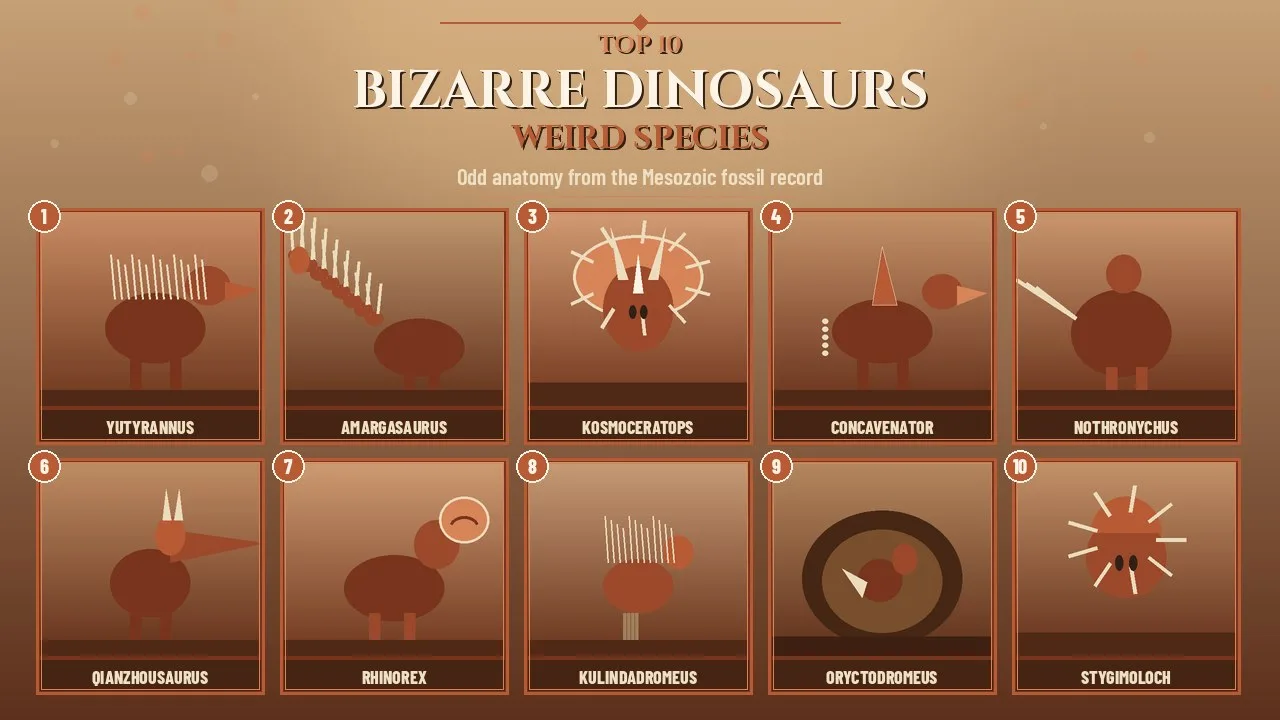
Bizarre dinosaurs include sail-necked sauropods, ornate horned frills, feathered tyrants and burrowers that rewrite how weird Mesozoic life could look.
Paleontologists have named well over a thousand non-avian dinosaur species, yet only a fraction look truly odd next to the classic long-necked and big-theropod image most people carry from museums and films. The animals on this list stand out for anatomy that still puzzles researchers: double neck spines, fifteen-horn frills, filament coats on giant predators, diggable dens, or growth stages so extreme that species names themselves are under debate.
This Finepedia Top 10 ranks bizarre dinosaurs by how strongly their bodies challenge textbook expectations. Selection favoured taxa with published descriptions, measurable sizes and clear discovery records. Unverifiable mating-season stories from popular listicles were left out. Each entry covers origins, key features, why the find matters, and a few surprises.
For more Finepedia deep dives into deep time and strange nature, browse the Top 10 Facts category (https://finepedia.com/category/top-10-facts) alongside recent lists such as the rarest rock formations in the world (https://finepedia.com/post/rarest-rock-formations-in-the-world-top-10-wonders) and the most famous trees in the world (https://finepedia.com/post/most-famous-trees-in-the-world-top-10).
How We Chose These Bizarre Dinosaurs
Popular roundups often recycle the same illustrations and soft claims. The criteria used here were stricter:
- Documented weirdness: the odd trait must appear in peer-reviewed descriptions or widely cited museum summaries, not only in blogs.
- Geographic and temporal spread: the ten taxa sample Jurassic through Late Cretaceous rocks on several continents so the list is not one quarry story.
- Scientific afterlife: preference went to species that changed debates about feathers, diet, locomotion, growth or biogeography.
- Name accuracy: spellings follow current usage (Qianzhousaurus, Nothronychus) and open taxonomic debates are stated plainly.
The order runs from giant feathered predators and sail-necked sauropods toward burrowers and contested pachycephalosaurs, ending with a comparison table that lines up size, period and signature trait.
Sizes below follow commonly cited published estimates and may shift as new specimens appear. Formation ages use rounded stage dates suitable for a general audience. Where taxonomy is contested, the article states both the historic name and the leading alternative interpretation.
Bizarre Dinosaurs at a Glance
| Rank | Dinosaur | Period | Region | Signature weird trait |
|---|---|---|---|---|
| 1 | Yutyrannus huali | Early Cretaceous | Liaoning, China | Largest known filament-covered tyrannosauroid |
| 2 | Amargasaurus cazaui | Early Cretaceous | Neuquen, Argentina | Paired elongated neural spines along the neck |
| 3 | Kosmoceratops richardsoni | Late Cretaceous | Utah, USA | Up to fifteen horns and horn-like frill spikes |
| 4 | Concavenator corcovatus | Early Cretaceous | Cuenca, Spain | Hip hump plus debated ulnar quill knobs |
| 5 | Nothronychus spp. | Late Cretaceous | New Mexico and Utah, USA | Pot-bellied North American therizinosaur |
| 6 | Qianzhousaurus sinensis | Late Cretaceous | Jiangxi, China | Extreme longirostrine snout (Pinocchio rex) |
| 7 | Rhinorex condrupus | Late Cretaceous | Utah, USA | Oversized fleshy nasal crest on a hadrosaur |
| 8 | Kulindadromeus zabaikalicus | Middle Jurassic | Siberia, Russia | Feather-like filaments on a non-theropod ornithischian |
| 9 | Oryctodromeus cubicularis | Late Cretaceous | Montana and Idaho, USA | First dinosaur clearly linked to a burrow system |
| 10 | Stygimoloch spinifer | Late Cretaceous | Hell Creek, North America | Spiked dome; widely argued as juvenile Pachycephalosaurus |
1. Yutyrannus
| Attribute | Details |
|---|---|
| Scientific name | Yutyrannus huali |
| Meaning | Beautiful feathered tyrant |
| When it lived | Early Cretaceous, roughly 125 million years ago |
| Where found | Liaoning Province, northeastern China |
| Size and diet | About 9 m long and around 1.4 tonnes; carnivorous tyrannosauroid |
Origins and History
Yutyrannus was named in 2012 by Xu Xing and colleagues from three nearly complete skeletons recovered from Early Cretaceous beds in Liaoning. The specimens preserve long filamentous integument along the body, making Yutyrannus the largest dinosaur known with direct evidence of a feather-like coat. Before this find, many reconstructions assumed large tyrannosauroids were mostly scaly as adults, with filaments limited to small relatives.
The species sits outside Tyrannosauridae proper but within the broader tyrannosauroid radiation that later produced Tyrannosaurus. Its discovery forced museum halls and textbooks to redraw giant predators with fuzzy outlines rather than bare reptile skin alone.
Key Features
- Filamentous feathers documented on multiple individuals, not a single fluke specimen.
- Body mass estimated near 1.4 tonnes, far above previous feathered theropods such as Beipiaosaurus.
- Robust skull with interlocking teeth suited to large prey.
- Lived in a cooler Early Cretaceous climate relative to many later tyrannosaur habitats, which may help explain insulating plumage.
- Three individuals known from the type series, allowing size and integument comparisons.
Significance
Yutyrannus sits at the centre of the debate over when tyrannosaurs lost extensive body covering. If a two-tonne Early Cretaceous form retained filaments, later giants may have kept feathers on at least parts of the body, or lost them secondarily in warmer climates. Either way, the species is a cornerstone of integument research and a favourite of science communicators who want bizarre dinosaurs that still look recognisably predatory.
Interesting Facts
- The species name huali is Mandarin for beautiful, referring to the plumage.
- Soft-tissue preservation in Liaoning volcanic lake deposits is exceptional worldwide.
- Some popular reconstructions show a shaggy mane along the neck; the fossils confirm filaments but not every artistic flourish.
- Yutyrannus appears in several documentaries as the counter-example to the scaly T. rex stereotype.
- Comparative histology on related tyrannosauroids continues to test whether filaments were widespread or patchy on later giants.
- Cold-climate interpretations of Early Cretaceous Liaoning remain an active research topic alongside feather function.
When people picture bizarre dinosaurs, Yutyrannus often tops the list because it combines familiar predator proportions with unexpected fuzz. That mix of the known and the strange is exactly why it opens this Finepedia ranking.
2. Amargasaurus
| Attribute | Details |
|---|---|
| Scientific name | Amargasaurus cazaui |
| Clade | Dicraeosaurid sauropod |
| When it lived | Early Cretaceous, about 130 to 125 million years ago |
| Where found | La Amarga Formation, Neuquen Province, Argentina |
| Size | Roughly 9 to 10 m long and about 2 tonnes |
Origins and History
Amargasaurus was described in 1991 by Leonardo Salgado and Jose Bonaparte from a relatively complete skeleton found in Patagonia. Unlike the towering titanosaurs that dominate later South American faunas, this dicraeosaurid stayed comparatively short and light. What made headlines were the paired, elongate neural spines rising from the neck vertebrae like a picket fence of bone.
Researchers still disagree whether the spines supported a continuous sail of skin, separate keratin sheaths, or some combination of soft tissues. Muscle scarring and spine spacing continue to fuel competing reconstructions in papers and museum mounts. Whatever soft tissue sat on the spines, the osteology alone is enough to make Amargasaurus unforgettable in lateral view.
Patagonian dicraeosaurids lived alongside other Early Cretaceous herbivores and predators in a landscape very different from the later titanosaur-dominated plains. That older ecological chapter is easy to miss if museum tours jump straight from Jurassic giants to Late Cretaceous celebrities. Slowing down for Amargasaurus rewards anyone who cares about how weird sauropods could look.
Key Features
- Two parallel rows of tall neural spines along the neck and forward trunk.
- Relatively short neck for a sauropod, typical of dicraeosaurids.
- Estimated mass only a few tonnes, making it far lighter than contemporary giant sauropods.
- Herbivorous diet inferred from dentition and clade membership.
- Holotype preserves much of the vertebral column, so the weird neck is not based on a single bone.
Significance
Amargasaurus shows that sauropods experimented with display and defence structures long before Late Cretaceous giants filled every niche. The spines may have deterred predators, supported thermoregulatory tissues, or served in visual signalling. Whatever the function, the animal remains one of the most instantly recognisable bizarre dinosaurs in any gallery.
Interesting Facts
- The genus name refers to the La Amarga locality.
- Closely related Dicraeosaurus from Tendaguru, Tanzania, has shorter spines, highlighting regional variation.
- Life restorations swing between full sails and bare bone spikes; both remain scientifically open.
- At under 10 m, Amargasaurus was small by sauropod standards yet visually dramatic.
- Biomechanical papers have modelled whether the spines limited neck flexibility during feeding.
- Popular books sometimes exaggerate a Spinosaurus-style continuous sail; the fossil only guarantees the bony cores.
South American Early Cretaceous faunas were already experimenting with unusual sauropod bauplans. Amargasaurus proves that bizarre dinosaurs did not wait for the Late Cretaceous to invent showy hardware.
3. Kosmoceratops
| Attribute | Details |
|---|---|
| Scientific name | Kosmoceratops richardsoni |
| Clade | Chasmosaurine ceratopsid |
| When it lived | Late Cretaceous, about 76 to 75 million years ago |
| Where found | Kaiparowits Formation, Grand Staircase-Escalante, Utah |
| Size | About 4.5 m long; herbivorous |
Origins and History
Kosmoceratops was named in 2010 by Scott Sampson, Mark Loewen and colleagues as part of a wave of discoveries from southern Laramidia, the western North American landmass isolated by the Western Interior Seaway. The name combines Greek kosmos (ornate) with ceratops (horned face). It is not cosmic in the space sense; the authors meant richly decorated.
The skull carries an extreme count of horns and horn-like processes on the frill and face. In the same paper the team also named Utahceratops, underscoring how productive the Kaiparowits badlands have been for ceratopsid diversity. Together those finds showed that southern Laramidia was not a species-poor backwater but a factory of endemic horned dinosaurs.
Field crews working Utah's plateaus still recover ceratopsid material every season. Each new frill fragment is checked against the Kosmoceratops blueprint because the ornate layout is now a reference point for the whole basin.
Key Features
- As many as fifteen horns and horn-like structures on a single skull.
- Forward-curving frill spikes and an elaborate nasal and brow horn suite.
- Short, deep snout compared with longer-faced chasmosaurines.
- Lived on an island-like western continent that fostered endemic horned dinosaurs.
- Holotype skull is among the most ornate of any ceratopsid yet described.
Significance
Kosmoceratops is a textbook case of sexual selection and species recognition driving exaggerated armour. When Laramidia was split from Appalachia, ceratopsids on the west radiated into locally distinct horn layouts. The species also anchors public understanding that bizarre dinosaurs were not rare freaks but the expected outcome of isolation and display competition.
Interesting Facts
- Grand Staircase-Escalante National Monument remains a hotspot for new Late Cretaceous taxa.
- Some frill spikes point forward rather than back, complicating simple defence-only explanations.
- Digital skull models are widely used in museum interactives and classroom kits.
- The ornate layout inspired comparisons with baroque sculpture in popular science writing.
- Intracontinental endemism on Laramidia is now a standard explanation for rapid ceratopsid speciation.
- Frill vascular canals hint that soft tissues and keratin sheaths made living heads even flashier than bone alone.
Horned dinosaurs illustrate how sexual selection and species recognition can outpace simple armour narratives. Kosmoceratops is the ornate extreme of that process among currently named taxa.
4. Concavenator
| Attribute | Details |
|---|---|
| Scientific name | Concavenator corcovatus |
| Clade | Carcharodontosaurid theropod |
| When it lived | Early Cretaceous, about 130 million years ago |
| Where found | Las Hoyas fossil site, Cuenca Province, Spain |
| Size | Roughly 6 m long; carnivorous |
Origins and History
Concavenator was described in 2010 by Ortega, Escaso and Sanz from a nearly complete skeleton at Las Hoyas, a famous Spanish Konservat-Lagerstatte. The epithet corcovatus refers to the hump: two elongated neural spines over the hips create a triangular rise unlike the long sail of Spinosaurus.
Even more contentious are bumps on the ulna that the authors compared with quill knobs of modern birds. If correctly identified, they hint that some early Cretaceous allosauroids bore feather-like structures on the forearms. Other workers have questioned whether the scars are truly homologous with avian quill knobs, so the claim remains debated rather than settled.
Key Features
- Distinctive hip hump formed by elongated neural spines.
- Possible ulnar quill knobs, still contested in the literature.
- Body plan otherwise similar to other mid-sized carcharodontosaurids.
- Preserved in fine lacustrine sediments that also yield insects and plants.
- One of the most complete European theropod skeletons of its age.
Significance
Concavenator links European Early Cretaceous faunas to global theropod evolution and keeps the feather-origin debate lively outside classic Liaoning taxa. Whether or not the forearm scars prove feathers, the hump alone earns the animal a place among bizarre dinosaurs that refuse simple silhouette stereotypes.
Interesting Facts
- Las Hoyas is better known to many visitors for its birds and insects than for giant predators.
- Life restorations variously show a skin sail, a fat pad or a bare bony hump.
- The species name is Latin for humped, not a reference to a geographic corcova.
- Spanish museums often pair Concavenator mounts with educational panels on scientific disagreement.
- Carcharodontosaurids elsewhere in the world rarely preserve such complete skeletons from this interval.
- The hump may have been a display structure visible in lateral profile to rivals or mates.
Europe's Early Cretaceous record is patchy compared with Asia and North America, so Concavenator punches above its weight in any global survey of bizarre dinosaurs.
5. Nothronychus
| Attribute | Details |
|---|---|
| Scientific names | Nothronychus mckinleyi; N. graffami |
| Clade | Therizinosaurid theropod |
| When it lived | Late Cretaceous, about 93 to 91 million years ago |
| Where found | Zuni Basin, New Mexico; Tropic Shale, Utah |
| Size | About 4 to 6 m long; herbivorous or omnivorous theropod |
Origins and History
Therizinosaurs were long thought to be an Asian oddity until Nothronychus mckinleyi was named in 2001 from New Mexico. A second, more complete species, N. graffami, followed in 2009 from marine Tropic Shale deposits in Utah, showing the animal sometimes drifted or washed into coastal waters after death.
These North American finds proved that pot-bellied, small-headed, long-clawed theropods crossed into Laramidia. Their gut-heavy build and leaf-shaped teeth support a plant-dominated diet, a striking shift for animals nested among carnivorous theropods.
Key Features
- Broad belly, small skull and elongate neck relative to typical theropods.
- Enormous hand claws, likely for pulling vegetation rather than killing large prey.
- Two named species spanning New Mexico and Utah.
- First clear demonstration that therizinosaurs were not Asia-only.
- Slow, upright posture often reconstructed with a more horizontal back than early cartoons suggested.
Significance
Nothronychus rewrote paleobiogeography for therizinosaurs and remains a teaching example of diet shifts inside Theropoda. It sits comfortably on any list of bizarre dinosaurs because it looks like a ground sloth designed by a committee of raptor engineers.
Interesting Facts
- The genus name roughly means slothful claw, nodding to ground-sloth comparisons.
- N. graffami includes one of the most complete therizinosaur skeletons known.
- Museum mounts emphasise the claws; visitors often guess carnivore before reading the label.
- Related Asian giants such as Therizinosaurus pushed claw length to extreme records.
- Stable isotope and tooth-wear studies on therizinosaurs increasingly support high-fibre plant diets.
- The Utah marine occurrence of N. graffami shows carcasses could raft into offshore settings.
Therizinosaurs force students to drop the assumption that every theropod chased down struggling prey. Nothronychus is the North American proof of that ecological twist.
6. Qianzhousaurus
| Attribute | Details |
|---|---|
| Scientific name | Qianzhousaurus sinensis |
| Nickname | Pinocchio rex |
| When it lived | Late Cretaceous, about 72 to 66 million years ago |
| Where found | Near Ganzhou, Jiangxi Province, China |
| Size | Roughly 6 to 9 m long; carnivorous longirostrine tyrannosaurid |
Origins and History
Qianzhousaurus was named in 2014 by Lu Junchang and colleagues from a nearly complete skull and partial skeleton. Media coverage immediately labelled it Pinocchio rex for its elongated snout. The genus belongs to a longirostrine tyrannosaur lineage that also includes Alioramus, showing that not all Late Cretaceous Asian tyrannosaurids evolved the deep, bone-crushing skull of Tarbosaurus.
Correct spelling matters: the name is Qianzhousaurus, after Qianzhou (an older name linked to Ganzhou), not Quanzhou or similar misspellings found in some secondary listicles.
Key Features
- Markedly elongated snout with slender teeth compared with deep-skulled tyrannosaurids.
- Small nasal crests or hornlets above the eyes.
- Body length estimates commonly fall between 6 and 9 m.
- Likely targeted smaller or more elusive prey than heavy-skulled cousins.
- Part of a southern Chinese Late Cretaceous fauna rich in oviraptorosaurs and other theropods.
Significance
Qianzhousaurus proves tyrannosaurids experimented with snout length the way ceratopsids experimented with frills. For readers tracking bizarre dinosaurs, it is the clearest rebuttal to the idea that every Late Cretaceous apex predator looked like a stockier T. rex clone.
Interesting Facts
- Press nicknames stuck faster than the Linnaean name in many headlines.
- Alioramus from Mongolia is a close long-snouted relative.
- Bite mechanics studies suggest a different feeding style from bone-crunching tyrannosaurines.
- The holotype includes a well-preserved skull ideal for CT scanning and digital reconstruction.
- Longirostrine tyrannosaurids may have preferred different prey guilds than deep-skulled relatives living nearby.
- Southern China Late Cretaceous horizons continue to produce oviraptorosaurs that shared habitats with Qianzhousaurus.
Spelling discipline matters in SEO and scholarship alike: searchers looking for bizarre dinosaurs should find Qianzhousaurus, not the mangled Quanzhou forms that still circulate online.
7. Rhinorex
| Attribute | Details |
|---|---|
| Scientific name | Rhinorex condrupus |
| Meaning | Nose king |
| When it lived | Late Cretaceous, about 75 million years ago |
| Where found | Neslen Formation, Utah, USA |
| Size | Large hadrosaurid; exact length estimates vary with incomplete material |
Origins and History
Rhinorex was named in 2014 by Terry Gates and colleagues from a partial skull and skeleton recovered from coal-bearing deposits in eastern Utah. The animal is a saurolophine hadrosaur related to Gryposaurus, but its nasal architecture is exaggerated into a fleshy, protruding nose that inspired the genus name.
Hadrosaurs are famous for hollow crests in lambeosaurines, yet solid-nosed forms also evolved striking facial soft tissues. Rhinorex highlights that duck-billed dinosaurs were not anatomically uniform herds of lookalikes.
Key Features
- Enlarged, fleshy nasal region reconstructed from osteological correlates.
- Close relationship to Gryposaurus within Saurolophinae.
- Lived in coastal plain and wetland settings recorded by the Neslen Formation.
- Herbivorous dental batteries typical of hadrosaurids.
- Holotype incomplete, so length figures should be treated as approximate.
Significance
Rhinorex adds soft-tissue weirdness to a clade often reduced to crest shape alone. Acoustic or visual signalling hypotheses are plausible for such a nose, though soft tissue rarely fossilises directly. Among bizarre dinosaurs, it reminds readers that duckbills could look comic and still be ecologically successful megaherbivores.
Interesting Facts
- The epithet condrupus roughly nods to the cliff from which the specimen was recovered.
- Coal-mine geology in Utah has yielded several important hadrosaur finds.
- Life restorations emphasise a drooping or bulbous schnoz rather than a hollow tube crest.
- Comparisons with Gryposaurus help students see gradual versus extreme nasal evolution.
- Soft-tissue reconstruction methods developed for hadrosaurs now inform museum lighting and sculpture choices.
- Wetland floodplain settings preserved enough bone to diagnose the nose even without a complete skeleton.
Duck-billed dinosaurs can look comical beside tyrannosaurs, yet their facial experiments belong on any serious roster of bizarre dinosaurs.
8. Kulindadromeus
| Attribute | Details |
|---|---|
| Scientific name | Kulindadromeus zabaikalicus |
| Clade | Basal neornithischian ornithopod-grade dinosaur |
| When it lived | Middle to Late Jurassic, roughly 169 to 159 million years ago |
| Where found | Kulinda locality, Transbaikal region, Siberia, Russia |
| Size | About 1.5 m long; small herbivore |
Origins and History
Kulindadromeus was named in 2014 by Godefroit and colleagues from multiple individuals preserving both scales and feather-like filaments. Because it is an ornithischian rather than a theropod, the find challenged the long-held assumption that complex filamentous integument was restricted to the bird line.
Note the spelling: Kulindadromeus (and the locality Kulinda), sometimes rendered with slight variants in secondary sources. The species showed monofilaments and more complex branched structures on different body regions alongside typical scales on the lower limbs.
Key Features
- Feather-like filaments on a non-theropod dinosaur.
- Regional variation: filaments on the body, scales on the shins and ankles.
- Small bipedal herbivore from Jurassic Siberia.
- Multiple specimens, strengthening the integument interpretation.
- Lived tens of millions of years before iconic Late Cretaceous feathered theropods of Liaoning fame.
Significance
If filaments evolved once deep in Dinosauria, many lineages may have been fuzzier than classic art suggested. Even if filaments evolved more than once, Kulindadromeus proves bizarre dinosaurs include humble plant-eaters whose skin rewrites textbooks, not only giant predators with sails and horns.
Interesting Facts
- The Siberian locality name Kulinda anchors both genus and media coverage.
- Soft-tissue maps from Kulindadromeus are frequently cited in feather-origin reviews.
- Small size made filament insulation plausible even in temperate Jurassic settings.
- Museum exhibits often pair it with Archaeopteryx to contrast ornithischian and theropod coverings.
- If filaments are homologous across Dinosauria, countless scaly restorations of ornithischians may be incomplete.
- Alternative models allow convergent evolution of fuzzy coats more than once; either outcome is scientifically interesting.
Kulindadromeus is small, but its skin makes it a giant in debates about what bizarre dinosaurs can teach us about bird origins and deep homology.
9. Oryctodromeus
| Attribute | Details |
|---|---|
| Scientific name | Oryctodromeus cubicularis |
| Meaning | Digging runner of the den |
| When it lived | Late Cretaceous, about 95 million years ago |
| Where found | Blackleaf Formation, Montana and Idaho, USA |
| Size | About 2.1 m long and roughly 22 to 32 kg |
Origins and History
Oryctodromeus was named in 2007 by Varricchio and colleagues after adult and juvenile skeletons were found inside a sediment-filled burrow structure. The association of bones with a dug tunnel made it the first dinosaur widely accepted as a burrower based on both anatomy and trace evidence.
Unlike specialised diggers with huge claws, Oryctodromeus appears to have used a combination of limbs and snout to enlarge dens. Juveniles in the same burrow suggest parental or at least group use of underground shelters.
Key Features
- Direct association with a burrow cast containing multiple individuals.
- Modest size suited to life partly underground.
- Skeletal traits consistent with digging, without extreme fossorial specialisation.
- Ornithopod herbivore of mid-Cretaceous western North America.
- Evidence for denning behaviour rare among dinosaurs.
Significance
Burrowing expands the behavioural repertoire reconstructed for dinosaurs beyond nesting on open ground. Oryctodromeus helps explain how small herbivores might have survived temperature swings and predators. On a list of bizarre dinosaurs, a badger-like denner is as surprising as any horned frill.
Interesting Facts
- The species epithet cubicularis refers to a bedchamber or den.
- Comparable burrow claims for other taxa are rarer and often more controversial.
- Educational programs use Oryctodromeus to teach ichnology alongside osteology.
- Living animals such as wombats offer loose modern analogies for den living, not close kinship.
- Sedimentology of the Blackleaf burrow helps distinguish dug tunnels from chance erosional pipes.
- Juvenile remains in the den support social or parental use rather than a one-off burial.
Behavioural fossils are rarer than bones. Oryctodromeus earns its rank among bizarre dinosaurs because it preserves a lifestyle, not only a silhouette.
10. Stygimoloch
| Attribute | Details |
|---|---|
| Scientific name | Stygimoloch spinifer (often treated as a growth stage of Pachycephalosaurus) |
| Meaning | Horned demon from the Styx |
| When it lived | Late Cretaceous Maastrichtian, Hell Creek and related formations |
| Where found | Western North America |
| Status note | Many specialists argue it is a junior synonym of Pachycephalosaurus wyomingensis |
Origins and History
Stygimoloch was named in 1983 for spiky-skulled pachycephalosaur material from the Hell Creek region. The dramatic name and cluster of horns around a tall dome made it a staple of books on bizarre dinosaurs. Later work by Horner, Goodwin and others argued that Stygimoloch (and Dracorex) represent younger growth stages of Pachycephalosaurus, with spikes and dome shape changing as animals matured.
Not every researcher accepts the synonymy, so museum labels sometimes still list Stygimoloch separately. The honest approach for readers is to present both the historic genus and the ongoing junior-synonym debate rather than invent mating-season head-butting romance.
Key Features
- Tall, narrow dome with prominent clusters of horns and nodes.
- Thickened skull roof typical of pachycephalosaurs.
- Known mainly from cranial material; postcrania are less complete.
- Stratigraphic occurrence overlaps Pachycephalosaurus in latest Cretaceous beds.
- Morphology that fits a plausible juvenile-to-adult transformation series in some studies.
Significance
Whether kept as a valid genus or folded into Pachycephalosaurus, the morphotype shows how extreme cranial ornament can be in marginocephalians. The debate itself is educational: species names in paleontology are hypotheses, and growth series can erase names that once seemed securely weird.
Interesting Facts
- Dracorex hogwartsia entered the same synonymy discussion after its 2006 description.
- Bonebed and histology studies are central to the growth-stage argument.
- Video games and films often keep the Stygimoloch name for recognisability.
- Hell Creek Formation continues to yield pachycephalosaur skulls that refine the growth model.
- Ontogenetic synonymy is not unique to pachycephalosaurs; similar debates have reshaped ceratopsid and tyrannosaur tallies.
- Keeping the historic name in popular culture does not settle the taxonomic question in peer-reviewed literature.
For readers, the takeaway is methodological: bizarre dinosaurs sometimes look stranger because we are looking at teenagers and adults as if they were different species.
Size and Trait Comparison
| Dinosaur | Approx. length | Diet | Weird trait category |
|---|---|---|---|
| Yutyrannus | ~9 m | Carnivore | Integument (filaments) |
| Amargasaurus | ~9 to 10 m | Herbivore | Neural spines / possible sail |
| Kosmoceratops | ~4.5 m | Herbivore | Cranial ornament |
| Concavenator | ~6 m | Carnivore | Hip hump; debated quills |
| Nothronychus | ~4 to 6 m | Herbivore / omnivore | Body plan and claws |
| Qianzhousaurus | ~6 to 9 m | Carnivore | Elongated snout |
| Rhinorex | large hadrosaur | Herbivore | Fleshy nose |
| Kulindadromeus | ~1.5 m | Herbivore | Ornithischian filaments |
| Oryctodromeus | ~2.1 m | Herbivore | Burrowing behaviour |
| Stygimoloch | medium pachycephalosaur | Herbivore / omnivore | Spiked dome; taxonomy debate |
Readers who enjoy deep-time curiosities may also like Finepedia lists on the most haunted places in America (https://finepedia.com/post/most-haunted-places-in-america-top-10) for cultural oddities and the most expensive plants in the world (https://finepedia.com/post/most-expensive-plants-in-the-world-top-10) for living botanical extremes.
Frequently Asked Questions
What makes a dinosaur count as bizarre?
On this list, bizarre means anatomy or behaviour that strongly departs from the popular long-neck or big-theropod template and is documented in scientific descriptions. Sails, extreme frills, filaments on unexpected clades, burrows and contested growth forms all qualify. Sheer size alone does not. A giant titanosaur can be impressive without being anatomically weird in the sense used here.
Which of these bizarre dinosaurs had feathers?
Yutyrannus preserves extensive filaments, and Kulindadromeus preserves feather-like structures on an ornithischian. Concavenator has debated forearm scars that some authors compare with quill knobs. Other taxa on the list are not known for feather fossils. Absence of evidence is not evidence of scaly skin everywhere, but Finepedia only claims feathers where fossils or strong osteological correlates exist.
Is Stygimoloch a real separate species?
Many paleontologists treat Stygimoloch as a juvenile or subadult morph of Pachycephalosaurus wyomingensis. Others still list it separately. Finepedia reports the debate rather than inventing behavioural stories to keep the old name exciting. Growth series, histology and stratigraphic overlap are the evidence streams to watch as the argument continues.
Were any bizarre dinosaurs burrowers?
Oryctodromeus is the clearest case: skeletons were found inside a burrow structure, and the anatomy fits digging. A few other dinosaurs have been suggested as burrowers, but the evidence is usually weaker. Trace fossils must be tied carefully to body fossils before lifestyle claims stick.
Did Amargasaurus have a skin sail?
Possibly. The paired neck spines are certain; whether they supported a continuous sail, separate sheaths or mixed soft tissues remains unresolved. Museum mounts and art often choose one reconstruction for clarity. Readers should treat sails as a hypothesis layered onto solid osteology.
Where can I see fossils of these species?
Casts and mounts circulate internationally. Original material for several taxa is held in Chinese, Argentine, Spanish, Russian and North American collections. Checking a museum catalogue or traveling exhibition list is the best way to confirm what is on display. Provincial and university museums sometimes hold holotypes that never tour.
How many bizarre dinosaurs are known overall?
There is no official count. Paleontologists have named well over a thousand non-avian dinosaurs, and odd specialisations keep appearing as new formations are explored. This Top 10 is a curated sample, not a complete catalogue. Future digs in Africa, Antarctica and under-sampled Asian basins will almost certainly expand the roster of bizarre dinosaurs.
Conclusion
From feathered giants and sail-necked sauropods to burrowers and debated dome-heads, bizarre dinosaurs show how far Mesozoic evolution wandered from the silhouettes stamped on lunchboxes. The ten taxa here were chosen for verified anatomy, clear discovery records and lasting scientific impact rather than recycled mating myths. Comparison tables, discovery years and open debates are intentional value-adds beyond thin popular listicles.
As new digs and histology studies continue, expect more strange body plans to join the ranks and, occasionally, for dramatic names to fold into growth series of better-known species. That mix of spectacle and scientific caution is the right way to enjoy paleontology: stay amazed, check the papers, and keep spellings such as Qianzhousaurus and Nothronychus correct when you share the stories.
- Xu, X. et al. (2012). A gigantic feathered dinosaur from the Lower Cretaceous of China. Nature. Summary coverage via American Museum of Natural History and Natural History Museum, London pages on Yutyrannus.
- Sampson, S.D. et al. (2010). New horned dinosaurs from Utah provide evidence for intracontinental dinosaur endemism. PLOS ONE. (Kosmoceratops; open access.)
- Ortega, F., Escaso, F. and Sanz, J.L. (2010). A bizarre, humped Carcharodontosauria (Theropoda) from the Lower Cretaceous of Spain. Nature. (Concavenator.)
- Godefroit, P. et al. (2014). A Jurassic ornithischian dinosaur from Siberia with both feathers and scales. Science. (Kulindadromeus.)
- Varricchio, D.J. et al. (2007). First trace and body fossil evidence of a burrowing, denning dinosaur. Proceedings of the Royal Society B. (Oryctodromeus.)
- Lu, J. et al. (2014). A new clade of Asian Late Cretaceous long-snouted tyrannosaurids. Nature Communications. (Qianzhousaurus.)
- Wikipedia overview pages for Amargasaurus, Nothronychus, Rhinorex and Pachycephalosaurus / Stygimoloch synonymy (used for cross-checking spellings, dates and formation names; primary papers preferred above).
- Reference listicle consulted for topic inspiration only: https://10mosttoday.com/10-most-bizarre-dinosaurs/




















Log in with