










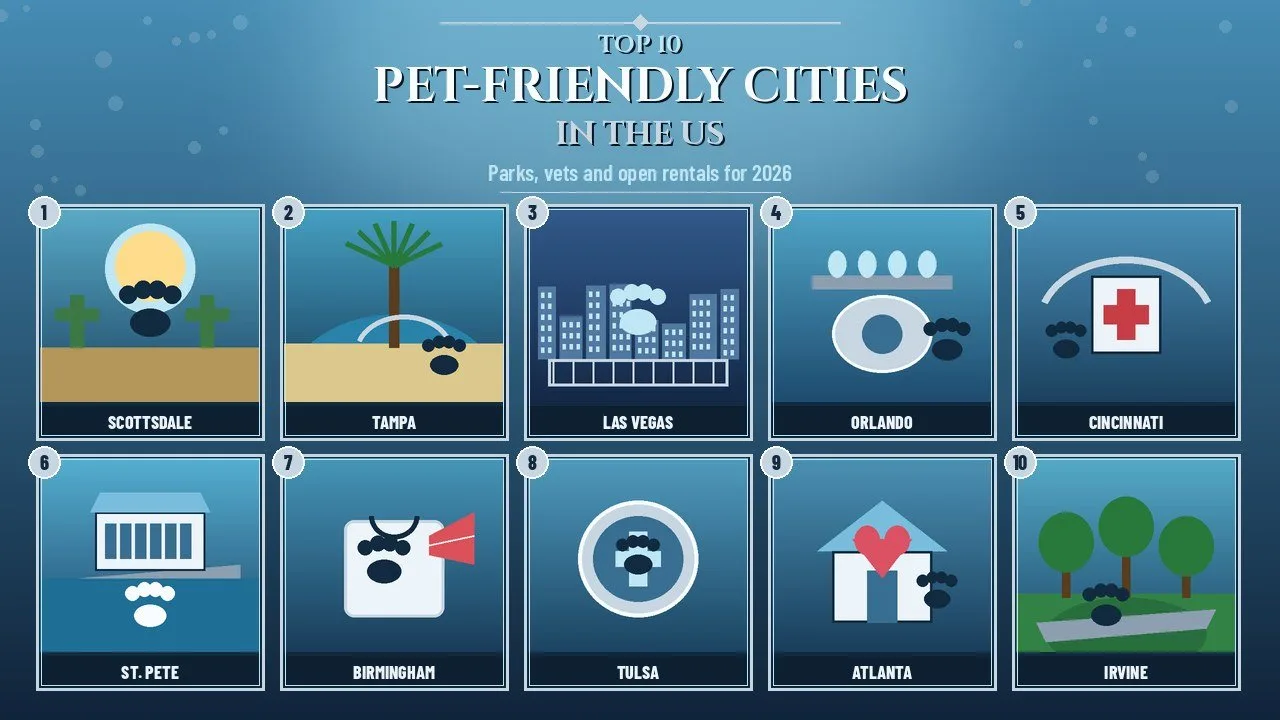
Most pet-friendly cities across America combine open rentals, dense veterinary care, parks and pet services, with Scottsdale topping 2026 rankings.
Roughly 95 million American households keep at least one pet, and the American Pet Products Association projects about $165 billion in pet spending for 2026. That money does not buy the same life in every zip code. The share of rentals that accept animals, the density of veterinarians, the cost of a routine exam, the number of dog parks and the walkability of sidewalks all change from city to city. A household that moves without checking those numbers can end up with a healthy animal and nowhere legal to live, or with cheap rent and a long drive to the nearest clinic.
This Finepedia guide ranks ten American cities that treat companion animals well, using current public scorecards rather than a decade-old travel list. The order follows WalletHub's 2026 comparison of the 100 largest cities across 23 metrics in pet budget, pet health and wellness, and outdoor pet-friendliness. Each city section explains what the numbers mean on the ground, how local pet culture developed, and what an owner should weigh before signing a lease. Soft claims that could not be verified have been left out. Figures below for rental shares, veterinary prices, insurance premiums and dimension ranks come from the WalletHub 2026 release unless another source is named. For more listicles in the same format, browse Finepedia's Top 10 Facts collection (https://finepedia.com/category/top-10-facts), or travel-adjacent pieces such as the guide to the most Instagrammable places to visit (https://finepedia.com/post/most-instagrammable-places-to-visit-top-10) and the overview of the most dangerous tourist destinations in the world (https://finepedia.com/post/most-dangerous-tourist-destinations-in-the-world-top-10).
How We Chose These Pet-Friendly Cities
Older roundups of animal-friendly metro areas often leaned on anecdotes, a handful of dog beaches or a single rental survey. To keep this list useful in 2026, every pick had to clear three bars:
- Scale: the city is among the 100 largest in the United States by population, so the ranking compares places where many people actually relocate for work.
- Evidence: scores come from a published multi-metric study (WalletHub, August 2026) that draws on Census, Bureau of Labor Statistics, RentPath, BringFido, Walk Score, Trust for Public Land and related public datasets collected as of July 2026.
- Balance: the study weights pet health and wellness at half the total score, with pet budget and outdoor pet-friendliness sharing the rest, so a city cannot win on cheap insurance alone or on parkland alone.
Cities appear in overall score order from first to tenth. A high outdoor rank does not erase expensive veterinary bills, and a bargain budget does not erase a thin clinic network. When a city leads one dimension and trails another, that trade-off is stated plainly. Readers planning a trip rather than a move may also want the hotel room secrets you should know guide (https://finepedia.com/post/hotel-room-secrets-you-should-know-top-10) before booking lodging that accepts animals.
Pet-Friendly Cities at a Glance
| Rank | City | Overall score | Strongest dimension | Watch-out |
|---|---|---|---|---|
| 1 | Scottsdale, AZ | 68.02 | Pet health and wellness (1st) | High dog-insurance costs (budget 86th) |
| 2 | Tampa, FL | 63.51 | Balanced care access and mid-low costs | Outdoor rank mid-pack among leaders (15th) |
| 3 | Las Vegas, NV | 61.55 | Pet budget (5th) and outdoor (4th) | Middling specialty-service depth (health 48th) |
| 4 | Orlando, FL | 58.66 | Vets and dog-friendly restaurants | Outdoor friendliness only 49th |
| 5 | Cincinnati, OH | 58.17 | Top-tier vet density; no weak dimension | Winter climate vs Sun Belt rivals |
| 6 | St. Petersburg, FL | 57.84 | Pet businesses per capita (4th) | Midfield budget and outdoor ranks |
| 7 | Birmingham, AL | 57.40 | Pet budget (9th); dense pet retail | Outdoor friendliness 72nd |
| 8 | Tulsa, OK | 57.16 | Cheapest dog insurance (tied 1st) | Outdoor 63rd; health midfield |
| 9 | Atlanta, GA | 56.85 | Health and wellness (6th); shelters | Higher upkeep costs (budget 66th) |
| 10 | Irvine, CA | 56.59 | Outdoor (8th) and health (11th) | Expensive care (budget 79th) |
1. Scottsdale, Arizona
| Attribute | Details |
|---|---|
| Overall WalletHub rank (2026) | 1 of 100 (score 68.02) |
| Dimension ranks | Budget 86 · Health and wellness 1 · Outdoor 5 |
| Pet-friendly rentals | Nearly 98% of listings allow pets |
| Standout metrics | Most pet businesses per capita; ~2,200 sq ft average home size; parkland over 30% of city area |
| Best for | Owners who want service density and space more than the lowest monthly bills |
City Pet Culture
Scottsdale grew as a desert resort and retirement community that later filled with young professionals and outdoor-focused households. That mix left a retail landscape heavy on grooming, boarding, specialty food and training storefronts, plus trails that connect neighborhoods to the McDowell Sonoran Preserve and city parks. Municipal dog parks such as Chaparral, Horizon and Vista del Camino give off-leash hours a formal address, while the city's large average home size gives indoor animals room when summer pavement is too hot for long walks.
Key Features
- Nearly 98% of rental listings accept pets, so apartment hunting turns on layout and commute instead of hunting for a rare landlord exception.
- WalletHub ranks Scottsdale first for pet health and wellness among the 100 largest cities, driven by pet businesses, dog-friendly shops and related services per capita.
- Average home size near 2,200 square feet is among the highest in the large-city sample, which helps large dogs and multi-pet households.
- Parkland covers more than 30% of the city area (third-highest share in the study), and the outdoor dimension finishes fifth overall.
- Dog-friendly restaurants rank about tenth per capita, so patio dining with a leash under the table is common rather than exceptional.
Significance
Scottsdale shows that the "most pet-friendly" label is not the same as "cheapest place to own a pet." Dog insurance premiums sit near the top of the national range, which pulls the budget rank down to 86th. Households that can absorb that cost get the widest service network in the ranking plus substantial indoor and outdoor space. For movers comparing Phoenix-area suburbs, Scottsdale trades monthly insurance and care prices for choice and convenience.
Interesting Facts
- Scottsdale's pet-business density is reported at roughly eight times the per-capita rate of last-place Newark, New Jersey, in the same study.
- The city earned a top-three weather grade in WalletHub's related climate ranking, even though midday summer walks still require early or late timing.
- Trust for Public Land's ParkScore materials list about 30.5% of Scottsdale as parkland and three dedicated dog parks inside city limits.
2. Tampa, Florida
| Attribute | Details |
|---|---|
| Overall WalletHub rank (2026) | 2 of 100 (score 63.51) |
| Dimension ranks | Budget 25 · Health and wellness 8 · Outdoor 15 |
| Pet-friendly rentals | Nearly 89% of listings allow pets |
| Standout metrics | Tied for most veterinarians per capita; top-tier shelter density; 10th-most dog parks per capita |
| Best for | Owners who want affordable care without sacrificing clinic access |
City Pet Culture
Tampa Bay's waterfront neighborhoods, mild winters and dense apartment growth created a market where dogs are a normal part of patio culture and weekend park routines. Local adoption culture is visible in a high concentration of animal shelters relative to population, and the veterinary sector is thick enough that WalletHub places Tampa in a five-way tie for the most veterinarians per capita among the 100 largest cities (with Miami, Las Vegas, Orlando and Cincinnati).
Key Features
- Veterinary and pet-care provider costs land among the 15 least expensive cities in the study, supporting a 25th-place budget rank.
- Nearly 89% of rental listings allow pets, well above many coastal markets that still treat dogs as exceptions.
- High numbers of doggie daycare and boarding businesses per capita help households that travel or work long hours.
- Dog parks reach the tenth-highest count per capita, and dog-friendly restaurants are plentiful.
- Strong shelter density supports an adopt-first path for new owners.
Significance
Tampa is the clearest "balanced" city near the top of the 2026 list: costs stay in the better half of the field, clinic access is elite, and outdoor amenities are solid without relying on desert parkland percentages. Owners comparing Florida metros often look at Tampa, Orlando and St. Petersburg together; Tampa leads that trio on the overall score. The city also illustrates why shelter density belongs in a national scorecard: households that prefer adoption over pet-store purchases find more intake and placement options per resident than in many larger coastal markets. Pair that with boarding supply and mid-low veterinary prices, and the day-to-day logistics of keeping a dog or cat healthy become easier than the tourism branding alone would suggest.
Interesting Facts
- Three Florida cities sit in the national top six (Tampa, Orlando and St. Petersburg), the strongest state cluster in the 2026 top ten.
- Tampa's outdoor rank (15th) outpaces Orlando's (49th) even though both share top veterinarian density.
- The city's combination of cheap-ish care and dense shelters is uncommon among coastal metros that usually score well on lifestyle but poorly on price.
3. Las Vegas, Nevada
| Attribute | Details |
|---|---|
| Overall WalletHub rank (2026) | 3 of 100 (score 61.55) |
| Dimension ranks | Budget 5 · Health and wellness 48 · Outdoor 4 |
| Pet-friendly rentals | More than 98% of listings allow pets |
| Standout metrics | About $56 average vet visit; dog insurance under $58 per month; ~19% parkland |
| Best for | Cost-conscious owners who still want parks and open rentals |
City Pet Culture
Las Vegas is better known for tourism than for suburban dog parks, yet the residential valley around the Strip built a large inventory of pet-accepting apartments and a competitive veterinary market. Off-leash parks and open space corridors give dogs a break from apartment living, while the casino-core hospitality culture has slowly spilled into more patio and outdoor dining that tolerates leashed dogs in designated areas.
Key Features
- Average veterinary visit cost is about $56, among the four lowest in the 100-city sample.
- Average dog insurance premium stays below $58 per month, reinforcing a fifth-place pet-budget rank.
- More than 98% of rental listings accept pets, matching Scottsdale's open housing profile.
- Veterinarian density ties for first place nationally with Tampa, Orlando, Miami and Cincinnati.
- Roughly 19% of the city is parkland (14th-highest share), and dog-park density is among the highest.
Significance
Las Vegas wins on price and outdoor access more than on specialty pet retail. Its health-and-wellness rank sits at 48th because trainers, daycares and niche shops do not keep pace with its clinics. For an owner whose priority is affordable exams and a lease that allows a large dog, that trade can still be the right one. Heat remains a practical constraint: summer sidewalks can burn paws, so early-morning walks and indoor enrichment matter as much as the parkland percentage on a spreadsheet. Still, among large cities that keep both rentals and veterinary bills open, few match this combination.
Interesting Facts
- The gap between the cheapest and most expensive large-city veterinary markets is about threefold; Las Vegas sits near the inexpensive end.
- North Las Vegas, a separate city in the same metro, ranks first nationally for pet budget but only 11th overall because of weaker health scores.
- Parkland share near 19% puts Las Vegas ahead of many denser coastal cities despite its desert setting.
4. Orlando, Florida
| Attribute | Details |
|---|---|
| Overall WalletHub rank (2026) | 4 of 100 (score 58.66) |
| Dimension ranks | Budget 39 · Health and wellness 7 · Outdoor 49 |
| Standout metrics | Tied for most veterinarians per capita; tied for most dog-friendly restaurants per capita |
| Trade-off | Midfield costs; outdoor friendliness in the bottom half of the 100 |
| Best for | Owners who prioritize clinic access and patio culture over parkland percentages |
City Pet Culture
Orlando's tourism economy trained businesses to handle visitors with unusual requests, and that hospitality habit shows up in a national lead for dog-friendly restaurants per capita (tied with San Diego, Portland and Austin). Year-round warmth keeps dogs outdoors more months of the year than in Midwestern markets, even when parkland and walkability scores trail the desert and Pacific cities that dominate the outdoor dimension.
Key Features
- Veterinarian density ties for first among the 100 largest cities.
- Dog-friendly restaurants per capita also tie for first; the study reports a 32-fold gap between the leaders and last-place North Las Vegas on that metric.
- Pet health and wellness finishes seventh overall, the second-best mark after Scottsdale among Florida cities in the top ten.
- Pet budget ranks 39th and outdoor pet-friendliness 49th, so the city climbs on services rather than scenery.
- Central Florida's wider metro also includes strong neighboring options, but WalletHub scores city proper only.
Significance
Orlando proves that infrastructure can outweigh mediocre outdoor scores. Owners who need same-week dental cleanings and patio dinners with a dog may prefer it to a greener city with sparse clinics. Anyone relocating for theme-park work should still check individual HOA and apartment breed rules, which sit outside the WalletHub rental-share metric. Tourist crowding near major attractions can also limit quiet walking windows, so residential neighborhoods north and south of the corridor often work better for daily routines than addresses chosen only for commute to a resort campus.
Interesting Facts
- Orlando, Tampa and Las Vegas are three of the five cities sharing the top veterinarian-density mark, and all three finished in the national top four overall.
- The restaurant gap (32x between best and worst) is the widest single-metric spread WalletHub reports in the 2026 study.
- Jacksonville and Miami also appear in the full 100 but finish far behind Orlando on the overall score.
5. Cincinnati, Ohio
| Attribute | Details |
|---|---|
| Overall WalletHub rank (2026) | 5 of 100 (score 58.17) |
| Dimension ranks | Budget 41 · Health and wellness 17 · Outdoor 24 |
| Standout metrics | Tied for most veterinarians per capita; no dimension below 41st |
| Regional note | Only Midwestern city in the 2026 top ten |
| Best for | Owners who want balanced scores and elite clinic density in a four-season climate |
City Pet Culture
Cincinnati's river-city neighborhoods and older streetcar-era street grid support walkable blocks in several districts, while the wider metro hosts a large veterinary and university-hospital presence. Unlike Sun Belt cities that win on weather alone, Cincinnati enters the top five by never collapsing on any scoring pillar. Local dog culture shows up in neighborhood parks and a dense clinic map rather than in desert trail systems.
Key Features
- Shares the national lead for veterinarians per capita with Miami, Tampa, Las Vegas and Orlando.
- Health and wellness rank 17th, outdoor 24th and budget 41st — all upper-half finishes.
- No other Midwest city reaches the top ten; Columbus, Cleveland and Toledo sit much further down the list.
- Outdoor rank (24th) beats Birmingham (72nd) and Tulsa (63rd) despite colder winters.
- Balance matters: cities that ace one pillar and fail another (for example North Las Vegas on budget, or Gilbert on health) finish outside the top ten.
Significance
Cincinnati is the counter-example to the idea that animal-friendly living is only a warm-weather story. For households that need snow-season planning but refuse to sacrifice clinic access, it is the strongest Midwestern option in the 2026 data. The city also shows why single-metric "cheapest vet bill" lists mislead: Columbus has the lowest veterinary costs nationally yet ranks 38th overall because health and wellness lag. Relocating families should still tour specific neighborhoods for sidewalk quality and off-leash rules, because a strong citywide clinic map does not guarantee that every suburb has a fenced run within a short walk.
Interesting Facts
- Cincinnati is the only top-ten city outside the Sun Belt and California in the 2026 ranking.
- Ohio's cheapest-vet city (Columbus) and its most balanced pet city (Cincinnati) are different places — a reminder to read full scorecards.
- Winter does not prevent a top-25 outdoor rank when dog parks, trails and walkability are present.
6. St. Petersburg, Florida
| Attribute | Details |
|---|---|
| Overall WalletHub rank (2026) | 6 of 100 (score 57.84) |
| Dimension ranks | Budget 45 · Health and wellness 12 · Outdoor 39 |
| Standout metrics | Fourth-most pet businesses per capita |
| Trade-off | Midfield costs and outdoor scores |
| Best for | Owners who want short drives to groomers, shops and boarding |
City Pet Culture
St. Petersburg's downtown waterfront, murals and patio dining scene made dogs a visible part of public life earlier than in many Florida cities of similar size. A thick cluster of pet storefronts followed: supply shops, groomers and boarding operators sit close enough that routine errands rarely become cross-county trips. The city often appears alongside Tampa in regional "Tampa Bay" conversation, but WalletHub scores it separately — and it earns its own top-ten slot.
Key Features
- Fourth-highest pet-business density per capita among the 100 largest cities (behind Scottsdale, Birmingham and Boise on that metric).
- Health and wellness finishes 12th, the city's strongest dimension.
- Budget (45th) and outdoor (39th) sit near the national midpoint.
- Completes a Florida trio in the top six with Tampa and Orlando.
- Competition among local providers gives owners more choice on price and scheduling than sparse markets allow.
Significance
St. Petersburg shows that a city can reach the national top ten without winning on cheap insurance or record parkland. Service density and steady midfield scores are enough when nothing collapses. Households comparing Tampa Bay addresses should weigh Tampa's stronger overall score against St. Petersburg's retail convenience and waterfront lifestyle.
Interesting Facts
- Boise ranks just above St. Petersburg for pet businesses per capita yet finishes only 48th overall — proof that one strong metric is not enough.
- St. Petersburg's health rank (12th) beats Las Vegas (48th) even though Las Vegas places higher overall on budget and outdoor strength.
- The city is the third Florida entry in the top ten, underscoring how strongly the state performs on clinic and service metrics.
7. Birmingham, Alabama
| Attribute | Details |
|---|---|
| Overall WalletHub rank (2026) | 7 of 100 (score 57.40) |
| Dimension ranks | Budget 9 · Health and wellness 35 · Outdoor 72 |
| Standout metrics | Second-most pet businesses per capita; fourth-lowest dog insurance premiums |
| Trade-off | Weakest outdoor rank inside the top ten |
| Best for | Budget-focused owners who still want dense pet retail |
City Pet Culture
Birmingham has appeared in WalletHub's upper tier for several years — local reporting notes top-15 finishes across multiple editions, including fourth in 2025 and seventh in 2026. The city's pet scene is built less on tourism marketing and more on practical infrastructure: affordable insurance markets, a deep bench of pet businesses and a growing set of dog parks and walking trails that residents use even when national outdoor scores lag coastal peers.
Key Features
- Dog insurance premiums rank fourth-lowest among the 100 largest cities.
- Pet businesses per capita rank second nationally, behind only Scottsdale.
- Overall pet-budget dimension finishes ninth, the third-best budget mark among the top ten after Tulsa and Las Vegas.
- Health and wellness sits at 35th; outdoor pet-friendliness at 72nd.
- Overall score of 57.40 keeps Birmingham ahead of 93 larger peers.
Significance
Birmingham is the top-ten option for households that count monthly dollars first. Insurance and retail access are excellent; parkland and walkability are not the selling point. Movers who need trail miles every evening may look further west or to Florida, while those who need predictable costs and nearby groomers will find Birmingham hard to beat on value.
Interesting Facts
- Local coverage lists Birmingham at 9th (2020), 5th (2021), 15th (2022), 6th (2023), 4th (2025) and 7th (2026) in successive WalletHub editions.
- The outdoor gap inside the top ten is large: Birmingham at 72nd versus Scottsdale at 5th or Las Vegas at 4th.
- Second-place pet-business density means prescription food, boarding and grooming rarely require a long drive.
8. Tulsa, Oklahoma
| Attribute | Details |
|---|---|
| Overall WalletHub rank (2026) | 8 of 100 (score 57.16) |
| Dimension ranks | Budget 2 · Health and wellness 43 · Outdoor 63 |
| Standout metrics | Tied for lowest dog insurance premiums nationally (with Oklahoma City) |
| Trade-off | Midfield health; outdoor scores in the lower half |
| Best for | Owners who want the lowest recurring insurance cost among top-ten cities |
City Pet Culture
Tulsa's pet-friendliness story is financial before it is scenic. Oklahoma's insurance market produces the lowest dog-insurance premiums in the large-city sample, shared by Tulsa and Oklahoma City. That saving repeats every month for the life of the policy — often ten to fifteen years for a dog — which can outweigh one-time moving incentives elsewhere. Local parks and clinics exist at midfield density rather than as national showpieces.
Key Features
- Dog insurance cost ties for cheapest in the country; premiums run about one-fourth of Seattle's in the same study.
- Pet-budget dimension ranks second of 100 (only North Las Vegas scores better on budget).
- Health and wellness ranks 43rd; outdoor pet-friendliness 63rd.
- Overall score still clears 92 other large cities.
- Oklahoma City shares the insurance lead but finishes far lower overall (63rd) because other dimensions lag.
Significance
Tulsa is Scottsdale's mirror image: where Scottsdale accepts high insurance costs in exchange for elite services and parkland, Tulsa sells the opposite bargain. Owners who care more about the monthly check than about specialty shops or trail networks will find no stronger budget story inside the top ten.
Interesting Facts
- WalletHub reports roughly a fourfold gap between the cheapest and most expensive dog-insurance markets; Tulsa sits at the floor of that range.
- North Las Vegas beats Tulsa on pure budget rank yet loses overall because health and wellness fall to 75th.
- Recurring premiums matter more over a decade than many one-time relocation perks that never appear in city scorecards.
9. Atlanta, Georgia
| Attribute | Details |
|---|---|
| Overall WalletHub rank (2026) | 9 of 100 (score 56.85) |
| Dimension ranks | Budget 66 · Health and wellness 6 · Outdoor 36 |
| Standout metrics | Third-most animal shelters per capita; fifth-most dog-friendly restaurants per capita |
| Trade-off | Higher upkeep costs than most top-ten peers |
| Best for | Adopters and owners who want dense services even if monthly costs run higher |
City Pet Culture
Atlanta's sprawling metro has long supported a large rescue and shelter network, and WalletHub's city-proper metrics still place it third nationally for animal shelters per capita (behind Phoenix and Los Angeles). Patio culture in neighborhoods from Midtown to the Eastside puts dogs under restaurant tables at a rate that finishes fifth per capita. The result is a health-and-wellness profile that ranks sixth overall — second only to Scottsdale inside the top ten on that dimension.
Key Features
- Third-highest animal-shelter density per capita among the 100 largest cities.
- Dog-friendly restaurants rank fifth per capita, just behind the four-way national lead group.
- Health and wellness dimension finishes sixth of 100.
- Budget rank of 66th is among the weakest cost showings inside the top ten.
- Outdoor friendliness at 36th is mid-pack: usable, but not a desert-parkland story.
Significance
Atlanta is the service-and-adoption pick. Households that want to meet many shelter animals before choosing a companion, then keep that animal near clinics, trainers and patios, get a strong match. They should budget more for upkeep than peers in Tulsa, Birmingham or Las Vegas would.
Interesting Facts
- Phoenix leads shelter density with about 22 times the per-resident capacity of last-place Santa Ana, California; Atlanta sits near the top of that wide range.
- Atlanta and Scottsdale are the only top-ten cities also appearing among the five densest shelter markets.
- Higher costs do not prevent a top-ten finish when health infrastructure is elite enough.
10. Irvine, California
| Attribute | Details |
|---|---|
| Overall WalletHub rank (2026) | 10 of 100 (score 56.59) |
| Dimension ranks | Budget 79 · Health and wellness 11 · Outdoor 8 |
| Standout metrics | Top-12 finishes on both health and outdoor dimensions |
| Trade-off | Second-weakest budget rank inside the top ten (after Scottsdale) |
| Best for | Owners who will pay more for parks, walkability and service access in Southern California |
City Pet Culture
Irvine is a planned Orange County city known for master-planned villages, wide park belts and strict development standards. That design history shows up in an eighth-place outdoor pet-friendliness rank and an eleventh-place health-and-wellness rank — a double top-twelve finish that only Scottsdale also achieves inside the top ten. California's coastal markets are expensive for veterinary care and insurance, and Irvine is no exception, but it still undercuts the worst statewide budget ranks held by Los Angeles, Long Beach and San Francisco.
Key Features
- Outdoor pet-friendliness ranks eighth of 100; health and wellness eleventh.
- Pet budget ranks 79th — costly, yet less extreme than several larger California cities.
- No single top-five trophy metric; the city advances by avoiding collapse on any pillar.
- Edges North Las Vegas (11th overall) by a tenth of a point despite far weaker budget scores, because North Las Vegas's health rank falls to 75th.
- Closes the national top ten at 56.59 points.
Significance
Irvine is the California proof that parks and services can overcome a harsh cost profile — up to a point. Owners relocating within Southern California may still prefer it to denser, more expensive coastal cores. Owners relocating from Tulsa or Birmingham should expect a sharp jump in monthly pet costs in exchange for outdoor quality. Planned-community rules can be stricter than citywide rental-share statistics imply, so confirm weight limits, breed lists and pet rents for the specific village or apartment community before assuming the WalletHub housing metric applies to your lease.
Interesting Facts
- Among top-ten cities, only Scottsdale (budget 86th) has a weaker cost rank than Irvine (79th).
- Los Angeles ranks 97th, Long Beach 94th and San Francisco 91st for pet budget, framing Irvine as expensive nationally but moderate for California.
- Margins at the bottom of the top ten are thin: Atlanta sits a quarter-point above Irvine, and North Las Vegas a tenth-point below.
Scorecard Comparison Across the Top 10
| City | Budget rank | Health rank | Outdoor rank | Defining strength |
|---|---|---|---|---|
| Scottsdale | 86 | 1 | 5 | Service density and space |
| Tampa | 25 | 8 | 15 | Affordable care plus clinics |
| Las Vegas | 5 | 48 | 4 | Cheap exams and parks |
| Orlando | 39 | 7 | 49 | Vets and dog-friendly dining |
| Cincinnati | 41 | 17 | 24 | Balanced Midwest access |
| St. Petersburg | 45 | 12 | 39 | Pet-business cluster |
| Birmingham | 9 | 35 | 72 | Insurance and retail value |
| Tulsa | 2 | 43 | 63 | Lowest insurance costs |
| Atlanta | 66 | 6 | 36 | Shelters and services |
| Irvine | 79 | 11 | 8 | Parks plus care access |
Frequently Asked Questions
What makes a city count as pet-friendly?
A useful definition goes beyond dog beaches. Strong cities combine pet-accepting housing, affordable veterinary care, enough clinics and sitters per resident, parks or dog runs, and rules that protect animals. WalletHub's 2026 study folds those ideas into 23 metrics across budget, health and outdoor life.
Which US city is the most pet-friendly in 2026?
Scottsdale, Arizona, ranks first among the 100 largest cities with a score of 68.02. It leads pet health and wellness, posts nearly 98% pet-friendly rentals and dedicates more than 30% of its area to parkland, though dog insurance there is expensive.
Are big coastal cities good for pets?
Not always. New York and Chicago finish near the bottom of the 2026 large-city list because high costs and thinner pet-retail density outweigh strengths such as dog parks. Mid-size Sun Belt and Midwest cities dominate the top ten instead.
How important are pet-friendly rentals?
Critical for anyone who does not own a home. Scottsdale and Las Vegas both clear about 98% pet-accepting listings, which removes the common trap of finding the perfect commute and then discovering the lease bans dogs. Always confirm breed, weight and deposit rules in writing.
Is veterinary cost the same as pet-friendliness?
No. Columbus, Ohio, has the lowest veterinary exam costs in the study yet ranks only 38th overall. Clinic density, housing rules and outdoor access still matter. Look at the full score, not a single price tag.
Do these rankings include cats and other pets?
Most public metrics still lean dog-heavy (dog parks, dog-friendly restaurants, dog insurance). Cats and small animals benefit from the same clinic density, rental policies and animal-protection laws, but off-leash park scores matter less for indoor pets.
Should I move just because a city ranks in the top 10?
Use the ranking as a shortlist, then check neighborhood crime data, your commute, breed-specific housing rules, summer heat or winter ice, and the exact veterinary hospitals you would use. A top-ten city with the wrong apartment rules is still a bad fit. Speak with a local rescue or veterinary receptionist about wait times and emergency clinic hours before you sign; public scorecards measure averages, while your animal will need care on a specific Tuesday night.
Conclusion
America's friendliest cities for pets in 2026 are not the old coastal default picks from vintage travel blogs. Scottsdale leads on services and space, Tampa and Las Vegas prove that affordable care can coexist with open rentals, and Cincinnati shows a Midwestern city can crack the top five with balanced scores. Further down the list, Birmingham and Tulsa win on monthly costs, Atlanta on shelters and restaurants, and Irvine on parks despite California prices.
If you are relocating with an animal, read the dimension ranks that match your constraints: budget first for insurance-sensitive households, health first for medical needs, outdoor first for working breeds. Verify the lease, tour the nearest emergency clinic and walk the actual dog park at the hour you would use it. Rankings describe city-wide patterns; your block still decides the daily routine.
- WalletHub, "Most Pet-Friendly Cities in 2026" (Adam McCann; data as of 7 July 2026; published August 2026): https://wallethub.com/edu/most-pet-friendly-cities/5562
- American Pet Products Association pet-spending projection cited in WalletHub 2026 (about $165 billion; ~95 million pet-owning households)
- Trust for Public Land ParkScore materials for Scottsdale parkland and dog-park counts
- City of Scottsdale Parks and Recreation dog-park pages (Chaparral, Horizon, Vista del Camino)
- Quartz summary of the 2026 WalletHub top ten (Anthony Lopopolo, updated 29 September 2026)
- Local reporting on Birmingham's multi-year WalletHub placements (Bham Now, August 2026)
- Mental Floss overview of WalletHub's most and least pet-friendly cities
- 10mosttoday.com August 2020 US cities roundup consulted for topic inspiration only (dated list; not used for order or soft claims). Local copy saved as ref.txt in the article folder.


















Log in with