






 By
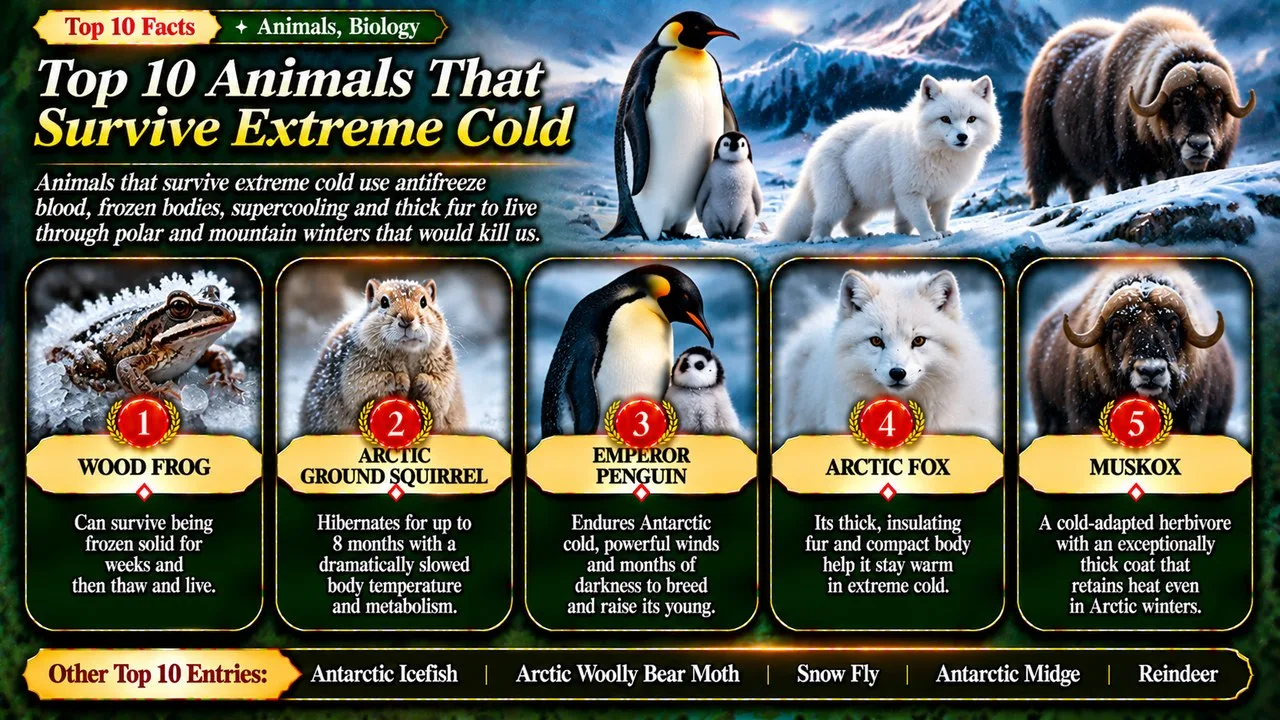
Animals that survive extreme cold use antifreeze blood, frozen bodies, supercooling and thick fur to live through polar and mountain winters that would kill us.
Winter is a serious test for any animal. Water freezes, food vanishes under snow and ice and a body loses heat fast. Some animals stay and endure it. Their answers range from thick coats and clever blood flow to sugar-packed cells, natural antifreeze and the ability to freeze solid and thaw out again in spring.
This Finepedia guide, written in November 2026, takes its topic from a Listverse list about animals that have adapted to survive below freezing [23]. The selection, order and wording are our own: we kept six of its subjects, replaced broad groups such as snakes, bears and bacteria with single species, and added the emperor penguin, Arctic fox, Arctic woolly bear moth and muskox. Every figure below is checked against at least two sources, and numbers we could not confirm were left out.
Key Facts
This table sums up the ten animals and the main trick each one uses against the cold.
Animals That Survive Extreme Cold at a Glance
| Rank | Name | Where it lives | Main cold-weather trick |
|---|---|---|---|
| 1 | Wood Frog | North America, including Alaska | Freezes solid and thaws in spring |
| 2 | Arctic Ground Squirrel | Arctic Alaska, Canada and Siberia | Body cools below 0 C without freezing |
| 3 | Antarctic Icefish | Southern Ocean | Antifreeze proteins and clear blood |
| 4 | Emperor Penguin | Antarctica | Dense feathers and winter huddles |
| 5 | Arctic Woolly Bear Moth | High Arctic | Caterpillar freezes each winter for about 7 years |
| 6 | Snow Fly | Snowy northern forests and mountains | Sheds a leg as it starts to freeze |
| 7 | Antarctic Midge | Antarctic Peninsula | Tolerates freezing and drying out |
| 8 | Reindeer | Arctic and subarctic | Sees ultraviolet light; warms air in its nose |
| 9 | Arctic Fox | Arctic tundra | Heat exchange in its legs and a slower winter metabolism |
| 10 | Muskox | Arctic Canada, Greenland and Alaska | Very warm underwool called qiviut |
1. Wood Frog
The wood frog lives across much of North America, from the eastern United States to Canada and Alaska, where it is the most widespread frog [1]. Instead of digging deep below the frost line, it spends winter just under leaf litter on the forest floor, and there it does something remarkable: it lets itself freeze [1][2].
As ice forms in its body, the frog's liver turns stored glycogen into large amounts of glucose, and it also builds up urea. These act as cryoprotectants, limiting how much ice forms and stopping cells from drying out and collapsing [1][2]. A large share of its body water can turn to ice. While frozen, the frog shows no heartbeat, no breathing and no detectable brain activity, yet it revives when spring arrives [1].
Frogs in Interior Alaska are even tougher than those farther south. A University of Alaska Fairbanks study published in 2014 tracked wood frogs in their natural winter shelters and found that repeated freezing and thawing in autumn helped them pack their tissues with much more glucose than frogs frozen in the lab [2][24]. In the wild they survived temperatures as low as about minus 18 C for months, with every tracked frog coming back to life [2][24]. Surviving frozen solid earns the wood frog first place.
2. Arctic Ground Squirrel
The Arctic ground squirrel lives in the tundra of Alaska, northern Canada and Siberia, and it spends more than half of each year in hibernation [3]. Its burrow sits in frozen ground.
In the late 1980s the biologist Brian Barnes of the University of Alaska Fairbanks implanted small transmitters in hibernating squirrels and discovered that their core body temperature falls a few degrees below 0 C without the animal freezing [4][3]. Its body fluids are supercooled: they stay liquid below their normal freezing point because there are no ice crystals to start the freezing process [3]. UAF describes it as the only warm-blooded animal known to survive body temperatures below freezing [4].
Related: Top 10 Most Bizarre Phobias: Strange Fears That Exist
The squirrel cannot stay that cold all winter. Every two to three weeks it rewarms to normal body temperature by shivering for 12 to 15 hours, still asleep, and then cools down again [3][4]. Scientists study these animals because their organs, including the heart and brain, are protected from low oxygen during hibernation, which could help research on organ transplants and stroke [4]. A mammal that runs colder than ice water takes second place.
3. Antarctic Icefish
The crocodile icefish are a family of fish that live in the Southern Ocean around Antarctica, where the water stays at or a little below 0 C all year [5]. At least 16 species are recognised [5]. In water this cold, ordinary fish blood would freeze, but icefish and their notothenioid relatives carry their own protection.
Their blood contains antifreeze glycoproteins, molecules that attach to tiny ice crystals and stop them from growing [7][6]. This adaptation is thought to have evolved from a digestive enzyme gene, and it helped notothenioid fish survive and spread as the Southern Ocean cooled [7]. Similar antifreeze proteins evolved separately in Arctic cod, a striking example of nature finding the same solution twice [7].
Icefish have another oddity. They are the only known vertebrates that lack haemoglobin as adults, so their blood is almost colourless [5][6]. Cold water holds more dissolved oxygen, and icefish make up for the missing pigment with larger gills, a much greater blood volume and large, powerful hearts [5][6]. Some species may also absorb oxygen through their scaleless skin [6]. A fish that survives with antifreeze in clear blood earns third place.
4. Emperor Penguin
The emperor penguin is the tallest and heaviest of all penguins, standing about 100 cm and weighing roughly 22 to 45 kg [8]. It is found only in Antarctica, and unlike almost every other bird it breeds in the depths of the southern winter, on sea ice far from open water [8][9].
After the female lays her single egg, she passes it to the male and walks back to the sea to feed [9]. The male balances the egg on his feet under a warm fold of skin for about two months or a little more, eating nothing but some snow [9][8]. By the time the chick hatches, he may have gone without food for around four months, living entirely on the fat he built up in summer [9].
To survive blizzards and bitter wind, the males huddle together in large groups, slowly shuffling so that birds take turns on the cold outside edge [8][9]. Dense feathers provide most of their insulation, backed up by a layer of fat under the skin, and new feathers grow in before old ones fall out so that the bird is never left exposed [8]. Breeding in the coldest conditions of any bird earns the emperor fourth place.
5. Arctic Woolly Bear Moth
The Arctic woolly bear moth, Gynaephora groenlandica, lives in the High Arctic of Greenland and Canada, where summers are short and cool [10]. It is famous for one of the slowest lifecycles of any moth. Its hairy caterpillar is active for only a few weeks each summer, feeding mostly on Arctic willow, and spends the rest of the year frozen [10][11].
Related: Top 10 Facts About Dogs
In autumn the caterpillar enters a dormant state. It produces cryoprotectants such as glycerol and allows its body to freeze solid, then thaws in spring and starts feeding again [10][11]. It repeats this cycle year after year, moulting each spring, until it has eaten enough to reach the size needed to change into a moth [10][11].
In the High Arctic the whole caterpillar stage usually lasts about seven years, according to field studies [10][11]. In warmer alpine habitats the cycle is much shorter [10]. The caterpillars also bask in the sun on cold days, raising their body temperature well above the air around them [10]. Once the adult finally emerges, it lives only a short time to mate and lay eggs. Seven winters spent frozen earn this moth fifth place.
6. Snow Fly
Snow flies, the genus Chionea, are wingless crane flies that are active in winter. Adults can be seen walking across snow in forests and mountains of the Northern Hemisphere, and they lack flight muscles, perhaps because flying in sub-zero air would use too much energy [12]. They are about the size of a blueberry and can live for up to two months [13].
In laboratory tests, snow flies kept walking until their body temperature fell to about minus 7 C [12][13]. A 2023 study led by John Tuthill at the University of Washington found that they have a grisly survival trick. When a leg starts to freeze, the fly rapidly amputates it, stopping the ice from spreading into its body [13].
The researchers suggested that the fly has about half a second to shed the freezing leg before ice reaches its vital organs [13]. More than half the snow flies tested lost at least one leg, and those that did survived longer than those that did not [13]. Giving up a leg to save the body earns this insect sixth place.
7. Antarctic Midge
The Antarctic midge, Belgica antarctica, is a small flightless fly only a few millimetres long. It is the only insect that can survive year-round on the Antarctic continent [14][15]. It was named after the Belgica, the ship of a Belgian expedition that collected it off the Antarctic Peninsula [14].
Related: Top 10 Tallest Buildings in the World
Its larvae take about two years to grow. They can survive freezing and also severe drying out, and they toughen themselves against cold by building up glycerol and other protective chemicals [14]. Burrowing helps too: just a centimetre below the surface, the temperature stays much more stable than the air above [14]. The wingless adults emerge in summer, mate and lay eggs within a few days and live for no more than about ten days [14].
In 2014 scientists sequenced its genome and found it to be the smallest insect genome known at that time, at about 99 million base pairs [15][14]. The researchers suggested that this compact genome could itself be an adaptation to its harsh home [15]. Its lack of wings may also help, since a flying insect could be blown away from shelter by strong winds [14]. Antarctica's only resident insect earns seventh place.
8. Reindeer
Reindeer, known as caribou in North America, live across the Arctic and subarctic, where winters are long, dark and snowy [16]. Their coat has two layers: a dense woolly undercoat and long outer hairs that are hollow and filled with air, which trap heat and even help them float when swimming [16].
Their noses are also built for the cold. Turbinate bones greatly increase the surface area inside the nostrils, and a counter-current heat exchange warms and moistens freezing air before it reaches the lungs, while saving heat and water on the way out [16]. Long hair between the toes covers the foot pads in winter, so the animal walks on the hard rims of its hooves [16].
In 2011 researchers led by Glen Jeffery at University College London found that reindeer can see ultraviolet light, which humans cannot [17][16]. In the white glare of the Arctic, snow reflects ultraviolet light strongly, while lichen, a key winter food, and the fur of wolves absorb it and appear dark [17]. Urine in the snow also stands out, which may warn reindeer of predators nearby [17][16]. A deer that sees its winter food in a hidden colour takes eighth place.
9. Arctic Fox
The Arctic fox lives on the tundra around the North Pole and is built for the cold [18]. In winter most of these foxes turn pure white, which hides them against the snow, and their dense coat is mostly fine underfur [18][19].
The fox's legs and paws use counter-current heat exchange. Warm blood flowing down to the feet passes close to cold blood coming back, so heat is passed to the returning blood instead of being lost to the snow [18][19]. This lets the fox keep its feet just above freezing without losing feeling or movement [18]. Thick fur on its paw pads gives extra protection and grip on ice [19].
Related: 10 Sikh Gurus: The Pillars of Sikhism Who Shaped Faith, Equality, Courage, and Humanity
When it rests, the fox curls into a tight ball, tucks its legs underneath and wraps its large bushy tail around its face [19]. It also saves energy by slowing its metabolism in winter, to about a quarter less than in summer [18][19]. A predator that has turned heat saving into an art earns ninth place.
10. Muskox
The muskox is a large hoofed mammal of the Arctic, native to Canada and Greenland and reintroduced to Alaska and Siberia [20][22]. It lives on the open tundra all year round, where winter winds sweep the snow and there is little shelter.
Its coat has two parts. Long, dark guard hairs reach almost to the ground and protect against wind and snow, while beneath them lies a soft underwool called qiviut [20][21]. Qiviut is warmer than sheep's wool and softer than cashmere, and the animals shed it each spring [21][22]. People collect it from bushes or comb it from captive animals, and a one-ounce skein of qiviut yarn sells for around 100 dollars [22].
Muskoxen also defend themselves together. When the herd is threatened, the adults form a ring or line facing outward with the calves in the centre, a tactic that works well against wolves [20][22]. Even calves raised by people instinctively form this circle when they are frightened [22]. An animal that thrives on the open tundra with a coat of priceless wool closes our list in tenth place.
Conclusion
From frogs that freeze solid to fish with clear antifreeze blood, these ten animals show how many different ways life has found to cope with extreme cold. Some resist the ice with fur, feathers and fat, while others let ice in and control where it forms.
Scientists study several of them to learn how to protect human organs from cold and low oxygen. To learn more about the places where they live, see Top 10 Coldest Places in the World and Interesting Facts About Antarctica.
- ^ [1] "Wood frog". Wikipedia. Wikipedia
- ^ [2] "Alaska frogs stock up on glucose to survive extreme cold". University of Alaska Fairbanks. UAF News
- ^ [3] "Arctic ground squirrel". Wikipedia. Wikipedia
- ^ [4] "Arctic ground squirrels are supercooled". University of Alaska Fairbanks. UAF Centennial
- ^ [5] "Channichthyidae". Wikipedia. Wikipedia
- ^ [6] "Antarctic Adaptations". Antarctic and Southern Ocean Coalition. ASOC
- ^ [7] "Antifreeze protein". Wikipedia. Wikipedia
- ^ [8] "Emperor penguin". Wikipedia. Wikipedia
- ^ [9] "Emperor penguin breeding cycle". Australian Antarctic Program. Australian Antarctic Program
- ^ [10] "Gynaephora groenlandica". Wikipedia. Wikipedia
- ^ [11] "Notes from the Lab: Woolly Bears". Missoula Butterfly House and Insectarium. Missoula Butterfly House
- ^ [12] "Chionea". Wikipedia. Wikipedia
- ^ [13] "A grisly trick helps snow flies survive freezing: self-amputation". Science News. Science News
- ^ [14] "Belgica antarctica". Wikipedia. Wikipedia
- ^ [15] "Compact genome of the Antarctic midge is likely an adaptation to an extreme environment". Nature Communications. Nature Communications
- ^ [16] "Reindeer". Wikipedia. Wikipedia
- ^ [17] "Tests show Arctic reindeer see in UV". BBC News. BBC News
- ^ [18] "Arctic fox". Wikipedia. Wikipedia
- ^ [19] "Cute But Tough: The Arctic Fox". Yukon Wildlife Preserve. Yukon Wildlife Preserve
- ^ [20] "Muskox". Wikipedia. Wikipedia
- ^ [21] "Qiviut". Wikipedia. Wikipedia
- ^ [22] "Captive Muskox and Exquisite Qiviut". Alaska Department of Fish and Game. Alaska Department of Fish and Game
- ^ [23] "10 Amazing Ways Animals Have Adapted to Survive below Freezing". Listverse. Topic reference on Listverse
- ^ [24] "Wood frog adaptations to overwintering in Alaska: new limits to freezing tolerance". Journal of Experimental Biology. Journal of Experimental Biology



















Discussion
Log in with