



 By
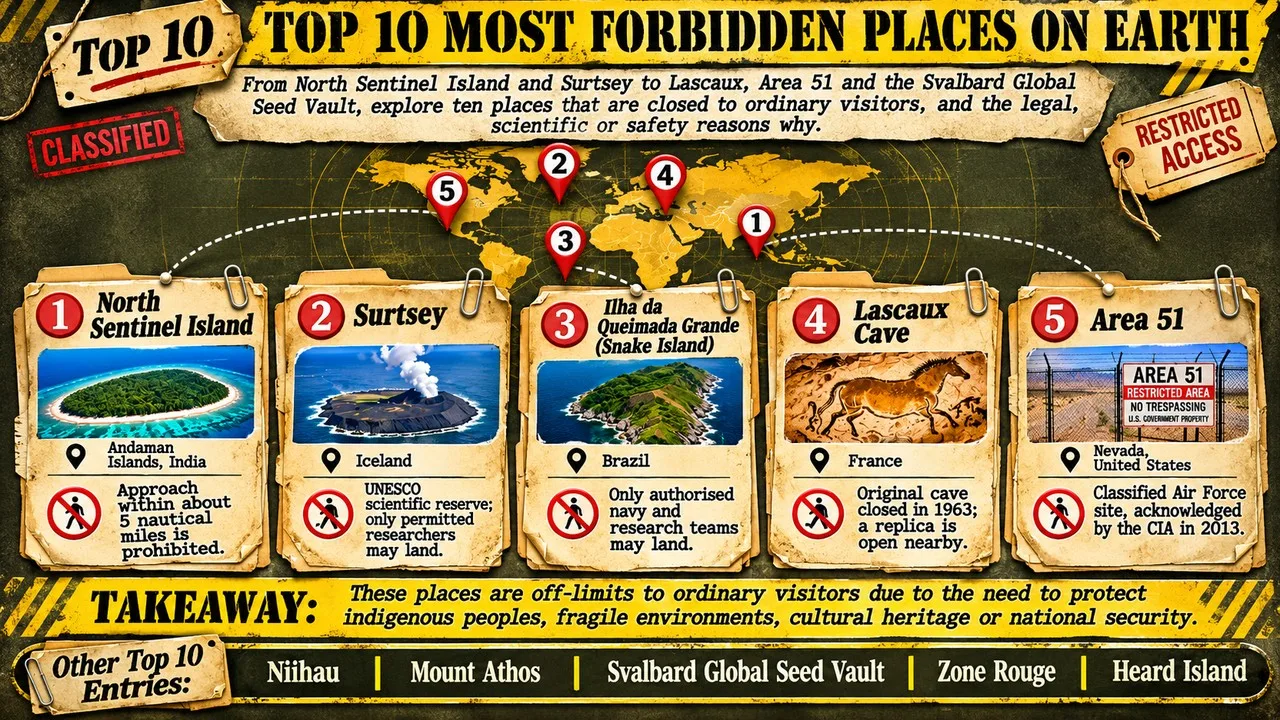
Some places on Earth are closed to ordinary visitors by law, science, military security or religious custom, and the reasons matter as much as the ban itself. This list covers ten sites where public access is forbidden or tightly limited, and it uses official rules rather than rumours [1][2].
"Forbidden" rarely means that nobody ever goes. Researchers, residents, pilgrims and officials often have a legal way in. The point is that a casual traveller cannot, or must not, simply arrive. Some bans protect people, such as the Sentinelese of North Sentinel Island; some protect nature or heritage, as on Surtsey and at Lascaux; others protect a military secret or a religious rule [1][2].
Rules can change, and a few well-known "closed" sites, such as parts of the Chernobyl exclusion zone, now run official tours. The ten below were still off-limits to the general public as of November 2026, according to the laws and managers cited.
Key Facts
The table names each place, the country that controls it, the kind of restriction and the main reason for the ban.
Forbidden Places at a Glance
| Rank | Place | Location | Type of ban | Notable fact |
|---|---|---|---|---|
| 1 | North Sentinel Island | Andaman Islands, India | Legal and Indigenous protection | Approach within about 5 nautical miles is prohibited |
| 2 | Surtsey | Iceland | Scientific reserve | New volcanic island; only permitted researchers may land |
| 3 | Ilha da Queimada Grande | Brazil | Conservation and safety | Only authorised navy and research teams may land |
| 4 | Lascaux Cave | France | Heritage protection | Original cave closed in 1963; a replica is open nearby |
| 5 | Area 51 | Nevada, United States | Military security | Classified Air Force site, acknowledged by the CIA in 2013 |
| 6 | Niihau | Hawaii, United States | Private ownership | Access is by invitation of the landowner |
| 7 | Mount Athos | Greece | Religious rule | Women are barred; men need a pilgrim's permit |
| 8 | Svalbard Global Seed Vault | Norway | Security and conservation | Seed backup store; not open as a tourist attraction |
| 9 | Zone Rouge | North-eastern France | Safety | First World War battlefield land still closed in places |
| 10 | Heard Island | Australian territory, Indian Ocean | Strict permit | Remote World Heritage islands with almost no landings |
1. North Sentinel Island
North Sentinel Island, in India's Andaman and Nicobar Islands, is home to the Sentinelese, who have long lived in voluntary isolation. Indian law treats the island as a tribal reserve under the Andaman and Nicobar Islands (Protection of Aboriginal Tribes) Regulation, 1956. Entry by outsiders is prohibited, and an exclusion zone extends about 5 nautical miles (about 9 kilometres) from the shore [1][3].
The ban exists mainly to protect the islanders. Contact could introduce diseases to a community with little immunity, and the Sentinelese have repeatedly made it clear that they do not want visitors. In 2018, an American missionary, John Allen Chau, was killed after landing illegally, and people accused of helping him were later detained [1][3].
Population estimates vary widely, and sensational claims about the community's customs are poorly founded. What is clear is the legal rule: no tourist, journalist or missionary has a right to go there, and boats that approach too closely have been warned off or fired on with arrows [3].
2. Surtsey
Surtsey rose from the sea off Iceland's south coast in a volcanic eruption that began in November 1963 and lasted until 1967. Iceland made it a nature reserve in 1965, while the eruption was still going, so that plants, birds and insects could colonise the new land with as little human help, or harm, as possible. UNESCO listed the island as a World Heritage site in 2008 [2][4].
Landing, diving nearby, bringing in soil or organisms and leaving waste are all prohibited without permission from the Environment Agency of Iceland. Only a few research visits take place each year, usually with a small scientific party, and tourists may not go ashore at all [2][4]. The island can be viewed from the air or from boats that stay outside the reserve.
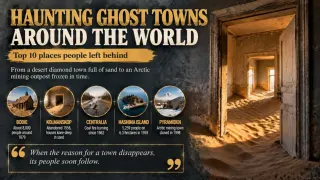
Related: Top 10 Haunting Ghost Towns Around the World
Erosion is cutting Surtsey down, and some scientists expect it to shrink further this century. Until then it remains one of the world's most carefully guarded natural laboratories [4].
3. Ilha da Queimada Grande
Ilha da Queimada Grande, often called Snake Island, lies off the coast of São Paulo state in Brazil. It is the only natural home of the golden lancehead, a critically endangered pit viper. The island is administered as a protected area, and the public is not allowed to land. Only the Brazilian Navy and researchers authorised by the environmental agency ICMBio may go ashore [2].
Viral stories sometimes claim there is a snake for every square metre. A systematic study estimated a population of about 2,000 to 4,000 snakes, which is still a high density on a small island, but far more sober than the internet figure [2]. The snakes, not a general travel ban for its own sake, are the reason for the rule.
People once lived there to tend a lighthouse, which was later automated. Today the island is a conservation site, and unauthorised landings are illegal as well as dangerous [2].
4. Lascaux Cave
Lascaux, in the Vézère Valley of south-western France, holds some of the most famous Palaeolithic paintings in the world, discovered in 1940. After it was opened to visitors, carbon dioxide, warmth and microbes began to damage the art. The original cave was closed to the public in 1963, and it has stayed closed, except for tightly limited scientific and conservation work [2].
A series of replicas has been built so that people can still see the images. The latest, Lascaux IV, is a full-scale facsimile at the International Centre for Cave Art near Montignac. The real cave remains sealed as a conservation measure, not as a secret [2].
Lascaux shows a different kind of forbidden place: one that was loved too much. The ban is there so that the paintings, which are about 17,000 years old, can survive [2].
5. Area 51
Area 51 is a classified United States Air Force facility in the Nevada Test and Training Range, in Lincoln County, Nevada. It was established in the 1950s for flight testing of the U-2 reconnaissance aircraft and later used for other secret programmes. The CIA officially acknowledged the site's existence in 2013. The surrounding airspace is restricted, and the base is closed to the public and kept under constant watch [2].
Related: Top 10 Great Roman Amphitheatres Still Standing
Popular culture has tied Area 51 to stories about unidentified aircraft and hidden technology. The documented history is more prosaic: it is a military test site, and that is why ordinary visitors cannot enter. Viewing areas along public roads, such as those near the small town of Rachel, look toward the range but are not a way in.
Whatever work goes on there now is not public. The forbidden status is a matter of national security rules, not of tourism marketing [2].
6. Niihau
Niihau, the westernmost of the main Hawaiian Islands, has been privately owned since 1864, when Elizabeth Sinclair bought it from the Kingdom of Hawaii. The Robinson family still owns the island, and access for outsiders is by invitation, typically limited to residents' relatives, certain official visitors and occasional tightly run tours [2]. The 2020 United States census recorded 84 residents, most of them Native Hawaiian.
The island is sometimes called the Forbidden Island, a nickname that dates from the early twentieth century, when it was closed more tightly to visitors in order to preserve the community and the landscape. Hawaiian is still spoken there, and the owners have also managed the island as habitat for native species.
Unlike North Sentinel Island, Niihau is not closed by a national tribal-protection law. The restriction is a private one, but it is real: a traveller cannot simply book a ferry and land [2].
7. Mount Athos
Mount Athos is a self-governing monastic republic on a peninsula in northern Greece, recognised in Greek law and in the European Union. Women and female animals (with limited exceptions such as cats) are not allowed to enter, a rule known as the avaton, which has been in place for centuries. Men may visit only with a pilgrim's permit, the diamonitirion, which is issued in limited numbers [2].
Related: Top 10 Oldest Buildings in the World
Twenty Eastern Orthodox monasteries stand on the mountain, along with smaller sketes and hermitages. The ban is religious, not military. It is also one of the world's most famous examples of a place that is open in a narrow way to some people and closed to others.
Those who do obtain a permit travel by boat and stay as guests of the monasteries, under rules that include modest dress and respect for the daily cycle of prayer. There is no ordinary tourist hotel on the peninsula [2].
8. Svalbard Global Seed Vault
The Svalbard Global Seed Vault is a backup store for crop seeds, built into the rock near Longyearbyen on the Norwegian Arctic archipelago of Svalbard and opened in 2008. It holds duplicate samples from seed banks around the world, so that food-crop varieties can be replaced if a collection is lost to war, disaster or equipment failure. The site is not a museum, and it is not open for casual visits [2].
Access is limited to official partners and authorised staff. The vault uses the permafrost and the mountain's depth as natural refrigeration, with added cooling to keep the samples stable. From the outside, the most visible feature is a narrow concrete entrance on a remote hillside.
The restriction is about security and the integrity of the collection, not about hiding a secret. The vault's purpose is public; the door, for good reason, is not [2].
9. Zone Rouge
The Zone Rouge, or Red Zone, is land in north-eastern France that was so badly damaged in the First World War that it was declared unfit for ordinary use after 1918. Trenches, villages and woods were destroyed, and the soil was left full of unexploded shells, including gas munitions, as well as chemical contamination. Over the following century much of the original zone was cleared and returned to farms, forests or towns, but some parcels remain closed [2].
In the areas that are still restricted, entry is illegal because of the risk of unexploded ordnance. Official clearance work continues, slowly, and visitors to the nearby memorials and ossuaries, such as those around Verdun, stay on authorised ground.
Related: Top 10 Most Dangerous Tourist Destinations in the World
The Zone Rouge is a forbidden landscape born of war rather than of secrecy. It is also a reminder that a ban can shrink with time, yet still leave pockets that are too dangerous to open [2].
10. Heard Island
Heard Island and the McDonald Islands are an Australian external territory in the southern Indian Ocean, about 4,000 kilometres south-west of the mainland. The volcanic islands are a UNESCO World Heritage site, with glaciers, colonies of penguins and seals, and the active volcano Big Ben on Heard Island. There is no permanent population, and landings are rare [2].
The Australian Antarctic Division manages the territory and issues permits only for carefully justified research or management visits. The journey is long, the weather is severe, and the rule is designed to keep the ecosystem as free of introduced species and disturbance as possible.
Among the places on this list, Heard Island is forbidden as much by distance as by paperwork. Even with a permit, getting ashore is difficult; without one, it is not allowed [2].
Conclusion
These ten sites are closed for different reasons: to protect an isolated people, a new island, a rare snake, ancient paintings, a military test range, a private community, a monastic rule, a seed store, a poisoned battlefield and a remote wildlife sanctuary. In each case the restriction is specific, and several of the places can be understood from official replicas, viewpoints or nearby towns without breaking the rule.
Bans are not always permanent. Lascaux has a public replica, parts of the old Red Zone have been cleared, and research goes on at Surtsey and Heard Island. What remains forbidden is unauthorised arrival, and that is the line this list has tried to draw as of November 2026.
- ^ [1] "Easing Restricted Area Permit norms not linked to John Allen Chau's killing: Home Ministry". The Hindu. The Hindu: North Sentinel Island legal status
- ^ [2] "10 forbidden places on Earth, from an Indian fort to a Japanese shrine". The National. The National: Forbidden places
- ^ [3] "Andaman and Nicobar Islands (Protection of Aboriginal Tribes) Regulation, 1956". Government of India (summarised in official statements). The Hindu: 1956 Regulation and 5-nautical-mile zone
- ^ [4] "Surtsey". UNESCO World Heritage Centre. UNESCO: Surtsey




















Discussion
Log in with