




 By
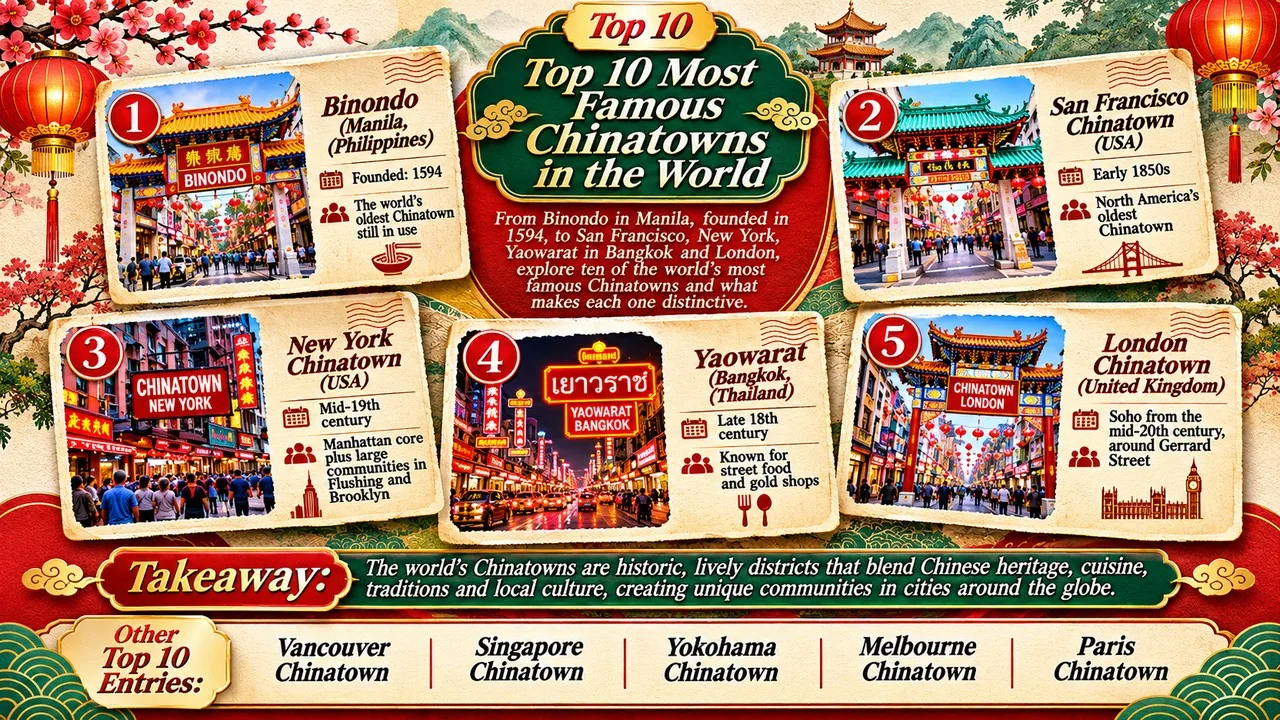
From Binondo in Manila, founded in 1594, to San Francisco, New York and Yaowarat in Bangkok, Chinatowns are among the world's most distinctive neighbourhoods. This list ranks ten of the best-known districts by age, size, cultural life and how widely they are recognised, rather than by a single population count [1][2].
Claims about the "largest Chinatown outside Asia" are often disputed, because the answer depends on whether one counts a historic core, a city or a wider metropolitan area. San Francisco's compact historic quarter is not automatically larger than New York's several Chinese districts or Vancouver's. The list therefore avoids that title and focuses on places that travellers and historians actually name first [1][3].
Dates below follow standard local and reference accounts as of November 2026. Singapore is included as a historic quarter, with the important caveat that it sits inside a Chinese-majority city, so it is not a minority enclave in the same sense as Binondo or Soho.
Key Facts
The table gives each district's city, a founding or early date, and the feature that has made it famous.
Most Famous Chinatowns at a Glance
| Rank | Chinatown | City, country | Established | Notable fact |
|---|---|---|---|---|
| 1 | Binondo | Manila, Philippines | 1594 | The world's oldest Chinatown still in use |
| 2 | San Francisco Chinatown | San Francisco, USA | Early 1850s | North America's oldest Chinatown |
| 3 | New York Chinatown | New York City, USA | Mid-19th century | Manhattan core plus large communities in Flushing and Brooklyn |
| 4 | Yaowarat | Bangkok, Thailand | Late 18th century | Famous for street food, gold shops and Chinese New Year |
| 5 | London Chinatown | London, United Kingdom | Soho from the mid-20th century | Around Gerrard Street, after an earlier settlement in Limehouse |
| 6 | Vancouver Chinatown | Vancouver, Canada | 1880s | A national historic site, with a larger Chinese community in the metro area |
| 7 | Singapore Chinatown | Singapore | Early 19th century | A conserved historic quarter in a Chinese-majority city |
| 8 | Yokohama Chinatown | Yokohama, Japan | After 1859 | Among Japan's larger and best-known Chinatowns |
| 9 | Melbourne Chinatown | Melbourne, Australia | 1850s | Among the oldest continuous Chinatowns in the Southern Hemisphere |
| 10 | Paris Chinatown | Paris, France | Especially from the 1970s | The large Asian quarter of the 13th arrondissement |
1. Binondo
Binondo, on the north bank of the Pasig River in Manila, was established in 1594 by the Spanish colonial government as a settlement for Chinese Catholic converts [2][4]. It is widely recognised as the world's oldest Chinatown that is still a living commercial district. For more than four centuries it has been a centre of trade between Chinese merchants and the Philippine capital, even as fires, war and redevelopment have changed its streets [2][4].
The quarter is known today for Ongpin Street, packed restaurants, herbal shops and the Binondo Church, formally the Minor Basilica of Saint Lorenzo Ruiz. Chinese New Year and the mid-autumn festival draw large crowds, and food tours through the alleys have become a standard introduction to Manila for many visitors [2].
Starting the list here corrects a common omission. Many popular rankings begin with San Francisco or New York and skip the fact that a Chinese district in Manila is more than 250 years older [2][4].
2. San Francisco Chinatown
San Francisco's Chinatown took shape in the early 1850s, after Chinese migrants arrived during the California Gold Rush, an influx often dated from 1848 [3]. It is North America's oldest Chinatown and one of the most visited neighbourhoods in the city, centred on Grant Avenue and Stockton Street, with a famous Chinese New Year parade [3].
The district was destroyed in the 1906 earthquake and fire and then rebuilt with the pagoda-style street fronts that tourists now expect. Those facades were a deliberate design choice, meant both to attract visitors and to help the community stay in the same location after the disaster [3]. The quarter remains a dense residential and commercial neighbourhood, not only a stage set.
Related: Top 25 Interesting Facts About the Solar System
It is often called the largest Chinatown outside Asia, but that claim is disputed once New York, Vancouver and other metropolitan counts are included. Its real distinction is age, compactness and the way it has come to stand, in photographs and films, for the idea of a Chinatown [1][3].
3. New York Chinatown
New York's best-known historic Chinatown is in Manhattan, around Mott, Canal and Pell Streets, and grew through the late nineteenth and twentieth centuries as Chinese residents settled south of Canal Street [1][5]. It remains a busy neighbourhood of shops, associations and restaurants, and it is only one part of a much larger Chinese New York. Flushing in Queens and parts of Brooklyn now hold some of the city's most important Chinese commercial and residential concentrations [5].
Any serious account of famous Chinatowns has to include New York for that metropolitan scale as well as for the older Manhattan streets. Manhattan's core is still the image most visitors meet first, with its narrow blocks, grocery stalls and banquet halls [5].
Together, the city's Chinese districts make New York one of the main centres of overseas Chinese life in the Americas, whether or not a single official "largest" title is used [1][5].
4. Yaowarat
Yaowarat, Bangkok's Chinatown, grew after the Siamese capital moved to Bangkok in the late eighteenth century, when Chinese traders settled along the Chao Phraya River [1][6]. The main street, Yaowarat Road, is lined with gold shops, restaurants and neon signs, and it is one of the best-known night-time food streets in Asia. Nearby Wat Traimit, the Temple of the Golden Buddha, holds a large solid-gold Buddha statue that is a major religious and tourist site in its own right [6].
Chinese New Year turns the district into one of Bangkok's biggest street festivals. The neighbourhood is also a working wholesale and retail centre, not only a dining strip, which is why it stays busy in the daytime as well as after dark [6].
Yaowarat is a reminder that some of the world's most famous Chinatowns are in South-East Asia, in cities that have had Chinese commercial communities for centuries, rather than only in North America and Europe [1].
5. London Chinatown
London's present Chinatown is clustered around Gerrard Street in Soho, with gates, stone lions and a dense run of restaurants, bakeries and shops [7]. It developed in the mid-twentieth century, after an earlier Chinese settlement in Limehouse, in the East End, faded. The move to Soho, in the West End, put the district at the centre of London's entertainment and tourist map [7].
Related: Top 10 Mythical Creatures in World Mythology - That Inspired Myths Across Civilizations (unchanged)
The area is compact, and it is as much a dining and festival quarter as a large residential enclave. Lunar New Year celebrations in and around Chinatown are now among the most visible public festivals in central London [7].
London's example shows how a Chinatown can shift location as a city changes, yet still become one of the best-known Chinese streets in Europe [7].
6. Vancouver Chinatown
Vancouver's Chinatown dates from the 1880s, when Chinese workers and merchants settled near the growing port and the Canadian Pacific Railway [8]. The historic core, including Pender Street and the narrow lanes around it, is a National Historic Site of Canada. It holds heritage buildings, the Millennium Gate, family associations and the Dr. Sun Yat-Sen Classical Chinese Garden [8].
Greater Vancouver also has a very large Chinese population outside the old core, especially in Richmond and other suburbs. That wider community is one reason Vancouver is often mentioned in debates about the largest Chinese districts in North America, even when visitors still head first to the historic Chinatown [8].
The neighbourhood has faced pressure from development and changing retail, like many older Chinatowns, but it remains one of the most important Chinese heritage districts in Canada [8].
7. Singapore Chinatown
Singapore's Chinatown, also known as Niu Che Shui or Kreta Ayer, was laid out in the early nineteenth century as the Chinese quarter of the colonial town plan [1][9]. Temple Street, Pagoda Street and the surrounding blocks still hold shophouses, the Buddha Tooth Relic Temple and a mix of stalls, restaurants and restored buildings. The district is a conserved historic area and a major stop on any first visit to the city [9].
Related: Top 25 Interesting Facts About the Universe
The important difference from the other entries on this list is demographic. Singapore is a Chinese-majority country, so Chinatown is a heritage and commercial quarter rather than a minority enclave created at the edge of a non-Chinese city [9]. That does not make it less famous, but it does change what the word Chinatown means here.
It is included because travellers treat it as one of the classic Chinatowns of Asia, and because its streets preserve an early layout that has disappeared in many other ports [1][9].
8. Yokohama Chinatown
Yokohama Chinatown grew after the port of Yokohama opened in 1859, when Chinese traders and residents settled near the foreign concession [10]. It is now one of the largest and best-known Chinatowns in Japan, with several ornamental gates, a dense grid of restaurants and shops, and large crowds at Chinese New Year and other festivals [10].
The district is as much a food destination as a historic quarter, and it is a standard excursion from Tokyo. Kobe also has a well-known Chinatown, Nankin-machi, but Yokohama's is generally treated as the larger and more famous of the two [10].
Its history is tied to Japan's treaty-port era, which makes it a useful counterpart to the older South-East Asian and American districts on this list [10].
9. Melbourne Chinatown
Melbourne's Chinatown, centred on Little Bourke Street between Swanston and Spring Streets, began in the 1850s during the Victorian gold rush [11]. It ranks among the oldest continuous Chinatowns in the Southern Hemisphere and has remained in the same central city location for more than 170 years, through changing immigration laws and several waves of Chinese settlement in Australia [11].
The street is narrow, decorated with arches, and lined with restaurants, societies and the Chinese Museum. It is both a dining strip and a heritage precinct in the middle of Melbourne's grid, which is unusual among Australian Chinese neighbourhoods that later spread to the suburbs [11].
Related: Top 25 Weird Facts About Left-Handed People
Melbourne's claim is continuity as much as size. Few Chinatowns outside Asia have occupied the same downtown blocks for so long [11].
10. Paris Chinatown
The best-known Chinese and wider East and South-East Asian quarter in Paris is in the 13th arrondissement, around Avenue d'Ivry, Avenue de Choisy and Les Olympiades, often called the Triangle de Choisy [12]. It grew especially from the 1970s, when migrants and refugees from China, Vietnam, Cambodia and Laos settled in the high-rise neighbourhood, and it is now one of the largest Asian commercial districts in Europe [12].
Paris also has an older Chinese presence in the area around Arts et Métiers in the 3rd arrondissement, but it is the 13th that most visitors mean by Chinatown. The wide avenues, tower blocks and large supermarkets give it a very different look from Gerrard Street or Grant Avenue [12].
It closes the list as a modern European example: a famous Asian quarter that is younger than Binondo or San Francisco, yet central to how people now imagine Chinese Paris [12].
Conclusion
These ten districts stretch from a 1594 settlement in Manila to a 1970s quarter in Paris, and from gold-rush streets in San Francisco and Melbourne to the neon of Yaowarat and the conserved shophouses of Singapore. Some are small historic cores; others sit inside much larger metropolitan Chinese communities.
A Chinatown is never only a tourist street. The most famous ones are also places of worship, family business and long memory, and they change as new generations move out or move in. This list is a guide to the names most often used for those places, beginning with the oldest and then the ones that have shaped the global image of a Chinatown.
- ^ [1] "Chinatown". Wikipedia. Wikipedia: Chinatown
- ^ [2] "Binondo". Wikipedia. Wikipedia: Binondo
- ^ [3] "Chinatown, San Francisco". Wikipedia. Wikipedia: Chinatown, San Francisco
- ^ [4] "Binondo–world's oldest Chinatown–turns 430". Philippine Information Agency. 2024. PIA: Binondo turns 430
- ^ [5] "Chinatown, Manhattan". Wikipedia. Wikipedia: Chinatown, Manhattan
- ^ [6] "Yaowarat Road". Wikipedia. Wikipedia: Yaowarat Road
- ^ [7] "Chinatown, London". Wikipedia. Wikipedia: Chinatown, London
- ^ [8] "Chinatown, Vancouver". Wikipedia. Wikipedia: Chinatown, Vancouver
- ^ [9] "Chinatown, Singapore". Wikipedia. Wikipedia: Chinatown, Singapore
- ^ [10] "Yokohama Chinatown". Wikipedia. Wikipedia: Yokohama Chinatown
- ^ [11] "Chinatown, Melbourne". Wikipedia. Wikipedia: Chinatown, Melbourne
- ^ [12] "Quartier asiatique". Wikipedia. Wikipedia: Quartier asiatique, Paris






















Discussion
Log in with