




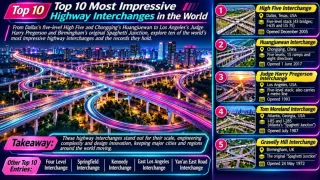

Top 10 Most Impressive Highway Interchanges in the World
 By Dhiraj Sharma · Published
Share Post
Loading…
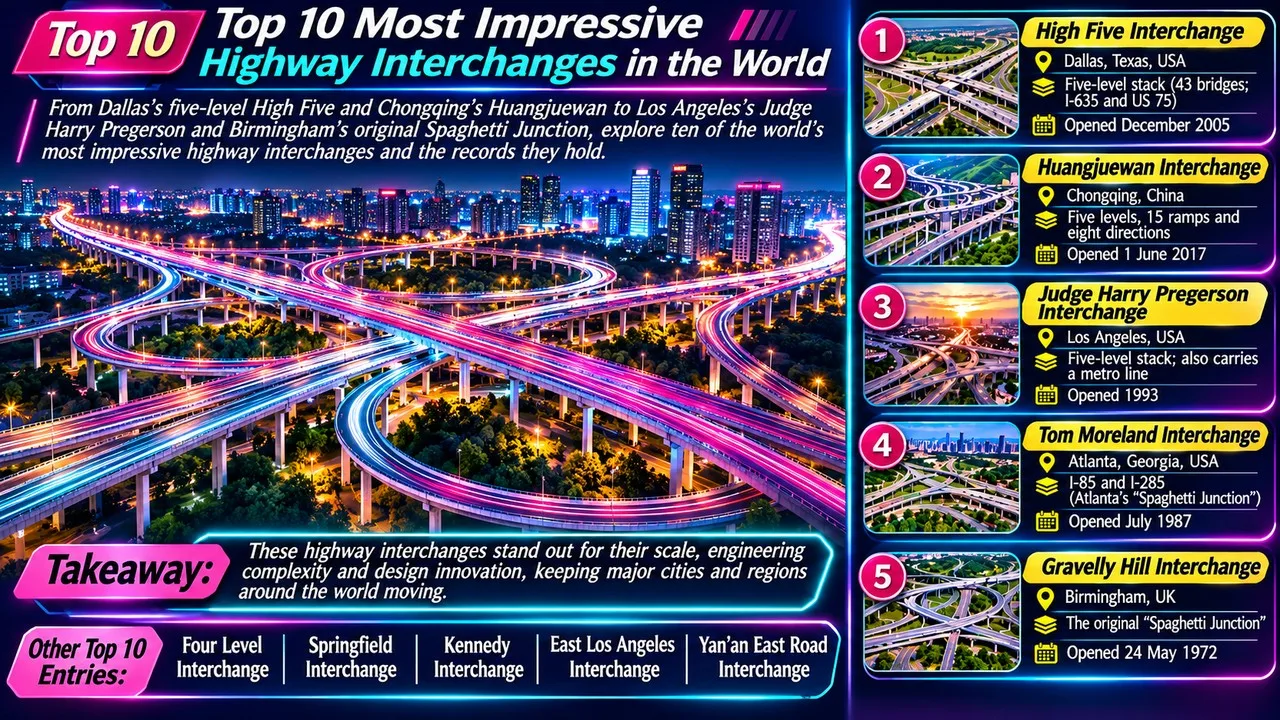
Highway interchanges can be landmarks in their own right, from Dallas's High Five to Chongqing's Huangjuewan and Birmingham's Spaghetti Junction. This list ranks ten of the most impressive examples by a mix of structural complexity, historical firsts and how widely they are recognised, rather than by traffic volume alone [1][2].
A stack interchange lifts one road over another on several levels, with flyover ramps that let traffic change direction without stopping at lights. The world's first full stack opened in Los Angeles in 1953. Later designs added a fifth level, transit lines and ever denser webs of ramps [1][3]. Dates and figures below are those reported by standard engineering and reference sources as of November 2026. Rankings of this kind are partly a matter of judgment, so the list also notes where a junction is famous mainly for its age, its nickname or the volume of traffic it carries.
Related Finepedia lists include the most beautiful highways and the famous bridges that cross international borders.
Key Facts
The table summarises each interchange's location, roads, opening date and the feature that makes it stand out.
Most Impressive Highway Interchanges at a Glance
| Rank | Interchange | Location | Roads | Opened or rebuilt | Notable fact |
|---|---|---|---|---|---|
| 1 | High Five Interchange | Dallas, Texas, USA | I-635 and US 75 | December 2005 | Five-level stack with 43 bridges |
| 2 | Huangjuewan Interchange | Chongqing, China | Several city expressways | 1 June 2017 | Five levels, 15 ramps and eight directions |
| 3 | Pregerson Interchange | South Los Angeles, USA | I-105 and I-110 | 1993 | Five-level stack that also carries a metro line |
| 4 | Tom Moreland Interchange | Atlanta, Georgia, USA | I-85 and I-285 | July 1987 | Atlanta's "Spaghetti Junction" |
| 5 | Gravelly Hill Interchange | Birmingham, United Kingdom | M6, A38(M), A38, A5127 | 24 May 1972 | The original "Spaghetti Junction" |
| 6 | Four Level Interchange | Los Angeles, California, USA | US 101 and SR 110 | 22 September 1953 | The world's oldest stack interchange |
| 7 | Springfield Interchange | Springfield, Virginia, USA | I-95, I-395 and I-495 | Rebuilt 2007 | The "Mixing Bowl" reconstruction |
| 8 | Kennedy Interchange | Louisville, Kentucky, USA | I-64, I-65 and I-71 | 1964; rebuilt 2016 | Louisville's "Spaghetti Junction" |
| 9 | East Los Angeles Interchange | Los Angeles, California, USA | I-5, I-10, US 101 and SR 60 | Built from 1961 | Among the world's busiest interchange complexes |
| 10 | Yan'an East Road Interchange | Shanghai, China | Yan'an and North-South Elevated Roads | 1990s | Often described as a six-level urban stack |
1. High Five Interchange
The High Five Interchange in Dallas, Texas, is a five-level stack that joins Interstate 635, the Lyndon B. Johnson Freeway, with US Highway 75, the Central Expressway [4]. It opened in December 2005 after about five years of construction and cost about 261 million US dollars. The structure includes 43 bridges, direct-connect ramps and a highest roadway about 36 metres, or 117 feet, above the ground [4].
The name comes from the five stacked levels, which let through traffic and turning movements pass without the tight loops of an older cloverleaf. When it opened, it was widely treated as a model for large American stacks and as a landmark on the north side of Dallas [4].
The High Five is not the only five-level interchange on this list, but it remains one of the clearest examples of the type: a compact, high structure designed to keep a very busy suburban junction moving [4].
2. Huangjuewan Interchange
The Huangjuewan Interchange in Chongqing, in south-west China, opened to traffic on 1 June 2017. It is a five-level junction with 15 ramps serving eight directions, built to tie together several of the city's expressways in a dense riverside setting [5][6]. Photographs of the ramps, looping over one another against the hills, made the project famous far beyond China when it opened.
Some early reports exaggerated the number of roads involved. The reliable description is five levels, 15 ramps and eight directions, which is already one of the more complex urban stacks built in the 2010s [5][6]. Drivers and commentators have also noted that the layout can be hard to read at first, a reminder that visual drama and ease of use are not always the same thing.
Related: Top 10 Highest Bridges in the World
Huangjuewan shows how quickly Chinese cities adopted multi-level stacks after the first generation of American examples. It earns a high place here for scale, setting and the number of movements packed into one site [5].
3. Judge Harry Pregerson Interchange
The Judge Harry Pregerson Interchange in South Los Angeles joins Interstate 105, the Glenn Anderson Freeway, with Interstate 110, the Harbor Freeway [7]. It opened in 1993 as a five-level stack and cost about 135 million US dollars, a record at the time for a single California traffic structure. What sets it apart from many other stacks is that it also carries a Metro C Line (formerly Green Line) light-rail route and the Harbor Transitway through the junction [7].
The interchange is named for Judge Harry Pregerson, who oversaw litigation tied to the building of I-105. The freeway itself was one of the last major Interstate projects in Los Angeles and was designed with transit from the start, which is why trains and buses share the structure with cars [7].
Seen from the air, the Pregerson stack is a tight knot of ramps over a low-rise neighbourhood. It is impressive both as concrete engineering and as an early attempt to put public transport inside a highway junction [7].
4. Tom Moreland Interchange
The Tom Moreland Interchange, in DeKalb County on the north-east side of Atlanta, is where Interstate 85 meets Interstate 285, the city's beltway [8]. It is widely known as Spaghetti Junction, a nickname it shares with several other complex interchanges. The rebuilt stack opened in 1987, with a formal ribbon-cutting on 9 July 1987, and was named for Tom Moreland, then Georgia's highway commissioner [8].
The junction handles traffic between downtown Atlanta, the north-eastern suburbs and the Hartsfield-Jackson airport corridor, and it has long been one of the most congested points on the Interstate system in the south-eastern United States. Later lane additions and repairs have changed some ramps, but the basic multi-level layout remains the one completed in the 1980s [8].
On this list it stands for a second wave of American spaghetti junctions: larger and busier than the first 1950s stacks, and already a local landmark before five-level designs such as the High Five were built [8].
5. Gravelly Hill Interchange
Gravelly Hill Interchange is Junction 6 of the M6 motorway in Birmingham, England, where the motorway meets the A38(M) Aston Expressway, the A38 and the A5127 [2][9]. It opened on 24 May 1972 after about four years of construction. The junction is a free-flow, five-level interchange and is the place that first made the nickname "Spaghetti Junction" famous in British and later world usage [2][9].
Related: Top 10 Greatest Engineering Achievements
The structure spreads over a large site above the River Tame, canals and local roads, which is one reason it looks so tangled from the air. It was a symbol of British motorway building in the early 1970s and, fifty years later, was still being described by official sources as an engineering landmark [9].
Gravelly Hill is not the largest stack on this list, but it is the one whose name entered everyday language. Later junctions in Atlanta, Louisville and elsewhere borrowed the same nickname [2].
6. Four Level Interchange
The Four Level Interchange, also called The Stack and formally the Bill Keene Memorial Interchange, stands just north of downtown Los Angeles, where US Route 101 meets State Route 110 [3][10]. It opened on 22 September 1953 and is recognised by Guinness World Records as the world's oldest stack interchange [3]. The four roadway levels let traffic move between the Hollywood Freeway and the Harbor / Arroyo Seco corridor without a surface roundabout or a cloverleaf.
The design became the model for later stacks in the United States and abroad. It is lower and more compact than the High Five or Pregerson interchanges, and it sits close to the civic centre rather than in a suburb [10].
Its place on this list is historical as much as visual. Almost every later multi-level interchange on these pages is, in some sense, a descendant of this 1953 experiment [3][10].
7. Springfield Interchange
The Springfield Interchange in Springfield, Virginia, is where Interstate 95, Interstate 395 and Interstate 495, the Capital Beltway, meet on the south side of the Washington, D.C., area [11]. Locals have long called it the Mixing Bowl. An eight-year reconstruction, completed in July 2007, cost about 676 million US dollars and added flyovers and collector-distributor lanes meant to separate through traffic from turning movements [11].
Related: Top 10 Longest Rail Tunnels in the World
The original junction had grown into one of the most congested interchanges on the East Coast, in part because I-95, I-395 and the Beltway all come together in a small area near a large retail and office district. The rebuild did not make the site simple, but it replaced a confusing tangle with a more layered, purpose-built layout [11].
The Mixing Bowl is impressive less as a single sculptural stack than as a rebuilt traffic machine: a reminder that some of the world's most demanding junctions are works of reconstruction, not first-time design [11].
8. Kennedy Interchange
The Kennedy Interchange in Louisville, Kentucky, joins Interstate 64, Interstate 65 and Interstate 71 just south of the Ohio River [12]. It opened in 1964 and has been known locally as Spaghetti Junction for decades. The interchange was rebuilt between 2013 and late 2016 as part of the Ohio River Bridges Project, which also added new river crossings and changed how traffic approaches downtown Louisville [12].
The rebuilt junction keeps the three Interstates in a tight downtown site, with new ramps meant to smooth movements that had been awkward in the 1960s layout. Like Birmingham and Atlanta, Louisville shows how the "spaghetti" nickname travels with any junction that looks chaotic from above, whether or not it is a pure five-level stack [12].
Its interest today lies in that rebuild. The Kennedy Interchange is an example of a mid-century knot taken apart and put back together without abandoning the same three highways or the same river approach [12].
9. East Los Angeles Interchange
The East Los Angeles Interchange is a large complex in Boyle Heights, about 1.6 kilometres east of downtown Los Angeles, where Interstate 5, Interstate 10, US Route 101 and State Route 60 come together [13]. Construction of the 135-acre, or 55-hectare, junction began in 1961. It includes dozens of bridges and several freeway segments that change names and directions as they pass through the site [13].
The southern part of the complex has often been described as among the busiest freeway interchanges in the world. A commonly cited figure is more than 550,000 vehicles a day in 2008, though that count is now dated and applies to one portion of the site rather than the whole [13]. Not every movement is possible inside the interchange, which is one reason it can feel more complicated than a single clean stack.
Related: Top 10 Tallest Dams in the World
It earns a place here for scale and traffic rather than for a tidy five-level profile. Together with the Four Level and Pregerson stacks, it is part of the unusually dense freeway landscape of Los Angeles [13].
10. Yan'an East Road Interchange
The Yan'an East Road Interchange in Shanghai is where the Yan'an Elevated Road meets the North-South Elevated Road, in the Puxi side of the city close to the older urban core [1][14]. Standard descriptions treat it as a multi-level urban stack, and the Wikipedia survey of stack interchanges lists it among examples often counted as having six levels, including lower service or local roads as well as the main expressway decks [1].
The junction was built as Shanghai's elevated road system grew in the 1990s, and it has long been one of the most photographed highway structures in the city. Like Huangjuewan, it shows a Chinese approach to stacking roads in tight urban space, though it is an older and more central example than the Chongqing junction [14].
Exact opening dates and level counts can differ between sources, depending on whether lower frontage roads are included. The conservative description is a very tall, multi-level stack at the crossing of two of Shanghai's main elevated highways, and one of the most impressive urban interchanges in Asia [1][14].
Conclusion
These ten junctions range from the first stack in 1953 to five-level designs opened in 2005 and 2017, and from a British motorway landmark to some of the busiest freeways in the United States and China. A few are famous mainly for a nickname or a rebuild; others, such as the High Five and Huangjuewan, are famous for the way they look from the air.
There is no single official ranking of interchanges, and traffic figures change as new lanes are added. The list is a guide to the junctions that best show how highway engineering became a kind of urban sculpture, and a starting point for anyone comparing the stacks of Dallas, Los Angeles, Birmingham, Louisville, Shanghai and Chongqing.
- ^ [1] "Stack interchange". Wikipedia. Wikipedia: Stack interchange
- ^ [2] "Spaghetti Junction, Birmingham". Wikipedia. Wikipedia: Spaghetti Junction, Birmingham
- ^ [3] "Oldest stack interchange". Guinness World Records. Guinness: Oldest stack interchange
- ^ [4] "High Five Interchange". Wikipedia. Wikipedia: High Five Interchange
- ^ [5] "Huangjuewan interchange". Wikipedia. Wikipedia: Huangjuewan interchange
- ^ [6] "New China overpass opens to public". BBC News. 2 June 2017. BBC: New China overpass opens to public
- ^ [7] "Judge Harry Pregerson Interchange". Wikipedia. Wikipedia: Judge Harry Pregerson Interchange
- ^ [8] "Tom Moreland Interchange". Wikipedia. Wikipedia: Tom Moreland Interchange
- ^ [9] "Spaghetti Junction Birmingham UK: History And How It Was Built". Institution of Civil Engineers. ICE: Spaghetti Junction, Birmingham
- ^ [10] "Four Level Interchange". Wikipedia. Wikipedia: Four Level Interchange
- ^ [11] "Springfield Interchange". Wikipedia. Wikipedia: Springfield Interchange
- ^ [12] "Kennedy Interchange". Wikipedia. Wikipedia: Kennedy Interchange
- ^ [13] "East Los Angeles Interchange". Wikipedia. Wikipedia: East Los Angeles Interchange
- ^ [14] "Yan'an Elevated Road". Wikipedia. Wikipedia: Yan'an Elevated Road























Discussion
Log in with