








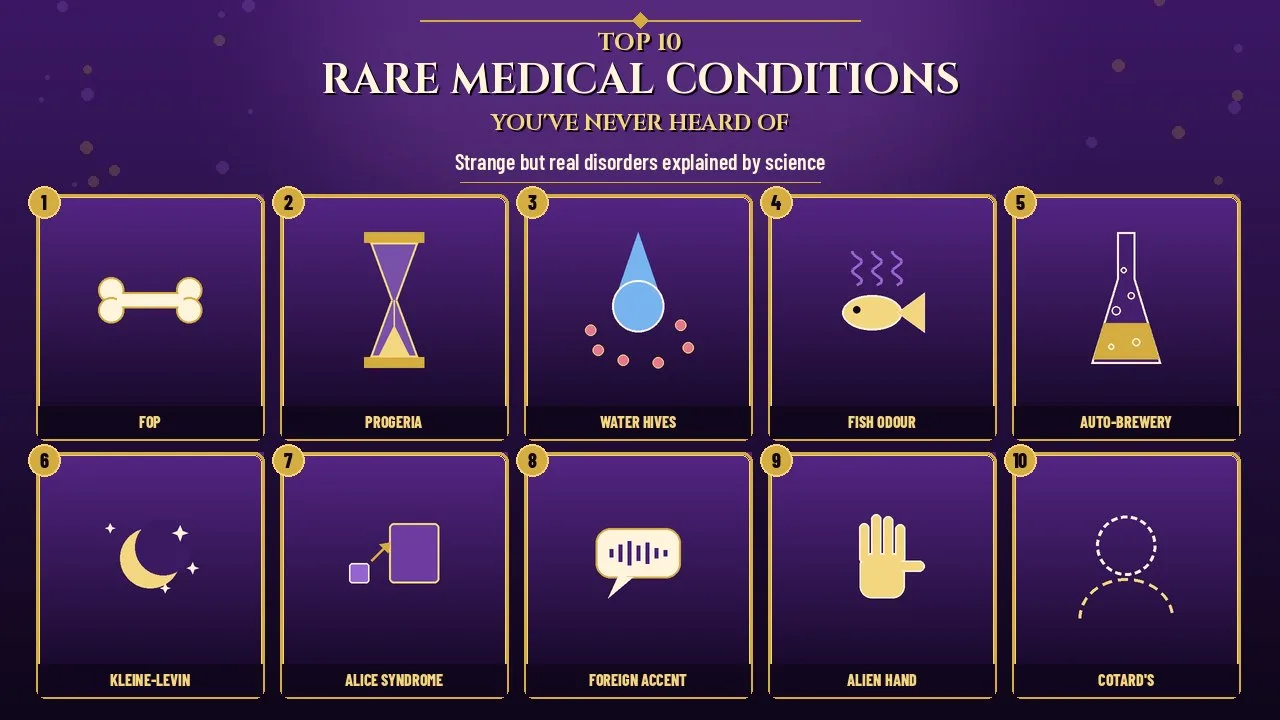
Rare medical conditions you've never heard of include genetic, metabolic and neurological disorders so uncommon that many doctors never meet a single case.
This Finepedia Top 10 explains ten genuinely rare conditions, what causes them, how they are diagnosed and what treatment looks like today. It is an educational guide written for curious readers, students and families, not a diagnostic tool. Symptoms such as unusual body odour, hives after a shower or sudden changes in speech can have many ordinary explanations, so anyone worried about their own health should speak with a qualified doctor rather than self-diagnose from a list.
Selection criteria were fourfold. First, verified rarity: every condition is either recognised as a rare disease by health agencies or appears mainly as individual case reports in the medical literature. Second, documented science: each entry has a named first description, a known or strongly suspected mechanism, and peer-reviewed sources behind it. Third, variety across body systems: the list moves from bone and genes, through skin and metabolism, to the brain and the mind, rather than following any other site's order. Fourth, reader value: each section adds Quick Facts, treatment status as of October 2026 and myth-busting notes, so the list teaches rather than merely shocks.
Some of these disorders touch on themes Finepedia covers elsewhere. Readers who enjoy strange-but-true medical topics may also like the guide to bizarre phobias (https://finepedia.com/post/10-most-bizarre-phobias-strange-fears-that-actually-exist), the explainer on physical symptoms of anxiety (https://finepedia.com/post/physical-symptoms-of-anxiety-top-10-signs-explained) and the history of the most dangerous science experiments (https://finepedia.com/post/most-dangerous-science-experiments-top-10-in-history).
What Counts as a Rare Medical Condition?
There is no single worldwide definition. In the United States, the Orphan Drug Act of 1983 treats a disease as rare when it affects fewer than 200,000 people in the country. The European Union uses a threshold of no more than 1 in 2,000 people. Researchers have catalogued more than 6,000 distinct rare diseases, and a widely cited 2020 analysis in the European Journal of Human Genetics estimated that around 72 percent are genetic and roughly 70 percent begin in childhood.
Individually each disorder is uncommon, yet together rare diseases affect an estimated 263 to 446 million people at any one time, according to that same analysis. That is why patient groups mark Rare Disease Day on the last day of February each year, a campaign launched by EURORDIS in 2008.
| Region or body | Rare disease threshold | Notes |
|---|---|---|
| United States | Fewer than 200,000 people nationally | Set by the Orphan Drug Act of 1983 |
| European Union | No more than 1 in 2,000 people | Used for orphan medicine designation |
| Global estimate | 6,000+ distinct conditions | Around 72 percent genetic, about 70 percent start in childhood |
Rare Medical Conditions at a Glance
| Rank | Condition | Body system | Estimated rarity | Treatment status (Oct 2026) |
|---|---|---|---|---|
| 1 | Fibrodysplasia ossificans progressiva | Bone and muscle | About 1 in 1 million people | First approved drug in 2023 (palovarotene) |
| 2 | Hutchinson-Gilford progeria syndrome | Genetic ageing | About 1 in 4 million births | First approved drug in 2020 (lonafarnib) |
| 3 | Aquagenic urticaria | Skin and immune | Fewer than 100 published cases | Antihistamines and barrier creams |
| 4 | Trimethylaminuria | Metabolism | Incidence unknown; often missed | Diet changes and odour control |
| 5 | Auto-brewery syndrome | Gut microbiome | Dozens of published cases | Low-carb diet, antifungals or antibiotics |
| 6 | Kleine-Levin syndrome | Sleep and brain | 500+ reported cases | Supportive care; lithium in some cases |
| 7 | Alice in Wonderland syndrome | Perception | Under-recognised; true rate unknown | Treat the trigger (migraine, infection) |
| 8 | Foreign accent syndrome | Speech and brain | Around 170+ documented cases | Speech therapy |
| 9 | Alien hand syndrome | Movement and brain | No reliable prevalence data | Rehabilitation and task training |
| 10 | Cotard's syndrome | Psychiatry | Very rare; mostly case reports | Treat depression or psychosis; ECT in some cases |
For more lists in this format, browse the Top 10 Facts hub (https://finepedia.com/category/top-10-facts).
1. Fibrodysplasia Ossificans Progressiva (FOP)
| Attribute | Details |
|---|---|
| Also known as | Stone man syndrome; myositis ossificans progressiva |
| Cause | Variants in the ACVR1 gene, a bone growth signalling receptor |
| Estimated rarity | About 1 in 1 million people worldwide (MedlinePlus Genetics) |
| Tell-tale early sign | Malformed big toes present at birth |
| Treatment status | Palovarotene (Sohonos) approved by the FDA in August 2023 for eligible patients |
Origins and History
FOP is a disorder in which muscles, tendons and ligaments slowly turn into bone. Over years, this extra skeleton bridges joints and locks the body into place, which is why the condition earned the nickname stone man syndrome. Physicians described cases centuries ago, but the cause stayed hidden until 2006, when a team led by Eileen Shore and Frederick Kaplan at the University of Pennsylvania identified a recurring mutation in the ACVR1 gene.
That discovery explained why the body behaves as it does. ACVR1 normally helps regulate bone growth in a tightly controlled way. In FOP, the receptor is switched on when it should be resting, so healing tissue is rebuilt as bone instead of muscle. Most cases arise from a brand-new mutation, although an affected parent can pass it on in an autosomal dominant pattern.
Key Features
- Bone formation usually becomes noticeable in early childhood, starting at the neck and shoulders and moving downward.
- Flare-ups bring painful swelling that often ends in new bone in that area.
- Bumps, falls, injections and even viral illnesses such as influenza can trigger flare-ups.
- Surgery to remove extra bone backfires, because the trauma provokes more bone growth.
- Bone around the jaw and ribs can make eating and breathing difficult in later life.
Significance
FOP matters far beyond its small patient community. Because it involves a single switch that turns soft tissue into bone, it has become a model for studying abnormal bone growth after injuries, burns and hip replacements. The August 2023 FDA approval of palovarotene, the first medicine for the disease, was a landmark for families who had waited decades for any treatment. The drug aims to reduce the volume of new bone; it does not reverse bone already formed.
Diagnosis is often delayed because early lumps are mistaken for tumours. Doctors are urged to look at a child's big toes before ordering biopsies, since the biopsy itself can worsen the disease. A 2010 mortality study by the International FOP Association and clinicians estimated a median lifespan of about 56 years, with breathing complications the most common cause of death.
Interesting Facts
- The skeleton of Harry Eastlack, an American man with FOP who died in 1973, is displayed at the Mutter Museum in Philadelphia and is often studied by researchers.
- People with FOP are born with a normal-looking skeleton except for the characteristic big toes.
- Dental work must be planned carefully, because stretching the jaw can trigger a flare-up.
- Only several hundred cases had been reported in the literature before genetic testing became widespread.
2. Hutchinson-Gilford Progeria Syndrome
| Attribute | Details |
|---|---|
| Also known as | Progeria; HGPS |
| Cause | A spontaneous LMNA gene mutation that produces a faulty protein called progerin |
| Estimated rarity | About 1 in 4 million births |
| Average life expectancy | About 14.5 years without treatment (Progeria Research Foundation) |
| Treatment status | Lonafarnib (Zokinvy) approved by the FDA on 20 November 2020 |
Origins and History
Progeria is named after two British doctors, Jonathan Hutchinson and Hastings Gilford, who described it in the late nineteenth century. Children with the condition look healthy at birth, but within the first two years they stop growing normally, lose hair and body fat, and develop stiff joints and fragile skin. Their intelligence is unaffected.
For more than a century, nobody knew why. In 2003, researchers supported by the Progeria Research Foundation and the US National Human Genome Research Institute identified the culprit: a single-letter change in the LMNA gene. The mutation creates progerin, a defective version of the lamin A protein that normally supports the nucleus of each cell. Progerin builds up and damages cells over time, especially in blood vessels.
Key Features
- Growth failure and loss of body fat in infancy.
- Hair loss, including eyebrows and eyelashes.
- Hip problems, stiff joints and thin skin with visible veins.
- Hardening of the arteries, the same heart disease seen in older adults.
- Normal intelligence and personality, a point families stress often.
Significance
Progeria is one of the clearest examples of a rare disease reshaping mainstream science. Because children with HGPS develop artery disease decades early, researchers study it to understand heart disease and ageing in the wider population. According to the Progeria Research Foundation, lonafarnib, a drug first developed for cancer, improves the vascular system and has been associated with an average 30 percent increase in lifespan with long-term use.
The foundation was started in 1999 by the family of Sam Berns, whose story was told in the 2013 documentary Life According to Sam. As of March 2026, the foundation had identified 216 children and young adults living with progeria or related progeroid laminopathies in 52 countries. Work on a gene-editing therapy designed to correct the underlying mutation is now under way.
Interesting Facts
- Most cases are not inherited; the mutation usually appears for the first time in the affected child.
- Researchers have found small amounts of progerin in normal ageing cells, which links this rare disease to everyday ageing.
- Lonafarnib was the first FDA-approved treatment for any premature ageing disorder.
- Progeria materials from the foundation have been translated into 38 languages to help families worldwide.
3. Aquagenic Urticaria
| Attribute | Details |
|---|---|
| Also known as | Water allergy (a popular but imprecise name) |
| Category | A rare form of physical urticaria (hives) |
| Estimated rarity | Fewer than 100 cases published in the medical literature |
| First described | 1964 by dermatologists Walter Shelley and Howard Rawnsley in JAMA |
| Treatment status | Antihistamines, protective creams; no cure |
Origins and History
Aquagenic urticaria is a condition in which ordinary water causes itchy hives within minutes of touching the skin. The temperature and source do not matter: tap water, sea water, rain, sweat and even tears can set it off. Shelley and Rawnsley first reported cases at the University of Pennsylvania in 1964, and fewer than 100 cases have been documented since.
Calling it a water allergy is convenient but not quite accurate. A true allergy involves the immune system recognising a foreign protein, and water is not foreign to the body. Researchers still debate the mechanism. One early theory proposed that water reacts with a substance in skin oil to release histamine; another suggests that water carries skin molecules deeper into the tissue, where immune cells react to them.
Key Features
- Small, itchy wheals appear within minutes of water contact.
- Lesions favour the neck, upper trunk and arms and usually fade within an hour.
- Onset often begins around puberty, with more cases reported in females.
- Drinking water is usually tolerated, although a few severe cases describe throat symptoms.
- Doctors confirm it with a simple test: a water-soaked compress applied to the skin.
Significance
Because water cannot be avoided, the condition affects daily routines such as bathing, swimming and exercising in hot weather. Patients often shorten showers, carry towels and avoid rain. Dermatologists typically start with non-sedating antihistamines, and some patients use barrier creams or petroleum-based products before bathing. In stubborn cases, specialists have reported benefit from phototherapy or newer biologic drugs, although evidence is limited to small reports.
The condition is also a reminder that hives have many triggers. Cold, heat, pressure, sunlight and exercise can all cause physical urticaria, and doctors work through these possibilities before settling on such a rare label.
Interesting Facts
- Several family clusters have been reported, hinting at a possible genetic factor in some cases.
- Aquagenic pruritus, a related condition, causes intense itching from water without visible hives.
- The temperature of the water makes no difference, which helps separate it from cold or heat urticaria.
- Most patients learn practical routines, such as quick showers and immediate drying, to limit symptoms.
4. Trimethylaminuria (Fish Odour Syndrome)
| Attribute | Details |
|---|---|
| Also known as | TMAU; fish malodour syndrome |
| Cause | Usually variants in the FMO3 gene, which encodes a liver enzyme |
| Estimated rarity | Incidence unknown; considered uncommon and under-diagnosed |
| Main symptom | A strong fishy smell in sweat, urine and breath |
| Treatment status | No cure; diet changes, antibiotics or activated charcoal can reduce odour |
Origins and History
Trimethylaminuria is a metabolic disorder in which the body cannot break down trimethylamine, a compound produced when gut bacteria digest certain foods. Trimethylamine smells strongly of rotting fish. Normally an enzyme made in the liver, FMO3, converts it into an odourless molecule. When that enzyme is missing or weak, trimethylamine escapes through sweat, urine and breath.
Most cases are inherited in an autosomal recessive pattern, meaning a person inherits a faulty gene copy from each parent. MedlinePlus Genetics notes that the odour can vary over time and may worsen with stress, illness or foods rich in choline and related compounds. A few cases have been linked to liver or kidney disease rather than genes, and temporary episodes have been reported in some women around menstruation.
Key Features
- A fishy body odour that may come and go, sometimes unnoticed by the person themselves.
- Symptoms often worsen after eating eggs, liver, legumes, some fish and other choline-rich foods.
- Physical health is otherwise usually normal.
- Diagnosis relies on a urine test that measures trimethylamine and its odourless form.
- Genetic testing can confirm FMO3 variants.
Significance
The real burden of trimethylaminuria is social and emotional. MedlinePlus reports that some people experience depression and isolation, because the condition can affect relationships, school and work. Many patients go years without a diagnosis after being told to improve hygiene, which does not help a metabolic problem.
Management focuses on reducing trimethylamine. Dietitians may advise limiting choline-rich foods while protecting nutrition, especially in children and during pregnancy. Short courses of antibiotics can reduce gut bacteria that produce the compound, and slightly acidic soaps can help wash it from the skin. Some clinicians also suggest activated charcoal or riboflavin supplements, although evidence for these remains limited.
Interesting Facts
- Carriers with only one altered FMO3 copy may have mild or occasional symptoms.
- The intensity of the smell can vary from day to day, which makes diagnosis tricky.
- Trimethylamine is the same compound responsible for the smell of fish that is no longer fresh.
- Patient advocacy groups push for wider urine testing, because many people with unexplained body odour are never tested.
5. Auto-Brewery Syndrome
| Attribute | Details |
|---|---|
| Also known as | Gut fermentation syndrome; endogenous ethanol fermentation; meitei-sho in Japan |
| Cause | Gut microbes that ferment carbohydrates into alcohol |
| Estimated rarity | Rare and under-diagnosed; a 2021 systematic review found 20 well-documented patients |
| Known culprits | Yeasts such as Candida and Saccharomyces; high-alcohol-producing Klebsiella bacteria |
| Treatment status | Low-carbohydrate diet, antifungal or antibiotic treatment, probiotics in some cases |
Origins and History
Auto-brewery syndrome is a condition in which microbes in the digestive tract turn sugars and starches into alcohol, making a person drunk without drinking. Japanese doctors published some of the earliest series of cases, calling the condition meitei-sho. A report from the 1970s counted 39 Japanese cases since 1952, most linked to Candida yeast.
For decades the syndrome was considered a yeast problem. In 2019, a team in China writing in Cell Metabolism described a man with severe fatty liver disease whose intoxication did not improve with antifungal drugs. His gut instead held a strain of Klebsiella pneumoniae that produced large amounts of alcohol. His blood alcohol reportedly reached about 400 milligrams per decilitre after high-carbohydrate meals, and he had been suspected of secret drinking.
Key Features
- Episodes of slurred speech, dizziness, brain fog and fatigue after carbohydrate-rich meals.
- Measurable blood or breath alcohol without any alcoholic drinks.
- Many reported patients have a history of antibiotic use, diabetes or other gut problems.
- Diagnosis may involve a supervised glucose challenge followed by alcohol testing.
- Symptoms can be mistaken for hidden alcoholism, delaying help.
Significance
Auto-brewery syndrome has gained attention partly because of its legal side. Some people with confirmed diagnoses have faced drink-driving charges, and courts have had to weigh medical evidence. Doctors stress that the condition is genuine but rare, and that it should be confirmed with careful testing before being used to explain intoxication.
The 2019 Klebsiella findings also opened a new line of research. The same team reported that alcohol-producing Klebsiella strains were more common in people with non-alcoholic fatty liver disease, suggesting that gut microbes may influence liver health even in people who never drink. Treatment usually combines a low-sugar, low-starch diet with medicine aimed at whichever microbe is responsible.
Interesting Facts
- Some patients keep a breathalyser at home to track episodes after meals.
- Antifungals help yeast-driven cases but not bacterial ones, which is why identifying the microbe matters.
- Researchers have explored faecal microbiota transplant as a possible treatment in difficult cases.
- The condition was rarely recognised outside Japan until the late twentieth century.
6. Kleine-Levin Syndrome
| Attribute | Details |
|---|---|
| Also known as | Sleeping Beauty syndrome; periodic hypersomnia |
| Main symptoms | Episodes of extreme sleep (up to about 20 hours a day), confusion and appetite changes |
| Who is affected | Mostly teenagers; males about three times as often as females (NORD) |
| Reported cases | More than 500 in the medical literature |
| Treatment status | No cure; stimulants or lithium help some patients |
Origins and History
Kleine-Levin syndrome is a sleep disorder in which people fall into recurring episodes of extreme sleepiness lasting days or weeks, then return to normal between episodes. It is named after German psychiatrist Willi Kleine and American neurologist Max Levin, who published early descriptions in the 1920s and 1930s.
The cause remains unknown. Researchers suspect a temporary malfunction of the hypothalamus and thalamus, brain regions that regulate sleep, appetite and body temperature. A Stanford-led review cited by NORD found that about 72 percent of studied cases were preceded by signs of infection, such as a flu-like illness, which has led to theories about an autoimmune trigger. A small number of families have more than one affected member.
Key Features
- Sudden episodes of sleeping 18 to 20 hours a day, waking mainly to eat or use the bathroom.
- Confusion, a dreamlike feeling of unreality and slowed speech while awake.
- Compulsive overeating in many patients; uninhibited behaviour in some.
- Two to twelve episodes a year in typical cases, with normal health in between.
- Episodes often become less frequent with age and may stop by early adulthood.
Significance
Because it strikes teenagers, the syndrome can disrupt school, friendships and family life for years. Many families describe long searches for answers, as episodes are mistaken for depression, drug use or laziness. Doctors rule out epilepsy, brain infections and other sleep disorders before making the diagnosis.
Treatment is supportive. Stimulant medicines may reduce sleepiness, though they do little for the other symptoms. Some studies report that lithium can shorten or reduce episodes in certain patients, but the evidence remains limited. Families are often advised to keep the patient safe and supervised during episodes, especially away from driving.
Interesting Facts
- Patients often have little memory of what happened during an episode.
- The popular nickname Sleeping Beauty syndrome hides how distressing episodes can be.
- NORD reports that women tend to have a longer course of the disorder than men.
- Brain imaging studies have shown reduced blood flow in regions such as the thalamus during episodes.
7. Alice in Wonderland Syndrome
| Attribute | Details |
|---|---|
| Also known as | AIWS; Todd's syndrome |
| Main symptoms | Distorted sense of body size, object size, distance or time |
| Named | 1955 by British psychiatrist John Todd |
| Common triggers | Migraine in adults; infections such as Epstein-Barr virus in children |
| Treatment status | Usually temporary; doctors treat the underlying cause |
Origins and History
Alice in Wonderland syndrome is a perceptual disorder in which people feel that their body, or objects around them, have changed size, shape or distance. A room might seem to stretch away, hands might feel enormous, or time might seem to slow down. British psychiatrist John Todd named the syndrome in 1955 after Lewis Carroll's 1865 novel, in which Alice repeatedly grows and shrinks.
Todd was not the first to notice the symptoms, but he gathered them under one memorable name. Some writers have suggested that Carroll, who had migraines, drew on his own experiences, though historians consider that idea unproven. A systematic review published in 2016 described the syndrome as having many possible causes rather than one single disease process.
Key Features
- Micropsia and macropsia, where objects appear much smaller or larger than they are.
- Feelings that one's own body or body parts are growing or shrinking.
- Distorted sense of distance and of the passage of time.
- Episodes usually last minutes and the person often knows the perception is not real.
- Brain imaging during episodes suggests changes in areas that combine vision and body sense.
Significance
In children, the most commonly reported cause is infection, especially Epstein-Barr virus, the virus behind glandular fever. In adults, migraine is the most frequent link, and episodes may act like a migraine aura. Less often, epilepsy, head injury, brain lesions or certain medicines can be involved, so doctors check for these when symptoms appear.
For most people, AIWS is short-lived and harmless. Reassurance is an important part of care, because the experience can be frightening, especially for children who struggle to describe it. Treating migraine or allowing an infection to clear typically settles the symptoms.
Interesting Facts
- Because symptoms are hard to describe, experts believe the syndrome is under-recognised.
- Some episodes happen at night or on waking, adding to confusion for children.
- The syndrome is not a psychiatric illness in most cases, but a temporary change in how the brain processes perception.
- Medical comparisons with Alice's adventures appeared in journals in 1933 and 1952, before Todd coined the name.
8. Foreign Accent Syndrome
| Attribute | Details |
|---|---|
| Category | A rare motor speech disorder |
| Typical cause | Stroke or brain injury affecting speech areas; occasionally psychological factors |
| First described | 1907 by French neurologist Pierre Marie |
| Documented cases | At least 172 case reports, according to a 2018 neurology review |
| Treatment status | Speech and language therapy; support for identity concerns |
Origins and History
Foreign accent syndrome is a speech disorder in which a person suddenly speaks their own language with what listeners hear as a foreign accent. The person has not learned a new language; rather, brain changes alter the rhythm, stress, pitch and vowel sounds of their speech. French neurologist Pierre Marie described the first known case in 1907, a Parisian man whose speech began to sound Alsatian after a stroke.
The most famous early case came from Norway. In 1941, during an air raid on Oslo, a 30-year-old woman named Astrid was struck by shell fragments and suffered a head injury. When she recovered her speech, Norwegians heard her accent as German. Neurologist Georg Monrad-Krohn described her case in 1947. During the wartime occupation, shopkeepers reportedly refused to serve her because they believed she was German.
Key Features
- Speech rhythm, stress and vowel sounds change, so listeners perceive a foreign accent.
- The perceived accent varies by listener; one person may hear French while another hears Italian.
- Most cases follow a stroke or brain injury, often affecting the left side of the brain.
- Some patients also have mild aphasia, difficulty finding or forming words.
- A smaller number of cases are linked to psychological or functional causes.
Significance
Foreign accent syndrome shows how finely the brain controls the music of speech. Small changes in timing and pitch can make a native speaker sound like a stranger. For patients, the effect on identity can be profound. Many describe feeling that they have lost part of themselves, and some face suspicion or teasing.
Speech and language therapists work on rhythm, stress and articulation to help patients regain their usual voice, though results vary. Counselling and peer support also help people cope with the change. The term foreign accent syndrome itself was coined later, in 1982, by researcher Harry Whitaker.
Interesting Facts
- Reported accent changes include Japanese to Korean and British English to French, among many others.
- Astrid's case became one of the most cited in neurology and speech science.
- Patients usually understand their own language perfectly; the change is in production, not comprehension.
- Researchers stress that patients do not gain fluency in another language.
9. Alien Hand Syndrome
| Attribute | Details |
|---|---|
| Also known as | Alien limb syndrome; anarchic hand |
| Main feature | A hand that performs purposeful movements without the person's control |
| First described | 1908 by German neurologist Kurt Goldstein |
| Term coined | 1972 by French neurologists Brion and Jedynak (main etrangere) |
| Treatment status | No cure; rehabilitation, task training and occupational therapy |
Origins and History
Alien hand syndrome is a neurological disorder in which one hand seems to act on its own, carrying out goal-directed movements the person did not intend. In 1908, German neurologist Kurt Goldstein described a woman whose left hand repeatedly grabbed her throat, and she had to use her other hand to pull it away. An autopsy later showed damage to the corpus callosum and the right side of the brain.
The modern name dates to 1972, when French neurologists Brion and Jedynak described patients with tumours of the corpus callosum who did not recognise one hand as their own. Since then, case reports have linked the syndrome to strokes, brain surgery that separates the two hemispheres, neurodegenerative diseases such as corticobasal degeneration, and tumours.
Key Features
- The affected hand may grasp objects, refuse to let go or undo actions of the other hand.
- Patients are aware of the movements but feel unable to control them.
- A frontal type involves grasping and groping; a callosal type involves conflict between the hands.
- The left hand is more often affected in right-handed people with callosal damage.
- No reliable prevalence data exist because the syndrome is so rarely reported.
Significance
Alien hand syndrome offers a striking window into how the brain creates a sense of ownership and control over movement. The corpus callosum, a thick bundle of nerve fibres linking the two hemispheres, helps coordinate the hands. When those connections or frontal control areas are damaged, the hands can work at cross purposes.
Doctors manage the condition through rehabilitation. Patients may keep the affected hand busy by holding an object, use visual cues or practise structured tasks. Some cases improve over time, especially after stroke, while those linked to progressive diseases may not. Because the experience can be distressing, psychological support is part of good care.
Interesting Facts
- The condition is sometimes called Dr. Strangelove syndrome after the 1964 film character whose gloved hand acts on its own.
- Some patients talk to their hand or give it a name to cope with the experience.
- Interhand conflict can be as simple as one hand buttoning a shirt while the other unbuttons it.
- Recent reviews of published cases link it most often to stroke, tumours and neurodegenerative disease.
10. Cotard's Syndrome
| Attribute | Details |
|---|---|
| Also known as | Cotard's delusion; walking corpse syndrome |
| Main feature | A belief that one is dead, does not exist or has lost internal organs |
| First described | 1880 by French neurologist Jules Cotard |
| Often linked with | Severe depression, psychosis, bipolar disorder and some brain conditions |
| Treatment status | Treat the underlying illness; antidepressants, antipsychotics or electroconvulsive therapy |
Origins and History
Cotard's syndrome is a rare psychiatric condition in which a person holds a fixed belief that they are dead, that they do not exist or that parts of their body are missing or rotting. French neurologist Jules Cotard described the condition in a lecture in 1880 and expanded it in an 1882 paper, calling it the delire des negations, or delusion of negation.
His best-known patient, referred to as Mademoiselle X, believed she had no brain, nerves or internal organs and no need to eat. She also believed she could not die a natural death. She later died of starvation. Her case remains a powerful reminder that this delusion can be life-threatening.
Key Features
- Nihilistic delusions about one's own existence or body.
- Severe low mood, guilt and anxiety in many patients.
- Neglect of food, hygiene or personal safety because the person feels already dead.
- In some cases, a belief of being immortal sits alongside the belief of being dead.
- Often appears with psychotic depression, schizophrenia, bipolar disorder or neurological illness.
Significance
Cotard's syndrome is important because of the risks it carries. People may stop eating or caring for themselves, and suicide risk can be high when it occurs with severe depression. Prompt psychiatric assessment is essential.
Treatment focuses on the underlying condition. Antidepressants, antipsychotics and mood stabilisers are commonly used, and electroconvulsive therapy has been reported as effective in severe or treatment-resistant cases. Many patients improve with proper care, which makes early recognition vital. Researchers also study the syndrome to understand how the brain builds a sense of self and of being alive.
Interesting Facts
- The condition is sometimes called walking corpse syndrome, though clinicians prefer Cotard's syndrome.
- Some neurologists link the delusion to problems connecting emotions with perception.
- Cotard's original term, delusion of negation, captured how patients denied parts of themselves.
- Most of what is known comes from individual case reports rather than large studies.
How These Rare Conditions Compare
| Group | Conditions | What is happening | Best-known support |
|---|---|---|---|
| Genetic and structural | FOP, progeria | A single gene change drives the disease from birth | Specialist centres and newly approved drugs |
| Skin and metabolism | Aquagenic urticaria, trimethylaminuria | The body reacts to water or fails to process a compound | Symptom control and diet changes |
| Gut microbiome | Auto-brewery syndrome | Microbes produce alcohol inside the body | Diet plus targeted antifungal or antibiotic treatment |
| Sleep and perception | Kleine-Levin syndrome, Alice in Wonderland syndrome | Temporary changes in sleep or perception networks | Supportive care and treatment of triggers |
| Speech, movement and self | Foreign accent syndrome, alien hand syndrome, Cotard's syndrome | Brain injury or illness changes speech, control or sense of self | Therapy, rehabilitation and psychiatric care |
Frequently Asked Questions
What is the rarest medical condition in this list?
Hutchinson-Gilford progeria syndrome is one of the rarest, at about 1 in 4 million births; the Progeria Research Foundation had identified 157 children and young adults with classic progeria worldwide as of March 2026. Aquagenic urticaria has fewer than 100 published cases, though some mild cases may never be reported. Exact rankings are difficult because many rare conditions are under-diagnosed.
Why do rare diseases take so long to diagnose?
Most doctors may never see a case, and early symptoms often look like common problems. Hives, fatigue or odd body odour have many ordinary causes. Specialist testing, such as genetic tests or urine analysis, is often needed. Patient groups say families can wait years for an answer.
Can these rare conditions be cured?
Most cannot be cured yet, but many can be managed. FOP and progeria now have approved medicines that slow the disease. Auto-brewery syndrome can improve with diet and targeted treatment, and Alice in Wonderland syndrome often fades when the trigger is treated. Research into gene therapies continues.
Is water allergy real?
Aquagenic urticaria is real, but water allergy is a loose name. The condition causes hives after skin contact with water of any temperature. It is not a classic allergy to a foreign substance, and the exact mechanism is still debated. Antihistamines usually help control symptoms.
Can someone really get drunk without drinking alcohol?
Yes, in auto-brewery syndrome. Yeasts or bacteria in the gut ferment carbohydrates into alcohol, raising blood alcohol levels. Doctors confirm it with supervised testing because it is rare. Treatment includes a low-carbohydrate diet and medicine targeting the microbes responsible.
Should I worry if I have one of these symptoms?
Most symptoms in this list have common causes. Occasional strange perceptions, body odour or hives rarely mean a rare disease. However, persistent, worsening or unexplained symptoms deserve a check-up. Sudden speech changes or weakness need emergency care, because they can signal a stroke.
Where can families find reliable information?
Reliable sources include MedlinePlus Genetics, the Genetic and Rare Diseases Information Center, the National Organization for Rare Disorders and Orphanet. Condition-specific charities, such as the Progeria Research Foundation and the International FOP Association, also offer guidance, research updates and support networks.
Conclusion
Rare medical conditions you've never heard of show how varied and surprising the human body can be. From bone that grows where muscle should be to a voice that suddenly sounds foreign, each condition on this list affects only a small number of people, yet each has taught scientists something valuable about genes, metabolism or the brain. Treatment is improving, with landmark drugs for FOP and progeria approved in the last few years. Awareness matters too, because faster recognition means earlier care. If a symptom here sounds familiar, talk to a doctor rather than relying on internet lists.
- MedlinePlus Genetics (US National Library of Medicine) - Fibrodysplasia ossificans progressiva; Trimethylaminuria
- US Food and Drug Administration - FDA approves first treatment for fibrodysplasia ossificans progressiva (August 2023); FDA approves first treatment for Hutchinson-Gilford progeria syndrome (November 2020)
- Progeria Research Foundation - Quick Facts (as of March 31, 2026)
- National Human Genome Research Institute - Researchers identify gene for premature ageing disorder (2003)
- Kaplan FS et al. - Early mortality and cardiorespiratory failure in patients with FOP (2010)
- Shelley WB, Rawnsley HM - Aquagenic urticaria: contact sensitivity reaction to water, JAMA (1964); DermNet - Aquagenic urticaria
- Yuan J et al. - Fatty liver disease caused by high-alcohol-producing Klebsiella pneumoniae, Cell Metabolism (2019); Gut fermentation syndrome: a systematic review of case reports (2021)
- National Organization for Rare Disorders (NORD) - Kleine-Levin syndrome
- Blom JD - Alice in Wonderland syndrome: a systematic review, Neurology Clinical Practice (2016)
- Monrad-Krohn GH - Dysprosody or altered melody of language, Brain (1947); review of foreign accent syndrome in stroke patients (2018)
- Pathophysiology and treatment of alien hand syndrome (review, PMC)
- Nguengang Wakap S et al. - Estimating cumulative point prevalence of rare diseases, European Journal of Human Genetics (2020)
- Finepedia related reading: bizarre phobias (https://finepedia.com/post/10-most-bizarre-phobias-strange-fears-that-actually-exist); physical symptoms of anxiety (https://finepedia.com/post/physical-symptoms-of-anxiety-top-10-signs-explained); most dangerous science experiments (https://finepedia.com/post/most-dangerous-science-experiments-top-10-in-history)
- Reference consulted for topic existence only (not copied): https://10mosttoday.com/10-most-rare-medical-conditions-youve-never-heard-of/


















Log in with