






Top 10 Animals Once Thought Extinct That Turned Up Alive
 By Dhiraj Sharma · Published
Share Post
Loading…
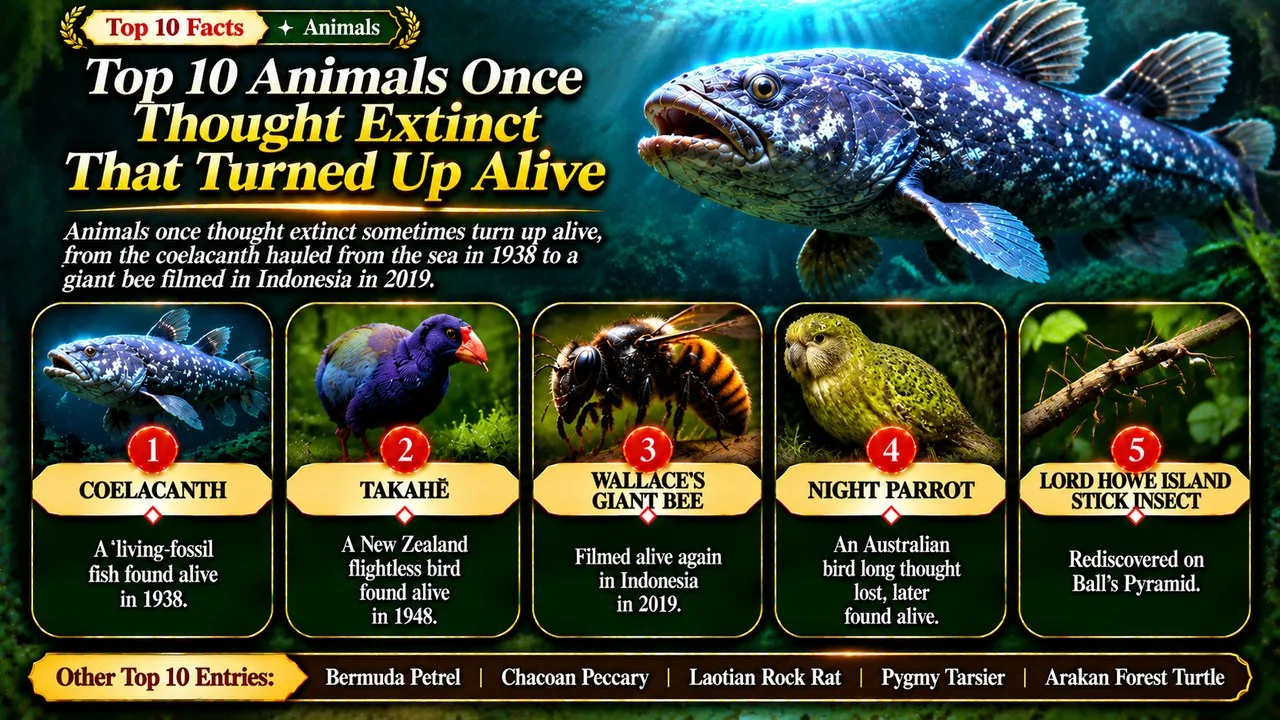
Animals once thought extinct sometimes turn up alive, from the coelacanth hauled from the sea in 1938 to a giant bee filmed in Indonesia in 2019.
Biologists have a name for a species that vanishes from the record and later reappears: a Lazarus taxon. The term was coined in 1983 by Karl Flessa and David Jablonski, after the biblical Lazarus who was raised from the dead [1]. In fossil studies it describes a group that disappears for millions of years and then turns up again; in conservation it means a living species wrongly written off as extinct [1].
This Finepedia guide, written in November 2026, takes its topic from a Listverse list of animals thought extinct that were not [24], but the selection, order and wording are our own. We kept the best-documented cases and added others with strong records, choosing animals whose loss and return are confirmed by museums, zoos, conservation agencies or peer-reviewed research. The list runs from the most famous comeback in science to a turtle first found alive again in a food market.
Key Facts
This table sums up all ten animals and when each was found again.
Animals Once Thought Extinct at a Glance
| Rank | Name | Where found | Thought lost | Found again |
|---|---|---|---|---|
| 1 | Coelacanth | Off South Africa, Comoros, Indonesia | About 66 million years | 1938 |
| 2 | Lord Howe Island Stick Insect | Ball's Pyramid, Australia | Since about 1920 | 2001 |
| 3 | Takahe | Murchison Mountains, New Zealand | Since 1898 | 1948 |
| 4 | Bermuda Petrel | Castle Harbour islets, Bermuda | About 300 years | 1951 |
| 5 | Chacoan Peccary | Gran Chaco, South America | Known only as fossils | Early 1970s |
| 6 | Laotian Rock Rat | Khammouan, Laos | Family gone 11 million years | 1996 market find |
| 7 | Night Parrot | Western Queensland, Australia | No confirmed record 1912 to 1979 | Photographed 2013 |
| 8 | Pygmy Tarsier | Central Sulawesi, Indonesia | Last collected 1921 | 2008 |
| 9 | Wallace's Giant Bee | North Moluccas, Indonesia | Lost after 1858, again after 1981 | 1981 and 2019 |
| 10 | Arakan Forest Turtle | Myanmar and Bangladesh | Last record 1908 | 1994, wild in 2009 |
1. Coelacanth
Coelacanths are lobe-finned fish more closely related to lungfish and land vertebrates than to most other fish. Their fossils go back more than 400 million years, and because the youngest fossils are about 66 million years old, scientists assumed the group had died out around the time of the dinosaurs [2][3].
On 22 December 1938, Marjorie Courtenay-Latimer, curator of the East London Museum in South Africa, spotted a strange blue fish about 1.5 metres long among a trawler's catch [3]. The ichthyologist J. L. B. Smith identified it as a living coelacanth and named it Latimeria chalumnae in her honour [2][3]. A second specimen did not reach science until 1952, from the Comoro Islands, where local fishermen already knew the fish as gombessa [3].
A second living species, the Indonesian coelacanth, was identified in the late 1990s [2][3]. The West Indian Ocean coelacanth can reach about two metres and 100 kilograms and usually lives 90 to 300 metres down [3]. No other rediscovery has changed science so much, so the coelacanth takes first place.
2. Lord Howe Island Stick Insect
Dryococelus australis, the stick insect of Lord Howe Island, is a large, wingless, nocturnal insect up to about 20 centimetres long, nicknamed the tree lobster [4][5]. It was once common on Lord Howe Island, far out in the Tasman Sea from New South Wales, where fishermen used it as bait [4].
Its decline began in 1918, when the supply ship SS Makambo ran aground and black rats got ashore. By 1920 no stick insects could be found, and the species was declared extinct [4]. Climbers on Ball's Pyramid, a towering volcanic sea stack 23 kilometres from Lord Howe, found dead ones in the 1960s, and in 2001 a small population was found living on a single bush on the rock [4][5]. Wikipedia records that only 24 insects were counted at first [4].
In 2003 a team brought two breeding pairs to mainland Australia, and Melbourne Zoo has bred the species ever since, with the aim of returning it to Lord Howe once the rats are gone [5]. Its survival on one bare rock makes it one of the most remarkable comebacks in the insect world.
Related: Top 10 Amazing Animals of the Amazon Rainforest
3. Takahe
The South Island takahe, Porphyrio hochstetteri, is a flightless bird of New Zealand and the largest living member of the rail family [6]. Europeans first knew it only from fossil bones found in 1847. Live birds were caught in 1850 and a handful of times afterwards, but after a bird taken in 1898 no more were found, and the species was presumed extinct [6].
In November 1948 the Invercargill doctor Geoffrey Orbell led a carefully planned search into the remote Murchison Mountains above Lake Te Anau in Fiordland and found a surviving population in the tussock grasslands [6][7]. The find launched New Zealand's longest-running endangered species programme [7].
Since then, captive rearing, predator control and moves to offshore islands have slowly rebuilt numbers. The Department of Conservation gives the population as around 500 as of October 2023, and the bird's status was improved in 2016 from Nationally Critical to Nationally Vulnerable [6][7]. Few birds have been brought back from the brink with such care, which earns the takahe third place.
4. Bermuda Petrel
The Bermuda petrel, Pterodroma cahow, known locally as the cahow after its eerie calls, is a nocturnal seabird that nests in burrows and is Bermuda's national bird [8]. In the early 1500s it was probably the most numerous bird on the islands, with an estimated half a million pairs, but early settlers hunted it heavily and introduced animals added to the losses, and it was thought extinct for around 300 years [8][9].
In January 1951 an expedition led by Robert Cushman Murphy of the American Museum of Natural History and Louis Mowbray of the Bermuda Aquarium found living cahows nesting on tiny islets in Castle Harbour [9][10]. A Bermudian schoolboy named David Wingate was with them [9]. By 1962 researchers had documented 18 nesting pairs, about 36 birds in all [9].
Wingate went on to spend his career saving the bird, serving as Bermuda's conservation officer from 1966 to 2000 and restoring nearby Nonsuch Island as a safe nesting site [10]. Its long absence and slow recovery make the cahow one of the best-known Lazarus species in the world [8].
5. Chacoan Peccary
The Chacoan peccary, Catagonus wagneri, also called the tagua, is a pig-like hoofed mammal of the Gran Chaco, a hot, dry region of thorn scrub shared by Paraguay, Bolivia and Argentina [11]. Scientists first described it in 1930 from fossil remains and assumed it was long extinct [11][12].
Related: Top 10 Most Extreme Hearing Animals
In the early 1970s researchers confirmed that the animal was still alive in the Chaco, and it was identified as a living species in 1975 [11][12]. Local people had known it all along; it took outside science decades to catch up [11]. That makes it one of the most recently discovered large mammals [12].
It is now the only living member of its genus and is classed as endangered, with a total population estimated at about 3,000 [11]. Its range is being turned into large cattle ranches [11]. A large mammal hiding in plain sight earns the tagua fifth place.
6. Laotian Rock Rat
Called kha-nyou in Laos, Laonastes aenigmamus is a dark, squirrel-tailed rodent of the limestone hills of Khammouan province in Laos, with a small range also in western Vietnam [13]. The first specimens were found in 1996 by biologist Robert Timmins, on sale as meat in a market in Thakhek [13][14]. In 2005 a team of scientists described it and was so struck by its strange skull that they placed it in a brand-new family [13].
In 2006, palaeontologist Mary Dawson of the Carnegie Museum of Natural History and her colleagues reported in Science that the animal in fact belonged to the Diatomyidae, a rodent family previously recorded only as fossils and thought to have died out about 11 million years ago [13][14]. "It's the coelacanth of rodents," Dawson said [14].
Unlike the other animals on this list, the rock rat was not lost as a species but as a whole family. That 11-million-year gap makes it one of the most striking Lazarus taxa among mammals.
7. Night Parrot
The night parrot, Pezoporus occidentalis, is a small, green and yellow ground parrot of arid inland Australia and one of the most elusive birds in the world [15]. The last living specimen was collected in Western Australia in 1912, and there were no confirmed records between 1912 and 1979, leading many to believe it was extinct [15][16]. Dead birds were found in Queensland in 1990 and 2006 [16].
In 2013 the naturalist John Young photographed and filmed a live bird in western Queensland [16]. The Western Australian Museum then used DNA from five feathers he collected near a roost to confirm that they came from night parrots [17]. The site, now protected as Pullen Pullen Reserve, was kept secret to protect the birds [16].
Related: Top 10 Extraordinary Lizards of the World
The story is not without controversy: in 2019 the Australian Wildlife Conservancy withdrew some later records by Young, though the 2013 Queensland find stands [15]. The species is classed as critically endangered, with perhaps 50 to 249 mature birds [15].
8. Pygmy Tarsier
The pygmy tarsier, Tarsius pumilus, is a tiny nocturnal primate from the mossy mountain forests of Central Sulawesi, Indonesia. It weighs about 55 grams on average, making it smaller than other tarsiers [18]. For decades it was known only from museum specimens, the last collected in 1921, and many researchers thought it had died out [18][19].
In 2000 two Indonesian scientists trapping rats accidentally caught and killed one, proving the species still existed [18][19]. Then, in 2008, a team led by Sharon Gursky of Texas A&M University set up about 276 mist nets on Mount Rore Katimbo in Lore Lindu National Park and caught two males and a female, the first live pygmy tarsiers seen by scientists in more than 80 years [18][19]. The animals were fitted with radio collars so their movements could be followed [19].
The team worked at heights of more than 2,000 metres in steep, wet terrain [19]. A primate this small and this hard to find shows that even well-studied groups can still hide surprises.
9. Wallace's Giant Bee
Wallace's giant bee, Megachile pluto, is the largest known living bee. Females reach about 38 millimetres long with a wingspan of about 63.5 millimetres, roughly four times the size of a honeybee, and carry huge jaws [20][21]. The naturalist Alfred Russel Wallace collected the first specimen in 1858 on the islands now called the North Moluccas [20].
The bee then went unseen by science for more than a century, until the American entomologist Adam Messer found nests on Bacan and nearby islands in 1981 [20][21]. After that it vanished again. In January 2019 a team co-led by photographer Clay Bolt and entomologist Eli Wyman found a female nesting in a tree termite mound and photographed and filmed it alive for the first time [20][21].
Related: Top 10 Remarkable Frogs of the World
The females use their jaws to collect resin, which they use to line tunnels inside the termite nests [21]. Lost twice and found twice, the giant bee earns a place on the list, though forest clearance for plantations still threatens its home [20].
10. Arakan Forest Turtle
The Arakan forest turtle, Heosemys depressa, is a small, semi-terrestrial turtle of the Arakan Hills of western Myanmar and the neighbouring Chittagong Hill Tracts of Bangladesh [22]. Adults are less than a foot long, with a light brown carapace mottled with black [23]. The species was named in 1875 from a specimen collected in Arakan [22].
For most of the 20th century it was known from almost nothing. The last record was a single animal collected by a British Army officer in 1908, and the turtle was believed extinct until 1994, when conservationists found a few for sale in a food market in China [23]. In 2009 a Wildlife Conservation Society team became the first scientists to see it in the wild, finding five turtles in a sanctuary in Myanmar's Rakhine Yoma Elephant Range [22][23].
A further population was reported in Bangladesh in 2015 [22]. The turtle remains critically endangered, but its reappearance closes our list with a reminder that markets and local knowledge can lead scientists to species they thought were gone.
Conclusion
From a fish known from fossils to a bee that went missing twice, these ten animals show how easily a species can be written off. Some survived on a single rock or a few islets, others in remote forests or deserts that scientists rarely visit, and several were well known to local people long before outside experts found them [1].
Each rediscovery is a second chance rather than a happy ending, since most of these animals remain rare and threatened. For more creatures that surprise science, see Top 10 Misidentified Prehistoric Animals and Top 10 Longest Living Animals on Earth.
- ^ [1] "Lazarus taxon". Wikipedia. Wikipedia
- ^ [2] "Coelacanth". Wikipedia. Wikipedia
- ^ [3] "Coelacanths: The fish that outdid the Loch Ness Monster". Natural History Museum. Natural History Museum
- ^ [4] "Dryococelus australis". Wikipedia. Wikipedia
- ^ [5] "Lord Howe Island Stick Insect". Zoos Victoria. Zoos Victoria
- ^ [6] "South Island takahe". Wikipedia. Wikipedia
- ^ [7] "Takahe". New Zealand Department of Conservation. DOC
- ^ [8] "Bermuda petrel". Wikipedia. Wikipedia
- ^ [9] "Future Is Bright For Extinct Cahow". Bernews. Bernews
- ^ [10] "David Wingate: It became my goal to rediscover cahows". The Royal Gazette. The Royal Gazette
- ^ [11] "Chacoan peccary". Wikipedia. Wikipedia
- ^ [12] "Chacoan peccary". San Francisco Zoo and Gardens. San Francisco Zoo
- ^ [13] "Laotian rock rat". Wikipedia. Wikipedia
- ^ [14] "Laotian Rodent Proves Living Fossil". Scientific American. Scientific American
- ^ [15] "Night parrot". Wikipedia. Wikipedia
- ^ [16] "Night Parrot". Bush Heritage Australia. Bush Heritage Australia
- ^ [17] "DNA confirms elusive Night Parrot found". Western Australian Museum. WA Museum
- ^ [18] "Pygmy tarsier". Wikipedia. Wikipedia
- ^ [19] "Texas A&M anthropologist discovers long-lost primate in Indonesia". EurekAlert. EurekAlert
- ^ [20] "Megachile pluto". Wikipedia. Wikipedia
- ^ [21] "The world's largest bee rediscovered after 38 years". Natural History Museum. Natural History Museum
- ^ [22] "Arakan forest turtle". Wikipedia. Wikipedia
- ^ [23] "Scientists See Rare Turtle for the First Time in the Wild". Wildlife Conservation Society. WCS Newsroom
- ^ [24] "Top 10 Animals You Thought Were Extinct But Aren't". Listverse. Topic reference on Listverse





















Discussion
Log in with