






Top 10 Carnivorous Plants and How They Catch Their Prey
 By Dhiraj Sharma · Published
Share Post
Loading…
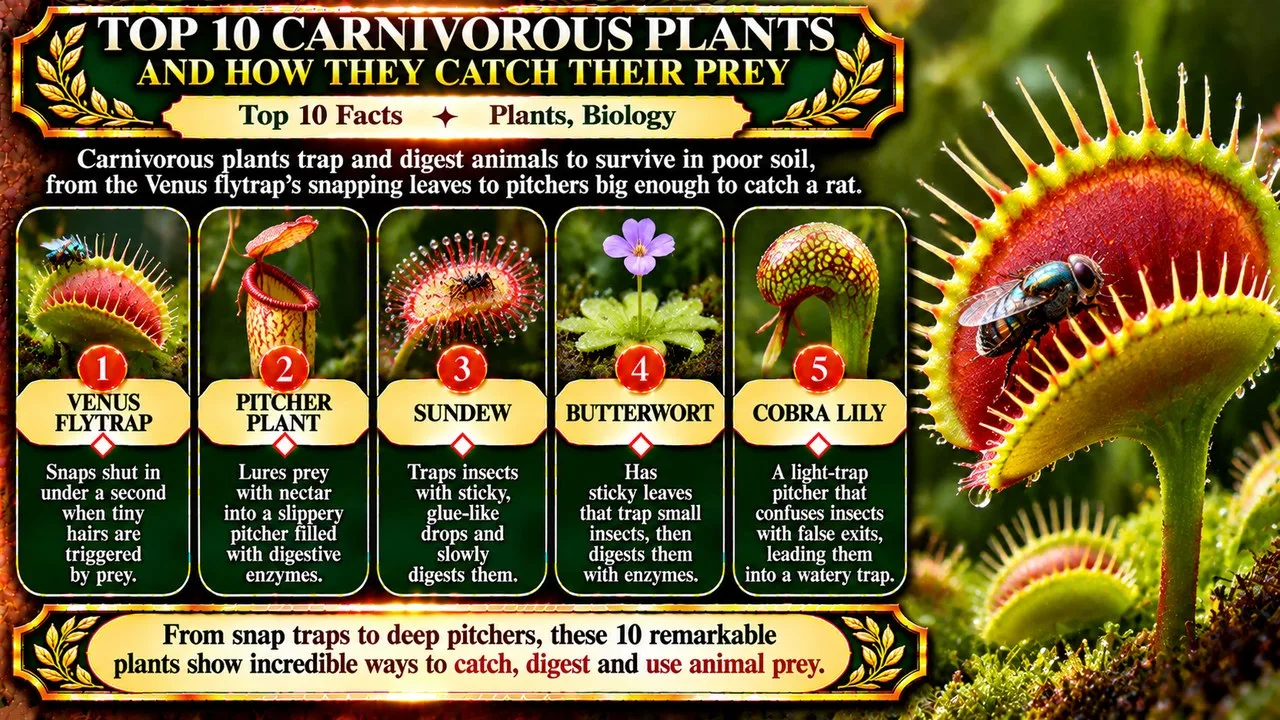
Carnivorous plants trap and digest animals to survive in poor soil, from the Venus flytrap's snapping leaves to pitchers big enough to catch a rat.
Carnivorous plants are flowering plants that catch, kill and digest small animals, mostly insects, and absorb the nutrients they release. They grow in sunny, waterlogged places such as acidic bogs, where the soil holds very little nitrogen, and they grow on all continents apart from Antarctica [1]. Charles Darwin was the first to study them in depth, and his 1875 book Insectivorous Plants showed that the habit was real and important [1].
Carnivory has evolved independently many times in different plant families, and botanists group the traps into five basic types: pitfalls, sticky flypaper leaves, snap traps, suction bladders and lobster-pot traps that steer prey one way [1]. This Finepedia guide, written in November 2026, takes its topic from a Listverse list of plants that eat animals [25], but the selection, order and wording are our own. We chose ten plants or plant groups that between them cover all five trap types, and checked each one against encyclopaedias, botanical studies and science news reports.
Key Facts
This table sums up all ten plants and the trap each one uses.
Carnivorous Plants at a Glance
| Rank | Name | Native range | Key figure | Trap type |
|---|---|---|---|---|
| 1 | Venus Flytrap | North and South Carolina, USA | Six trigger hairs per trap | Snap trap |
| 2 | Tropical Pitcher Plants | Southeast Asia to Madagascar | Pitchers up to 41 cm tall | Pitfall |
| 3 | North American Pitcher Plants | Eastern North America | About 8 to 11 species | Pitfall |
| 4 | Cobra Lily | Northern California and Oregon | Only species in its genus | Pitfall with false exits |
| 5 | Sundews | Every continent but Antarctica | About 150 to 194 species | Sticky flypaper |
| 6 | Bladderworts | Fresh water worldwide | Suction in about half a millisecond | Suction bladder |
| 7 | Waterwheel Plant | Europe, Asia, Africa, Australia | Traps only 2 to 3 mm long | Underwater snap trap |
| 8 | Butterworts | Northern Hemisphere and the Andes | More than 120 species | Greasy flypaper |
| 9 | Corkscrew Plants | Africa and tropical America | Carnivory proven in 1998 | Underground lobster pot |
| 10 | Portuguese Sundew | Portugal, Spain and Morocco | Leaves 10 to 20 cm long | Flypaper on dry ground |
1. Venus Flytrap
The Venus flytrap, Dionaea muscipula, is the most famous carnivorous plant in the world and the sole member of its genus. In the wild it grows only in damp, sandy wetlands of North and South Carolina [2][4], almost all of it within about 75 miles of Wilmington, North Carolina [3].
Each trap is the end of a leaf, made of two hinged lobes edged with stiff teeth. On the inner faces sit six sensitive hairs, three on each lobe [4]. A single touch is not enough: the trap closes only if a second hair is touched within about 20 seconds, a check that stops it wasting energy on rain or debris [2]. In normal daytime warmth the lobes shut in about half a second, then glands release a red digestive fluid. Digestion takes about ten days, and a trap dies after catching three or four insects [4].
The flytrap takes first place because it is the clearest example of a plant that moves to hunt. It is also rarer than its fame suggests. A 2019 survey estimated that only about 302,000 plants were left in the wild, and poaching and habitat loss continue to threaten them [2].
2. Tropical Pitcher Plants
Tropical pitcher plants, the genus Nepenthes, are mostly climbing vines of the Old World tropics. Depending on the authority the genus holds roughly 140 to 170 species, ranging from southern China and the Philippines through Borneo and Sumatra to Madagascar, the Seychelles, India and northern Australia [5][8]. Each leaf ends in a tendril that swells into a pitcher with a slippery, often brightly coloured rim and a pool of digestive fluid inside. Insects lured by nectar lose their footing, fall in and drown [5][8]. The nickname monkey cups comes from an old belief that monkeys drank rainwater from the pitchers [5].
The giant of the group is Nepenthes rajah, found only on Mount Kinabalu and nearby Mount Tambuyukon in Sabah, Malaysian Borneo, at about 1,500 to 2,650 metres [6]. Its urn-shaped traps can reach 41 centimetres in height and hold about 3.5 litres of liquid. Ants are its usual prey, but it occasionally traps frogs, lizards and even rats [6].
Some of these plants have found a stranger diet. Mountain tree shrews and summit rats visit N. rajah to lick nectar from the underside of its lid and leave their droppings in the pitcher, which supplies the plant with nitrogen [7][8]. That mix of hunting and toilet duty earns the genus second place.
Related: Top 25 Interesting Facts About the Solar System
3. North American Pitcher Plants
The North American pitcher plants, or trumpet pitchers, belong to the genus Sarracenia, which has about 8 to 11 species [9]. They grow along the eastern side of North America, from south-eastern Canada and the Great Lakes to Texas, but most species are found only in the south-eastern United States [9][8].
Each plant forms a cluster of tall, tube-shaped leaves with a lid, or hood, above the opening. A trail of nectar glands leads insects up to the lip and into the throat, which is so smooth that visitors tumble into the liquid at the base [8][9]. Downward-pointing hairs stop them climbing back out, and enzymes break down their bodies [9]. Colour and scent add to the lure [9].
The family includes some striking forms. The purple pitcher plant, S. purpurea, has squat, jug-like leaves that have been known to catch salamanders, while the green pitcher plant is critically endangered and survives in only a few parts of Alabama, Georgia, North Carolina and Tennessee [8]. Their bright trumpets make these some of the most recognisable wild plants of American bogs and pine savannas.
4. Cobra Lily
Known to botanists as Darlingtonia californica, the cobra lily is the sole species of its genus and a close relative of the trumpet pitchers. It grows in northern California and south-western Oregon, always where cold water keeps flowing through bogs, fens and seeps, and most often on nutrient-poor serpentine rock [10][11].
Its name comes from the shape of its leaves. Each tube rises and curls over at the top into a rounded hood, with a forked appendage hanging in front of the opening that looks like a snake's tongue or fangs [10]. This fishtail appendage carries nectar glands that tempt insects towards the mouth [11]. Once inside, prey see light shining through translucent patches in the hood, which act as false exits. Insects fly up towards them, tire, and finally slide down the tube [10].
Botanist William Brackenridge found the plant in 1841 near Mount Shasta during the Wilkes Expedition, and John Torrey named it in 1853 after the Philadelphia botanist William Darlington [10]. Its trick of fake windows is unlike anything used by the other pitcher plants on this list.
5. Sundews
Sundews, the genus Drosera, are among the largest groups of carnivorous plants, with roughly 150 to 194 species depending on the count, native to every continent except Antarctica [12][13]. Many form low rosettes of leaves less than 2.5 centimetres across, but their leaves are covered in gland-tipped hairs, often called tentacles, each holding a glistening bead of sticky mucilage [13].
Related: Top 10 Mythical Creatures in World Mythology - That Inspired Myths Across Civilizations (unchanged)
The beads look like morning dew, which gives the plant both its English name and its Greek one [12]. An insect that lands is caught in the glue, and in many species the tentacles slowly bend over to press it against more glands. Enzymes then digest the body, and when the meal is finished the leaf unfurls and resets [13].
Sundews hold a special place in science. Charles Darwin ran years of experiments on the round-leaved sundew, Drosera rotundifolia, and those tests were the first to confirm that plants could really be carnivorous [12]. In an 1860 letter he admitted that he cared more about Drosera at that moment than about the origin of all the species in the world [12]. Their worldwide range and slow-motion hunting make them a natural choice here.
6. Bladderworts
Bladderworts, the genus Utricularia, are the largest group on this list, with about 233 species living in fresh water and waterlogged soil on every continent except Antarctica [14]. They have no roots. Instead, their stems and leaves carry tiny bladders, from 0.02 to 1.2 centimetres across, that act as underwater vacuum traps [14].
Each bladder pumps water out until it is under low pressure, with a small trapdoor held shut. When a water flea or mosquito larva brushes the trigger hairs, the door flips open and water rushes in, carrying the prey with it [14]. High-speed filming has shown that the suction stage takes only about half a millisecond, making it one of the fastest movements known in the plant world [15][16]. Aquatic species can catch fish fry and young tadpoles as well as tiny crustaceans [14].
Above the water, bladderworts produce delicate flowers often compared to snapdragons or orchids, so few people guess what is happening below the surface [14]. Their speed earns them sixth place.
7. Waterwheel Plant
Aldrovanda vesiculosa, better known as the waterwheel plant, is a rootless plant that floats just below the surface of still, fresh water. It is the only living species of its genus, although up to 19 extinct species are known from fossils [17]. Its traps are arranged in whorls of five to nine around the stem, like the spokes of a wheel, which gives the plant its name [17].
Each trap is only 2 to 3 millimetres long, but it works like a miniature Venus flytrap. Trigger hairs inside the two lobes sense small swimming animals, and the trap snaps shut around them [17]. The two plants are close relatives in the sundew family, and the waterwheel is one of very few plants able to move quickly [17].
Related: Top 25 Interesting Facts About the Universe
The species was once spread widely in Europe, Africa, Asia and Australia, but it has declined sharply and is listed as endangered on the IUCN Red List [18]. Only about 50 wild populations were confirmed at last count [17]. It makes the list as the underwater cousin of the flytrap.
8. Butterworts
Butterworts, the genus Pinguicula, are low plants with flat rosettes of pale, greasy-looking leaves. More than 120 species are known, with many in Europe and North America and the largest number in Central and South America [19][20]. The genus name comes from the Latin pinguis, meaning fat, a word applied by the Swiss naturalist Conrad Gesner in 1561 to the glistening leaves [19].
The leaves work like fly paper. One type of gland produces beads of sticky mucilage that attract small insects such as gnats and fruit flies, while a second type, lying flat on the surface, releases digestive enzymes once an insect is stuck [20]. In some species the leaf edges curl slowly towards a struggling insect, which helps keep the nutrients on the leaf. The leaves can also catch and digest windblown pollen [20].
Many butterworts live in cold places and survive winter as tight buds called hibernacula, while some warm-climate species switch to fleshy, non-carnivorous leaves for part of the year [19][20]. Their quiet, buttery traps make them one of the easiest carnivores to overlook.
9. Corkscrew Plants
Corkscrew plants, the genus Genlisea, are small herbs of wet ground in Africa and Central and South America, with about 30 species [21]. Above ground they show only a small rosette of green leaves and a tall stem of flowers. The real action happens underground, where the plant grows a second set of pale, highly modified leaves shaped like twisted tubes [21].
These buried leaves are lobster-pot traps. Tiny animals, mainly protozoa, enter slits along two spiral arms, where inward-pointing hairs force them deeper towards the part of the leaf that digests them [1][21][22]. Charles Darwin suspected the plant was carnivorous, but proof came only in 1998, when a team led by German botanist Wilhelm Barthlott showed that the leaves catch and digest protozoa, perhaps thousands a day [21][22].
Related: Top 25 Weird Facts About Left-Handed People
The genus is named after the French writer Stephanie Felicite, comtesse de Genlis. Several species also have some of the smallest genomes known in flowering plants [21]. Because it hunts single-celled prey in the soil, Genlisea shows how far carnivory can stretch.
10. Portuguese Sundew
Drosophyllum lusitanicum, known as the dewy pine or Portuguese sundew, is the sole member of its genus and family. It looks much like a true sundew but sits in a plant family of its own [23][24]. It grows in Portugal, south-western Spain and northern Morocco [23][24].
Unlike most carnivorous plants, it lives in dry places. It grows on acidic, nutrient-poor heathland and scrub that is regularly swept by fire, a habitat very different from the wet bogs where other carnivores grow [24]. A study in Annals of Botany found that the plant relies heavily on prey for nutrients in these dry heathlands [24].
Its leaves, 10 to 20 centimetres long, unroll from a central rosette and are covered in stalked and stalkless glands that hold sticky beads [23]. The leaves do not move, so the strong glue does all the work, and insects that land become stuck and are slowly digested [23][24]. It closes the list as proof that carnivorous plants can thrive far from the swamp.
Conclusion
From the snapping Venus flytrap to the corkscrew plant hunting protozoa underground, these ten plants show the many ways flowering plants have learned to feed on animals. Pitfalls, glue, snap traps, suction bladders and lobster pots each solve the same problem: how to get nitrogen and other nutrients from soil that offers almost none [1].
Many carnivorous plants are now threatened by drainage, development and collection, and a 2020 assessment found that about a quarter of species face extinction [1]. For more remarkable plants, see Top 10 Unusual Flowers of the World and Top 10 Most Poisonous Plants on Earth.
- ^ [1] "Carnivorous plant". Wikipedia. Wikipedia
- ^ [2] "Venus flytrap". Wikipedia. Wikipedia
- ^ [3] "5 Things You Didn't Know About Venus Flytraps". NC State College of Natural Resources. NC State
- ^ [4] "Venus flytrap". Encyclopaedia Britannica. Britannica
- ^ [5] "Nepenthes". Wikipedia. Wikipedia
- ^ [6] "Nepenthes rajah". Wikipedia. Wikipedia
- ^ [7] "Small mammals use Borneo pitcher plant as toilet in exchange for nectar". Mongabay. Mongabay
- ^ [8] "Pitcher plant". Encyclopaedia Britannica. Britannica
- ^ [9] "Sarracenia". Wikipedia. Wikipedia
- ^ [10] "Darlingtonia californica". Wikipedia. Wikipedia
- ^ [11] "Darlingtonia californica, California pitcherplant". US Forest Service. USDA Forest Service
- ^ [12] "Drosera". Wikipedia. Wikipedia
- ^ [13] "Sundew". Encyclopaedia Britannica. Britannica
- ^ [14] "Utricularia". Wikipedia. Wikipedia
- ^ [15] "Carnivorous bladderworts suck up prey". Science News. Science News
- ^ [16] "The biomechanics of fast prey capture in aquatic bladderworts". Biology Letters via PubMed Central. PubMed Central
- ^ [17] "Aldrovanda vesiculosa". Wikipedia. Wikipedia
- ^ [18] "Waterwheel plant". Encyclopaedia Britannica. Britannica
- ^ [19] "Pinguicula". Wikipedia. Wikipedia
- ^ [20] "Butterwort". Encyclopaedia Britannica. Britannica
- ^ [21] "Genlisea". Wikipedia. Wikipedia
- ^ [22] "Protozoan-Killing Plants". Discover Magazine. Discover
- ^ [23] "Drosophyllum". Wikipedia. Wikipedia
- ^ [24] "Plant carnivory beyond bogs: reliance on prey feeding in Drosophyllum lusitanicum". Annals of Botany via PubMed Central. PubMed Central
- ^ [25] "10 Plants That Eat Animals". Listverse. Topic reference on Listverse






















Discussion
Log in with