






 By
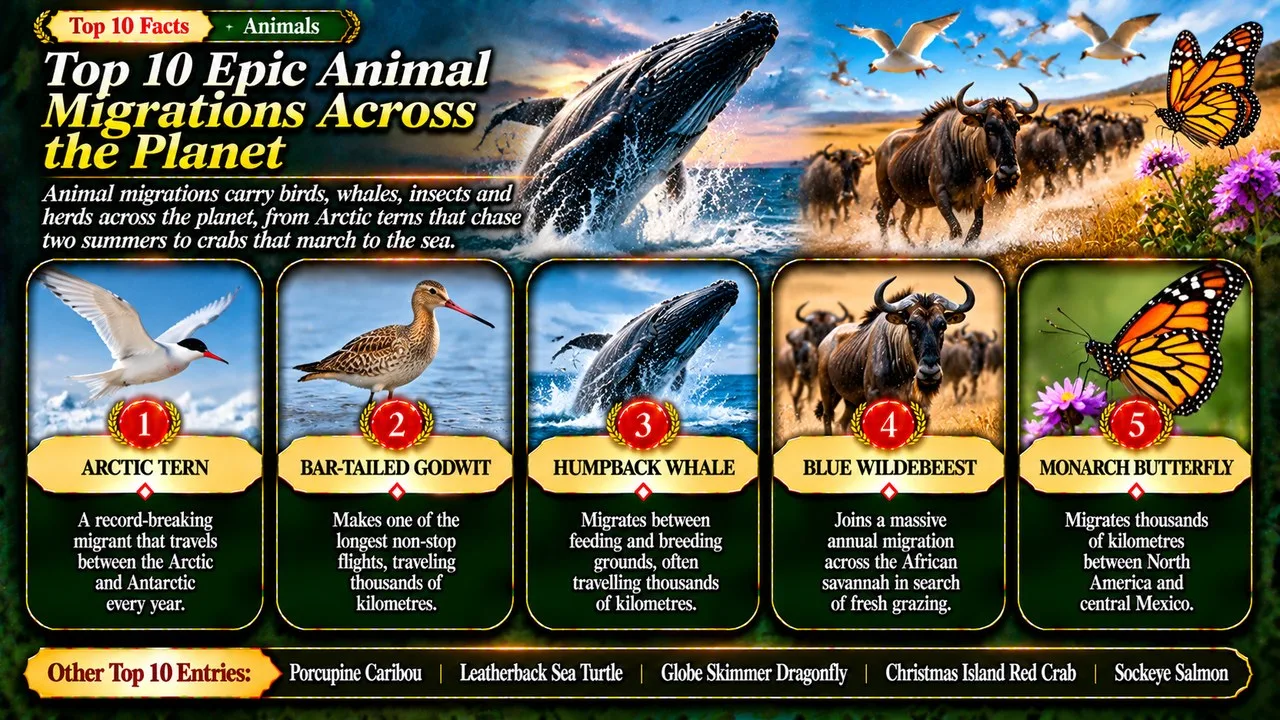
Animal migrations carry birds, whales, insects and herds across the planet, from Arctic terns that chase two summers to crabs that march to the sea.
Migration is the regular, often seasonal movement of animals from one place to another and back again, usually to find food, escape harsh weather or reach safe places to breed [1]. It is found in every major animal group, from insects to whales, and many of the longest journeys have only been measured in the last 20 years, thanks to tiny tracking tags and satellites [1].
This Finepedia guide, written in November 2026, takes its topic from a Listverse list of extraordinary animal migration journeys [23], but the selection, order and wording are our own. We ranked the journeys for distance, scale and sheer endurance, and swapped in the leatherback turtle and the Christmas Island red crab for two of the original entries to cover reptiles and a land-to-sea march. Every distance below comes from tracking studies, government wildlife agencies or record bodies, and is given as reported as of November 2026.
Key Facts
This table sums up all ten migrations and their headline figures.
Animal Migrations at a Glance
| Rank | Name | Route | Key figure | Notable fact |
|---|---|---|---|---|
| 1 | Arctic Tern | Arctic to Antarctica and back | 96,000 km in one year (record bird) | Sees two summers a year |
| 2 | Bar-Tailed Godwit | Alaska to New Zealand or Australia | 13,560 km nonstop | Flew 11 days without landing |
| 3 | Humpback Whale | Polar seas to tropical breeding grounds | Up to about 8,000 km one way | One of the longest mammal migrations |
| 4 | Blue Wildebeest | Serengeti to Maasai Mara loop | About 1.5 million animals | Around 8,000 calves born a day at peak |
| 5 | Monarch Butterfly | Canada and the US to central Mexico | Up to 3,000 miles | The migrating generation has never seen Mexico |
| 6 | Porcupine Caribou | Alaska and Yukon to the Beaufort coast | About 450 miles each spring | Longest overland migration of any land mammal |
| 7 | Leatherback Sea Turtle | Indonesia to the US West Coast | About 7,000 miles | Crosses the Pacific to eat jellyfish |
| 8 | Globe Skimmer Dragonfly | India to Africa and back | 14,000 to 18,000 km circuit | Longest known insect migration |
| 9 | Christmas Island Red Crab | Forest to sea on Christmas Island | Tens of millions of crabs | Roads close for the march |
| 10 | Sockeye Salmon | Pacific Ocean to home rivers | Up to 1,600 km inland | Spawns once and then dies |
1. Arctic Tern
The Arctic tern is a slim, grey and white seabird that breeds around the Arctic and spends the northern winter around Antarctica, so it experiences two summers every year [2]. The shortest distance between its breeding and wintering areas is about 19,000 kilometres, but terns rarely fly in a straight line, following winds and rich feeding areas instead [2].
Light-level geolocator tags have revealed how far they really go. Birds that bred in Greenland and Iceland averaged about 70,900 kilometres a year, with one reaching 81,600 kilometres [2]. In 2016 Newcastle University reported that a tern from the Farne Islands off Northumberland had flown about 96,000 kilometres, almost 60,000 miles, in a round trip to the Weddell Sea in Antarctica, the longest migration ever recorded for any bird [3][2].
Arctic terns often live 15 to 30 years, with a record of 31, so a single bird may fly well over a million kilometres in its lifetime [2]. No other animal is known to travel so far each year, which puts the tern at the top of this list.
2. Bar-Tailed Godwit
The bar-tailed godwit is a long-billed wading bird, and the Alaskan population makes the longest known nonstop flights of any bird [4]. Each autumn the birds leave Alaska and fly across the Pacific to New Zealand and eastern Australia without landing, feeding or drinking. To do it they carry the largest fat loads of any migratory bird studied and shrink their digestive organs before departure [4].
Satellite tags have set one record after another. In 2007 a female flew 11,680 kilometres from Alaska to New Zealand in about eight days [4]. In October 2022 a juvenile tagged B6 left Alaska on 13 October and landed in north-eastern Tasmania 11 days and 1 hour later, having flown at least 13,560 kilometres, or about 8,425 miles [4][5]. Guinness World Records lists this as the longest nonstop migration by a bird [5].
B6 was a juvenile bird on its first southward journey [5]. For pure endurance, no other migrant comes close to the godwit.
Related: Top 10 Animals That Can Live Without Food for Months
3. Humpback Whale
Humpback whales live in all the world's oceans and make one of the longest migrations of any mammal. Each year they move between cold, rich feeding grounds near the poles and warm tropical waters where they mate and give birth [10][11]. NOAA Fisheries says some populations swim about 5,000 miles between the two [11].
Individual whales have been recorded travelling up to 8,000 kilometres in one direction [10]. Southern Hemisphere humpbacks feed near Antarctica in summer and head north to breeding areas off Australia, Africa and South America, and Northern Hemisphere populations make similar journeys in the opposite season [10][11]. Adults are 14 to 17 metres long and can weigh up to 40 tonnes [10].
The breeding grounds are also where males sing the long, complex songs the species is famous for [10]. A journey this long by an animal of that size, repeated every year, earns the humpback third place.
4. Blue Wildebeest
The great migration of East Africa is the largest movement of land mammals on the planet. NASA's Earth Observatory describes the Serengeti as the site of the largest unaltered animal migration in the world, with around 1.5 million wildebeest circling the Serengeti plains of Tanzania and Kenya's Maasai Mara in search of fresh grass and water [9][8]. Hundreds of thousands of zebras and gazelles move with them [9].
The herds follow the rains on a roughly clockwise loop. In the early months of the year they gather on the short-grass plains of the southern Serengeti and the Ngorongoro area to give birth, and during the peak calving period of about six weeks some 8,000 calves are born each day [9]. Later the herds head north, and the crossings of the crocodile-filled Grumeti and Mara rivers are the most dangerous part of the loop, with drowning a constant risk [9]. NASA puts the full journey at about 1,000 kilometres [9].
The total wildebeest population is estimated at around 1.5 million and is considered stable [8]. Few sights in nature match a herd stretching to the horizon, which is why the migration is ranked fourth.
5. Monarch Butterfly
The monarch is the only butterfly known to make a two-way migration as birds do [7]. Each autumn, monarchs from southern Canada and the northern United States fly south to overwinter, the eastern population in the mountains of central Mexico and the western population on the California coast [6][7]. Some travel as far as 3,000 miles, covering 50 to 100 miles a day for up to two months [7].
Related: Top 10 Amazing Animals of the Amazon Rainforest
In Mexico they gather in the same 11 or 12 mountain areas of the states of Mexico and Michoacan, roosting in oyamel fir forests 2,400 to 3,600 metres above sea level [7]. Tens of thousands may cluster on one tree, and in 1986 Mexico set up a biosphere reserve to protect these forests for the butterflies [7].
The most remarkable part is that no single butterfly makes the round trip. The southbound generation lives far longer than its parents, and three to four generations are needed to return north in spring [6][7]. The migrating butterflies find their winter home even though they have never been there before [7].
6. Porcupine Caribou
The Porcupine caribou herd ranges across north-eastern Alaska and the northern Yukon and takes its name from the Porcupine River [12]. The herd spends winter scattered across the Brooks Range and nearby mountains, and in late March pregnant females begin walking north to calve on the coastal plain of the Arctic National Wildlife Refuge [13].
The US Fish and Wildlife Service says the cows travel roughly 450 miles every spring to reach the coast, arriving in May as the snow melts [13]. Bulls join them later in the summer before the herd drifts back south [13]. National Park Service research has found that over a full year the herd completes the longest overland migration of any land mammal on Earth [13][12].
The herd's numbers rose sharply in the 2010s, and in 2017 biologists reported what may have been its largest count since modern monitoring began in the 1970s [12]. A 2017 US law opened part of the refuge's coastal plain to oil and gas drilling, which conservationists see as a threat to the calving grounds [12].
7. Leatherback Sea Turtle
The leatherback is the largest living turtle, reaching up to about 700 kilograms, and both its common and scientific names refer to its leathery carapace [16]. It feeds mainly on jellyfish and makes some of the longest journeys of any reptile [16][17].
Western Pacific leatherbacks nest on beaches in Indonesia and the Solomon Islands, then cross the ocean to feed on jellyfish off California, Oregon and Washington [16][17]. NOAA Fisheries says these endangered turtles migrate about 7,000 miles across the Pacific to reach North American waters [17]. One turtle tracked from a beach in Papua, Indonesia, swam some 20,000 kilometres over 647 days before reaching the United States [16].
Related: Top 10 Fascinating Spiders of the World
After feeding, adults swim back west to nest, and NOAA says the crossing takes nine to eleven months [17]. NOAA surveys show that numbers off the West Coast have fallen steeply, so this record-breaking journey is now under serious threat [17].
8. Globe Skimmer Dragonfly
The globe skimmer, Pantala flavescens, is a medium-sized, golden-orange dragonfly found on every continent except Antarctica [14]. In 2009 the biologist Charles Anderson, working in the Maldives, proposed that huge numbers of these insects cross the western Indian Ocean from India to East Africa each year, riding monsoon winds [15][14].
He estimated that the full multigenerational circuit, from India to southern Africa and back, covers 14,000 to 18,000 kilometres, the longest known migration of any insect [15][14]. Individual dragonflies fly more than 6,000 kilometres, and swarms stop over at the Maldives, the Seychelles and Mozambique [14]. Rain-filled pools left by the monsoon give their young a place to grow [14].
Stable isotope evidence has since backed the idea that the migrants cross the Arabian Sea from India or beyond [14]. An insect that crosses an ocean on its own wings deserves its place on this list.
9. Christmas Island Red Crab
The Christmas Island red crab is a large land crab, up to about 116 millimetres across its back, that lives only on Christmas Island and the Cocos (Keeling) Islands in the Indian Ocean [18]. For most of the year it lives in the forest, but every wet season it makes a mass march to the sea to breed [18][19].
The migration starts with the first rains of the wet season, and its exact timing is set by the phase of the moon. Millions of crabs leave the forest together and carpet roads, rocks and beaches on their way to the coast [19][18]. After mating, each female can carry up to 100,000 eggs, and when the high tide starts to turn before dawn in the moon's last quarter, she releases them into the sea [19].
Related: Top 10 Colourful Parrots of the World
Parks Australia closes roads and builds temporary barriers, underpasses and even crab bridges so the animals can cross safely [19][18]. Sir David Attenborough described filming it as one of his greatest television moments [19]. The spectacle earns the red crab its place, though invasive yellow crazy ants have killed millions of them [18].
10. Sockeye Salmon
The sockeye, or red salmon, is a Pacific salmon that hatches in fresh water, spends years at sea and then returns to its home river to spawn [20]. Its journeys inland can be enormous. Some populations travel up to 1,600 kilometres between the ocean and their spawning grounds, and those bound for Redfish Lake in Idaho swim more than 1,400 kilometres upriver and climb about 2,000 metres [20].
At sea, salmon appear to navigate using a magnetic sense and the movement of the sun across the sky as a compass, scientists told KDLG radio in Bristol Bay, Alaska [22]. Most return to the stream where they were born, although a small share stray to new waters, which lets the species colonise new places [21]. As they near spawning they turn red, which gives the species its other common name [20].
A female lays 2,000 to 5,000 eggs and then dies, like all sockeye after spawning [21][20]. A migration that ends in a single spawning closes our list.
Conclusion
These ten journeys range from a dragonfly riding monsoon winds to whales and wildebeest moving in their hundreds of thousands. Each shows a different solution to the same problem: food, warmth and safe breeding places are rarely found in one spot all year [1].
Many of the records here were only measured in the last two decades, and several of these migrations face pressure from habitat loss, climate change and busy roads and seas. For more remarkable animals, see Top 10 Longest Living Animals on Earth and Top 10 Unique Animals Found Only in Africa.
- ^ [1] "Animal migration". Wikipedia. Wikipedia
- ^ [2] "Arctic tern". Wikipedia. Wikipedia
- ^ [3] "Arctic Terns". Newcastle University Press Office. Newcastle University
- ^ [4] "Bar-tailed godwit". Wikipedia. Wikipedia
- ^ [5] "Longest non-stop migration by a bird". Guinness World Records. Guinness World Records
- ^ [6] "Monarch butterfly migration". Wikipedia. Wikipedia
- ^ [7] "Monarch Butterfly Migration and Overwintering". US Forest Service. US Forest Service
- ^ [8] "Blue wildebeest". Wikipedia. Wikipedia
- ^ [9] "Circling the Serengeti". NASA Earth Observatory. NASA
- ^ [10] "Humpback whale". Wikipedia. Wikipedia
- ^ [11] "Humpback Whale". NOAA Fisheries. NOAA Fisheries
- ^ [12] "Porcupine caribou". Wikipedia. Wikipedia
- ^ [13] "Caribou Food for Thought". US Fish and Wildlife Service. US Fish and Wildlife Service
- ^ [14] "Pantala flavescens". Wikipedia. Wikipedia
- ^ [15] "Dragonflies migrate 14,000-18,000 km from India to S. Africa". Mongabay. Mongabay
- ^ [16] "Leatherback sea turtle". Wikipedia. Wikipedia
- ^ [17] "Pacific Leatherback Turtles off the West Coast Disappearing, New Survey Shows". NOAA Fisheries. NOAA Fisheries
- ^ [18] "Christmas Island red crab". Wikipedia. Wikipedia
- ^ [19] "Red crab migration". Parks Australia, Christmas Island National Park. Parks Australia
- ^ [20] "Sockeye salmon". Wikipedia. Wikipedia
- ^ [21] "Sockeye Salmon Frequently Asked Questions". US National Park Service, Katmai. National Park Service
- ^ [22] "Fish Facts: How Bristol Bay salmon find their way home". KDLG. KDLG
- ^ [23] "10 Extraordinary Animal Migration Journeys". Listverse. Topic reference on Listverse





















Discussion
Log in with