




 By
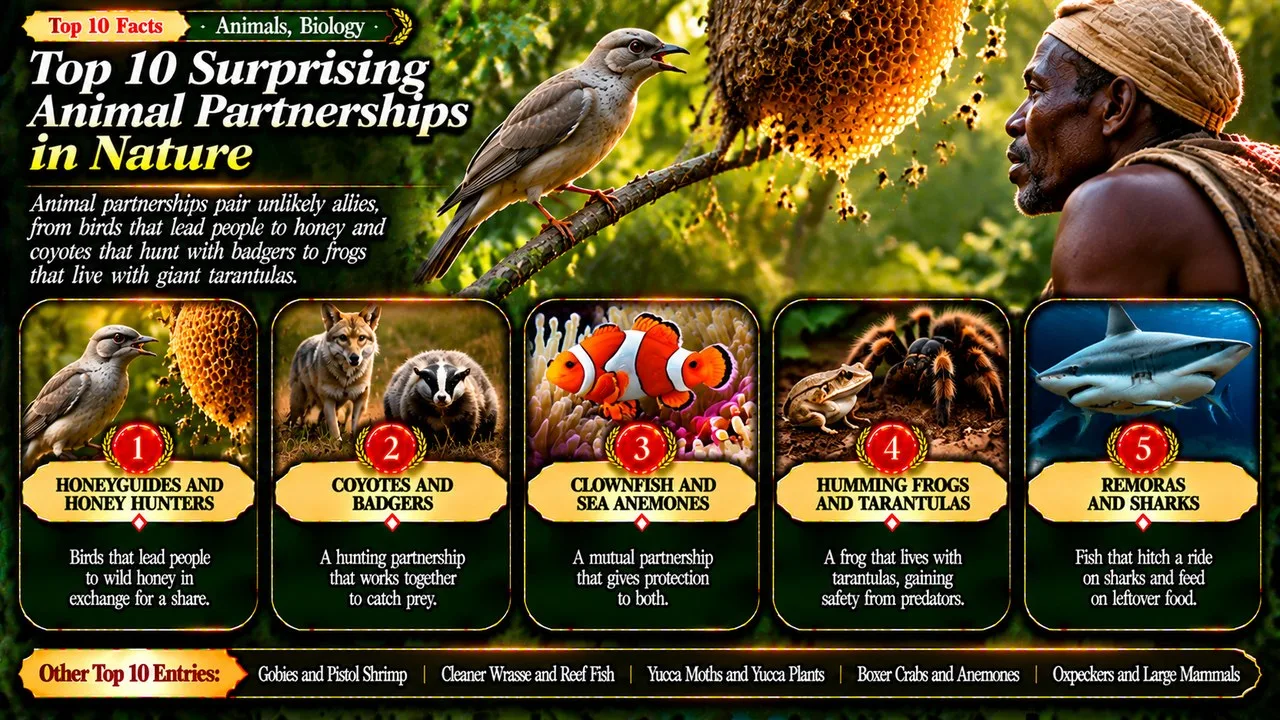
Animal partnerships pair unlikely allies, from birds that lead people to honey and coyotes that hunt with badgers to frogs that live with giant tarantulas.
Nature is often seen as fierce competition, but cooperation is common too. Biologists call close, long-term relationships between different species symbiosis. When both partners gain, it is called mutualism. When one gains and the other is barely affected, it is called commensalism. Some partnerships fall somewhere in between, and scientists still argue about who really benefits.
This Finepedia guide, written in November 2026, takes its topic from a Listverse list of unusual animal partnerships [23]. The selection, order and wording are our own. We kept six of its pairings, added clownfish, yucca moths, boxer crabs and cleaner wrasse, and left out the crocodile and plover, a popular story that lacks good evidence. Where research questions how much each partner really gains, we say so.
Key Facts
This table sums up the ten partnerships, the partners involved and what each side gets.
Surprising Animal Partnerships at a Glance
| Rank | Name | Partners | Where | What each side gets |
|---|---|---|---|---|
| 1 | Honeyguides and Honey Hunters | Greater honeyguide and people | Sub-Saharan Africa | People get honey; birds get wax |
| 2 | Coyotes and Badgers | Coyote and American badger | North America | Both catch more ground squirrels |
| 3 | Gobies and Pistol Shrimp | Goby and snapping shrimp | Tropical seas | Shrimp digs a home; goby keeps watch |
| 4 | Cleaner Wrasse and Reef Fish | Cleaner wrasse and client fish | Indo-Pacific reefs | Food for the wrasse; fewer parasites for clients |
| 5 | Clownfish and Sea Anemones | Clownfish and anemone | Indo-Pacific reefs | Shelter for the fish; care and defence for the anemone |
| 6 | Yucca Moths and Yucca Plants | Yucca moth and yucca | North America | Pollination for the plant; seeds for the larvae |
| 7 | Boxer Crabs and Anemones | Lybia crab and small anemones | Indo-Pacific | Weapons and food for the crab |
| 8 | Humming Frogs and Tarantulas | Dotted humming frog and tarantula | Western Amazon | Shelter for the frog; ant control for the spider |
| 9 | Remoras and Sharks | Remora and large sea animals | Warm oceans | A free ride and scraps for the remora |
| 10 | Oxpeckers and Large Mammals | Oxpecker and grazing mammals | Sub-Saharan Africa | Food for the bird; benefits to the host debated |
1. Honeyguides and Honey Hunters
The greater honeyguide is a small bird of sub-Saharan Africa related to woodpeckers. It has one of the most remarkable partnerships in nature: it works with people [1]. Honeyguides love to eat beeswax, but they cannot easily break into wild bees' nests on their own. People can open the nests but often struggle to find them.
The bird leads honey hunters to a nest with chattering calls and short flights from tree to tree. The hunters then calm the bees with smoke, open the nest and take the honey, leaving the wax for the bird [1][2]. In northern Mozambique, Yao honey hunters summon honeyguides with a traditional call, a loud trill followed by a grunt that sounds like brrr-hm, which is passed down through generations [2][1].
In 2016 a team led by Claire Spottiswoode of the University of Cambridge showed that the birds really do respond to this call. Playing it greatly increased the chances of being guided by a honeyguide and of being shown a bees' nest, compared with other sounds [2][1]. It is one of the few known cases of free-living wild animals and humans cooperating with signals understood by both sides. That rare two-way bond takes first place.
2. Coyotes and Badgers
Coyotes and American badgers are both predators, and sometimes they even prey on each other. Yet in parts of North America they team up to hunt ground squirrels and prairie dogs [3][5]. Each partner brings a different skill. The badger is a powerful digger that chases prey underground, while the coyote is a fast runner that catches animals above ground.
When the two hunt together, a squirrel that hides from the badger in its burrow may be dug out, and one that runs from its burrow may be caught by the coyote. A 1992 study in Wyoming by Steven Minta and colleagues found that coyotes hunting with badgers caught about 34 percent more ground squirrels than those hunting alone [4][24]. Badgers also seemed to benefit, spending more time underground and active when a coyote was nearby [4][24].
Related: Top 10 Extraordinary Lizards of the World
The bond can look surprisingly friendly. Coyotes have been seen laying their heads on their badger companions or licking their faces [3]. Native American stories have long referred to the two animals working together, and researchers are still studying how often and why they team up [5]. Two rival hunters who choose to work together earn second place.
3. Gobies and Pistol Shrimp
On sandy sea floors in tropical waters, certain gobies and pistol shrimp share a home. Pistol shrimp, also called snapping shrimp, are famous for their oversized claw, which snaps shut with a loud crack [6]. But some species have poor eyesight, which leaves them vulnerable outside their burrows.
The shrimp does the building. It digs and constantly maintains a burrow in the sand, which the goby shares [6][7]. In return, the goby acts as a lookout, sitting at the entrance and watching for predators. While the shrimp works, it keeps one of its long antennae touching the goby's body [6][7].
If danger appears, the goby flicks its tail, and the shrimp feels the signal through its antenna. Both then dash into the burrow together [6][7]. The goby also gains a safe place to rest and lay its eggs. The Aquarium of the Pacific notes that the partners communicate mainly by touch [7]. A pairing of a builder and a guard earns third place.
4. Cleaner Wrasse and Reef Fish
The bluestreak cleaner wrasse is one of the most common cleaner fish on tropical reefs in the Indian and Pacific oceans [8]. It runs cleaning stations, fixed spots on the reef where other fish, called clients, come to be groomed. The wrasse eats parasites, dead tissue and loose scales from their bodies [8].
Large and often predatory fish line up and open their mouths and gill covers, letting the tiny wrasse swim inside to clean [8]. It is rare for a client to eat its cleaner, perhaps because the cleaning service is too valuable to lose [8]. The relationship is not always fair. Cleaners sometimes cheat by biting off healthy tissue and mucus, which is costly for the client to produce [8].
Cleaner wrasse are also surprisingly clever. In a study published in 2019 by researchers from Osaka City University, the Max Planck Institute for Ornithology and the University of Konstanz, cleaner wrasse tried to scrape off coloured marks on their bodies that they could only see in a mirror [9][8]. Some scientists say this shows a form of self-recognition, while others disagree [8]. A tiny fish that runs a reef health service earns fourth place.
5. Clownfish and Sea Anemones
Clownfish, also called anemonefish, are among the best-known partnerships on the reef, made famous by the film Finding Nemo [10]. These colourful fish live in the warm waters of the Indian and Pacific oceans and rely on sea anemones for shelter and protection [10][11].
Related: Top 10 Animals That Can Live Without Food for Months
Sea anemones have stinging tentacles that can paralyse small fish. Clownfish, however, have a protective coat of mucus and adjust it to their own host anemone, so they can live among the tentacles without being stung [11][10]. Predators that chase them are not so lucky. Each fish forms a relationship with a particular anemone [11].
The anemone benefits too. Clownfish chase away fish that eat anemones, clean and fan their hosts, and provide nutrients through their waste [10]. Clownfish also have an unusual social life. They live in small groups led by a breeding female, and if she disappears, the breeding male changes sex and takes her place [10][11]. A partnership that is both famous and well studied earns fifth place.
6. Yucca Moths and Yucca Plants
Yucca plants of North America have one of the tightest partnerships in the plant world. Their flowers are pollinated by yucca moths, and the moths' caterpillars can feed only on yucca seeds [12][13]. It is a classic example of mutualism, in which each partner depends on the other [12][13].
The female moth does something no ordinary pollinator does. Using two tentacle-like mouthparts, she scrapes pollen from a yucca flower and packs it into a sticky ball under her chin [14][12]. She then flies to another flower, cuts a small hole in its ovary and lays her eggs inside. Afterwards, she pushes some of the pollen onto the flower's stigma, deliberately fertilising it [14][13].
The fertilised flower grows seeds, and the moth's larvae eat some of them, but enough are left for the plant to reproduce [14]. Scientists estimate that the partnership is tens of millions of years old [12]. Some yuccas, such as those in Zion National Park, are pollinated by just one moth species [13][12]. A moth that deliberately plants its own food supply earns sixth place.
7. Boxer Crabs and Anemones
Boxer crabs, also called pom-pom crabs or cheerleader crabs, belong to the genus Lybia and live in shallow tropical waters of the Indo-Pacific [15]. They are named for their habit of holding a tiny sea anemone in each claw, which look like pom-poms or boxing gloves [15][16].
Related: Top 10 Fascinating Spiders of the World
The anemones serve as weapons. If a predator comes too close, the crab waves an anemone at it, threatening it with stinging tentacles [15]. The anemones also help the crab to feed. Its claws are thin and weak, so it uses the anemones' tentacles to collect particles of food, which it then picks off with its mouthparts [15].
A 2017 study found that the crabs are almost never seen without their anemones. When a crab loses one, it can split the remaining anemone in two, and both halves regrow into identical clones [16]. Crabs may also fight to steal anemones from each other [16]. A crab that carries living boxing gloves earns seventh place.
8. Humming Frogs and Tarantulas
In the western Amazon, the dotted humming frog, a small frog of the species Chiasmocleis ventrimaculata, lives with large burrowing tarantulas [17][18]. Between one and four frogs may be seen coming out of a tarantula's burrow, and they return to the same burrow rather than moving between them [17].
The partnership was described in a 1989 study by Reginald Cocroft and Kenneth Hambler in south-eastern Peru [18][17]. Tarantulas eat small frogs, yet they leave these frogs alone, and the spider's presence may protect the frog and its eggs from predators [17][18]. The frogs leave the burrow cautiously at dusk to feed [17].
The spider may also gain something. Humming frogs specialise in eating ants, and ants are major predators of spider eggs, so the frog may help guard the tarantula's young [18][17]. The original study called the relationship commensal, but many scientists now suspect it is mutual [18]. A tiny frog living safely with a giant spider earns eighth place.
9. Remoras and Sharks
Remoras, also called suckerfish or sharksuckers, are fish whose first dorsal fin has evolved into an oval sucking disc on top of the head. It lets the remora grip the skin of a larger animal [19][20].
Remoras spend most of their lives attached to hosts such as sharks, rays, whales and turtles [19]. By hitching a ride, they travel farther than they could swim alone and save energy [19][20]. Along the way they eat their host's food scraps, bacteria, parasites and waste [20].
Related: Top 10 Amazing Animals of the Amazon Rainforest
Whether the host benefits is less clear. Remoras can remove parasites and loose skin, which may help, but they can also add drag [19][20]. A 2025 study found that green turtles in the Red Sea with many remoras attached spent less time grazing [19]. The relationship is often described as commensalism, sitting somewhere between a helpful partnership and a burden depending on the host [19]. The ocean's best-known hitchhiker earns ninth place.
10. Oxpeckers and Large Mammals
Oxpeckers are two species of African birds, the red-billed and yellow-billed oxpeckers, that spend their days perched on large mammals such as cattle, zebras, giraffes, buffalo and rhinoceroses [21]. They feed on ticks and other parasites picked from their hosts' skin, and in Swahili the red-billed oxpecker is called the rhino's guard [21].
For a long time the oxpecker was the textbook example of mutualism, with the birds removing harmful ticks and raising an alarm when predators came near [21][22]. Research has complicated that picture. A study in Zimbabwe by Paul Weeks, published in 2000, found that oxpeckers on cattle spent much of their time feeding on wounds and earwax rather than on adult ticks [22].
Removing the birds did not clearly reduce tick numbers, and wounds healed faster when oxpeckers were kept away [22][21]. Oxpeckers also drink blood from open wounds, which is why some scientists see them as partly parasitic [21][22]. Others think wild hosts still benefit overall [22]. A partnership whose true balance is still debated closes our list.
Conclusion
From honeyguides that work with people to remoras that ride on sharks, these ten partnerships show how varied cooperation in nature can be. Some are true mutualism, some mostly benefit one side and a few are still being studied.
The best stories are those backed by careful research, which is why we left out popular tales that lack evidence. For more remarkable animals, see Top 10 Unique Animals Found Only in Africa and Top 10 Bioluminescent Sea Animals That Use Light to Survive.
- ^ [1] "Greater honeyguide". Wikipedia. Wikipedia
- ^ [2] "How humans and wild birds collaborate to get precious resources of honey and wax". University of Cambridge. University of Cambridge
- ^ [3] "Coyote". Wikipedia. Wikipedia
- ^ [4] "What Birds, Coyotes, and Badgers Know About Teamwork". JSTOR Daily. JSTOR Daily
- ^ [5] "Strange Bedfellows". National Parks Conservation Association. NPCA
- ^ [6] "Alpheidae". Wikipedia. Wikipedia
- ^ [7] "Watchman Goby". Aquarium of the Pacific. Aquarium of the Pacific
- ^ [8] "Cleaner wrasse". Wikipedia. Wikipedia
- ^ [9] "Are fish aware of themselves?". Max Planck Society. Max Planck Society
- ^ [10] "Clownfish". Wikipedia. Wikipedia
- ^ [11] "Clown Anemonefish". Florida Museum of Natural History. Florida Museum
- ^ [12] "Yucca". Wikipedia. Wikipedia
- ^ [13] "Yucca". Zion National Park, US National Park Service. National Park Service
- ^ [14] "The Yucca and its Moth". The Nature Conservancy. The Nature Conservancy
- ^ [15] "Lybia tessellata". Wikipedia. Wikipedia
- ^ [16] "Boxer crabs acquire anemones by stealing from each other, and splitting them into clones". EurekAlert. EurekAlert
- ^ [17] "Chiasmocleis ventrimaculata". Wikipedia. Wikipedia
- ^ [18] "Tiny Frogs and Giant Spiders: Best of Friends". Scientific American. Scientific American
- ^ [19] "Remora". Wikipedia. Wikipedia
- ^ [20] "Hitching a Ride on a Shark". Marine Science Institute, University of Texas at Austin. UT Marine Science Institute
- ^ [21] "Oxpecker". Wikipedia. Wikipedia
- ^ [22] "Do oxpeckers help or mostly just freeload?". Science News. Science News
- ^ [23] "10 Bizarre Animal Symbiotic Relationships". Listverse. Topic reference on Listverse
- ^ [24] "Hunting Associations between Badgers and Coyotes". Journal of Mammalogy. Journal of Mammalogy


















Discussion
Log in with