






 By
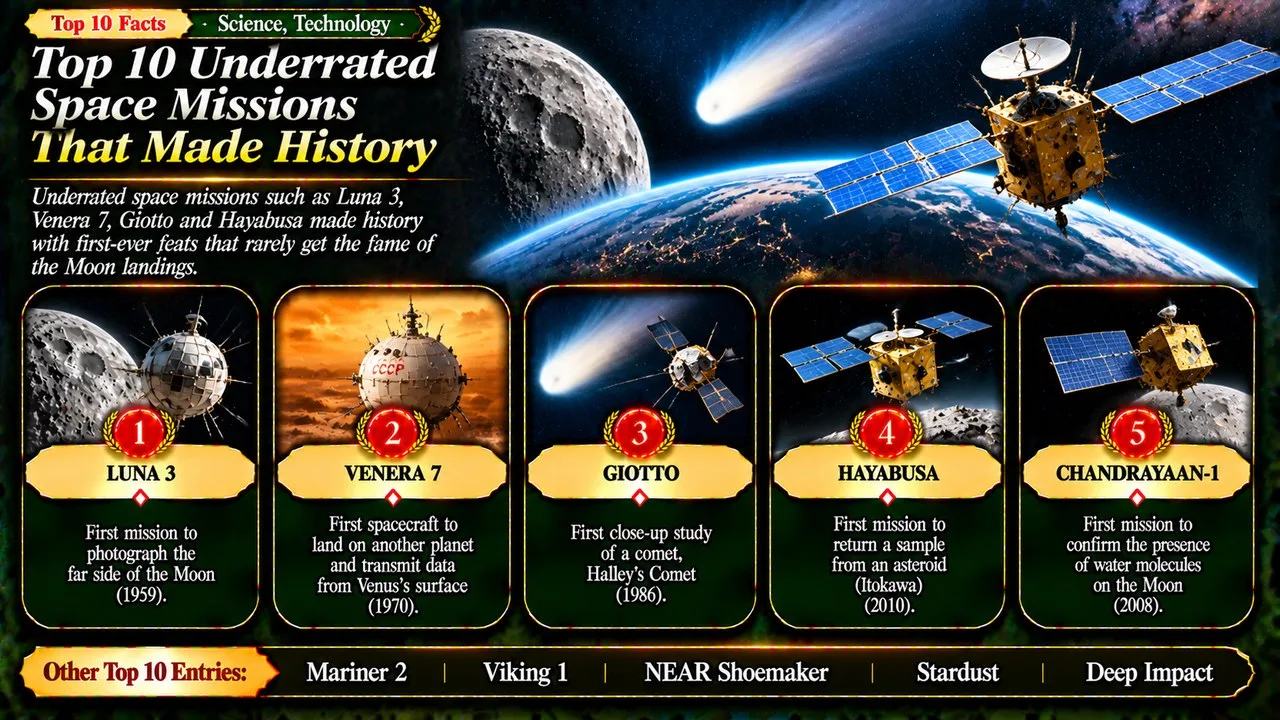
Underrated space missions such as Luna 3, Venera 7, Giotto and Hayabusa made history with first-ever feats that rarely get the fame of the Moon landings.
When people think of space history, they usually picture Sputnik, Apollo 11 or the Hubble Space Telescope. Yet many of the most important steps in exploring our neighbourhood in space were taken by small robotic probes whose names few people know. They were the first to photograph the Moon's hidden face, land on another planet, fly into a comet or bring pieces of an asteroid home.
This Finepedia guide, written in November 2026, takes its topic from a Listverse list of pioneering space missions that got little public attention [22]. The selection, order and wording are our own. We kept eight of its missions, replaced Pioneer 10 and Ulysses with Mariner 2 and Deep Impact, and ordered the list by date. Dates and figures are checked against space agency records and at least one other source.
Key Facts
This table sums up the ten missions, who flew them and the first that each one achieved.
Underrated Space Missions at a Glance
| Rank | Name | Agency | Key date | First or main achievement |
|---|---|---|---|---|
| 1 | Luna 3 | USSR | October 1959 | First photos of the Moon's hidden far side |
| 2 | Mariner 2 | NASA | December 1962 | First successful flyby of another planet |
| 3 | Venera 7 | USSR | December 1970 | First data sent from the surface of another planet |
| 4 | Viking 1 | NASA | July 1976 | First fully successful Mars landing |
| 5 | Giotto | ESA | March 1986 | First close-up images of a comet nucleus |
| 6 | NEAR Shoemaker | NASA | February 2001 | First to circle an asteroid, then touch down on it |
| 7 | Stardust | NASA | January 2006 | First to return comet dust to Earth |
| 8 | Deep Impact | NASA | July 2005 | First to blast material out of a comet |
| 9 | Hayabusa | JAXA, Japan | June 2010 | First to return asteroid samples to Earth |
| 10 | Chandrayaan-1 | ISRO, India | 2008 to 2009 | Helped reveal water molecules on the Moon |
1. Luna 3
Because the Moon always keeps the same face turned towards the Earth, nobody had ever seen its far side until 1959. That changed with Luna 3, a Soviet probe launched as part of the Luna programme [1]. It swung around the Moon and, on 7 October 1959, began taking pictures of the side hidden from Earth [2][1].
The probe developed its film on board, scanned the images and radioed them back to Earth. According to NASA, it took 29 photographs covering about 70 percent of the hidden hemisphere [2]. The pictures were noisy and blurry by modern standards, but they were enough to show that the far side looks very different from the side we know [2][1].
Instead of the large dark plains seen from Earth, the far side turned out to be mostly rugged, mountainous terrain with only a couple of dark regions. One was named Mare Moscoviense, the Sea of Moscow [1]. The images were published around the world and used to create a first rough far-side atlas [1]. Why the two halves of the Moon are so different is still not fully understood [1]. A first look at the hidden half of our nearest neighbour takes first place.
2. Mariner 2
Mariner 2 was launched by NASA from Cape Canaveral on 27 August 1962, after its identical twin, Mariner 1, failed [3][4]. It was the first probe to report back successfully from an encounter with another planet, and NASA calls it humanity's first successful planetary science mission [4][3].
On 14 December 1962 it flew past Venus at a distance of about 35,000 km [3][4]. During a scan lasting around 42 minutes, its radiometers showed that Venus has cool clouds high up but an extremely hot surface, far hotter than many scientists had expected [4][3].
Related: Quasars: Distant Beacons or Local Oddballs?
On the way, Mariner 2 also measured the solar wind, the steady stream of charged particles flowing out from the Sun, confirming earlier Soviet measurements [3]. The probe was simple and carried no camera, because its rocket could not lift heavier equipment [3]. Even so, it opened the age of planetary exploration. The first visitor to another world earns second place.
3. Venera 7
Venus is a brutal place to land, with searing heat and crushingly thick air. Venera 7, a Soviet probe launched on 17 August 1970, was built to survive pressures far greater than expected and temperatures up to 580 C [5][6].
On 15 December 1970 it reached the surface of Venus, and so it was the first craft to soft-land safely on another planet and send data home from its surface [5][6]. At first, controllers thought it had gone silent on impact. Later analysis of the recordings found that it had kept transmitting a weak signal for about 23 minutes [6][5]. It may have bounced and come to rest on its side, pointing its antenna away from Earth.
The data showed a surface temperature of about 475 C, confirming that Venus is far too hot for life as we know it [6][5]. The later Venera landers built on what it achieved. A probe that sent a faint signal from the most hostile planet nearby earns third place.
4. Viking 1
Viking 1 was a NASA mission made up of an orbiter and a lander. It was launched on 20 August 1975 and entered orbit around Mars in June 1976 [7][8]. The landing was planned for 4 July 1976, the US bicentennial, but photos showed that the chosen site was too rough. Instead, the lander touched down safely on 20 July 1976, seven years to the day after Apollo 11 landed on the Moon [7][8].
NASA describes it as the first truly successful landing on Mars, and it sent back the first images from the Martian surface [8][7]. Its robotic arm scooped up soil for experiments designed to look for signs of life. Its results were puzzling and are still debated today [7].
The lander worked far longer than planned. It kept sending weather reports until November 1982, when a faulty command ended contact, and its surface mission of more than six years held the record until the Opportunity rover beat it in 2010 [7][8]. It was later renamed the Thomas Mutch Memorial Station in honour of the leader of the imaging team [7][8]. The first lasting foothold on Mars earns fourth place.
5. Giotto
Giotto was the European Space Agency's first deep-space mission. It was named after the Italian painter Giotto di Bondone, who saw Halley's Comet in 1301 and painted it as the Star of Bethlehem [9][10]. Launched on 2 July 1985, it was sent to meet Halley's Comet on its return to the inner reaches of our neighbourhood in space [10].
Related: Top 10 Famous Astronomical Observatories
In March 1986 Giotto flew through the dusty cloud around the comet and passed within 596 km of the nucleus [9][10]. Its images showed the shape of a comet nucleus for the first time, revealing a dark, solid body, and it found the first evidence of organic material in a comet [10][9]. Only 7.6 seconds before closest approach, a dust particle of about one gram sent the craft spinning and contact was briefly lost, but its thrusters steadied it within about half an hour [10].
The encounter damaged several instruments, including the camera, but ESA decided to send the probe on. In 1992 it flew past a second comet, Grigg-Skjellerup, passing only about 200 km from its nucleus [10][9]. A small probe that took the first close look at a comet earns fifth place.
6. NEAR Shoemaker
NEAR, short for Near Earth Asteroid Rendezvous, was built by the Johns Hopkins University Applied Physics Laboratory for NASA and launched on 17 February 1996 [11][12]. It was later renamed NEAR Shoemaker in honour of the planetary geologist Eugene Shoemaker [11][12]. On the way, it flew past the asteroid Mathilde in 1997 [11].
On 14 February 2000 it entered orbit around the asteroid Eros, the first craft ever to circle an asteroid [12][11]. For a year it mapped the asteroid's shape, surface, composition and gravity with a set of cameras, spectrometers and a laser rangefinder [11].
The spacecraft had not been designed to land, but as its mission ended, controllers guided it slowly down to the surface. On 12 February 2001 it touched down on Eros and kept sending data from the surface [11][12]. NASA received its last signal on 28 February 2001, after the craft had succumbed to the extreme cold [12]. A probe that landed on a world it was never built to land on earns sixth place.
7. Stardust
Stardust was a NASA Discovery mission launched on 7 February 1999 to collect dust from a comet and bring it back to Earth [13][14]. To catch the particles without destroying them, it used aerogel, an extremely light, foam-like material of silica that slowed them down gently [13][14].
Related: Top 10 Most Bizarre Phobias: Strange Fears That Exist
On 2 January 2004 Stardust flew through the coma of comet Wild 2, collecting samples and taking detailed pictures of the nucleus [13][14]. Between its comet encounter and its return, the craft also spent long periods exposing a second collector to catch dust drifting in from interstellar space [14][13]. On 15 January 2006 its sample capsule parachuted down in the Utah desert, making Stardust the first mission to return samples from a comet to Earth [14][13].
In 2014 scientists reported possible interstellar dust grains among the samples [13]. The spacecraft was later reused to fly past comet Tempel 1 in 2011 before it was retired [13][14]. A mission that brought comet dust home earns seventh place.
8. Deep Impact
Deep Impact took a bolder approach to studying a comet. Launched by NASA on 12 January 2005, it carried a separate impactor designed to smash into comet Tempel 1 so that scientists could see what lies beneath its surface [15][16].
On 4 July 2005 the impactor struck the comet's nucleus at about 37,000 km per hour [16][15]. NASA estimates that the collision released energy equal to about 4.7 tonnes of TNT and made a crater roughly 150 metres across [16]. The flyby craft watched from about 500 km away, though a huge, bright cloud of dust hid the crater from view [16][15].
The results showed that the comet was dustier and less icy than expected, with a very porous surface layer [15][16]. Earlier missions had only flown past comets; Deep Impact was the first to throw material out from inside one [15]. The craft then began an extended mission called EPOXI and flew past comet Hartley 2 in 2010 [16][15]. A spacecraft that hit a comet to see inside it earns eighth place, just ahead of the missions that brought real samples home.
9. Hayabusa
Hayabusa, Japanese for peregrine falcon, was a mission by the Japan Aerospace Exploration Agency to bring back a sample from the small asteroid Itokawa [17][18]. It was launched on 9 May 2003 and powered by ion engines, an efficient but gentle form of propulsion [17][18].
The mission was plagued by problems. A huge solar flare damaged its solar cells and delayed its arrival at Itokawa until September 2005 [17][18]. In November 2005 it touched the asteroid's surface to collect material, but its small lander, MINERVA, failed to reach the surface, and fuel leaks and loss of control meant the return trip had to be pushed back by three years [17][18]. Engineers kept it alive by combining parts of two failing ion engines into one working unit [17].
Related: Top 10 Facts About Dogs
On 13 June 2010 its capsule landed in the Woomera area of South Australia, while the spacecraft itself burned up in the atmosphere [17][18]. Inside were tiny grains from Itokawa, making Hayabusa the first mission to return asteroid samples to Earth [17]. A mission that came home against the odds earns ninth place.
10. Chandrayaan-1
Chandrayaan-1 was India's first mission to the Moon. Its name comes from the Sanskrit words for Moon and craft. The Indian Space Research Organisation launched it on 22 October 2008 from Sriharikota, and it orbited the Moon at a height of about 100 km [19][20].
On 14 November 2008 it released the Moon Impact Probe, which struck near the lunar south pole and made India one of only a handful of countries to reach the Moon's surface [19]. The orbiter carried instruments from India and abroad, including NASA's Moon Mineralogy Mapper, built with Brown University [19][20].
In September 2009 scientists announced that the mapper had found signs of water molecules and hydroxyl bound in the top layer of lunar soil, especially at high latitudes [21][19]. Chandrayaan-1 operated for 312 days instead of the planned two years, but it achieved most of its goals [19]. Its finding changed the old picture of a bone-dry Moon. A first Indian mission that helped reveal lunar water closes our list.
Conclusion
From grainy pictures of the Moon's far side to grains of asteroid dust in a laboratory, these ten missions show how much robotic explorers have achieved. Many of the firsts we now take for granted came from small probes with modest budgets.
Each mission made later ones possible, from Venus landers to comet and asteroid sample returns that continue today. To learn more about the worlds they visited, see Interesting Facts About the Moon and Eight Planets Compared.
- ^ [1] "Luna 3". Wikipedia. Wikipedia
- ^ [2] "First Close-up of the Far Side of Moon". NASA Science. NASA
- ^ [3] "Mariner 2". Wikipedia. Wikipedia
- ^ [4] "Mariner 2". NASA Science. NASA
- ^ [5] "Venera 7". Wikipedia. Wikipedia
- ^ [6] "Venera 7, 1st to Send Data from Venus Surface, Launched 45 Years Ago". Space.com. Space.com
- ^ [7] "Viking 1". Wikipedia. Wikipedia
- ^ [8] "Viking 1". NASA Science. NASA
- ^ [9] "Giotto (spacecraft)". Wikipedia. Wikipedia
- ^ [10] "Giotto overview". European Space Agency. ESA
- ^ [11] "NEAR Shoemaker". Wikipedia. Wikipedia
- ^ [12] "NEAR Shoemaker". NASA Science. NASA
- ^ [13] "Stardust (spacecraft)". Wikipedia. Wikipedia
- ^ [14] "Stardust". NASA Science. NASA
- ^ [15] "Deep Impact (spacecraft)". Wikipedia. Wikipedia
- ^ [16] "Deep Impact (EPOXI)". NASA Science. NASA
- ^ [17] "Hayabusa". Wikipedia. Wikipedia
- ^ [18] "Six days left for Hayabusa: A recap of the mission". The Planetary Society. The Planetary Society
- ^ [19] "Chandrayaan-1". Wikipedia. Wikipedia
- ^ [20] "Chandrayaan-1". Indian Space Research Organisation. ISRO
- ^ [21] "Brown Scientists Announce Finding of Water on the Moon". Brown University. Brown University
- ^ [22] "10 Groundbreaking Space Missions That Flew Under the Radar". Listverse. Topic reference on Listverse






















Discussion
Log in with