



Top 10 Trade Goods That Connected the Ancient World
 By Dhiraj Sharma · Published
Share Post
Loading…
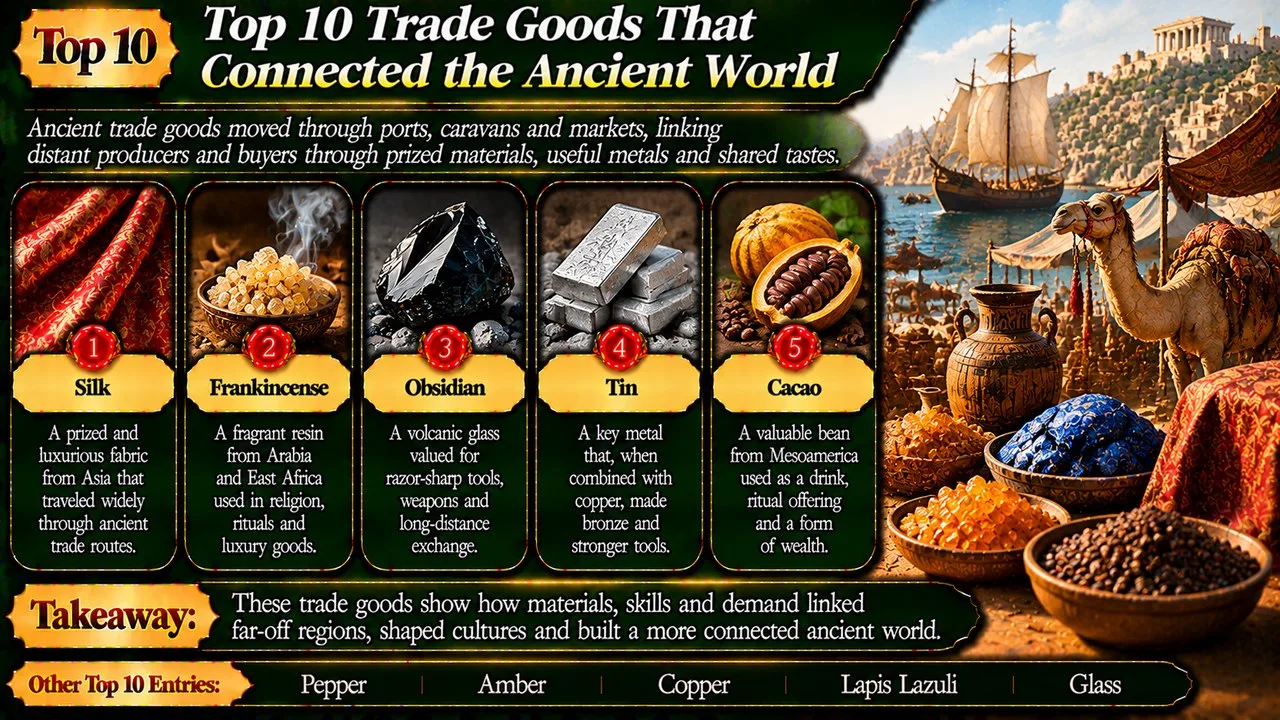
Ancient trade goods moved through ports, caravans and markets, linking distant producers and buyers through prized materials, useful metals and shared tastes.
No single road connected every society in this list. Silk and incense travelled through overlapping Old World networks, while cacao and much obsidian circulated within the Americas. Goods could pass through many hands without any merchant completing the full journey. Archaeologists reconstruct those connections through objects, written records and the chemical character of materials.
The order weighs cultural reach, practical importance and the strength of the evidence for movement. A Listverse list of trade finds supplies the topic [18], not the narrative or ranking. Rather than repeat uncertain claims about isolated discoveries, this selection follows well-attested commodities. It avoids converting ancient prices into modern money or treating a distant find as proof of one direct voyage.
Key Facts
These ten entries highlight contrasting features and contexts.
Trade Goods That Connected the Ancient World at a Glance
| Rank | Name | Context | Main feature | Notable point |
|---|---|---|---|---|
| 1 | Silk | Asia | Luxury textile | Many intermediaries |
| 2 | Pepper | South Asia | Dried fruit | Maritime trade |
| 3 | Frankincense | Arabia and Africa | Aromatic resin | Ceremonial demand |
| 4 | Amber | Baltic | Fossil resin | Northern links |
| 5 | Obsidian | Volcanic regions | Sharp glass | Source tracing |
| 6 | Copper | Mining regions | Useful metal | Workshop supplies |
| 7 | Tin | Mining regions | Bronze ingredient | Debated routes |
| 8 | Lapis Lazuli | Afghanistan | Blue stone | Prestige objects |
| 9 | Glass | Many regions | Made material | Raw and finished |
| 10 | Cacao | Americas | Beans | Drink and exchange |
1. Silk
Silk gave its name to the Silk Road, although that familiar label covers a web of routes rather than one continuous track. Chinese silk production created a fabric valued far beyond its place of manufacture. Its history is therefore one of exchanges in several directions, not simply a stream of luxuries leaving China. [1] [11]
The appeal lay partly in the fibre's sheen and the skill required to turn it into fine cloth. Fabric could carry social value as clothing, a gift or a sign of prestige. Yet a textile found far from its likely source does not identify every stage of its journey. Merchants, diplomats and local buyers might all have contributed, and surviving pieces represent only a small portion of what once circulated. [1] [11]
Silk leads for the breadth of the contacts associated with it. The routes also carried artistic ideas and religious practices, although a piece of cloth cannot explain those changes by itself. It provides a material starting point for understanding how distant communities became connected through repeated, practical exchanges.
2. Pepper
Black pepper comes from the fruit of Piper nigrum, a climbing plant native to the Indian subcontinent. Dried peppercorns offered a concentrated and transportable flavouring that attracted buyers far beyond the growing regions. Maritime links between South Asia, the Red Sea and the Mediterranean helped carry it into Roman markets. Its journey depended on shipping knowledge, ports, inland transport and the work of growers as well as merchants. [2]
Pepper's value makes it a frequent subject of exaggerated stories. It was not simply added to rotten meat to make dangerous food acceptable. Flavour, social distinction and medical ideas all contributed to demand in different settings. Nor should the term pepper be applied indiscriminately to every hot spice. American chillies belong to a different plant group and entered Old World food traditions through much later exchanges. [2]
It ranks for showing how an ordinary modern kitchen ingredient can preserve the outline of older commercial routes. A small, durable commodity was well suited to long journeys. Its history also cautions against treating luxury as a permanent property: a spice's price and social meaning depend on access, supply and the society using it.
Related: History of Human Civilization: From Ancient Times to the Modern Age
3. Frankincense
Frankincense is an aromatic resin obtained from Boswellia trees. Ancient demand was closely tied to burning incense in religious and ceremonial settings, as well as other uses. Producing regions in southern Arabia and the Horn of Africa supplied networks that carried the resin towards Mediterranean and Near Eastern markets. [3] [16]
It is not the same material as myrrh, although the two often appear together in historical accounts. Different trees produce different resins, and broad labels can conceal variation within a traded commodity. Land routes and coastal shipping connected collection areas with buyers, while communities along the way could benefit from handling goods and supplying travellers. An incense route was thus a chain of places and services, not just a line on a map. [3] [16]
Its position reflects the power of belief and ceremony to shape trade. Not every valuable cargo was essential for food or metalworking. A material could sustain long-distance commerce because people gave it religious and social significance, turning the scent rising from a small burner into the endpoint of a much larger journey.
4. Amber
Amber is fossilised tree resin, not a gemstone formed by the same processes as diamond or sapphire. Baltic amber was especially important in exchanges that brought northern material into Mediterranean societies. Its warm colour, relative softness and suitability for carving made it useful for ornaments. People could appreciate the finished object without having accurate knowledge of the material's geological origin or the full route it had travelled. [4] [12]
Ancient writers offered competing explanations for amber, including myths linked to tears and trees. Such stories are evidence of interpretation, not accounts of how the material actually formed. Archaeological finds reveal movement across regions, while material analysis can help distinguish likely sources. The phrase Amber Road is a convenient collective label; it should not suggest that every piece followed one fixed itinerary from a beach to a southern buyer. [4] [12]
Amber ranks for linking regions that can otherwise appear separate in a conventional account of the ancient Mediterranean. Its presence far from a source opens questions about exchange without answering every question about the people involved.
5. Obsidian
Obsidian is a volcanic glass that breaks with exceptionally sharp edges. Before metal tools became widespread in many regions, it was valuable for cutting implements, weapons and other objects. Mesoamerican communities traded it over considerable distances, while other obsidian networks developed elsewhere. The material's usefulness did not depend on being rare everywhere; it depended on access to particular deposits and the skill to work it well. [5] [13]
Related: Marco Polo (2014): The Netflix Series that Explores the Mongol Empire
Different volcanic sources can carry distinctive chemical signatures. Comparing an artefact with geological samples can help researchers identify where its raw material originated. That makes obsidian unusually informative for studying exchange. A match does not necessarily prove that the object's final owner travelled to the source. Raw pieces, prepared cores and finished tools could move through different stages, with manufacture taking place at more than one point along the way. [5] [13]
It earns its place because the cargo itself can preserve clues to its travels. Unlike a written claim by a distant observer, a chemical comparison can test a proposed source directly. The interpretation still requires context, but it gives archaeology a powerful way to move beyond simply noting that two objects look alike.
6. Copper
Copper was both a useful material in its own right and a major ingredient in bronze. Communities that lacked accessible ores had reasons to obtain it from elsewhere, making supplies important to workshops and rulers. In the eastern Mediterranean, Cyprus became closely associated with copper production and exchange. Elsewhere, other deposits supplied their own networks, so no single island explains the whole history of the metal. [6] [14]
Copper could travel as raw metal, ingots or finished objects. Those forms imply different kinds of work and different choices about where manufacture took place. The distinctive oxhide-shaped ingots found in Bronze Age contexts are particularly recognisable, although their shape alone cannot settle every question about ownership or destination. Shipwrecks and finds on land provide complementary evidence, sometimes preserving cargoes that written records mention only in general terms. [6] [14]
The metal ranks for its practical reach. Tools, vessels, ornaments and weapons connected a supply of ore with many parts of daily and public life. Its movement also shows why trade is not only a history of finished luxuries: workshops often depended on getting the right basic material before a skilled craftsperson could begin.
7. Tin
Tin was especially important because combining it with copper could produce bronze with useful working properties. The ingredients were not always available in the same place. That mismatch encouraged movement between mining areas, trading centres and workshops. A modest-looking supply of metal could therefore matter to communities making tools and weapons far from a suitable deposit, even when the finished objects attracted more public attention. [7] [15]
Related: Top 10 Most Bizarre Phobias: Strange Fears That Exist
Tracing ancient tin is difficult. Written references, cargoes, mining evidence and scientific analyses do not always point to one simple origin for every region and period. Claims that all Mediterranean tin came from a single famous source overstate the evidence. Different supply routes could exist at the same time, and some remain debated. A proposed connection becomes stronger when several kinds of evidence agree, rather than when one isolated clue is stretched too far. [7] [15]
It ranks as a reminder that the less conspicuous ingredient can be essential. Bronze is often remembered through a statue or a blade, but its manufacture depended on reliable access to materials. Following tin turns attention from the impressive finished object towards the difficult business of obtaining what the workshop needed in the first place.
8. Lapis Lazuli
Lapis lazuli is a blue rock used for beads, inlay and carved objects. Deposits in what is now Afghanistan were a major source for material valued in ancient Mesopotamia and other regions. The stone moved through networks that linked mining communities with urban centres and elite consumers. [8]
Finds in royal and religious settings show how a traded material could express status and devotion. The presence of lapis does not mean that its owner visited a remote mine or understood the entire supply chain. Intermediaries could pass the material onward as raw pieces or worked objects. Carving added labour and cultural meaning, turning a geological resource into an ornament or image suited to a particular buyer. [8]
Its place reflects the way appearance, distance and skilled work can combine to create value. Lapis also helps connect accounts of ancient exchange with later histories of art materials. A blue stone and a blue painted passage need not belong to the same period or process, yet both can depend on long journeys from a limited source.
9. Glass
Glass could circulate as raw material, finished vessels, beads and other decorative objects. Ancient production required knowledge of ingredients and heating, but the places making raw glass were not necessarily the same as those shaping it into finished wares. Trade therefore linked different kinds of workshops as well as producers and consumers. A bead or vessel can preserve evidence of both manufacture and later movement. [9]
Related: Top 10 Facts About Dogs
The spread of glassblowing made the creation of hollow vessels more flexible and helped widen the range of objects available. Older methods did not simply vanish at once. Nor should every piece of glass found abroad be treated as a luxury reserved for rulers. Date, form, quality and context all matter when judging who might have used it and how unusual it was in a particular community. [9]
Glass ranks for showing that a manufactured material can have its own geography of supply. Chemical analysis can investigate ingredients and possible production traditions, although recycling complicates a tidy reading of origin. The finished object's appearance is only the beginning of the enquiry; its composition and archaeological setting help reveal the commercial relationships behind it.
10. Cacao
Cacao circulated within the Americas long before European Atlantic trade. Its beans supplied drinks associated with Mesoamerican cultures, including the Maya and Aztecs. The familiar sweet chocolate bar is not an appropriate model for every ancient preparation. Drinks could be bitter, foamy or flavoured in different ways, and their cultural significance extended beyond providing a pleasant taste at the end of a meal. [10] [17]
Cacao beans could also serve as tribute and as a medium of exchange. Those roles connected growing areas with courts and markets, giving the commodity value in several settings. Archaeological residues, vessels and written accounts help reconstruct its use, but evidence for one place should not be treated as a uniform practice across all the Americas. Production, access and preparation varied between communities and through time. [10] [17]
It closes the list by making the geographic limits explicit. Cacao did not need a connection to Rome or China to support important long-distance exchange. Its history belongs to independent American networks and reminds readers that ancient commerce was not one global market waiting to be discovered, but many relationships built around particular materials and local priorities.
Conclusion
These commodities reveal exchange as a chain of skilled work, negotiation and movement. Their journeys connect naturally with historic covered markets and the cargo evidence in famous shipwrecks. Neither an exotic object nor a familiar spice tells the whole story alone. Combining material analysis with archaeological context and written records offers a clearer picture of how goods crossed distances, and why buyers wanted them when they arrived.
- ^ [1] "Silk". Wikipedia. Read
- ^ [2] "Pepper". Wikipedia. Read
- ^ [3] "Frankincense". Wikipedia. Read
- ^ [4] "Amber". Wikipedia. Read
- ^ [5] "Obsidian". Wikipedia. Read
- ^ [6] "Copper". Wikipedia. Read
- ^ [7] "Tin". Wikipedia. Read
- ^ [8] "Lapis Lazuli". Wikipedia. Read
- ^ [9] "Glass". Wikipedia. Read
- ^ [10] "Cacao". Wikipedia. Read
- ^ [11] "Silk Road". World History Encyclopedia. Read
- ^ [12] "Amber". World History Encyclopedia. Read
- ^ [13] "Obsidian in Mesoamerica". World History Encyclopedia. Read
- ^ [14] "Copper in Antiquity". World History Encyclopedia. Read
- ^ [15] "Trade in Ancient Mesopotamia". World History Encyclopedia. Read
- ^ [16] "Frankincense". Encyclopaedia Britannica. Read
- ^ [17] "Chocolate in Mesoamerica". World History Encyclopedia. Read
- ^ [18] "Topic inspiration: Trade Goods That Connected the Ancient World". Listverse. Read






















Discussion
Log in with