





Top 10 Remarkable Numbers and the Ideas Behind Them
 By Dhiraj Sharma · Published
Share Post
Loading…
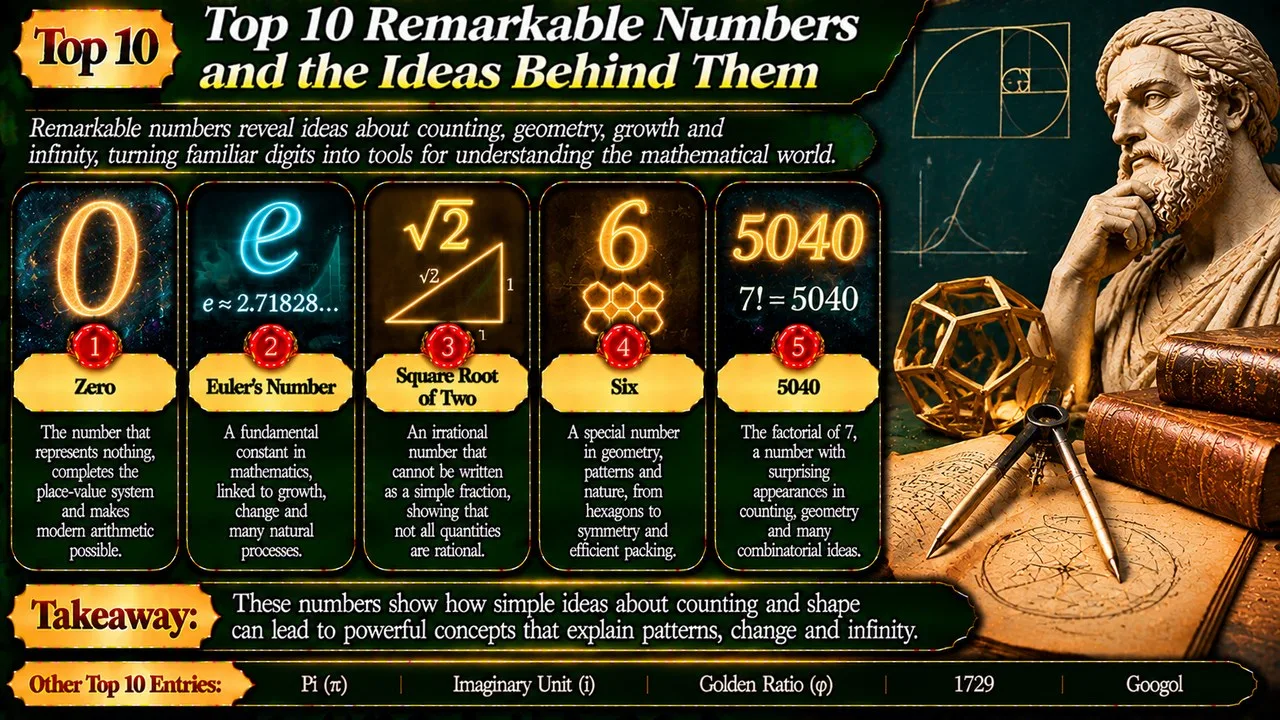
Remarkable numbers reveal ideas about counting, geometry, growth and infinity, turning familiar digits into tools for understanding the mathematical world.
Some numbers matter because they describe a recurring relationship; others expose a limit in an older way of thinking. Their importance is not a matter of hidden luck or a mystical message. A definition, a proof and a useful application can make an apparently ordinary symbol worth examining closely.
This order favours explanatory reach, historical influence and the clarity of an example. A Listverse number list inspires the topic [21], but the selection replaces several cultural curiosities with well-defined mathematical cases. Approximations are labelled as such. Repeating digits or an attractive anecdote never substitutes for stating exactly what property makes a number unusual.
Key Facts
These ten entries highlight contrasting features and contexts.
Remarkable Numbers and the Ideas Behind Them at a Glance
| Rank | Name | Context | Main feature | Notable point |
|---|---|---|---|---|
| 1 | Zero | Arithmetic | Additive identity | Place value |
| 2 | Pi | Geometry | Circle ratio | Irrational |
| 3 | Euler's Number | Calculus | Continuous change | Growth models |
| 4 | Imaginary Unit | Algebra | Square gives -1 | Complex numbers |
| 5 | Square Root of Two | Geometry | Square diagonal | Irrational |
| 6 | Golden Ratio | Proportion | Self-related ratio | Exact geometry |
| 7 | Six | Divisors | Perfect number | 1 + 2 + 3 |
| 8 | 1729 | Cubes | Two representations | Taxicab property |
| 9 | Googol | Magnitude | Ten to power 100 | Finite |
| 10 | 5040 | Factors | Seven factorial | Rich divisibility |
1. Zero
Zero does more than stand for an empty collection. In place-value notation it keeps positions distinct: 105 does not mean the same thing as 15. Treating zero as a number also allows it to participate in arithmetic rather than serving only as a gap. These roles developed through a long history, with important contributions from Indian mathematics alongside earlier placeholder practices in other cultures. [1] [11]
Its arithmetic behaviour is distinctive. Adding zero leaves a number unchanged, while multiplying by it gives zero. Division by zero is not an ordinary arithmetic operation: no unique answer can make it behave like division by a nonzero number. These facts are connected. If multiplying different numbers by zero produces the same result, reversing that operation cannot recover one definite starting number. [1] [11]
Zero leads the list because it changes both notation and the kinds of questions that can be asked. Its apparently simple shape hides a conceptual distinction between nothing being present and nothing being represented. Keeping those meanings apart helps explain why the history of zero cannot sensibly be reduced to one isolated mark on one object.
2. Pi
Take the distance around a circle and divide it by that circle's diameter: the result is pi. The relationship is the same for every circle in ordinary flat geometry, regardless of its size. The familiar approximation 3.14 is useful, but it is not the exact value. A decimal expansion can be shortened for a practical calculation without changing the mathematical definition of the number. [2] [12]
Pi is irrational, so no ratio of whole numbers gives its exact value. Its decimal digits continue without settling into a repeating block. It is also transcendental, a stronger property that rules out roots of nonzero polynomials with integer coefficients. That result explains why constructing a square with exactly the area of a given circle cannot be done using only the classical straightedge and compass operations. [2] [12]
Its position reflects the breadth of its appearances, from geometry to probability and waves. The number itself is finite; it is the written decimal expansion that has no final digit. This distinction is more informative than a claim that pi is an infinite number, which confuses a value with one way of expressing it.
Related: Top 25 Interesting Facts About the Solar System
3. Euler's Number
Euler's number, usually written e, is approximately 2.71828. It appears naturally when growth is compounded at ever shorter intervals. Imagine a fixed annual rate being applied more and more frequently while the total rate remains unchanged. The limiting growth factor in the standard unit-rate example is e. The definition concerns a mathematical limit, not a promise about real financial returns or an indefinitely growing population. [3] [13]
Its deeper role appears in calculus. The function e raised to x has a rate of change equal to its own value. This makes it especially useful when a rate is proportional to the amount already present. Growth and decay models can therefore be written compactly using e, although the assumptions behind a model must still be checked against the physical or social situation being studied. [3] [13]
It ranks highly because the same constant links a familiar idea about repeated multiplication with the language of continuous change. Its significance lies in the relationships it simplifies, not merely in memorising an unusually long string of decimal digits.
4. Imaginary Unit
The imaginary unit, written i, is defined so that its square equals minus one. No real number has that property, since squaring a positive or negative real number cannot give a negative result. Introducing i extends arithmetic to complex numbers. Such a number can combine a real component with an imaginary component, allowing equations to have solutions that the real number line alone cannot supply. [4] [14]
The name imaginary can be misleading. Complex numbers are precise mathematical objects with consistent rules, not estimates or invented answers chosen to rescue a difficult exercise. They can be represented on a plane, where multiplication by i corresponds to a quarter-turn. That geometric view helps connect algebra with rotations and makes the new notation easier to understand than an unexplained demand to accept an impossible square root. [4] [14]
Its rank reflects both conceptual change and practical reach. Complex arithmetic appears in the analysis of waves and electrical phenomena, among other subjects. The useful question is not whether a number can be pictured as a pile of objects, but whether its definition is coherent and whether its relationships help describe a problem accurately.
5. Square Root of Two
The square root of two is the length of a square's diagonal when each side has unit length. Pythagoras's theorem gives the relationship directly: the squared diagonal equals the sum of the two squared sides. The resulting value is about 1.41421. It is a precise geometric quantity even though a short decimal approximation cannot capture it exactly, a useful distinction between measurement and mathematical definition. [5] [15]
Related: Top 10 Mythical Creatures in World Mythology - That Inspired Myths Across Civilizations (unchanged)
Its irrationality has a classic proof. Assume a fraction in lowest terms squares to two. The equation forces the numerator to be even, and then forces the denominator to be even as well. That contradicts the starting claim that the fraction had been fully reduced. The contradiction establishes that no ratio of integers can equal the diagonal's exact length. It does not mean the length is vague or unknowable. [5] [15]
The number ranks here for exposing the limits of fractions in a particularly accessible shape. Stories about a discoverer being punished at sea are much less secure than the mathematical result and are not needed. A familiar square supplies enough evidence for a profound conclusion about what the number line contains.
6. Golden Ratio
The golden ratio arises when a line is divided so that the whole compared with the larger part has the same ratio as the larger part compared with the smaller. Its value is approximately 1.61803. That definition produces an exact relationship, not a personal judgement about whether a shape is beautiful. The same ratio appears in pentagonal geometry and in the construction of a golden rectangle. [6] [16]
Consecutive Fibonacci numbers approach this ratio when the later number is divided by the earlier one. The connection is a genuine mathematical result, but it should not be expanded into a claim that every spiral, artwork or human face obeys one universal aesthetic rule. A logarithmic spiral need not have the particular proportions of a golden spiral, and a roughly similar rectangle is not proof of deliberate design. [6] [16]
Its place reflects the contrast between a precise definition and an exceptionally lively popular reputation. Studying the actual geometry is more rewarding than hunting for the ratio in every photograph. The number can be fascinating without becoming a universal explanation of art, nature or attractiveness, and an approximate measurement cannot establish an artist's intention.
7. Six
Six is the smallest perfect number. Here perfect has a technical meaning: add its positive divisors smaller than itself, and the total returns the number. For six, the calculation is 1 + 2 + 3 = 6. The next example is 28, whose proper positive divisors also add back to 28. The label is about a relationship among factors, not moral quality or special luck. [7] [17]
Related: Top 25 Interesting Facts About the Universe
Perfect numbers attracted the attention of ancient Greek mathematicians and later number theorists. Even perfect numbers have a close connection with certain primes of the form two raised to a power, minus one. That relationship lets a simple schoolroom example open into a much larger topic. The calculation for six is easy to check, but the wider theory involves questions far beyond testing a handful of small integers. [7] [17]
It ranks for making a definition tangible before introducing abstraction. There is no need to attach an unverified claim about the total number of known examples. Six already demonstrates how a modest integer can belong to a special class whose members are selected by an exact rule rather than by appearance or reputation.
8. 1729
The number 1729 is famous for a property associated with Srinivasa Ramanujan and G. H. Hardy. It can be formed from two positive cubes in two different ways: 1 cubed plus 12 cubed, and 9 cubed plus 10 cubed. Both calculations give 1729. Among positive integers, it is the smallest with that particular property, which places it in the study of so-called taxicab numbers. [8] [18]
The familiar anecdote concerns Hardy mentioning a taxi's number while visiting Ramanujan. Retellings often emphasise the contrast between an apparently dull number and Ramanujan's immediate recognition of its structure. The exact dialogue is unnecessary here. The arithmetic is independently checkable, and the conditions matter: the cubes are positive, the two representations differ, and the claim concerns the smallest number meeting those conditions. [8] [18]
It earns its place by joining an accessible calculation to a broader mathematical search. A memorable story can invite attention, but the property survives without the story. Changing the number of required representations or the powers being added creates different questions, showing how a small curiosity can lead towards a whole family of problems.
9. Googol
A googol is ten raised to the hundredth power. In ordinary decimal notation it is a one followed by a hundred zeros. It offers a memorable way to discuss a very large finite quantity without pretending that the word refers to the largest number that could ever exist. [9] [19]
Related: Top 25 Weird Facts About Left-Handed People
Finite is the important qualification. Add one to a googol and the result is larger; multiply it by ten and a larger integer appears again. A googolplex, defined by raising ten to a googol, is vastly larger but still finite. None of these operations reaches infinity. The contrast is useful because everyday speech often treats an unimaginably large count and an unbounded mathematical concept as though they meant the same thing. [9] [19]
Its ranking reflects educational value rather than a practical need to write every digit. Exponential notation makes exact communication possible even when expanding the number would be cumbersome. A short definition can therefore carry more information than an impressive-looking page of zeros, while preserving a clear distinction between size and infinity.
10. 5040
The number 5040 equals seven factorial: multiply the whole numbers from one through seven. Factorials count arrangements of distinct objects, so it is the number of possible orders for seven different items. The same integer also has an unusually rich collection of divisors. Its prime factors are two to the fourth power, three squared, five and seven, giving 60 positive divisors in all. [10] [20]
It is a highly composite number, meaning that it has more positive divisors than any smaller positive integer. That property differs from being a perfect number: one definition counts divisors, while the other adds particular divisors. Plato also discussed 5040 in the Laws, valuing its convenient divisibility when imagining the organisation of a city. The historical proposal does not turn the number into a universally ideal population. [10] [20]
It closes the list because several distinct ideas meet in one ordinary-looking integer. Counting arrangements, factoring and planning equal groups each illuminate a different property. The interest lies in stating those properties accurately, rather than claiming that the number possesses a hidden power or that its ancient admirers had discovered a perfect rule for society.
Conclusion
These numbers reward precise questions. A definition can separate a useful approximation from an exact value, or a large integer from infinity. Their links with counting and patterns complement ancient board games, while historic calendars show mathematical conventions meeting public life. The most remarkable feature is not that certain numbers are mysterious, but that a clear argument can explain why they keep appearing in apparently different problems.
- ^ [1] "Zero". Wikipedia. Read
- ^ [2] "Pi". Wikipedia. Read
- ^ [3] "Euler's Number". Wikipedia. Read
- ^ [4] "Imaginary Unit". Wikipedia. Read
- ^ [5] "Square Root of Two". Wikipedia. Read
- ^ [6] "Golden Ratio". Wikipedia. Read
- ^ [7] "Six". Wikipedia. Read
- ^ [8] "1729". Wikipedia. Read
- ^ [9] "Googol". Wikipedia. Read
- ^ [10] "5040". Wikipedia. Read
- ^ [11] "Zero". Wolfram MathWorld. Read
- ^ [12] "Pi". Wolfram MathWorld. Read
- ^ [13] "e". Wolfram MathWorld. Read
- ^ [14] "Imaginary Unit". Wolfram MathWorld. Read
- ^ [15] "Pythagoras's Constant". Wolfram MathWorld. Read
- ^ [16] "Golden Ratio". Wolfram MathWorld. Read
- ^ [17] "Perfect Number". Wolfram MathWorld. Read
- ^ [18] "Hardy-Ramanujan Number". Wolfram MathWorld. Read
- ^ [19] "Googol". Wolfram MathWorld. Read
- ^ [20] "Highly Composite Number". Wolfram MathWorld. Read
- ^ [21] "Topic inspiration: Remarkable Numbers and the Ideas Behind Them". Listverse. Read






















Discussion
Log in with