






 By
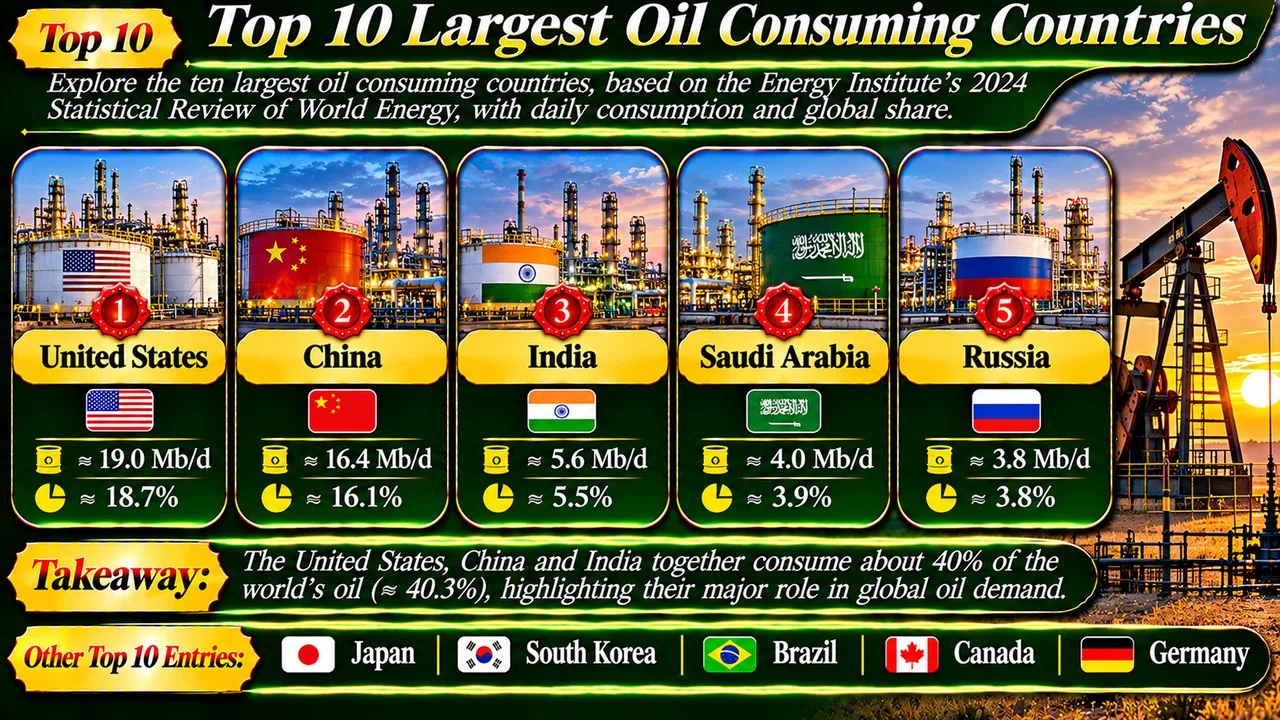
The largest oil consuming countries are led by the United States and China, which together burn more than a third of the roughly 101 million barrels used daily.
Oil remains the single biggest source of energy in the world economy. It fuels cars, lorries, ships and aircraft, provides the raw material for plastics and chemicals, and in some countries still generates electricity. Even as solar power, wind and electric vehicles grow quickly, world oil demand has kept rising and passed the symbolic level of 100 million barrels per day in 2023 [1][2].
This Finepedia list ranks the ten biggest consumers using the Energy Institute Statistical Review of World Energy 2025, which gives figures for the full year 2024. The review counts inland demand plus international aviation and marine bunkers and refinery fuel, but leaves out biofuels such as ethanol [1]. All figures are in thousand barrels per day, are checked against a second published table [2], and are current as of November 2026. Rankings from other data sets, such as those compiled from national statistics, can differ slightly in order because of different definitions [4]. The Energy Institute's 2026 summary reports that global oil use rose a further 1.3 percent in 2025 to about 103 million barrels per day [3].
Key Facts
Here is a quick overview of the ten countries, with daily consumption in 2024 and each country's share of the world total.
Largest Oil Consumers at a Glance
| Rank | Country | Consumption 2024 (thousand barrels/day) | Share of world total | Notable fact |
|---|---|---|---|---|
| 1 | United States | 18,995 | 18.7% | Also the world's biggest producer |
| 2 | China | 16,374 | 16.1% | Demand dipped in 2024 as electric vehicles spread |
| 3 | India | 5,621 | 5.5% | Fastest growth among the top three |
| 4 | Saudi Arabia | 3,959 | 3.9% | Burns oil to generate power |
| 5 | Russia | 3,846 | 3.8% | Uses a fraction of what it produces |
| 6 | Japan | 3,238 | 3.2% | Long-term decline in demand |
| 7 | South Korea | 2,891 | 2.9% | Huge refining and petrochemical sector |
| 8 | Brazil | 2,575 | 2.5% | Heavy use of ethanol alongside oil |
| 9 | Canada | 2,333 | 2.3% | Major exporter with high per-person use |
| 10 | Germany | 2,051 | 2.0% | Europe's largest oil consumer |
1. United States
The United States used about 18,995 thousand barrels of oil per day in 2024, close to 19 million barrels and roughly 18.7 percent of the world total [1][2]. No other country has used more oil for decades, a lead driven by long driving distances, a very large fleet of cars and pickup trucks, and the busiest air travel market on the planet.
Most American oil goes into transport fuels such as gasoline, diesel and jet fuel, with a further large share used by the petrochemical industry. Demand in 2024 was almost flat compared with the previous year, slipping by about 0.1 percent [2].
The country is also the biggest oil producer in the world. Thanks to the shale boom that began in the late 2000s, US output of crude oil and related liquids reached about 21.1 million barrels per day in 2025, according to the Energy Institute [3]. Even so, the United States still imports certain grades of crude because many of its refineries were built to process heavier oil than the light crude produced from shale.
2. China
China consumed about 16,374 thousand barrels per day in 2024, or 16.1 percent of the global total [1][2]. Its demand grew rapidly for more than two decades as industry expanded, car ownership soared and new airports and motorways opened across the country.
In 2024, however, Chinese oil consumption fell by about 1.2 percent [2]. Analysts linked the slowdown to the rapid adoption of electric cars, the growth of trucks running on liquefied natural gas and a weaker property and construction sector. Petrochemical feedstocks are now one of the main sources of growth in Chinese oil demand.
Related: Top 10 Countries with the Most Natural Resources
China produces a substantial amount of oil at home but imports the majority of what it uses, making it the world's largest crude importer. Huge state reserves and long-term supply deals with countries in the Middle East, Africa, Russia and Latin America help secure its supply.
3. India
India ranked third with about 5,621 thousand barrels per day in 2024, a 3.1 percent increase on the previous year and about 5.5 percent of world demand [1][2]. It overtook Japan in the mid-2010s and is now one of the main drivers of global oil demand growth.
Growing incomes are putting more motorcycles, cars and trucks on Indian roads, and domestic air travel has expanded rapidly. Cooking gas, in the form of liquefied petroleum gas supplied to hundreds of millions of households, is another important part of the country's oil use.
Because domestic oil production is small, India relies on imports for the great majority of its crude. It has built some of the world's largest refineries, including the giant complex at Jamnagar in Gujarat, and exports refined fuels as well as consuming them at home.
4. Saudi Arabia
Saudi Arabia used about 3,959 thousand barrels per day in 2024, up roughly 1.5 percent from 2023 [1][2]. For a country with a population of only a few tens of millions, this is a very high level, placing it far above most nations in oil use per person.
A distinctive feature of Saudi consumption is the burning of crude oil and fuel oil in power stations, especially during the hot summer months when air conditioning drives up electricity demand. Cheap domestic fuel prices for many years also encouraged high use of petrol and diesel.
The kingdom is one of the world's largest oil producers and exporters. Under its long-term plans, it aims to replace oil in power generation with natural gas and renewable energy, which would free up more crude for export.
5. Russia
Russia consumed about 3,846 thousand barrels per day in 2024, an increase of about 2.2 percent, giving it 3.8 percent of the world total [1][2]. Long distances, a cold climate and a large industrial base all support domestic demand for diesel, petrol and heating fuels.
Related: Top 10 Most Bizarre Phobias: Strange Fears That Exist
Russia is one of the three largest oil producers in the world, along with the United States and Saudi Arabia, and uses only a fraction of its own output. The rest is exported as crude oil and refined products, which makes oil revenue a central part of the national budget.
Russia's vast refining industry turns crude into diesel and other fuels both for the home market and for export. Since 2022, Russian exports have shifted largely away from Europe toward buyers in Asia.
6. Japan
Japan used about 3,238 thousand barrels per day in 2024, 3.2 percent of the world total [1][2]. Its consumption fell by about 5.4 percent compared with 2023, the steepest drop among the top ten [2].
Japan used to rank second among global oil users, yet its demand has been falling for years. An ageing and shrinking population, improvements in vehicle fuel efficiency, a high share of hybrid cars and a move away from oil in power generation have all contributed.
The country has almost no domestic oil production and imports nearly all of its crude, much of it from the Middle East. Since the oil shocks of the 1970s, Japan has kept large strategic stockpiles and worked to diversify its energy sources.
7. South Korea
South Korea consumed about 2,891 thousand barrels per day in 2024, growing roughly 3.4 percent from the previous year [1][2]. That is a remarkably high figure for a country of around 51 million people.
Related: Top 10 Facts About Dogs
A large part of South Korean oil use goes into the petrochemical industry, which turns naphtha and other feedstocks into plastics and chemicals for export. The country also operates some of the largest refineries in the world, which supply fuel for domestic transport and for shipping abroad.
Like Japan, South Korea has very little oil of its own and depends on imports, mainly from the Middle East. Its major ports and shipyards also make it a significant user of marine fuels.
8. Brazil
Brazil used about 2,575 thousand barrels per day in 2024, almost unchanged from 2023, making it the largest oil consumer in Latin America [1][2]. Road transport dominates Brazilian oil demand, because most goods move by lorry across the country's vast territory.
Brazil is unusual among major consumers because of its heavy use of sugarcane ethanol. Most new cars are flexible-fuel models that can run on ethanol, petrol or any blend, and petrol sold at the pump already contains a large share of ethanol. Because the Energy Institute figures leave out biofuels, Brazil's true liquid fuel use is higher than this ranking shows [1].
The country has also become a major oil producer, thanks to huge deep-water fields found beneath a thick layer of salt off its southeastern coast. These pre-salt fields have turned Brazil into a significant crude exporter.
9. Canada
Canada consumed about 2,333 thousand barrels per day in 2024, up about 0.9 percent [1][2]. With a population of around 41 million, it has one of the highest levels of oil consumption per person in the world.
Cold winters, long distances between cities, a large mining and resource industry and widespread use of trucks all push up Canadian demand. Oil sands operations in Alberta also consume significant amounts of energy to extract and upgrade bitumen.
Related: Top 10 Tallest Buildings in the World
Canada holds some of the largest proven oil reserves in the world, mostly in the oil sands, and produces far more oil than it uses. Most of its exports flow by pipeline to the United States, although the Trans Mountain expansion completed in 2024 opened more access to Pacific markets.
10. Germany
Germany used about 2,051 thousand barrels per day in 2024, a rise of around 0.9 percent, making it the largest oil consumer in Europe and the tenth largest worldwide [1][2]. It edges ahead of Iran, which used about 1,950 thousand barrels per day [2].
German oil demand is driven by road transport, a large chemical industry and heating oil, which is still used in millions of homes. Its motorways, freight lorries and busy airports add to demand for diesel and jet fuel.
Germany produces very little oil and imports almost all its crude, mainly by pipeline and through ports on the North Sea. Over the long term, its consumption has been falling as engines become more efficient, electric cars spread and homes switch to heat pumps under the country's climate targets.
Conclusion
The world's largest oil consumers fall into a few groups. The United States, China and India are giant economies whose size drives demand. Saudi Arabia, Russia and Canada are oil-rich producers that also use plenty at home. Japan, South Korea and Germany are industrial importers whose consumption is flat or falling, while Brazil blends oil with its own biofuels.
Together the top ten account for roughly 60 percent of global oil demand. How quickly electric vehicles, efficiency and cleaner fuels spread in these countries will shape the future of the oil market. To see the other side of the picture, read about the largest oil producing countries.
- ^ [1] "Statistical Review of World Energy 2025". Energy Institute. Energy Institute: Statistical Review of World Energy
- ^ [2] "Global Oil Consumption". Planete Energies. Planete Energies: Global Oil Consumption
- ^ [3] "Statistical Review of World Energy 2026: Highlights". Energy Institute. Energy Institute: 2026 Highlights
- ^ [4] "List of countries by oil consumption". Wikipedia. Wikipedia: List of countries by oil consumption





















Discussion
Log in with