






Top 10 Countries with the Most Natural Resources
 By Dhiraj Sharma · Published
· Updated
Share Post
Loading…
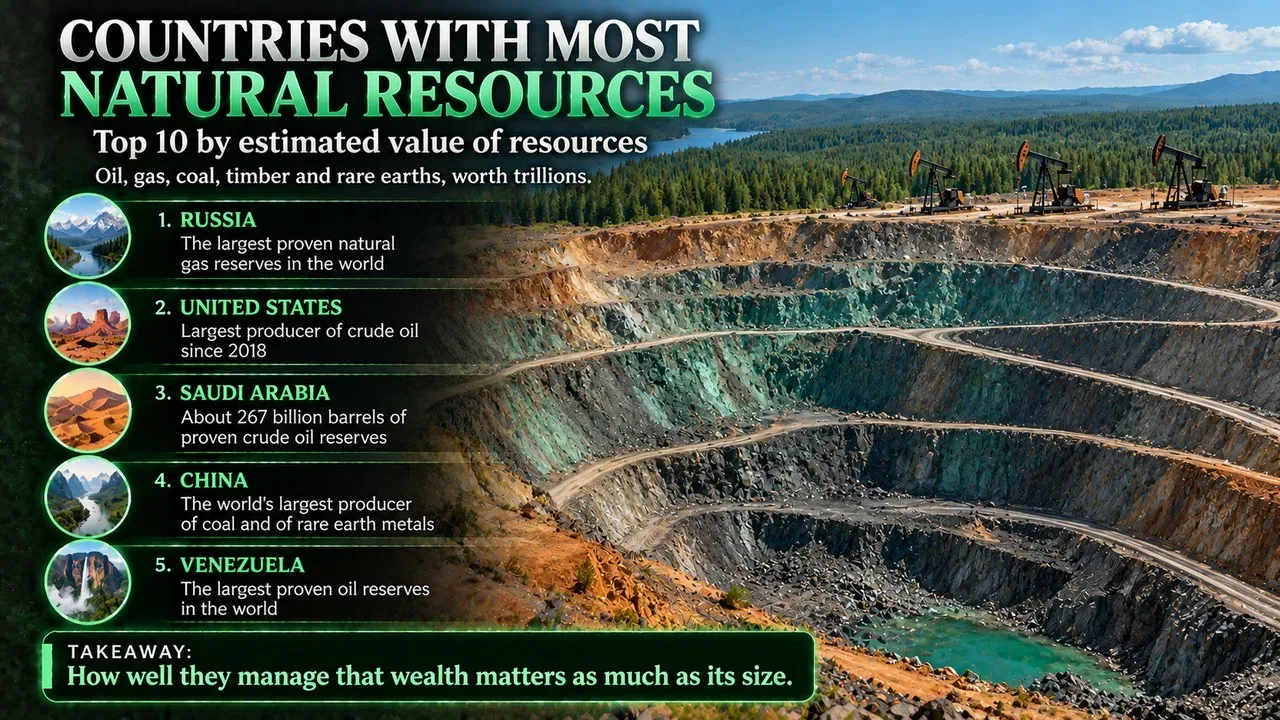
The countries with the most natural resources in the world are, by estimated value, Russia, the United States, Saudi Arabia, Canada and Iran, followed by China, Brazil, Australia, Iraq and Venezuela.[1] Russia leads with natural resources valued at about $75 trillion, mostly coal, natural gas, oil and rare earth metals.[1] This ranking comes from 2021 Statista data, as reported by Visual Capitalist, and it is still the most widely quoted estimate of the total value of each country's natural wealth.[1]
This Finepedia list, updated in October 2026, ranks the top 10 countries with the most natural resources. For each country it gives the estimated value, the main resources and the records that set it apart. It also covers how natural resources are classified and why great resource wealth does not always make a country rich.
Key Facts
The table below sums up the ten countries on this list, with the estimated value and main natural resources of each.
The 10 Countries at a Glance
| Rank | Country | Estimated value (trillion US$) | Main natural resources |
|---|---|---|---|
| 1 | Russia | 75 | Coal, natural gas, oil, gold, timber, rare earth metals |
| 2 | United States | 45 | Coal, timber, natural gas, gold, copper |
| 3 | Saudi Arabia | 34 | Oil, timber |
| 4 | Canada | 33 | Oil, uranium, timber, natural gas, phosphate |
| 5 | Iran | 27 | Oil, natural gas |
| 6 | China | 23 | Coal, rare earth metals, timber |
| 7 | Brazil | 22 | Gold, uranium, iron, timber, oil |
| 8 | Australia | 20 | Coal, timber, copper, iron ore, gold, uranium |
| 9 | Iraq | 16 | Oil, phosphate rock |
| 10 | Venezuela | 14 | Iron, natural gas, oil |
Source: Visual Capitalist, based on 2021 Statista data, with values rounded to the nearest trillion US dollars.[1]
What Counts as a Natural Resource
Natural resources can be classified in several ways, including by origin, stage of development, renewability and ownership.[2] Biotic resources come from the biosphere and include flora and fauna, fisheries and livestock. Abiotic resources come from non-living, inorganic material.[2] Some resources are renewable, meaning they can be used at a certain rate and natural processes will restore them. Many extractive industries, however, rely on non-renewable resources that can be extracted only once.[2]
A resource is not the same as a reserve. Petroleum in sedimentary rock remains a potential resource until it is extracted and put to use. Reserves are the part of an actual resource that can be developed profitably in the future.[2] Even renewable resources can be depleted by overuse.[2]
How the Ranking Works
No official body values every country's natural wealth each year. The ranking here follows 2021 data from Statista, as published by Visual Capitalist, which estimates the total value of each country's natural resources in trillions of US dollars.[1] These figures are rough and depend on commodity prices, so each entry below also gives firmer facts on reserves and production.
1. Russia
Russia's natural resources are valued at about $75 trillion, mostly coal, natural gas, oil and rare earth metals.[1] The World Bank also estimates the total value of Russia's natural resources at US$75 trillion.[5] At the end of 2018, Russia's Ministry of Natural Resources and the Environment valued the country's mineral reserves at about $1.44 trillion.[1]
Key Resources
Russia has the world's largest natural gas reserves, the second-largest coal reserves, the eighth-largest oil reserves and the largest oil shale reserves in Europe.[4] It is the second-largest producer of natural gas and the second-largest oil exporter and producer, and it is the third-largest exporter of natural gas and of coal.[4] The mineral-rich Ural Mountains, together with the oil, gas, coal and timber of Siberia and the Russian Far East, make Russia rich in the resources that dominate its exports.[4]
Related: Top 10 Largest Oil Producing Countries
Interesting Facts
- Gas giant: Russia held the world's largest proven natural gas reserves in 2020, at 1.32 quadrillion cubic feet, close to 20 percent of the world total. [1]
- Energy superpower: Because of its gas, coal and oil reserves, Russia has been widely described as an energy superpower. [4]
2. United States
The natural resources of the United States are estimated at about $45 trillion. They include coal, timber, natural gas and valuable metals such as gold.[1]
Key Resources
The United States is the world's largest producer of petroleum and natural gas.[6] It is also the world's second-largest producer of energy overall.[7] In 2025, 37 percent of the country's energy came from petroleum, 36 percent from natural gas and 9 percent from coal.[7] By 2020, better fracking methods had raised natural gas production by more than half, while coal production fell by half.[7]
Interesting Facts
- Farm and forest: The country's agricultural products include wheat, corn and other grains, cotton, beef, pork, poultry and dairy, along with forest products and seafood. [6]
- Gold: The United States holds the world's largest gold reserves. [6]
3. Saudi Arabia
Saudi Arabia's natural resources are estimated at about $34 trillion, with oil wealth driving the total.[1] Wikipedia describes the kingdom as an "energy superpower" with natural resources valued at US$34.4 trillion in 2016.[8]
Key Resources
Petroleum was discovered in the country in 1938. Since then, Saudi Arabia has become the world's second-largest oil producer and leading oil exporter, with the second-largest oil reserves and sixth-largest gas reserves.[8] The vast reserves were found in the Al-Ahsa region along the Persian Gulf coast, and full-scale development began in 1941 under the US-controlled Aramco.[8] According to the Saudi government, proven reserves are about 260 billion barrels, roughly a quarter of the world's oil reserves.[9]
Interesting Facts
- State oil company: Much of the economy's refining and chemical manufacturing is vertically integrated in the state-owned Saudi Aramco. [9]
- Second in the region: With $34.4 trillion of natural resources, Saudi Arabia has been described as having the second most valuable natural resources in the world. [10]
- Desert: The 647,500 square kilometre Rub' al Khali, or Empty Quarter, is the world's largest continuous sand desert. [8]
4. Canada
Canada's natural resources are estimated at about $33 trillion. The country's wealth is driven by oil, and it also has large uranium deposits and some of the world's largest lumber companies.[1]
Key Resources
The vast Athabasca oil sands and other reserves give Canada 13 percent of the world's oil reserves, the third- or fourth-largest in the world.[11] Among developed countries, Canada has an unusually important primary sector, led by forestry and petroleum.[11] It is a leading exporter of zinc, uranium, gold, nickel, aluminium, iron ore, coking coal, copper and cobalt.[11]
Interesting Facts
- Uranium: Canada was the world's second-largest uranium producer in 2018, and Saskatchewan alone produces about 15 percent of the world's uranium. [12]
- Hydropower: Hydroelectricity supplied 59 percent of Canada's electricity in 2016, making it the world's second-largest producer of hydroelectricity after China. [11]
- Metals: In 2019, Canada was the fifth-largest producer of gold and nickel. [12]
5. Iran
Iran's natural resources are estimated at about $27 trillion, mainly oil and natural gas.[1]
Related: Top 10 Largest Countries in the World by Area
Key Resources
Iran's energy sector holds 10 percent of the world's proven oil reserves and 15 percent of its gas reserves, which has led many to describe Iran as an "energy superpower".[13] In 2009, mineral products, mainly petroleum, made up 80 percent of export revenues, even though mining employs less than 1 percent of the workforce.[13] Iran ranks among the world's 15 major mineral-rich countries.[13]
Interesting Facts
- Farm produce: Iran is the world's largest producer of saffron, pistachios, honey, berberis and berries, and the second-largest producer of dates. [13]
- Industry: Iran's main manufactured products are petrochemicals, steel and copper products. [13]
6. China
China's natural resources are estimated at about $23 trillion, mainly coal, rare earth metals and timber. It has vast coal reserves and is the top producer of the fuel.[1]
Key Resources
China is the largest producer and consumer of coal in the world. It produced 4.71 billion tonnes in 2023, more than half of global production.[15] Its coal reserves are concentrated in Inner Mongolia, Shanxi and Shaanxi, and carrying coal to the southeastern coast uses nearly half of China's rail capacity.[15] China's mineral resources include fuels such as coal, oil and natural gas, as well as metals and non-metallic minerals.[17] The northeast is rich in coal and oil, the central part of north China has abundant coal, and the southwest has immense hydroelectric potential.[14] Coal provides 70 to 75 percent of China's energy, and the government has wanted to shift towards oil, natural gas and renewable energy, largely for environmental reasons.[14]
Interesting Facts
- Rare earths: China dominates the world's rare earth reserves and production. In 2019, it supplied about 90 percent of global demand for the 17 rare earth powders. [16]
- Growing share: China's share of rare earth production rose from 21 percent to 60 percent between 1985 and 1995. [16]
- Inner Mongolia: In the early 2000s, huge coal and rare earth deposits were discovered in Inner Mongolia, driving rapid growth in a historically underdeveloped region. [17]
- Mineral producer: By the end of the 1990s, China was the world's second-largest producer of solid minerals and the largest producer of several, including iron and coal. [17]
7. Brazil
Brazil's natural resources are estimated at about $22 trillion, including gold, uranium, iron, timber and oil.[1] Brazil and Australia are both leading producers of metals such as iron ore.[1]
Key Resources
Brazil's mining centres on iron, and it is the second-largest iron ore exporter in the world. It also mines copper, gold, bauxite, manganese and tin.[19] Vale, a Brazilian company, is the largest producer of iron ore in the world, and the oil and gas company Petrobras is the most valuable company in Latin America.[18] Most iron is mined in the states of Minas Gerais and Pará.[19]
Interesting Facts
- Niobium: In 2019, Brazil was the world's largest producer of niobium, at 88.9 thousand tonnes. [19]
- Gemstones: Brazil is the world's largest producer of amethyst, topaz and agate. [19]
- Farmland: Brazil is the world's largest producer of sugarcane, soy, coffee and oranges. [18]
8. Australia
Australia's natural resources are estimated at about $20 trillion, including coal, timber, copper, iron ore, gold and uranium. It is also a top coal exporter.[1]
Related: Top 10 Smallest Countries in Europe
Key Resources
In 2019, Australia was the world's largest producer of iron ore and bauxite. It was also the second-largest producer of gold, manganese and lead, and the third-largest of zinc, cobalt and uranium.[20] Mining has helped drive Australia's economic growth ever since the gold rush of the 1840s.[21] At the height of the mining boom in 2009–10, mining made up 8.4 percent of GDP.[21]
Interesting Facts
- Opals: Australia is the world's largest producer of opal and one of the largest producers of diamonds, rubies, sapphires and jade. [20]
- Gas: In 2015, Australia was the 12th-largest producer of natural gas in the world. [20]
9. Iraq
Iraq's natural resources are estimated at about $16 trillion, mainly oil and phosphate rock.[1]
Key Resources
Iraq has the world's fifth-largest proven petroleum reserves.[23] According to the Oil and Gas Journal, its proven reserves are 115 billion barrels. Geologists estimate that the little-explored western and southern deserts may hold another 45 to 100 billion barrels of recoverable oil.[23] Crude oil makes up 92 to 99 percent of Iraq's exports and 90 percent of the state budget.[22]
Interesting Facts
- Oil money: Iraq's oil revenues were 21 billion dollars in 1979 and 27 billion dollars in 1980, helped by record oil prices. [22]
- Record output: In 1979, Iraqi oil production reached 3.5 million barrels per day. [22]
- Untapped fields: Only a fraction of Iraq's known oil fields are in development. [23]
10. Venezuela
Venezuela's natural resources are estimated at about $14 trillion, mainly iron, natural gas and oil.[1] Its economy is closely tied to petroleum, as the country holds the largest crude oil supply in the world.[24]
Interesting Facts
- OPEC: In 1958, a Venezuelan government that included Pérez Alfonso drew up the plan for an international oil cartel that became OPEC. [24]
- Low production: Despite its reserves, Venezuela is only the 25th-largest oil producer in the world and the eighth-largest member of OPEC. [24]
- Oil revenue: Between 1998 and 2008, the government received about US$325 billion from oil production and exports. [24]
- Gold: In 2021, gold mining generated about $2.3 billion, of which the state received only 25 percent. [24]
The Resource Curse
Great natural wealth does not always bring prosperity. The resource curse, also called the paradox of plenty, is the idea that countries rich in natural resources such as fossil fuels and certain minerals tend to have lower economic growth, less democracy or poorer development than countries with fewer resources.[3] Richard Auty first used the term in 1993.[3]
The International Monetary Fund classifies 51 countries as resource-rich. These are countries that get at least 20 percent of their exports or fiscal revenue from non-renewable natural resources.[3] One effect, known as Dutch disease, makes a country's other tradable goods less competitive on world markets.[3] Resource revenue can also cause conflict between groups fighting over a share of it, including armed separatist movements in the regions where the resources are produced.[3] The evidence is mixed. One review found that about 40 percent of studies showed a negative effect, 40 percent showed none and 20 percent showed a positive one.[3]
Related: Top 10 Most Populous Countries in the World
Key Figures
- $75 trillion: Estimated value of Russia's natural resources. [1]
- 1.32 quadrillion cubic feet: Russia's proven natural gas reserves in 2020. [1]
- 260 billion barrels: Saudi Arabia's proven oil reserves, according to its government. [9]
- 1938: Year oil was discovered in Saudi Arabia. [8]
- 13 percent: Canada's share of world oil reserves. [11]
- 4.71 billion tonnes: China's coal production in 2023. [15]
- 90 percent: China's share of global rare earth demand supplied in 2019. [16]
- 115 billion barrels: Iraq's proven oil reserves. [23]
- 51: Countries the IMF classifies as resource-rich. [3]
Frequently Asked Questions
Which country has the most natural resources?
Russia, with natural resources valued at about $75 trillion, mostly coal, natural gas, oil and rare earth metals.[1]
Which country has the largest oil reserves?
Venezuela holds the largest crude oil supply in the world, and Saudi Arabia has the second-largest oil reserves.[24][8]
Which country produces the most coal?
China produced 4.71 billion tonnes of coal in 2023, more than half of global production.[15]
Who controls rare earth elements?
China dominates the world's rare earth reserves and production. In 2019, it supplied about 90 percent of global demand.[16]
Does natural wealth make a country rich?
Not always. The resource curse hypothesis holds that resource-rich countries often grow more slowly, although studies are divided.[3]
See also
- Top 10 Largest Islands in the World
- Top 10 Highest Mountains in the World
- Top 10 Longest Rivers in North America
- ^ [1] "Ranked: Top 10 Countries by Value of All Their Natural Resources". Visual Capitalist. Visual Capitalist
- ^ [2] "Natural resource". Wikipedia. Wikipedia
- ^ [3] "Resource curse". Wikipedia. Wikipedia
- ^ [4] "Economy of Russia". Wikipedia. Wikipedia
- ^ [5] "List of companies of Russia". Wikipedia. Wikipedia
- ^ [6] "Economy of the United States". Wikipedia. Wikipedia
- ^ [7] "Energy in the United States". Wikipedia. Wikipedia
- ^ [8] "Saudi Arabia". Wikipedia. Wikipedia
- ^ [9] "Economy of Saudi Arabia". Wikipedia. Wikipedia
- ^ [10] "Economy of the Middle East". Wikipedia. Wikipedia
- ^ [11] "Economy of Canada". Wikipedia. Wikipedia
- ^ [12] "Mining in Canada". Wikipedia. Wikipedia
- ^ [13] "Economy of Iran". Wikipedia. Wikipedia
- ^ [14] "Economy of China". Wikipedia. Wikipedia
- ^ [15] "Coal in China". Wikipedia. Wikipedia
- ^ [16] "Rare-earth element". Wikipedia. Wikipedia
- ^ [17] "Mining in China". Wikipedia. Wikipedia
- ^ [18] "Economy of Brazil". Wikipedia. Wikipedia
- ^ [19] "Mining in Brazil". Wikipedia. Wikipedia
- ^ [20] "Mining in Australia". Wikipedia. Wikipedia
- ^ [21] "Economy of Australia". Wikipedia. Wikipedia
- ^ [22] "Economy of Iraq". Wikipedia. Wikipedia
- ^ [23] "Petroleum industry in Iraq". Wikipedia. Wikipedia
- ^ [24] "Economy of Venezuela". Wikipedia. Wikipedia





















Discussion
Log in with