




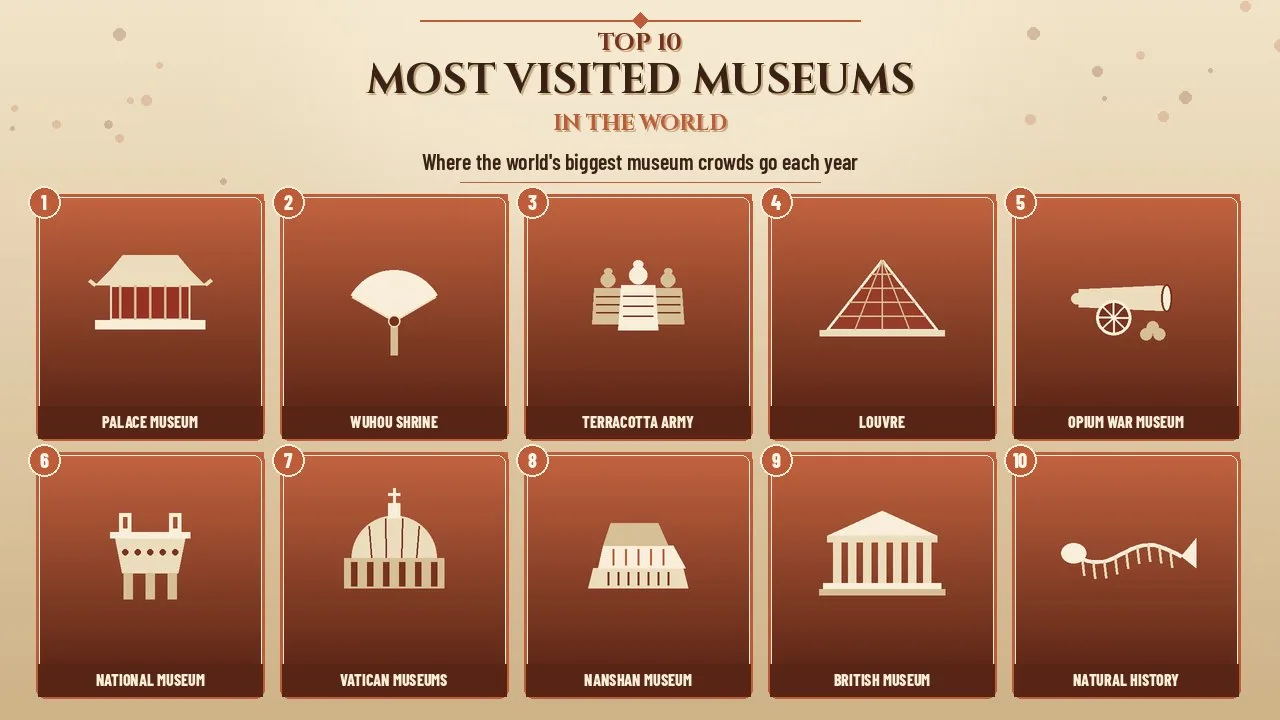
The most visited museums in the world each draw over six million people a year, led by Beijing's Palace Museum, and the Louvre is the busiest outside China.
This ranking uses the latest complete global count of all museum types, the TEA Global Experience Index for 2024, published in October 2025 by the Themed Entertainment Association with its research partners. It counts every kind of museum, from imperial palaces and archaeological sites to science centres and natural history halls, which is why China now fills much of the top of the chart. Further down, you will also find the newer 2025 art museum ranking from The Art Newspaper, plus the venues most likely to break into the top 10 next.
Attendance figures are rounded to the nearest thousand as reported. Museums count visitors in slightly different ways (some count every entry, some count tickets, some count free and paid visits together), so treat small gaps between neighbours as a near tie rather than a clear win.
How the Ranking Works
Two surveys dominate museum attendance reporting, and they measure different things. Knowing which one you are reading explains why one list puts the Louvre first and another puts it fourth.
| Survey | Who publishes it | What it counts | Latest edition |
|---|---|---|---|
| TEA Global Experience Index | Themed Entertainment Association with Entertainment + Culture Advisors and The Park Database | All museums: history, science, natural history, art and heritage sites | 2024 attendance, released October 2025 |
| Visitor Figures survey | The Art Newspaper | Art museums only, with permanent collections of art and design | 2025 attendance, released 31 March 2026 |
The TEA report, formerly called the Theme Index and Museum Index, is the broadest annual count and the basis for our main list. Its 2024 top 20 museums drew a combined 145.9 million visits, up 13.4 percent on 2023, and 14 of those 20 museums are in China. The report links that rise to state investment in cultural venues, free or low-cost entry and very large urban populations.
At a Glance
| Rank | Museum | City and country | 2024 visitors | Change on 2023 | Best known for |
|---|---|---|---|---|---|
| 1 | Palace Museum | Beijing, China | 17,000,000 | +17.2% | The Forbidden City, home of 24 emperors |
| 2 | Chengdu Wuhou Shrine Museum | Chengdu, China | 14,570,000 | -10.6% | Shrine to Zhuge Liang and Liu Bei |
| 3 | Emperor Qinshihuang's Mausoleum Site Museum | Xi'an, China | 11,610,000 | +3.5% | The Terracotta Army |
| 4 | Musée du Louvre | Paris, France | 8,737,000 | -1.4% | Mona Lisa, Venus de Milo |
| 5 | Opium War Museum | Dongguan, China | 7,221,000 | +33.4% | Lin Zexu's 1839 opium destruction at Humen |
| 6 | National Museum of China | Beijing, China | 6,957,000 | +3.0% | Five thousand years of Chinese history |
| 7 | Vatican Museums | Vatican City | 6,825,000 | +0.9% | Sistine Chapel, Raphael Rooms |
| 8 | Shenzhen Nanshan Museum | Shenzhen, China | 6,805,000 | +26.2% | Local history and touring blockbusters |
| 9 | British Museum | London, United Kingdom | 6,480,000 | +11.3% | Rosetta Stone, Parthenon sculptures |
| 10 | Natural History Museum | London, United Kingdom | 6,302,000 | +10.8% | Hope the blue whale, dinosaur galleries |
Source for all 2024 figures and changes: TEA Global Experience Index 2024.
1. Palace Museum, Beijing
| Attribute | Details |
|---|---|
| Location | Centre of Beijing, directly north of Tiananmen Square |
| Opened as a museum | 10 October 1925 |
| 2024 visitors | 17,000,000 (TEA) |
| Collection | More than 1.8 million objects |
| World Heritage status | UNESCO listed in 1987 |
The Palace Museum occupies the Forbidden City, the vast walled compound from which Ming and Qing emperors ruled China for almost five centuries. With 17 million visitors in 2024, it was the busiest museum on the planet by a clear margin of more than two million.
Origins and History
Construction of the palace began under the Yongle Emperor in 1406 and was largely finished by 1420, when the Ming court moved its capital to Beijing. Twenty-four emperors lived and governed here until the last emperor, Puyi, was expelled from the inner court in 1924. A year later, on 10 October 1925, the complex opened to the public as the Palace Museum, turning a forbidden residence into a national treasure house.
During the Second Sino-Japanese War, many of the finest pieces were packed into crates and moved south and west for safety. Part of that evacuated collection later went to Taiwan, which is why a separate National Palace Museum exists in Taipei today.
Key Features
- Gate after gate of red walls and yellow-glazed roofs laid out along a strict north–south axis
- The Hall of Supreme Harmony, the largest surviving wooden hall in the compound and the setting for coronations
- Galleries of ceramics, bronzes, clocks, paintings, calligraphy and jade drawn from the imperial collection
- Timed, real-name online booking, introduced to manage crowds and protect the buildings
Significance
The Palace Museum is both a museum and the object on display. Walking through it shows how imperial power was expressed in architecture, from the size of each courtyard to the number of guardian figures on each roof ridge. Its centenary in October 2025 was marked with a programme of major anniversary exhibitions.
In Popular Culture
Bernardo Bertolucci filmed The Last Emperor inside the Forbidden City, and the film won nine Academy Awards in 1988. In recent years the museum's own design shop and documentaries about its restorers have made it a youth brand in China as much as a heritage site.
Interesting Facts
- The museum's visitor figure in 2024 was higher than the entire population of many European countries.
- Many of its halls have names built around harmony, reflecting the Confucian ideals of the court.
- The Palace Museum and the National Palace Museum in Taipei share the same imperial roots but are separate institutions.
- Large parts of the compound that were closed for decades have reopened as restoration has progressed.
2. Chengdu Wuhou Shrine Museum
| Attribute | Details |
|---|---|
| Location | Wuhou District, Chengdu, Sichuan Province, China |
| Dedicated to | Zhuge Liang and Liu Bei of the Three Kingdoms period |
| 2024 visitors | 14,570,000 (TEA) |
| 2023 visitors | 16,300,000, the highest of any museum that year |
| Protected status | National key cultural relics protection unit since 1961 |
The Wuhou Shrine is a temple complex honouring Zhuge Liang, the famous strategist and chancellor of the Shu Han state in the third century, alongside the ruler he served, Liu Bei. It may surprise international readers, but in 2023 this shrine outdrew every other museum in the world.
Origins and History
Zhuge Liang was given the posthumous title Marquis Wu, which is where the name Wuhou comes from. The shrine grew up beside Liu Bei's tomb, known as Huiling, and over the centuries the two memorials were merged into one site. Most of the halls standing today were rebuilt in 1672, during the early Qing dynasty, after earlier structures were lost.
The Three Kingdoms era is one of the most retold periods in Chinese history, thanks largely to the 14th-century novel Romance of the Three Kingdoms. The shrine is the most important place in China to connect with those stories.
Key Features
- A rare joint temple in which a ruler and his minister are honoured together
- Painted clay statues of Shu Han generals and officials lining the corridors
- Steles and inscribed tablets, including famous calligraphy on Zhuge Liang's memorials to the throne
- Gardens, bamboo groves and red walled lanes that are popular for photographs
- Jinli, a busy pedestrian street of snack stalls and craft shops, right next door
Significance
The Wuhou Shrine shows how heavily museum attendance in China is shaped by culture-driven domestic tourism. Video games, television dramas and films about the Three Kingdoms bring a steady flow of younger visitors who know the characters well before they arrive.
Interesting Facts
- Its 2024 dip of 10.6 percent was still enough to keep it second in the world.
- Liu Bei's burial mound sits inside the grounds, enclosed by its own wall.
- Zhuge Liang is often shown holding a feather fan, a symbol of calm intelligence.
- The site is also a major venue for Chengdu's Lunar New Year lantern displays.
3. Emperor Qinshihuang's Mausoleum Site Museum, Xi'an
| Attribute | Details |
|---|---|
| Location | Lintong District, about 40 km east of central Xi'an, Shaanxi Province |
| Discovered | March 1974, by farmers digging a well |
| Museum opened | 1979 |
| 2024 visitors | 11,610,000 (TEA) |
| World Heritage status | Mausoleum of the First Qin Emperor, UNESCO listed in 1987 |
Better known as the home of the Terracotta Army, this museum protects the clay soldiers buried to guard Qin Shi Huang, the ruler who unified China in 221 BC. More than 11.6 million people came to see them in 2024.
Origins and History
Qin Shi Huang began planning his tomb soon after taking the throne as a boy, and the work continued until his death in 210 BC. Its existence was recorded by the historian Sima Qian, but the pits of clay warriors were forgotten for more than two thousand years. In 1974, villagers sinking a well struck fragments of a terracotta figure, and archaeologists soon uncovered an entire buried army.
Key Features
- Pit 1, a vast hall holding rows of infantry figures in battle formation
- Pit 2, with cavalry, chariots and archers, and Pit 3, thought to be the command post
- Two bronze chariots with horses, reassembled from thousands of fragments
- Ongoing excavation that visitors can watch from walkways above the pits
Significance
The Terracotta Army reveals the scale of the first imperial state: its standardised weapons, organised workshops and ability to command huge labour forces. Each warrior was assembled from moulded parts and then finished by hand, so faces, hairstyles and armour vary from figure to figure. Archaeologists estimate the three main pits hold several thousand figures, many still unexcavated.
In Popular Culture
The warriors appear in films, novels and video games worldwide, and small touring groups of figures have drawn record crowds at museums abroad. A replica warrior is now one of the most recognised souvenirs of China.
Interesting Facts
- The figures were originally painted in bright colours, most of which flaked away soon after exposure to air.
- The emperor's own burial mound has never been opened.
- Many original bronze weapons were found still sharp after more than two millennia.
- Visitor numbers keep rising even though the site has been open for over four decades.
4. Musée du Louvre, Paris
| Attribute | Details |
|---|---|
| Location | Right Bank of the Seine, 1st arrondissement, Paris, France |
| Opened as a museum | 10 August 1793 |
| 2024 visitors | 8,737,000 (TEA) |
| 2025 visitors | 9,046,000 (The Art Newspaper) |
| Adult ticket | 22 euros for EU visitors; 32 euros for most non-EU visitors since 14 January 2026 |
The Louvre is the most visited museum outside China and the busiest art museum in the world. It began as a fortress, became a royal palace and opened as a public museum during the French Revolution.
Origins and History
King Philip II built the first Louvre as a fortress around 1190 to defend Paris. Later monarchs turned it into a grand palace, until Louis XIV moved the court to Versailles in 1682. In 1793, the revolutionary government opened the former royal collection to the public, and later conquests and acquisitions swelled it into one of the largest art collections on earth.
I. M. Pei's glass pyramid opened in 1989 as a new main entrance. It was controversial at first and is now a symbol of the museum. The Louvre's attendance peaked at about 10.2 million in 2018, and staff have since argued that the building is struggling to cope with crowds of that size.
Key Features
- The Mona Lisa by Leonardo da Vinci, behind protective glass in the Salle des États
- The Venus de Milo and the Winged Victory of Samothrace
- Curatorial departments covering antiquities, paintings, sculpture, decorative arts, prints and drawings, and Islamic art
- Napoleon III's apartments and the medieval foundations of the original fortress
Significance
The Louvre sets the global benchmark for what a universal museum looks like, and its problems are watched closely by other institutions. On 19 October 2025, thieves stole French crown jewels valued at about 88 million euros from the Apollo Gallery in less than eight minutes. The museum was also dealing with staff strikes over overcrowding, water damage and a suspected long-running ticket fraud. Director Laurence des Cars resigned on 24 February 2026. Even so, the museum gained visitors in 2025.
Interesting Facts
- The Mona Lisa was stolen in 1911 and missing for more than two years.
- The higher non-EU ticket price is part of a national policy also applied at Versailles and other major sites.
- A long-term modernisation plan includes a new entrance and a dedicated room for the Mona Lisa.
- Fewer than one in ten objects in the collection is on display at any time.
5. Opium War Museum, Dongguan
| Attribute | Details |
|---|---|
| Location | Humen Town, Dongguan, Guangdong Province, China |
| Founded | 1957 as the Lin Zexu Memorial Hall, opened 1 January 1958 |
| 2024 visitors | 7,221,000 (TEA), up 33.4 percent |
| Sites managed | Lin Zexu Memorial Hall, Sea Battle Museum, Shajiao Fort and Weiyuan Fort |
| Status | National First-Class Museum since 2020 |
The Opium War Museum marks one of the turning points of modern Chinese history: the public destruction of seized opium at Humen in June 1839, and the war with Britain that followed. It posted the biggest jump in the top 10 in 2024.
Origins and History
Between 3 and 25 June 1839, the imperial commissioner Lin Zexu oversaw the destruction of more than a thousand tonnes of opium in pools dug on the Humen shore, using salt and lime to break it down before flushing it out to sea. Britain responded with force, and the First Opium War (1839 to 1842) ended with the Treaty of Nanking, which opened ports to foreign trade and ceded Hong Kong Island.
The local government set up a memorial hall and park beside the old destruction pools in 1957. The Sea Battle Museum opened in December 1999, and the whole site now covers about 800,000 square metres.
Key Features
- The original opium destruction pools, protected as a national heritage site
- Two core exhibitions: The Destruction of Opium at Humen and The Opium War
- Coastal forts and cannon emplacements at Weiyuan and Shajiao that guarded the Pearl River
- A panoramic painting of the sea battle at Humen
Significance
For Chinese audiences, Humen marks the start of the so-called century of humiliation, and the museum is a major site for patriotic education trips by schools and workplaces. Its location in the fast-growing Greater Bay Area and its place on school and workplace itineraries help explain its climb.
Interesting Facts
- 26 June, the International Day against Drug Abuse and Illicit Trafficking, was chosen to recall the Humen destruction.
- The museum's collection includes original wooden stakes and boards from the destruction pools.
- It also holds calligraphy by Lin Zexu himself.
- It runs an online exhibition on Google Arts and Culture.
6. National Museum of China, Beijing
| Attribute | Details |
|---|---|
| Location | East side of Tiananmen Square, Beijing |
| Formed | 2003, by merging the Museum of Chinese History and the Museum of the Chinese Revolution |
| Building | Completed 1959; reopened in 2011 after a major expansion |
| 2024 visitors | 6,957,000 (TEA) |
| Collection | More than 1.4 million objects |
The National Museum of China tells the story of Chinese civilisation from prehistoric times to the present, all under one enormous roof across the square from the Forbidden City.
Origins and History
The building was one of the Ten Great Buildings completed in 1959 for the tenth anniversary of the People's Republic. It originally housed two separate museums, one for ancient history and one for the revolution. They were merged in 2003, and after a long renovation the expanded museum reopened in 2011 with close to 200,000 square metres of floor space, making it one of the largest museum buildings in the world.
Key Features
- Ancient China, a permanent gallery tracing dynasties from the Stone Age to the Qing
- Bronze ritual vessels, jade burial suits and early porcelain
- The Road of Rejuvenation, a gallery on China's modern history
- Rotating loan exhibitions from museums abroad
Significance
The museum is China's official national narrative in physical form, and a fixed stop on most organised tours of Beijing. Because admission is free with advance booking, it attracts both domestic tourists and local families on weekends.
Interesting Facts
- Its building faces the Great Hall of the People across Tiananmen Square.
- Among its treasures is the Houmuwu Ding, one of the heaviest bronze vessels to survive from ancient China.
- Daily entry is managed through real-name reservations.
- Its renovated building holds dozens of exhibition halls, so most visitors see only a fraction in one day.
7. Vatican Museums, Vatican City
| Attribute | Details |
|---|---|
| Location | Vatican City, surrounded by Rome, Italy |
| Origins | Early 16th century, under Pope Julius II |
| 2024 visitors | 6,825,000 (TEA) |
| 2025 visitors | 6,933,822 (The Art Newspaper), during the Jubilee year |
| Highlight | The Sistine Chapel, painted by Michelangelo |
The Vatican Museums hold the art collection gathered by the popes over five centuries, ending with the Sistine Chapel, which is still used for papal conclaves.
Origins and History
The collection traces its birth to 1506, when the ancient sculpture group Laocoön and His Sons was unearthed in Rome and acquired by Pope Julius II. Julius also hired Michelangelo to paint the Sistine Chapel ceiling, completed in 1512, and Raphael to decorate the papal apartments now called the Raphael Rooms. Michelangelo returned decades later to paint The Last Judgment on the altar wall.
Key Features
- The Sistine Chapel ceiling and The Last Judgment
- The Raphael Rooms, including The School of Athens
- Classical sculpture in the Pio-Clementine Museum, including the Apollo Belvedere
- The Gallery of Maps, a long corridor of painted 16th-century maps of Italy
- The modern spiral staircase designed by Giuseppe Momo in 1932
Significance
The Vatican Museums combine religious pilgrimage, Renaissance art and ancient sculpture in one visit, which gives them a wider audience than a pure art gallery. The 2025 Jubilee year brought large numbers of pilgrims to Rome and helped lift attendance.
Interesting Facts
- The route through the museums runs for several kilometres.
- The Sistine Chapel closes to visitors when cardinals gather to elect a pope.
- Photography is not allowed inside the Sistine Chapel.
- The Vatican collection also includes Egyptian and Etruscan antiquities.
8. Shenzhen Nanshan Museum
| Attribute | Details |
|---|---|
| Location | 2093 Nanshan Boulevard, Nanshan District, Shenzhen, China |
| Opened | 31 January 2018 |
| 2024 visitors | 6,805,000 (TEA), up 26.2 percent |
| Floor space | About 36,000 square metres, with seven exhibition halls |
| Admission | Free for permanent galleries; some special shows are ticketed |
The Nanshan Museum is the surprise of the list: a district museum that opened less than a decade ago and now outdraws the British Museum. It sits in the Shenzhen district that is home to many of China's biggest technology companies.
Origins and History
The museum ran a trial opening during Shenzhen Design Week in 2017 and opened officially on 31 January 2018. Its founding board included figures from business and from the Hong Kong museum world. Run by the district government, it also manages smaller historical museums in nearby Nantou Ancient Town, which was an administrative centre for the coast long before Shenzhen became a city.
Key Features
- Nanshan Story, permanent galleries on ancient Nanshan, modern Nanshan and the area's role in China's reform and opening-up from 1979
- Four temporary halls that host six to ten special exhibitions a year
- Major loans, including shows on the Dunhuang Mogao Grottoes and, from June to October 2026, 171 works of Oceanian art from the Musée du quai Branly in Paris
- Evening opening on Saturdays
Significance
Nanshan shows how a young, wealthy and densely populated city can create huge museum audiences quickly. Free entry, a metro stop nearby and a steady stream of headline exhibitions turn it into a regular weekend outing rather than a once-in-a-lifetime trip.
Interesting Facts
- It cost about 200 million yuan to build.
- It is one of the largest district-level museums in China.
- The nearby Shekou area is where the first industrial zone of China's reform era opened in 1979.
- It is a short walk from Taoyuan station on Shenzhen Metro lines 1 and 12.
9. British Museum, London
| Attribute | Details |
|---|---|
| Location | Great Russell Street, Bloomsbury, London |
| Founded | 1753; opened to the public on 15 January 1759 |
| 2024 visitors | 6,480,000 (TEA) |
| 2025 visitors | 6,440,120 (The Art Newspaper) |
| Collection | About 8 million objects; general admission free |
The British Museum was the first national public museum in the world, created by an Act of Parliament to hold the collection of the physician Sir Hans Sloane.
Origins and History
Sloane left more than 71,000 objects to the nation on his death in 1753, and the museum opened in Montagu House six years later. The present building, with its row of Greek Revival columns, was built in stages in the 19th century. Foster and Partners covered the central courtyard with a glass roof to create the Great Court, which opened in 2000.
Key Features
- The Rosetta Stone, which helped scholars decode Egyptian hieroglyphs
- The Parthenon sculptures from Athens, whose return Greece has long requested
- The Sutton Hoo ship burial treasures from Anglo-Saxon England
- Assyrian palace reliefs and Egyptian mummies
Significance
The British Museum is the classic example of a universal museum, telling world history through objects from every continent. It is also at the centre of debates about restitution, colonial collecting and how such collections should be shared. In 2023 it revealed that about 2,000 items had been stolen or gone missing from its stores, and it has been recovering them since.
Interesting Facts
- General admission has been free since the museum opened in 1759.
- The circular former Reading Room hosted writers including Karl Marx.
- A large-scale masterplan to renew its western galleries is under way.
- Its 2024 rise of 11.3 percent was one of the strongest among European museums.
10. Natural History Museum, London
| Attribute | Details |
|---|---|
| Location | Cromwell Road, South Kensington, London |
| Opened | 1881, in a building designed by Alfred Waterhouse |
| 2024 visitors | 6,302,000 (TEA) |
| 2025 visitors | About 7.1 million, a record year (reported by The Art Newspaper) |
| Collection | About 80 million specimens; general admission free |
The Natural History Museum completes the top 10 and is the only science and nature museum on the list. Its building is so ornate that it is often called a cathedral of nature.
Origins and History
The natural history collections began as part of the British Museum's founding gift from Hans Sloane. As they outgrew Bloomsbury, the superintendent Richard Owen campaigned for a separate building, and Alfred Waterhouse's terracotta-clad Romanesque hall opened in South Kensington in 1881. The museum became fully independent of the British Museum in 1963.
Key Features
- Hope, the skeleton of a blue whale that has hung in Hintze Hall since 2017
- Dinosaur galleries with a moving Tyrannosaurus rex model
- The Earth Hall, entered by an escalator through a giant metal globe
- The Darwin Centre, which houses millions of preserved specimens and working scientists
Significance
The Natural History Museum is both a family day out and a working research institution, with scientists studying biodiversity, minerals and climate history. Its record 2025 attendance shows the appeal of free, hands-on science in a major tourist city.
Interesting Facts
- The terracotta tiles on its walls are decorated with carved plants and animals.
- Dippy, a cast of a Diplodocus skeleton, stood in the main hall for decades before touring the UK.
- Wildlife Photographer of the Year, one of the world's best-known photography competitions, is run by the museum.
- The 2025 figure of about 7.1 million would have placed it sixth in the 2024 global table.
The Art Museum Ranking for 2025
The Art Newspaper's survey covers only art museums, but it is more recent, with full-year 2025 figures published on 31 March 2026. More than 200 million visits were made to its top 100 museums, compared with 230 million in 2019 and 54 million in 2020.
| Rank | Art museum | City | 2025 visitors |
|---|---|---|---|
| 1 | Musée du Louvre | Paris | 9,046,000 |
| 2 | Vatican Museums | Vatican City | 6,933,822 |
| 3 | National Museum of Korea | Seoul | 6,507,483 |
| 4 | British Museum | London | 6,440,120 |
| 5 | Metropolitan Museum of Art | New York | 5,984,091 |
| 6 | State Russian Museum | St Petersburg | 5,087,276 |
| 7 | National Museum of Anthropology | Mexico City | 5,048,893 |
| 8 | Shanghai Museum East | Shanghai | 4,593,216 |
| 9 | Tate Modern | London | 4,514,266 |
| 10 | National Gallery | London | 4,147,544 |
Source: The Art Newspaper, Visitor Figures 2025.
A few patterns stand out. The National Museum of Korea has become one of the busiest museums in Asia, ranking third among the world's art museums. The Metropolitan Museum of Art is the most visited museum in the United States, with almost six million visitors in 2025. Shanghai Museum East, which only opened in 2024, is already in the top 10.
Museums to Watch
Grand Egyptian Museum, Giza
The Grand Egyptian Museum near the Giza pyramids opened fully in November 2025, displaying the complete Tutankhamun collection together for the first time. The Art Newspaper reported early crowds of up to 18,000 visitors a day, which would add up to roughly 6.5 million a year if sustained, enough to challenge the bottom of the global top 10.
Metropolitan Museum of Art, New York
The Met recorded 5.73 million visitors in the 2024 TEA count and close to six million in 2025. It sits just outside the all-museum top 10 and could re-enter it as tourism to New York keeps recovering.
Sanxingdui Museum, Guanghan
Home to the extraordinary bronze masks of an ancient Sichuan culture, the Sanxingdui Museum grew by 85.6 percent in 2024 to almost six million visitors, its first full year after a new main building opened in 2023. Another strong year would put it in the top 10.
Comparison by Type of Museum
| Type | Museums in the top 10 | Examples |
|---|---|---|
| Imperial palace or heritage site | 3 | Palace Museum, Wuhou Shrine, Terracotta Army museum |
| Art and universal collection | 3 | Louvre, Vatican Museums, British Museum |
| National or regional history | 3 | National Museum of China, Opium War Museum, Nanshan Museum |
| Natural history and science | 1 | Natural History Museum, London |
What the top 10 have in common is not a single type of collection but location and access. Most sit in very large cities or major tourist hubs, four of the ten offer free general admission, and almost all are linked to a story their visitors already know, from the Three Kingdoms to the Mona Lisa.
Tips for Visiting the World's Busiest Museums
- Book timed tickets online in advance. The Palace Museum, the National Museum of China and the Louvre all rely on reservations at busy times.
- Go early in the morning or on late-opening evenings, when galleries are calmer.
- Avoid national holidays. China's Golden Week in early October and the Spring Festival bring the heaviest crowds.
- Pick a short list of highlights rather than trying to see everything, especially at the Louvre and the British Museum.
- Check for closures, since rooms can shut for renovation or, at the Vatican, for papal events.
Frequently Asked Questions
What is the most visited museum in the world?
The Palace Museum in Beijing, housed in the Forbidden City, is the most visited museum in the world. It welcomed about 17 million visitors in 2024, according to the TEA Global Experience Index. Among art museums, the Louvre in Paris leads, with just over nine million visitors in 2025 according to The Art Newspaper.
Why are so many Chinese museums in the top 10?
China has invested heavily in museums as part of its cultural policy, and many state museums offer free or low-cost admission with online booking. Combined with very large cities, a growing middle class and strong domestic tourism, that produces enormous visitor numbers. In 2024, 14 of the top 20 museums worldwide were in China.
Is the Louvre still the most visited museum?
The Louvre is still the most visited art museum and the busiest museum outside China. It counted 8.7 million visitors in 2024 in the TEA count and about 9.05 million in 2025 in The Art Newspaper survey. When all museum types are counted, three Chinese museums draw larger crowds.
Which museum in the United States gets the most visitors?
The Metropolitan Museum of Art in New York is the most visited museum in the United States. It recorded about 5.73 million visitors in 2024 in the TEA count and almost six million in 2025 in The Art Newspaper survey. The American Museum of Natural History, also in New York, drew about 5.4 million in 2024.
Are the most visited museums free to enter?
Several are. The British Museum and the Natural History Museum in London offer free general admission, as do the National Museum of China and the Nanshan Museum with advance booking. The Louvre, the Vatican Museums, the Palace Museum and the Terracotta Army museum charge entry, and the Louvre now charges most non-EU visitors 32 euros.
How are museum visitor numbers counted?
Each museum reports its own attendance, usually from ticket sales, turnstiles or entry counters, and surveys such as the TEA Global Experience Index and The Art Newspaper compile and check these figures. Methods vary, so small differences between museums should be read as close results rather than exact gaps.
When will newer figures be available?
The TEA Global Experience Index is normally released in the second half of the year after the one it covers, while The Art Newspaper publishes its art museum survey each spring. This article uses the latest editions available in October 2026: TEA for 2024 and The Art Newspaper for 2025.
Conclusion
The most visited museums in the world are no longer a mostly European club. Beijing's Palace Museum, Chengdu's Wuhou Shrine and the Terracotta Army museum in Xi'an now top the all-museum count, while the Louvre, the Vatican Museums and London's two great free museums hold their places among the world's elite. Behind them, newcomers such as the Nanshan Museum, Shanghai Museum East and the Grand Egyptian Museum show how fast the map is changing. Whichever you visit, book ahead and go early: millions of other people have the same idea.
For more ranked lists, browse the Top 10 Facts collection, see the most walkable cities in the world, or read about the inventions that changed the world.
- Themed Entertainment Association, Entertainment + Culture Advisors and The Park Database, TEA Global Experience Index 2024 (released October 2025)
- The Art Newspaper, The world's 100 most visited art museums in 2025 (31 March 2026)
- ARTnews and Artforum coverage of The Art Newspaper 2025 survey (31 March and 1 April 2026)
- Associated Press and Reuters reporting on the Louvre jewel theft, ticket prices and director's resignation (November 2025 to February 2026)
- Nanshan District Government of Shenzhen, Nanshan Museum visitor information
- Guangdong Provincial Foreign Affairs Office and Google Arts and Culture, Opium War Museum profiles
- UNESCO World Heritage Centre, Imperial Palaces of the Ming and Qing Dynasties and Mausoleum of the First Qin Emperor

















Log in with