



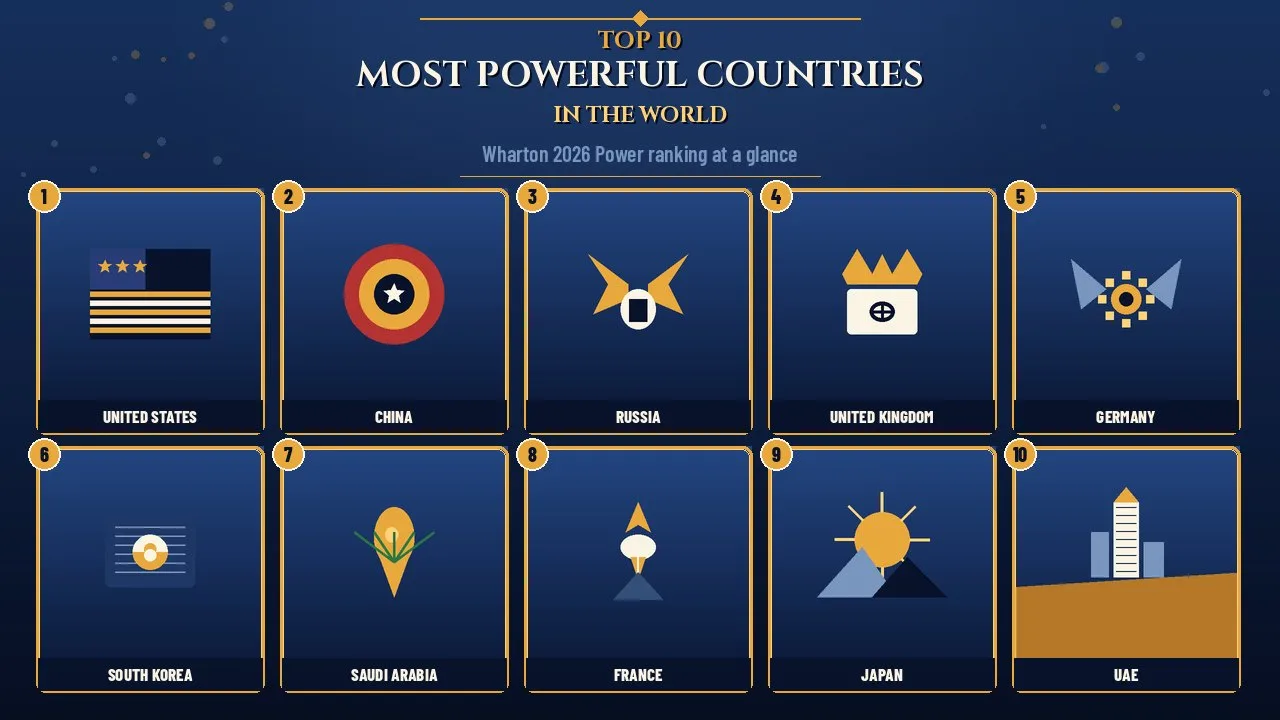
The world's most powerful countries in 2026 are led by the United States, China and Russia, ranked on Wharton Best Countries Index Power scores.
Power is not just tanks or GDP. Every year, researchers ask people across many countries which nations they see as strong, influential and able to shape events beyond their borders. The answers produce a Power ranking that sits beside wealth lists and military indexes, and often surprises readers who expect the biggest economies to fill every slot.
This guide uses the 2026 Best Countries Index Power scores from the Wharton School of the University of Pennsylvania, produced with WPP's BAV brand analytics platform. The survey asked 15,131 adults in 33 countries how they rate 85 nations on power-related traits. Scores are relative: the leader is set at 100.0, and every other country is scaled against that benchmark. Visual Capitalist published the full Power table in July 2026. Historically, the same perception-based Power category appeared in U.S. News & World Report Best Countries rankings; the 2020 reference list for this topic followed that measure. We cite the latest Wharton 2026 Power scores here and state that year clearly.
The top three pull far ahead of everyone else. After Germany in fifth place, the gap between neighbours is small, which is why South Korea, Saudi Arabia and the United Arab Emirates now sit with France and Japan in a crowded middle band. India, Israel and Canada sit just outside the top 10. For context on economic size rather than perceived power, see Finepedia's guide to the richest countries in the world.
How This Power Ranking Works
The Wharton Best Countries Index does not add military budgets to GDP and call that power. Respondents rate countries on attributes linked to influence, alliances, leadership and strength. Those ratings feed a Power factor score. The method captures soft power and hard power together as the public sees them.
That design explains several quirks:
- Russia ranks third even though its 2026 IMF-projected nominal GDP (about $2.66 trillion) is far below Germany, Japan or the United Kingdom.
- South Korea and Saudi Arabia outrank France and Japan on perceived power despite smaller economies than those European and East Asian peers.
- The United Arab Emirates enters the top 10 after a sharp climb in earlier editions, which researchers link to infrastructure investment, Expo hosting and an active country brand.
Hard data still matters for context. Below we note IMF April 2026 World Economic Outlook projections for nominal GDP, United Nations Security Council status, NATO or major alliance membership where relevant, and other verified facts. Those figures explain why a country is seen as powerful; they are not the ranking formula itself.
At a Glance
| Rank | Country | Power score (2026) | IMF GDP 2026 (nominal) | Standout lever of influence |
|---|---|---|---|---|
| 1 | United States | 100.0 | $32.38 trillion | Economy, alliances, military reach |
| 2 | China | 93.6 | $20.85 trillion | Scale, industry, manufacturing trade |
| 3 | Russia | 91.4 | $2.66 trillion | Nuclear forces, energy, geopolitics |
| 4 | United Kingdom | 84.3 | $4.26 trillion | Finance, diplomacy, security ties |
| 5 | Germany | 74.1 | $5.45 trillion | Export industry, EU weight |
| 6 | South Korea | 62.7 | $1.93 trillion | Technology, defence industry |
| 7 | Saudi Arabia | 61.0 | $1.39 trillion | Energy markets, regional diplomacy |
| 8 | France | 59.5 | $3.60 trillion | UNSC seat, nuclear forces, culture |
| 9 | Japan | 59.0 | $4.38 trillion | Technology, capital, alliances |
| 10 | United Arab Emirates | 58.6 | $0.62 trillion | Trade hub, investment brand |
Power scores: Wharton Best Countries Index 2026 (Visual Capitalist summary, July 2026). GDP: IMF World Economic Outlook, April 2026 projections, rounded.
1. United States
| Attribute | Details |
|---|---|
| Power rank 2026 | 1 of 85 (score 100.0) |
| IMF GDP 2026 | About $32.38 trillion (largest economy) |
| Population 2026 | About 343 million (IMF) |
| Security role | Permanent UNSC member; NATO leader |
| Core strengths | Dollar system, alliances, force projection, culture |
Origins of Its Lead
The United States sits at the top of the Power table with the benchmark score of 100.0. Survey respondents still treat it as the clearest example of a country that can move markets, coalitions and crises at the same time. That image rests on more than one pillar: the world's largest nominal economy, deep capital markets, a network of alliances, and a military designed for long-range operations.
IMF April 2026 projections put US output near a quarter of world GDP at market exchange rates. Size alone does not equal power, but it funds research, fleets, aid and the soft power that flows from universities, entertainment and technology platforms. For how wealth rankings differ from happiness rankings, compare this list with Finepedia's happiest countries in the world.
Key Features
- Permanent seat on the United Nations Security Council with veto power.
- Leading role in NATO and bilateral defence ties across Europe, Asia and the Middle East.
- Home currency that dominates trade invoices, reserves and debt markets.
- Large, diversified economy spanning energy, advanced manufacturing, software and services.
- Cultural exports that shape language, media and consumer habits worldwide.
Significance
When investors price risk, when alliances form, and when humanitarian or military responses are organised, Washington remains a default convening point. That does not mean the gap to China is fixed. The 2026 Power scores place China only 6.4 points behind, which is a narrow lead in perception terms. Competition over technology, supply chains and regional security is the backdrop against which this ranking is read.
Interesting Facts
- The US is set as 100.0 by construction; every other Power score is relative to that ceiling.
- SIPRI data for 2021–2025 credit the United States with about 42% of global major arms exports, with Saudi Arabia among the largest recipients.
- California's economy alone has often been compared in size to major national economies, which illustrates how concentrated US production is in a few large states.
- Soft power and hard power mix: film, music and tech brands travel with treaty alliances and carrier groups.
2. China
| Attribute | Details |
|---|---|
| Power rank 2026 | 2 of 85 (score 93.6) |
| IMF GDP 2026 | About $20.85 trillion (second-largest) |
| Population 2026 | About 1.40 billion (IMF) |
| Security role | Permanent UNSC member |
| Core strengths | Manufacturing scale, trade ties, military modernisation |
Origins of Its Rise
China's second-place Power score of 93.6 reflects decades of industrial growth, export dominance and a larger role in global institutions. Respondents see a country that can change prices for goods, metals and shipping lanes, and that invests heavily in infrastructure at home and abroad.
On IMF 2026 projections it remains the second-largest economy in dollar terms. On purchasing-power measures it looks even larger. That economic weight underpins diplomacy across Asia, Africa and Latin America, even where political systems differ sharply from Western partners.
Key Features
- Permanent United Nations Security Council membership.
- World's largest goods-trading relationships with many partners and a central role in manufacturing supply chains.
- Rapid modernisation of naval, air and missile forces alongside the largest active-duty military by headcount among major powers.
- Strategic position in critical minerals and industrial inputs that other economies depend on.
- Expanding technology sector in electronics, electric vehicles and digital platforms.
Significance
China's nearness to the US score is the story of this edition. A perception gap under seven points signals that many respondents no longer treat American primacy as uncontested. Trade disputes, Taiwan tensions and technology controls all feed into how people rate both countries. For demographic context that shapes long-term power, see Finepedia's coverage of China's demographics.
Interesting Facts
- China moved up in several Best Countries Index categories in recent editions even as Power remained near the top.
- Visual Capitalist notes China's grip on rare earths and trade links as part of why perceptions of its strength have risen.
- The country combines a huge domestic market with export capacity few peers can match.
- Relations with Russia are often described as a strategic partnership, while ties with several Southeast Asian neighbours remain contested at sea.
3. Russia
| Attribute | Details |
|---|---|
| Power rank 2026 | 3 of 85 (score 91.4) |
| IMF GDP 2026 | About $2.66 trillion |
| Population 2026 | About 143 million (IMF) |
| Security role | Permanent UNSC member; large nuclear arsenal |
| Core strengths | Nuclear forces, energy exports, geographic reach |
Origins of Its Standing
Russia's third-place finish is the clearest proof that this ranking is not a GDP league table. Its economy is smaller than Germany's, Japan's or the United Kingdom's on IMF 2026 projections, yet its Power score of 91.4 sits close behind China. Respondents still associate Russia with military capacity, nuclear deterrence, energy leverage and a willingness to use force in its neighbourhood.
Geography matters. Russia spans northern Asia and much of Eastern Europe and remains the world's largest country by area. That scale, plus pipelines and commodity exports, keeps it central to European energy debates and Eurasian security. Finepedia's largest countries by area list puts that landmass in context.
Key Features
- Permanent UNSC seat and veto.
- One of the world's largest nuclear arsenals, which shapes how other states calculate risk.
- Major exporter of oil, gas and other commodities, even under sanctions pressure.
- Defence industry with long-standing customers in several regions.
- Direct involvement in the war in Ukraine since 2022, which dominates international coverage of Russian power.
Significance
Critics argue that battlefield losses and sanctions have reduced Russian influence. The survey still places it in the top tier, which shows how slowly public perceptions of nuclear-armed states change. Energy customers, arms clients and diplomatic partners in parts of Asia, Africa and the Middle East also sustain a global footprint that GDP alone would understate.
Interesting Facts
- The drop from Russia (91.4) to the United Kingdom (84.3) is smaller than the drop from Germany (74.1) to South Korea (62.7), which underlines how tight the top band is.
- SIPRI figures for 2021–2025 still list Russia among the top major arms exporters, with India a leading recipient share in that period.
- Natural resources and a vast land border with Europe and Asia give Moscow levers that smaller rich states lack.
- Leadership continuity under Vladimir Putin is part of how international audiences frame Russian decision-making.
4. United Kingdom
| Attribute | Details |
|---|---|
| Power rank 2026 | 4 of 85 (score 84.3) |
| IMF GDP 2026 | About $4.26 trillion |
| Population 2026 | About 70 million (IMF) |
| Security role | Permanent UNSC member; NATO member; nuclear-weapon state |
| Core strengths | Finance, intelligence, diplomacy, language |
Origins of Its Influence
The United Kingdom ranks fourth with a Power score of 84.3. It is smaller in population and land area than the top three, yet retains outsized diplomatic and financial reach. London remains a global centre for banking, law and media. English is a working language of business and science, which amplifies British soft power.
Brexit changed trade and regulatory ties with the European Union, but the Power ranking still places the UK ahead of Germany. That result tracks how respondents weigh security alliances, intelligence services and historical networks as much as single-market access.
Key Features
- Permanent UNSC membership.
- Nuclear deterrent and a capable navy within NATO.
- Deep capital markets and a major role in international finance.
- Worldwide diplomatic posts and Commonwealth links.
- Strong cultural industries in television, publishing, higher education and the arts.
Significance
For middle powers studying how to punch above their weight, the UK is a case study. It combines a top-five economy with treaty commitments, nuclear status and a brand built over centuries of trade and empire, now reframed as partnership and soft power. Walkable historic cores in British cities also draw visitors; see Finepedia's most walkable cities in the world for how urban design supports tourism economies.
Interesting Facts
- The UK score of 84.3 leaves a clear gap to Germany at 74.1, so fourth place is not a photo finish.
- Secret Intelligence Service (MI6) and related agencies are frequently cited in popular culture as symbols of British statecraft.
- British universities attract large numbers of international students, which spreads networks of influence.
- The pound and London clearing remain important even after the EU exit.
5. Germany
| Attribute | Details |
|---|---|
| Power rank 2026 | 5 of 85 (score 74.1) |
| IMF GDP 2026 | About $5.45 trillion (Europe's largest) |
| Population 2026 | About 83.5 million (IMF) |
| Security role | NATO member; leading EU economy |
| Core strengths | Manufacturing exports, EU politics, engineering |
Origins of Its Weight
Germany is fifth on Power and first among EU economies on IMF 2026 GDP projections. Its reputation rests on industrial exports, fiscal credibility and a central role in European Union decision-making. After 1945 it rebuilt under democratic institutions and became a civilian power that prefers economic tools, though recent years have pushed defence spending higher.
Respondents still rate Germany below the UK on Power despite a larger economy. That gap highlights the survey's focus on perceived global reach, including military projection and security council status, where Britain scores differently.
Key Features
- Largest economy in Europe by nominal GDP in the IMF 2026 outlook used here.
- World-leading firms in vehicles, chemicals, machinery and industrial equipment.
- Heavy influence inside the European Union on rules, budgets and enlargement debates.
- NATO membership and growing defence commitments after Russia's full-scale invasion of Ukraine.
- Strong vocational training and engineering culture that supports export quality.
Significance
When the eurozone faces a crisis, markets watch Berlin. When Europe debates energy, Ukraine aid or China policy, German coalitions shape the feasible centre. Power here is institutional and economic more than theatrical, which still registers clearly in a global opinion survey.
Interesting Facts
- Germany's Power score (74.1) sits well below the UK (84.3) but well above South Korea (62.7).
- SIPRI lists Germany among the top major arms exporters in 2021–2025, with Ukraine a major recipient share.
- Post-war recovery and reunification are often taught as models of industrial and political rebuilding.
- High living costs and an ageing population are domestic constraints that sit beside export strength.
6. South Korea
| Attribute | Details |
|---|---|
| Power rank 2026 | 6 of 85 (score 62.7) |
| IMF GDP 2026 | About $1.93 trillion |
| Population 2026 | About 51.6 million (IMF) |
| Security role | US alliance; advanced conventional forces |
| Core strengths | Semiconductors, shipbuilding, defence exports, culture |
Origins of Its Climb
South Korea's sixth-place finish, ahead of France and Japan, is one of the sharpest surprises for readers of older power lists. The 2020 reference ranking that inspired this article did not place South Korea in its top 10. The 2026 survey does, with a score of 62.7.
The story combines hard industry and soft power. South Korea is a top producer of memory chips, displays, ships and consumer electronics. Its defence firms sell artillery, aircraft and naval systems abroad. At the same time, music, television and film have made Korean culture a global brand that younger audiences recognise instantly.
Key Features
- Tight security alliance with the United States and a heavily equipped military facing North Korea.
- Central role in global semiconductor supply chains.
- Growing arms export industry; SIPRI data for 2021–2025 put South Korea among the top major exporters, with Poland a leading customer share.
- Cultural exports (music, drama, film, food) that raise familiarity and favourability.
- High educational attainment and dense urban innovation hubs such as Seoul.
Significance
South Korea shows how a mid-sized economy can enter the perceived-power top 10 through technology, deterrence and branding. It also shows how regional threat environments keep defence capacity salient in public rankings. Neighbourhood tension with the North and competition with China and Japan form the strategic frame.
Interesting Facts
- South Korea's GDP is far below France or Japan, yet its Power score is higher in this survey.
- The gap from South Korea (62.7) to Saudi Arabia (61.0) is only 1.7 points.
- Pop culture success and industrial policy have moved in parallel over three decades.
- Demographic decline is a long-term challenge even as near-term tech power remains strong.
7. Saudi Arabia
| Attribute | Details |
|---|---|
| Power rank 2026 | 7 of 85 (score 61.0) |
| IMF GDP 2026 | About $1.39 trillion |
| Population 2026 | About 36.7 million (IMF) |
| Security role | Major US security partner; Gulf leader |
| Core strengths | Oil markets, sovereign wealth, Islamic holy sites |
Origins of Its Influence
Saudi Arabia ranks seventh with a Power score of 61.0, ahead of France and Japan. Energy is the foundation. As a leading oil exporter and a central OPEC+ voice, Riyadh can move prices that affect inflation and growth worldwide. Sovereign wealth funds recycle hydrocarbon revenue into global assets, sports and tourism projects under Vision 2030 diversification plans.
Religious geography adds another layer: custodianship of Mecca and Medina gives the kingdom a unique role for Muslim communities. Security ties with the United States and large arms imports underpin regional military capacity.
Key Features
- Outsized role in oil pricing and spare production capacity debates.
- Large sovereign investment vehicles active in equities, infrastructure and entertainment.
- Major importer of advanced weapons; SIPRI notes Saudi Arabia among the largest arms import markets in 2021–2025, with a high US share.
- Diplomatic initiatives across the Middle East, including outreach that shifts with regional wars and ceasefires.
- Megaprojects aimed at post-oil growth, from new cities to tourism zones.
Significance
Saudi Arabia's place above several larger OECD economies shows how energy and capital can outweigh population or manufacturing breadth in perception surveys. It also shows the Middle East's continued weight in any honest map of global power.
Interesting Facts
- The kingdom's Power score sits only 1.7 points behind South Korea and 1.5 above France.
- Holy sites for Islam give soft power that no GDP table captures.
- Domestic reforms since the mid-2010s have changed social rules while concentrating decision-making.
- Regional rivalries and partnerships (Iran, UAE, Israel, Yemen) shape how outsiders read Saudi strength.
8. France
| Attribute | Details |
|---|---|
| Power rank 2026 | 8 of 85 (score 59.5) |
| IMF GDP 2026 | About $3.60 trillion |
| Population 2026 | About 69 million (IMF) |
| Security role | Permanent UNSC member; NATO member; nuclear-weapon state |
| Core strengths | Diplomacy, nuclear forces, culture, arms exports |
Origins of Its Reach
France scores 59.5 and ranks eighth. It retains the formal markers of a great power: a permanent Security Council seat, an independent nuclear deterrent, overseas territories and a tradition of autonomous foreign policy inside NATO and the EU. Paris also projects culture through language, museums, cuisine and luxury brands that define taste far beyond Europe.
Being outranked by South Korea and Saudi Arabia will surprise older textbooks. The survey is measuring current perception, not historical prestige alone. France remains highly capable; the middle of the top 10 is simply crowded.
Key Features
- Permanent UNSC veto power.
- Nuclear forces and expeditionary military experience in Africa and the Middle East.
- Major arms exporter; SIPRI data for 2021–2025 place France near the top of global major arms export shares.
- Central role in European Union politics alongside Germany.
- Soft power through fashion, food, film and tourism draws that keep France highly visible.
Significance
France argues that Europe needs strategic autonomy. That message, plus operations abroad and a seat at every major diplomatic table, keeps it in the Power top 10 even when East Asian technology brands dominate headlines. Cultural influence remains hard to quantify but easy to recognise in daily consumer life.
Interesting Facts
- France's score (59.5) is only half a point above Japan (59.0).
- French is an official language of many international organisations, which multiplies diplomatic bandwidth.
- Luxury conglomerates headquartered in France shape global fashion calendars.
- Overseas departments and territories extend French presence into the Atlantic, Caribbean and Indo-Pacific.
9. Japan
| Attribute | Details |
|---|---|
| Power rank 2026 | 9 of 85 (score 59.0) |
| IMF GDP 2026 | About $4.38 trillion |
| Population 2026 | About 123 million (IMF) |
| Security role | US alliance; Self-Defense Forces; rising defence budgets |
| Core strengths | Technology, capital, quality manufacturing |
Origins of Its Position
Japan ranks ninth with a Power score of 59.0, just behind France. It is the fourth-largest economy on the IMF 2026 nominal GDP list used in Finepedia's richest-countries guide, and a cornerstone of Asian supply chains for cars, robotics, precision machinery and components. Constitutional limits shaped its post-1945 defence posture, yet budgets and threat perceptions have risen with regional tensions.
The survey places Japan below South Korea on Power despite Japan's larger economy. That result may reflect Korea's recent cultural boom and defence-export surge, or simply the narrow margins from sixth to tenth place.
Key Features
- Deep alliance with the United States, including basing arrangements.
- Advanced civilian technology and a still-formidable industrial base.
- Large official foreign assets and a major role in global finance.
- Pacifist-leaning public tradition alongside gradual defence normalisation.
- Soft power through design, animation, cuisine and trusted consumer brands.
Significance
Japan proves that military restraint does not erase power if economic and technological depth remain. It also shows that perception rankings can reorder familiar hierarchies when neighbours innovate quickly. For how Japanese and other inventors reshaped modern life, see Finepedia's inventions that changed the world.
Interesting Facts
- Japan and France are separated by only 0.5 Power points in 2026.
- Ageing demographics and public debt are long-running constraints beside high productivity in key sectors.
- Tokyo remains one of the world's premier global cities for human capital and services.
- Disputes with neighbours over history and maritime boundaries coexist with huge trade flows.
10. United Arab Emirates
| Attribute | Details |
|---|---|
| Power rank 2026 | 10 of 85 (score 58.6) |
| IMF GDP 2026 | About $0.62 trillion |
| Population 2026 | About 11.5 million (IMF) |
| Security role | Regional diplomacy; advanced imported defence systems |
| Core strengths | Aviation hub, finance, logistics, nation branding |
Origins of Its Entry
The United Arab Emirates closes the top 10 with a score of 58.6. Wharton researchers have highlighted the UAE as a case of deliberate brand investment: airport upgrades, Expo 2020 Dubai (held 2021–2022), free zones and a message of openness to business. Climbing into the Power top 10 from much lower ranks in earlier years is rare for a country of this population size.
Oil and gas still matter, but Dubai and Abu Dhabi have pushed aviation, ports, tourism, finance and renewable bets so that the federation is seen as a connector between Asia, Africa and Europe.
Key Features
- Global aviation and logistics hubs that move people and cargo at scale.
- Sovereign wealth and investment vehicles with worldwide portfolios.
- Active diplomacy across the Middle East, Africa and Asia.
- Business-friendly free zones that attract regional headquarters.
- High visibility through sport, culture and mega-events.
Significance
The UAE's tenth place, above Israel (56.4), India (45.0) and Canada (42.1) in the same Power table, is the headline change versus older lists that favoured larger industrial democracies. It shows that infrastructure, narrative and capital allocation can move perception scores even when land area and population are modest.
Interesting Facts
- The gap from Japan (59.0) to the UAE (58.6) is only 0.4 points.
- Expo hosting is frequently cited by index researchers as part of the branding push.
- A large share of residents are foreign workers, which shapes labour markets and city life.
- Regional security policy remains closely watched given conflicts and alignments nearby.
Just Outside the Top 10
| Rank | Country | Power score 2026 | Why it sits close |
|---|---|---|---|
| 11 | Israel | 56.4 | Technology, defence industry, regional military weight |
| 12 | India | 45.0 | Size, growth, diaspora, rising diplomacy |
| 13 | Canada | 42.1 | G7 economy, resources, alliances |
| 14 | Türkiye | 32.7 | Geography, military industry, regional role |
| 15 | Italy | 31.6 | G7 economy, manufacturing, soft power |
Israel appeared in the 2020 reference top 10 for this topic; in the 2026 Wharton Power table it ranks 11th. India remains the demographic giant and a top-tier economy by GDP, yet its Power score still trails the UAE in this survey. Those gaps may close if growth, naval capacity and diplomatic coalitions keep expanding.
How Power Compares With Wealth and Happiness
| Country | Power rank 2026 | Approx. GDP rank 2026 (IMF nominal) | Notes |
|---|---|---|---|
| United States | 1 | 1 | Leads both power and total GDP lists |
| China | 2 | 2 | Same story on both measures |
| Russia | 3 | ~9 | Power far above GDP rank |
| United Kingdom | 4 | 5 | Close alignment |
| Germany | 5 | 3 | Slightly higher on GDP than on Power |
| South Korea | 6 | Outside top 10 GDP | Power ahead of sheer economic size |
| Saudi Arabia | 7 | Outside top 10 GDP | Energy leverage lifts perception |
| France | 8 | 7 | Broadly aligned |
| Japan | 9 | 4 | GDP rank stronger than Power rank |
| UAE | 10 | Outside top 10 GDP | Brand and hub strategy lift perception |
Happiness rankings tell yet another story. Nordic countries dominate life-evaluation surveys while rarely appearing in Power top 10s. Wealth, wellbeing and influence overlap only partly, which is why Finepedia keeps separate guides rather than one merged league table.
Frequently Asked Questions
Which is the most powerful country in the world in 2026?
The United States ranks first on the Wharton Best Countries Index Power score for 2026, with the benchmark value of 100.0. China is second at 93.6 and Russia third at 91.4, according to the table summarised by Visual Capitalist in July 2026.
How is the most powerful countries list decided?
This article follows Wharton's 2026 Best Countries Index Power factor. Thousands of adults in 33 countries rate nations on power-related attributes. Scores are relative to the leader. It is a perception index, not a formula that adds tanks to GDP.
Why does Russia rank above richer countries?
Respondents still associate Russia with nuclear forces, energy exports and geopolitical reach. Those impressions can outweigh a smaller nominal GDP compared with Germany, Japan or the United Kingdom in a survey about power rather than income.
Did South Korea and the UAE always rank this high?
No. Older popular lists, including the 2020 reference that inspired this topic, often featured Israel or other states instead. The 2026 Wharton Power table places South Korea sixth and the UAE tenth, reflecting technology, defence exports, energy and nation branding.
Is this the same as the U.S. News Best Countries Power ranking?
The 2020 reference used U.S. News & World Report Best Countries Power rankings, which historically drew on the Wharton/BAV perception model. For 2026 we use the Wharton Best Countries Index Power scores published with that year's survey of 15,131 adults. Always check the edition year when comparing lists.
Does military size alone decide power?
No. Military capacity matters, and it clearly lifts Russia and the United States, but trade, finance, technology, alliances and cultural reach also shape how people answer survey questions. Indexes that count only hardware, such as Global Firepower, produce different orders.
Where do India and Israel stand?
In the 2026 Power table summarised here, Israel is 11th (56.4) and India is 12th (45.0). Both remain highly consequential; they simply sit just outside this article's top 10 cut.
Conclusion
The world's most powerful countries in 2026, on Wharton's Best Countries Index Power scores, are still led by the United States, China and Russia. The United Kingdom and Germany complete a familiar upper band, while South Korea, Saudi Arabia, France, Japan and the United Arab Emirates fill a tight lower half of the top 10.
Perception is not destiny, and it is not the same as moral approval. It is a snapshot of how thousands of people distribute influence in their minds. Pair this list with GDP rankings, happiness reports and security analyses, and the map of global power becomes clearer: a stable top tier, a restless middle, and more than one path into the club.
- Wharton School / WPP BAV, Best Countries Index 2026 (Power factor; survey of 15,131 adults in 33 countries across 85 nations): https://knowledge.wharton.upenn.edu/special-report/best-countries-index-2026/
- Visual Capitalist, Ranked: The Most Powerful Countries, According to Global Opinion (12 July 2026), full Power score table: https://www.visualcapitalist.com/ranked-the-worlds-most-powerful-countries-according-to-global-opinion/
- U.S. News & World Report, Most Powerful Countries (Power ranking page; historically tied to Best Countries methodology): https://www.usnews.com/news/best-countries/rankings/power
- IMF World Economic Outlook database, April 2026 (nominal GDP and population projections used for context)
- SIPRI arms-transfer reporting for 2021–2025 as summarised in Visual Capitalist coverage of major exporters (contextual military-trade facts)
- Reference topic only (June 2020 list; different order and older data): https://10mosttoday.com/ (path: 10-most-powerful-countries article on that site)

















Log in with