










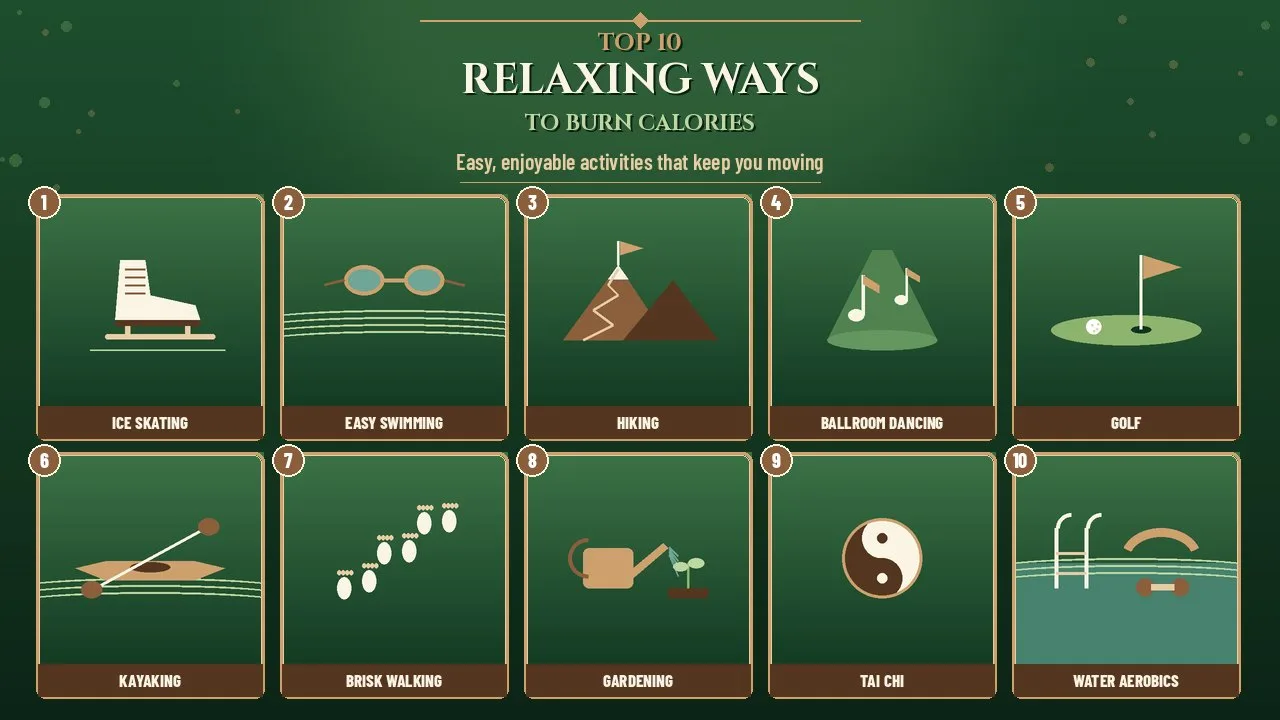
Relaxing ways to burn calories, from easy swimming and hiking to ballroom dancing and tai chi, can use about 144 to 252 calories in 30 minutes.
Not everyone enjoys a crowded gym, a loud spin class or a treadmill that faces a wall. The good news is that the body does not care much whether movement feels like a workout. Energy is used whenever muscles work, and many calm, social or outdoor pastimes keep them working for long stretches without the stress that puts people off exercise.
This list ranks ten enjoyable, low-pressure activities by how many calories they typically burn. They are the kind of things you might do on a weekend, on holiday or after work to unwind, yet each one counts toward the weekly activity most health agencies recommend.
How We Ranked These Activities
Calorie figures in this article come from Harvard Health Publishing's widely used table of calories burned in 30-minute activities, which lists estimates for people weighing 125, 155 and 185 pounds (about 57, 70 and 84 kilograms). Harvard compiled the figures from ACE Fitness, the Calorie Control Council and the University of Rochester Medical Center.
We used four simple rules to build the list.
- The activity must be something people commonly do for pleasure or relaxation, not a high-intensity training method.
- It must be possible at a gentle, conversational pace for a beginner.
- It must be low impact or adjustable, so most healthy adults can try it.
- Items are ranked by the estimated calories a 155-pound (70 kg) person burns in 30 minutes.
All numbers are averages. Your own burn depends on body weight, fitness, effort, terrain and how long you keep going. A heavier person uses more energy for the same task, and a brisk pace burns more than a lazy one.
At a Glance
| Rank | Activity | Calories in 30 min (125 lb) | Calories in 30 min (155 lb) | Calories in 30 min (185 lb) | Approx. per hour (155 lb) |
|---|---|---|---|---|---|
| 1 | Ice skating | 210 | 252 | 294 | 504 |
| 2 | Easy swimming | 180 | 216 | 252 | 432 |
| 3 | Hiking | 170 | 216 | 252 | 432 |
| 4 | Ballroom and social dancing | 165 | 198 | 231 | 396 |
| 5 | Golf, walking and carrying clubs | 165 | 198 | 231 | 396 |
| 6 | Kayaking and canoeing | 150 | 180 | 210 | 360 |
| 7 | Brisk walking (4 mph) | 135 | 175 | 189 | 350 |
| 8 | Gardening | 135 | 162 | 189 | 324 |
| 9 | Tai chi | 120 | 144 | 168 | 288 |
| 10 | Water aerobics | 120 | 144 | 168 | 288 |
Hourly figures are simply the 30-minute estimate doubled, so treat them as a rough guide.
1. Ice Skating
Gliding around a rink feels more like play than training, yet ice skating tops this list. Pushing off with each stride, holding your balance and steering through turns keeps the legs, hips and core active the whole time, even at an easy pace.
| Attribute | Details |
|---|---|
| Calories in 30 minutes | About 210 to 294, depending on body weight |
| Intensity | Moderate at a leisurely pace |
| Impact | Low, with smooth gliding strides |
| Main muscles | Thighs, glutes, calves and core |
| Best for | Families, couples and winter outings |
Origins and History
People in northern Europe were moving across frozen lakes on blades made from animal bones thousands of years ago, mainly to travel in winter. Iron and later steel blades turned skating into a pastime, and public rinks spread through European and North American cities in the nineteenth and twentieth centuries. Today indoor rinks make skating possible all year round, even in hot climates.
Key Features
- Works the outer thighs and hip stabilisers, which many gym routines neglect.
- Improves balance and coordination as you learn to shift your weight.
- Easy to make social: many rinks play music and run evening sessions.
- Rental skates mean you do not need to buy equipment to try it.
Why It Burns Calories
Every stride is a small sideways push, and the muscles also work constantly to keep you upright on a narrow blade. That steady demand is why even casual skating outranks walking. Beginners should wear a helmet or padded clothing at first, since falls are part of learning.
Interesting Facts
- Figure skating was part of the Summer Olympics in 1908 and 1920 before the first Winter Games in 1924.
- Outdoor skating on natural ice is only safe when local authorities confirm the ice is thick enough.
- Roller skating and inline skating use similar movements and are good warm-weather alternatives.
2. Easy Swimming
Swimming at a relaxed pace is one of the most soothing ways to stay active. The water supports your body weight, cools you down and muffles outside noise, so a slow swim can feel almost meditative while still using every major muscle group.
| Attribute | Details |
|---|---|
| Calories in 30 minutes | About 180 to 252 for general swimming |
| Intensity | Moderate when recreational, vigorous when doing hard laps |
| Impact | Very low; water supports the joints |
| Main muscles | Shoulders, back, chest, legs and core |
| Best for | People with sore joints, hot days, all ages |
Origins and History
Swimming is one of the oldest recorded human activities, with ancient rock art in the Sahara showing figures that appear to be swimming. Public baths were central to Roman social life, and swimming became an organised sport in nineteenth-century Britain before joining the first modern Olympic Games in 1896.
Key Features
- Moves the arms and legs together, giving a full-body workout.
- Low strain on knees, hips and ankles compared with land exercise.
- Breathing in rhythm with strokes can feel calming.
- Easy to adjust: switch strokes, rest at the wall or use a float.
Why It Burns Calories
Water is far denser than air, so every arm pull and kick meets resistance. Harvard's figure of about 216 calories in 30 minutes for a 155-pound person applies to general swimming; vigorous laps push it to around 360. The US Centers for Disease Control and Prevention (CDC) lists recreational swimming as a moderate-intensity activity and swimming laps as vigorous.
Interesting Facts
- Swimming in cool water can make you feel hungry afterwards, so plan a sensible snack.
- Open-water swimming in lakes and the sea adds scenery but needs extra safety care.
- Even treading water keeps the body working steadily.
3. Hiking
Hiking turns exercise into an outing. A trail through woods, hills or along a coast gives the mind something to focus on besides effort, and the uneven ground makes the legs work harder than walking on a pavement.
| Attribute | Details |
|---|---|
| Calories in 30 minutes | About 170 to 252 for cross-country hiking |
| Intensity | Moderate, rising with hills and a heavier pack |
| Impact | Low to moderate |
| Main muscles | Thighs, glutes, calves and core |
| Best for | Nature lovers, groups and weekend trips |
Origins and History
Walking for pleasure in the countryside grew popular in eighteenth- and nineteenth-century Europe, helped by Romantic writers who celebrated mountains and open landscapes. Long-distance trails followed, such as the Appalachian Trail in the United States, completed in 1937. In 1982 Japan's Forestry Agency introduced the term shinrin-yoku, or forest bathing, to encourage people to spend relaxing time among trees.
Key Features
- Uphill sections strengthen the legs and raise the heart rate.
- Downhill sections train balance and control.
- Fresh air, daylight and green views help many people unwind.
- Free to start on local paths with comfortable shoes.
Why It Burns Calories
Climbing even gentle slopes lifts your full body weight against gravity, and rough paths force small stabilising muscles to fire constantly. Carrying a daypack adds to the load. That is why a hike burns noticeably more than a stroll covering the same distance on flat ground.
Interesting Facts
- Walking poles can spread effort to the arms and ease pressure on the knees on descents.
- A short hike with friends often lasts much longer than a planned workout, which raises the total burn.
- Many national parks grade their trails from easy to strenuous so beginners can choose safely.
4. Ballroom and Social Dancing
Dancing is exercise disguised as fun. Music sets the pace, a partner or group keeps you motivated, and learning steps keeps the brain engaged, so an hour on the dance floor can pass far faster than an hour on a bike.
| Attribute | Details |
|---|---|
| Calories in 30 minutes | About 165 to 231 for disco, ballroom and square dancing |
| Intensity | Moderate; slow waltz and foxtrot are lighter |
| Impact | Low to moderate |
| Main muscles | Legs, glutes, core and posture muscles |
| Best for | Couples, social groups and music lovers |
Origins and History
Ballroom dancing grew out of the court and social dances of Europe, with the waltz becoming fashionable in the late eighteenth and early nineteenth centuries. Standardised styles were developed in England in the early twentieth century, and today social dancing ranges from salsa and swing to line and square dancing.
Key Features
- Builds coordination, rhythm and posture.
- Remembering routines gives the brain a workout as well.
- Highly social, which helps people stick with it.
- Effort can be raised simply by choosing faster dances.
Why It Burns Calories
Harvard estimates that slow dances such as the waltz and foxtrot burn about 108 calories in 30 minutes for a 155-pound person, while livelier ballroom, disco and square dancing reach about 198. Fast styles such as ballet or the twist rise to around 216. The CDC counts ballroom and line dancing as moderate-intensity activity.
Interesting Facts
- Competitive ballroom is often called DanceSport.
- Many community centres offer beginner classes for people with no partner.
- Dancing in the kitchen to a few favourite songs still counts as movement.
5. Golf, Walking and Carrying Clubs
Golf has a reputation as a gentle game, but how you play matters. Walking the course and carrying your own bag turns a round into a long, steady walk broken up by swings, and that can double the calories compared with riding in a cart.
| Attribute | Details |
|---|---|
| Calories in 30 minutes | About 165 to 231 when carrying clubs |
| Intensity | Light with a cart, moderate when walking |
| Impact | Low |
| Main muscles | Legs, core, shoulders and back |
| Best for | Patient players, business outings, retirees |
Origins and History
Modern golf developed in Scotland during the fifteenth century, and the Old Course at St Andrews is often described as the home of golf. The game spread around the world in the nineteenth and twentieth centuries and is now played on tens of thousands of courses.
Key Features
- An 18-hole round usually takes several hours, adding up to a long active session.
- Walking between shots covers several kilometres on grass.
- The swing rotates the trunk and engages the core and shoulders.
- Played outdoors, often in quiet green surroundings.
Why It Burns Calories
Harvard puts golf with a cart at about 126 calories in 30 minutes for a 155-pound person, compared with about 198 when carrying clubs. Using a push trolley falls between the two. Because rounds last so long, total calories for a walking round can be substantial.
Interesting Facts
- Golf was played on the Moon in 1971 when astronaut Alan Shepard hit two balls during the Apollo 14 mission.
- Many courses allow walking only at certain times, so check before you book.
- Practice ranges and pitch-and-putt courses offer shorter sessions for beginners.
6. Kayaking and Canoeing
Paddling across a calm lake or a slow river is a peaceful way to spend an afternoon. The rhythm of each stroke, the sound of water and the chance to see wildlife make kayaking and canoeing popular with people who want exercise and quiet at the same time.
| Attribute | Details |
|---|---|
| Calories in 30 minutes | About 150 to 210 for kayaking |
| Intensity | Moderate on calm water |
| Impact | Very low |
| Main muscles | Shoulders, arms, back and core |
| Best for | Lake and river lovers, wildlife watchers |
Origins and History
Kayaks were developed by Arctic peoples, including the Inuit and Aleut, for hunting on cold seas, while canoes were built by many cultures from hollowed logs or bark frames. Both became leisure craft in the nineteenth century and are now widely rented at lakes, rivers and coasts.
Key Features
- A kayak uses a double-bladed paddle; a canoe uses a single-bladed one.
- The core twists with each stroke, so it is not only an arm workout.
- Gentle on the legs and joints.
- Easy to share: tandem boats carry two people.
Why It Burns Calories
Each stroke pulls the boat through water, using the large muscles of the back and shoulders along with the abdominals. Paddling into wind or current raises the effort, while drifting lowers it. Always wear a buoyancy aid and stay on water that suits your skill.
Interesting Facts
- Stand-up paddleboarding is a related activity that adds a balance challenge for the legs.
- Whitewater kayaking and rafting are far more demanding than calm-water paddling.
- Early morning is often the calmest time on lakes.
7. Brisk Walking
Walking is the simplest activity on this list, and picking up the pace turns it into real exercise. A brisk walk needs no equipment beyond good shoes, fits into daily routines and can be done almost anywhere.
| Attribute | Details |
|---|---|
| Calories in 30 minutes | About 135 to 189 at 4 mph |
| Intensity | Moderate |
| Impact | Low |
| Main muscles | Legs, glutes and core |
| Best for | Everyone, especially beginners |
Origins and History
Walking is humanity's oldest form of transport, but walking for health became a deliberate habit in the twentieth century as daily life grew more sedentary. Pedometers and later step-counting phones and watches made it easy to track, and walking groups now meet in parks around the world.
Key Features
- Can be built into commutes, errands and phone calls.
- Easy to do with friends, family or a dog.
- Safe for most people, including those returning to activity.
- Pace can be adjusted minute by minute.
Why It Burns Calories
The CDC defines brisk walking as about 2.5 miles per hour or faster and classes it as moderate intensity. Harvard estimates a 155-pound person burns about 133 calories in 30 minutes at 3.5 mph and about 175 at 4 mph. Adding hills or walking on grass and sand raises the figure.
Interesting Facts
- The CDC's talk test says that during moderate activity you can talk but not sing.
- Walking after meals is a popular habit in many cultures.
- Cities designed for pedestrians make daily walking easier; see our list of the most walkable cities.
8. Gardening
Gardening rarely feels like exercise, yet digging, planting, weeding and carrying soil keep the body moving for hours. It also offers fresh air, a sense of achievement and, often, something to eat at the end of the season.
| Attribute | Details |
|---|---|
| Calories in 30 minutes | About 135 to 189 for general gardening |
| Intensity | Light to moderate; heavy digging can be vigorous |
| Impact | Low |
| Main muscles | Arms, shoulders, back, legs and grip |
| Best for | Homeowners, allotment holders, older adults |
Origins and History
People have cultivated plants for about 10,000 years, since the start of farming. Ornamental and kitchen gardens became a leisure pursuit for wealthy households in ancient Egypt, Persia and China, and home gardening is now one of the most popular hobbies in many countries.
Key Features
- Combines bending, lifting, reaching and squatting.
- Builds grip and upper-body strength.
- Time outdoors and contact with plants help many people relax.
- Tasks can be matched to energy levels on any given day.
Why It Burns Calories
Harvard estimates general gardening at about 162 calories in 30 minutes for a 155-pound person, with raking at about 144 and chopping wood or shovelling snow at about 216. The CDC counts general yard work as moderate activity and heavy digging as vigorous. Lift with your legs, not your back, and take breaks.
Interesting Facts
- Pushing a hand mower burns more than using a powered mower.
- Raised beds reduce bending for people with back or knee problems.
- Community gardens add a social side to the hobby.
9. Tai Chi
Tai chi is a slow, flowing practice that began as a Chinese martial art and is now done worldwide for health and calm. Its gentle, continuous movements and steady breathing make it one of the most relaxing ways to stay active.
| Attribute | Details |
|---|---|
| Calories in 30 minutes | About 120 to 168 |
| Intensity | Light to moderate |
| Impact | Very low |
| Main muscles | Legs, hips, core and posture muscles |
| Best for | Stress relief, balance, older adults |
Origins and History
Tai chi developed in China, with its best-known family styles tracing their roots to the seventeenth to nineteenth centuries. It became a popular public exercise in the twentieth century, and today groups practise it in parks from Beijing to New York, often early in the morning.
Key Features
- Movements are slow, controlled and linked into sequences called forms.
- Weight shifts constantly from one leg to the other, building balance.
- Breathing and focus give it a meditative quality.
- Needs no equipment and little space.
Why It Burns Calories
Holding slightly bent knees and moving smoothly through each posture keeps the leg muscles working throughout. Harvard estimates about 144 calories in 30 minutes for a 155-pound person. Health agencies including the CDC promote tai chi-based programmes to improve balance and reduce falls in older adults.
Interesting Facts
- Qigong is a related practice that focuses more on breathing and posture.
- Tai chi can be done seated by people with limited mobility.
- The faster, more martial styles burn more than slow forms.
10. Water Aerobics
Water aerobics brings the fun of a group fitness class into a swimming pool. Participants march, kick, jump and push against the water in time to music, usually standing in waist- or chest-deep water, so no swimming skill is needed.
| Attribute | Details |
|---|---|
| Calories in 30 minutes | About 120 to 168 |
| Intensity | Moderate |
| Impact | Very low |
| Main muscles | Legs, arms, core and shoulders |
| Best for | People with arthritis, pregnancy, recovery, beginners |
Origins and History
Exercising in water has long been used for rehabilitation, and organised water fitness classes spread widely from the 1980s onward. Today they are a standard offering at public pools, gyms and holiday resorts.
Key Features
- Water resistance works muscles in every direction of movement.
- Buoyancy reduces stress on the joints.
- Classes are social and led by an instructor.
- Floats, noodles and water dumbbells can raise the challenge.
Why It Burns Calories
Moving limbs through water takes more effort than moving them through air, even when it feels easy. Harvard estimates water aerobics at about 144 calories in 30 minutes for a 155-pound person, the same as tai chi. The CDC lists water aerobics classes as moderate-intensity activity.
Interesting Facts
- The cool water helps keep body temperature down during effort.
- Many pools run classes for older adults and expectant mothers.
- Deep-water versions use a flotation belt so your feet never touch the floor.
Other Gentle Ways to Stay Active
The top ten are not the only options. Harvard's table includes several other relaxed activities that still add up over a week, with figures shown for a 155-pound person over 30 minutes.
| Activity | Calories in 30 min (155 lb) | Notes |
|---|---|---|
| Stretching and hatha yoga | 144 | Calming; active styles such as power yoga burn more |
| Playing with children (moderate effort) | 141 | Easy to fit into family time |
| Golf using a cart | 126 | Less walking than carrying clubs |
| Slow dancing (waltz, foxtrot) | 108 | Gentle and social |
| Bowling | 108 | Short bursts of activity between turns |
| Frisbee | 105 | Fun in parks and on beaches |
| Horseback riding (general) | 70 | Works posture and balance muscles |
How These Activities Compare
Different relaxing activities suit different goals. This table compares them on the factors that matter most when choosing one you will enjoy and keep doing.
| Activity | Joint impact | Social | Equipment or venue | Main extra benefit |
|---|---|---|---|---|
| Ice skating | Low | High | Rink and skates | Balance and leg strength |
| Easy swimming | Very low | Medium | Pool or safe open water | Full-body, joint friendly |
| Hiking | Low to moderate | High | Trails and good shoes | Time in nature |
| Ballroom dancing | Low to moderate | Very high | Class or dance hall | Coordination and memory |
| Golf, walking | Low | High | Course and clubs | Long active sessions |
| Kayaking | Very low | Medium | Boat and calm water | Upper-body strength |
| Brisk walking | Low | Medium | None | Easiest to do daily |
| Gardening | Low | Low to medium | Garden or allotment | Grip and functional strength |
| Tai chi | Very low | Medium | None | Balance and calm |
| Water aerobics | Very low | High | Pool and class | Gentle on joints |
How Much Activity Do You Need?
The Physical Activity Guidelines for Americans, used by the CDC, recommend that adults get at least 150 minutes of moderate-intensity aerobic activity a week, or 75 minutes of vigorous activity, plus muscle-strengthening activities on at least two days. The World Health Organization gives similar advice.
Most activities on this list count as moderate when done at a steady pace. The CDC describes moderate activity as 3 to 5.9 METs, where one MET is the energy used sitting quietly, and vigorous activity as 6 METs or more. In practical terms:
- 30 minutes of brisk walking or easy swimming five days a week meets the aerobic target.
- A two-hour hike or a walking round of golf at the weekend covers a large share of it.
- Combining two or three activities you enjoy makes it easier to stay consistent.
Tips for Burning More Calories While Staying Relaxed
You do not need to turn a pleasant pastime into a punishing workout to get more from it. Small changes add up.
- Go a little longer. Duration often matters more than intensity for total calories.
- Add gentle hills, stairs or a slightly faster pace for short stretches.
- Choose the active version: walk the golf course, paddle rather than drift, dance the faster songs.
- Make it social, because people tend to keep going longer with company.
- Mix activities through the week so different muscles get a chance to work and recover.
- Pair activity with sensible eating; exercise alone rarely produces large weight loss.
For a look at the opposite approach, read our list of extreme ways people try to stay skinny, which explains why crash methods tend to backfire.
Why Relaxing Exercise Matters
The best exercise is the one you will actually do. Many people start an intense programme, find it unpleasant and stop within weeks. Activities that feel enjoyable and calming are easier to repeat, and regular, moderate movement over months and years brings well-established benefits, from better heart health and mood to stronger muscles and bones.
Relaxing activities also tend to happen outdoors, with other people or in water, which adds benefits of their own. A walk in a park, a dance class with friends or a quiet paddle can lower stress while still keeping the body active. That combination of pleasure and movement is what makes these ten pastimes such good long-term habits.
Frequently Asked Questions
What is the most relaxing way to burn calories?
It depends on what you find calming. Swimming, tai chi and walking are often described as the most soothing because they are gentle and rhythmic. Among relaxed pastimes, leisure ice skating, easy swimming and hiking burn the most, at about 216 to 252 calories in 30 minutes for a 155-pound person, according to Harvard's estimates.
How many calories does a 30-minute walk burn?
Harvard Health estimates that a 155-pound person burns about 133 calories walking for 30 minutes at 3.5 mph and about 175 calories at 4 mph. A lighter person burns a little less and a heavier person a little more. Walking uphill, on sand or carrying a bag increases the total noticeably.
Does tai chi really count as exercise?
Yes. Tai chi is light to moderate physical activity that keeps the leg and core muscles working through slow, continuous movement. Harvard estimates about 144 calories in 30 minutes for a 155-pound person. It is especially valued for improving balance, and health agencies promote tai chi programmes to help prevent falls in older adults.
Is swimming better than walking for burning calories?
At comparable easy paces, general swimming burns a little more than brisk walking: about 216 calories in 30 minutes versus about 175 for a 155-pound person, by Harvard's figures. Swimming is gentler on the joints, while walking is easier to do every day. Choosing the one you enjoy most is usually the better plan.
Can I lose weight with relaxing activities alone?
Relaxing activities help, but weight loss mainly depends on overall energy balance, which includes diet. Regular moderate activity supports weight control, improves fitness and helps maintain muscle. Combining enjoyable movement with sensible eating habits is more effective and sustainable than relying on exercise alone or on extreme diets.
How often should I do these activities?
Health guidelines recommend at least 150 minutes of moderate activity a week for adults, such as 30 minutes on five days. Any of the ten activities here can count toward that target when done at a steady pace. Adding muscle-strengthening work on two days a week completes the recommendation.
Are calorie burn figures accurate?
They are estimates, not exact measurements. Published tables average results for people of a given weight, while real burn varies with fitness, effort, terrain, technique and body composition. Fitness trackers also estimate rather than measure. Use the numbers to compare activities, not to count every calorie precisely.
Conclusion
Burning calories does not have to mean sweating through a session you dread. Ice skating, easy swimming, hiking, ballroom dancing and a walking round of golf all use around 200 calories or more in half an hour for an average adult, while kayaking, brisk walking, gardening, tai chi and water aerobics follow close behind. Each one fits naturally into leisure time and counts toward recommended weekly activity.
The real advantage of these relaxing options is that people keep doing them. Pick two or three you enjoy, mix them through the week and let the calories take care of themselves.
For more ranked lists, browse the Top 10 Facts collection, see the most walkable cities in the world for places where daily walking comes easily, read about extreme ways people try to stay skinny, or plan a nature walk with the most famous trees in the world.
- Harvard Health Publishing, Calories burned in 30 minutes for people of three different weights (accessed October 2026)
- US Centers for Disease Control and Prevention, How to Measure Physical Activity Intensity (December 2025)
- US Department of Health and Human Services, Physical Activity Guidelines for Americans, 2nd edition
- World Health Organization, Guidelines on physical activity and sedentary behaviour (2020)

















Log in with