






 By
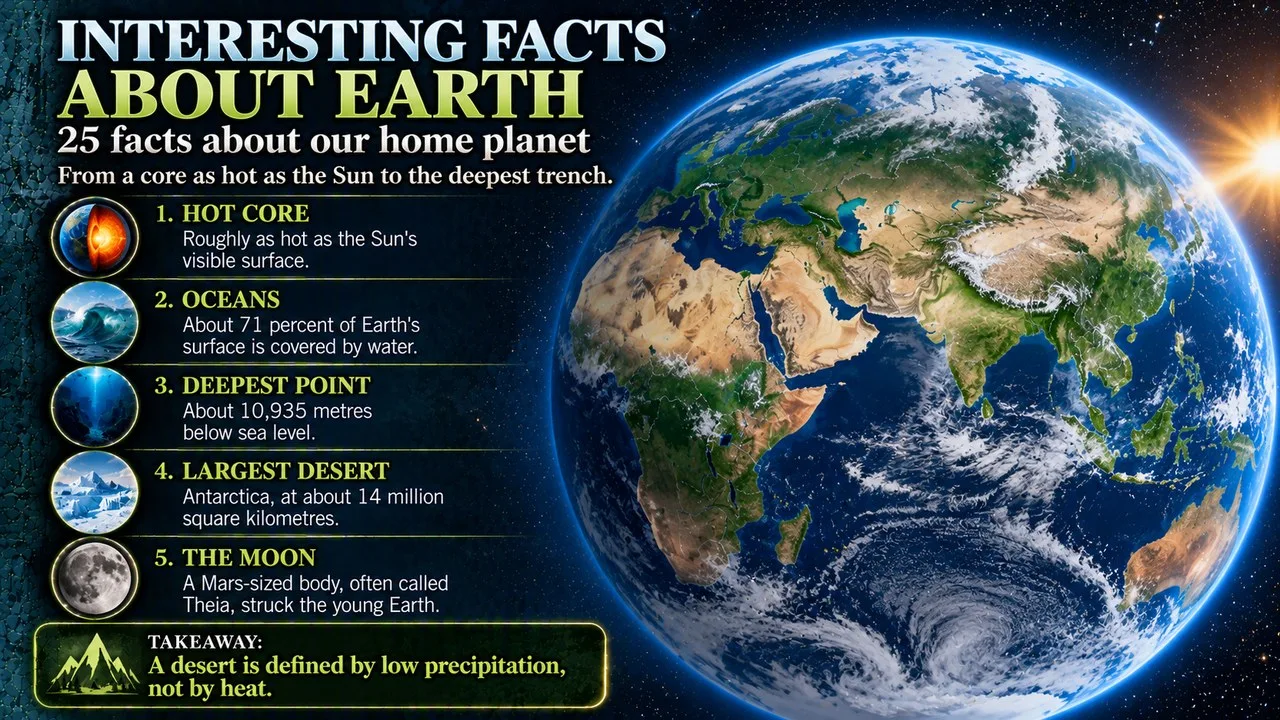
Earth is the third planet from the Sun and the only astronomical object known to harbour life.[1] It formed about 4.54 billion years ago and is the densest planet in the Solar System.[1] Its surface is shaped by slowly moving tectonic plates, an ocean that covers 70.8 percent of the crust, an atmosphere made mostly of nitrogen and oxygen, and a magnetic field generated in its liquid outer core.[1]
Introduction
This Finepedia guide, updated in October 2026, collects the top 25 interesting facts about Earth. It starts with the planet's age and shape, moves down through its interior to its surface and oceans, and ends with its continents, forests, lowest land and largest reef. Every figure comes from a cited source listed at the end.
Key Facts
| Property | Value |
|---|---|
| Position | Third planet from the Sun |
| Age | About 4.54 billion years |
| Distance from the Sun | About 1 astronomical unit, or eight light-minutes |
| Length of year | About 365.25 days |
| Axial tilt | About 23.44 degrees |
| Ocean cover | 70.8 percent of the surface |
| Highest point | Mount Everest, 8,848 m |
| Deepest point | Challenger Deep, about 10,935 m |
| Main gases in dry air | Nitrogen 78.08 percent, oxygen 20.95 percent |
| Natural satellite | The Moon |
Sources: Earth, Challenger Deep and Atmosphere of Earth.[1][6][11]
How the Facts Were Chosen
The list is ordered loosely from Earth's place in space, through its interior and atmosphere, to its oceans, land and life. Where sources give a range, such as the depth of the Challenger Deep or the temperature at the centre of the planet, the article gives the range or the latest measured value.
The 25 Facts at a Glance
| No. | Fact |
|---|---|
| 1 | Earth is the only known planet with life |
| 2 | Earth is about 4.54 billion years old |
| 3 | It is not a perfect sphere |
| 4 | Earth is the densest planet |
| 5 | The centre may be as hot as 6,000 °C |
| 6 | A solid inner core was discovered in 1936 |
| 7 | Moving iron makes a magnetic field |
| 8 | The air is mostly nitrogen |
| 9 | The greenhouse effect keeps Earth warm |
| 10 | Days are slowly getting longer |
| 11 | The tilted axis causes the seasons |
| 12 | Earth races around the Sun at almost 30 km/s |
| 13 | The ocean covers 70.8 percent of the surface |
| 14 | The Challenger Deep is the deepest point |
| 15 | Everest is the highest point above sea level |
| 16 | Most of the ocean floor is young |
| 17 | The surface is broken into tectonic plates |
| 18 | The equator spins at about 1,675 km/h |
| 19 | Gravity is not the same everywhere |
| 20 | Supercontinents form and break apart |
| 21 | Most English-speaking countries count seven continents |
| 22 | The Amazon is the largest tropical rainforest |
| 23 | The Moon may have formed from a giant impact |
| 24 | The Dead Sea shore is the lowest land |
| 25 | The Great Barrier Reef can be seen from space |
1. Earth Is the Only Known Planet With Life
Earth is the only astronomical object known to harbour life.[1] Self-replicating molecules appeared about four billion years ago, and the last common ancestor of all current life arose about half a billion years later.[1] Among the earliest fossil evidence of life are microbial mat fossils in 3.48-billion-year-old sandstone in Western Australia and biogenic graphite in 3.7-billion-year-old rocks in western Greenland.[1]
The evolution of photosynthesis let life harvest the Sun's energy directly. The oxygen it released built up in the atmosphere and formed a protective ozone layer, which helped life colonise the land.[1]
2. Earth Is About 4.54 Billion Years Old
The primordial Earth had formed by about 4.54 billion years ago, give or take 40 million years.[1] Because the surface is constantly recycled, very little of the original rock survives, so scientists date the planet mainly from meteorites.[2]
Clair Cameron Patterson used uranium–lead dating on several meteorites to find an age of 4.55 billion years, give or take 70 million years, very close to today's accepted figure.[2] The oldest minerals found so far are small zircon crystals from the Jack Hills of Western Australia, which are at least 4.404 billion years old.[2] Meteorite samples range from 4.53 to 4.58 billion years old.[2]
3. It Is Not a Perfect Sphere
Because Earth rotates, its shape is an ellipsoid that bulges at the equator. Its diameter is 43 kilometres longer across the equator than from pole to pole.[1] As a result, the point on the surface farthest from the centre is not the top of Mount Everest but the summit of the volcano Chimborazo in Ecuador, 6,384.4 kilometres from the centre.[1]
Local features change the shape a little too. The Mariana Trench shortens Earth's average radius by 0.17 percent, and Mount Everest lengthens it by 0.14 percent.[1]
4. Earth Is the Densest Planet
Earth is the densest planet in the Solar System.[1] It has a silicate crust above a highly viscous solid mantle, and below that an iron-rich core.[1] The crust varies from about 6 kilometres thick under the oceans to 30 to 50 kilometres thick under the continents, and it is separated from the mantle by the Mohorovičić discontinuity.[1] Overall, Earth is the sixth-largest object in the Solar System, after the Sun and the four outer planets.[1]
Earth's mean density is about 5.51 grams per cubic centimetre, around five and a half times the density of water.[1] Most of that mass is concentrated in the metallic core, which is made mainly of iron and nickel, while lighter silicate rocks make up the mantle and the crust above it.[1]
5. The Centre May Be as Hot as 6,000 °C
The temperature at the centre of Earth may reach up to 6,000 °C, and the pressure could reach 360 gigapascals, about 52 million pounds per square inch.[1] The inner core is a mostly solid ball with a radius of about 1,230 kilometres. That is about 20 percent of Earth's radius, or 70 percent of the Moon's radius.[3]
The heat inside Earth comes partly from the planet's formation and partly from the decay of radioactive elements such as uranium, thorium and potassium.[1] This internal heat drives slow convection in the mantle and the outer core, which moves the tectonic plates and powers the magnetic field.[1][5]
6. A Solid Inner Core Was Discovered in 1936
In 1936 the Danish seismologist Inge Lehmann found that Earth has a solid inner core separate from its molten outer core.[3] She studied seismograms of earthquakes in New Zealand and deduced that seismic waves were reflecting off the boundary of an inner core.[3] She estimated its radius at 1,400 kilometres, not far from the accepted value today of 1,221 kilometres.[3] Lehmann published her findings in a paper titled P′, and she lived from 1888 to 1993.[4]
The inner core is not rigidly connected to the mantle, so it may rotate slightly faster or slower than the rest of Earth. In 2023 researchers reported that it stopped spinning faster than the surface around 2009 and is probably now rotating more slowly.[3]
Related: Top 10 Famous Impact Craters on Earth
7. Moving Iron Makes a Magnetic Field
Earth's magnetic field is generated by electric currents from convection in a mixture of molten iron and nickel in the outer core. The convection is driven by heat escaping from the core.[5] The field reaches out into space and defines the magnetosphere, which deflects most of the harmful solar wind and cosmic radiation.[1]
Charged particles that get through and collide with atoms in the ionosphere create the auroras.[5] The field also reverses from time to time. The gaps between reversals range from less than 100,000 years to as much as 50 million years, and the most recent, the Brunhes–Matuyama reversal, happened about 780,000 years ago.[5] Mars shows why the field matters: when its magnetic field faded, the solar wind stripped away almost all of its atmosphere.[5]
8. The Air Is Mostly Nitrogen
By number of molecules, dry air is 78.08 percent nitrogen, 20.95 percent oxygen, 0.93 percent argon and 0.04 percent carbon dioxide, with small amounts of other gases.[6] Half the mass of the atmosphere lies within 5.5 kilometres of the ground, which is why the air on high mountains is so thin.[6] The Kármán line, 100 kilometres up, is often used as the edge of space.[6]
The early atmosphere had almost no free oxygen. The Great Oxidation Event began about 2.46 to 2.43 billion years ago and was probably caused by cyanobacteria, which evolved photosynthesis that releases oxygen as a by-product.[7]
9. The Greenhouse Effect Keeps Earth Warm
Gases such as water vapour and carbon dioxide absorb heat radiated from the surface. Without this greenhouse effect, Earth's average surface temperature would be about −18 °C.[8] That is far colder than the 20th-century average of about 14 °C, so the natural greenhouse effect is what keeps most of the planet above freezing.[8]
Human activity has strengthened this natural effect. Burning fossil fuels has raised the amount of carbon dioxide in the air since the Industrial Revolution, and the extra trapped heat is the main cause of present-day global warming.[8] Earth's average surface temperature has already risen by more than 1 °C compared with pre-industrial times.[8]
10. Days Are Slowly Getting Longer
The Moon's gravity raises tides and gradually slows Earth's rotation.[1] Historical astronomical records show that the length of a day has grown by about 2.3 milliseconds per century since the 8th century BC.[9]
Atomic clocks show that the modern day is about 1.7 milliseconds longer per century than it was several centuries ago.[9] Earth's gravity has already locked the Moon's rotation, which is why the same side of the Moon always faces us.[1]
11. The Tilted Axis Causes the Seasons
Earth's axis is tilted by about 23.44 degrees from the perpendicular to its orbit.[1] This tilt, not the distance from the Sun, produces the seasons, because each hemisphere leans towards the Sun for part of the year and away from it for the rest.[1] The Moon's gravity helps keep the axis stable.[1]
At the June solstice the Northern Hemisphere is tilted most towards the Sun and has its longest day, while the Southern Hemisphere has its shortest. In December the pattern is reversed.[1] Near the poles the effect is extreme: inside the Arctic and Antarctic circles there are days in midsummer when the Sun never sets and days in midwinter when it never rises.[1]
12. Earth Races Around the Sun at Almost 30 km/s
Earth's average orbital speed is 29.78 kilometres per second, about 107,000 kilometres per hour. At that speed it could cross its own diameter in 7 minutes and reach the Moon in 4 hours.[10] The orbit is a slightly stretched ellipse with an eccentricity of 0.0167.[10]
Related: Top 10 Deepest Ocean Trenches
Earth is closest to the Sun, at perihelion, around 3 January, and farthest away, at aphelion, around 4 July.[10] It receives about 7 percent more solar energy at perihelion than at aphelion, yet the Northern Hemisphere has winter in January, which shows that the tilt matters more than distance.[10]
13. The Ocean Covers 70.8 Percent of the Surface
Most of Earth's surface is ocean, 70.8 percent or about 361 million square kilometres.[1] The ocean has a mean depth of 3,682 metres and an estimated volume of 1.332 billion cubic kilometres.[1] Large ice sheets in the polar deserts hold more water than all of Earth's groundwater, lakes, rivers and atmospheric water combined.[1]
The ocean is usually divided into the Pacific, Atlantic, Indian, Southern and Arctic oceans.[1] About 97.5 percent of Earth's water is salt water. Only about 2.5 percent is fresh water, and most of that is frozen in ice sheets and glaciers.[1]
14. The Challenger Deep Is the Deepest Point
The Challenger Deep, in the Mariana Trench of the western Pacific Ocean, is the deepest known point in the ocean. A 2021 study put its depth at 10,935 metres, give or take 6 metres.[11] The first descent by any vehicle was made by the United States Navy bathyscaphe Trieste in January 1960, piloted by Jacques Piccard and Lieutenant Don Walsh.[11] On 26 March 2012 the Canadian film director James Cameron made a solo descent in the Deepsea Challenger.[11]
The Challenger Deep lies at the southern end of the Mariana Trench, near the island of Guam, where the Pacific Plate is pushed beneath the smaller Mariana Plate.[11] It is deeper than Mount Everest is high, so the world's highest mountain would disappear below the surface if it were placed at the bottom of the trench.[11][12]
15. Everest Is the Highest Point Above Sea Level
Land on Earth ranges from 418 metres below sea level at the Dead Sea to 8,848 metres at the top of Mount Everest.[1] A joint survey by Nepal and China in 2020 measured Everest at 8,848.86 metres.[12] Everest is not the tallest mountain from base to summit, however: Mauna Kea in Hawaii rises more than 10,200 metres from the ocean floor.[12]
Everest stands on the border between Nepal and the Tibet Autonomous Region of China, in the Mahalangur Himal range of the Himalayas.[12] Edmund Hillary and Tenzing Norgay made the first confirmed ascent on 29 May 1953, and thousands of climbers have reached the summit since then.[12]
16. Most of the Ocean Floor Is Young
Subduction carries oceanic crust back into the mantle, so most of the ocean floor is less than 100 million years old.[1] The oldest oceanic crust, in the western Pacific, is about 200 million years old.[1] Continental crust lasts far longer. The oldest dated continental crust is about 4,030 million years old.[1]
New ocean floor forms at mid-ocean ridges, where hot rock rises from the mantle, cools and spreads away on either side.[13] Older, colder and denser crust eventually sinks back into the mantle at subduction zones, which is why the sea floor is constantly renewed while some continental rocks survive for billions of years.[13]
17. The Surface Is Broken Into Tectonic Plates
Earth's lithosphere, its rigid outer shell of crust and upper mantle, is broken into seven or eight major plates, depending on how they are defined, and many smaller plates.[13] The plates interact to build mountain ranges, volcanoes and earthquakes.[1] Plate tectonics grew out of the idea of continental drift, which Alfred Wegener argued for in the early 20th century.[13] The plates have been moving for about 3 to 4 billion years.[13]
Plates move at speeds of up to about 10 centimetres a year.[13] Where they pull apart, new crust forms. Where they collide, one plate may slide beneath the other or both may crumple upwards, and where they slide past each other, as along the San Andreas Fault, the strain is released in earthquakes.[13]
Related: Top 10 Ways the Earth Is Still Changing
18. The Equator Spins at About 1,675 km/h
Earth's rotational speed is about 1,674.7 kilometres per hour at the equator. It falls with latitude and is zero at the poles.[9] On average, one solar day, the time for the Sun to return to the same point in the sky, lasts 24 hours.[1]
Measured against the distant stars, Earth turns once every 23 hours, 56 minutes and 4 seconds, a period called the sidereal day.[9] The solar day is about four minutes longer because Earth also moves along its orbit each day, so it has to turn a little further to bring the Sun back to the same place in the sky.[9]
19. Gravity Is Not the Same Everywhere
Near the surface, gravity accelerates objects at about 9.8 metres per second squared.[1] Differences in topography, geology and deep tectonic structure cause local and regional differences in Earth's gravity field.[1]
Gravity is slightly weaker at the equator than at the poles. One reason is that the equatorial bulge puts the surface farther from the centre of the planet, and another is that Earth's rotation produces an outward centrifugal effect that is largest at the equator.[19] Scientists measure these small differences with satellites and sensitive instruments called gravimeters.[19]
20. Supercontinents Form and Break Apart
Over hundreds of millions of years, tectonic forces have pushed continental crust together into supercontinents that later broke apart.[1] Rodinia began breaking up about 750 million years ago. The continents later joined again as Pannotia, 600 to 540 million years ago, and then as Pangaea, which began to break apart about 180 million years ago.[1] Earlier supercontinents included Vaalbara, Kenorland and Columbia.[14]
Pangaea gathered nearly all of the world's land into one mass surrounded by a single ocean called Panthalassa.[20] As it broke apart, the Atlantic Ocean opened and the continents began moving towards their present positions, a process that continues today at a few centimetres a year.[20][13]
21. Most English-Speaking Countries Count Seven Continents
There is no single definition of a continent, so the number varies from four to seven.[14] Most English-speaking countries recognise seven. From largest to smallest, they are Asia, Africa, North America, South America, Antarctica, Europe and Australia.[14] Zealandia, a mostly submerged landmass that rises above the sea mainly in New Zealand and New Caledonia, has also been identified as a continent.[14]
Other traditions combine some of these landmasses. A six-continent model treats North and South America as one continent, and other models join Europe and Asia as Eurasia.[14] The five rings of the Olympic flag represent the five inhabited continents of the combined-America model and leave out Antarctica.[14]
22. The Amazon Is the Largest Tropical Rainforest
The Amazon basin covers 7 million square kilometres, and rainforest covers 6 million square kilometres of it.[15] The Amazon makes up more than half of the world's remaining rainforest and is the largest and most biodiverse tract of tropical rainforest. It has an estimated 390 billion trees in about 16,000 species.[15] Nine countries share the basin, and Brazil holds 58.4 percent of the forest.[15]
The forest plays a large part in the climate of South America, because its trees release huge amounts of water vapour that falls again as rain.[15] Clearing for cattle ranching, farming and logging has removed a large share of the original forest, and scientists warn that further losses could turn parts of it into drier savanna.[15]
23. The Moon May Have Formed From a Giant Impact
The most widely accepted theory of the Moon's origin is the giant-impact hypothesis. It says the Moon formed after a Mars-sized protoplanet called Theia collided with the early Earth.[1] The idea was first proposed in 1946 by the Canadian geologist Reginald Daly. The collision would have happened about 4.5 billion years ago.[16] One key piece of evidence is that lunar and Earth rocks have identical stable isotope ratios, which points to a common origin.[16]
Related: Top 10 Rarest Rock Formations in the World
Computer models of such a collision show that debris thrown into orbit could have gathered quickly to form the Moon.[16] Some questions remain open, such as why the Moon and Earth are so alike in composition if much of the Moon should have come from Theia, and several versions of the hypothesis try to explain this.[16]
24. The Dead Sea Shore Is the Lowest Land
As of 2025, the surface of the Dead Sea is 439.78 metres below sea level, so its shores are the lowest land on Earth.[17] With a salinity of 34.2 percent in 2011, it is 9.6 times as salty as the ocean, and the dense water makes swimming feel like floating.[17] At 304 metres deep, it is the deepest hypersaline lake in the world.[17]
The Dead Sea lies in the Jordan Rift Valley, with Jordan to the east and Israel and the West Bank to the west.[17] Its main source of water is the Jordan River, but the diversion of water for farming and industry and the extraction of minerals have caused its level to fall steadily for decades.[17]
25. The Great Barrier Reef Can Be Seen From Space
The Great Barrier Reef, off Australia, is the world's largest coral reef system. It is made up of more than 2,900 individual reefs and 900 islands, stretching for more than 2,300 kilometres.[18] It can be seen from outer space and is the biggest single structure made by living organisms.[18] It became a World Heritage Site in 1981.[18] A 2012 study found that the reef had lost more than half its coral cover since 1985.[18]
The reef supports a huge variety of life. More than 1,500 species of fish and about 400 species of coral live there, and six species of sea turtle come to the reef to breed.[18] Large parts of it are protected by the Great Barrier Reef Marine Park, but warming seas have caused repeated mass coral bleaching.[18]
Key Figures
- 4.54 billion years: Age of Earth.[1]
- 70.8 percent: Share of the surface covered by ocean.[1]
- 78.08 percent: Share of nitrogen in dry air.[6]
- 10,935 m: Depth of the Challenger Deep, from a 2021 study.[11]
- 8,848.86 m: Height of Mount Everest, from the 2020 survey.[12]
- −18 °C: Earth's average temperature without the greenhouse effect.[8]
- 29.78 km/s: Earth's average orbital speed.[10]
- 780,000 years: Time since the last magnetic reversal.[5]
- 439.78 m: Depth of the Dead Sea surface below sea level in 2025.[17]
Frequently Asked Questions
How old is Earth?
About 4.54 billion years.[1]
What is Earth's deepest point?
The Challenger Deep in the Mariana Trench, measured at about 10,935 metres in 2021.[11]
Why does Earth have seasons?
Its axis is tilted by about 23.44 degrees, so each hemisphere takes turns leaning towards the Sun.[1]
What is Earth's atmosphere made of?
Dry air is about 78 percent nitrogen, 21 percent oxygen and just under 1 percent argon.[6]
Which point on Earth is farthest from its centre?
The summit of Chimborazo in Ecuador, because of the bulge at the equator.[1]
Conclusion
Earth is a planet of contrasts. Its centre may be as hot as the surface of the Sun, yet its oceans and atmosphere keep most of the surface at temperatures where liquid water and life can exist.[1][5][8] The ground beneath our feet feels still, but the planet spins at up to 1,675 kilometres per hour, races around the Sun at almost 30 kilometres per second, and its plates slowly rearrange the continents.[9][10][13]
Many of these facts were discovered only recently, from Inge Lehmann's discovery of the inner core in 1936 to the 2020 survey of Everest and the 2021 measurement of the Challenger Deep.[3][11][12] As scientists keep measuring the planet more precisely, some of the figures here will change, but the main lesson stays the same: Earth is still the only world known to support life.[1]
See also
- Top 10 Highest Mountains in the World
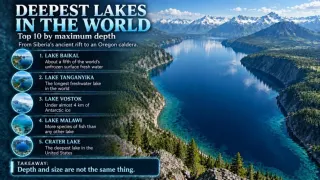
- Top 10 Deepest Lakes in the World
- Interesting Facts About the Earth
- ^ [1] "Earth". Wikipedia. Wikipedia
- ^ [2] "Age of Earth". Wikipedia. Wikipedia
- ^ [3] "Earth's inner core". Wikipedia. Wikipedia
- ^ [4] "Inge Lehmann". Wikipedia. Wikipedia
- ^ [5] "Earth's magnetic field". Wikipedia. Wikipedia
- ^ [6] "Atmosphere of Earth". Wikipedia. Wikipedia
- ^ [7] "Great Oxidation Event". Wikipedia. Wikipedia
- ^ [8] "Greenhouse effect". Wikipedia. Wikipedia
- ^ [9] "Earth's rotation". Wikipedia. Wikipedia
- ^ [10] "Earth's orbit". Wikipedia. Wikipedia
- ^ [11] "Challenger Deep". Wikipedia. Wikipedia
- ^ [12] "Mount Everest". Wikipedia. Wikipedia
- ^ [13] "Plate tectonics". Wikipedia. Wikipedia
- ^ [14] "Continent". Wikipedia. Wikipedia
- ^ [15] "Amazon rainforest". Wikipedia. Wikipedia
- ^ [16] "Giant-impact hypothesis". Wikipedia. Wikipedia
- ^ [17] "Dead Sea". Wikipedia. Wikipedia
- ^ [18] "Great Barrier Reef". Wikipedia. Wikipedia
- ^ [19] "Gravity of Earth". Wikipedia. Wikipedia
- ^ [20] "Pangaea". Wikipedia. Wikipedia






















Discussion
Log in with