










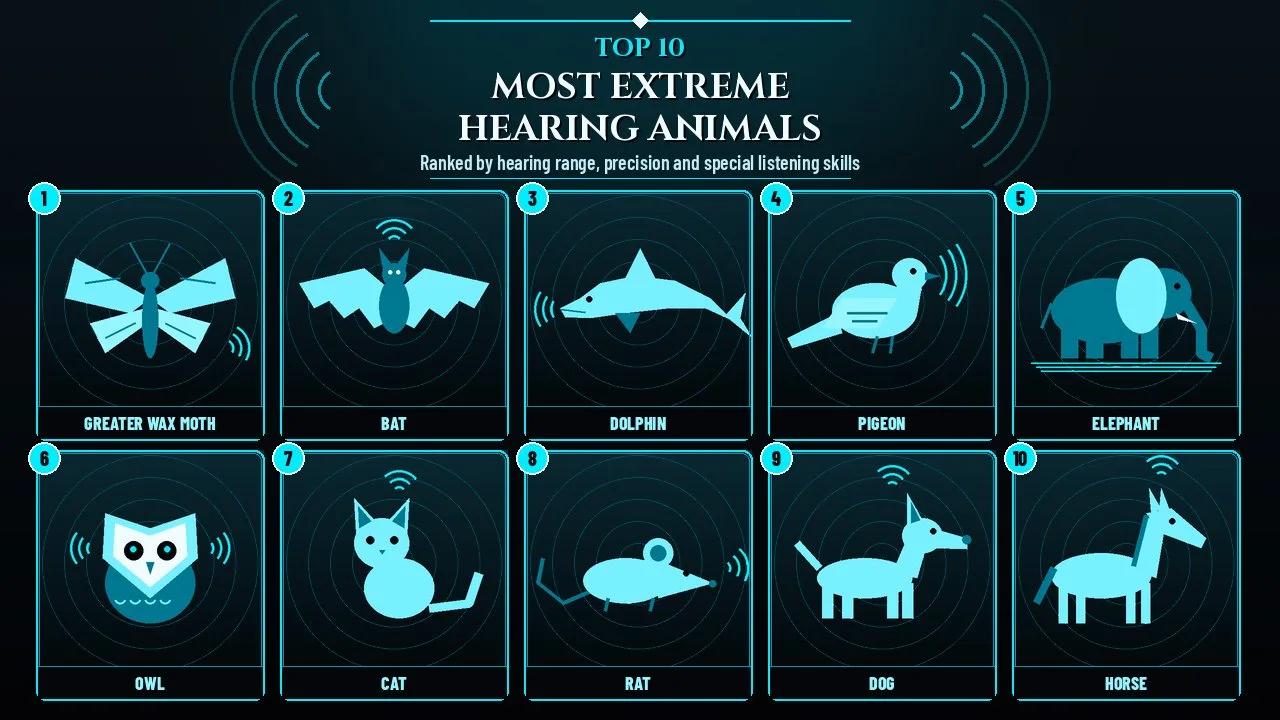
The most extreme hearing animals detect sound far beyond human limits, from the wax moth's 300 kHz ultrasound to the pigeon's deep, slow infrasound.
Human ears are good generalists. A healthy young adult hears roughly from 20 hertz, a deep organ-pipe rumble, up to about 20 kilohertz, a thin whine that most people lose gradually as they age. That band covers speech and music well, but it is only a narrow slice of the sound that fills the world. Above it lies ultrasound, used by bats, rodents and insects. Below it lies infrasound, produced by storms, ocean waves, earthquakes and the deepest calls of large mammals.
This 2026 Finepedia guide ranks ten animals whose hearing pushes past human limits in the most striking ways. Some hear frequencies more than ten times higher than we can. Others sense vibrations so slow that a single cycle takes many seconds. A few do not have unusual ranges at all, but they have turned hearing into a precision tool for hunting or navigation. Each entry has a Quick Facts table, an explanation of how the hearing works, why it matters for survival and a handful of facts worth remembering.
If you enjoy wildlife lists, Finepedia also covers the most venomous snakes in the world and the most dangerous fish in the world, and the full Animals section has many more profiles.
How We Ranked the Most Extreme Hearing Animals
There is no single number that captures "the best ears". An animal can hear very high pitches and still be poor at telling where a sound came from, while another can hear only a modest range yet pinpoint a mouse in total darkness. To keep the list fair, each animal was scored on three questions:
- High-frequency ceiling: how far above the human upper limit of about 20 kHz the animal can still detect sound.
- Low-frequency floor: how far below the human lower limit of about 20 Hz the animal can still detect sound.
- Specialised hearing system: whether the animal uses hearing in an unusual way, such as echolocation, sound localization in darkness or detecting sound through the ground.
The animals that combine a record-breaking range with a specialised system sit at the top. Domestic and farm animals that hear well beyond us, but in a more ordinary way, fill the lower places.
Hearing ranges in this article come from published audiograms, which are charts of the quietest sound an animal can detect at each frequency. Different studies use different methods and sound levels, so figures can vary. Where sources disagree, the article gives the commonly cited range and notes the variation instead of picking one dramatic number.
A Quick Guide to Sound Terms
| Term | Meaning |
|---|---|
| Hertz (Hz) | Cycles per second; the unit for the pitch of a sound |
| Kilohertz (kHz) | One thousand hertz |
| Ultrasound | Sound above about 20 kHz, too high for humans to hear |
| Infrasound | Sound below about 20 Hz, too low for humans to hear as a tone |
| Audiogram | A chart of the quietest audible sound at each frequency |
| Echolocation | Making sounds and listening to the echoes to sense surroundings |
At a Glance
| Rank | Animal | Approximate hearing range | What makes it extreme |
|---|---|---|---|
| 1 | Greater Wax Moth | Up to about 300 kHz | Highest frequency sensitivity recorded in any animal |
| 2 | Bat | Roughly 2 kHz to well over 100 kHz, varies by species | Echolocation in flight; some calls exceed 200 kHz |
| 3 | Dolphin | About 75 Hz to 150 kHz (bottlenose) | Underwater biosonar received through the lower jaw |
| 4 | Pigeon | Down to about 0.05 Hz | Detects infrasound far below human limits |
| 5 | Elephant | About 16 Hz to 12 kHz | Low-frequency rumbles and ground-borne vibration |
| 6 | Owl | About 200 Hz to 12 kHz (barn owl) | Pinpoints prey in total darkness |
| 7 | Cat | About 48 Hz to 85 kHz at loud levels | One of the broadest ranges of any mammal |
| 8 | Rat | About 200 Hz to 76 kHz | Communicates in ultrasonic calls |
| 9 | Dog | About 67 Hz to 45 kHz | Hears high whistles and faint sounds people miss |
| 10 | Horse | About 55 Hz to 33.5 kHz | Highly mobile ears that track sounds and signal mood |
1. Greater Wax Moth
| Attribute | Details |
|---|---|
| Scientific name | Galleria mellonella |
| Animal group | Insect (moth) |
| Hearing range | Neural responses up to about 300 kHz |
| Hearing organ | Tympanal ears on the body with four sensory cells |
| Hearing headline | Highest frequency sensitivity recorded in any animal |
Hearing Range
The greater wax moth is a small, dull-brown insect best known to beekeepers as a pest. Its caterpillars tunnel through honeycomb, feeding on wax, pollen and debris inside weak hives. Nobody expected it to hold a world record, yet in 2013 researchers at the University of Strathclyde in Scotland showed that its ears respond to sounds approaching 300 kHz.
That figure is about fifteen times higher than the top of normal human hearing. It is also well above the highest bat echolocation call known to the research team, which was 212 kHz. In their experiments, Hannah Moir, Joseph Jackson and James Windmill played pure tones to the moths and recorded both the vibration of the eardrum and the electrical activity of the auditory nerve. The ear kept responding all the way up the scale, although louder sounds were needed at the very top.
How It Works
The moth's ear is astonishingly simple. A thin membrane, the tympanum, sits over an air-filled cavity, and only four sensory cells are attached to it. There is no cochlea and no array of thousands of tuned hair cells as in a mammal. Instead the ear works more like a fast, sensitive switch: when the membrane moves far enough, the cells fire.
The researchers measured the membrane with laser Doppler vibrometry, a technique that tracks tiny movements by bouncing a laser beam off a surface. They found that the membrane still vibrated meaningfully at the highest frequencies tested, and nerve recordings confirmed that the cells were firing in response.
- The ear is most sensitive in the band used by the moths' own courtship signals, roughly 70 to 90 kHz.
- Males produce trains of ultrasonic pulses to attract females, so hearing serves mating as well as defence.
- At 300 kHz the nerve still responded, though it needed a much louder sound to do so.
Why It Matters
Moths and bats have been locked in an evolutionary contest for tens of millions of years. Bats hunt with ultrasonic calls, and many moths have evolved ears to hear them coming. When a moth detects a bat, it can dive, spiral or drop out of the air. Some bats, in turn, call at frequencies that typical moth ears cannot detect well.
The wax moth's extreme range suggests that it is ready for even the highest-pitched hunters. It also challenges the idea that complex hearing requires a complex ear. Engineers have since studied the moth's tympanum as a model for tiny, sensitive microphones and acoustic sensors.
Interesting Facts
- The greater wax moth is widely used in laboratories as a low-cost model organism for studying infections and immune responses.
- Its caterpillars attracted headlines for their ability to chew through polyethylene plastic.
- The record is about sensitivity to frequency, not loudness; humans are far more sensitive than the moth to quiet sounds in our own range.
- Popular articles often claim the moth hears "150 times better" than people, but the study itself made no such comparison.
2. Bat
| Attribute | Details |
|---|---|
| Scientific group | Order Chiroptera, more than 1,400 species |
| Animal group | Mammal |
| Typical hearing range | About 2 kHz to 110 kHz in commonly cited tables; varies widely by species |
| Highest echolocation calls | Some species call above 200 kHz, with a reported maximum of about 212 kHz |
| Hearing headline | Builds a moving sound picture of the world by echolocation |
Hearing Range
Bats are the classic ultrasound specialists. Most echolocating species send out calls somewhere between 20 and 120 kHz, far above human hearing, and their ears are tuned to catch the faint echoes that come back. Comparative tables often give a range of about 2 to 110 kHz for a typical bat, but there is no single number for the whole group. Some small tropical species call above 200 kHz, while a few large species use lower calls that people can partly hear.
Not every bat echolocates with its voice. Most fruit bats in the Old World navigate largely by sight and smell, although some, such as the rousette fruit bats, make clicking sounds with their tongues.
How It Works
An echolocating bat produces a call in its larynx and emits it through its mouth or, in some families, through its nose. The sound travels outward, hits an insect or a branch and reflects back. By comparing the outgoing call with the returning echo, the bat's brain works out distance, direction, size, texture and even movement.
- Delay: the time between call and echo tells the bat how far away a target is.
- Loudness and timing differences between the two ears reveal direction.
- Changes in pitch caused by movement, the Doppler effect, show whether prey is approaching or flying away.
- As a bat closes in on prey, it speeds up its calls into a rapid sequence often called the feeding buzz.
Bats also protect their own ears. Tiny muscles in the middle ear contract while a call is being produced, dampening the bat's hearing at the instant of its loudest sound and relaxing in time to catch the echo.
Why It Matters
Echolocation lets bats hunt flying insects at night, when competition from birds is low. A single bat can eat large numbers of insects in one evening, which makes bats valuable natural pest controllers for farms and forests.
The study of bat hearing also shaped human technology. Research on bat sonar in the twentieth century helped scientists understand how animals process echoes, and the same principles appear in sonar, ultrasound imaging and navigation aids for people with visual impairments.
Interesting Facts
- In the 1790s, Lazzaro Spallanzani and Louis Jurine found that blinded bats could still avoid obstacles, but bats with plugged ears could not.
- American biologist Donald Griffin coined the term "echolocation" in the 1940s after recording bat ultrasound with new equipment.
- Horseshoe bats adjust the pitch of their calls while flying so that the returning echoes fall in the most sensitive part of their hearing.
- Some tiger moths fight back by producing their own ultrasonic clicks, which can jam the sonar of hunting bats.
3. Dolphin
| Attribute | Details |
|---|---|
| Example species | Common bottlenose dolphin (Tursiops truncatus) |
| Animal group | Marine mammal (toothed whale) |
| Hearing range | About 75 Hz to 150 kHz in classic bottlenose studies |
| Main sound path | Fat-filled channel in the lower jaw leading to the middle ear |
| Hearing headline | Uses biosonar to find and identify objects underwater |
Hearing Range
Dolphins hear across a huge span. Classic laboratory work on bottlenose dolphins found hearing from roughly 75 Hz up to about 150 kHz, and comparative tables for porpoises give a similar ceiling. Values differ between studies, species and individuals, and older dolphins, like older humans, tend to lose some of their top range.
Their echolocation clicks are short, broadband bursts with much of their energy in the tens of kilohertz to over 100 kHz, while their social whistles fall mostly in a lower band that people can hear.
How It Works
Dolphins have tiny external ear openings, but these are not the main route for sound underwater. Instead, sound passes into the head through the thin bone and fatty tissue of the lower jaw. A specialised channel of fat conducts the vibrations back to the middle and inner ear, which sit in bony capsules partly isolated from the rest of the skull.
- Clicks are produced by structures in the nasal passages called phonic lips, just below the blowhole.
- The melon, the rounded fatty forehead, focuses outgoing clicks into a forward beam.
- Echoes return through the lower jaw and are processed by a large auditory region of the brain.
- The isolation of the ear capsules helps dolphins tell which side a sound came from, even though sound travels much faster in water than in air.
Why It Matters
Sea water is often murky and light fades quickly with depth, so vision is limited for a hunting dolphin. Biosonar fills the gap. With it a dolphin can detect fish buried in sand, judge the size and shape of objects and track prey in conditions where eyesight is almost useless.
Hearing also holds dolphin society together. Bottlenose dolphins develop individual signature whistles, sound patterns that work rather like names and help group members recognise one another over distance.
Interesting Facts
- The United States Navy has trained bottlenose dolphins to locate underwater objects, including sea mines, because their sonar outperforms many machines in shallow water.
- Harbour porpoises, close relatives of dolphins, use very high-pitched, narrow-band clicks of around 130 kHz.
- Underwater noise from shipping and construction is a growing concern because it can mask the sounds dolphins depend on.
- Dolphins can produce clicks and whistles at the same time.
4. Pigeon
| Attribute | Details |
|---|---|
| Scientific name | Columba livia (rock dove and domestic or homing pigeon) |
| Animal group | Bird |
| Lowest frequency detected | About 0.05 Hz in laboratory tests |
| Upper hearing limit | Only a few kilohertz, around 8 kHz in one modern audiogram |
| Hearing headline | Sensitive to infrasound far below human hearing |
Hearing Range
The pigeon earns its place for the opposite reason to the moth. Its high-frequency hearing is modest, well below that of a human, but at the bottom of the scale it is extraordinary. In 1979, Cornell University researchers Melvin Kreithen and Douglas Quine reported that homing pigeons in a sound-isolation chamber could detect sound waves as slow as 0.05 Hz. That is one cycle every twenty seconds, a pressure change so gradual that a person would never recognise it as sound.
The same study found that below 10 Hz the pigeons were at least 50 decibels more sensitive than humans. A later study using a different training method confirmed that pigeons hear low frequencies better than people, with the advantage appearing below about 32 Hz.
How It Works
The scientists did not ask the pigeons to peck a button for each sound. Instead they used a conditioned heart-rate response: the birds learned that a particular tone came before a mild stimulus, so their heart rate rose whenever they heard it. By lowering the volume step by step, the researchers mapped the quietest sound that still triggered a response.
When structures of the middle or inner ear were removed, the infrasound responses weakened or disappeared, showing that the pigeons were truly hearing the signals rather than feeling them in some other way.
- Natural infrasound comes from weather systems, wind over mountains, ocean waves and earthquakes.
- Infrasound loses little energy as it travels, so it can be detected hundreds or even thousands of kilometres from its source.
- Related research found that pigeons can also detect very small changes in the pitch of these slow sounds.
Why It Matters
Homing pigeons can return to their lofts from places they have never visited, and scientists have argued for decades about how they do it. Sun position, the Earth's magnetic field, smell and landmarks all appear to play a role. Infrasound is a more controversial candidate.
United States Geological Survey geophysicist Jonathan Hagstrum has proposed that pigeons may use the infrasonic signature of the landscape around their home as an acoustic map, and has linked some unusual lost-race events to disturbances in the atmosphere. The idea remains debated, but it shows why extremely low-frequency hearing could be useful to a long-distance navigator.
Interesting Facts
- Pigeons are among the most studied birds in sensory science and have also been shown to see ultraviolet light.
- Infrasound is also produced by thunderstorms and approaching weather fronts, so pigeons may sense changes in the sky before people do.
- A pigeon's ear openings are hidden under feathers just behind and below the eyes.
- Wind noise is a major challenge for testing infrasound, which is why the original experiments were done in a sealed chamber.
5. Elephant
| Attribute | Details |
|---|---|
| Species | African savanna, African forest and Asian elephants |
| Animal group | Mammal |
| Hearing range | About 16 Hz to 12 kHz in comparative tables |
| Special sense | Detects low-frequency rumbles and ground-borne vibration |
| Hearing headline | Among the best low-frequency hearing of any land mammal tested |
Hearing Range
Elephants are built for the deep end of the sound spectrum. A 1982 study by Rickye and Henry Heffner tested a young Asian elephant and found hearing from about 17 Hz to 10.5 kHz, with unusually good sensitivity to low tones. Comparative tables round this to about 16 Hz to 12 kHz. At the top end elephants hear less than humans, but at the bottom they hold a clear advantage.
Elephants also produce rumbles with fundamental frequencies that can dip below 20 Hz, partly in the infrasonic range. Many of these calls have harmonics that people can hear as a low purr, but much of the energy lies below human perception.
How It Works
Large animals tend to hear low frequencies well because of the size of their ear structures. An elephant's eardrum and middle-ear bones are large and heavy, which suits slow vibrations. The famous outer ears, or pinnae, help gather sound and can be spread wide when an elephant listens intently.
Research led by Caitlin O'Connell-Rodwell at Stanford University has shown that elephants also respond to vibrations travelling through the ground. These signals may be picked up through sensitive receptors in the feet and trunk, and through bone conduction that carries vibration up the skeleton to the ear.
- Low-frequency rumbles travel well through open savanna and forest because long waves are less blocked by vegetation.
- Elephants sometimes freeze, lean forward and lift a foot when they appear to be listening through the ground.
- The 1982 study also found that the elephant could locate a sound source to within about one degree, among the best results recorded for any animal.
Why It Matters
Elephant families spread out while feeding, and low-frequency calls help them stay in contact, coordinate movement and find mates. Females come into breeding condition for only a few days at a time, so being able to signal over a wide area is valuable.
Ground-borne signals could also give early warning of distant activity, such as the movement of another herd. Researchers are still working out how far and how reliably elephants use this channel, so this article avoids repeating the large distance figures sometimes quoted online.
Interesting Facts
- An elephant's ears are also cooling radiators; flapping them moves warm blood through thin skin and helps shed heat.
- African elephants have much larger ears than Asian elephants, partly linked to living in hotter, open habitats.
- Elephants can recognise the voices of many individual family members.
- Some conservation projects use sound recorders in forests to count elephants by their rumbles.
6. Owl
| Attribute | Details |
|---|---|
| Best-studied species | Barn owl (Tyto alba) |
| Animal group | Bird |
| Hearing range | About 200 Hz to 12 kHz |
| Special features | Facial disc and asymmetric ear openings |
| Hearing headline | Can strike prey in complete darkness by sound alone |
Hearing Range
The owl's hearing range is not extreme by the standards of this list. Barn owls hear from about 200 Hz to roughly 12 kHz, a span that sits inside the human range. What makes them exceptional is not how high or low they can hear, but how precisely they can tell where a sound is coming from.
In laboratory experiments in the mid twentieth century, barn owls caught mice in rooms with no light at all, guided only by rustling sounds. Later work showed that they can locate sounds to within a degree or two in both direction and height.
How It Works
An owl's face is a sound collector. The stiff feathers of the facial disc form a shallow dish that funnels sound towards the ear openings, much as a satellite dish focuses radio waves. Behind the feathers, the ear openings of many owls, including barn owls, are placed at different heights on each side of the head.
- Differences in arrival time between the two ears tell the owl whether a sound is to the left or right.
- Because one ear is higher than the other, differences in loudness tell the owl whether a sound is above or below.
- The owl's brain combines these cues into a neural map of space, discovered by Eric Knudsen and Masakazu Konishi in the 1970s.
- Soft, fringed flight feathers keep the owl almost silent, so its own wingbeats do not drown out its prey.
Why It Matters
Night hunting is hard. Small mammals hide under leaves, grass or snow, and eyes cannot see them in the dark. By relying on hearing, owls can hunt successfully at night and in dense cover. Great grey owls are known to plunge into deep snow to catch voles they cannot see.
The barn owl has also become one of the most important animals in hearing research. Studies of how its brain calculates sound direction have influenced theories of human hearing and the design of directional microphones.
Interesting Facts
- Owls cannot rotate their heads all the way around; many species can turn their heads about 270 degrees, thanks to extra neck vertebrae and special blood-vessel adaptations.
- German researchers reported in 2017 that barn owls show no typical age-related hearing loss, keeping sharp hearing well into old age.
- Bird ears can regrow lost sensory hair cells, something human ears cannot do.
- The "ear tufts" on owls such as the great horned owl are feathers, not ears.
7. Cat
| Attribute | Details |
|---|---|
| Scientific name | Felis catus |
| Animal group | Mammal |
| Hearing range | About 45 Hz to 64 kHz in standard tables; 48 Hz to 85 kHz at loud levels |
| Ear mobility | Each outer ear is moved by about 30 muscles, often cited as 32 |
| Hearing headline | One of the broadest hearing ranges among mammals |
Hearing Range
The domestic cat hears both low and high sounds well, which is rarer than it sounds. Many small mammals hear very high frequencies but lose sensitivity to low ones. In a 1985 study, Rickye and Henry Heffner found that cats hearing sounds at a fairly loud level of 70 decibels could detect frequencies from 48 Hz up to 85 kHz. They concluded that cats evolved extended high-frequency hearing without giving up low-frequency hearing.
Standard comparative tables, which use a slightly different threshold, give a range of about 45 Hz to 64 kHz. Either way, a cat hears more than an octave above the human limit.
How It Works
A cat's outer ears are mobile funnels. Each one can turn independently through a wide arc, so a cat can track two sounds at once or swivel one ear backwards while looking forward. The ear's shape boosts certain frequencies and helps the cat judge whether a sound is in front, behind, above or below.
- The many small muscles of each ear allow fine adjustments in direction.
- The folds and ridges of the ear alter incoming sounds in ways the brain uses to judge height.
- A large middle-ear cavity, divided into two chambers, improves sensitivity.
- Cats are especially sensitive in the range of mouse squeaks and rustles.
Why It Matters
Small rodents communicate partly in ultrasound, and their movements through grass produce high-frequency rustles. A cat that can hear these sounds can locate prey before it sees it. Cats often sit motionless with ears turning, then pounce on a spot they have identified by sound alone.
For owners, sensitive hearing explains why many cats dislike loud music, vacuum cleaners and household appliances that emit high-pitched noise inaudible to people.
Interesting Facts
- White cats with blue eyes are more likely to be born deaf because of a gene that affects both coat colour and the inner ear.
- Kittens are born with their ear canals closed, and these open in the first couple of weeks of life.
- A cat's ear position is a useful mood signal: ears flattened sideways or back usually show fear or irritation.
- Studies have found that cats can tell their owner's voice apart from the voices of strangers.
8. Rat
| Attribute | Details |
|---|---|
| Scientific name | Rattus norvegicus (brown rat) and relatives |
| Animal group | Mammal (rodent) |
| Hearing range | About 200 Hz to 76 kHz |
| Communication | Ultrasonic calls around 22 kHz and 50 kHz |
| Hearing headline | Holds conversations humans cannot hear |
Hearing Range
Rats hear from about 200 Hz up to around 76 kHz, almost four times the human upper limit. Their low-frequency hearing is weaker than ours, which is common in small mammals, because small heads and ears are better suited to short, high-pitched sound waves.
That high-frequency range is not just a by-product of size. Rats use it for a rich social language of ultrasonic calls that is almost completely private from human listeners.
How It Works
Rats produce ultrasonic vocalisations in the larynx and hear them with a cochlea tuned for high frequencies. Researchers record these calls with special microphones and slow them down or shift their pitch so that people can study them.
- Calls around 22 kHz are linked with alarm, distress and negative situations.
- Calls around 50 kHz are linked with play, anticipation of rewards and positive social contact.
- Rat pups separated from the nest emit ultrasonic calls that prompt the mother to retrieve them.
- Rats are also sensitive to sudden sounds, which trigger a strong startle response used in laboratory research.
Why It Matters
Ultrasonic calls let rats warn each other of danger without alerting many predators, whose hearing may be less sensitive at those frequencies. The calls also coordinate mating and maternal care.
Neuroscientist Jaak Panksepp and colleagues found that young rats tickled by researchers produce 50 kHz calls, and they described these calls as a form of laughter. The work helped open a wider scientific discussion about emotion in animals.
Interesting Facts
- Many ultrasonic pest repellers are sold on the idea of rat hearing, but studies have found that rodents often get used to the sounds.
- Laboratory rats are one of the most important animals in hearing research, including studies of noise damage.
- Mice, close relatives of rats, can hear even higher, with comparative tables giving an upper limit of about 91 kHz.
- A 2005 study found that rats could learn to tell Dutch from Japanese speech, apparently by picking up differences in rhythm.
9. Dog
| Attribute | Details |
|---|---|
| Scientific name | Canis familiaris |
| Animal group | Mammal |
| Hearing range | About 67 Hz to 45 kHz |
| Ear mobility | Around 18 muscles control each outer ear |
| Hearing headline | Hears high-pitched sounds and quiet noises people miss |
Hearing Range
Dogs hear from about 67 Hz to 45 kHz according to standard comparative tables, which draw on behavioural tests by hearing researchers such as the Heffners. That is more than twice the human upper limit, though slightly less than a cat. Figures of 40 Hz to 60 kHz often quoted online are higher than the measured values, and breed, age and health all make a difference.
At the low end, dogs and humans are roughly similar. The real advantage lies above 20 kHz, where dogs keep hearing tones that are silent to us.
How It Works
Dogs have a long, L-shaped ear canal that channels sound towards the eardrum. The outer ear is moved by a set of muscles, commonly cited as about 18, which let many breeds raise, rotate and tilt their ears towards a sound. Upright-eared breeds generally have the most mobility, while heavy drop ears can muffle sound slightly.
- Moving the ears helps a dog judge the direction of a sound.
- The head tilt many dogs make may help them adjust the position of their ears and gather more information.
- Dogs detect high-frequency squeaks from rodents and insects in grass.
- A trained dog can learn to respond to whistles above human hearing.
Why It Matters
Dogs descended from wolves that hunted small prey and relied on hearing for warnings. Today their hearing makes them useful as guard dogs, search dogs and assistance dogs for people who are deaf or hard of hearing, alerting their owners to doorbells, alarms and crying babies.
Understanding dog hearing also matters at home. Fireworks, thunder and loud appliances can cause real distress. Owners who want to keep their pets safe should also know the foods dogs should never eat, and anyone choosing a new pet can compare the cheapest dog breeds to own.
Interesting Facts
- Puppies are born functionally deaf, and their ear canals open at around two weeks of age.
- The "silent" dog whistle is often credited to the Victorian scientist Francis Galton, who used whistles to test the upper limits of animal hearing.
- Dalmatians have a high rate of congenital deafness linked to genes for white coat colour; veterinary research has found that around a third have hearing loss in one or both ears.
- Dogs can learn to recognise the sound of their owner's car or footsteps.
10. Horse
| Attribute | Details |
|---|---|
| Scientific name | Equus caballus |
| Animal group | Mammal |
| Hearing range | About 55 Hz to 33.5 kHz |
| Ear mobility | Each ear can rotate through roughly 180 degrees independently |
| Hearing headline | Hears well above humans and uses ear position as a signal |
Hearing Range
Behavioural tests by Rickye and Henry Heffner in the 1980s found that horses hear from about 55 Hz to 33.5 kHz, with best sensitivity in the middle of that span. That gives a horse an upper limit well above a human's, though lower than a dog's or cat's. Higher low-end figures from some websites, such as 14 Hz, are not supported by those measured audiograms.
How It Works
A horse's large, funnel-shaped ears can rotate independently, so one ear can point forward at a rider or a distant sound while the other turns back. This mobility helps the horse monitor a wide area for danger.
Surprisingly, horses are not good at pinpointing sounds. The Heffners found that horses needed sounds to be separated by more than 20 degrees before they could reliably tell the difference, much coarser than humans, elephants or owls. Horses also had trouble locating high-frequency tones. The researchers suggested that animals with a very wide field of vision, like horses, may rely on their eyes to fix the exact location of a sound once their ears have detected it.
- Ear movement directs attention towards a sound.
- The wide field of view then helps the horse find the source.
- Low-frequency tones are easier for horses to localise than high ones.
Why It Matters
Horses are prey animals, and their survival in the wild depended on hearing predators early and fleeing fast. Sensitive hearing explains why horses can be startled by sudden or unfamiliar noises, such as plastic bags rustling or distant machinery.
For riders and handlers, a horse's ears are one of the clearest windows into its attention. Ears pricked forward suggest interest, ears flicking back and forth show monitoring, and ears pinned flat against the head warn of anger or discomfort.
Interesting Facts
- Horses can often hear approaching people, vehicles or animals before their riders do.
- Many horses respond to the tone of a handler's voice more than to specific words.
- Ear covers, sometimes called ear bonnets or fly veils, are used in some sports to reduce noise and keep insects away.
- A 2012 study found that horses can match the voices of familiar people to their faces.
Honourable Mentions
Several other animals could easily have made a longer list:
- Beluga whale: comparative tables give it a hearing range of about 1 kHz to 123 kHz, and it relies on echolocation in Arctic waters.
- House mouse: hears up to about 91 kHz and uses ultrasonic songs during courtship.
- Ormia ochracea: a tiny parasitic fly whose ears, less than a millimetre apart, are mechanically linked so it can locate singing crickets with remarkable accuracy.
- Tiger moths: some species produce ultrasonic clicks that warn or jam hunting bats.
- Goldfish and other fish: many species hear through their swim bladders and inner ears, and the most dangerous fish also rely on lateral-line senses to detect water movement.
Comparison: How Each Animal Beats Human Hearing
| Animal | Beyond human high limit | Beyond human low limit | Specialised system |
|---|---|---|---|
| Greater Wax Moth | Yes, to about 300 kHz | No | Simple four-cell tympanal ear |
| Bat | Yes, often above 100 kHz | No | Echolocation in air |
| Dolphin | Yes, to about 150 kHz | No | Biosonar through the lower jaw |
| Pigeon | No | Yes, down to about 0.05 Hz | Possible infrasound navigation |
| Elephant | No | Slightly, about 16 Hz | Low rumbles and ground vibration |
| Owl | No | No | Precise sound localization in darkness |
| Cat | Yes, to about 64 to 85 kHz | No | Mobile ears, very broad range |
| Rat | Yes, to about 76 kHz | No | Ultrasonic social calls |
| Dog | Yes, to about 45 kHz | No | Mobile ears, high-pitch sensitivity |
| Horse | Yes, to about 33.5 kHz | No | Independent ear rotation |
| Human | About 20 kHz | About 20 Hz | Speech and music processing |
Human Hearing for Comparison
People usually lose high-frequency hearing first. Many adults can no longer hear tones above 15 to 17 kHz, and long exposure to loud noise speeds up the decline. Our hearing is most sensitive between roughly 2 and 5 kHz, the region where many speech sounds sit.
Humans are not poor listeners, though. In our best range we can detect remarkably quiet sounds, and in the quietest rooms on Earth people report hearing their own heartbeat and blood flow. Finepedia's guide to the most silent places in the world explores what happens when almost all outside sound is removed.
Frequently Asked Questions
Which animal has the best hearing in the world?
It depends on what "best" means. The greater wax moth has the highest recorded frequency sensitivity, about 300 kHz. Bats and dolphins have the most sophisticated echolocation. Barn owls are the champions of locating sounds in darkness, while pigeons and elephants are among the best at very low frequencies.
Can any animal hear higher than a bat?
Yes. In 2013 researchers at the University of Strathclyde showed that the greater wax moth responds to sounds approaching 300 kHz. The highest bat echolocation call they cited was about 212 kHz, so the moth's hearing extends beyond the calls of even the highest-pitched known bats.
What is the normal hearing range of humans?
Young, healthy adults are usually said to hear from about 20 Hz to 20 kHz. Most people lose some top-end hearing with age and noise exposure, so many adults cannot hear above roughly 15 to 17 kHz. Human hearing is most sensitive in the middle range used for speech.
Can cats hear better than dogs?
For high frequencies, generally yes. Standard tables give cats an upper limit of about 64 kHz, and one study found up to 85 kHz at loud levels, compared with about 45 kHz for dogs. Both hear far above humans, and both use mobile ears to judge where sounds come from.
What is infrasound and which animals can hear it?
Infrasound is sound below about 20 Hz, too low for humans to hear as a tone. Homing pigeons have been shown to detect frequencies as low as 0.05 Hz. Elephants communicate with rumbles that dip into the infrasonic range, and some large whales also use very low-frequency calls.
How do dolphins hear underwater without outer ears?
Dolphins have small ear openings, but underwater most sound enters through the lower jaw. A channel of fatty tissue carries vibrations to the middle and inner ear, which sit in bony capsules partly isolated from the skull. This arrangement helps dolphins receive echoes from their clicks and judge direction.
Can owls really turn their heads all the way around?
No. Many owls can rotate their heads about 270 degrees, not a full circle. A 2013 Johns Hopkins study explained that extra neck vertebrae and special blood-vessel features let them turn so far without cutting off blood to the brain. Head turning helps owls aim their ears and eyes.
Conclusion
The most extreme hearing animals show how many different ways there are to listen. The greater wax moth breaks the frequency record with an ear of just four cells. Bats and dolphins turn sound into a picture of their surroundings. Pigeons and elephants tune into slow, deep signals that travel across landscapes, while owls, cats, rats, dogs and horses each use sharp hearing for hunting, talking or staying safe.
Human ears hear only a narrow band of this acoustic world. Learning how other animals hear helps scientists design better microphones, sonar and hearing aids, and it is a reminder that the quietest moment for us may be full of sound for the animals around us. For more lists like this, browse Finepedia's Top 10 Facts collection.
- Moir H.M., Jackson J.C. and Windmill J.F.C., Extremely high frequency sensitivity in a simple ear, Biology Letters 9(4): 20130241 (2013): https://doi.org/10.1098/rsbl.2013.0241
- Heffner R.S. and Heffner H.E., Hearing range of the domestic cat, Hearing Research 19 (1985): 85 to 88
- Heffner R.S. and Heffner H.E., Hearing in the elephant (Elephas maximus): absolute sensitivity, frequency discrimination and sound localization, Journal of Comparative and Physiological Psychology 96 (1982)
- Heffner R.S. and Heffner H.E., Hearing in large mammals: horses and cattle, Behavioral Neuroscience (1983), and related horse sound-localization studies
- Kreithen M.L. and Quine D.B., Infrasound detection by the homing pigeon: a behavioral audiogram, Journal of Comparative Physiology 129 (1979): 1 to 4
- Fay R.R., Hearing in Vertebrates: A Psychophysics Databook (1988), as summarised in the Louisiana State University comparative hearing-range table by George M. Strain
- Research summaries on bat echolocation, dolphin biosonar, barn owl sound localization, elephant seismic communication and rat ultrasonic vocalisations
- Reference topic only: 10mosttoday.com listicle on extreme hearing animals

















Log in with