


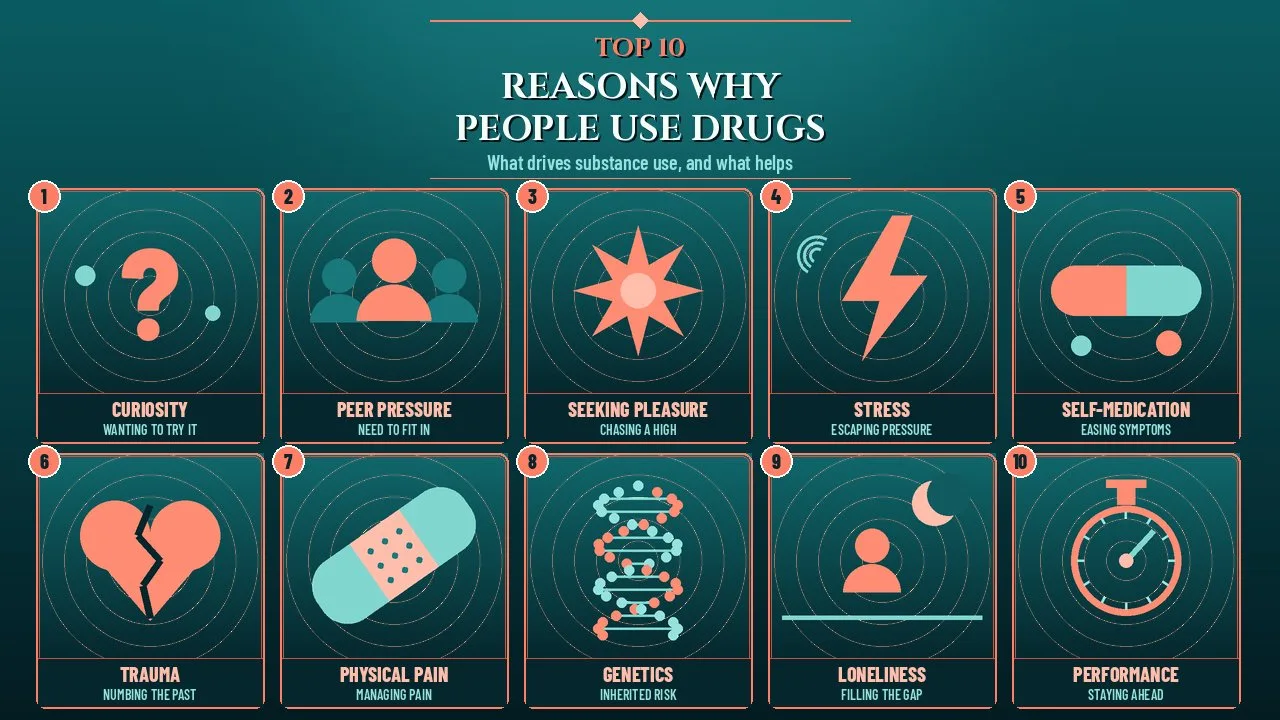
The most common reasons why people use drugs include curiosity, peer pressure, stress, pain and mental health struggles, shaped by genes and life events. Few people start using a substance because of one single cause. Most first use happens when several pressures line up at the same time, such as a stressful period, easy access and friends who already use.
Understanding these motives matters because it changes how families, schools and doctors respond. Shame and punishment rarely stop someone who is using a drug to cope with pain, grief or anxiety, while support that addresses the underlying need often does. This guide ranks ten of the most widely documented reasons, explains the science behind each one and shows what tends to help.
The list is based on research summaries from the US National Institute on Drug Abuse (NIDA), the World Health Organization (WHO), the United Nations Office on Drugs and Crime (UNODC) and the US National Survey on Drug Use and Health (NSDUH). It covers illegal drugs, alcohol and the misuse of prescription medicines. It is written for general education and is not medical advice.
Drug Use Around the World: Key Numbers
Drug use is far more common than many people assume, and it has been rising faster than the global population. The figures below come from the latest major reports available as of October 2026.
| Measure | Figure | Source |
|---|---|---|
| People worldwide who used a drug in 2023 (excluding alcohol and tobacco) | 316 million, about 6 percent of people aged 15 to 64 | UNODC World Drug Report 2025 |
| Most widely used drug worldwide | Cannabis, with about 244 million users | UNODC World Drug Report 2025 |
| People who used opioids in 2023 | About 61 million | UNODC World Drug Report 2025 |
| Deaths each year linked to alcohol | About 2.6 million (2019) | WHO, 2024 |
| Deaths each year linked to psychoactive drug use | About 0.6 million (2019) | WHO, 2024 |
| People in the US aged 12 or older with a substance use disorder in 2023 | 48.5 million (17.1 percent) | NSDUH 2023 |
The 10 Reasons at a Glance
| Rank | Reason | Core motive | Who it affects most |
|---|---|---|---|
| 1 | Curiosity and experimentation | Wanting to know what a drug feels like | Teenagers and young adults |
| 2 | Peer pressure and fitting in | Belonging to a group | Adolescents and students |
| 3 | Seeking pleasure and a high | Euphoria and excitement | Recreational users of all ages |
| 4 | Coping with stress | Relief from tension and worry | Working adults, carers, students |
| 5 | Self-medicating mental health problems | Easing anxiety, depression or insomnia | People with untreated conditions |
| 6 | Trauma and adverse childhood experiences | Numbing painful memories | Survivors of abuse, neglect or violence |
| 7 | Relieving physical pain | Managing pain without proper supervision | People with injuries or chronic pain |
| 8 | Genetics and family history | Inherited vulnerability | Children of parents with addiction |
| 9 | Loneliness and social isolation | Filling an emotional gap | Isolated adults, older people, new arrivals |
| 10 | Performance and productivity pressure | Staying alert, focused or stronger | Students, shift workers, athletes |
1. Curiosity and Experimentation
Curiosity is one of the most common starting points for drug use, especially in the teenage years. Young people hear about a substance from friends, music, films or social media and want to find out for themselves what the fuss is about. For many, one or two tries is where it ends, but for some it becomes the first step towards regular use.
| Attribute | Details |
|---|---|
| Type of motive | Social and psychological |
| Peak age | Mid-teens to early twenties |
| Key evidence | NIDA lists curiosity and social pressure among the main reasons people first try drugs |
| Why it is risky | The earlier use begins, the higher the later risk of addiction |
| What helps | Honest information, supervision and engaging alternatives |
Why It Happens
The adolescent brain is built to seek new experiences. NIDA explains that the prefrontal cortex, the region that weighs risks and controls impulses, is still maturing during adolescence and keeps developing into the mid-twenties. Reward systems, by contrast, are highly active in the teenage years, which makes novelty feel especially exciting and consequences feel distant.
Who Is Most Affected
- Teenagers who have easy access to alcohol, cannabis or medicines at home
- Students moving away from home for the first time
- Young people who see drug use presented as normal or glamorous online
- People who believe a substance is "natural" and therefore harmless
Why It Matters
Experimentation is not the same as addiction, and most people who try a drug do not develop a disorder. The concern is timing. NIDA notes that people who begin using substances early in life are more likely to develop serious problems later, partly because drugs act on a brain that is still wiring itself.
What Helps
- Clear, factual conversations rather than scare stories
- Parents and teachers who stay involved and set consistent rules
- Sports, clubs, creative hobbies and volunteering that offer real excitement
- Safe storage of alcohol and prescription medicines at home
Key Facts
- NSDUH 2023 found that 39 percent of US young adults aged 18 to 25 used an illicit drug in the past year, the highest rate of any age group.
- The prefrontal cortex is one of the last brain regions to mature.
- Delaying first use is one of the most effective prevention goals for families and schools.
2. Peer Pressure and Fitting In
Peer pressure pushes many people towards drugs because using can feel like the price of belonging. The pressure is not always open teasing or dares. More often it is quiet and indirect: everyone at a party is drinking, a friend passes a joint around, or a group jokes about the person who says no.
| Attribute | Details |
|---|---|
| Type of motive | Social |
| Peak age | Early teens to mid-twenties |
| Key evidence | Laboratory studies show teenagers take more risks when peers are watching |
| Common settings | Parties, college campuses, sports teams, workplaces with a drinking culture |
| What helps | Strong friendships outside the group and practised refusal skills |
Why It Happens
Humans are social animals, and acceptance by a group has always mattered for survival. In a well-known 2005 study by psychologists Margo Gardner and Laurence Steinberg, adolescents playing a driving game took noticeably more risks when friends were in the room, while adults were far less affected. Being watched by peers seems to amplify the reward value of risky choices for younger people.
Who Is Most Affected
- Adolescents trying to build an identity and find their place
- New students, new employees and anyone joining an established group
- People with low self-confidence or social anxiety
- Members of groups where heavy drinking or drug use is part of the culture
Why It Matters
NIDA describes adolescence as a period when risk factors such as friends who use drugs can strongly influence behaviour. The same social pull can work in the other direction, too. Young people whose friends do not use substances are much less likely to start, which is why friendship networks are a major focus of school prevention programmes.
What Helps
- Practising simple, face-saving ways to say no
- Having at least one friend who will back up a refusal
- Choosing activities where drinking or drug use is not the main event
- Parents who know their children's friends and stay in contact without spying
Key Facts
- Peer influence is strongest in early and middle adolescence.
- Social norms campaigns that show how many students do not use drugs can reduce perceived pressure.
- Peer pressure also affects adults, especially in workplaces with a strong after-hours drinking culture.
3. Seeking Pleasure and a High
Many people use drugs simply because they feel good, at least at first. Substances such as alcohol, cannabis, cocaine, ecstasy and opioids can produce euphoria, confidence, relaxation or a sense of connection with others. For recreational users, this pleasure is the whole point, and the risks can feel abstract next to an immediate reward.
| Attribute | Details |
|---|---|
| Type of motive | Biological and recreational |
| Brain system involved | The reward circuit, which uses the chemical messenger dopamine |
| Key evidence | NIDA names "to feel good" as one of the main reasons people take drugs |
| Common substances | Alcohol, cannabis, stimulants, ecstasy, opioids |
| What helps | Understanding the reward trap and finding natural sources of enjoyment |
Why It Happens
NIDA explains that most drugs affect the brain's reward circuit, flooding it with dopamine and other signals far more strongly than everyday pleasures do. Stimulants such as cocaine tend to bring a burst of energy and confidence, while opioids such as heroin produce a wave of relaxation and satisfaction. The brain remembers these intense rewards and learns to seek them again.
Who Is Most Affected
- People who enjoy thrill-seeking and novelty
- Party-goers and festival crowds
- People who feel bored, flat or unfulfilled in daily life
- Anyone who has had a very positive first experience with a substance
Why It Matters
The pleasure of a drug is real, which is why simply telling people that drugs are bad does not work. Over time, though, repeated use dampens the brain's own reward system. Activities that once felt enjoyable, such as food, friends or hobbies, can start to feel dull, and the person may need the drug just to feel normal.
What Helps
- Learning how tolerance and the reward system work
- Building in natural rewards such as exercise, music, sport and time outdoors
- Avoiding mixing substances, which multiplies the risk of harm
- Seeking help early if the drug becomes the main source of enjoyment
Key Facts
- Drugs can release far more dopamine than natural rewards like food.
- The high from many drugs fades faster each time as tolerance builds.
- Pleasure-seeking is often the stated reason for first use, but later use is frequently about avoiding feeling bad.
4. Coping With Stress
Stress is one of the strongest triggers for both starting and continuing drug use. Work pressure, money worries, exams, caring duties, relationship problems and long-term uncertainty all push people to look for fast relief. A drink after a hard day or a pill to switch off at night can feel like an easy fix, which is exactly what makes it dangerous.
| Attribute | Details |
|---|---|
| Type of motive | Psychological (escape and relief) |
| Common triggers | Job stress, debt, exams, conflict, caring for others |
| Key evidence | NIDA lists "to feel better", including relief from stress, as a core reason for drug use |
| Common substances | Alcohol, cannabis, sedatives, tranquilizers |
| What helps | Healthy stress tools, rest and practical support |
Why It Happens
When people are under pressure, the body releases stress hormones such as cortisol that keep the mind alert and tense. Alcohol, sedatives and cannabis can quieten that feeling for a few hours. NSDUH data from 2015 showed that among US adults who misused prescription tranquilizers, the most common reason for their last misuse was to relax or relieve tension, given by 46.2 percent.
Who Is Most Affected
- Employees in high-pressure or insecure jobs
- Students facing exams and competitive admissions
- Carers looking after children, sick relatives or older parents
- People going through divorce, bereavement or job loss
Why It Matters
Using a substance to manage stress creates a loop. The relief is short-lived, and the stress often returns stronger, along with poor sleep, low mood and health problems. NIDA also notes that stress is one of the most common triggers for relapse in people recovering from addiction, which is why stress management is a central part of treatment.
What Helps
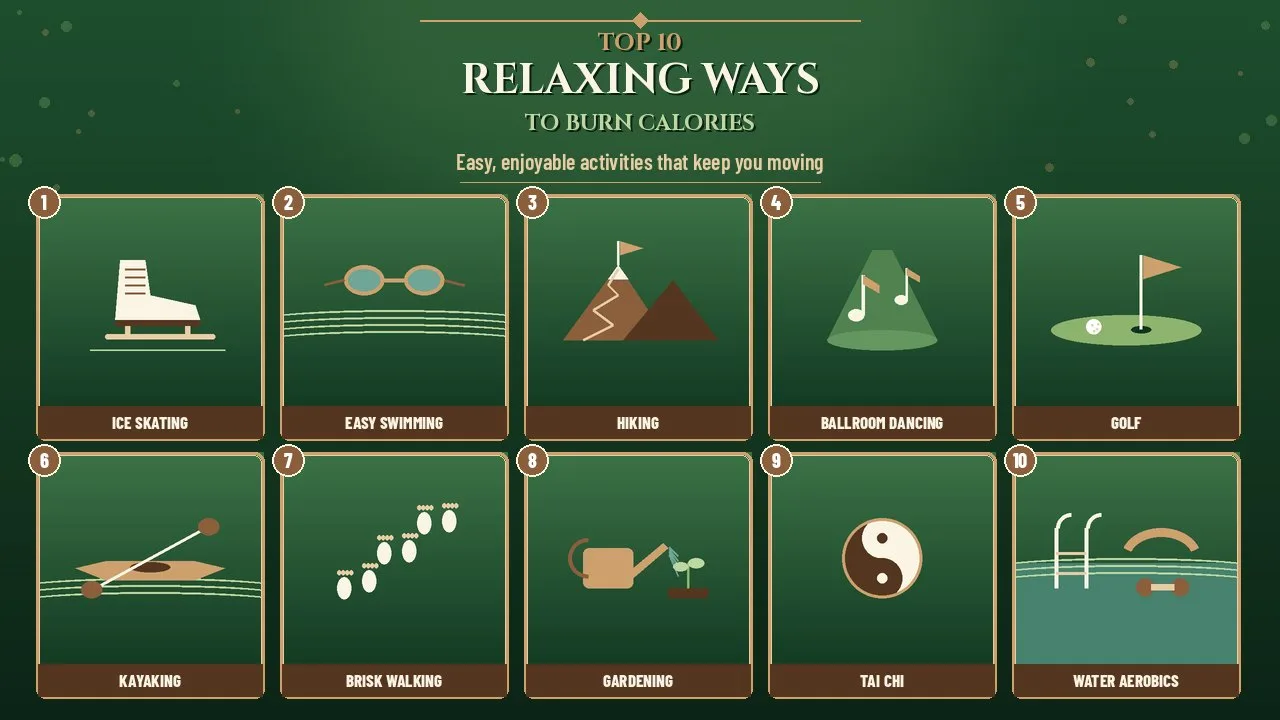
- Regular physical activity, which lowers stress hormones naturally, even gentle options like these relaxing ways to burn calories
- Consistent sleep routines and limits on caffeine late in the day
- Talking problems through with friends, family or a counsellor
- Practical help such as debt advice, flexible work or respite care
Key Facts
- Stress-related drinking often starts with small amounts and grows slowly.
- Stress is a leading trigger for relapse after treatment.
- Many workplaces now offer free confidential employee assistance programmes.
5. Self-Medicating Mental Health Problems
Many people use alcohol or drugs to ease the symptoms of an untreated mental health condition. Someone with anxiety may drink to feel calm in social situations, a person with depression may use stimulants to lift their mood, and someone with insomnia may rely on sedatives to sleep. This pattern is known as self-medication.
| Attribute | Details |
|---|---|
| Type of motive | Psychological and medical |
| Linked conditions | Anxiety, depression, PTSD, ADHD, bipolar disorder, insomnia |
| Key theory | The self-medication hypothesis, set out by psychiatrist Edward Khantzian in 1985 |
| Key evidence | NIDA reports that about half of people with a mental illness will also have a substance use disorder at some point, and vice versa |
| What helps | Diagnosis and treatment of the underlying condition |
Why It Happens
In 1985, Harvard psychiatrist Edward Khantzian proposed that people often choose a drug because its effects match the distress they are trying to manage. A person who feels restless and on edge may be drawn to sedating substances, while someone who feels empty or exhausted may prefer stimulants. The drug becomes a do-it-yourself treatment that brings brief relief but no lasting recovery.
Who Is Most Affected
- People whose mental health condition has never been diagnosed
- Those who cannot afford or access therapy and medical care
- People who fear stigma if they ask for help
- Young people experiencing a first episode of depression or anxiety
Why It Matters
Self-medication usually makes the original problem worse. Alcohol, for example, may calm anxiety for an evening but often deepens low mood and anxiety the next day. NSDUH 2023 found that 28.4 percent of US adolescents who had a major depressive episode used illicit drugs in the past year, compared with 11.6 percent of those without one. When mental illness and substance use occur together, treating both at the same time gives the best results.
What Helps
- Seeing a doctor or mental health professional about symptoms
- Integrated treatment that addresses mood and substance use together
- Talking therapies such as cognitive behavioural therapy (CBT)
- Telling a trusted person about difficult feelings instead of hiding them
Key Facts
- Mental illness and substance use disorders frequently occur together.
- Among US adults who misused prescription sedatives in 2015, 73.2 percent said their last misuse was to help with sleep.
- Treating only the drug use, while ignoring the mental health condition, often leads to relapse.
6. Trauma and Adverse Childhood Experiences
Trauma is one of the deepest roots of drug use. People who have lived through abuse, neglect, violence, war, disasters or the sudden loss of a loved one may use substances to numb painful memories, quieten nightmares or simply get through the day. Childhood trauma in particular leaves a long shadow.
| Attribute | Details |
|---|---|
| Type of motive | Emotional (numbing and escape) |
| Key research | The Adverse Childhood Experiences (ACE) studies by the CDC and Kaiser Permanente |
| Key finding | People with 5 or more ACEs were 7 to 10 times more likely to report illicit drug problems (Dube and colleagues, 2003) |
| Linked conditions | Post-traumatic stress disorder (PTSD), depression, anxiety |
| What helps | Trauma-informed care and specialised therapy |
Why It Happens
Adverse childhood experiences include physical, emotional and sexual abuse, neglect, and growing up with household problems such as domestic violence or a parent with addiction. A 2003 study of 8,613 adults, published in the journal Pediatrics, found that each type of ACE raised the likelihood of starting illicit drug use by age 14 two to four times. The more ACEs a person had, the higher their risk of drug problems, addiction and injecting drugs later in life.
Who Is Most Affected
- Survivors of childhood abuse or neglect
- Children who grew up with domestic violence or a parent in prison
- Military veterans, refugees and survivors of conflict
- People who have experienced sexual assault
Why It Matters
The ACE researchers estimated that adverse childhood experiences may account for between half and two-thirds of serious drug use problems in the group they studied. This is why many modern treatment services use a trauma-informed approach, which asks "what happened to you?" rather than "what is wrong with you?". Healing the trauma often reduces the need for the drug.
What Helps
- Trauma-focused therapies such as EMDR and trauma-focused CBT
- Safe, stable relationships with caring adults for children at risk
- Early support in schools for children living with violence or neglect
- Peer support groups where survivors can share experiences
Key Facts
- ACEs are common, and many adults report at least one.
- The link between ACEs and drug use held across four generations born from 1900 onwards.
- Trauma does not make addiction inevitable, and resilience can be built at any age.
7. Relieving Physical Pain
Physical pain is a major reason people start misusing prescription medicines, particularly opioid painkillers. A person may be prescribed medication after surgery or an injury, find that it works, and then begin taking more than prescribed, using it for longer than intended, or taking someone else's pills when their own run out.
| Attribute | Details |
|---|---|
| Type of motive | Medical |
| Common substances | Prescription opioids such as oxycodone, hydrocodone, codeine and tramadol |
| Key evidence | 63.4 percent of US adults who misused pain relievers said their last misuse was to relieve physical pain (NSDUH 2015) |
| Global context | UNODC says opioids account for about two-thirds of deaths directly related to drugs |
| What helps | Supervised pain management and safer alternatives |
Why It Happens
Pain is exhausting, and people living with it often feel desperate for relief. Research from the US national drug survey shows that most people who misuse prescription painkillers are trying to manage pain, not to get high. Using a medicine without one's own prescription, at a higher dose or more often than directed still counts as misuse, even when the goal is relief.
Who Is Most Affected
- People recovering from surgery, accidents or sports injuries
- Those with chronic back pain, arthritis, migraines or nerve pain
- Older adults managing several health conditions
- People who cannot easily access a pain specialist
Why It Matters
Opioids are effective painkillers, but the body adapts to them quickly. Over time, the same dose relieves less pain, and stopping suddenly can cause withdrawal symptoms. Opioids are also the most lethal group of drugs worldwide, according to UNODC. Proper medical supervision keeps the benefits while limiting these risks.
What Helps
- Taking medicines only as prescribed and never sharing them
- Asking doctors about non-opioid options, physiotherapy and pain clinics
- Returning unused medicines to a pharmacy for safe disposal
- Speaking up early if a dose seems to be working less well
Key Facts
- In 2023, about 8.6 million people in the US misused prescription pain relievers.
- Tramadol misuse is a growing concern in West and Central Africa, according to UNODC.
- Many people who misuse painkillers obtain them from friends or relatives.
8. Genetics and Family History
Some people are born with a higher vulnerability to addiction. A family history of alcohol or drug problems does not decide anyone's future, but it can make it easier to move from occasional use to dependence. Genes affect how strongly a person feels a drug's effects, how quickly their body processes it and how intense cravings become.
| Attribute | Details |
|---|---|
| Type of motive | Biological risk factor |
| Share of risk | Genes, including the effect of environment on gene expression, account for 40 to 60 percent of addiction risk (NIDA) |
| Related field | Epigenetics, the study of how life experiences switch genes on or off |
| Who is affected | Children and siblings of people with substance use disorders |
| What helps | Awareness, delayed first use and early support |
Why It Happens
NIDA estimates that genes, together with the way environmental factors change gene expression, explain between 40 and 60 percent of a person's risk of addiction. Some people inherit variations that make alcohol or drugs more rewarding, or that weaken the unpleasant effects that would normally discourage heavy use. Family environment also plays a part, since children learn attitudes to drinking and drugs by watching the adults around them.
Who Is Most Affected
- Children of parents with alcohol or drug use disorders
- People with several relatives affected by addiction
- Those who also have mental health conditions that run in families
- Young people who begin using substances early
Why It Matters
Genetic risk explains why two people can use the same drug in the same way and end up with very different outcomes. Knowing about a family history allows people to make informed choices, such as avoiding certain substances altogether or watching for early warning signs. It also helps reduce blame, because addiction is not simply a matter of weak willpower.
What Helps
- Open conversations about family history, without shame
- Delaying or avoiding alcohol and drug use in the teenage years
- Building strong protective factors such as stable routines and support
- Seeking advice early if use starts to feel hard to control
Key Facts
- No single "addiction gene" exists; many genes each add a small effect.
- Environment and genes interact, so a supportive upbringing can offset inherited risk.
- Many children of parents with addiction never develop a substance problem themselves.
9. Loneliness and Social Isolation
Loneliness can drive people towards drugs and alcohol as a substitute for the comfort that human connection normally provides. When days pass without meaningful contact, a substance can seem to fill the silence, dull feelings of rejection or make social situations easier to face. Isolation then deepens as use increases.
| Attribute | Details |
|---|---|
| Type of motive | Emotional and social |
| Key report | US Surgeon General's 2023 advisory on the epidemic of loneliness and isolation |
| Key comparison | The advisory likened the mortality impact of social disconnection to smoking up to 15 cigarettes a day |
| Classic experiment | Rat Park, run by psychologist Bruce Alexander in Canada from the late 1970s |
| What helps | Rebuilding connection through community, family and peer support |
Why It Happens
In the Rat Park studies, published between 1978 and 1981, Bruce Alexander and his team at Simon Fraser University compared rats kept alone in small cages with rats living in a large, enriched colony with other rats. The colony was about 200 times the floor area of a standard cage. The researchers reported that the isolated rats drank far more morphine-laced water, suggesting that environment and company shape drug-taking. Later attempts to repeat the results were mixed, but the idea that connection protects against addiction has strongly influenced thinking about recovery.
Who Is Most Affected
- Older adults living alone or after the loss of a partner
- People who have moved to a new city or country
- Remote workers and night-shift workers with little social contact
- People with disabilities or long-term illnesses that limit going out
Why It Matters
Loneliness and substance use feed each other. Drug use can damage relationships and lead to hiding, which increases isolation and strengthens the urge to use. Recovery programmes that rebuild social ties, such as mutual-help groups and community activities, tackle both problems together.
What Helps
- Joining clubs, classes, faith groups or volunteering projects
- Regular calls or meetups with family and friends
- Peer support groups for people affected by substance use
- Community programmes that check in on isolated older people
Key Facts
- Loneliness can affect people of any age, not only older adults.
- Isolation is linked to depression, anxiety and heart disease as well as substance use.
- Social connection is one of the strongest protective factors in recovery.
10. Performance and Productivity Pressure
Some people use drugs not to escape life but to keep up with it. Students take prescription stimulants to study through the night, shift workers use them to stay awake, and athletes use anabolic steroids or other substances to become stronger or recover faster. NIDA describes this motive as using drugs "to do better".
| Attribute | Details |
|---|---|
| Type of motive | Practical and competitive |
| Common substances | Prescription stimulants, cocaine, anabolic steroids, energy-boosting pills |
| Key evidence | US adults who misused stimulants most often did so to stay alert (28.4 percent), concentrate (26.2 percent) or study (22.4 percent) (NSDUH 2015) |
| Sports oversight | The World Anti-Doping Agency (WADA), founded in 1999 |
| What helps | Realistic goals, proper sleep and fair-play education |
Why It Happens
Modern life rewards long hours and constant output. Students under pressure to win places at top universities, workers juggling several jobs and athletes chasing contracts can all feel that natural limits are holding them back. Stimulants promise more focus and less sleep, while steroids promise faster muscle growth. The appeal is that the drug seems like a tool rather than a vice.
Who Is Most Affected
- College and university students during exam periods
- Long-haul drivers, night-shift workers and medical staff
- Professional and amateur athletes and bodybuilders
- Employees in high-pressure industries such as finance and technology
Why It Matters
Performance drugs carry serious risks. Misused stimulants can cause anxiety, a racing heart, high blood pressure and dependence, and research has not shown that they make healthy people learn better. Anabolic steroids can damage the heart, liver and hormones. Because these drugs are used to meet goals, users often do not see themselves as at risk, which delays help.
What Helps
- Planning study and work schedules that allow real sleep
- Talking to a doctor about concentration problems instead of borrowing pills
- Strength and fitness coaching that relies on training and nutrition
- Workplace and campus policies that discourage unhealthy overwork
Key Facts
- "Study drugs" are usually prescription stimulants meant for ADHD.
- Many sporting bodies follow the WADA Prohibited List.
- Sleep loss itself harms memory and focus more than most people expect.
Why Use Continues: Tolerance, Dependence and Addiction
The reason someone starts using a drug is often different from the reason they keep using it. A person may begin out of curiosity or to cope with stress, but over time the brain and body change in ways that make stopping harder.
- Tolerance: the body adapts, so the same amount produces a weaker effect and the person needs more to feel the same result.
- Dependence: the body becomes used to the drug, and stopping causes withdrawal symptoms such as shaking, sweating, sleeplessness or low mood.
- Craving: the brain links the drug with relief or reward, and cues such as places, people or emotions trigger strong urges.
- Addiction (substance use disorder): use continues despite harm to health, work, relationships or the law, and the person struggles to cut down.
NIDA describes addiction as a treatable disorder that affects the brain and behaviour. The American Psychiatric Association's diagnostic manual, DSM-5, lists 11 criteria for substance use disorder, including tolerance, withdrawal and failed attempts to cut down, and grades the disorder as mild, moderate or severe depending on how many criteria apply.
The Vietnam Veterans Study
One of the most striking examples of how environment shapes drug use comes from research led by psychiatric epidemiologist Lee Robins. In the early 1970s, many US soldiers serving in Vietnam used heroin, and about one in five in the general sample showed signs of dependence there. After they returned home, use dropped sharply. In the 8 to 12 months after return, fewer than 1 percent showed signs of opiate dependence. Leaving the stressful setting and the easy supply behind made a dramatic difference, a finding that still shapes how experts think about triggers and relapse.
Risk Factors and Protective Factors
Researchers group the forces behind drug use into risk factors, which raise the chance of problems, and protective factors, which lower it. Most people have a mix of both.
| Area of life | Risk factors | Protective factors |
|---|---|---|
| Individual | Early first use, impulsivity, untreated mental illness | Good coping skills, self-control, early treatment |
| Family | Parental addiction, neglect, conflict at home | Warm, involved parents with clear rules |
| Friends | Peers who use drugs, pressure to fit in | Friends who do not use, positive activities |
| School and work | Academic failure, extreme pressure, unemployment | Engagement, achievement, stable work |
| Community | Easy drug availability, poverty, violence | Safe neighbourhoods, youth programmes, access to care |
Comparison: How the 10 Reasons Differ
| Reason | Usually starts as | Main danger | First step to help |
|---|---|---|---|
| Curiosity | A one-off experiment | Early start raises later risk | Honest information |
| Peer pressure | Social use | Use spreads through a group | Refusal skills and new friends |
| Pleasure-seeking | Recreational use | Tolerance and loss of natural enjoyment | Natural rewards |
| Stress | A quick way to unwind | Daily reliance and relapse | Healthy stress tools |
| Self-medication | Easing symptoms | Worsening mental health | Diagnosis and treatment |
| Trauma | Numbing memories | Hidden, long-term use | Trauma-informed therapy |
| Physical pain | Prescribed medicine | Opioid dependence and overdose | Supervised pain care |
| Genetics | Ordinary use | Faster progression to addiction | Awareness and delay |
| Loneliness | Filling empty time | Deeper isolation | Rebuilding connection |
| Performance | A productivity tool | Heart strain and dependence | Sleep and realistic goals |
How to Help Someone Who Is Using Drugs
Supporting a friend or family member works best when it starts from concern rather than blame. People are more likely to accept help when they feel understood.
- Choose a calm, private moment when the person is sober.
- Describe specific worries, such as missed work or changes in mood, instead of labelling them.
- Listen to the reasons behind their use, because the motive often points to the solution.
- Offer practical help, such as finding a doctor, a counsellor or a support group.
- Look after your own wellbeing, and consider family support groups.
- In an emergency, such as an overdose, call local emergency services straight away.
Where to Find Help
Help is available in most countries, often free and confidential.
- India: the national drug de-addiction helpline 14446, run by the Ministry of Social Justice and Empowerment, and the Tele-MANAS mental health helpline 14416.
- United States: the SAMHSA National Helpline, 1-800-662-4357, free and available 24 hours a day.
- Other countries: a family doctor, local health department or national health service can point to nearby treatment and support services.
Frequently Asked Questions
What is the most common reason people start using drugs?
Curiosity and social influence are among the most common reasons people first try drugs, especially in the teenage years. NIDA groups the main motives into four types: to feel good, to feel better, to do better, and curiosity combined with social pressure. In practice, first use usually involves more than one of these motives at the same time.
Why do people keep using drugs even when they know the risks?
Repeated use changes the brain's reward and decision-making systems. Tolerance means more of the drug is needed for the same effect, and withdrawal makes stopping uncomfortable. Strong cravings can be triggered by stress, people or places linked to past use. Over time, use becomes less about pleasure and more about avoiding feeling bad, which makes quitting genuinely difficult.
Is addiction caused by genes or by environment?
Both play a part. NIDA estimates that genes, including the way experiences affect gene expression, account for 40 to 60 percent of a person's risk of addiction. The rest comes from environment and life experience, such as trauma, stress, family life, friends and how early drug use begins. A supportive environment can offset much of an inherited risk.
How many people in the world use drugs?
According to the UNODC World Drug Report 2025, about 316 million people used a drug other than alcohol or tobacco in 2023. That is roughly 6 percent of people aged 15 to 64, up from 5.2 percent a decade earlier. Cannabis was the most widely used drug, followed by opioids, amphetamines, cocaine and ecstasy.
What is self-medication with drugs?
Self-medication means using alcohol or drugs to manage symptoms of a mental or physical problem without medical guidance. Examples include drinking to calm anxiety or taking sleeping pills from a friend to cope with insomnia. The relief is usually short-lived, and the substance often worsens the original condition, so diagnosis and proper treatment are far more effective.
Can people recover from drug addiction?
Yes. Addiction is a treatable condition, and many people recover fully. Effective treatment often combines medical care, talking therapies, support groups and, for some substances such as opioids, approved medicines. Relapse can happen, as with other long-term health conditions, but it is a signal to adjust treatment rather than a sign of failure.
How can parents reduce the risk of their children using drugs?
Parents can lower risk by staying involved, knowing their children's friends, setting clear rules and talking openly about drugs without exaggeration. Keeping alcohol and medicines stored safely matters too. Encouraging sports, hobbies and strong friendships gives young people rewarding alternatives, and getting early help for anxiety, depression or trauma protects against self-medication later.
Conclusion
People use drugs for reasons that are deeply human: curiosity, the wish to belong, the search for pleasure, and the need to cope with stress, pain, trauma, loneliness and pressure. Genes and early life experiences then shape how likely it is that use turns into addiction. Seeing these motives clearly makes it easier to respond with understanding instead of judgement.
The most effective prevention and treatment work on the reason behind the drug, not just the drug itself. Honest education, treatment for mental health conditions, safe pain care, strong relationships and supportive communities all reduce the need to reach for a substance. For more evidence-based lists, explore our collection of Top 10 Facts, read about the most bizarre phobias that shape human behaviour, or see how The Queen's Gambit portrays addiction on screen.
- National Institute on Drug Abuse (NIDA), Drugs, Brains, and Behavior: The Science of Addiction, chapter on drug misuse and addiction
- United Nations Office on Drugs and Crime (UNODC), World Drug Report 2025, key findings and press release (June 2025)
- World Health Organization (WHO), news release on over 3 million annual deaths due to alcohol and drug use (June 2024)
- Substance Abuse and Mental Health Services Administration (SAMHSA), Highlights for the 2023 National Survey on Drug Use and Health
- SAMHSA, Why Do Adults Misuse Prescription Drugs? (CBHSQ Report, 2017, using 2015 NSDUH data)
- Dube, S. R. and colleagues, Childhood Abuse, Neglect, and Household Dysfunction and the Risk of Illicit Drug Use: The Adverse Childhood Experiences Study, Pediatrics (2003)
- Khantzian, E. J., The Self-Medication Hypothesis of Addictive Disorders, American Journal of Psychiatry (1985)
- Gardner, M. and Steinberg, L., Peer Influence on Risk Taking, Risk Preference, and Risky Decision Making in Adolescence and Adulthood, Developmental Psychology (2005)
- Robins, L. N. and colleagues, Drug Use by U.S. Army Enlisted Men in Vietnam: A Follow-Up on Their Return Home, American Journal of Epidemiology (1974)
- Office of the US Surgeon General, Our Epidemic of Loneliness and Isolation (2023)
















Log in with