




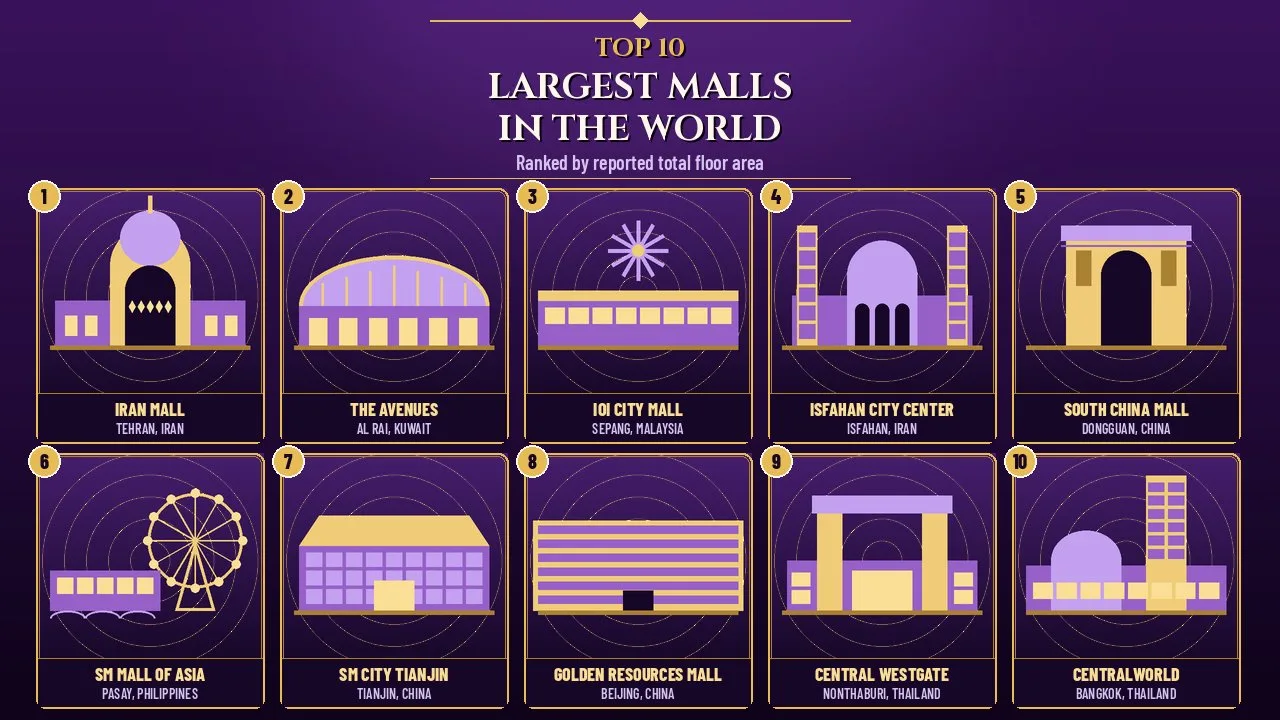
The largest malls in the world are giant retail and leisure complexes, led by Iran Mall in Tehran, each with more than 550,000 square metres of floor area.
A shopping mall used to mean a covered street of shops with a food court and a car park. The biggest modern malls have grown far beyond that idea. They now hold hotels, office towers, ice rinks, cinemas, theme parks, exhibition halls, traditional bazaars and even replicas of famous landmarks, all connected by climate-controlled walkways. Some of them cover more floor space than a small town.
This 2026 Finepedia guide ranks the ten largest malls on Earth by their reported total floor area. It explains where each mall is, when it opened, what is inside, and the stories behind the numbers, from a Tehran mega-complex with a hall of mirrors to a Chinese mall that stood almost empty for more than a decade. Every entry has a Quick Facts table, a short history, its key features, why it matters and a few facts worth remembering.
If you enjoy big buildings and record-breaking places, Finepedia also covers the tallest buildings in the world and the most visited museums in the world, and the Landmarks section has many more famous places.
How We Ranked the Largest Malls in the World
Measuring a mall sounds simple, but owners, journalists and researchers use different yardsticks, and the same mall can appear in very different places on different lists. Three measures come up most often:
- Gross leasable area (GLA): the floor space that tenants actually rent, such as shops, restaurants and entertainment venues.
- Gross floor area (GFA) or total floor area: all enclosed floor space, including corridors, atriums, service areas and sometimes car parks, hotels or offices attached to the mall.
- Land or site area: the size of the plot the complex stands on, which says little about how much shopping space is inside.
This list uses total floor area, because it is the figure most malls publish and the one used in the most widely cited global rankings. It is also the measure that best reflects how enormous these places feel to a visitor. The drawback is that some figures include parking or attached buildings while others do not, so small differences between neighbouring entries should not be read too strictly.
Floor areas below come from the malls' owners, their annual reports or established property references. Where two credible figures exist, the article gives both and explains the difference rather than picking the most dramatic number.
A Quick Guide to Mall Size Terms
| Term | Meaning |
|---|---|
| Square metre (m²) | The standard unit for floor area; 1 m² is about 10.76 square feet |
| GLA | Gross leasable area, the space rented to tenants |
| GFA | Gross floor area, all enclosed floor space in the building |
| Anchor store | A large tenant, such as a department store or hypermarket, that draws shoppers |
| Mixed-use complex | A development that combines shopping with hotels, offices or homes |
| Dead mall | A mall with very low occupancy, where most units stand empty |
At a Glance
| Rank | Mall | Location | Opened | Reported total floor area |
|---|---|---|---|---|
| 1 | Iran Mall | Tehran, Iran | 2018 | About 1,950,000 m² |
| 2 | The Avenues | Al Rai, Kuwait | 2007 | About 1,200,000 m² |
| 3 | IOI City Mall | Sepang, near Putrajaya, Malaysia | 2014 | About 821,000 m² |
| 4 | Isfahan City Center | Isfahan, Iran | 2012 | About 776,500 m² |
| 5 | South China Mall | Dongguan, China | 2005 | About 659,600 m² |
| 6 | SM Mall of Asia | Pasay, Metro Manila, Philippines | 2006 | About 590,000 m² (complex) |
| 7 | SM City Tianjin | Tianjin, China | 2016 | About 565,000 m² |
| 8 | Golden Resources Mall | Beijing, China | 2004 | About 557,400 m² |
| 9 | Central WestGate | Nonthaburi, Thailand | 2015 | About 550,300 m² |
| 10 | CentralWorld | Bangkok, Thailand | 1989 | About 550,000 m² |
1. Iran Mall
| Attribute | Details |
|---|---|
| Location | Beside Chitgar Lake, northwest Tehran, Iran |
| Opened | 1 May 2018 (first phase) |
| Reported total floor area | About 1,950,000 m² |
| Shops | 2,500+ retail units planned across all phases |
| Floors | 7 |
Iran Mall is the largest shopping mall in the world by reported total floor area. It sits beside Chitgar Lake on the northwestern edge of Tehran and was conceived as a city within a city, with shopping, culture, entertainment and dining spread across seven floors.
History
The idea for the project came from Iranian entrepreneur Ali Ansari, who also led its construction. The complex was planned on a site of about 317,000 m², and more than 1,200 contractors and roughly 25,000 workers took part in building it. Its first phase opened on 1 May 2018 with about 267,000 m² of leasable space and 708 retail units, while later phases were designed to push the built area towards its full size.
The mall was owned by Ayandeh Bank until October 2025, when Iranian authorities dissolved the bank and merged it into Bank Melli Iran. As part of that process, the Central Bank of Iran moved to sell the mall, so its future ownership is still being settled as of 2026.
Key Features
- A traditional bazaar designed after the historic markets of Isfahan, Kashan, Shiraz, Qazvin and Qom, using classic Iranian building patterns.
- A Mirror Hall decorated with ayeneh-kari, the Persian art of cut-mirror mosaic, modelled on the famous hall at Golestan Palace.
- Indoor gardens, including a glass-roofed garden with fountains and palm trees.
- Parking for more than 20,000 vehicles, a sign of the crowds the project was built to handle.
Why It Matters
Iran Mall shows how a mall can double as a showcase of national culture. Instead of copying a Western template, its designers built whole sections around Persian architecture and crafts, so a visitor can move from a modern fashion floor to a vaulted bazaar lane in a few minutes. It also proves that the world's biggest malls are no longer in North America but in the Middle East and Asia.
Interesting Facts
- Guinness World Records recognised the longest continuous concrete pour for Iran Mall, completed between 1 and 6 March 2018.
- Its reported total floor area is more than three times the size of most other malls on this list.
- The project attended the MAPIC retail property fair in Cannes for three years in a row, from 2015 to 2017.
2. The Avenues
| Attribute | Details |
|---|---|
| Location | Al Rai, Farwaniya Governorate, Kuwait |
| Opened | April 2007 (first phase) |
| Reported total floor area | About 1,200,000 m² |
| Shops | More than 1,400 |
| Developer | Mabanee Company |
The Avenues is the largest mall in Kuwait and one of the biggest in the Gulf region. It sits between the Fifth Ring Road and Al Ghazali Expressway, a short drive from central Kuwait City, and has grown in four separate phases into a sprawling network of themed streets.
History
The first phase opened in April 2007 under the patronage of the then Emir of Kuwait, Sheikh Sabah Al-Ahmad Al-Jaber Al-Sabah. Further phases followed in August 2009, November 2012 and March 2018. Over roughly twelve years, the developer Mabanee spent around 3 billion US dollars on construction, working with the design firm Gensler and local partners. Each phase added new districts rather than simply extending the original corridors.
Key Features
- 16 districts with different looks and moods, including Grand Avenue, Prestige, The Souk, SoKu, The Forum, Electra and The Gardens.
- A covered souk district that recreates the feel of a traditional Arabian market.
- A luxury district, Prestige, devoted to high-end fashion and jewellery houses.
- Parking for close to 17,000 vehicles.
Why It Matters
In a country where summer temperatures often pass 45°C, a giant indoor promenade is more than a shopping trip; it is one of the few places families can walk comfortably for hours. The Avenues shows the "districts" approach that many new megamalls now copy, where a single building is split into neighbourhoods with their own architecture so that it never feels like one endless corridor.
Interesting Facts
- The mall won an ICSC Gold Award in the Middle East and North Africa region for expansion and design.
- Its four construction phases spanned more than a decade, from 2007 to 2018.
- With more than 1,400 stores, it has more shops than many entire city centres.
3. IOI City Mall
| Attribute | Details |
|---|---|
| Location | IOI Resort City, Sepang District, Selangor, Malaysia (next to Putrajaya) |
| Opened | 20 November 2014; second phase 25 August 2022 |
| Reported total floor area | About 821,000 m² (8.84 million sq ft built-up) |
| Net lettable area | About 2.5 million sq ft across both phases |
| Owner | IOI Properties |
IOI City Mall is the largest mall in Malaysia and in Southeast Asia. It stands in IOI Resort City, a planned township beside Putrajaya, the country's administrative capital, and about half an hour's drive south of Kuala Lumpur.
History
The first phase opened in November 2014 with about 1.5 million square feet of lettable space on three levels and around 350 tenants, at a reported cost of about RM 2 billion. The second phase opened on 25 August 2022 and added roughly 1 million square feet more, with over 300 new stores, restaurants and cafés, a fitness centre, a sports hall and an exhibition hall. That expansion lifted it past 1 Utama to become the biggest mall in the country.
Key Features
- Icescape, a large indoor ice skating rink, one of the mall's signature attractions.
- District 21, an indoor adventure park with climbing and obstacle-style activities.
- An urban farm attraction, IOI City Farm, where children can meet animals and learn about plants.
- A multi-purpose sports hall with badminton and futsal courts, plus an exhibition centre added in phase two.
Why It Matters
IOI City Mall is a good example of a mall built as the heart of a new urban district rather than inside an existing city centre. Its owners planned it alongside offices, hotels and housing, so the mall works as the main public space for a whole township. That model, where a developer builds the town and the mall together, is now common across Southeast Asia.
Interesting Facts
- At its opening, the mall said it aimed to draw about two million visitors a month.
- Its two phases opened eight years apart, with the second almost doubling the shopping space.
- As of 2026, it ranks as the third-largest mall in the world by reported total floor area.
4. Isfahan City Center
| Attribute | Details |
|---|---|
| Location | Dastjerdi Highway, southern edge of Isfahan, Iran |
| Opened | November 2012 |
| Reported total floor area | About 776,500 m² |
| Shops | 700+ |
| Parking | About 5,500 car spaces |
Isfahan City Center is the second-largest mall in Iran after Iran Mall and the fourth-largest in the world. It lies on the southern side of Isfahan, a city famous for its blue-tiled mosques and Safavid-era bridges, and serves shoppers from Isfahan as well as the nearby towns of Sepahan Shahr and Baharestan.
History
The complex was developed by Prestige Land Iran, led by Masoud Sarrami and Mehdi Jahangiri, and designed by the architect Medardo Cadiz of Cadiz International. It opened in November 2012 and was built in two main phases, with a second stage completed in 2019. The project went ahead during a period of international sanctions on Iran, and its developers openly hoped that easing restrictions would bring foreign investment into its hotel and office components.
Key Features
- An indoor amusement park often described as the largest in the Middle East.
- A hotel and office towers integrated into the same complex.
- Cinemas, restaurants and a large hypermarket alongside more than 700 stores.
- Seven floors of retail and leisure space connected by central atriums.
Why It Matters
Isfahan City Center showed that a world-scale mall could succeed outside a country's capital. It turned a regional city into a shopping destination for central Iran and helped prove the commercial case for even larger projects such as Iran Mall in Tehran. It also blends modern mall design with domes and arches that echo Isfahan's historic architecture.
Interesting Facts
- Isfahan itself is home to Naqsh-e Jahan Square, a UNESCO World Heritage Site lined with a centuries-old covered bazaar, so the city has hosted large markets for more than 400 years.
- The developers opened a smaller second mall, Fadak City Center, elsewhere in Isfahan in 2021.
- With about 776,500 m² of floor area, it is larger than any mall in Europe or the Americas.
5. South China Mall
| Attribute | Details |
|---|---|
| Location | Wanjiang Subdistrict, Dongguan, Guangdong, China |
| Opened | 2005 |
| Reported total floor area | About 659,600 m² |
| Retail units | About 2,350 |
| Estimated cost | About 1.3 billion US dollars |
South China Mall in Dongguan is famous as much for its emptiness as for its size. When it opened in 2005 it was the largest mall in the world, but it became one of the best-known examples of a "dead mall" when the shoppers it was built for never arrived in large numbers.
History
The mall was built on former farmland and spearheaded by Hu Guirong, also known as Alex Hu, who had made his fortune in the instant noodle business. It was aimed at affluent shoppers from nearby Guangzhou and Shenzhen, but Dongguan was then largely a city of low-income factory workers. By 2008, more than 99 percent of the stores were reported to be vacant, and a planned luxury hotel was never completed.
Control passed to Founder Group, a company linked to Peking University, in late 2006, and the mall was rebranded as New South China Mall in 2007. After extensive renovations, occupancy improved in the late 2010s, and a 2020 report put it at about 91 percent. Footage from 2024, however, still showed large empty sections on the upper floors.
Key Features
- Seven themed zones modelled on places such as Amsterdam, Paris, Rome, Venice, Egypt, the Caribbean and California.
- A 25-metre replica of the Arc de Triomphe and a canal-style waterway inspired by Venice.
- An IMAX cinema, an amusement park and a marine mammal attraction.
- A former car park that was converted into a go-kart track during the mall's emptiest years.
Why It Matters
South China Mall is a warning that size alone does not make a mall succeed. Location, transport links and local spending power matter more. Its long struggle is now studied by planners and developers as a case of building ahead of demand, and its slow recovery shows how a giant property can be reshaped with entertainment rather than shops alone.
Interesting Facts
- The documentary short Utopia Part 3: The World's Largest Shopping Mall, by filmmaker Sam Green, premiered at the 2009 Sundance Film Festival.
- It overtook Golden Resources Mall in Beijing as the world's largest mall when it opened.
- A travel writer who visited in 2013 reported that four full floors were still unused, while most visitors came for the IMAX cinema and play areas.
6. SM Mall of Asia
| Attribute | Details |
|---|---|
| Location | Bay City, Pasay, Metro Manila, Philippines |
| Opened | 21 May 2006 |
| Reported floor area | About 590,000 m² for the complex; about 497,000 m² for the mall itself |
| Owner | SM Prime Holdings |
| Site | Reclaimed land on Manila Bay at the southern end of EDSA |
SM Mall of Asia, known to locals as MOA, is the largest mall in the Philippines and the anchor of a whole bayfront district in Pasay. It stands on reclaimed land along Manila Bay, at the southern end of EDSA, the main highway of Metro Manila.
History
Plans began in the mid-1990s, when the project was promoted as a future world's largest mall. The opening was pushed back to 21 May 2006 to give tenants more time to move in. Since then, SM Prime has steadily added new buildings around it, including an arena, convention space and entertainment wings. SM Prime's 2025 figures list about 497,000 m² of gross floor area for the mall proper, while global rankings that count the wider complex use a figure of about 590,000 m².
Key Features
- SM Mall of Asia Arena, an indoor venue seating about 16,000 for concerts and sporting events, with a full-house capacity of around 20,000.
- The MOA Eye, a giant Ferris wheel on the bayfront.
- An IMAX theatre that was the first in the Philippines, upgraded to IMAX with Laser in 2024.
- MOA Sky rooftop amenities, opened in 2023, and a FIFA-grade artificial football pitch.
Why It Matters
Mall of Asia shows how a mall can become a city's main public space. In Metro Manila, where parks are scarce and heat and rain are intense, the mall and its bayfront promenade serve as a place to walk, watch sunsets, attend concerts and meet friends. Its arena has hosted major international concerts and sporting events, giving the mall a cultural role far beyond retail.
Interesting Facts
- The surrounding area was built on land reclaimed from Manila Bay.
- The complex has dedicated function and convention space of about 46,600 m².
- It was the fourth SM Supermall built along EDSA, after SM Makati, SM North EDSA and SM Megamall.
7. SM City Tianjin
| Attribute | Details |
|---|---|
| Location | Tianjin Airport Economic Area, Binhai, Tianjin, China |
| Opened | 17 December 2016 |
| Reported total floor area | About 565,000 m² |
| Developer | SM Prime Holdings |
| Design | Architecture firm ARQ |
SM City Tianjin is the largest mall run by the Philippine SM Supermalls chain and its biggest property outside the Philippines. It stands in the Binhai area of Tianjin, the major port city southeast of Beijing, close to the city's international airport.
History
The SM Group, founded by the late Philippine businessman Henry Sy, opened its first mall in China, SM City Xiamen, in 2001. Rather than compete in Beijing and Shanghai, the company targeted fast-growing second-tier cities such as Suzhou, Chongqing, Zibo and Tianjin. Groundbreaking for the Tianjin mall took place on 26 November 2010, and it opened on 17 December 2016 as SM's seventh mall in China. At about 565,000 m² of gross floor area, it was the largest SM mall anywhere when it opened.
Key Features
- A layout designed by the architecture firm ARQ, built around long internal avenues and open atriums.
- A mix of international fashion brands, Chinese retailers, dining, cinemas and family entertainment.
- A location within an economic zone, serving both residents and the large workforce of nearby businesses.
- Easy access from Tianjin Binhai International Airport.
Why It Matters
SM City Tianjin is a rare case of a Southeast Asian mall operator building at world-record scale in China, a market dominated by domestic developers. It shows how mall know-how now flows in many directions, not only from the West to Asia. Its size also reflects the ambitions of the Binhai New Area, which was developed as a major growth zone for northern China.
Interesting Facts
- Its Chinese name translates roughly as SM Tianjin Binhai City Plaza.
- The project took six years from groundbreaking to opening.
- SM Supermalls is better known at home for giant malls such as SM Mall of Asia and SM Megamall in Metro Manila.
8. Golden Resources Mall
| Attribute | Details |
|---|---|
| Location | Yuanda Road, Haidian District, Beijing, China |
| Opened | 24 October 2004 |
| Reported total floor area | About 557,400 m² (about 6 million sq ft) |
| Floors | 6 |
| Nickname | The Great Mall of China |
Golden Resources Mall, known in Chinese as Jin Yuan, is a vast six-storey shopping centre near Beijing's northwest Fourth Ring Road. For about a year after it opened, it was the largest mall in the world, and English-language reports at the time nicknamed it the Great Mall of China.
History
The mall opened on 24 October 2004 at about one and a half times the size of the Mall of America. Its planners expected about 50,000 visitors a day, but early reports described as few as 20 shoppers an hour. Prices were well beyond most local budgets at the time, and the site was then in sparsely populated outer suburbs. The operators said openly that they expected profits to take years. South China Mall overtook it in size in 2005.
Key Features
- Six floors of shops, restaurants, cinemas and entertainment in a single, very long building.
- A second phase across the street and a road that passes beneath part of the complex.
- A modern cinema on the fifth floor with large-format screens.
- Subway access via Changchun Qiao station on Lines 10 and 12, and Landianchang station on Line 12.
Why It Matters
Golden Resources Mall is the success story that South China Mall was not. As Beijing grew outwards and the Chinese middle class expanded, the city wrapped around the mall and filled the nearby land with apartment blocks. By the early 2020s it was crowded at weekends. Its story shows that a mall built too early can still thrive once the city catches up.
Interesting Facts
- A manager at the opening explained the goal plainly: to build the largest shopping centre in the world as a symbol of China's progress.
- It held the world's largest mall title from 2004 to 2005.
- Its nickname plays on the Great Wall, China's most famous landmark.
9. Central WestGate
| Attribute | Details |
|---|---|
| Location | Bang Yai District, Nonthaburi Province, Bangkok Metropolitan Region, Thailand |
| Opened | 28 August 2015; IKEA store added 15 March 2018 |
| Reported total floor area | About 550,300 m² (including a 50,300 m² IKEA store) |
| Owner | Central Pattana |
| Transit | Talad Bang Yai MRT station, Purple Line |
Central WestGate is a huge suburban mall on the western edge of greater Bangkok. It sits at the busy Bang Yai intersection in Nonthaburi Province and was built to serve the fast-growing housing estates west of the capital.
History
Central Pattana, one of Thailand's largest mall developers, opened the mall in August 2015 under the name CentralPlaza WestGate Bangyai. Its opening drew very large crowds, a sign of how much demand there was for big shopping and leisure space outside central Bangkok. In March 2018, an IKEA store of about 50,300 m² opened as part of the complex, pushing the total floor area past 550,000 m².
Key Features
- A department store, supermarket, electronics and sports chains, and home furnishing stores, including a large IKEA.
- Mega Harborland, an indoor amusement park for children and families.
- A 12-screen cinema complex with IMAX with Laser, 4DX and VIP halls.
- Rail access from the MRT Purple Line, linking the mall to the Bangkok network.
Why It Matters
Central WestGate shows how megamalls are moving to the suburbs of big Asian cities, following new housing and rail lines. Instead of travelling into central Bangkok, families in the western suburbs can now find a full city-centre experience close to home. Pairing the mall with a huge IKEA store also made it a regional destination for home shopping.
Interesting Facts
- The IKEA store alone has more floor area than many complete shopping malls.
- Its Purple Line station opened in 2016, a year after the mall.
- It is owned by the same company that runs CentralWorld, number 10 on this list.
10. CentralWorld
| Attribute | Details |
|---|---|
| Location | Rama I Road, Siam area, Pathum Wan District, Bangkok, Thailand |
| Opened | 3 December 1989 (as World Trade Center); renamed CentralWorld in 2007 |
| Reported total floor area | About 550,000 m² of shopping mall; about 409,500 m² leasable |
| Operator | Central Pattana, on land leased from the Crown Property Bureau |
| Transit | Siam and Chit Lom BTS Skytrain stations |
CentralWorld is the oldest mall in the top ten and one of the best-known shopping addresses in Southeast Asia. It stands in the Siam area of central Bangkok, surrounded by other large malls and close to two BTS Skytrain stations.
History
The complex opened on 3 December 1989 as the World Trade Center. Central Group acquired it in 2002 and renamed it Central World Plaza, then carried out a major redesign and expansion that reopened in July 2006 with about 550,000 m² of shopping space, overtaking its neighbour Siam Paragon in size. It took the name CentralWorld in 2007.
On 19 May 2010, the mall was badly damaged by arson during a military operation against anti-government protesters. Part of it reopened on 28 September 2010 after months of repairs. The complex recovered and remains one of the busiest malls in Bangkok.
Key Features
- A shopping mall, department stores, an office tower of about 45 floors and a hotel tower with a convention centre, all in one complex.
- Around 495 stores and seven anchor tenants, according to its operator's 2011 report.
- Parking for about 7,000 cars.
- CentralWorld Square, a large outdoor plaza in front of the mall used for festivals and public events.
Why It Matters
CentralWorld proves that an older mall can stay at the top through reinvention. It has changed its name twice, survived two serious fires and been rebuilt and expanded, yet it remains one of Bangkok's main public gathering places. Its location in the Siam shopping district also makes it a key part of Bangkok's reputation as one of Asia's great shopping cities.
Interesting Facts
- Including its hotel, offices, convention centre and car parks, the whole complex covers more than 1 million m² of floor space.
- A second fire in April 2019 started elsewhere in the building and spread through air vents to the eighth floor.
- Its land belongs to the Crown Property Bureau and is held on a long-term lease.
Honourable Mentions
Several famous malls just miss the top ten by total floor area, or rank highly on other measures such as visitor numbers or leasable space.
- ICONSIAM, Bangkok, Thailand: a riverside complex on the Chao Phraya River that opened in 2018 with about 525,000 m² of floor area and more than 550 shops.
- Mall of America, Bloomington, Minnesota, United States: opened in 1992 and still the largest mall in the Americas, with about 520 stores and the Nickelodeon Universe indoor theme park at its centre.
- 1 Utama, Petaling Jaya, Malaysia: opened in 1995 and for years the biggest mall in Malaysia, with about 519,000 m² of floor area and a well-known rooftop garden.
- The Dubai Mall, United Arab Emirates: opened in 2008 at the foot of the Burj Khalifa, it is one of the most visited shopping destinations on Earth and houses the Dubai Aquarium and Underwater Zoo.
- West Edmonton Mall, Alberta, Canada: opened in 1981 and the largest mall in the world until 2004, famous for its indoor amusement park and water park.
Comparison: How the Top 10 Stack Up
| Rank | Mall | Country | Opened | Approximate floor area | Signature attraction |
|---|---|---|---|---|---|
| 1 | Iran Mall | Iran | 2018 | 1,950,000 m² | Traditional bazaar and Mirror Hall |
| 2 | The Avenues | Kuwait | 2007 | 1,200,000 m² | 16 themed districts |
| 3 | IOI City Mall | Malaysia | 2014 | 821,000 m² | Icescape ice rink |
| 4 | Isfahan City Center | Iran | 2012 | 776,500 m² | Indoor amusement park |
| 5 | South China Mall | China | 2005 | 659,600 m² | Arc de Triomphe replica |
| 6 | SM Mall of Asia | Philippines | 2006 | 590,000 m² | Arena and bayfront Ferris wheel |
| 7 | SM City Tianjin | China | 2016 | 565,000 m² | Largest SM mall |
| 8 | Golden Resources Mall | China | 2004 | 557,400 m² | Former world's largest mall |
| 9 | Central WestGate | Thailand | 2015 | 550,300 m² | Giant IKEA store |
| 10 | CentralWorld | Thailand | 1989 | 550,000 m² | Siam district location |
What the Largest Malls Have in Common
Looking across the list, a few clear patterns stand out.
- Asia and the Middle East dominate. Every mall in the top ten is in Asia or the Middle East, and none is in Europe or the Americas.
- Entertainment is as important as shopping. Ice rinks, theme parks, arenas and cinemas give people a reason to visit even when they do not plan to buy anything.
- Climate matters. In hot or rainy cities such as Kuwait City, Manila and Bangkok, an indoor mall is one of the most comfortable public spaces available all year.
- Many are part of larger developments. Hotels, offices, homes and transport links make the mall the centre of a district rather than a standalone building.
- Size is no guarantee of success. South China Mall and Golden Resources Mall both struggled after opening, while smaller malls in better locations thrived.
Largest Mall by Region
| Region | Largest mall (by reported floor area) | Country |
|---|---|---|
| Middle East | Iran Mall | Iran |
| Southeast Asia | IOI City Mall | Malaysia |
| East Asia | South China Mall | China |
| North America | Mall of America | United States |
Frequently Asked Questions
What is the largest mall in the world?
Iran Mall in Tehran is the largest mall in the world by reported total floor area, at about 1,950,000 square metres. Its first phase opened in May 2018 beside Chitgar Lake, and the complex includes a traditional bazaar, a Mirror Hall inspired by Golestan Palace, indoor gardens and parking for more than 20,000 cars.
Why do lists of the largest malls disagree?
Rankings use different measures. Some count only gross leasable area, the space rented to shops and restaurants, while others count total floor area, which can include corridors, car parks, hotels and offices. A mall with a huge attached complex can rank near the top on one list and much lower on another.
What is the largest mall in the United States?
Mall of America in Bloomington, Minnesota, is the largest mall in the United States and in the Americas. It opened in 1992 and has about 520 stores, plus the Nickelodeon Universe indoor theme park at its centre. It just misses the global top ten when malls are ranked by reported total floor area.
Is the Dubai Mall the biggest mall in the world?
No, not by floor area. The Dubai Mall is one of the most visited shopping destinations in the world and is famous for its aquarium, but several malls in Iran, Kuwait, Malaysia, China, the Philippines and Thailand report larger floor areas. Its fame comes from visitor numbers and attractions rather than record size.
What is a dead mall?
A dead mall is a shopping centre where most units stand empty because it cannot attract enough tenants or shoppers. South China Mall in Dongguan is the most famous large example. After opening in 2005, it was more than 99 percent vacant by 2008, before renovations and new attractions slowly brought tenants back.
Which country has the most malls in the top 10?
China has the most, with three malls on the list: South China Mall in Dongguan, SM City Tianjin and Golden Resources Mall in Beijing. Iran and Thailand each have two, while Kuwait, Malaysia and the Philippines each have one. Together they show how the centre of mall building has moved to Asia.
Which mall was the largest in the world before 2004?
West Edmonton Mall in Alberta, Canada, held the title of the world's largest mall from its opening in 1981 until 2004. Golden Resources Mall in Beijing then took the record, and South China Mall overtook both in 2005. Today, all three are smaller than the biggest malls in Iran and Kuwait.
Conclusion
The largest malls in the world are no longer simply places to shop. Iran Mall and Isfahan City Center blend modern retail with Persian bazaars and mirror work, The Avenues splits one building into sixteen neighbourhoods, and malls in Manila and Bangkok act as the main public squares of their cities. Their stories also show the risks of building big, from South China Mall's long years of empty corridors to Golden Resources Mall's slow climb to success.
What unites them is ambition. Each one was built to be more than a mall: a landmark, a meeting place and, in many cases, the centre of a whole new district. For more record-breaking places, explore the most expensive resorts in the world, the most walkable cities in the world, or browse Finepedia's Top 10 Facts collection.
- Iran Mall, official website and Guinness World Records entry for the longest continuous concrete pour (2018)
- The Avenues, official About page; Mabanee Company project information
- IOI Properties, IOI City Mall phase information; The Edge Malaysia coverage of the 2014 opening
- SM Prime Holdings, gross floor area listings (2025) and SM Investments release on SM City Tianjin (2016)
- Central Pattana annual reports (2011) and Nikkei Asia coverage of the Central WestGate opening (2015)
- Emporis press release on the world's largest shopping malls (2012), via archived copy
- CNN and China Times reporting on South China Mall occupancy (2015, 2020)




















Log in with