







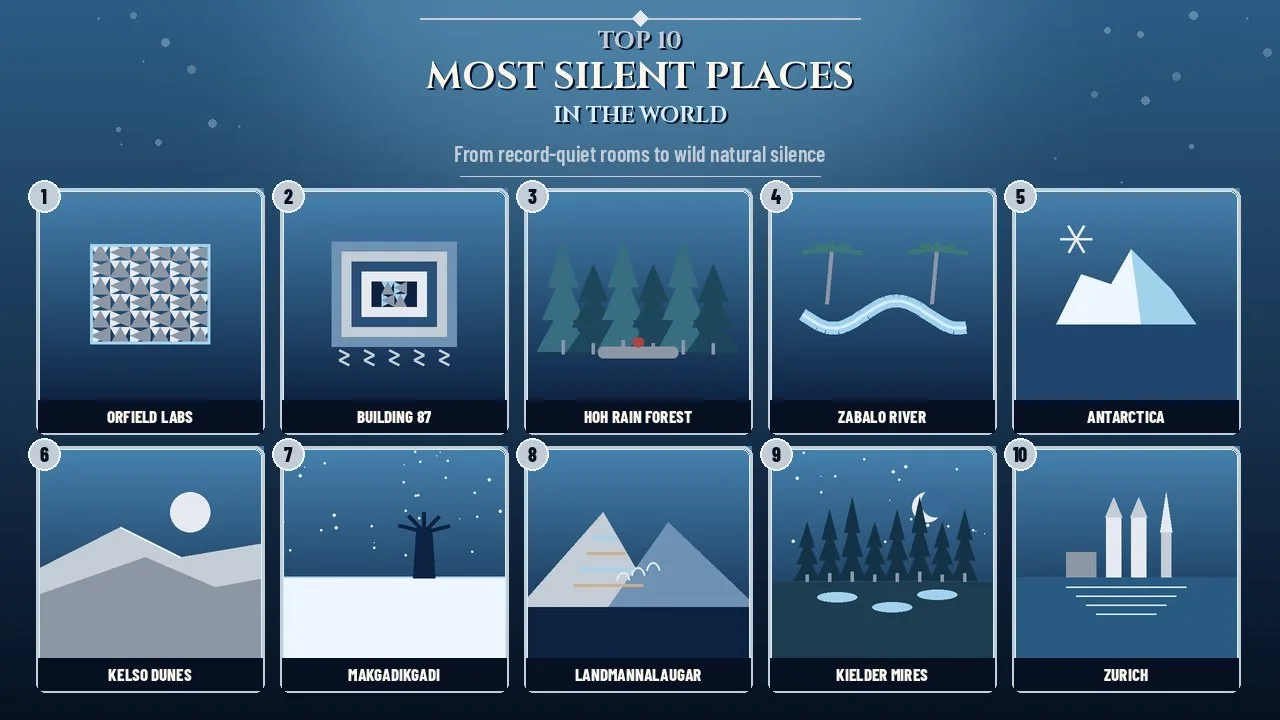
The most silent places in the world range from record-setting anechoic chambers in Minneapolis and Redmond to remote rainforests, deserts and polar ice.
Silence is harder to find than it sounds. Road traffic, aircraft, ventilation fans and phones follow people almost everywhere, and even wild landscapes now carry the faint hum of distant engines. Yet a handful of places still offer real quiet, either because engineers have built rooms that swallow almost every sound wave, or because nature, distance and protection have kept human noise away.
This 2026 Finepedia guide brings both kinds of quiet together. It starts with the two laboratory rooms that have held the Guinness World Records title for the quietest place on Earth, then moves through wilderness areas where researchers have documented long stretches without human-made sound, and ends with remote travel destinations and one surprisingly calm city. Every entry includes a Quick Facts table, its background, what makes it quiet, and why it matters.
If you enjoy unusual travel lists, you may also like Finepedia's guide to the most dangerous tourist destinations in the world, which sits at the opposite end of the calm-to-chaos scale.
How We Chose the Most Silent Places in the World
Quiet can be measured in two very different ways, so this list uses a clear, tiered method instead of a single score.
- Tier 1, measured silence: indoor rooms with independently verified background noise readings below 0 dB, the nominal threshold of human hearing. These rank first because their quiet is measured, certified and repeatable.
- Tier 2, documented natural quiet: wild places where acoustic ecologists or certifying bodies have recorded long intervals free of human-made noise, or where protection, size and isolation keep engines and machinery out.
- Tier 3, remote quiet destinations: visitor-friendly landscapes and one city that are widely studied or mapped for low noise and tranquillity, even if they are not silent around the clock.
Within each tier, places with stronger evidence (published measurements, certifications or national surveys) are placed higher. Popularity, scenery and ease of access were not ranking factors. Where an older list relied on a claim we could not verify, we replaced it with a better-documented location.
What Counts as Silent?
Sound levels are expressed in decibels (dB). The scale is logarithmic, so every 10 dB step represents a tenfold change in sound energy. A reading of 0 dB is roughly the quietest sound a young, healthy ear can detect, which means negative readings describe rooms quieter than human hearing can register at all.
Natural places never reach those figures. Wind, water, birds and insects are always present. What makes a wilderness silent in the acoustic ecology sense is the absence of human-made noise, not the absence of sound. Many researchers use a simple test: can you listen for 15 minutes in daylight without hearing an engine, a voice from a road or any machine?
Silence on the Decibel Scale
The table below puts the record-holding rooms beside everyday sounds. Everyday values are typical levels published by the US Centers for Disease Control and Prevention (CDC) and the US National Institute on Deafness and Other Communication Disorders.
| Sound or place | Typical level | What it means |
|---|---|---|
| Orfield Laboratories chamber (Guinness 2021) | -24.9 dB | Quietest certified reading listed by the lab |
| Microsoft Building 87 chamber (Guinness 2015) | -20.35 dBA | Average of two independent tests |
| Threshold of human hearing | 0 dB | Faintest sound a healthy ear can detect |
| Normal breathing | about 10 dBA | Barely audible in a quiet bedroom |
| Ticking watch | about 20 dBA | Noticeable only up close |
| Soft whisper | about 30 dBA | Quiet library level |
| Normal conversation | about 60 dBA | Everyday speech at arm's length |
| Sustained exposure risk | 85 dBA and above | Level linked to hearing damage over time |
At a Glance
| Rank | Place | Country | Type of quiet | Key evidence |
|---|---|---|---|---|
| 1 | Orfield Laboratories Anechoic Chamber | United States | Laboratory | Guinness records 2004, 2012 and 2021 |
| 2 | Microsoft Building 87 Anechoic Chamber | United States | Laboratory | Guinness record 2015 at -20.35 dBA |
| 3 | Hoh Rain Forest, Olympic National Park | United States | Temperate rainforest | One Square Inch of Silence project since 2005 |
| 4 | Zabalo River | Ecuador | Amazon rainforest | World's first Wilderness Quiet Park (2019) |
| 5 | Antarctica | International (Antarctic Treaty) | Polar ice sheet | No permanent population; about 118,000 visitors a season |
| 6 | Kelso Dunes, Mojave Desert | United States | Desert dune field | Designated wilderness inside Mojave National Preserve |
| 7 | Makgadikgadi Pans | Botswana | Salt pans | Over 30,000 square km of flat, sparsely settled pan |
| 8 | Landmannalaugar | Iceland | Highland nature reserve | Summer-only access by 4x4 mountain roads |
| 9 | Kielder Mires, Northumberland | United Kingdom | Blanket bog and forest | England's most tranquil square on the 2006 CPRE map |
| 10 | Zurich | Switzerland | City | Lowest noise pollution score in the 2017 Worldwide Hearing Index |
1. Orfield Laboratories Anechoic Chamber
| Attribute | Details |
|---|---|
| Location | Seward neighbourhood, Minneapolis, Minnesota, United States |
| Type | Anechoic test chamber inside an accredited acoustics lab |
| Lowest certified reading | -24.9 dB (Guinness World Records, 2021) |
| Earlier records | -9.4 dB (2004) and -13.4 dB (2012) |
| Size | About 12 ft x 10 ft x 7 ft 4 in (nominal) |
Origins and History
Orfield Laboratories is a private acoustics, lighting and multisensory design research company founded by Steve Orfield. Its headquarters is a plain concrete building that once housed Sound 80, the Minneapolis studio where parts of Bob Dylan's album Blood on the Tracks were recorded. The lab gained federal NVLAP accreditation for acoustic testing in 1997, and its anechoic chamber soon became the centre of its product-testing work.
In 2004 Guinness World Records recognised the chamber as the quietest place on Earth at -9.4 dB. The lab improved its reading to about -13 dB in 2012, lost the title to Microsoft in 2015, and then regained it in 2021 with a certified -24.9 dB. That back-and-forth makes Orfield the only site on this list to have held the record three times.
Key Features
- Double walls of steel and concrete separate the room from the rest of the building.
- Fibreglass wedges more than a metre deep cover the surfaces, so almost no sound reflects back to the listener.
- The room can be used fully anechoic or with a reflecting floor plane for specific tests.
- The chamber sits inside a lab that also runs reverberation rooms for standardised ASTM, ISO, ANSI and SAE testing.
- Visitors can book paid sessions, a rare chance for the public to experience a record-holding quiet room.
Significance
Manufacturers use the chamber to measure how loud their products really are, from car parts and phones to fans and medical equipment. Earlier clients reported by the Minneapolis Star Tribune include Harley-Davidson, Cessna and Whirlpool. The quieter the room, the quieter the sounds engineers can measure, which is why sub-zero readings have commercial value as well as novelty value.
The chamber also became a cultural talking point about how humans react to deep silence. Without echoes, people start to hear their own heartbeat, breathing and even the movement of facial muscles. Steve Orfield has summed up the effect with a short line: inside the room, "you become the noise."
Interesting Facts
- The lab lists three Guinness titles for the quietest place on Earth: 2004, 2012 and 2021.
- Orfield has since reported a reading of about -29 dB, but the figure the lab publishes as its certified record is -24.9 dB.
- A widely shared 2013 Smithsonian Magazine headline claimed the room could drive people "crazy in 45 minutes", which helped turn it into a visitor curiosity.
- The University of Minnesota alumni magazine reported the longest stay inside the chamber at about two hours.
2. Microsoft Building 87 Anechoic Chamber
| Attribute | Details |
|---|---|
| Location | Building 87, Microsoft campus, Redmond, Washington, United States |
| Type | Anechoic chamber in Microsoft's audio and hardware labs |
| Record reading | Average -20.35 dBA (Guinness World Records, October 2015) |
| Independent tests | -20.6 dBA and -20.1 dBA |
| Main uses | Testing Surface devices, HoloLens and voice assistants |
Origins and History
Microsoft built the chamber for its hardware and audio teams, who needed a space quiet enough to measure the tiny sounds made by keyboards, fans, hinges and speakers. According to CNN's report on the room, design and construction took a little over a year and a half, beginning with a search for a spot on campus where existing background noise was already low enough.
In October 2015 Guinness World Records announced that the chamber had beaten the previous record of about -13 dBA held by Orfield Laboratories. Two independent tests produced readings of -20.6 dBA and -20.1 dBA, an average of -20.35 dBA. Guinness noted the result was well beyond the -16 dBA the builders had originally hoped to reach. Orfield reclaimed the title in 2021, but Building 87 remains one of the two quietest rooms ever certified.
Key Features
- An onion-like design nests the chamber inside six layers of concrete and steel.
- The room sits on an array of vibration-damping springs, isolating it from footsteps, traffic and building machinery.
- Fibreglass wedges line the floor, walls and ceiling, absorbing more than 99.99 percent of sound energy, according to Microsoft.
- Measurements were carried out with specialist Bruel and Kjaer instruments working with independent sound specialists.
Significance
The chamber shows how far noise-isolation engineering advanced in about a decade. The first Guinness record in 2004 stood at -9.4 dB; Microsoft's 2015 room was more than ten decibels quieter, a large jump on a logarithmic scale. That progress matters for consumer technology, where buyers notice fan whine, coil noise or a click that sounds cheap.
It also matters for speech and voice research. Microsoft's teams have used the space to test how voice assistants hear commands, playing recorded speech and background noise at precisely controlled levels. A room with almost no noise of its own lets engineers isolate exactly what a device produces or picks up.
Interesting Facts
- Microsoft's own promotional line for the room described it as a place where sound goes to die.
- The acoustician involved in the design presented the project to the Acoustical Society of America in 2019 under the title Designing the quietest room in the world.
- Unlike Orfield, the chamber is a working corporate lab rather than a bookable visitor experience.
3. Hoh Rain Forest, Olympic National Park
| Attribute | Details |
|---|---|
| Location | Olympic Peninsula, Washington State, United States |
| Park size | About 922,650 acres, roughly 95 percent designated wilderness |
| Rainfall | About 140 inches (3.5 m) a year in the Hoh valley |
| Silence project | One Square Inch of Silence, marked on Earth Day 2005 |
| How to reach it | About 3.2 miles (5 km) along the Hoh River Trail from the visitor centre |
Origins and History
Olympic National Park protects mountains, glaciers, wild coastline and some of the finest temperate rainforest in the world. Most of the park lies within the Daniel J. Evans Wilderness, where roads do not cross the interior. The Hoh Rain Forest, on the park's western side, is a dense valley of Sitka spruce, western red cedar and moss-draped maples fed by heavy Pacific rainfall.
On Earth Day, 22 April 2005, acoustic ecologist and sound recordist Gordon Hempton placed a small red stone on a moss-covered log above Mount Tom Creek Meadow. He called the spot One Square Inch of Silence. The idea was simple: if a single point in the forest could be kept free of human-made noise, the miles of wilderness around it would stay quiet too.
Key Features
- The marked site is about two hours' gentle hike from the Hoh visitor centre.
- Hempton has described Olympic as having the widest range of soundscapes and the longest natural quiet of any unit in the US national park system.
- Natural sound is constant: rain, streams, wrens, elk and wind in the canopy.
- Most of the park has no through roads, which removes traffic noise from huge areas.
- Hiking quietly, in small groups, gives the best chance of hearing the valley at its most natural.
Significance
The Hoh is where the modern quiet-conservation movement took shape. Between 2005 and 2018, when aircraft noise reached the stone, the project used flight-tracking data to identify the plane and asked the operator to avoid flying over the park. Alaska Airlines, American Airlines and Hawaiian Airlines all cooperated voluntarily, according to the project.
The site also shows how fragile natural quiet is. NPR reported in 2018 that the valley had grown louder since 2005 because of more air traffic and nearby military jet training. By 2018 Hempton told Vox he could no longer listen for 10 minutes at the stone without hearing a plane, and he ended the original monitoring project. Hempton has estimated that only around a dozen places, or fewer, in the United States still pass the 15-minute test for natural quiet, which makes the Hoh both a destination and a warning.
Interesting Facts
- The red stone was a gift from a Quileute tribal elder of the Olympic Peninsula, according to Vox.
- The exact stone location is published by the project at N 47.8666, W 123.8701.
- Olympic National Park is also a UNESCO World Heritage Site, inscribed in 1981.
- Hempton later co-founded Quiet Parks International, which certifies quiet places worldwide.
- The rainforest's thick moss and soft ground absorb sound, adding to the hushed feel.
4. Zabalo River, Ecuador
| Attribute | Details |
|---|---|
| Location | Cofán territory, north-eastern Ecuadorian Amazon |
| Protected area | About one million acres of indigenous Cofán land |
| Certification | World's first Wilderness Quiet Park, Quiet Parks International (April 2019) |
| Quiet standard | Natural soundscape with long noise-free intervals of at least 15 minutes |
| Access | Guided trips with Cofán guides, by river from Zabalo village |
Origins and History
The Zabalo River winds through the Amazon rainforest in Ecuador's far north-east, on land the Cofán people have lived on and defended for centuries. The Cofán, a community of roughly 1,200 people, have long used conservation and small-scale ecotourism to protect their forest from oil extraction and outside development.
In 2010 Gordon Hempton met Cofán leader Randy Borman, who invited him to visit the region. That trip led to a new idea: certifying an entire wilderness for its natural quiet. On 14 April 2019, Quiet Parks International, the non-profit Hempton co-founded with Vikram Chauhan, named the Zabalo River the world's first Wilderness Quiet Park, with the award accepted on behalf of the Cofán Nation by Josh Borman.
Key Features
- The closest settlement to the main listening area, Zabalo village, lies about a dozen miles away, according to Vox.
- Kapok trees and palms form a canopy up to about 100 feet (30 m) tall, filtering wind and soaking up sound.
- Dawn brings an intense chorus of birds, frogs, insects and howler monkeys, the opposite of an empty room.
- Access is by river with Cofán guides, which keeps visitor numbers low and engines out of the core area.
- The certification rewards communities that keep their land free of human-made noise.
Significance
Zabalo changed how quiet can be protected. Instead of a single symbolic stone, an entire landscape gained a certification that ties natural sound to economic value. Quiet Parks International hopes that, like dark-sky parks for stargazers, quiet parks will draw visitors who pay specifically to listen, giving communities a reason to keep machinery and flight paths away.
For the Cofán, the award also supports land rights and conservation. Visitor income and international attention help fund forest patrols and trail work. Borman told Vox the certification was not something the community had chased, but it was a welcome recognition of what it had already been doing.
Interesting Facts
- Quiet Parks International also has categories for Urban Quiet Parks and Quiet Communities, which are not expected to match wilderness-grade quiet.
- The listening area's coordinates published by Quiet Parks International are about 0.38 degrees south, 75.77 degrees west.
- The Zabalo shows that silent does not mean soundless: it is one of the noisiest places on this list in natural terms and one of the quietest in human terms.
5. Antarctica
| Attribute | Details |
|---|---|
| Location | Southern polar continent, governed by the Antarctic Treaty System |
| Area | About 14 million square km, larger than Europe |
| Permanent population | None; only seasonal researchers and visitors |
| Visitors (2024-25) | 118,491 recorded by IAATO, including 938 deep-field clients |
| Lowest recorded temperature | -89.2 C at Vostok Station (1983) |
Origins and History
Antarctica is the coldest, windiest and most isolated continent on Earth. It has no native human population, no cities and no roads between research bases. The Antarctic Treaty, signed in 1959, set the continent aside for peaceful scientific use, and later agreements added strict environmental protection.
Human presence is small and seasonal. Scientists staff research stations, and tourism takes place mainly on the Antarctic Peninsula during the southern summer. The International Association of Antarctica Tour Operators (IAATO) recorded 118,491 visitors in the 2024-25 season, of whom 80,455 landed and only 938 travelled into the deep interior with specialist air operators.
Key Features
- The ice sheet covers almost the entire continent, creating thousands of kilometres of flat, featureless plateau.
- Snow absorbs sound, so a still day on the plateau can feel muffled and enormous.
- Natural sounds include wind, creaking glaciers, cracking sea ice and, on the coast, penguin and seal colonies.
- There is no regular air traffic over the interior and no road network linking stations.
- Visits are controlled by permits and operator guidelines, which limit group sizes at landing sites.
Significance
Antarctica's quiet is a by-product of its isolation and its legal protection. Few places on Earth combine such size with so little human activity.
The silence also has scientific value. Researchers listen to icequakes, glacier movement and ocean sounds to study how the ice sheet behaves. Human noise from ships and stations is a concern for wildlife, so managing it is part of protecting the continent.
Interesting Facts
- IAATO's 2024-25 visitor total was about five percent below the previous season's record of 122,072.
- The ice sheet holds most of the world's fresh water.
6. Kelso Dunes, Mojave Desert
| Attribute | Details |
|---|---|
| Location | Mojave National Preserve, San Bernardino County, California, United States |
| Size | About 45 square miles (120 square km) of dunes and sand sheets |
| Height | Tallest dunes rise about 650 feet (200 m) above the surrounding desert |
| Designation | Wilderness within the national preserve |
| Hike | About 3 miles round trip with 600 feet of climb, 2 to 3 hours |
Origins and History
The Kelso Dunes formed over thousands of years as wind carried sand from the Mojave River sink towards the Providence and Granite Mountains. When the wind met those ranges, it dropped its load, building a field of migrating and vegetation-stabilised dunes. The National Park Service says new accumulation is unlikely today, but the dune crests still shift back and forth with the seasons.
The area is protected inside Mojave National Preserve, created by the California Desert Protection Act of 1994. The preserve's visitor centre in the restored Kelso Depot sits a short drive from the dunes, and the nearest town is Baker.
Key Features
- The NPS calls the dunes the preserve's most popular hike yet says hikers can still expect solitude.
- Kelso is one of only seven dune fields in North America known to boom, producing a deep, felt rumble when dry sand slides.
- No shade, no services and long distances keep crowds small, especially away from weekends.
- Wildlife includes sidewinder rattlesnakes and the Mojave fringe-toed lizard.
- Rare plants and endemic insects make the dune ecosystem fragile.
Significance
Kelso shows a different kind of quiet from a rainforest. In open desert there are few birds, little running water and almost no vegetation to rustle, so on a windless morning the soundscape can be close to empty. Distance from major highways and the preserve's wilderness status keep human noise far away for much of the day.
The booming sand also gives visitors a rare reason to listen closely. The sound is most likely when grains are completely dry and people push sand down a steep slip face together.
Interesting Facts
- The sand travelled roughly 35 miles to reach the dunes, according to the NPS.
- Dune crests at Kelso can move within a zone 30 to 40 feet wide, like slow ocean waves.
- Summer heat is extreme and the trail has no shade, so cooler months and early starts are the safest choice.
7. Makgadikgadi Pans, Botswana
| Attribute | Details |
|---|---|
| Location | Central District, north-eastern Botswana |
| Size | Over 30,000 square km of salt pans, according to UNESCO's tentative-list entry |
| Main pans | Sowa (Sua) in the east and Ntwetwe in the west |
| Protected areas | Makgadikgadi Pans National Park, Nxai Pan National Park, Nata Bird Sanctuary |
| Best time for silence | Dry season, when the pans are hard, white and largely empty |
Origins and History
The Makgadikgadi Pans are the remains of an ancient lake that, in its early stages, may have covered more than 275,000 square km. Tectonic shifts diverted the rivers that fed it, and over time the water evaporated, leaving one of the largest salt-pan systems on Earth. UNESCO's tentative World Heritage listing, submitted by Botswana in 2010, describes the pans as covering more than 30,000 square km. Some older travel lists give far smaller figures, which usually refer to a single pan rather than the whole system.
People have lived around the pans for a very long time. Stone tools from the Early, Middle and Late Stone Age have been found nearby, and the UNESCO entry records about 200 heritage sites, including more than 500 stone wall structures. Lekhubu (Kubu Island), a granite outcrop crowned with baobabs, is managed by a local community trust.
Key Features
- In the dry winter months the pans become a flat, white crust stretching to the horizon.
- With no trees, roads or buildings on the pan surface, there is little to create or reflect sound.
- In the wet season, Sowa Pan can flood and attract huge flocks of flamingos.
- The wider area hosts one of Africa's great zebra and wildebeest migrations.
- Night skies are exceptionally dark, adding to the sense of stillness.
Significance
The pans offer one of the most extreme examples of open-air quiet. On a calm dry-season night, with no wind and no wildlife nearby, the main sounds are often those visitors make themselves.
The area is also ecologically important. Nata Bird Sanctuary is one of the largest breeding sites of lesser and greater flamingos in the world, according to UNESCO. Seasonal change means the same place can switch from deep silence to a noisy wildlife spectacle within months.
Interesting Facts
- Dust from the dry pans can travel as far as Johannesburg in South Africa, according to UNESCO.
- The pans hold fossil footprints, mammal bones and stone tools.
- Baines' Baobabs, painted by artist Thomas Baines in the 1860s, stand at the edge of Kudiakam Pan in Nxai Pan National Park.
- Localised soda-ash mining is the main industrial activity noted near the pans.
8. Landmannalaugar, Iceland
| Attribute | Details |
|---|---|
| Location | Fjallabak Nature Reserve, southern Highlands of Iceland |
| Landscape | Rhyolite mountains, lava fields and natural hot springs |
| Famous trail | Laugavegur, about 55 km to Thorsmork, usually hiked in 3 to 4 days |
| Access | Summer only, roughly late June to mid-September, via 4x4 F-roads F208 or F225 |
| 2026 visitor rule | Parking reservations required 9 AM to 4 PM, 20 June to 13 September |
Origins and History
Landmannalaugar lies in the volcanic interior of Iceland, inside the protected Fjallabak Nature Reserve. Its name refers to the warm pools that travellers once used on journeys across the highlands. Today the Iceland Touring Association (Ferdafelag Islands) runs a mountain hut and campsite here, and the area is the northern starting point of the Laugavegur trek.
The landscape is shaped by eruptions. Rhyolite gives the mountains their streaks of red, orange, green and yellow, while black obsidian and moss-covered lava fields lie between them. Hekla, one of Iceland's most active volcanoes, sits not far to the west.
Key Features
- The highland roads to the area close for most of the year, so there is no winter traffic.
- Beyond the hut area there are no permanent buildings, power lines or through roads.
- A natural hot spring near the hut lets visitors bathe in the open with only wind and water for company.
- Trails climb coloured ridges where the main sounds are wind, steam vents and footsteps on scree.
- Weather changes fast, and crossings on the F-roads require high-clearance 4x4 vehicles.
Significance
Landmannalaugar has become one of Iceland's signature wilderness experiences because it combines striking scenery with real remoteness. Away from the hut and car park, hikers can walk for hours across open country with no road noise and few other people, especially early in the day.
Its popularity also shows the tension at the heart of quiet tourism. In 2026, parking at Landmannalaugar must be reserved in advance during peak daytime hours to manage crowds. Visitors seeking silence get the best results by arriving early, staying overnight or walking further along the trail network.
Interesting Facts
- The Laugavegur trail links Landmannalaugar with the glacial valley of Thorsmork.
- The rhyolite colours come from minerals altered by geothermal heat.
- Snow can fall in the Highlands even in summer.
9. Kielder Mires, Northumberland
| Attribute | Details |
|---|---|
| Location | Kielder Forest area, Northumberland, England, near the Scottish border |
| Habitat | Border Mires, a network of about 60 peat bogs within and around the forest |
| Quiet evidence | A 500 m x 500 m square here was rated England's most tranquil in CPRE's 2006 map |
| Dark sky status | Part of Northumberland International Dark Sky Park (2013) |
| Nearby | Kielder Water reservoir and Kielder Forest, England's largest forest |
Origins and History
The Kielder Mires, also called the Border Mires, are blanket and raised peat bogs scattered through the uplands of north-west Northumberland. They formed over thousands of years in cool, wet conditions and now store large amounts of carbon. Much of the surrounding land was planted with conifers in the 20th century, creating Kielder Forest.
In 2006 the Campaign to Protect Rural England (CPRE) published a national tranquillity map. It was built from surveys asking thousands of people what tranquillity meant to them, then mapping factors such as road noise, aircraft, urban development, power lines and the sight of other people. A single 500-metre square in the mires scored as the most tranquil in England.
Key Features
- Remote forest tracks and boggy ground keep visitor numbers very low.
- Mobile phone signal is weak or absent across much of the area.
- Natural sounds include streams, curlews, buzzards and wind in the conifers.
- Night skies are some of the darkest in England, protected under the dark sky park.
- Occasional jet noise can come from RAF Spadeadam, a military range to the south-west.
Significance
Kielder is the best-documented example of mapped tranquillity in England. The CPRE approach goes beyond decibels, combining sound with what people see, which reflects how most visitors actually experience quiet. CPRE itself has said the 2006 map is ageing and that development has changed parts of the country, but it remains the main national reference point.
The mires also matter for climate and wildlife. Healthy peat bogs lock away carbon and support specialised plants and insects, and restoration projects have worked to protect them.
Interesting Facts
- The precise location of the most tranquil square has not been publicised or marked.
- Kielder Water is one of the largest artificial lakes in northern Europe.
- Northumberland International Dark Sky Park is among the largest protected dark-sky areas in Europe.
10. Zurich, Switzerland
| Attribute | Details |
|---|---|
| Location | Northern Switzerland, at the north end of Lake Zurich |
| Type | Major city, Switzerland's largest |
| Quiet evidence | Lowest noise pollution score among 50 cities in the 2017 Worldwide Hearing Index |
| Index authors | Mimi Hearing Technologies, using 200,000+ hearing tests plus WHO and SINTEF noise data |
| Other top-five cities | Vienna, Oslo, Munich and Stockholm |
Origins and History
Most quiet lists stick to wilderness, but noise is mainly an urban problem, so it is useful to ask which big city is calmest. In March 2017, for World Hearing Day, the Berlin-based company Mimi Hearing Technologies published the Worldwide Hearing Index. It combined results from more than 200,000 users of its hearing-test app with noise pollution data from the World Health Organization and the Norwegian research institute SINTEF.
Zurich came first overall, with the lowest noise pollution score of the 50 cities studied and the best combined ranking for noise and hearing loss. Guangzhou in China had the highest noise pollution score, while Delhi had the worst average hearing loss. The study found a 64 percent positive correlation between a city's noise pollution and the hearing loss of its residents.
Key Features
- Lake Zurich and the Limmat river give the city large stretches of open water and waterfront paths.
- An extensive tram and rail network reduces reliance on private cars in the centre.
- Forested hills such as the Uetliberg sit within easy reach of the city.
- Quiet old-town lanes contrast with the noise levels of many global capitals.
Significance
Zurich is on this list as a benchmark rather than a wilderness. It shows that planning choices such as public transport, green space and lakeside access can make a large city noticeably quieter than its peers.
The index dates from 2017, so treat it as a snapshot rather than a live ranking. It still remains one of the few global comparisons that link city noise directly to residents' hearing. Finepedia's list of the most walkable cities in the world explores how similar planning choices make cities pleasant on foot.
Interesting Facts
- Vienna had the least age-adjusted hearing loss in the 2017 index, while Zurich had the lowest noise pollution.
- The index used the Mimi app's estimate of each participant's hearing age compared with their real age.
Laboratory Silence vs Natural Quiet
The ten places above fall into two very different families. This comparison shows why both belong on a list of the most silent places in the world.
| Factor | Anechoic chambers (1 to 2) | Wild and remote places (3 to 9) | Quiet city (10) |
|---|---|---|---|
| How quiet is measured | Background noise in decibels, below 0 dB | Noise-free intervals, surveys and tranquillity maps | City noise pollution data and hearing tests |
| What you hear | Your own body: heartbeat, breathing, joints | Wind, water, birds, ice or sand, with no engines | Reduced traffic and calmer streets |
| Can the public visit? | Orfield offers paid sessions; Microsoft is a closed lab | Yes, often with permits, guides or long journeys | Yes, easily |
| Main threat to quiet | Building vibration and nearby machinery | Aircraft, roads, mining and crowds | Traffic growth and construction |
| Typical visit length | Minutes to a couple of hours | Hours to weeks | Any length |
The key difference is purpose. Chambers remove sound so engineers can measure products. Natural quiet places remove human noise so people and wildlife can hear the world as it sounds without machines.
Why Silence Matters
Quiet is more than a holiday luxury. The World Health Organization's 2018 Environmental Noise Guidelines for the European Region recommend keeping average road traffic noise below 53 dB Lden and night-time road noise below 45 dB, because long-term exposure above those levels is linked to sleep disturbance and heart disease. Aircraft noise guidelines are stricter still, at 45 dB Lden.
Natural quiet benefits wildlife too. Animals rely on sound to find mates, locate prey and detect predators, and studies summarised by Vox show that human noise can change bird calls and stress fish and other animals.
There is also a practical lesson for anyone planning a trip. A 2011 experiment at Muir Woods National Monument in California simply asked visitors to speak quietly and silence their phones, and it produced a 3-decibel drop, roughly the effect of removing about 1,200 people from the park, according to Vox. Visitor behaviour can make even a busy site noticeably quieter.
Tips for Visiting Quiet Places
- Go early. Dawn is often the quietest time for traffic and the richest time for natural sound.
- Stay overnight where allowed. The quiet deepens after day visitors leave.
- Silence your phone and keep voices low; small changes add up for everyone.
- Respect permits, guides and closures, especially in Antarctica, Zabalo and Botswana.
Quiet travel is the opposite of chasing busy viewpoints. If you prefer famous photo spots, Finepedia's guide to the most Instagrammable places to visit covers that side of travel, while the most expensive resorts in the world show how luxury hotels sell privacy and calm at a premium.
Frequently Asked Questions
What is the quietest place in the world?
The quietest certified place is the anechoic chamber at Orfield Laboratories in Minneapolis, which Guinness World Records recognised in 2021 at -24.9 dB. Microsoft's Building 87 chamber in Redmond held the title from 2015 with an average of -20.35 dBA. Both rooms are quieter than the threshold of human hearing.
Can you visit the quietest room in the world?
Yes, in the case of Orfield Laboratories, which offers paid sessions for visitors who want to experience its record-holding chamber. Microsoft's Building 87 chamber is a working research lab and is not run as a visitor attraction. Sessions are short, because many people find total silence disorienting after a while.
What happens to your body in an anechoic chamber?
With almost no outside sound and no echoes, your brain starts to notice internal sounds such as your heartbeat, breathing, stomach and joints. Some people feel calm, while others feel uneasy or lose their sense of balance, because hearing helps orientation. Steve Orfield's short summary is that inside the room, you become the noise.
What is the quietest place in nature?
There is no single official answer, because natural places always contain wind, water and wildlife. The Zabalo River in Ecuador is the first certified Wilderness Quiet Park, and the Hoh Rain Forest in Olympic National Park is home to the One Square Inch of Silence project. Antarctica's interior also offers vast areas with almost no human sound.
What is the quietest city in the world?
In the 2017 Worldwide Hearing Index by Mimi Hearing Technologies, Zurich had the lowest noise pollution score of the 50 cities studied, followed in the overall ranking by Vienna, Oslo, Munich and Stockholm. Guangzhou had the highest noise pollution score. The index is a 2017 snapshot rather than an annual ranking.
How is natural quiet measured?
Acoustic ecologists often use the noise-free interval: how long you can listen without hearing any human-made sound. Gordon Hempton's benchmark is 15 minutes in daylight. Quiet Parks International uses long noise-free intervals as part of its certification, while England's CPRE tranquillity map also considered visual intrusions such as roads and power lines.
Is there anywhere on Earth with zero sound?
No natural place has zero sound. Even the quietest wilderness has wind, insects or water, and even record-holding chambers have tiny residual noise below the threshold of hearing. Negative decibel readings mean the room is quieter than what a healthy ear can detect, not that sound has completely disappeared.
Conclusion
The most silent places in the world fall into two camps. At the extreme end are two engineered rooms in the United States, where background noise has been measured below the limits of human hearing and Guinness records have passed back and forth since 2004. Beyond the lab, places such as the Hoh Rain Forest, the Zabalo River, Antarctica and the Kelso Dunes offer something more humane: a soundscape free of engines, voices and machines.
Remote landscapes like the Makgadikgadi Pans, Landmannalaugar and the Kielder Mires show that quiet still survives where distance and protection keep noise away, while Zurich proves that cities can be calmer by design. As air traffic and development spread, real quiet is becoming a resource to protect, not just a feeling to enjoy. For more ranked lists like this one, explore Finepedia's Top 10 Facts collection.
- Guinness World Records, Microsoft lab sets new record for the world's quietest place (2 October 2015): https://www.guinnessworldrecords.com/news/2015/10/microsoft-lab-sets-new-record-for-the-worlds-quietest-place-399444
- Orfield Laboratories, Anechoic Chamber (Guinness 2004, 2012 and 2021 records; chamber details): https://www.orfieldlabs.com/labs/anechoic-chamber
- University of Minnesota Alumni Association, The Quietest Place in the World: https://www.minnesotaalumni.org/stories/the-quietest-place-in-the-world
- CNN Style, inside Microsoft's anechoic chamber in Building 87: https://www.cnn.com/style/article/anechoic-chamber-worlds-quietest-room
- Journal of the Acoustical Society of America, Designing the quietest room in the world (2019): https://pubs.aip.org/asa/jasa/article/146/4_Supplement/2767/703636/Designing-the-quietest-room-in-the-world
- One Square Inch of Silence project: https://onesquareinch.org/
- NPR, Are You Listening? Hear What Uninterrupted Silence Sounds Like (2018): https://www.npr.org/2018/08/10/633201540/are-you-listening-hear-what-uninterrupted-silence-sounds-like
- US National Park Service, Olympic National Park fun facts and wilderness: https://www.nps.gov/olym/learn/management/olympic-fun-facts.htm
- Quiet Parks International, Zabalo River, Ecuador: https://www.quietparks.org/zabalo-river-ecuador
- Vox, Building a movement to preserve silence as a natural resource (2020): https://www.vox.com/the-highlight/2020/3/18/21168504/gordon-hempton-wilderness-quiet-park-noise-pollution-zabalo-river-cofan
- IAATO, Overview of Antarctic Vessel Tourism: The 2024-25 Season: https://iaato.org/
- US National Park Service, Kelso Dunes, Mojave National Preserve: https://www.nps.gov/moja/kelso-dunes.htm
- UNESCO World Heritage Centre, Makgadikgadi Pans Landscape (tentative list): https://whc.unesco.org/en/tentativelists/5559/
- Ferdafelag Islands (Iceland Touring Association), Laugavegur trail and Landmannalaugar hut: https://www.fi.is/en/hiking-trails/trails/view/laugavegur
- Adventure.com, In search of silence: Is this England's quietest spot? (2018): https://adventure.com/kielder-mires-england-quietest-spot/
- Mimi Hearing Technologies, Worldwide Hearing Index 2017: https://mimi.io/blog/2017-3-8-worldwide-hearing-index-2017
- World Economic Forum, These are the cities with the worst noise pollution (2017): https://www.weforum.org/stories/2017/03/these-are-the-cities-with-the-worst-noise-pollution/
- CDC, What Noises Cause Hearing Loss: https://www.cdc.gov/hearing-loss/causes/index.html
- World Health Organization, Environmental Noise Guidelines for the European Region (2018)
- Reference topic only: 10mosttoday.com list on silent places (May 2020; different method, order and data)


















Log in with