






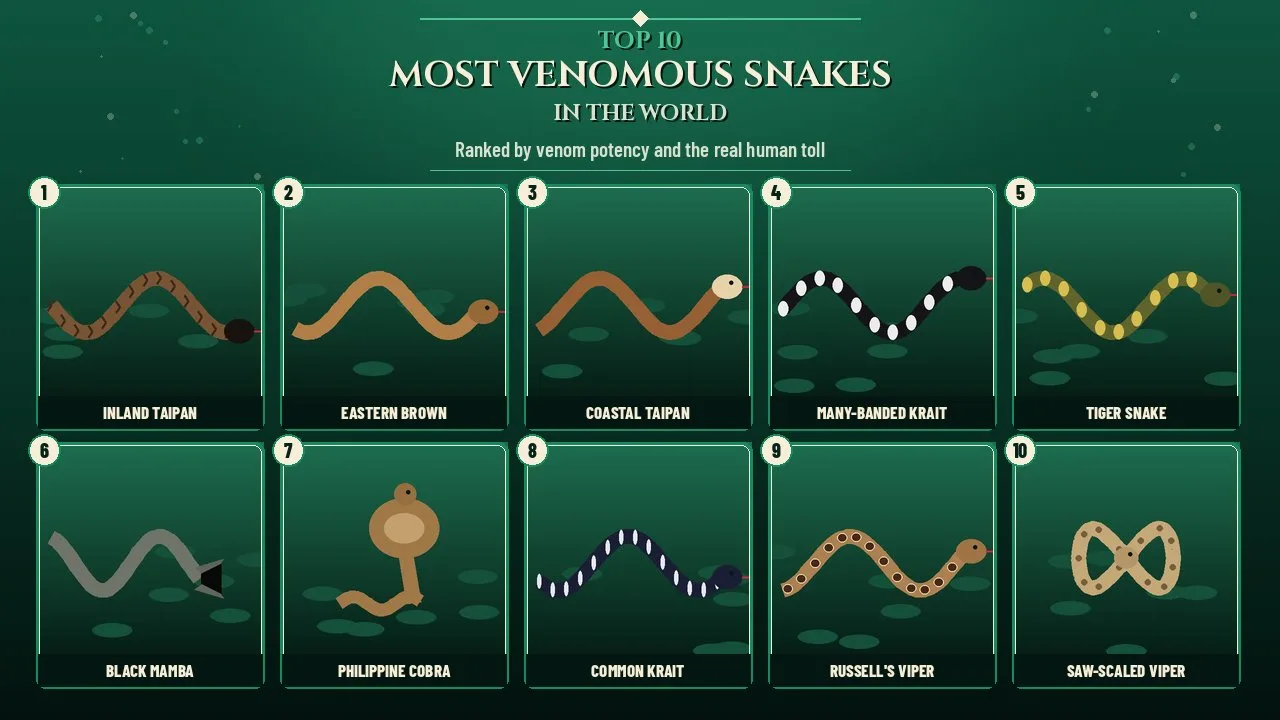
The most venomous snakes in the world range from Australia's shy inland taipan to Asia's kraits and vipers, ranked by venom potency and real human risk.
Venom is one of evolution's most efficient inventions. A few milligrams of protein, delivered through hollow or grooved fangs, can stop a rodent in seconds, and in a human it can shut down breathing, wreck blood clotting or destroy muscle and kidney tissue. Yet the snake with the strongest venom is not the snake that kills the most people. That gap between laboratory toxicity and everyday danger is the key to understanding this list.
This 2026 Finepedia guide ranks ten species that toxicologists, clinicians and public-health researchers repeatedly single out. The first part of the list is led by raw venom strength, measured in standard laboratory tests. The final entries are the snakes that, by sheer numbers of bites, cause the heaviest death toll on Earth. Every entry has a Quick Facts table, background on range and habits, how the venom works, why it matters, and a few facts worth remembering.
If dangerous animals interest you, Finepedia's guide to the most dangerous fish in the world covers venom and toxins under the water, and the full Animals section has more wildlife profiles.
How We Ranked the Most Venomous Snakes in the World
Scientists compare venoms with a number called the median lethal dose, usually written LD50. It is the dose, in milligrams of venom per kilogram of body weight, that kills half of a group of laboratory mice. A lower number means a stronger venom. The subcutaneous route, an injection under the skin, is the one most often used to compare snakes because it is closest to a real bite.
LD50 alone is not enough. Results vary by laboratory, by the method used and even by where the snakes were collected. A snake that carries a tiny amount of strong venom may be less threatening than one with a larger yield of weaker venom. Temperament, fang length, how often people meet the species and access to antivenom all change the real-world picture.
This list therefore uses a two-part method:
- Entries 1 to 7 are led by venom potency. They are species whose venom ranks among the strongest measured in mouse studies, with yield and medical evidence used to break ties.
- Entries 8 to 10 are led by human impact. They are not the most potent on a drop-for-drop basis, but they cause a very large share of the world's snakebite deaths because they live close to millions of people.
Where reported LD50 figures differ between studies, the article describes the venom's rank in words rather than quoting a single precise value, with the exception of the inland taipan, whose figure is widely agreed.
Venom, Poison and Why the Words Matter
A venomous animal injects its toxin, usually by a bite or sting. A poisonous animal causes harm when it is eaten or touched. Snakes are venomous, not poisonous, which is why it is generally safe to handle a dead snake's skin but never safe to handle its head, since reflex bites can still occur after death.
Snake venoms are cocktails rather than single chemicals. Most contain several of the following groups:
- Neurotoxins, which block signals between nerves and muscles and can paralyse the muscles used for breathing.
- Procoagulants and anticoagulants, which disrupt blood clotting and can cause uncontrolled bleeding.
- Myotoxins, which break down muscle tissue and can overload the kidneys.
- Cytotoxins, which destroy tissue around the bite and can lead to amputation.
Venom Types at a Glance
| Venom effect | What it does | Snakes on this list where it is prominent |
|---|---|---|
| Neurotoxic | Paralysis, drooping eyelids, breathing failure | Inland taipan, coastal taipan, kraits, black mamba, Philippine cobra, tiger snake |
| Haemotoxic and coagulopathic | Clotting failure, internal bleeding | Eastern brown snake, Russell's viper, saw-scaled viper, tiger snake |
| Myotoxic | Muscle breakdown, dark urine, kidney injury | Inland taipan, tiger snake, coastal taipan |
| Cytotoxic and local tissue damage | Swelling, blistering, tissue death near the bite | Russell's viper, saw-scaled viper |
At a Glance
| Rank | Snake | Scientific name | Main region | Why it ranks |
|---|---|---|---|---|
| 1 | Inland Taipan | Oxyuranus microlepidotus | Central Australia | Most toxic venom measured in mice |
| 2 | Eastern Brown Snake | Pseudonaja textilis | Eastern Australia, southern New Guinea | Second most toxic land snake; most Australian bite deaths |
| 3 | Coastal Taipan | Oxyuranus scutellatus | Northern Australia, New Guinea | Highly toxic venom plus a large yield |
| 4 | Many-banded Krait | Bungarus multicinctus | Southern China, Taiwan, Southeast Asia | Among the most potent land snake venoms |
| 5 | Tiger Snake | Notechis scutatus | Southern Australia, Tasmania | Potent mixed venom; second for Australian deaths |
| 6 | Black Mamba | Dendroaspis polylepis | Sub-Saharan Africa | Fast-acting neurotoxins, large size |
| 7 | Philippine Cobra | Naja philippinensis | Northern Philippines | One of the most toxic cobras; spits venom |
| 8 | Common Krait | Bungarus caeruleus | Indian subcontinent | Silent night bites; high untreated mortality |
| 9 | Russell's Viper | Daboia russelii | South Asia | Major cause of snakebite deaths in South Asia |
| 10 | Saw-scaled Viper | Echis carinatus | South Asia, Middle East, Central Asia | Small, common and responsible for many bites |
1. Inland Taipan
| Attribute | Details |
|---|---|
| Scientific name | Oxyuranus microlepidotus |
| Other names | Fierce snake, small-scaled snake |
| Range | Cracking-clay plains near the Queensland and South Australia border |
| Typical length | About 1.8 metres, rarely up to 2.5 metres |
| Venom headline | Subcutaneous mouse LD50 of about 0.025 mg per kg |
Origins and Range
The inland taipan lives in one of the emptiest corners of Australia. Its home is the semi-arid Channel Country, a maze of floodplains and black-soil plains where deep cracks in the dried clay give it shelter from heat and predators. Records come from places such as Diamantina National Park and Astrebla Downs National Park in western Queensland.
Because so few people live in that landscape, the snake was barely known to science for decades. A specimen head sent to the Queensland Museum by a grazier in 1972 helped confirm that the species was still living in the region after a long gap in records.
Key Features
- Its venom is the most toxic of any snake tested in mice, stronger drop for drop than any sea snake measured.
- An average bite delivers an estimated 44 milligrams of venom, with a recorded maximum of 110 milligrams.
- It changes colour with the seasons, turning darker in winter to absorb heat and paler in summer to reduce it.
- It feeds almost entirely on mammals, especially the long-haired rat and other native rodents.
- Its venom contains paradoxin, one of the most powerful nerve-blocking toxins yet described.
Significance
The inland taipan is the clearest example of why "most venomous" and "most dangerous" are different questions. On paper it is the deadliest snake alive. In practice it is shy, rarely seen and lives far from towns, so bites are rare and almost always involve people who handle the snake on purpose.
Since a specific taipan antivenom became available, no human deaths have been conclusively linked to this species. Survivors still describe long recoveries. Medical reports stress that pressure-immobilisation first aid, fast evacuation from remote areas and early antivenom are what turn a potentially fatal bite into a survivable one.
Interesting Facts
- In 1984, toxicologist Peter Mirtschin became the first recorded patient to receive taipan antivenom for an inland taipan bite.
- Like all native Australian snakes, it is protected by law, and keeping one illegally has led to bites far outside its natural range.
- Many experienced keepers describe it as relatively calm to handle, but no handler treats it casually.
2. Eastern Brown Snake
| Attribute | Details |
|---|---|
| Scientific name | Pseudonaja textilis |
| Other names | Common brown snake |
| Range | Eastern and central Australia and southern New Guinea |
| Typical length | Up to 1.5 metres, occasionally 2 metres; record about 2.4 metres |
| Venom headline | Second most toxic land snake venom after the inland taipan |
Origins and Range
Where the inland taipan avoids people, the eastern brown snake has adapted to live alongside them. It is found along most of the east coast of Australia, from far north Queensland down through New South Wales and Victoria to South Australia, with isolated populations in the Northern Territory.
Its favourite food is the introduced house mouse, so it thrives on farms, grain stores and the edges of cities. It is the dangerous snake most often encountered around Adelaide and also turns up in the outskirts of Sydney, Melbourne, Canberra and Brisbane.
Key Features
- Slender and fast, with colours from pale tan to almost black and a cream underside often flecked with orange.
- Its venom causes a severe clotting disorder called venom-induced consumption coagulopathy, which uses up the body's clotting factors.
- It also carries textilotoxin, a nerve-blocking enzyme from the phospholipase A2 family.
- It produces only a small amount of venom per bite, typically under 5 milligrams, but that venom is extremely potent.
Significance
The eastern brown snake matters because of where it lives. Australian data from 2005 to 2015 show that brown snakes as a group were responsible for 41 percent of identified snakebite victims and 15 of the 19 deaths in that period. The eastern brown is the species responsible for more Australian snakebite deaths than any other.
Deaths are usually caused by cardiac arrest or bleeding inside the skull, often within a short time of the bite. That is why Australian first-aid advice focuses on keeping the victim still, applying a firm pressure bandage along the whole limb and calling for help immediately.
Interesting Facts
- Eastern brown snakes sometimes shelter together in winter; 13 were once found coiled under a single concrete slab in western Sydney.
- When threatened, it raises its front body into a tall S-shaped curve with its mouth open.
- Its bite can be almost painless, so some victims do not realise how serious it is.
3. Coastal Taipan
| Attribute | Details |
|---|---|
| Scientific name | Oxyuranus scutellatus |
| Other names | Common taipan |
| Range | Coastal northern and eastern Australia and New Guinea |
| Typical length | About 2 metres; longest recorded specimen about 2.9 metres |
| Venom headline | Highly toxic venom with an average yield of about 120 milligrams |
Origins and Range
The coastal taipan was described by the German naturalist Wilhelm Peters in 1867. It lives in warm, wet coastal country from the Kimberley region of Western Australia across the Top End and Cape York, then south along Queensland as far as northern New South Wales. A separate subspecies lives in New Guinea.
It uses monsoon forest, open woodland, grassland and even sugarcane fields, where rats are plentiful. It avoids areas where the maximum winter temperature falls below about 20 degrees Celsius.
Key Features
- It is Australia's second-longest venomous snake, with a narrow head and a pale, often cream-coloured face.
- The average venom yield from one milking is about 120 milligrams, and a maximum of 400 milligrams has been recorded.
- Its venom contains taipoxin, a powerful nerve toxin, along with substances that disrupt clotting and damage muscle.
- It is alert and nervous, and when cornered it can strike several times in rapid succession.
Significance
Before antivenom, a serious coastal taipan bite was close to a death sentence. The turning point came in 1950, when 19-year-old amateur herpetologist Kevin Budden caught a taipan near Cairns so its venom could be studied. He was bitten while bagging the snake and died the following day, but the captured snake was handed to scientists and milked for research.
That venom helped Australian scientists produce a taipan antivenom, which became available in 1955 and saved a young boy near Cairns that same year. Australian data from 2005 to 2015 recorded 31 coastal taipan bite victims and no deaths in that group, a measure of how much antivenom changed the story.
Interesting Facts
- Budden's snake was milked for 78 milligrams of venom, which became the starting point for antivenom work.
- The name taipan comes from an Aboriginal language of Cape York in far north Queensland.
- Coastal taipans have been found living in sugarcane fields, where rats are plentiful.
4. Many-banded Krait
| Attribute | Details |
|---|---|
| Scientific name | Bungarus multicinctus |
| Other names | Taiwanese krait, Chinese krait |
| Range | Central and southern China, Taiwan, and parts of Southeast Asia |
| Typical length | 1 to 1.5 metres, maximum about 1.85 metres |
| Venom headline | Mouse studies place it among the most potent land snake venoms |
Origins and Range
The many-banded krait is a glossy black snake ringed with narrow white bands. It is most common in humid lowlands, especially marshy subtropical country, and is often found near rivers, streams, ditches and rice paddies. It also turns up in villages and suburban gardens, which brings it close to farmers working at dusk.
Records stretch from central and southern China and Taiwan into Myanmar and other parts of mainland Southeast Asia. It can live up to about 1,500 metres above sea level but prefers the lowlands.
Key Features
- It is nocturnal and can become more defensive at night.
- A bite often causes little swelling or pain, sometimes only mild itching and numbness, which hides how serious it is.
- Its venom carries both alpha-bungarotoxin and beta-bungarotoxin, which attack nerve signalling from two different directions.
- Mouse studies dating back to 1943 have repeatedly placed its venom among the most toxic of any land snake.
Significance
The many-banded krait has made an unexpected contribution to medicine and neuroscience. Alpha-bungarotoxin, isolated from its venom, binds tightly and almost irreversibly to the nicotinic acetylcholine receptor, the switch that lets nerves trigger muscle contraction.
Because it locks onto that receptor so precisely, researchers have used it for decades as a molecular tag to map receptors in muscles and the brain. Work with alpha-bungarotoxin helped scientists understand diseases such as myasthenia gravis, in which the body attacks those same receptors.
Interesting Facts
- It shares its genus with the common krait, which appears later on this list.
- Hatchlings are only about 25 centimetres long but are already venomous.
- Victims can appear well for hours before paralysis sets in, which is why clinicians treat any suspected krait bite as an emergency.
5. Tiger Snake
| Attribute | Details |
|---|---|
| Scientific name | Notechis scutatus |
| Range | Southern Australia from Western Australia to New South Wales, plus Tasmania and coastal islands |
| Typical length | Around 1 to 1.2 metres; some populations reach 2 metres |
| Venom yield | About 35 to 65 milligrams per milking |
| Venom headline | Potent neurotoxins, coagulants, haemolysins and myotoxins |
Origins and Range
The tiger snake takes its name from the dark crossbands that many individuals carry, although some populations are plain olive, brown or almost black. It prefers wet places: swamps, creeks, dams, coastal wetlands and pasture near permanent water, where frogs are abundant.
Island populations are some of the most fascinating in Australia. On several offshore islands, tiger snakes have grown larger heads and bodies to swallow seabird chicks, an example of rapid adaptation that biologists still study.
Key Features
- Its venom combines nerve toxins, clotting disruptors, red-blood-cell destroyers and muscle-damaging toxins.
- When threatened, it flattens its neck and body and raises its head in a warning display.
- Tasmanian tiger snakes tend to be calmer, probably because of the cooler temperatures they live in.
- Studies report an untreated mortality rate of between 40 and 60 percent.
Significance
Tiger snakes are second only to brown snakes as a cause of snakebite deaths in Australia. Between 2005 and 2015 they accounted for 17 percent of identified snakebite victims, with four deaths among 119 confirmed envenomations.
The availability of antivenom has greatly reduced fatal tiger snake bites. In Tasmania, doctors do not need to identify the snake at all, because one antivenom covers every venomous snake on the island, a useful simplification in an emergency.
Interesting Facts
- Tiger snakes give birth to live young, and litters of more than 30 have been recorded.
- Exporting any native Australian snake, including the tiger snake, is illegal.
- Tiger snake antivenom was once flown in to treat taipan bites before a taipan-specific antivenom existed.
6. Black Mamba
| Attribute | Details |
|---|---|
| Scientific name | Dendroaspis polylepis |
| Range | Savannah, woodland and rocky hills across much of sub-Saharan Africa |
| Typical length | 2 to 3 metres, with reports of up to about 4.5 metres |
| Speed | Up to about 16 km per hour over short distances |
| Venom headline | Neurotoxic venom that can cause symptoms within ten minutes |
Origins and Range
The black mamba was described by the zoologist Albert Günther in 1864. It ranges from Ethiopia, Eritrea and Somalia through East Africa and south to South Africa, Eswatini, Botswana, Namibia and Angola, living in savannah, open woodland, rocky slopes and, in some places, dense forest.
Its name is misleading. The snake is grey, olive or brown, never truly black. The name refers to the inky-black lining of its mouth, which it shows in a gaping threat display.
Key Features
- It is the second-longest venomous snake in the world after the king cobra.
- Its venom contains dendrotoxins and three-finger toxins that disrupt nerve signalling.
- It hunts by biting and releasing, then waiting for its prey to collapse.
- It has a long, coffin-shaped head and a slim body built for speed on the ground and in trees.
Significance
The black mamba's reputation for aggression is mostly exaggerated. In the wild it tends to avoid people and usually moves away when approached. It becomes dangerous when cornered, and the breeding season from September to February is the peak time for bites.
What makes it so feared is the speed of its venom. Before 1962, victims received a polyvalent antivenom that did not neutralise mamba venom, and 15 of 35 recorded patients died. After a mamba-specific antivenom was introduced in 1962, followed by a broader polyvalent product in 1971, deaths among treated patients fell sharply.
Interesting Facts
- Its speed is often overstated in folklore; measured estimates put it at no more than about 16 to 20 km per hour.
- Young black mambas can reach 2 metres by the end of their first year.
- Mambalgins, painkilling peptides found in mamba venom, have attracted research interest as possible models for new analgesics.
7. Philippine Cobra
| Attribute | Details |
|---|---|
| Scientific name | Naja philippinensis |
| Other names | Northern Philippine cobra, Philippine spitting cobra |
| Range | Luzon, Mindoro, Catanduanes and Masbate in the northern Philippines |
| Typical length | Up to about 1.6 metres; Mindoro specimens reportedly to 2 metres |
| Venom headline | Purely neurotoxic venom; can spit accurately up to about 3 metres |
Origins and Range
The Philippine cobra is a stocky, light-brown spitting cobra found only in the northern Philippines. It lives in lowland plains, forests and open fields, and often near farmland and rice paddies, where rodents attract it and where people work by hand.
It shares the classic cobra hood, spread by flexing long ribs behind the head, but it is less famous abroad than the Indian or king cobra despite having one of the most toxic venoms of any cobra.
Key Features
- Its venom is a potent postsynaptic neurotoxin that blocks nerve signals at the muscle.
- Research has found no significant tissue-destroying or heart-damaging components in its venom.
- It can spit venom accurately at a target up to about 3 metres away, aiming for the eyes.
- Bites typically cause strong neurotoxic symptoms with little or no local swelling.
Significance
Clinical evidence shows how quickly this cobra's venom acts. In a 1988 study of 39 patients envenomed by the species, 38 developed neurotoxic symptoms, the main danger being paralysis of the breathing muscles. With hospital care, most survived, and the two deaths in that study were patients who were already critically ill on arrival.
The species is a reminder that speed of transport and access to ventilation matter as much as antivenom. Spat venom is a separate risk: it rarely threatens life but can cause intense pain and lasting eye damage if not washed out quickly with plenty of clean water.
Interesting Facts
- Spitting cobras do not spit through the mouth; venom is forced through forward-facing openings in the fangs.
- Large rats have occasionally injured or blinded Philippine cobras during struggles.
- Its laboratory toxicity ranks near the top among cobras tested.
8. Common Krait
| Attribute | Details |
|---|---|
| Scientific name | Bungarus caeruleus |
| Other names | Indian krait |
| Range | India, Pakistan, Nepal, Bangladesh and Sri Lanka |
| Typical length | About 0.9 metres, up to 1.75 metres |
| Venom headline | Untreated mortality reported as high as 70 to 80 percent |
Origins and Range
The common krait is one of the "Big Four", the group of snakes responsible for most snakebite cases in India. It is a slim, glossy blue-black snake with thin white crossbands. It thrives in fields, plantations and villages, and it often enters homes in search of rodents, other snakes and warmth.
Unlike the species earlier on this list, its laboratory venom strength is not the highest. What lifts it onto the list is the way it bites: at night, silently, and very often while people sleep.
Key Features
- It is strictly nocturnal and rarely seen by day.
- It has small fangs, and a bite often causes little or no pain, so sleeping victims may not wake.
- Its venom is mainly neurotoxic, causing drooping eyelids, difficulty swallowing and then breathing failure.
- Without treatment, death can follow in about four to eight hours.
Significance
Records of people bitten while sleeping on the floor are common, and many victims arrive at hospital only after paralysis has started. Once paralysis sets in, antivenom becomes less effective, so clinicians often recommend giving it early in suspected krait cases, even before every symptom appears.
Simple prevention makes a large difference. Sleeping on a raised bed, using a well-tucked mosquito net and keeping homes free of rodents reduce the chance of a night-time bite, which is why these measures feature in public-health campaigns across South Asia.
Interesting Facts
- The common krait is generally calm by day and may hide its head rather than bite.
- Victims sometimes wake with abdominal pain and no visible bite mark.
- It frequently eats other snakes, including other kraits.
9. Russell's Viper
| Attribute | Details |
|---|---|
| Scientific name | Daboia russelii |
| Range | India, Sri Lanka, Bangladesh, Nepal and Pakistan |
| Typical length | Usually about 1 to 1.2 metres, with a heavy body |
| Venom yield | Roughly 130 to 250 milligrams in adults |
| Venom headline | Severe bleeding, kidney failure and tissue damage |
Origins and Range
Russell's viper is named after the Scottish surgeon and naturalist Patrick Russell, who studied Indian snakes in the eighteenth century. It was formally described in 1797. It is a thick-bodied viper with three rows of dark, chain-like spots along its back, and it favours open, grassy and scrubby country as well as farmland.
Rodents that live alongside people draw it into villages and even urban areas. Combined with its habit of lying still when approached, that brings it into constant contact with farmers and labourers.
Key Features
- It is famous for an extremely painful bite.
- Its venom causes the blood to clot and then fail to clot, leading to bleeding from gums, wounds and internal organs.
- Acute kidney injury is a common and serious complication.
- When disturbed, it produces a loud, sustained hiss, among the loudest of any snake.
Significance
Russell's viper is one of the Big Four and a major contributor to India's snakebite burden. India's nationally representative Million Death Study estimated about 1.2 million snakebite deaths in the country between 2000 and 2019, an average of about 58,000 a year, and Russell's viper is consistently among the leading causes.
Death can follow anywhere from one day to two weeks after the bite, from septicaemia or failure of the kidneys, lungs or heart. Early antivenom, such as the polyvalent product made in India, sharply reduces those risks, and newer antivenoms are being tested to cope with regional differences in venom.
Interesting Facts
- Its venom is so good at triggering clotting that it is used in a laboratory blood test, the dilute Russell's viper venom time, in hospitals worldwide.
- The original 1797 description misspelled Russell's name with a single "l".
- Venom composition varies between India and Sri Lanka, which affects how well some antivenoms work.
10. Saw-scaled Viper
| Attribute | Details |
|---|---|
| Scientific name | Echis carinatus |
| Other names | Indian saw-scaled viper, little Indian viper |
| Range | Indian subcontinent, plus parts of Central Asia and the Middle East |
| Typical length | Usually under 80 centimetres |
| Venom headline | Bleeding and clotting defects; untreated mortality about 20 percent |
Origins and Range
The saw-scaled viper is the smallest member of India's Big Four, but its range is enormous. It is found across India, Sri Lanka, Bangladesh and Pakistan, west into Oman, the United Arab Emirates, Iraq and Iran, and north into Afghanistan and parts of Central Asia.
It favours dry, rocky and sandy ground, scrub and farmland. Small, well camouflaged and often active after dark, it is easy to step on, which explains much of its danger.
Key Features
- Its flank scales have serrated keels, which it rubs together to make a rasping warning sound.
- It forms a figure-of-eight coil with its head in the centre, ready to strike like a released spring.
- Its venom causes bleeding and clotting defects, and some patients develop acute kidney injury requiring dialysis.
- It can climb into low bushes, sometimes up to about 2 metres above the ground.
Significance
The saw-scaled viper shows that a snake does not need to be large or extremely potent to be one of the world's deadliest. It is abundant in densely farmed areas, bites readily when disturbed and lives where hospitals can be far away.
Its venom has also become a research tool. Echistatin, a protein from the venom that blocks blood clotting, helped inspire work on anti-clotting drugs, a common pattern in which venom chemistry has guided new medicines.
Interesting Facts
- The rasping sound is produced by friction, not by breathing like a hiss.
- Several related Echis species across Africa and the Middle East are also major causes of snakebite.
- Despite its small size, its bite can cause bleeding that lasts for days without antivenom.
Honourable Mentions
Several other snakes come up in almost every discussion of the most venomous snakes in the world:
- King cobra: the longest venomous snake on Earth, able to deliver a very large volume of venom, though its venom is less potent drop for drop.
- Dubois' sea snake: a reef sea snake whose venom ranks among the most toxic of marine snakes in mouse studies; bites on people are rare.
- Mojave rattlesnake: in many populations its venom carries Mojave toxin, a neurotoxin described in 1975, making it one of the most dangerous snakes in North America.
- Common death adder: an Australian ambush hunter with fast-acting neurotoxic venom and a short, thick body.
- Indian cobra: the fourth member of India's Big Four and the snake for which the first antivenom was developed by Albert Calmette in 1895.
Contrary to a common myth, rattlesnakes are not the only venomous snakes in the United States. Coral snakes, copperheads and cottonmouths are also venomous and medically important.
Comparison: Potency Versus Human Toll
| Snake | Venom potency in lab tests | Contact with people | Real-world death toll |
|---|---|---|---|
| Inland Taipan | Extremely high | Very rare | No deaths conclusively linked since antivenom |
| Eastern Brown Snake | Extremely high | Frequent in eastern Australia | Leading cause of Australian bite deaths |
| Coastal Taipan | Very high | Moderate | Low since antivenom |
| Many-banded Krait | Very high | Common in farmland | Significant in its range |
| Tiger Snake | Very high | Moderate | Second in Australia |
| Black Mamba | High | Moderate | Significant where antivenom is scarce |
| Philippine Cobra | High | Common in farmland | Moderate, reduced by hospital care |
| Common Krait | High | Very common, often indoors | Very high in South Asia |
| Russell's Viper | Moderate to high | Very common | Very high in South Asia |
| Saw-scaled Viper | Moderate to high | Very common | Very high across its range |
Snakebite as a Global Health Problem
The World Health Organization estimates that about 5.4 million people are bitten by snakes each year, with 1.8 to 2.7 million cases of envenoming. Between roughly 81,000 and 138,000 people die each year, and around three times as many suffer amputations or other permanent disabilities.
In June 2017, the WHO listed snakebite envenoming as a highest-priority neglected tropical disease. Its strategy aims to halve deaths and disabilities from snakebite by 2030, by strengthening health systems, improving access to safe and effective antivenom, and engaging communities in prevention.
Most victims are farmers, labourers, herders and children in rural South Asia, Southeast Asia and sub-Saharan Africa. That is why the bottom three entries on this list matter so much: the deadliest snakes for humanity are the common, quiet species that live where people work and sleep.
Snakebite Safety Basics
General advice from health authorities is consistent:
- Keep calm, keep still and move away from the snake. Do not try to catch or kill it.
- Call emergency services or get to a hospital with antivenom as quickly as possible.
- Remove rings, watches and tight clothing near the bite before swelling starts.
- In Australia, apply a firm pressure bandage along the bitten limb and splint it, following local first-aid guidance.
- Do not cut the wound, suck out venom, apply ice or use a tight tourniquet.
- If venom is spat into the eyes, rinse them with large amounts of clean water and seek medical care.
Prevention at home and work helps just as much. Wear boots and long trousers in grass, use a torch at night, sleep on a raised bed under a tucked-in net in krait country, and keep homes and grain stores free of rodents.
For more unusual threats to health, Finepedia's list of rare medical conditions you have never heard of is a fascinating companion read, and the guide to the most dangerous beaches in the world covers box jellyfish and crocodiles on Australian coasts.
Frequently Asked Questions
What is the most venomous snake in the world?
The inland taipan of central Australia has the most toxic venom of any snake tested in laboratory mice, with a subcutaneous LD50 of about 0.025 milligrams per kilogram. It is shy and lives in remote country, so bites are rare, and no human deaths have been conclusively linked to it since taipan antivenom became available.
Which snake kills the most people?
No single species can be measured precisely, but the snakes of South Asia cause the largest toll. Russell's viper, the common krait, the saw-scaled viper and the Indian cobra, known as the Big Four, together account for most snakebite deaths in India, which records more snakebite deaths than any other country.
Is the black mamba the most venomous snake?
No. The black mamba's venom is fast-acting and dangerous, but several Australian and Asian snakes have more toxic venom in laboratory tests. Its fearsome reputation comes from its size, speed, neurotoxic venom and the high death rate of untreated bites in places where antivenom is hard to reach.
Why does Australia have so many venomous snakes but few deaths?
Australia is home to many of the most venomous snakes in the world, yet it averages only a few snakebite deaths a year. Good roads and air ambulances, widespread knowledge of pressure-immobilisation first aid, and hospitals stocked with effective antivenom mean that most bite victims reach treatment in time.
What does LD50 mean for snake venom?
LD50 is the median lethal dose: the amount of venom per kilogram of body weight that kills half of a group of test mice. A smaller number means a more toxic venom. It is useful for comparing species, but it does not account for venom yield, temperament or how often a snake meets people.
Are sea snakes more venomous than land snakes?
Some sea snakes, such as Dubois' sea snake, have extremely potent venom, but laboratory studies show the inland taipan's venom is stronger than any sea snake tested. Most sea snakes are reluctant to bite, have small fangs, and rarely encounter people outside fishing nets, so deaths are uncommon.
What should I do if a snake bites me?
Stay calm, keep still and get emergency help straight away. Remove tight items near the bite, keep the limb immobilised and follow local first-aid advice, such as a pressure bandage in Australia. Never cut the wound, suck out venom or apply ice. Antivenom given in hospital is the only specific treatment.
Conclusion
The most venomous snakes in the world are not always the ones that should worry travellers or farmers the most. The inland taipan holds the record for toxicity but lives quietly in the outback, while kraits and vipers with weaker venom kill tens of thousands of people every year because they share fields and homes with them.
Understanding that difference changes how we think about snakes. Good first aid, fast transport, affordable antivenom and simple prevention such as raised beds, torches and boots save far more lives than fear. Respect these ten species, give them space, and they will almost always do the same for you. For more ranked lists, browse Finepedia's Top 10 Facts collection.
- World Health Organization, Snakebite envenoming fact sheet: https://www.who.int/news-room/fact-sheets/detail/snakebite-envenoming
- Suraweera W. et al., Trends in snakebite deaths in India from 2000 to 2019 in a nationally representative mortality study, eLife (2020): https://doi.org/10.7554/eLife.54076
- Australian Snakebite Project data, 2005 to 2015, as summarised in species references for brown, tiger and coastal taipan snakes
- Queensland Museum and Australian Reptile Park species information on taipans and brown snakes
- Clinical and toxicology literature on Bungarus, Naja, Daboia and Echis venoms, including LD50 compilations by Broad, Sutherland and Coulter (1979)
- Background on alpha-bungarotoxin and nicotinic acetylcholine receptor research

















Log in with