








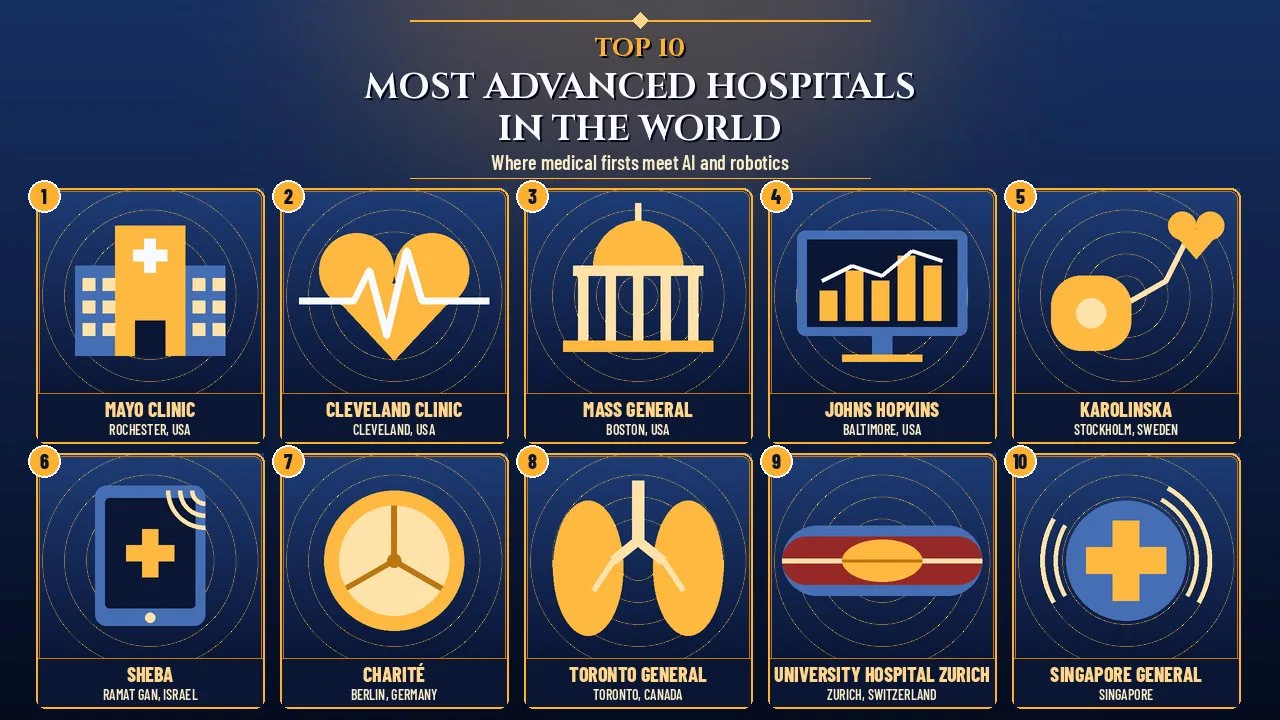
The most advanced hospitals in the world, led by Mayo Clinic and Cleveland Clinic, pair top patient outcomes with AI, robotics and landmark medical firsts. Each of them treats huge numbers of complex cases, runs a large research programme and keeps adding new technology to everyday care. Many of the procedures that patients now take for granted, from anaesthesia to heart bypass surgery, were first proven inside these buildings.
Calling a hospital "advanced" can mean many things, so this list uses a clear, published yardstick rather than reputation alone. It starts with the ten hospitals that Newsweek and Statista named the best in the world for 2026, then reorders them by how far each one leads in digital and smart-hospital technology. The result is a ranking that rewards both clinical excellence and genuine innovation.
The facts below come from the hospitals' own annual reports and fact sheets, the Newsweek and Statista rankings, peer-reviewed journals and major news organisations, and they are current as of October 2026. This guide is for general information only and is not medical advice or a recommendation of any particular provider.
How This Ranking Was Built
Two independent global rankings form the backbone of this list. Newsweek and Statista's World's Best Hospitals 2026, published on 25 February 2026, evaluated 2,530 hospitals in 32 countries using quality metrics, peer recommendations, patient experience data and patient-reported outcome measures. Their World's Best Smart Hospitals 2026 list ranks 350 hospitals from 30 countries on how well they use artificial intelligence, robotics, telemedicine, digital records and patient safety technology.
To create a single "most advanced" order, the ten hospitals in the 2026 global top 10 were ranked by the average of their two positions. A hospital that excels in overall care but sits lower on the smart-technology list therefore moves down, while one that leads on both stays near the top. When two hospitals tied, the one with the better overall rank went first.
| Criterion | What it measures | Source |
|---|---|---|
| Overall hospital quality | Clinical metrics, expert recommendations, patient experience and outcome tracking | World's Best Hospitals 2026 (Newsweek and Statista) |
| Smart technology | Use of AI, robotics, telemedicine, digital tools and safety systems | World's Best Smart Hospitals 2026 (Newsweek and Statista) |
| Medical firsts | Documented world or national firsts in surgery and treatment | Hospital archives, journals and news of record |
| Research strength | Size of research teams, budgets and clinical trials | Annual reports and official fact sheets |
| Recent progress | New buildings, machines and procedures in 2024 to 2026 | Hospital announcements and verified news reports |
The Most Advanced Hospitals at a Glance
| Rank | Hospital | City and country | World's Best 2026 rank | Smart Hospitals 2026 rank | Average |
|---|---|---|---|---|---|
| 1 | Mayo Clinic (Rochester) | Rochester, United States | 1 | 1 | 1.0 |
| 2 | Cleveland Clinic | Cleveland, United States | 3 | 2 | 2.5 |
| 3 | Massachusetts General Hospital | Boston, United States | 5 | 3 | 4.0 |
| 4 | The Johns Hopkins Hospital | Baltimore, United States | 6 | 4 | 5.0 |
| 5 | Karolinska University Hospital | Stockholm, Sweden | 4 | 11 | 7.5 |
| 6 | Sheba Medical Center | Ramat Gan, Israel | 7 | 9 | 8.0 |
| 7 | Charité – Universitätsmedizin Berlin | Berlin, Germany | 8 | 8 | 8.0 |
| 8 | Toronto General Hospital (UHN) | Toronto, Canada | 2 | 37 | 19.5 |
| 9 | University Hospital Zurich (USZ) | Zurich, Switzerland | 9 | 40 | 24.5 |
| 10 | Singapore General Hospital | Singapore | 10 | 49 | 29.5 |
1. Mayo Clinic
Mayo Clinic in Rochester, Minnesota, is the only hospital that holds first place on both of the 2026 global lists used here. It was named the best hospital in the world for 2026 and also the world's best smart hospital, where it reclaimed the top spot from Cleveland Clinic. Its model of doctors from many specialties working on one patient together has been copied around the world.
| Attribute | Details |
|---|---|
| Location | Rochester, Minnesota, United States, with major campuses in Arizona and Florida |
| Roots | Dr William Worrall Mayo settled in Rochester in 1864; Saint Marys Hospital opened in 1889 |
| 2026 rankings | No. 1 World's Best Hospitals; No. 1 World's Best Smart Hospitals |
| Size in 2025 | Nearly 85,000 staff and 161,590 surgical patients |
| Signature strength | Integrated team care, transplants, AI and particle therapy |
Origins and History
The story began when William Worrall Mayo moved his family to Rochester in 1864, and his sons William and Charles later joined his practice. After a tornado hit the town in 1883, Mother Alfred Moes of the Sisters of Saint Francis offered to build a hospital if the Mayo doctors would staff it. Saint Marys Hospital opened in 1889 with just 27 beds and soon became famous as the "hospital in the cornfield".
Research has been part of Mayo's identity for a century. In 1950, Mayo scientists Edward Kendall and Philip Hench shared the Nobel Prize in Physiology or Medicine for work on adrenal hormones that led to cortisone treatment.
What Makes It Advanced
- Newsweek's smart-hospital survey singled out its work in artificial intelligence, patient safety technology and telemedicine
- Mayo Clinic Digital Pathology, launched in January 2025, digitises tissue slides so they can be analysed by AI tools
- In 2025 it deployed NVIDIA Blackwell supercomputing infrastructure to build generative AI models for pathology and drug discovery
- It performed 2,065 solid-organ transplants in 2025, the most of any US provider
- Teams introduced 149 new surgeries and procedures in 2025 and delivered more than 26 million diagnostic tests
Latest Advances (2025–2026)
Mayo is in the middle of a 9 billion dollar programme called Bold. Forward. Unbound., which links new clinical buildings with digital systems. In Jacksonville, Florida, the Duan Family Building opened in July 2025 and is set to host the first clinical carbon ion therapy programme in the Americas. Carbon ions are heavier than protons and can deliver a stronger dose to aggressive tumours while sparing nearby tissue.
Why It Matters
Mayo shows that a hospital can grow very large without losing its focus on the individual patient. Its digital platforms let doctors share data and AI models across sites, so a breakthrough in Rochester can reach patients in Arizona or Florida quickly.
Interesting Facts
- Mayo Clinic cared for patients from all 50 US states and 141 countries in 2025
- Its Rochester campus began with a 27-bed hospital built by Franciscan sisters
- Two Mayo researchers won a Nobel Prize for discoveries behind cortisone
- Philanthropic support reached 1.47 billion dollars in 2025
2. Cleveland Clinic
Cleveland Clinic in Ohio has a long record of turning bold ideas into standard treatments, particularly for the heart. It ranks third in the world for overall quality in 2026 and second for smart technology, with Newsweek highlighting its use of AI, robotics and telemedicine. Today it is a global system with hospitals in the United States, the Middle East and Europe.
| Attribute | Details |
|---|---|
| Location | Cleveland, Ohio, United States |
| Founded | 1921, by four physicians |
| 2026 rankings | No. 3 World's Best Hospitals; No. 2 World's Best Smart Hospitals |
| Size in 2025 | 83,000 caregivers, 23 hospitals and 300 outpatient locations |
| Signature strength | Heart care, transplants and computing-driven research |
Origins and History
Cleveland Clinic was founded in 1921 by George Crile, Frank Bunts, William Lower and John Phillips, doctors who had served together in a military medical unit during the First World War. They copied the cooperative style of army medicine, with specialists working side by side, and set aside part of the income for research and teaching.
Its heart programme changed medicine. In 1958, F. Mason Sones accidentally injected dye into a coronary artery and discovered that it was safe, creating cine coronary angiography. That breakthrough let René Favaloro develop coronary artery bypass surgery at the clinic in 1967, an operation now performed worldwide.
What Makes It Advanced
- It hosts IBM Quantum System One, unveiled in March 2023 as the first quantum computer dedicated to healthcare research
- The quantum machine supports work on drug discovery, genomics and medical imaging under a 10-year partnership with IBM
- Researchers here discovered serotonin in 1948, a key brain chemical linked to mood
- Its surgeons pioneered "stopped heart" surgery using a heart-lung machine in 1956
- It reports 3.6 million unique patients and 15.9 million patient encounters a year
Medical Firsts
| Year | First |
|---|---|
| 1958 | Coronary angiography developed by F. Mason Sones |
| 1967 | Coronary artery bypass surgery pioneered by René Favaloro |
| 1998 | First successful larynx (voice box) transplant |
| 2008 | First near-total face transplant in the United States |
Why It Matters
Few hospitals have shaped one field as completely as Cleveland Clinic has shaped heart care. By pairing a busy clinical practice with a quantum computer and large data teams, it is now trying to repeat that success in areas such as cancer genetics and drug design.
Interesting Facts
- Cleveland Clinic counts 6,600 physicians and scientists and 17,600 nurses among its caregivers
- Its first building opened on Euclid Avenue, and a 184-bed hospital followed in 1924
- It runs hospitals in Abu Dhabi and London as well as across Ohio and Florida
- Its 2025 operating revenue was 18.3 billion dollars
3. Massachusetts General Hospital
Massachusetts General Hospital, known as Mass General or MGH, is the oldest and largest teaching hospital of Harvard Medical School. It ranks fifth in the world for 2026 and third for smart technology, with standout scores in AI, robotics and patient safety technology. It is also home to the largest hospital-based research enterprise in the United States.
| Attribute | Details |
|---|---|
| Location | Boston, Massachusetts, United States |
| Opened | 1821 (chartered in 1811) |
| 2026 rankings | No. 5 World's Best Hospitals; No. 3 World's Best Smart Hospitals |
| Research | Budget of nearly 1.2 billion dollars in 2021 and more than 9,500 researchers |
| Signature strength | Research, transplantation and surgical innovation |
Origins and History
On 16 October 1846, surgeon John Collins Warren removed a tumour from the neck of a patient named Gilbert Abbott while dentist William T. G. Morton kept him unconscious with ether. It was the first successful public demonstration of ether anaesthesia, and it ended the era of fully conscious surgery. The operating theatre where it happened, now called the Ether Dome, became a US National Historic Landmark in 1965.
The hospital itself opened in 1821 in a granite building designed by architect Charles Bulfinch. The Ether Dome served as its operating room until 1867 and is still used for lectures today.
What Makes It Advanced
- The Mass General Research Institute spans more than 30 institutes, centres and departments
- MGH lists among its firsts the first X-ray exposure produced in a hospital and the first antiseptic operating suite in the United States
- It performed the first penile transplant in the United States in 2016
- Newsweek rated its robotics and AI work among the best of any hospital worldwide
The Pig Kidney Breakthrough
On 16 March 2024, MGH surgeons transplanted a genetically edited pig kidney into a living patient for the first time in history. The recipient, 62-year-old Richard Slayman, had end-stage kidney disease. The organ came from a pig edited with CRISPR technology by the company eGenesis to remove harmful genes and add human ones.
The work continued in January 2025, when Tim Andrews of New Hampshire received another gene-edited pig kidney at Mass General. He lived without dialysis for a record 271 days before the organ was removed in October 2025 because its function was declining. Each case has taught doctors more about how animal organs might one day ease the shortage of donor kidneys.
Why It Matters
MGH shows how a hospital can move a discovery from the laboratory bench to the bedside under one roof. Its research scale means many experimental treatments reach patients here years before they are widely available.
Interesting Facts
- The Ether Dome sits on the fourth floor of the hospital's original Bulfinch Building
- Generations of doctors have learned from case conferences held in the Ether Dome
- Its sister hospital in the Mass General Brigham system, Brigham and Women's, performed the world's first successful human organ transplant in 1954
- MGH has been treating patients in Boston for more than 200 years
4. The Johns Hopkins Hospital
The Johns Hopkins Hospital in Baltimore helped invent the modern teaching hospital, combining patient care, research and the training of young doctors in one place. In 2026 it ranks sixth in the world for overall quality and fourth for smart technology, with strengths in AI, robotics and telemedicine. Its surgeons are known for operations that had never been attempted before.
| Attribute | Details |
|---|---|
| Location | Baltimore, Maryland, United States |
| Opened | 1889 |
| 2026 rankings | No. 6 World's Best Hospitals; No. 4 World's Best Smart Hospitals |
| Famous first | The "blue baby" heart operation, 1944 |
| Signature strength | Surgical innovation, reconstructive transplants and data-driven operations |
Origins and History
The hospital opened in 1889, funded by the estate of Baltimore merchant Johns Hopkins, who wanted a hospital and a university that would work together. Its early leaders, including surgeon William Halsted, introduced the residency system in which young surgeons train for years under senior doctors. Halsted also brought rubber surgical gloves into the operating room around 1889 and 1890, first to protect the hands of his nurse, Caroline Hampton, from harsh disinfectants.
In 1944, surgeon Alfred Blalock and cardiologist Helen Taussig, working with surgical technician Vivien Thomas, performed the first "blue baby" operation. Their shunt redirected blood to the lungs of children born with a heart defect that starved their bodies of oxygen, and it opened the door to modern children's heart surgery.
What Makes It Advanced
- The Judy Reitz Capacity Command Center, opened in February 2016 with GE Healthcare, uses real-time and predictive analytics to manage beds and patient flow
- In 2012 its surgeons performed a bilateral arm transplant for a soldier who had lost all four limbs
- On 26 March 2018 it completed the world's first total penis and scrotum transplant, a 14-hour operation for a wounded veteran
- Newsweek ranked its AI and robotics work among the top four of any hospital
Medical Firsts
| Year | Achievement |
|---|---|
| 1889 to 1890 | Rubber surgical gloves introduced in the operating room |
| 1944 | First "blue baby" operation (Blalock-Taussig shunt) |
| 2016 | Opening of the Judy Reitz Capacity Command Center |
| 2018 | World's first total penis and scrotum transplant |
Why It Matters
Johns Hopkins shaped how doctors are trained across the world, and it continues to treat hospital operations as a science in their own right. Its command centre showed other hospitals that the flow of patients, beds and staff can be planned with the same care as surgery itself.
Interesting Facts
- Vivien Thomas had no medical degree, yet his surgical skill was central to the blue baby operation
- The surgical glove began as a way to protect a nurse's skin, not to stop infection
- Both of its landmark reconstructive transplants were performed for injured service members
5. Karolinska University Hospital
Karolinska University Hospital in Stockholm is Scandinavia's flagship academic hospital and works hand in hand with Karolinska Institutet, the medical university whose Nobel Assembly awards the Nobel Prize in Physiology or Medicine. It ranks fourth in the world for overall quality in 2026 and 11th for smart technology, the third-highest smart-hospital position outside the United States, after Charité and Sheba.
| Attribute | Details |
|---|---|
| Location | Stockholm, Sweden (Solna and Huddinge sites) |
| Formed | 2004, by merging Karolinska Hospital and Huddinge University Hospital |
| 2026 rankings | No. 4 World's Best Hospitals; No. 11 World's Best Smart Hospitals |
| Size in 2024 | More than 16,300 staff and about 60,000 operations |
| Signature strength | Heart and lung surgery, robotic surgery and clinical research |
Origins and History
Construction of the original Karolinska Hospital began in Solna in 1932, and its cancer building, Radiumhemmet, opened five years later. The full hospital was inaugurated in 1940, and Astrid Lindgren Children's Hospital began work there in 1980. In 2004 it merged with Huddinge University Hospital to form today's Karolinska University Hospital.
Karolinska's most famous moment came on 8 October 1958, when surgeon Åke Senning implanted the world's first implantable pacemaker, designed by engineer Rune Elmqvist, in a patient named Arne Larsson. The first device lasted only hours, but Larsson went on to receive many more pacemakers over his long life, proving the idea worked.
What Makes It Advanced
- Its new Solna hospital, New Karolinska Solna, was built from 2010 and gradually replaced the old buildings
- In April 2024 it became the first hospital in Europe to operate with a new single-port surgical robot, completing 100 such operations that year
- It carries out more lung surgery than any other hospital in Sweden, with over 600 operations in 2024
- Minimally invasive methods were used in 94 percent of its lung cancer operations in 2024
- It performs 69 percent of all minimally invasive heart surgery in Sweden
Latest Advances (2024–2026)
Karolinska's 2024 annual review reported that a study of more than 600,000 operations showed rising survival rates, even among patients over 75 with several other illnesses. The single-port robot, which passes the camera and instruments through one small opening, has been used for prostate, gynaecological, colorectal and head and neck cancer surgery.
Why It Matters
Karolinska proves that a publicly funded hospital can compete with the richest private systems in the world. Its close link with Karolinska Institutet means discoveries in the laboratory can be tested quickly in patients.
Interesting Facts
- The first implanted pacemaker in 1958 stopped after a few hours and was replaced by a backup
- Karolinska had about 1.6 million outpatient visits and inpatient stays in 2024
- Its 2024 budget was 29.3 billion Swedish kronor
- Karolinska reported 2025 as its fifth straight year in Newsweek's global top 10, and it rose to fourth place in 2026
6. Sheba Medical Center
Sheba Medical Center at Tel HaShomer, near Tel Aviv, is Israel's largest hospital and one of the world's most active testbeds for digital health. It ranks seventh in the world for 2026 and ninth for smart technology, with standout scores in AI, robotics and telemedicine. It is affiliated with the Faculty of Medicine at Tel Aviv University.
| Attribute | Details |
|---|---|
| Location | Ramat Gan (Tel HaShomer), Israel |
| Founded | 1948 |
| 2026 rankings | No. 7 World's Best Hospitals; No. 9 World's Best Smart Hospitals |
| Size | Almost 2,000 beds and 159 departments and clinics on a 200-acre campus |
| Signature strength | Virtual care, medical simulation and health-tech innovation |
Origins and History
Sheba began in 1948 as a military hospital and grew into a full academic medical centre with acute care, cancer, children's, women's and rehabilitation hospitals on one large campus. It was the first hospital in Israel to earn the Joint Commission International gold seal as an academic medical centre, in 2013.
What Makes It Advanced
- Sheba Beyond, launched in January 2021, is described as Israel's first virtual hospital, offering remote consultations, home care and digital rehabilitation
- ARC Innovation, founded in 2019, connects Sheba doctors with start-ups, technology firms and other hospitals to build and test new tools
- The Israel Center for Medical Simulation, founded in 2001, trains doctors and nurses on realistic scenarios before they treat real patients
- Its rehabilitation hospital runs a virtual reality centre where patients practise everyday tasks safely
Latest Advances (2025–2026)
Sheba says it has stayed in Newsweek's global top 10 every year since 2019, and the 2026 smart ranking again placed it among the world's ten most technology-ready hospitals. Its innovation model treats the hospital as a living laboratory, where new software and devices are trialled with clinicians and patients rather than designed in isolation.
Why It Matters
Sheba shows how a hospital can deliver advanced care far beyond its walls. Virtual wards and remote monitoring let specialists follow patients at home, which frees hospital beds and keeps people in familiar surroundings.
Interesting Facts
- Sheba is named after Chaim Sheba, a former director general of Israel's Ministry of Health
- Its campus covers about 200 acres
- It has 75 laboratories
- Sheba describes its simulation centre as one of the most comprehensive in the world
7. Charité – Universitätsmedizin Berlin
Charité in Berlin is one of Europe's largest university hospitals and a historic home of German medicine. It ranks eighth in the world on both 2026 lists, making it the highest-placed European hospital in the smart-hospital ranking, with strengths in AI, patient safety technology and telemedicine. It serves as the shared medical faculty of two universities, Humboldt-Universität zu Berlin and Freie Universität Berlin.
| Attribute | Details |
|---|---|
| Location | Berlin, Germany (four campuses) |
| Founded | 1710 |
| 2026 rankings | No. 8 World's Best Hospitals; No. 8 World's Best Smart Hospitals |
| Size | 3,293 beds (2024) and 25,256 employees across the Charité group (2025) |
| Signature strength | Research, heart medicine and robotic surgery |
Origins and History
Charité was founded in 1710 as a quarantine house in case plague reached Berlin, and it later became a charity hospital and teaching centre. Some of the greatest names in medical history worked here, including Robert Koch, who identified the bacteria behind tuberculosis, Paul Ehrlich, a founder of chemotherapy, and Emil von Behring, who won the first Nobel Prize in Physiology or Medicine. The pathologist Rudolf Virchow, often called the father of modern pathology, also taught at Charité.
What Makes It Advanced
- It has four campuses, 17 CharitéCenters and about 100 departments and institutes
- Its workforce includes 5,882 researchers and physicians and 7,098 nursing staff
- Staff come from 133 countries
- It performed close to 100 living-donor kidney transplants in 2024, placing it among Europe's leading centres
Latest Advances (2025–2026)
In June 2025, doctors at the German Heart Centre of the Charité implanted a heart valve made from the patient's own tissue, the first of its kind in the world. The leaflets are shaped from the patient's pericardium, the sac around the heart, and delivered by catheter. Because the valve is living tissue, researchers hope it could one day grow with children born with heart valve defects and spare them repeated open-heart surgery.
In August 2025, Charité surgeons completed its first fully robot-assisted, minimally invasive kidney transplant, one of the first in Germany. The donor and recipient left hospital after seven and ten days.
Why It Matters
Charité links three centuries of scientific tradition with modern digital and robotic medicine. Its work on living heart valves could change care for the roughly 160,000 children born each year with a pulmonary valve defect.
Interesting Facts
- More than half of Germany's Nobel laureates in physiology or medicine worked at Charité
- The name Charité means charity in French
- Its heart valve trial began with seven young adults
- It is one of the largest employers in Berlin
8. Toronto General Hospital
Toronto General Hospital, part of the University Health Network (UHN), is the birthplace of several world firsts in diabetes and transplant care. It ranks second in the world for overall quality in 2026, the best result outside the United States, though it sits 37th on the smart-technology list, which is why it lands eighth here. It is a major teaching hospital of the University of Toronto.
| Attribute | Details |
|---|---|
| Location | Toronto, Ontario, Canada |
| Opened | June 1829, as the General Hospital of the Town of York |
| 2026 rankings | No. 2 World's Best Hospitals; No. 37 World's Best Smart Hospitals |
| Famous firsts | First clinical use of insulin (1922) and first successful single lung transplant (1983) |
| Signature strength | Organ transplantation and organ repair technology |
Origins and History
The hospital traces its roots to 1819, when a trust fund was set up to build a hospital in the Town of York, as Toronto was then called. It opened in June 1829 and moved several times, including to College Street in 1913, a building that is now part of the MaRS innovation district.
In January 1922, a 14-year-old boy named Leonard Thompson, close to death from diabetes, became the first person to receive insulin at Toronto General. A purified extract given on 23 January brought rapid improvement, and insulin went on to save millions of lives.
What Makes It Advanced
- In 1983 its surgeons performed the world's first successful single lung transplant, followed by the first double lung transplant in 1986
- In 2008 Shaf Keshavjee and Marcelo Cypel developed the Toronto Ex Vivo Lung Perfusion system, which keeps donor lungs breathing and warm outside the body so they can be assessed and repaired
- UHN's transplant programme was described in 2018 as the largest adult transplant programme in North America
- UHN says the first external heart pacemaker was used in an open-heart resuscitation at Toronto General in 1950
Why It Ranks Here
Toronto General's clinical record is outstanding, and Newsweek's experts rated it the second-best hospital on Earth. Its lower smart-hospital position means it scores less strongly on the digital measures used in this ranking, even though its lung repair technology has since been adopted by other transplant centres.
Why It Matters
Donor organs are scarce, and many lungs used to be thrown away because they were judged too damaged. By repairing lungs outside the body, Toronto's team has helped increase the number of transplants that can safely take place.
Interesting Facts
- Insulin was discovered at the University of Toronto and first used clinically at Toronto General
- The first insulin patient, Leonard Thompson, was 14 years old
- Its 1913 College Street building is now part of the MaRS Discovery District
- Toronto's ex vivo lung method was first used in 2008
9. University Hospital Zurich
University Hospital Zurich (USZ) is one of Switzerland's largest hospitals and a pioneer in heart and transplant medicine. It ranks ninth in the world for 2026 and 40th for smart technology. It works closely with the University of Zurich and with ETH Zurich, one of Europe's leading technical universities.
| Attribute | Details |
|---|---|
| Location | Zurich, Switzerland |
| Founded | 1833, as the cantonal hospital of Zurich |
| 2026 rankings | No. 9 World's Best Hospitals; No. 40 World's Best Smart Hospitals |
| Size | About 900 beds, around 42,000 inpatients and over 600,000 outpatient visits a year |
| Signature strength | Interventional cardiology, liver perfusion and robotic diagnosis |
Origins and History
USZ grew out of the cantonal hospital founded in Zurich in 1833 and has more than 40 specialist departments today. On 16 September 1977, cardiologist Andreas Grüntzig performed the world's first coronary balloon angioplasty here, opening a narrowed heart artery with a tiny balloon on a catheter. That procedure paved the way for the stent treatments now used in heart clinics worldwide.
What Makes It Advanced
- In 2012 its transplant surgeons used the HOPE liver perfusion method for the first time in the world, flushing donor livers with cold, oxygen-rich fluid before transplant
- In 2022 a Zurich team reported in Nature Biotechnology that a human liver kept alive in a machine for three days had been successfully transplanted
- It is Switzerland's largest kidney transplant centre, with about 110 kidney transplants a year
- Around 2,500 staff work in research across almost every medical discipline
Latest Advances (2025–2026)
In September 2025, USZ researchers presented a study showing that robot-assisted bronchoscopy finds small, hard-to-reach lung tumours far more often than older methods. In 78 patients with 127 small lesions, conventional bronchoscopes reached a usable biopsy in only 23 percent of cases, while the robotic system with built-in CT imaging succeeded in more than 84 percent. The hospital had used the technology for about 600 biopsies since 2024.
Why It Matters
Finding lung cancer early can be the difference between a cure and a late diagnosis. Combined with its work on machine-preserved livers, this shows how USZ uses engineering to rescue organs and to catch disease sooner.
Interesting Facts
- Its Andreas Grüntzig Clinical Research Center is named after the angioplasty pioneer
- The machine-preserved liver in the 2022 study had at first been judged unsuitable for transplant
- The robot-found lung tumours in the 2025 study had a median size of only 11 millimetres
- USZ is linked with both the University of Zurich and ETH Zurich
10. Singapore General Hospital
Singapore General Hospital (SGH) is the country's oldest and largest acute tertiary hospital and the flagship of the SingHealth public healthcare group. It ranks tenth in the world for 2026 and 49th for smart technology, making it the top-ranked hospital in Asia on the global list. It is a key teaching hospital for Singapore's three medical schools.
| Attribute | Details |
|---|---|
| Location | Outram, Singapore |
| Established | 1821 |
| 2026 rankings | No. 10 World's Best Hospitals; No. 49 World's Best Smart Hospitals |
| Size (year to March 2025) | 1,931 beds, 10,725 staff and 115,751 surgical operations |
| Signature strength | Transplants, nursing excellence and large-scale public care |
Origins and History
SGH began in 1821 as a small wooden shed for British troops and moved to its long-term home on Outram Road in 1882. On 8 July 1970, its doctors performed Southeast Asia's first deceased-donor kidney transplant. In 2010 it became the first hospital in Asia to earn Magnet Recognition for nursing excellence from the American Nurses Credentialing Center.
What Makes It Advanced
- Five national specialist centres sit on the SGH campus, so patients can see several types of expert in one place
- Duke-NUS Medical School is located on the campus, linking research directly with care
- It handled 773,802 specialist outpatient attendances and 78,476 inpatients in the year to March 2025
- It provides about one-fifth of Singapore's acute hospital beds
Latest Advances (2025–2026)
On 18 January 2026, SGH moved its emergency department into the new Emergency Medicine and National Neuroscience Institute building. The new department covers about 14,000 square metres, more than six times the size of the old one, with 10 triage rooms and 12 resuscitation and trauma rooms. Its pharmacy uses an automated storage system in which robots retrieve medicines by barcode, and wards in the new building use digital bedside screens instead of manual information boards.
Why It Matters
SGH shows how a public hospital can deliver world-class care to an entire nation at scale. Its larger emergency department was designed to ease crowding and meet projected future needs.
Interesting Facts
- SGH ran Singapore's first 24-hour emergency unit by 1964
- The new emergency department saw 216 patients on its first day
- The old emergency department at Block 1 had operated since 1977
- SGH is wholly owned by the government of Singapore
Honourable Mentions
Several other hospitals narrowly missed this list or excel in one area of advanced medicine.
| Hospital | City | World's Best 2026 | Smart Hospitals 2026 | Why it stands out |
|---|---|---|---|---|
| The Mount Sinai Hospital | New York, United States | 22 | 5 | One of the world's top five smart hospitals |
| MD Anderson Cancer Center | Houston, United States | Not ranked (specialist) | 6 | Leading cancer centre with strong AI and robotics scores |
| Memorial Sloan Kettering Cancer Center | New York, United States | Not ranked (specialist) | 7 | Cancer specialist with top-ten smart technology |
| Brigham and Women's Hospital | Boston, United States | 18 | 12 | Site of the first successful human organ transplant (1954) |
| The University of Tokyo Hospital | Tokyo, Japan | 13 | 25 | Japan's highest-ranked hospital on both lists |
| Hôpital Pitié-Salpêtrière (AP-HP) | Paris, France | 11 | 42 | France's top-ranked hospital |
| Lausanne University Hospital (CHUV) | Lausanne, Switzerland | 21 | Not in top 50 | Strong academic hospital in French-speaking Switzerland |
The global World's Best Hospitals list covers general hospitals only, so specialist cancer centres such as MD Anderson and Memorial Sloan Kettering appear in the smart ranking but not in the overall top 250.
What Makes a Hospital Advanced?
Advanced hospitals share a handful of features that go beyond expensive machines. These are the qualities that the ten hospitals above have in common.
- Research inside the hospital: large teams of scientists working next to clinicians, so new ideas reach patients quickly
- Digital foundations: electronic records, patient portals and data platforms that AI tools can learn from
- Robotics and minimally invasive surgery: smaller cuts, less pain and faster recovery
- Organ preservation and transplant science: machines that keep donor organs alive longer, and experiments with animal organs
- Command centres and analytics: real-time tracking of beds, staff and patient flow
- Virtual care: remote monitoring and video consultations that extend care into the home
- Training and simulation: practising rare emergencies safely before they happen
Many of these ideas grew out of earlier breakthroughs covered in our list of inventions that changed the world, from X-rays to the computer.
Comparison: Landmark Firsts of the Top 10
| Hospital | Landmark first | Year |
|---|---|---|
| Mayo Clinic | Nobel Prize for discoveries leading to cortisone treatment | 1950 |
| Cleveland Clinic | Coronary angiography | 1958 |
| Massachusetts General Hospital | Public demonstration of ether anaesthesia | 1846 |
| The Johns Hopkins Hospital | Blue baby heart operation | 1944 |
| Karolinska University Hospital | First implantable pacemaker | 1958 |
| Sheba Medical Center | Israel's first virtual hospital (Sheba Beyond) | 2021 |
| Charité | Heart valve made from the patient's own tissue | 2025 |
| Toronto General Hospital | First successful single lung transplant | 1983 |
| University Hospital Zurich | First coronary balloon angioplasty | 1977 |
| Singapore General Hospital | Southeast Asia's first deceased-donor kidney transplant | 1970 |
The United States holds four of the top ten places, but the list spans three continents. Europe contributes Sweden, Germany and Switzerland, while Canada, Israel and Singapore add one hospital each. Several of these nations also appear in our ranking of the most powerful countries in the world, but smaller countries such as Switzerland, Israel and Singapore show that size is not everything.
Frequently Asked Questions
What is the most advanced hospital in the world?
Based on the 2026 rankings from Newsweek and Statista, Mayo Clinic in Rochester, Minnesota, is the most advanced hospital in the world. It is the only hospital ranked first both for overall quality and for smart technology, with strengths in artificial intelligence, patient safety systems and telemedicine, and it performed more organ transplants in 2025 than any other US provider.
Which country has the most advanced hospitals?
The United States has the most hospitals near the top of global rankings, with four of the ten on this list and 103 of the 350 hospitals on the 2026 smart-hospital ranking. Germany, Switzerland, Sweden, Canada, Israel and Singapore also have hospitals in the world's top ten, so advanced care is spread across several regions.
How are the world's best hospitals ranked?
Newsweek and Statista score general hospitals on clinical quality metrics, recommendations from thousands of doctors and hospital managers, patient experience surveys and the use of patient-reported outcomes. Their separate smart-hospital ranking adds expert recommendations, a digital maturity survey and accreditation. This article combines both positions to reward hospitals that lead in quality and technology.
What is a smart hospital?
A smart hospital uses digital technology to change how care is delivered, not just to store records. Typical features include AI tools that read scans or predict risks, surgical robots, telemedicine, patient portals, automated pharmacies and safety systems that warn staff about possible errors. The goal is safer, faster and more personal care for every patient.
Which is the best hospital in Asia?
In East and Southeast Asia, Singapore General Hospital is the highest-ranked hospital on the 2026 World's Best Hospitals global list, in tenth place, followed by the University of Tokyo Hospital in 13th. Israel's Sheba Medical Center, in Western Asia, ranks seventh. On the smart list, Samsung Medical Center in Seoul is 15th.
Can international patients be treated at these hospitals?
Yes, most of these hospitals have international patient offices that help with appointments, medical records, visas and costs. Treatment is usually expensive for overseas patients and often requires a referral and a review of medical records first. Anyone considering treatment abroad should talk to their own doctor before travelling.
Do advanced hospitals treat rare diseases?
Yes. Large academic hospitals like these are often where patients with rare or complex conditions are referred, because they bring many specialists, genetic testing and clinical trials together. If you are curious about unusual disorders, our guide to rare medical conditions you've never heard of explains several that specialist centres treat.
Conclusion
The most advanced hospitals in the world earn that title through a mix of history, research and constant reinvention. Mayo Clinic, Cleveland Clinic, Massachusetts General and Johns Hopkins lead on both quality and technology, while Karolinska, Sheba and Charité show that Europe and the Middle East are setting the pace in digital and robotic care. Toronto General, Zurich and Singapore General round out the list with outstanding clinical records and world firsts of their own.
What links them is a willingness to try what has never been done, from the first public use of ether in 1846 to pig kidney transplants and living heart valves in the 2020s. For more fact-based rankings, browse our Top 10 Facts collection, or learn how the body reacts to stress in our guide to the physical symptoms of anxiety.
- Newsweek and Statista, World's Best Hospitals 2026, global top 250 and methodology (published 25 February 2026)
- Newsweek and Statista, World's Best Smart Hospitals 2026, ranking and methodology
- Mayo Clinic, 2025 performance report and Mayo Clinic History and Heritage materials; Mayo Clinic News Network on the Duan Family Building, Digital Pathology and NVIDIA infrastructure
- Cleveland Clinic, 2025 Year-End Facts and Figures; Cleveland Clinic history pages; Cleveland Clinic and IBM news release on IBM Quantum System One (March 2023)
- Massachusetts General Hospital, Mass General Research Institute overview and Ether Dome history; Mass General Brigham news release on the first pig kidney transplant into a living recipient (March 2024); Associated Press report on Tim Andrews (October 2025)
- Johns Hopkins Medicine, news releases on the first total penis and scrotum transplant (2018), the double arm transplant (2012), the blue baby operation and the Judy Reitz Capacity Command Center
- Karolinska University Hospital, history page and Annual Review 2024; Heart Rhythm Society history of Åke Senning
- Sheba Medical Center, facts and figures; ARC Innovation at Sheba
- Charité – Universitätsmedizin Berlin, Facts and Figures 2025 and Annual Report 2024; German Centre for Cardiovascular Research (DZHK) news on the autologous heart valve (June 2025); Charité news on robotic kidney transplantation (August 2025)
- University Health Network, Toronto General history; University of Toronto Libraries exhibition on the discovery of insulin
- University Hospital Zurich, About USZ, transplant department and robotic bronchoscopy news (2025); Nature Biotechnology, Transplantation of a human liver following 3 days of ex situ normothermic preservation (2022)
- Singapore General Hospital, Who We Are and kidney transplant programme pages; SGH and The Straits Times on the new emergency department (April 2026)
















Log in with