






 By
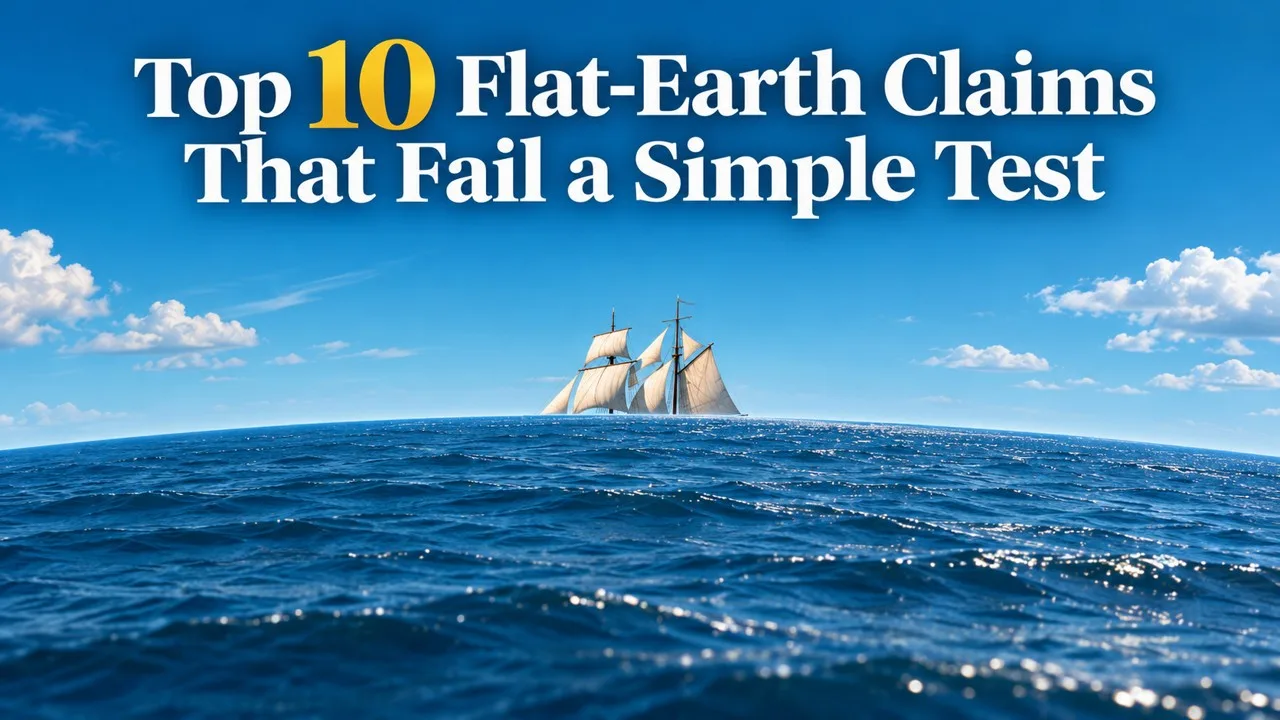
Flat-Earth claims often fail a simple test, from ships going hull-down to stars that pivot around a southern celestial pole.
The ten claims below are that a spinning Earth would be felt as a shove, that water cannot sit on a curved surface, that ships vanish only because they are far away, that Antarctica is a surrounding ice wall, that a modern space agency invented the globe, that density replaces gravity, that air routes make sense only on a flat map, that the stars turn above a single flat plane, that the Sun is a small local spotlight, and that a gyroscope's roughly fifteen-degree-per-hour drift is not Earth's rotation. This article is educational debunking. It will not mock named private people, and it will not treat a conspiracy story as a second content stream that has to be toured.
Key Facts
| Claim | A simple test or better description | A limit |
|---|---|---|
| 1 | Uniform rotation is not felt as a continuous shove; changing speed or direction is | Foucault's pendulum and the Coriolis effect are among the measurable traces of the spin |
| 2 | "Level" on a planet is an equipotential surface; oceans follow the geoid, which is curved | A still pond is locally flat to the eye and still consistent with a large sphere |
| 3 | A distant ship typically disappears hull first, masts later, as expected on a curved surface | Haze and refraction can complicate a single view; they do not reliably invert the order |
| 4 | Antarctica is a continent around the South Pole, reached, mapped, and circumnavigated | This is geography, not a tour of denial forums |
| 5 | A spherical Earth was argued and measured in antiquity, long before any modern space agency | Photographs from space are later confirmations, not the first evidence |
| 6 | Density and buoyancy already assume a downward force; in a vacuum, objects fall together regardless of density | "Density explains falling" moves the question without answering it |
| 7 | Long flights follow great-circle routes that look curved on a flat rectangular map and shorter on a globe | Winds and airspace add wiggles; they do not turn the globe into a poster |
| 8 | Southern skies show stars circling a southern celestial pole, and the visible constellations change with latitude | A single north-centered dome does not fit both hemispheres |
| 9 | The Sun's angular size stays nearly constant, and sunrise and sunset sweep the globe in a way a close lamp does not | A spotlight model fails time zones and the shape of night |
| 10 | A properly mounted gyroscope precesses with Earth's rotation, about fifteen degrees per sidereal hour | A poorly leveled demonstration is not a disproof |
1. A Spin You Do Not Feel as a Shove
If the Earth is rotating, a familiar objection says, people would be flung sideways or would at least feel a constant push [1]. The simple correction is that motion at a steady speed in a straight line is not felt, and a rotation that is very nearly constant is felt only through much smaller effects than a shove. The ground, the air, and the observer already share the same motion. What can be measured are traces of the rotation: a Foucault pendulum's slow turn, the slight equatorial bulge, and the Coriolis deflection that appears in large-scale winds and in long-range gunnery tables. Those are tests. "I do not feel like a passenger on a carousel" is not one, because a carousel of that slowness, with the rider already moving with it, is not designed to be felt as a shove [1].
The unexpected fact is that an unnoticed motion can still be, in instruments, a loud result [1]. This article will not offer a stunt. The careful fact is a documented distinction between velocity and acceleration, and documented pendulum and Coriolis measurements. Intuition is local. The instruments are larger than a room.
A planet can turn underfoot all day and still not tug at a sleeve.
2. Water Finds an Equipotential, Not a Cosmic Plane
Water "finds its level," and a flat-Earth claim takes that proverb as a proof that oceans cannot curve [2]. In physics, a free liquid surface at rest follows an equipotential of gravity, including the small centrifugal contribution from Earth's rotation. On a nearly spherical mass, that surface is curved. Over a short pond the curvature is tiny, so the water looks flat, which is why the proverb works in a garden. Over an ocean, the same rule produces a surface that follows the geoid. Surveyors and sailors have long had to allow for that. Experiments that claim to show a dead-flat canal over many miles have a messy history of setup error and of later, clearer measurements that recover the expected drop. The proverb is safe. The planetary inference is not [2].
The unexpected fact is that "level" can be a curved word without ceasing to be a useful one [2]. This article will not turn a lakeshore into a personal dare. The careful fact is a documented meaning of a level surface and documented geodetic curvature. Eyesight is short. The ocean is not.
A still harbor can look like a tabletop and still be, at the scale of a chart, a piece of a sphere.
3. Ships Go Hull-Down
A ship heading out to sea does not usually shrink evenly to a point and then vanish, as a shrinking object on a flat plane would [3]. The hull disappears first; masts and superstructure linger; a glass can bring some of the hull back into view as if it were in a shallow dip. That "hull-down" behavior is the simple, old observation that matches a curved surface. Atmospheric refraction can lift or distort a distant image, which is why a single odd photograph is a poor rebuttal, and why careful observers repeat the sight under different conditions. Distance alone, without curvature, does not explain the systematic loss of the bottom first [3].
Related: Top 10 Most Bizarre Phobias: Strange Fears That Exist
The unexpected fact is that a harbor pastime can be a geometry lesson [3]. This article will not require anyone to argue with strangers on a pier. The careful fact is a documented order of disappearance and a documented role for refraction as a complication, not as a general escape. The sea is the test. The mast is the marker.
A hull can be gone while a mast is still there, and that order is the part a flat plane does not naturally give.
4. Antarctica Is a Continent, Not a Surrounding Wall
A persistent claim holds that Antarctica is a ring of ice around a flat disc, a wall that cannot be crossed [4]. The geographic record is otherwise. Antarctica is a continent centered on the South Pole, with a documented coastline, research stations, mapped mountain ranges, and a history of expeditions, flights, and ships that have gone around it. The South Pole itself has been reached and occupied. This article will not tour rumors about hidden patrols, and it will not name private promoters of those rumors. The simple test is the ordinary literature of geography, exploration, and official Antarctic programs [4].
The unexpected fact is that a "secret wall" story has to erase a very public map [4]. The careful fact is a documented continent, documented circumnavigation, and documented year-round presence at the pole. Isolation is real. A surrounding wall is the addition that the maps do not support.
A place can be difficult to reach and still not be, in any honest atlas, a fence around the world.
5. The Globe Is Older Than Any Modern Space Agency
A later claim says that a modern space agency invented the spherical Earth to fool the public [5]. The timeline does not allow it. Greek geographers argued for a spherical Earth, and Eratosthenes estimated its circumference in the third century BCE with a method that still appears in classrooms. Medieval and early modern astronomers, navigators, and later national surveys added more precise figures, all long before the National Aeronautics and Space Administration existed. Photographs and satellite geodesy are welcome later confirmations. They are not the first reason anyone had to think the planet was round. A conspiracy that must begin in antiquity, and then include every maritime nation, is no longer a small suspicion about one agency [5].
The unexpected fact is that a space-age villain is being asked to take credit for a Hellenistic measurement [5]. This article will not follow a labyrinth of later accusations. The careful fact is a documented ancient measurement, documented later navigation, and a documented founding date for a modern agency that arrives very late in the story. Images from orbit are evidence. They are not the beginning of the evidence.
Related: Top 10 Oldest Buildings in the World
A sphere can be known by sticks and shadows and still be, later, photographed.
6. Density Does Not Replace Gravity
Some accounts say that gravity is unnecessary because "density makes things fall," or because heavy things sink and light things rise [6]. Density is mass per volume. Buoyancy is the result of a pressure difference in a fluid already sitting in a gravitational field, or in an equivalent accelerating frame. In a vacuum, a dense object and a less dense object fall together, which is the opposite of what a density-only slogan predicts. The simple test is a vacuum-tube demonstration, or the weaker classroom version with a coin and a feather in still air after the air's role is allowed for. Replacing the word "gravity" with the word "density" leaves the original question unanswered: why is there a down [6]?
The unexpected fact is that a useful school word, density, can be asked to do a job it cannot do alone [6]. This article will not stage a fight about terms for their own sake. The careful fact is a documented meaning of density, documented buoyancy, and documented vacuum-fall results. Sinking is a real behavior in fluids. It is not a theory of a planet's pull.
A rock can be denser than water and still need, in the explanation, a reason to have a direction called down.
7. Airline Routes Make Sense as Great Circles
On a flat rectangular map, especially a Mercator chart, many long flights look like odd curves, and a claim follows that the routes only "work" if the Earth is flat [7]. The opposite is true. The shortest path on a sphere is a great circle, which appears curved on many flat maps and looks more like a straight, shorter arc on a globe. Airlines follow those paths when they can, then add detours for winds, reserved airspace, and politics. The simple test is to stretch a string on a globe between two distant cities and compare it with the advertised track. A flat-poster reading of the same route is a map artifact [7].
The unexpected fact is that a "curved" flight can be the straight one, once the paper is allowed to be curved too [7]. This article will not be a booking guide. The careful fact is documented great-circle geometry and documented operational detours. Maps lie in known ways. The globe is the reason the lie has that shape.
A path can look wasteful on a classroom wall and still be, on the planet, a near-shortest line.
Related: 10 Sikh Gurus: The Pillars of Sikhism Who Shaped Faith, Equality, Courage, and Humanity
8. Stars That Pivot Around a Southern Pole
If the sky were a set of lights turning above a single flat plane, centered on a northern pivot, the southern hemisphere would not have the skies it has [8]. Observers south of the equator see a southern celestial pole, with stars circling it, and they lose northern circumpolar constellations that are always up in high northern latitudes. Travel north or south, and the height of those poles over the horizon changes in a regular way. The simple test is a long-exposure photograph of the southern sky, or a change of latitude and a look at what rises. A one-dome, north-only model has to invent a special mechanism for each of those facts [8].
The unexpected fact is that a plane ticket, or a photograph from a southern observatory, is already a cosmology test [8]. This article will not name private broadcasters of the one-dome story. The careful fact is documented southern circumpolar motion and documented change of view with latitude. The night sky is public. The second pole is the part a flat, north-centered lid does not furnish.
A star can circle a point that is not in the north, and that fact is hard to unsee once it has been seen.
9. The Sun Is Not a Small Local Spotlight
A close, small lamp moving above a disc can be drawn so that it lights part of the map at a time [9]. It does a poor job of matching the real Sun. The Sun's apparent size stays nearly constant from sunrise to sunset, which is not what a nearby spotlight does as it approaches and recedes. Night is a curved terminator moving around a globe, producing time zones in a regular sequence, not a shrinking pool of lamp-light with the peculiar edges a close source would throw over a flat surface. Eclipses and the seasons have their own spherical accounts. The simple test is to watch the Sun's disc with safe projection and to notice that noon in one city is night in another, every day, in a stable pattern [9].
The unexpected fact is that a lamp drawn on a poster fails a measurement anyone can make of the Sun's size [9]. This article will not give a staring instruction; projection or published data will do. The careful fact is a documented nearly constant angular size and documented time-zone structure. Light is local at noon. The engine of that noon is not a nearby stage lamp.
A sunset can be a daily fact in one harbor and a sunrise, at the same minute, in another, which is an awkward trick for a single hanging spotlight.
Related: Top 10 Tallest Buildings in the World
10. A Gyroscope That Keeps Earth's Time
A gyroscope, mounted so that it can hold an orientation relative to inertial space, will appear to drift relative to the laboratory as the Earth turns, about fifteen degrees per sidereal hour [10]. That rate is a simple consequence of a 360-degree rotation in a sidereal day, and it is used in inertial navigation. Demonstrations that seem to show a different drift, or none, often fail because the mount is not isolated, not level, or not run long enough under controlled conditions. The claim that "the gyroscope disproves a spinning Earth" is, in the cases that can be checked, a claim about a particular table-top setup. The better test is a well-built device, or the related Foucault pendulum, both of which track the rotation [10].
The unexpected fact is that a navigation tool can be quoted as a disproof of the motion it is built to follow [10]. This article will not treat a viral clip as an experiment of record. The careful fact is a documented sidereal rate and documented use of gyroscopes in navigation. Drift, here, is a feature. It is Earth's hour hand.
A wheel can seem to wander along a scale and still be, in the better description, the one object in the room that refused to turn with the walls.
Conclusion
The ten claims above fail tests that do not require a secret file: an unfelt but measurable spin, a curved idea of level, ships that go hull-down, a southern continent, a globe older than any modern agency, a vacuum fall that density alone cannot explain, great-circle routes, a southern celestial pole, a Sun that does not behave like a close lamp, and a gyroscope that keeps sidereal time. A simple test is often already public.
A planet can be large, and still be checked with a harbor, a pendulum, and a map that is allowed to be honest about its own distortions.
- ^ [1] Physics accounts of uniform motion, Foucault's pendulum, Earth's equatorial bulge, and the Coriolis effect as measurable traces of rotation. https://www.britannica.com/science/Foucault-pendulum https://www.britannica.com/science/Coriolis-force
- ^ [2] Geodetic and physical accounts of a level surface as an equipotential, of the geoid, and of how a locally flat pond is consistent with a curved ocean. https://www.britannica.com/science/geoid https://www.britannica.com/science/sea-level
- ^ [3] Nautical and geometric accounts of hull-down disappearance, including the complicating role of atmospheric refraction. https://www.britannica.com/science/horizon https://www.britannica.com/technology/navigation
- ^ [4] Geographic and exploratory accounts of Antarctica as a continent around the South Pole, including mapping, circumnavigation, and year-round research presence. https://www.britannica.com/place/Antarctica U.S. Antarctic Program materials
- ^ [5] Historical accounts of ancient and later measurements of a spherical Earth, including Eratosthenes, distinguished from much later space-agency imagery. https://www.britannica.com/biography/Eratosthenes https://www.britannica.com/topic/geodesy
- ^ [6] Physical accounts of density, buoyancy, and free fall in a vacuum, showing why density is not a replacement for a downward gravitational force. https://www.britannica.com/science/gravity-physics https://www.britannica.com/science/buoyancy
- ^ [7] Geometric and aviation accounts of great-circle routes and of why those tracks appear curved on common rectangular maps. https://www.britannica.com/science/great-circle-route https://www.britannica.com/science/Mercator-projection
- ^ [8] Astronomical accounts of the south celestial pole, southern circumpolar stars, and the change of visible sky with latitude. https://www.britannica.com/science/celestial-sphere https://www.britannica.com/place/south-celestial-pole
- ^ [9] Astronomical accounts of the Sun's nearly constant angular size, the terminator, and the regular structure of time zones, contrasted with a close-spotlight model, without unsafe viewing instructions. https://www.britannica.com/science/Sun https://www.britannica.com/science/time-zone
- ^ [10] Accounts of gyroscopic precession relative to a rotating Earth, the roughly fifteen-degree-per-sidereal-hour rate, and the use of gyroscopes in inertial navigation. https://www.britannica.com/science/gyroscope https://www.britannica.com/technology/inertial-guidance-system





















Discussion
Log in with