






Top 10 Factors, Besides the Iceberg, in the Titanic Disaster
 By Dhiraj Sharma · Published
Share Post
Loading…
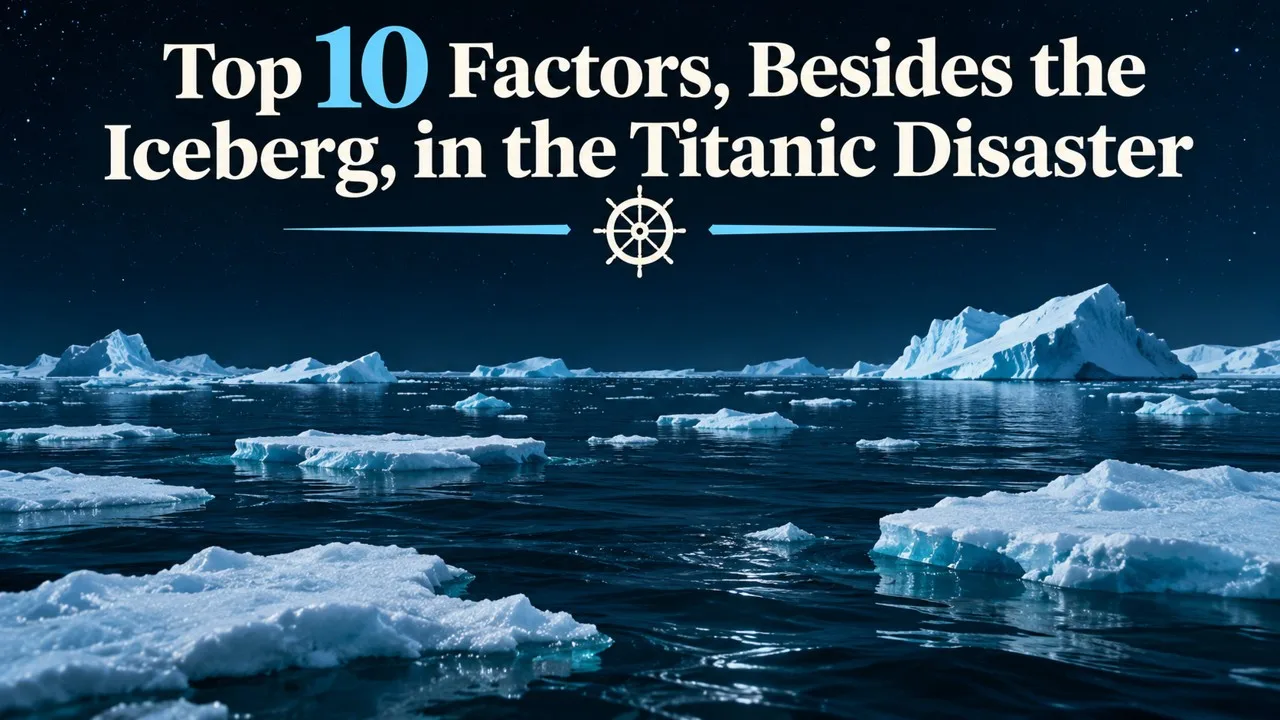
The iceberg still matters in the Titanic disaster; other factors, from a still night to a nearby ship that did not come, are contributing causes.
The ten factors below are a very calm sea, later claims about open portholes, rivet quality, ice warnings that did not reach the bridge as they should have, a last-minute engine order, missing binoculars in the crow's nest, a brusque wireless exchange, speed in an ice region, a coal-bunker fire, and the nearby Californian. On the night of 14–15 April 1912 the ship struck ice and sank in the North Atlantic, with a great loss of life. This article is inquiry-based history. The ice remains the object that opened the hull. The other items are contributing or later-debated factors, not a rewrite that erases the berg. This article will not dwell on drowning or treat the wreck as a spectacle.
Key Facts
| Factor | The better-supported role | A limit |
|---|---|---|
| 1 | A nearly flat sea made a dark iceberg harder to spot, because there was little breaking water at its base | Bioluminescence as a reliable beacon should be treated as a later, softer idea |
| 2 | Some later writers argue that open portholes sped flooding | The strong numerical claims are estimates, not a settled second hole in the ship |
| 3 | Some wrought-iron rivets, especially in the bow, have been shown to contain slag that could have helped seams fail | "Cheap, unique junk" overstates a period technology that still had a quality problem in places |
| 4 | At least one serious ice warning was not delivered to the bridge as a formal master message | "A typo" is the wrong name for a wireless-workload failure |
| 5 | A late order to stop or reverse engines may have reduced rudder effect; this is a later hypothesis, not a proven "nail in the coffin" | A counterfactual cannot be run at sea |
| 6 | Lookouts lacked binoculars after a key was taken off the ship; how much the glasses would have helped on that night is debated | Eyes in the dark were the usual tool for ice |
| 7 | A brusque exchange with a nearby ship cut short an ice warning shortly before the collision | Period radio manners, not a simple personal vendetta, are the setting |
| 8 | The ship was near full service speed in a known ice region, which reduced time to react | Later stories of a record attempt or a single pressuring owner should be qualified |
| 9 | A coal fire in a bunker is documented; its role in weakening a bulkhead is disputed and often overstated | A fire can be real and still not be the main cause |
| 10 | The nearby Californian saw rockets and did not come in time; the wireless operator was off duty | "Ignored" should not erase a failure of interpretation |
1. A Still Night, and Ice That Did Not Break the Water
The night of the collision was unusually calm and clear, with stars and little swell [1]. Lookouts later said that a very still sea made ice harder to see, because there were no waves collapsing in white at the base of a berg. That is a straightforward visibility point, and it belongs in any careful account. Later retellings sometimes add that glowing plankton would ordinarily have outlined the ice and were missing that night. Bioluminescence can happen in those waters; it is a softer, less necessary part of the explanation. The ship still had to be in the ice, and the berg still had to be there [1].
The unexpected fact is that "good weather" can be, for a lookout, a kind of poor light [1]. This article will not quote survivor lines at length. The careful fact is documented calm and documented testimony about a dark object on a dark sea. Beauty on the water was real. It did not announce the ice.
A flat sea can look safe and still have been, that night, part of why the object was seen late.
2. Open Portholes, as a Later Estimate
After the collision, some passengers and crew opened portholes or left them open, and later researchers, including the writer Tim Maltin, have argued that those openings let water in faster than the hull damage alone would have [2]. It is a possible contributing path, and it is not a replacement for the torn or sprung plates. Strong later numbers, such as a claim that a handful of open lights would have "doubled" the flooding, should be read as estimates from a particular reconstruction, not as a second official finding of the 1912 inquiries. Curiosity after a shock is human. It is not, on present evidence, a complete new theory of the sinking [2].
The unexpected fact is that a small window can be asked, a century later, to do a lot of explanatory work [2]. This article will not restage the flooding as a diagram for its own sake. The careful fact is some testimony about open lights and a documented, still-debated later calculation. Water entered because the ship was already wounded. The glass is a possible extra mouth.
A porthole can matter at the margin and still not have been, in the inquiries, the hole that began the night.
3. Rivets, Slag, and a Qualified Metallurgy
The Olympic-class hull plates were joined with rivets, iron in some areas and steel in others, a standard method of the time [3]. Later laboratory work by Tim Foecke and Jennifer Hooper McCarty found that some wrought-iron rivets, especially toward the bow, contained more slag than a well-made iron rivet should, which could have made them more likely to fail as the ice pressed along the seams. That is a serious, limited finding. Popular versions that call the ship uniquely shoddy, or that treat every rivet as junk, outrun the papers. The design was conventional, the yard was among the best, and a quality problem in some batches is still a contributing factor worth naming. The iceberg supplied the load [3].
Related: Top 10 Most Bizarre Phobias: Strange Fears That Exist
The unexpected fact is that a later microscope can change, a little, how a famous seam is imagined [3]. The careful fact is documented mixed rivet types and documented slag in some recovered or period-matched iron. Craft was real. So, in places, was a weaker fastener.
A rivet can be ordinary for its year and still have been, in some rows, a poorer bar than the ship needed that night.
4. A Warning That Did Not Arrive as a Master's Message
Titanic received multiple ice warnings on 14 April [4]. One important message, from the liner Mesaba, reported heavy ice on the track ahead. In later reconstructions, it was not treated as a formal "MSG" or master-service message that had to be taken at once to the captain and signed, and it did not shape the bridge's night as it might have. The failure is better described as wireless workload and procedure than as "a typo." The operators were also handling passenger traffic, a paying part of the new service. Other warnings had already been received. The Mesaba message is still a missed last chance, not the only ice information the ship had [4].
The unexpected fact is that a crucial sentence can sit in a wireless room and never become a helm order [4]. The careful fact is documented incoming ice reports and a documented delivery failure on at least one late, specific warning. Attention was divided. The ice was not a secret to the North Atlantic that day.
A telegram can be correctly sent and still not have been, on the bridge, a sentence that changed the speed.
5. A Last Engine Order, as a Hypothesis
In the last seconds, First Officer William Murdoch ordered the helm hard over and signaled the engine room to stop or reverse [5]. Later commentary, including a discussion associated with the scientist Richard Corfield, has suggested that taking way off the center propeller, the one that most affected the rudder on this class, may have reduced the ship's ability to turn, and that a different order might have widened the miss. That is a counterfactual. It cannot be rerun, and it should not be filed as a finding that Murdoch "caused" the collision. He was trying to avoid ice that was already too close. The hypothesis belongs in a list of contributing mechanical ideas, with a label on it [5].
The unexpected fact is that an instinctive good order can be argued, later, to have had a cost in steering [5]. This article will not offer a helm lesson. The careful fact is a documented last maneuver and a documented, unprovable later critique. Urgency was real. Certainty about the other path is not.
Related: Top 10 Oldest Buildings in the World
A telegraph can be thrown with the best intention and still have been, in a later paper, a debated lever.
6. Lookouts, a Missing Key, and a Debated Glass
David Blair, an officer transferred off the ship before the maiden voyage, apparently took the key to a locker that held binoculars for the crow's nest [6]. The lookouts on duty, including Frederick Fleet, later said they had no glasses. That bureaucratic miss is documented in the human sense. What is debated is how much binoculars would have helped in picking up a dark berg on a dark, still night. Some officers of the period argued that the unaided eye was better for that work, and that glasses were for identifying a light already seen. A missing tool can be real and still not be, by itself, the reason the ice was struck [6].
The unexpected fact is that a key in a transferred officer's pocket can become a century-long "if only" [6]. The careful fact is documented absence of the glasses and documented disagreement about their value that night. Equipment was missing. The usefulness is the open clause.
A locker can be closed and still not have been, in every seaman's opinion, the difference between a miss and a wound.
7. A Brusque "Keep Out," and a Warning Cut Short
Shortly before the collision, the wireless operator of the nearby Californian, Cyril Evans, tried to tell Titanic that his own ship was stopped in ice [7]. Jack Phillips, busy with passenger traffic to Cape Race, told him, in the brusque manner of the service, to stop transmitting. Evans shut down for the night. The exchange is documented and later became a moral scene. It is better read as workload and radio custom than as a personal decision to "ignore ice." The warning, if it had been completed and taken to the bridge, might have added to information already received. It was still a lost message from a ship that was, fatally, close [7].
The unexpected fact is that a piece of workplace rudeness can sit, afterward, next to a disaster [7]. This article will not reprint a transcript as a drama. The careful fact is a documented cut-off call and a documented later shutdown of the nearby set. Manners were short. The distance between the ships was shorter.
Related: 10 Sikh Gurus: The Pillars of Sikhism Who Shaped Faith, Equality, Courage, and Humanity
A operator can tell another to go away and still not have been, in any simple sense, the man who chose the iceberg.
8. Speed in a Region Already Known for Ice
Titanic was making near her full service speed when she entered a region where ice had been reported [8]. That was not unique to this ship; Atlantic liners of the period often kept speed in clear weather and trusted lookouts, a practice the later inquiries treated as a serious contributing error. Stories that Captain Edward Smith was chasing a record, or that Bruce Ismay personally forced the pace in a simple, proved scene, are weaker than the general fact of high speed in ice waters. Time to see, time to turn, and energy at impact all scale with that speed. The berg was still the thing that was hit [8].
The unexpected fact is that a normal commercial habit can be, after a wreck, the habit that will not be defended [8]. The careful fact is documented high speed and documented later official criticism of that practice. Punctuality was a value. It was the wrong value for that patch of sea.
A ship can be almost "on time" and still have been, in the inquiry's judgment, too fast for the reports already on the chart.
9. A Coal Fire That Is Documented, and a Theory That Is Not Settled
A fire in a coal bunker on Titanic is attested in testimony and in later photographs of a darker patch on the hull [9]. Coal fires were an unwelcome but known problem on steamships. Some later accounts, widely popularized in the last two decades, argue that the fire substantially weakened a bulkhead and so hastened the sinking. Many historians treat that causal step as overstated. The fire can be listed as a real condition of the voyage without being promoted into a second iceberg. It may have mattered at the margin. It has not displaced the ice, the wounds, or the missing boats in any careful ranking [9].
The unexpected fact is that a dirty, ordinary bunker problem can be asked to explain a world's most famous hull [9]. The careful fact is documented fire and documented scholarly dispute about later, large claims. Heat was present. A collapsed official story of the night is not.
Related: Top 10 Tallest Buildings in the World
A fire can burn in a bunker and still not have been, on the better evidence, the main author of the sinking.
10. A Nearby Ship That Did Not Come in Time
The Leyland liner Californian was close enough, on the night, that her officers saw rockets and a ship that later was not there [10]. Her wireless operator had gone off duty. Captain Stanley Lord and his officers did not treat the rockets as a distress call that required an immediate approach through the ice. The British inquiry was severely critical. Later defenders have argued about distances, about what the rockets looked like, and about ice around the Californian herself. "Ignored" is too simple if it means a man watched a sinking and chose to stay put in full knowledge. "Failed to interpret and to come" is the finding that has lasted. Other, farther ships also received calls and turned, too late to take people off [10].
The unexpected fact is that a rescue can fail at a few miles as well as at a few hundred [10]. This article will not turn Lord into a stage villain or a martyr. The careful fact is documented rockets, a documented silent wireless, and a documented official criticism. Nearness was a chance. It was not taken in time.
A ship can be almost in sight and still not have been, that night, a lifeboat.
Conclusion
The ten factors above include a still sea, a debated role for open lights, some weaker rivets, a warning that stayed in a wireless room, a last engine order that later writers second-guess, missing binoculars, a cut-off call, high speed, a bunker fire of disputed importance, and a nearby ship that did not come. The iceberg remains the object that the hull met.
A disaster can have many contributing conditions and still have one name, on the chart, for the thing that opened the plates.
- ^ [1] Inquiry testimony and later historical accounts of the calm, clear night of 14 April 1912 and of the difficulty of seeing a dark iceberg on a still sea, with bioluminescence treated as a softer later idea. https://www.britannica.com/topic/Titanic Royal Museums Greenwich Titanic materials
- ^ [2] Later reconstructions, including work associated with Tim Maltin, of possible flooding through open portholes, presented as estimates rather than as a second official cause, and without a sensational flooding narrative. https://www.britannica.com/topic/Titanic related documentary discussions
- ^ [3] Metallurgical studies by Tim Foecke and Jennifer Hooper McCarty of slag in some wrought-iron rivets, qualified against popular claims that the entire ship was uniquely shoddy. related metallurgy discussions https://www.britannica.com/technology/ship-construction
- ^ [4] Accounts of ice warnings received on 14 April, including the Mesaba message and the failure to treat it as a formal master's message, framed as wireless workload rather than as a typo. https://www.britannica.com/topic/Titanic later official-inquiry materials
- ^ [5] Accounts of the last helm and engine orders, and of later hypotheses that reducing propeller way may have hurt rudder effect, clearly labeled as unrun counterfactuals. https://www.britannica.com/topic/Titanic https://www.britannica.com/technology/rudder
- ^ [6] Testimony and later historical accounts of the missing crow's-nest binoculars after David Blair's transfer, and of contemporary debate about the value of glasses for spotting ice at night. https://www.britannica.com/topic/Titanic https://www.encyclopedia-titanica.org/
- ^ [7] Accounts of the wireless exchange between Titanic and the Californian shortly before the collision, including the later shutdown of the nearby set, without a dramatic reprint of the exchange. https://www.britannica.com/topic/Titanic https://www.britannica.com/technology/wireless-telegraphy
- ^ [8] Inquiry findings and later historical accounts of high speed in a reported ice region, with later record-attempt and owner-pressure stories qualified. https://www.britannica.com/topic/Titanic https://www.britannica.com/biography/Edward-J-Smith
- ^ [9] Testimony and later debates about a coal-bunker fire, distinguishing a documented fire from overstated claims that it was a principal cause of the sinking. https://www.britannica.com/topic/Titanic https://www.britannica.com/technology/steamship
- ^ [10] Inquiry records and later historical debate about the Californian, the rockets, the silent wireless, and the failure to approach in time, avoiding a simple villain or martyr reading. https://www.britannica.com/topic/Titanic https://www.britannica.com/topic/International-Convention-for-the-Safety-of-Life-at-Sea




















Discussion
Log in with