






Top 10 Famous Figures Who Turned Out to Be Legendary
 By Dhiraj Sharma · Published
Share Post
Loading…

Some famous names belong to literature, advertising, or later tradition, and did not exist is too blunt when a real person was later buried in stories.
The ten names below are Mulan, Homer, Lycurgus of Sparta, Sun Tzu, Betty Crocker, Robin Hood, John Henry, Pythagoras, Uncle Sam, and King Arthur. A William Tell apple shot is treated as a non-event in another Finepedia list; this one stays with the problem of a figure's status. "Did not exist" fits a brand character and a medieval letter-king better than it fits a philosopher who was later coated in miracles. This article will not display likenesses or copyrighted character designs.
Key Facts
| Name | The better-supported status | A limit |
|---|---|---|
| 1 | Mulan is a figure of Chinese ballad and later literature, not a securely documented single soldier | Later films and novels are adaptations, not biographies |
| 2 | Homer is the traditional name for the Iliad and the Odyssey; a single, biographically known author is not secure | The poems are real; the life story is the thin part |
| 3 | Lycurgus, the lawgiver of early Sparta, is treated by many historians as legendary or composite | Spartan institutions were real; the single founder is the problem |
| 4 | The Art of War is a real text; whether a single historical Sun Tzu wrote it as later biography claims is debated | This is not a manual of tactics |
| 5 | Betty Crocker was invented as a company signature and a composite face, not born as one baker | A brand character can still sign real recipes |
| 6 | Robin Hood is a ballad outlaw; no single documented life matches the later hero | Sherwood, in the stories, is a literary forest |
| 7 | John Henry is a labor legend, possibly attached to one or more railroad workers, whose contest with a machine is not a filed event | The work of driving steel was real and deadly |
| 8 | Pythagoras almost certainly existed; many famous tales, and some mathematical credits, are later tradition | "Did not exist" is the wrong verdict |
| 9 | Uncle Sam is a personification of the United States, later linked, as an explanation, to a New York packer named Samuel Wilson | A nickname is not a complete biography |
| 10 | King Arthur, as the later romances have him, is not a documented post-Roman king | Earlier war leaders may lie behind the name; the court at Camelot is literary |
1. Mulan Is a Ballad, Not a Service Record
The woman who disguises herself to take a parent's place in the army is a figure of the Ballad of Mulan and of later Chinese storytelling, then of still later fiction and film [1]. There is no securely documented service record for a single historical soldier that matches the later full biography. A ballad can remember a type of loyalty, or even a lost local story, without handing historians a birth date and a unit. Later adaptations are literature and cinema. They are not newly discovered archives. This article will not reproduce copyrighted character designs [1].
The unexpected fact is that a national heroine can be, in the surviving early form, a poem [1]. The careful fact is a documented literary tradition and an absence of a matching official life. Courage, as a theme, is real in the tale. A personnel file is what we do not have.
A name can be famous in a uniform and still not have been, in any surviving roll, a person who signed a discharge.
2. Homer Names Poems More Securely Than a Life
The Iliad and the Odyssey exist, and they stand at the start of the European epic tradition [2]. "Homer" is the name later antiquity attached to their making, along with a biography of a blind bard from this or that city. Modern scholarship commonly treats the poems as products of a long oral tradition, written down in the early first millennium BCE, and treats a single, recoverable personal life as unproved. Some specialists still argue for a dominant composer of one or both poems. The honest public sentence is that the texts are solid and the childhood is not. "Homer did not exist" is too blunt if it sounds as if the poems had no makers [2].
The unexpected fact is that the West's most famous author can be, biographically, a question mark [2]. This article will not quote the epics at length. The careful fact is documented poems and an undocumented, or only later-documented, life. Tradition needed a name. The verses did not need a classroom biography to be real.
A poet can be indispensable as a name and still not be, in the evidence, a single dated career.
3. Lycurgus, or a Constitution with a Founder's Name
Ancient writers credit Lycurgus with giving Sparta its severe constitution, land arrangements, and training system [3]. Plutarch wrote a life of him as if he were a dated reformer. Many modern historians treat that life as legendary or as a composite, a way of attaching a later, slowly formed social order to a single wise founder. Sparta was a real state with unusual institutions. The problem is the biography that makes those institutions the gift of one man on one visit to an oracle or one return from travel. "Did not exist" may over-state a case in which a name might still hide a dim early figure. "Not usable as a dated biography" is the safer claim [3].
Related: Top 10 Most Bizarre Phobias: Strange Fears That Exist
The unexpected fact is that a constitution can have a founder in literature and a much slower birth in practice [3]. This article will not display a crest. The careful fact is documented later lives of Lycurgus and a documented scholarly reluctance to treat them as reportage. Austerity was a Spartan brand. A single lawgiver is the convenience.
A city can be famous for laws and still not have received them, as a parcel, from one traveler.
4. A Text That Is Real, a Biography That Is Debated
The Art of War is a genuine Chinese classic of strategy, compiled in something like its received form by the late centuries BCE [4]. Later tradition makes Sun Tzu, or Sun Wu, a contemporary of kings, a general who tested discipline in a court, and the book's sole author. Scholars debate how much of that life can be recovered and whether the text is a layered collection under an ancestral name. The honest statement is not "the book is a fake." It is that a famous general's full biography is thinner than the book's later fame. This article will not extract tactics or quote the text as a field manual [4].
The unexpected fact is that a world's most reprinted military book can have, as a person, a less stable file than its chapters [4]. The careful fact is a documented text and a debated authorial life. Strategy is the subject. A dated career is the part that will not sit still.
A name on a title page can be a tradition of teaching and still not be, in every detail, a personnel record.
5. Betty Crocker Was Invented in an Office
Betty Crocker began in the 1920s as a company signature for a flour firm, a way to answer letters in one friendly voice, and later as a composite portrait assembled from more than one employee [5]. There was no single baker by that name who wrote every later booklet and appeared on every later package. The character signed real recipes and a real advice service. "Did not exist" is, here, accurate in the biographical sense, and still slightly rude to the staff whose work the name organized. A trademark face is not a childhood [5].
The unexpected fact is that millions of kitchens can have, as a teacher, a committee [5]. This article will not display a logo or a package portrait. The careful fact is a documented corporate invention and a documented later composite picture. Advice was a service. The birth certificate is the missing document, on purpose.
Related: Top 10 Oldest Buildings in the World
A household name can be printed in a million kitchens and still not have been, at any hospital, a newborn.
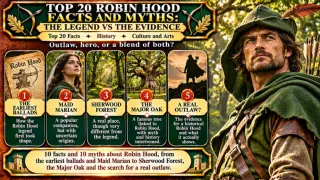
6. Robin Hood Lives in Ballads
Robin Hood, in the surviving early ballads and in later retellings, robs the rich, aids the poor, and lives in a forest of later English imagination [6]. Medieval records contain men with similar names, and later antiquaries tried to pin the hero to a dated outlaw. No single documented life has convinced historians that it is the ballad figure. Sherwood, in the full later sense, is a literary geography. Outlawry and official corruption were real social facts. The merry, green-clad biography is the part that belongs to song [6].
The unexpected fact is that a political hero of later popular culture can be, in the early texts, already a moving target [6]. This article will not display a likeness or a county seal. The careful fact is a documented ballad tradition and an absence of a matching, agreed life. Injustice, as a theme, is historical. The particular yeoman is not a personnel file.
A forest can be full of later stories and still not have been, in any one year, the registered address of that hero.
7. John Henry, Steel, and a Contest That Lives in Song
John Henry, in American work song and later literature, is a steel driver who races a steam drill and wins at the cost of his life [7]. Railroad construction, including dangerous hammer work, sometimes by convict or poorly protected labor, was real. Researchers have proposed historical candidates, including men who may have worked on southern railroad projects in the nineteenth century. None of those identifications has become a settled, documented contest against a machine on a dated day. The legend is a way of talking about labor, dignity, and replacement by equipment. The race, as a filed event, is the weak part [7].
The unexpected fact is that a work song can be a better record of a feeling than of a stopwatch [7]. This article will not display a likeness. The careful fact is a documented occupational world and a documented, unsettled search for one man. Muscle was spent. The victory over the drill is the legend's shape.
Related: 10 Sikh Gurus: The Pillars of Sikhism Who Shaped Faith, Equality, Courage, and Humanity
A hammer can have killed men in fact and still not have been, in a surviving report, the tool that beat a particular engine.
8. Pythagoras Existed; Many of the Stories Did Not
Pythagoras of Samos, in the sixth century BCE, is hard to erase as a historical person: a teacher, the founder of a community in southern Italy, a name later Greek writers could not quite ignore [8]. Almost everything popularly attached to him is shakier. Later lives give him miracles, a golden thigh, travels that look like a tour of later philosophy, and a clean authorship of theorems that were probably the work of a school over time. The theorem later named for him has a longer, international history. "Pythagoras did not exist" over-corrects. "The biography is mostly later tradition" is the point of this list [8].
The unexpected fact is that a mathematician can be real and still be, in the ancient lives, half a saint [8]. This article will not assign a schoolroom proof as a personal autograph. The careful fact is a documented early reputation and a documented legendary overlay. A community existed. The wonders are the later coat.
A founder can have walked in a real city and still not have done, in any sober report, the marvels a later life required.
9. Uncle Sam Is a Personification, Not a Single Life
Uncle Sam is a national personification of the United States, used in print, political cartoons, and later official imagery [9]. A popular explanation traces the name to Samuel Wilson, a Troy, New York, packer whose "U.S." provisions during the War of 1812 were supposedly joked about as "Uncle Sam's." That story is an attractive local origin; it is not a complete proof that one man became the later figure, and the figure is, in any case, not a biography. No childhood of the emblem needs to be found. This article will not display the later pointing-poster likeness or a flag [9].
The unexpected fact is that a country can acquire a relative who never had to be born [9]. The careful fact is a documented emblem and a documented, later origin story of a possible namesake. Provisioning was a real trade. The tall uncle is a symbol.
Related: Top 10 Tallest Buildings in the World
A nickname can sit on barrels and still not have been, except as a joke, a man who enlisted.
10. Arthur, as the Romances Have Him, Is Not a Dated Reign
King Arthur, with a court, a round table, and a particular set of later knights, is a figure of medieval Welsh tradition and of still later French and English romance [10]. Historians have looked for a post-Roman war leader who might stand somewhere behind the name. No contemporary chronicle gives a king who matches the later career. Camelot is a literary address. Early medieval Britain had real conflicts and real leaders after Roman administration receded. The full royal biography is the invention that later centuries loved [10].
The unexpected fact is that a throne can be solid in literature and vacant in the fifth-century record [10]. This article will not display a crest or a copyrighted later knight. The careful fact is a documented romance tradition and an absence of a matching dated reign. War in post-Roman Britain was real. The particular crown is not a proven office.
A king can rule a library and still not have been, in any surviving tax or letter, the man the later novels require.
Conclusion
The ten names above include a ballad soldier, a name for two epics, a possibly composite lawgiver, a debated author of a real book, a company baker, a ballad outlaw, a labor legend, a philosopher buried in later wonders, a national uncle, and a romance king. "Did not exist" is a tool. Used without care, it flattens different kinds of uncertainty into one sneer.
A figure can be historically important as a story, and still not be, except in the special case of a brand, a person who left a file.
- ^ [1] Literary-historical accounts of the Ballad of Mulan and later retellings, distinguished from a securely documented individual service record, without copyrighted character designs. https://www.britannica.com/topic/Hua-Mulan https://www.britannica.com/art/ballad
- ^ [2] Classical and modern accounts of the Homeric poems and of the uncertain biographical status of a single author named Homer, without long quotation. https://www.britannica.com/biography/Homer-Greek-poet https://www.britannica.com/topic/Homeridae
- ^ [3] Historical accounts of the Lycurgus tradition and of modern caution about treating the Spartan lawgiver as a dated biography. https://www.britannica.com/biography/Lycurgus-Spartan-lawgiver https://www.britannica.com/place/Sparta
- ^ [4] Historical and textual accounts of the Art of War and of scholarly debate about a single historical Sun Tzu, presented without tactical instruction or long quotation. https://www.britannica.com/biography/Sunzi https://www.britannica.com/topic/The-Art-of-War
- ^ [5] Business-historical accounts of the 1920s invention of Betty Crocker as a company signature and later composite portrait, without logos or package art. https://www.britannica.com/topic/Betty-Crocker https://www.britannica.com/topic/advertising
- ^ [6] Literary and historical accounts of the Robin Hood ballad tradition and of the failure of later attempts to fix one documented life to the hero. https://www.britannica.com/topic/Robin-Hood https://www.britannica.com/art/ballad
- ^ [7] Folklore and labor-historical accounts of the John Henry tradition, including proposed historical candidates and the unsettled status of the contest with a machine. https://www.britannica.com/topic/John-Henry-folk-hero related Library of Congress folksong materials
- ^ [8] Historical accounts of Pythagoras as an early Greek figure and of the later legendary overlay, including caution about treating famous theorems as his personal autograph. https://www.britannica.com/biography/Pythagoras https://mathshistory.st-andrews.ac.uk/Biographies/Pythagoras/
- ^ [9] Historical accounts of Uncle Sam as a personification and of the later Samuel Wilson origin story, without likenesses or flags. https://www.britannica.com/topic/Uncle-Sam related National Museum of American History materials
- ^ [10] Historical and literary accounts of the Arthurian tradition, distinguishing later romance from the absence of a documented king who matches that career. https://www.britannica.com/topic/King-Arthur https://www.britannica.com/topic/Arthurian-legend




















Discussion
Log in with