






Top 10 Historical Food-Safety Rules That Now Seem Odd
 By Dhiraj Sharma · Published
Share Post
Loading…
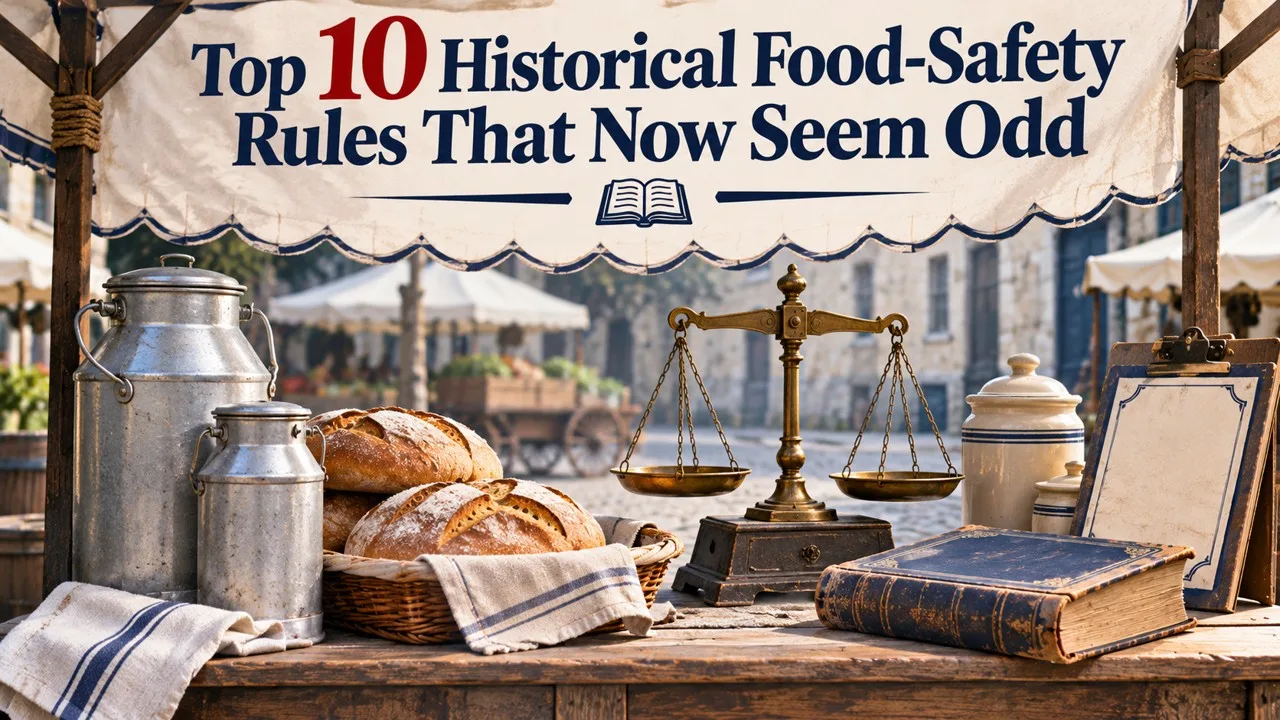
Past food-safety rules can look odd until they are read as answers to shared cups, dirty milk, and food that was not what the label said.
The ten cases below are penny-lick glasses, the common drinking cup, oyster-bed certification, dairy hygiene and pasteurization, poisonous candy colors, margarine color laws, swill milk, federal meat inspection, lead in food-contact surfaces, and commercial canning after early botulism outbreaks. Some popular retellings of "quirky" rules, including embroidered market gloves, "sanity gates," and a wartime skull stamp on plates, do not rest on a file this article can stand behind, so they are not repeated here as fact. This is a history of regulation. It is not current medical, dairy, or canning advice.
Key Facts
| Rule or campaign | What is documented | A limit |
|---|---|---|
| 1 | Shared glass penny-licks for ice cream, later pushed out as unsanitary | A real hygiene worry; a single 1898 outbreak number is not required to make the point |
| 2 | Bans on the common drinking cup, especially after 1909 in Kansas and then in other states | A small object became a legal issue because it was public and unwashed |
| 3 | Shellfish-growing waters certified after oyster-linked typhoid outbreaks | This was about beds and shipping, not a theatrical "private shuck" decree |
| 4 | Clean milking, tuberculin-tested herds, and the rise of pasteurization | Later dairy codes, not a miracle three-year "cow bath" certificate |
| 5 | Nineteenth-century action against mineral colors in candy | Bright green was sometimes literally toxic |
| 6 | Oleomargarine laws that governed color and labeling | A fraud-and-identity rule that now looks like a war on a spread |
| 7 | Campaigns against "swill milk" from distillery-fed city cows | Urban dairies, not a nostalgic farm picture |
| 8 | The 1906 federal meat-inspection regime after a public scandal | Inspection, not a later curved-chute legend moved backward in time |
| 9 | Recognition that acidic food and drink can take up lead from glaze, pipes, or vats | A long, documented poisoning path, not a 1944 collector stamp |
| 10 | Commercial canning reforms after early-twentieth-century botulism in canned foods | History of a industry standard, not a home-canning lesson |
1. A Glass That Too Many Mouths Shared
In late-nineteenth-century Britain, cheap street ice cream was often sold in a small, thick glass, the penny-lick, which the customer licked clean and handed back [1]. Vendors could not, in practice, wash each glass as a shop would wash a cup. Public-health writers treated the habit as a way to move infection from mouth to mouth. The glasses were later discouraged or banned in various places, and single-use cones and paper cups took over the trade. A popular story that pins a precise East End outbreak, and a famous statistician already dead by then, on a single 1898 committee should not be required to make the hygiene point [1].
The unexpected fact is how much of the "treat" was the vessel, and how late that vessel was recognized as the risk [1]. This article will not offer a current ice-cream rule. The careful fact is a documented shared glass, a documented official discomfort, and a later shift to a disposable or edible holder. The cone's fame as a fair novelty sits beside this plainer reason: a glass that went from mouth to mouth was a bad idea once germs were a public language.
A penny could buy a lick. The lick, it turned out, was also a public-health object.
2. The Train-Station Cup That Became Illegal
In the same years, many schools, trains, and public fountains offered a common drinking cup, chained or left beside the cooler for whoever came next [2]. After 1909, Kansas, under a campaign associated with the public-health official Samuel Crumbine, banned the public common cup; other states followed. The rule can look fussy, a law about a tin cup. It was aimed at a cup that never got a reliable wash between strangers. Individual cups and later bubbler fountains were the replacements [2].
The unexpected fact is that a legal fight could be won over an object this small [2]. This article will not treat the ban as a war on hospitality. The careful fact is a documented early-twentieth-century campaign, a documented wave of state rules, and a later world in which a shared station cup looks almost unimaginable. Familiarity had hidden the risk. The statute made the familiarity visible.
A cup can be a public utility and still be, once the germ theory has a prosecutor, a public problem.
3. Oysters, Typhoid, and a Rule About Water
American and European cities loved oysters, and they also learned, sometimes in outbreaks, that a shellfish bed is only as clean as the water over it [3]. In the mid-1920s, oyster-associated typhoid pushed United States authorities toward a system of certifying growing waters and controlling shipment, later organized as a national shellfish sanitation program. The rule that now seems bureaucratic, a map of approved beds, was a response to a disease that had a plausible path from sewage to a half-shell. Colorful later stories of a 1906 "private shuck" law, complete with monogrammed spoons and a sudden death of most Manhattan oyster bars, are neater than a file this article can cite [3].
Related: Top 10 Most Popular Food Rivalries in the World
The unexpected fact is that the oyster was regulated as geography, not as a table trick [3]. This article will not issue a current shellfish warning. The careful fact is a documented set of outbreaks, a documented certification regime, and a shift from "fresh from the harbor" as a boast to "from a classified water" as a condition of sale. The harbor had to be named before the oyster could be trusted.
A delicacy can make a sewer visible. The map of the beds was the odd-looking rule that followed.
4. Clean Cows, Clean Cans, and Then Heat
Once tuberculosis and other infections were traced in part to milk, cities and later states began to write dairy codes: cleaner barns, washed udders and vessels, tuberculin testing of herds, and, increasingly, pasteurization [4]. Washing a cow before milking can sound like a comic ordinance. It was one piece of a larger attempt to stop a daily staple from carrying disease. Pasteurization, at first contested by "certified raw milk" campaigns, became the dominant control in many places. A single 1890s Paris "cow bath" story, complete with painted certificates and a claim that it caused later American statutes, is more advertisement than a history this article will retell as fact [4].
The unexpected fact is how much of modern milk's dullness, the sameness of a sealed bottle, was fought for as a safety project [4]. This article will not tell anyone how to treat milk at home. The careful fact is a documented sequence of dairy rules, a documented debate over heat versus "certified" raw milk, and a later world in which unwashed-can milk is the oddity. The cow was only one surface in the chain.
A wash can be a rule about a hide and still be, in the end, a rule about a city.
5. When a Bright Sweet Could Be a Mineral
Nineteenth-century candy and sugar ornaments sometimes got their greens, yellows, and reds from mineral pigments, including arsenic and lead compounds [5]. Poisonings, and scandals such as the 1858 Bradford sweets case, in which a cheap sugar substitute and a toxic adulterant killed many customers, made color itself a regulatory problem. Later statutes and standards restricted or banned dangerous colorings in food. A rule against a vivid green can look, now, like hostility to fun. It was hostility to a pigment that did not belong in a mouth [5].
The unexpected fact is that "too bright" was, in some shops, a chemical warning [5]. This article will not list pigments as a crafts guide. The careful fact is a documented set of adulterations and accidents, a documented later tightening of food color, and a public that had to learn that a lime-green sweet might be a mineral, not a fruit. Dye is now a regulated industry for a reason that began as a coroner's file.
Related: Top 10 Food Preservation Methods and How They Work
A color can be the whole of a child's pleasure and still be, in a badly made batch, the poison.
6. A Spread That Had to Look Unlike Butter
From the late nineteenth century, American federal and state oleomargarine laws taxed the new spread, policed its labels, and, in many places, forbade it to look too much like butter, sometimes by banning yellow coloring or even requiring a conspicuous tint [6]. The 1886 federal Oleomargarine Act is a landmark in that story. The rules can seem, now, like a campaign against a grocery staple. They were written as anti-fraud measures, under heavy dairy-industry pressure, at a moment when a cheap fat could be sold as if it were churned cream [6].
The unexpected fact is that a food-safety file can be, at the same time, a food-identity fight [6]. This article will not referee butter and margarine as nutrition. The careful fact is a documented tax-and-color regime, a documented later relaxation as the product became ordinary, and a reminder that "looks like butter" was once a legal problem. The oddness is the dye. The reason was a label.
A supermarket tub can be boring only because a statute once made its color a matter for inspectors.
7. Milk from the Distillery Next Door
In mid-nineteenth-century cities, notably New York, "swill milk" from cows fed on distillery mash, kept in filthy urban sheds, became a public scandal [7]. The milk was thin, often whitened with additives, and was blamed for infant illness and death. Reformers used reporting and, eventually, ordinances to push the trade toward cleaner feed, better sheds, or out of the worst cellars. A rule about what a cow may eat can look strangely specific. It was aimed at a milk supply that grew beside a still [7].
The unexpected fact is that a city's drinking problem and its milk problem could share an address [7]. This article will not romanticize a vanished urban dairy. The careful fact is a documented scandal, documented attempts to regulate feed and premises, and a later preference for milk that came from farther away and was then heated. The farm in the alley was the oddity. The rule tried to end it.
Related: Top 10 Historical Food Fads That Left a Mark
A calf can live next to a distillery and still not be a safe source of a baby's breakfast. That sentence was, for a time, news.
8. Inspection as a Standing Rule, Not a Folklore Gate
The 1906 Federal Meat Inspection Act, passed in the wake of a public scandal about packing-house conditions, required ongoing federal inspection of meat in interstate commerce and set sanitary standards for plants [8]. Earlier local rules had already tried, unevenly, to move slaughter out of crowded streets and to watch diseased animals. Later writing sometimes invents a 1930s "sanity gate" as if a curved cattle chute of a much later design had been a Depression-era nationwide ordinance. This article will stay with the 1906 statute and its predecessors, which are odd only in how late a rich country was in writing them down [8].
The unexpected fact is that a novel could do what years of local complaint had not [8]. This article will not restage the packing house, and it will not back-date a later animal-handling design. The careful fact is a documented federal inspection regime, a documented earlier patchwork of city rules, and a later public that now expects a stamp as a default. The stamp is the dull descendant of a panic.
A carcass can be a legal document. That is the strangeness that inspection introduced, and then made ordinary.
9. When the Vessel Was Part of the Poison
Lead has a long, documented career in food-contact surfaces: glazes on earthenware, linings in cider or wine vessels, pipes, and solder [9]. Acidic drinks, including cider, were especially good at taking the metal up, and "Devonshire colic" is the classic historical name for a cider-country lead palsy. Later rules limited lead in glazes and in other food-contact materials. A wartime French "skull stamp" on peasant plates makes a vivid collector story; it is not used here as a certified 1944 decree. The quieter fact is enough: the dish, or the vat, could be the source [9].
The unexpected fact is that a poisoning could be, in a real sense, ceramic or architectural [9]. This article will not appraise antiques, and it will not give a test to run at home. The careful fact is a documented path from glaze or lining into food, a documented set of later standards, and a reason that "food-safe" became a phrase about objects, not only about ingredients. The recipe could be innocent. The pot was not.
Related: Top 10 Common Misconceptions in Food History
A plate can look harmless and still be, if the glaze is wrong and the food is sharp, a dose.
10. A Sealed Can, and a Lesson Paid for in Outbreaks
Commercial canning made food travel, and it also created a closed, low-oxygen space in which a rare but severe poisoning, botulism, could appear when a process failed [10]. Early-twentieth-century outbreaks, including famous American cases associated with canned olives and other low-acid foods, pushed the industry and then regulators toward stricter heat processes, record-keeping, and factory controls. Later consumer packaging, including tamper-evident seals, has its own, partly separate history. A story that a single 1960s fruit-juice law invented the modern seal is tidier than the record [10].
The unexpected fact is that the safest-looking package, a sealed can, was the one that had to be most carefully cooked [10]. This article will not give home-canning instructions, temperatures, or a method. The careful fact is a documented set of industrial outbreaks, a documented tightening of commercial practice, and a later public that trusts a can because an earlier public could not. The rule is industrial history. It is not a kitchen leaflet.
A lid can be a safety device and still have been, in a bad batch, the thing that hid the problem. The reforms were about the process under the lid.
Conclusion
The ten rules and campaigns above include a shared ice-cream glass, a chained cup, a map of oyster beds, a dairy code, a ban on mineral candy colors, a margarine tint, a war on swill milk, a federal meat stamp, a limit on lead in the vessel, and a harder cook for the commercial can. Several neater "quirky rule" anecdotes did not survive a check against a public file, and they were left out on purpose.
A food-safety history should be allowed to sound ordinary. The ordinary is what a city was trying, late and sometimes clumsily, to get to.
- ^ [1] Public-health and food-historical accounts of Victorian penny-lick glasses and of the later shift to single-use cones and cups, without relying on an unverifiable 1898 outbreak statistic. Britannica: ice cream Britannica: public health
- ^ [2] Historical accounts of the campaign against the common drinking cup, including the 1909 Kansas ban associated with Samuel Crumbine and later state rules. Kansas Historical Society Britannica: public health
- ^ [3] Historical accounts of oyster-associated typhoid in the 1920s and of the later certification of shellfish-growing waters, including the national shellfish sanitation framework, without a theatrical "private shuck" decree. U.S. Food and Drug Administration, shellfish-sanitation history Britannica: oyster
- ^ [4] Histories of dairy sanitation, certified milk, and the rise of pasteurization as a response to milk-borne disease, without a single miraculous "cow bath" ordinance presented as fact. Britannica: pasteurization Britannica: milk
- ^ [5] Accounts of nineteenth-century poisonous food colors and adulterated sweets, including the 1858 Bradford incident, and of later restrictions on mineral dyes in food. Britannica: adulteration Britannica: food coloring
- ^ [6] Legal and food-historical accounts of the 1886 Oleomargarine Act and of state color and labeling rules that kept the spread from looking too much like butter. Britannica: margarine U.S. statutes and related archives
- ^ [7] Historical reporting and later studies of the mid-nineteenth-century swill-milk scandal in New York and of efforts to regulate urban dairies. Britannica: New York City Britannica: milk
- ^ [8] Accounts of the 1906 Federal Meat Inspection Act and of earlier local slaughterhouse rules, distinguished from later animal-handling designs sometimes back-dated in popular retellings. Britannica: Meat Inspection Act U.S. Department of Agriculture, Food Safety and Inspection Service
- ^ [9] Historical accounts of lead poisoning from cider vats, pipes, and glazes, including Devonshire colic, and of later limits on lead in food-contact materials, without an unverified wartime "poison plate" stamp. Britannica: lead poisoning Britannica: cider
- ^ [10] Industrial and regulatory histories of botulism in early commercial canned foods, including canned-olive outbreaks, and of later process controls, offered as history and not as a canning method. Britannica: botulism U.S. Food and Drug Administration





















Discussion
Log in with