






 By
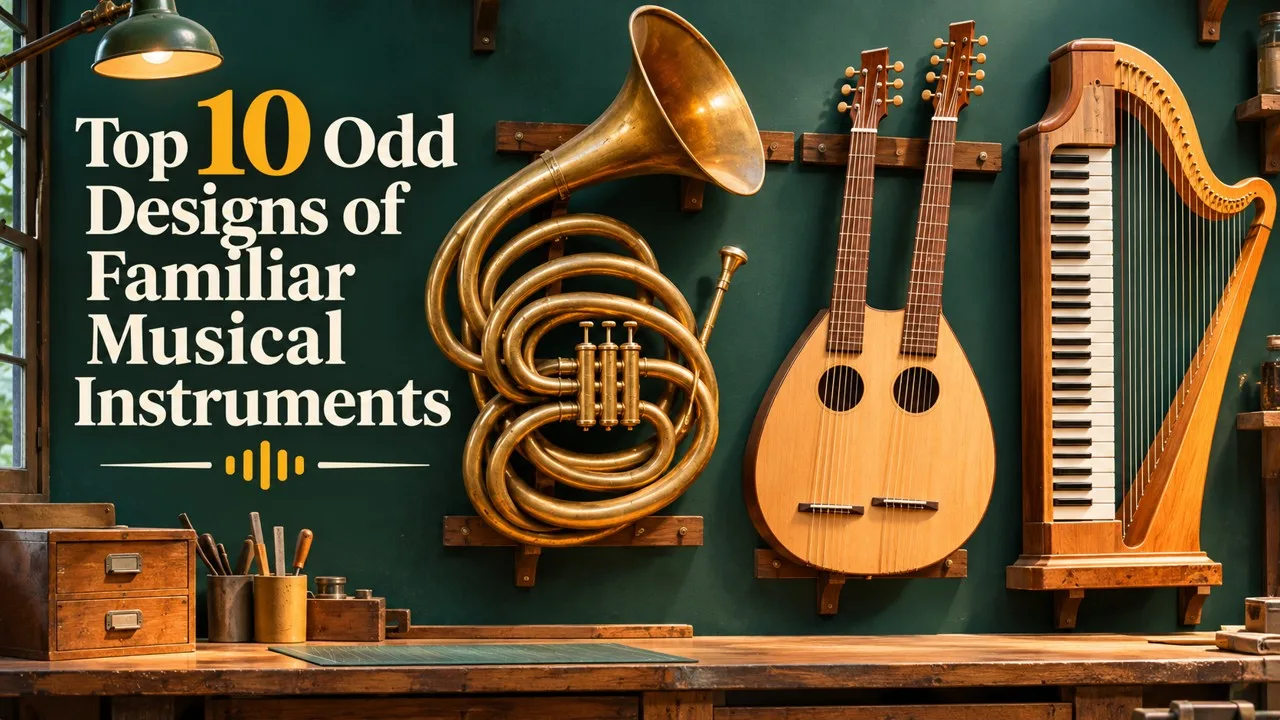
Some familiar instruments have been rebuilt with a slide, a horn, extra necks, or a larger body, and the odd version is still a cousin of the ordinary one.
The ten designs below are the Firebird trumpet, the Stroh violin, the contrabass balalaika, the Pikasso guitar, the Superbone, the subcontrabass flute, the octobass, Leonardo's viola organista, the heckelphone, and the laser harp. This list is about odd versions of common types, not about uncommon instruments already treated elsewhere, including the hurdy-gurdy, which must stay in a separate sentence from the organista. There will be no notation of protected tunes, no brand marks, and no performer likenesses.
Key Facts
| Design | What is documented | A limit |
|---|---|---|
| 1 | A valve trumpet fitted with a trombone-style slide, associated with Maynard Ferguson and Larry Ramirez | A specialist's hybrid, not a standard orchestral tool |
| 2 | John Matthias Augustus Stroh's horn-resonator violin, built to be loud enough for early acoustic recording | The look is part phonograph; the purpose was the microphone's ancestor, the horn |
| 3 | A very large triangular balalaika used as a bass in folk orchestras | A family size, not a one-off stunt |
| 4 | Linda Manzer's many-stringed, many-necked guitar built for Pat Metheny | A unique commission, not a factory model |
| 5 | A trombone that also has valves, likewise tied to Ferguson and Holton work | Related to the Firebird, but the home instrument is a trombone |
| 6 | A flute built to speak far below the ordinary concert flute | Height and air demand are the point; exact retail names are not |
| 7 | Jean-Baptiste Vuillaume's mid-nineteenth-century octobass, played with levers and pedals | Only a few instruments survive |
| 8 | A keyboard that bows strings with a wheel, sketched by Leonardo and later built in reconstructions | It is not the older hurdy-gurdy under a new name, and 2013 was not the only attempt |
| 9 | Wilhelm Heckel's 1904 heckelphone, a wide-bore baritone member of the oboe family | It is not a bassoon lowered by an octave |
| 10 | A "harp" of light beams that trigger a synthesizer, popularized on late-twentieth-century stages | Jean-Michel Jarre made it famous; the technical invention has more than one parent |
1. A Trumpet That Also Has a Slide
The Firebird is a trumpet that keeps the usual three valves and adds a short trombone-style slide [1]. The design is associated with the jazz trumpeter Maynard Ferguson and the designer Larry Ramirez, and it has been produced in small numbers, often as a custom brass rather than as a school-band staple. The point of the hybrid is practical: valves for quick, discrete pitches, and a slide for a continuous glissando or a shade between notes. Players have to relearn how the left and right hands share the work. That is why the instrument remains a specialist's tool even though every part of it, taken alone, is familiar [1].
The unexpected fact is how much technique has to change when two ordinary brass ideas occupy one tube [1]. This article will not offer a method or a brand display. The careful fact is a documented hybrid, a documented pair of names, and a documented rarity in ordinary ensembles. Versatility is the sales word. Coordination is the real cost.
A trumpet can borrow a trombone's slide and still not become easy to borrow from a colleague's case.
2. A Violin Whose Body Is a Horn
In the late nineteenth and early twentieth centuries, before electrical microphones were ordinary, a recording horn rewarded an instrument that could throw sound in a narrow, loud beam [2]. John Matthias Augustus Stroh's violin replaces much of the wooden body with a metal resonator and a projecting horn, more than a little like a phonograph. The instrument was a studio and stage tool for loudness, not a joke about furniture. Its tone is often described as thinner or more metallic than a wooden violin, which was a price paid for being heard. Later players have also used Stroh-type violins in folk and experimental settings, long after the original recording problem had been solved by electronics [2].
The unexpected fact is that a "strange" violin can be a document of a vanished recording technology [2]. This article will not treat the horn as a logo. The careful fact is a documented inventor, a documented acoustic purpose, and a documented later afterlife. Amplification was the brief. Electricity later made the brief less urgent.
A violin can keep its strings and lose its wooden box, and still be, in origin, an answer to a room with a horn in the wall.
3. A Balalaika Built as a Bass
The Russian balalaika is usually pictured as a small triangular lute. In folk orchestras it is also a family, and the contrabass balalaika is the large bass member: still triangular, still typically three strings, but with a body big enough to sit on the floor and speak in a low register [3]. Players use fingers or a plectrum, as on the smaller instruments. The design looks extreme only if the small prima balalaika is taken as the whole species. In an ensemble it does the ordinary job of a bass: a foundation under brighter voices [3].
Related: Top 10 Unusual Musical Instruments and How They Work
The unexpected fact is that "odd" can be, here, only a change of scale [3]. This article will not treat a folk orchestra as a novelty act. The careful fact is a documented family size, a documented ensemble role, and a shape that remains a balalaika even when it is as tall as the person playing it. Culture is in the triangle. The oddness is mostly size.
A familiar outline can be enlarged until it looks like a stunt and still be, in the band, a bass line.
4. A Guitar With More Necks, and Far More Strings, Than Usual
In 1984 the luthier Linda Manzer completed a guitar for the jazz musician Pat Metheny with many strings and several necks, a commission later known as the Pikasso [4]. Counts are usually given as forty-two strings and four necks, with different ranks serving different musical jobs, including sympathetic or harp-like courses. The instrument is a one-off artistic commission, not a model a shop would hang on a wall. Its name is a pun and will not be treated here as a reason to discuss another artist's work or likeness. What matters is the idea: a guitar that has been multiplied until one player can set a lot of strings in motion at once [4].
The unexpected fact is that a "guitar" can be, in a luthier's hands, closer to a small orchestra of courses [4]. This article will not copy the instrument's exact outline or display a brand. The careful fact is a documented maker, a documented player, and a documented extreme of an ordinary form. Complexity is the point. Replicability is not.
A neck is a familiar idea. Four of them on one body is a research project that happens to be played in concert.
5. A Trombone That Also Has Valves
The Superbone is, in essence, the Firebird's cousin from the other side: a trombone that keeps its slide and adds three valves [5]. It is likewise associated with Maynard Ferguson and with a small Holton production. A player can use the slide as a trombone is used, or take some of the work on valves, or combine the two. The result is not a trumpet, even though the valve cluster may remind a listener of one. The two hybrids are easy to confuse in a caption. They are not the same starting instrument [5].
The unexpected fact is that one mid-century jazz career could leave two different answers to the same wish: valves and a slide on one brass [5]. This article will not display a trademark. The careful fact is a documented trombone-based hybrid, a documented relationship to the Firebird, and a documented specialist following. Familiarity is in the slide. The oddity is the extra choice.
Related: Top 10 Most Bizarre Phobias: Strange Fears That Exist
A trombone can gain valves and still be, at rest, a trombone with a problem of the left hand.
6. A Flute Tall Enough to Look Like a Different Species
Makers have extended the flute family far below the concert C instrument, through bass and contrabass sizes and, in a few cases, to a subcontrabass flute that stands on the floor and needs a long tube and a lot of air [6]. Heights on the order of two meters and more are commonly reported. The instrument still works as a flute: an edge tone, keys, a wide bore. What has changed is the register and the physical labor. It appears mainly in flute choirs, contemporary scores, and demonstrations, not in a classical orchestra's standing roster [6].
The unexpected fact is that a "flute" can be larger than the person who has to fill it [6]. This article will not lean on a shop name. The careful fact is a documented extreme of a common family, a documented use in ensembles that want a true flute bass, and a limit on how often anyone actually needs that voice. Depth is the brief. Portability is the cost.
A column of air can be lengthened until the familiar mouth-hole looks like a small detail on a piece of plumbing. It is still a flute.
7. An Octobass, or a Double Bass Taken Past Ordinary Reach
In the mid-nineteenth century the French maker Jean-Baptiste Vuillaume built the octobass, a member of the violin family so large that the player's hands cannot treat it like a double bass [7]. Accounts put the height at around three and a half meters. Three strings are sounded with the help of levers and pedals. The pitch sits in a region where a note is heard and, in a room, sometimes more nearly felt. Only a few historical and later instruments exist, usually as museum or special-concert objects, including examples associated with collections in Paris and Montreal. Berlioz admired the idea. Ordinary orchestras did not adopt it [7].
The unexpected fact is that a "violin-family" instrument can require a machine of levers before it can be played in tune [7]. This article will not treat the surviving instruments as circus props. The careful fact is a documented maker, a documented extreme size, and a documented rarity. The double bass already answers most scores. The octobass answers a wish for still more depth, at a nearly impractical scale.
Related: Top 10 Oldest Buildings in the World
A familiar scroll and a familiar bow can sit on an instrument that the arm, alone, cannot fully govern.
8. A Keyboard That Bows, After a Leonardo Sketch
Leonardo da Vinci sketched a keyboard instrument in which a moving wheel would bow the strings, so that a key press could produce a sustained, bowed tone rather than a plucked or struck one [8]. The idea sits in the same broad family as a wheel used as a bow, but it is not simply the older hurdy-gurdy under a Renaissance name: the layout is a keyboard, and the historical file is a set of drawings rather than a continuous folk tradition. Later makers have tried to realize the sketches. A well-known modern concert instrument was built by the Polish pianist and maker Sławomir Zubrzycki, completed around 2013, though that date should not be told as the first time anyone attempted a working version [8].
The unexpected fact is that a famous notebook can wait centuries for a reliable public performance [8]. This article will not confuse the organista with the hurdy-gurdy already discussed elsewhere, and it will not use a likeness of Leonardo. The careful fact is a documented sketch, documented later reconstructions, and a documented difference of layout. A wheel can be a bow. A keyboard can be the way a player asks that bow to speak.
A drawing of a mechanism is not yet an instrument. When it finally sounds, the credit is shared between a notebook and a later workshop.
9. A Heckelphone Is a Deep Oboe, Not a Lowered Bassoon
In 1904 the German maker Wilhelm Heckel introduced the heckelphone, a wide-bore woodwind pitched an octave below the oboe and intended to give the oboe family a stronger baritone voice [9]. It is sometimes loosely compared to a bassoon because it is large and low. That comparison misplaces the family: the fingering, the double reed, and the intended color belong with the oboe and the English horn, not with the bassoon, which already occupies a low register of its own. Richard Strauss and later composers wrote for it; the instrument remains rare, partly because the parts are few and the players fewer [9].
The unexpected fact is that a "gap in the wind section" can be filled by an instrument almost nobody owns [9]. This article will not pretend the heckelphone is a novelty bassoon. The careful fact is a documented 1904 introduction, a documented oboe-family identity, and a documented thin repertoire. Wagner had wanted a related voice. Heckel's workshop produced a later, specific answer.
Related: The Evolution of Stranger Things: Seasons, Themes, and Characters
A rare cousin can be mistaken for a more famous neighbor. The score, when there is one, usually knows the difference.
10. A Harp Whose "Strings" Are Beams of Light
A laser harp is a performance interface in which beams of light stand in for strings: a hand breaking a beam sends a signal to a synthesizer or computer, which then produces the sound [10]. The device became widely visible in the stage shows of Jean-Michel Jarre in the 1980s. He is the popularizer who made the image famous. The technical invention of light-beam instruments has more than one claimant, including work associated with Bernard Szajner and others, and should not be collapsed into a single star's biography. The "harp" is, musically, a controller. The tones come from whatever electronic source it is told to play [10].
The unexpected fact is that a familiar concert outline, a player and a fan of vertical lines, can hide a completely electronic instrument [10]. This article will not notate a protected piece or display a touring logo. The careful fact is a documented stage popularization, a documented shared technical history, and a documented difference between the visible beams and the sounding source. Spectacle is part of the design. So is a sensor.
A harp can keep the gesture of plucking a line in the air and still have, as its body, a machine that is not a box of strings.
Conclusion
The ten designs above include a trumpet with a slide, a horn violin, a bass balalaika, a many-necked guitar, a valved trombone, a floor-standing flute, an octobass with levers, a reconstructed Leonardo keyboard, a baritone oboe with a confusing popular name, and a harp made of light. Each is still in conversation with an ordinary instrument. The conversation is what makes the oddness legible.
A familiar type can be stretched, hybridized, or scaled until it looks new. The family resemblance is usually the most interesting fact left on the stage.
- ^ [1] Accounts of the Firebird trumpet as a valve-and-slide hybrid associated with Maynard Ferguson and Larry Ramirez, without brand display or performer likenesses. Britannica: trumpet https://www.britannica.com/biography/Maynard-Ferguson
- ^ [2] Historical accounts of John Matthias Augustus Stroh's horn-resonator violin and of its use in the acoustic-recording era. Britannica: violin National Science and Media Museum, early recording
- ^ [3] Accounts of the balalaika family, including the contrabass used as a bass voice in Russian folk orchestras. Britannica: balalaika https://www.britannica.com/art/stringed-instrument
- ^ [4] Accounts of Linda Manzer's many-stringed, many-necked guitar built for Pat Metheny, treated as a unique commission and without a copy of the instrument's exact outline. Linda Manzer Britannica: guitar
- ^ [5] Accounts of the Superbone as a slide trombone with added valves, distinguished from the Firebird trumpet, without trademark display. Britannica: trombone https://www.britannica.com/biography/Maynard-Ferguson
- ^ [6] Accounts of extended flute-family instruments, including contrabass and subcontrabass flutes used in flute ensembles and contemporary music. Britannica: flute https://www.britannica.com/art/wind-instrument
- ^ [7] Accounts of Jean-Baptiste Vuillaume's octobass, its lever-and-pedal playing method, and the rarity of surviving examples. Britannica: double bass Cité de la musique / Philharmonie de Paris
- ^ [8] Accounts of Leonardo da Vinci's viola organista sketches and of later working reconstructions, including Sławomir Zubrzycki's instrument, distinguished from the hurdy-gurdy. https://www.britannica.com/biography/Leonardo-da-Vinci https://www.britannica.com/art/keyboard-instrument
- ^ [9] Accounts of Wilhelm Heckel's 1904 heckelphone as a wide-bore baritone member of the oboe family, not as a lowered bassoon, and of its limited later repertoire. Britannica: oboe https://www.britannica.com/biography/Richard-Strauss
- ^ [10] Accounts of the laser harp as a light-beam controller popularized in Jean-Michel Jarre's concerts, with a shared technical history that includes other inventors, and without notation of protected music. https://www.britannica.com/art/electronic-instrument https://www.britannica.com/biography/Jean-Michel-Jarre





















Discussion
Log in with