






Top 10 Formerly Secret Tunnels Now Open to Visitors
 By Dhiraj Sharma · Published
Share Post
Loading…
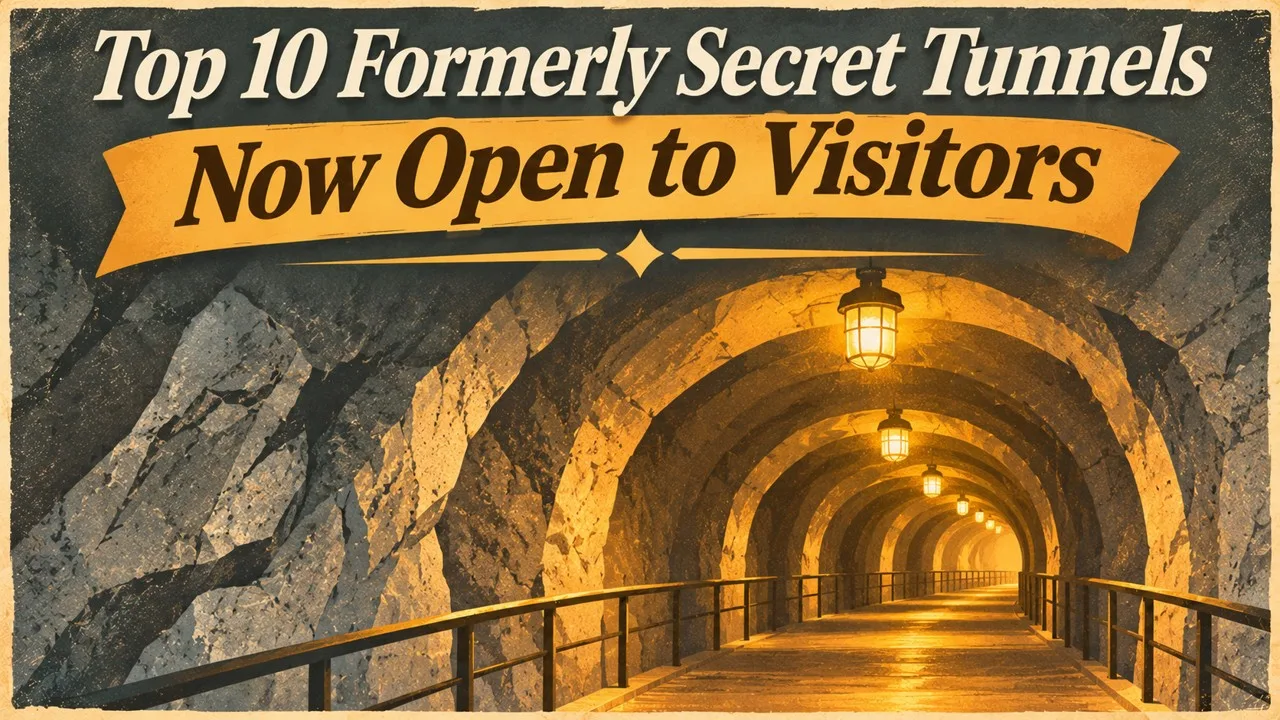
Some underground places now on a tour ticket were military, private, or ordinary service spaces, and a few were never really secret at all.
The ten sites below are the Third Tunnel of Aggression at the Korean Demilitarized Zone, Marie Antoinette's private rooms at Versailles, Portland's so-called Shanghai tunnels, the KGB prison cells in Tallinn, the green railway at Klevan, the still-unopened Kingsway Exchange tunnels in London, the official Paris catacombs circuit, the Chicago Pedway, the Cu Chi tunnel sites, and Civil War-era remains on Alcatraz. This article is a tourism and access history. It is not an escape guide, a trespass tip, or a lesson in digging.
Key Facts
| Place | What a visitor is actually looking at | A limit on the usual story |
|---|---|---|
| 1 | The Third Tunnel, shown on South Korean DMZ tours | This is not a route into the North, and it is not a tunneling lesson |
| 2 | The queen's private apartments at Versailles, reached by discreet doors | Private rooms are not the same as a secret tunnel network |
| 3 | Basements and sidewalk vaults under Portland's Old Town, sold as "Shanghai tunnels" | The kidnapping-through-trapdoors story is often mythologized |
| 4 | Basement cells of a former security-police prison in Tallinn, now a museum | This is a memorial, not a spectacle of interrogation |
| 5 | A tree-covered railway near Klevan, Ukraine, nicknamed the Tunnel of Love | It is a cutting with a canopy, not a classified passage, and travel conditions can change |
| 6 | The Kingsway Exchange tunnels under central London | A visitor attraction has been announced; it is not open as of late 2026 |
| 7 | The official Paris ossuary tour | Most of the quarry network remains illegal to enter, as a companion article in this series notes |
| 8 | The Chicago Pedway, a downtown indoor-underground walk | It was built as civic circulation, not as a secret |
| 9 | Enlarged tour sections of the Cu Chi tunnels in Vietnam | Wartime use can be described without weapons or trap instructions |
| 10 | Alcatraz's military past, including buried Civil War works and a citadel under the cellhouse | The 2019 yard finds are still in the ground, and this is not an escape story |
1. A DMZ Tunnel Shown from the South
The Third Tunnel of Aggression is one of several infiltration tunnels discovered from the South Korean side of the Demilitarized Zone, in this case in 1978 [1]. Officials in the South have presented it as a northern attempt to move troops under the armistice line toward Seoul. The North has called it a coal-related working, a claim that South Korean tours typically reject. The site is now part of organized DMZ visitor programs on the southern side. It is not a crossing, and it is not a prize for a curious walker [1].
The unexpected fact is how completely a once-concealed military excavation can become a ticketed stop, with a prepared walkway and a briefing [1]. This article will not describe a method for finding or digging such a passage, and it will not treat the tour as a view into the other state. The careful fact is a documented 1978 discovery, a still-disputed original purpose, and a tightly managed visitor access from the South. Armistice politics are the context. A list of tunnels should leave them there.
A former military hole can be interpreted in two official stories at once. The visitor, on the southern tour, is walking through that disagreement, not through a shortcut.
2. Private Rooms Behind a Formal Bedroom
At the Palace of Versailles, Marie Antoinette's formal bedroom was connected, through discreet doors in the paneling, to a set of private rooms: a more intimate suite with spaces for reading and receiving away from the full court [2]. Those cabinets were private, not a tunnel system under the palace. After restoration, they have been made visitable, sometimes on a timed or guided circuit, as part of the palace's effort to show the queen's domestic apartments rather than only the state rooms. Later retellings have linked the private rooms to the night of 5-6 October 1789, when a crowd reached the palace; the documented event is larger than a hiding-place anecdote, and this article will not reduce it to a secret-door story [2].
The unexpected fact is that "secret quarters" can mean, in a court, simply rooms the public of the day was not invited to enter [2]. This article will not offer a way to slip off a modern visitor path, and it will not treat panel doors as a puzzle. The careful fact is a documented private apartment, a later conservation opening, and a distinction between court privacy and underground mystery. Versailles is already crowded with myth. The rooms are real, and they are smaller than the myth.
A queen can need a quieter room without needing a labyrinth. The quieter room is what the ticket now sometimes includes.
3. Portland Vaults, and a Story That Grew
Under parts of Portland's Old Town and Chinatown are sidewalk vaults, basements, and connected service spaces, now marketed on paid tours as the Shanghai Tunnels [3]. There were vice businesses in the area, and there was a real Pacific maritime practice of shanghaiing, the coerced recruitment of sailors. What historians have repeatedly cautioned is the tidy tale of a purpose-built labyrinth of trapdoors used to drop men into tunnels and onward to ships. Much of that narrative was polished for tourism. The underground rooms are real. The complete kidnapping-grid story is not a settled documentary fact [3].
Related: Top 10 Famous Bell Towers of the World
The unexpected fact is that a city's favorite underground legend can outrun the architectural evidence [3]. This article will not map a way into private basements, and it will not sell a ghost tour as an archive. The careful fact is a documented under-sidewalk building practice, a later tour industry, and a folklore problem that honest local history has already flagged. Prohibition-era storage and bar connections are a narrower, more plausible use of some spaces. They still do not prove a civic network of human trafficking tunnels.
A tour can be entertaining and still need a footnote. In Portland, the footnote is the main historical point.
4. Basement Cells Kept as a Memorial
In Tallinn, basement cells of a former Soviet security-police prison, at Pagari Street, are now a museum to the people who were held there [4]. The building above has been redeveloped. The underground rooms were places of detention in the Stalinist and later Soviet periods, not a scenic tunnel. This article will state that interrogations and imprisonments happened, and it will stop there. It will not describe methods, and it will not decorate the rooms with screams [4].
The unexpected fact, for a list of "secret tunnels," is that the visitor is in a memorial museum, in cells, under an ordinary street [4]. This article will not treat the site as a horror attraction. The careful fact is a documented prison basement, a later museum use, and a city that has chosen to keep a difficult interior while changing the floors above. Memory work is the reason for access. Curiosity as entertainment is not.
A cell can be opened so that it will not be forgotten. That is a different kind of opening from a thrill tour.
5. A Green Railway, Not a Hidden Passage
The "Tunnel of Love" near Klevan, in western Ukraine, is a stretch of railway whose trees meet overhead in a long green canopy, and it became famous as a photograph [5]. It is a cutting, not an underground tunnel, and it was never a classified corridor in the sense of this list's other military sites. Travel writing has sometimes claimed that the trees were planted in the Cold War to hide transports on a line that served an industrial or military area. The line's practical use is documented; the idea of a perfect camouflage garden should be treated as a story that has grown with the nickname, unless a specific planting order is shown [5].
The unexpected fact is how quickly a working railway can be recast as a romantic secret [5]. This article will not give a travel plan, and it will not assume that any outdoor site is equally visitable in every year. Conditions in Ukraine have changed with the war, and a list written in 2026 should say so without turning the entry into a briefing. The careful fact is a documented, much-photographed railway canopy, a nickname, and a probable gap between folklore and forestry.
Related: Top 10 Famous Tombs and Mausoleums
A tunnel of leaves can be beautiful and still be, mainly, a track. The track is the thing that was there first.
6. London Deep Shelters That Are Not Yet a Museum
The Kingsway Exchange tunnels, under Holborn in central London, began as Second World War deep-level shelters and later housed a major telephone exchange, with further government communications use in the Cold War decades [6]. A commercial project branded The London Tunnels has acquired the complex and announced a heritage visitor attraction, with public opening targeted for 2028 rather than for the present. As of late 2026 the site is not a walk-in tour. Older popular claims that the rooms inspired a fictional spy workshop should be left in the rumor column [6].
The unexpected fact, on a list of places "now open," is that this one is still in the development queue [6]. This article will not pretend a press plan is a ticket office, and it will not describe a way to enter a closed civil complex. The careful fact is a documented wartime and communications history, a later private reuse scheme, and a scheduled opening that has not yet arrived. Deep shelters are part of London's wartime record. They do not become a museum the day a company is listed.
A tunnel can be famous in a prospectus and still be closed in the street. Honesty about the date is part of the history.
7. An Official Circuit in a Much Larger Grid
The official Paris catacombs, opened in a limited way from 1809 as an ossuary for bones moved from overflowing city cemeteries, are a ticketed path through a small part of a much larger former quarry network [7]. They were never a pure secret. They have been a curiosity and then a standard attraction for a very long time. As a companion article in this series has already stressed, most of the quarries remain illegal and unsafe to enter. This entry is about the legal circuit, not about the rest [7].
The unexpected fact is how early the bones were already a public spectacle, long before modern queue barriers [7]. This article will not map the forbidden passages, and it will not treat arranged remains as a gore exhibit. The careful fact is a dated official opening, a short legal route, and a municipal decision to show a portion of a burial transfer. Millions of Parisians' bones were moved into the quarries. Only a designed corridor is on the ticket.
Related: Top 10 Haunting Ghost Towns Around the World
A city can invite you into one hallway and still forbid the maze. Paris has been making that distinction for more than two centuries.
8. A Downtown Walk That Was Never a Secret
The Chicago Pedway is a network of underground and indoor pedestrian connections in the downtown Loop, begun in the mid-twentieth century and later extended, so that people can move between civic buildings, shops, and transit without staying on the winter sidewalk [8]. It is useful. It is not a formerly classified tunnel, and it is not "entirely" a single public park: some segments run through private buildings and follow those buildings' hours, a patchwork that visitors already know. Calling it secret is a stretch that this list should not repeat [8].
The unexpected fact is how often a practical civic concourse gets filed, in popular lists, beside wartime excavations [8]. This article will not treat the Pedway as a hidden city, and it will not promise a complete underground tour. The careful fact is a documented mid-century circulation project, a partial and sometimes confusing map, and a weather reason that is still the honest one. Chicago built a way to stay warm. That is enough.
A tunnel can be famous for not being glamorous. The Pedway's glamour, such as it is, is fluorescent and municipal.
9. Wartime Tunnels, Later Enlarged for a Tour
The Cu Chi tunnels, in the countryside north of Ho Chi Minh City, were a large wartime tunnel network used by communist forces during the Vietnam War, often described as running for many tens of kilometres in that district alone [9]. After the war, selected sections at sites such as Ben Dinh and Ben Duoc were opened as historical tours, with some passages enlarged so that visitors can enter. The wartime system included living space, routes, and defenses. This article will not describe weapons or traps, and it will not retell tunnel fighting as a scene [9].
The unexpected fact is how much of a modern visit is already a reconstructed, walkable version of a much tighter original [9]. This article will not give a crawl as a dare, and it will not invent a nationwide underground railway from a regional network. The careful fact is a documented wartime landscape, a later tourist presentation, and a difference between the historic system and the enlarged path. Specialized troops on the other side entered tunnels during the war; that work was dangerous, and it does not belong here as a method.
Related: Top 10 Iconic Parliament Buildings of the World
A battlefield can become a heritage site. The decent account names the war and leaves the engineering instructions out.
10. Military Remains Under a Famous Prison
Alcatraz Island was a coastal fort and military prison long before it became a federal penitentiary, and it is now a national historic site [10]. In 2019, researchers using ground-penetrating radar and laser scanning reported Civil War-era works still buried under the recreation yard, including a traverse and associated tunnels and magazines. Those features remain in the ground; they are not a corridor on the ordinary island ticket. Special tours can include other nineteenth-century military fabric, including remains of the citadel under the later cellhouse, which is a different space from the 2019 yard finds. None of this is an escape route, and this article will not discuss escapes as a method [10].
The unexpected fact is that the prison everyone photographs is sitting on a fort that instruments can still see just below the concrete [10]. This article will not conflate a buried geophysical find with a behind-the-scenes hallway, and it will not treat the island as a puzzle to beat. The careful fact is a documented military phase, a 2019 non-invasive survey, and a visitor program that already has more than one official path. The island's Native occupation of 1969-1971 is another part of its public history, and it should not be crowded out by a tunnel headline, even if it is not the item's center.
A famous jail can hide, under a yard, the outline of an older fort. The outline is knowledge. It is not, today, a walk.
Conclusion
The ten places above include a DMZ tour tunnel, private rooms at Versailles, Portland vaults wrapped in folklore, a Tallinn memorial in former cells, a green railway in Ukraine, a London deep-shelter complex that is not yet open, the official Paris ossuary, a Chicago civic walk, enlarged Cu Chi tour sections, and Alcatraz's military substructures. Several were never secret. One is still closed. One is a museum of political terror, not a tunnel ride.
An access history should say who may walk where, and why. It should not offer a second, unofficial map.
- ^ [1] Official and historical accounts of the Third Tunnel of Aggression, discovered in 1978 and shown on South Korean DMZ visitor programs, including the competing official explanations of its purpose. Britannica: Korean Demilitarized Zone Korea Tourism Organization
- ^ [2] Palace and historical accounts of Marie Antoinette's private apartments at Versailles, including their later restoration for visitors, without reducing 1789 to a secret-door anecdote. Palace of Versailles Britannica: Marie Antoinette
- ^ [3] Local historical discussions of Portland's under-sidewalk vaults and of the "Shanghai tunnels" story, including scholarly caution about the trapdoor-kidnapping narrative. Oregon Encyclopedia Britannica: Portland
- ^ [4] Museum and historical accounts of the former security-police cells at Pagari Street in Tallinn, treated as a memorial to detainees and not as a description of interrogation methods. Vabamu Museum of Occupations and Freedom Britannica: Tallinn
- ^ [5] Geographical and travel-historical accounts of the tree-covered railway near Klevan known as the Tunnel of Love, with the camouflage-planting story treated as a claim that needs evidence, and with current travel conditions left open. Britannica: Ukraine Wikipedia: Tunnel of Love (Klevan)
- ^ [6] Company and heritage reporting on the Kingsway Exchange tunnels and the planned London Tunnels visitor scheme, including an announced opening targeted for 2028 rather than a present-tense tour. The London Tunnels Visit London
- ^ [7] Official accounts of the legal Paris catacombs ossuary circuit, open in a limited form since 1809, and of the much larger off-limits quarry network. Les Catacombes de Paris Britannica: Paris
- ^ [8] Civic descriptions of the Chicago Pedway as a downtown pedestrian concourse with mixed public and private segments, not as a former secret. City of Chicago Britannica: Chicago
- ^ [9] Historical and site accounts of the Cu Chi tunnels and of later visitor sections at places such as Ben Dinh and Ben Duoc, without weapons, trap, or crawl instructions. Britannica: Vietnam War Vietnam National Tourism
- ^ [10] National Park Service and 2019 geophysical-research accounts of Civil War-era remains on Alcatraz, including buried works under the recreation yard and later special access to other military fabric, without any escape method. National Park Service: Alcatraz Island BBC News on the 2019 survey






















Discussion
Log in with