






 By
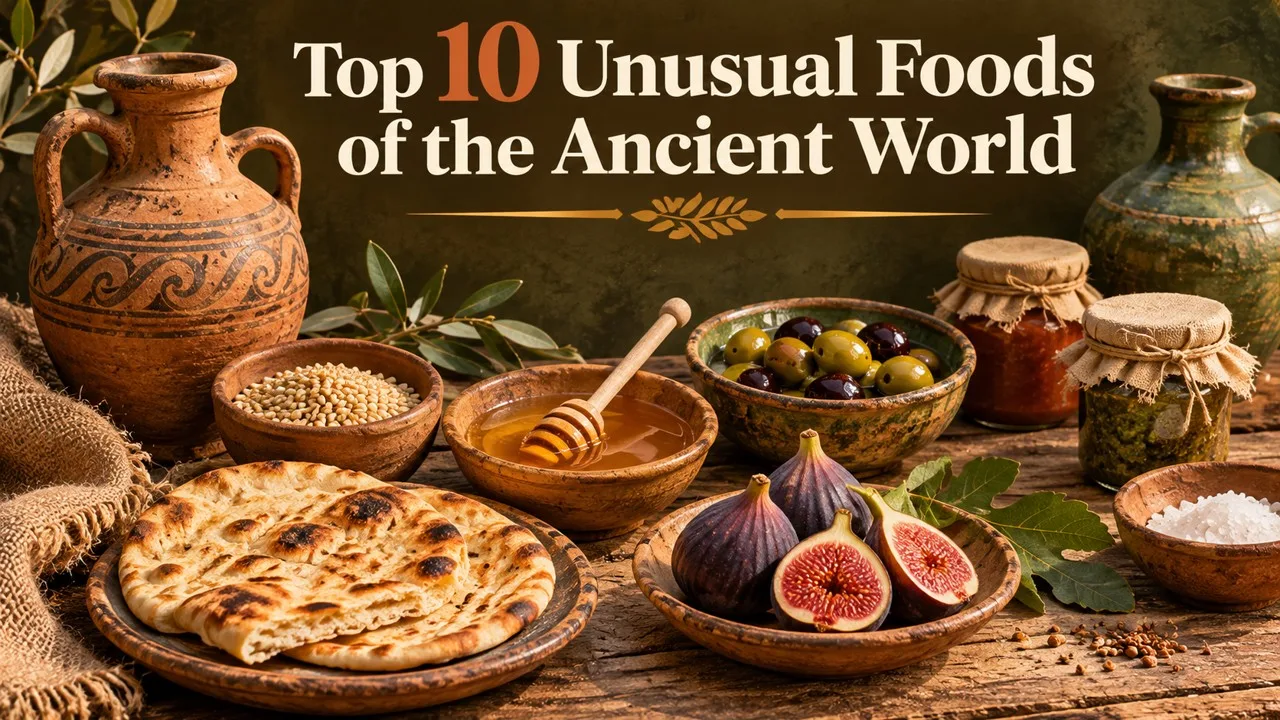
Ancient kitchens used birds, sauces, wines, and plants that later tables forgot, or remembered only as legends.
The ten foods below are peacock at luxury banquets, lard as a cooking fat, garum, pigeon and dove, wine from Chios, moretum, posca, silphium, Spartan black broth, and carob. The evidence is archaeological and textual. This article will not offer a reconstruction to cook, a fermentation method, or medical advice, and it will not treat a lost plant as a living North American namesake.
Key Facts
| Food | What is documented | A limit |
|---|---|---|
| 1 | Peacock at Roman and later elite feasts, often as a display bird | A showpiece is not an everyday roast, and this is not a recipe |
| 2 | Lard and other animal fats in several ancient cuisines, including China | Olive oil did not cancel lard everywhere, and this is not diet advice |
| 3 | Garum, a salted, fermented fish sauce of the ancient Mediterranean | The process is described as history, not as a method to copy |
| 4 | Pigeons and doves raised and eaten around the ancient world | This is not a suggestion about city birds, and a later extinction belongs to another century |
| 5 | Chian wine, a costly and admired export from Chios | Most ancient wine traveled in amphorae; that fact is not unique to Chios |
| 6 | Moretum, a pounded cheese-and-herb mixture in a Latin poem | A poem is not a Colosseum menu |
| 7 | Posca, a sour-wine or vinegar drink of soldiers and poorer drinkers | It is not a modern water-treatment manual |
| 8 | Silphium, a Cyrenaic plant used as seasoning and medicine, later lost | It is not the North American genus Silphium, and no use is advised |
| 9 | Melas zomos, the Spartan "black broth" described in later sources | Surviving remarks are not a complete kitchen formula |
| 10 | Carob pods eaten for their sweet pulp | The modern chocolate substitute is a later career, not an ancient disguise |
1. A Display Bird, Not a Daily Roast
Peacock, or peafowl, appears in Roman banquet writing as a luxury, sometimes brought in roasted and then dressed again with its feathers for a theatrical entrance [1]. The point was often display as much as flavor. Later medieval courts kept the habit at high tables. The bird was never, in these sources, an ordinary household meat like chicken or, in later centuries, turkey. People in some regions still eat peafowl, but that is a living cookery, not a direct survival of a Roman spectacle [1].
The unexpected fact is how much of the "dish" was theater [1]. This article will not reconstruct a roast, and it will not treat a later table as a relic of Nero's dining room. The careful fact is a documented elite showpiece, a documented later court fashion, and a gap between a banquet writer's set piece and everyday protein. Luxury wants to be seen. The feathers were part of the seeing.
A bird can be expensive because it is rare, or because it is loud on a platter. In this file, both reasons apply.
2. A Fat That Did Not Need to Wait for Europe
Rendered pork fat, lard, is an old cooking medium wherever pigs were kept in number [2]. In China, pig domestication is ancient, and pork fat was used in kitchens long before any later "arrival" of lard in a Western story. In the Mediterranean, olive oil was central in many Greek and Roman contexts, but it did not erase animal fats; Latin sources also know pork fat. Northern and inland European cooking later made lard a daily fat, which is not a barbarian joke and will not be told as one. Modern diet talk about lard is a different argument, and this article will not join it [2].
The unexpected fact is that an "unusual" fat is unusual only if one starts from a later olive-oil stereotype [2]. This article will not issue a health ruling. The careful fact is a documented regional split in fats, a documented early use in East Asia, and a documented Mediterranean mix rather than a monopoly. Cooking fat is infrastructure. Infrastructure is usually local.
A kitchen can run on oil in one valley and on pork fat in the next. Both can be ancient.
Related: Top 10 Most Bizarre Phobias: Strange Fears That Exist
3. A Traded Sauce, Not a Curiosity Jar
Garum, and the related liquid called liquamen, was a salted, fermented fish sauce used across the ancient Mediterranean as a basic seasoning, not only as a dare [3]. Production sites, amphora inscriptions, and writers from the Greek and Roman worlds describe a salted fish fermentation whose liquid was drawn off and sold in grades; a paste, allec, could remain. A companion article in this series has already met the sauce as cargo in a wreck. Here the point is the condiment in daily and luxury use, including expensive grades and, in some finds, labels that suggest a version acceptable under Jewish dietary rules [3].
The unexpected fact is how ordinary a "strange" sauce can be once it is on every table [3]. This article will not give a fermentation method, and it will not linger on viscera for effect. The careful fact is a documented industry, a documented taste for a savory liquid close in role to later East Asian fish sauces, and a later European forgetting that made the sauce look more alien than it was. Trade made it standard. Forgetting made it exotic.
A condiment can smell strong in a later retelling and still have been, in its century, as dull as salt.
4. Dovecotes, Not Pavement Flocks
Pigeons and doves were kept and eaten widely in the ancient Mediterranean and Near East, and in many later societies [4]. Dovecotes supplied squabs, a manageable meat, to households that could not always afford large livestock. The birds in those lofts are not the same story as later complaints about city pigeons, and this article will not treat street birds as a larder. The North American passenger pigeon, hunted to extinction in the modern period, is a different species and a different century; it does not belong here as an ancient dish or as a restoration project [4].
The unexpected fact is how completely a former staple can be recast as a pest, and how carefully those two facts should be kept apart [4]. This article will not suggest eating urban birds. The careful fact is a documented domestication and table use, a documented architecture of raising them, and a refusal to drag a later extinction or a cloning debate into an ancient kitchen. Squab is a historical food. The pavement is not a recipe.
A small bird can be a farm animal. That is the whole of the ancient point.
5. A Famous Island Wine, Shipped Like the Others
Wine from Chios, often called Chian, was among the most admired Greek wines of the classical and later periods, dark, costly, and talked about by writers who cared about status as well as taste [5]. It was exported widely, including toward Athens and later into Roman markets. Amphorae, not barrels, were the normal shipping containers for such wines; wooden barrels became more important later and in other regions. The island's fame was about origin, style, and price, not about a unique box [5].
The unexpected fact is that a luxury label can be remembered for a packaging contrast that was not actually special [5]. This article will not sneer at beer-drinking neighbors as a way to praise a Greek island. The careful fact is a documented high-status export, documented literary praise, and a container history that Chian wine shared with ordinary cargo. Prestige is in the name of the island. The jar is the same family of jar.
Related: Top 10 Oldest Buildings in the World
A wine can be famous and still travel in the same clay as a lesser vintage. The fame is the vintage, not the vessel.
6. A Farmer's Mortar, Preserved in Verse
Moretum is a Roman cheese-and-herb mixture pounded in a mortar, and it is known above all from a Latin poem of that title, transmitted with the so-called Appendix Vergiliana [6]. In the poem a farmer pounds cheese with garlic, herbs, oil, and related seasonings, then eats the result with bread. The name is related to the mortar itself. Later writers have compared a garlic-heavy version to pesto, which is a loose likeness, not a proven family tree. Claims that it was an upper-class favorite sold in arena crowds go beyond what that poem securely shows [6].
The unexpected fact is that one of our best "recipes" is a literary scene, not a market ledger [6]. This article will not convert the poem into instructions, and it will not invent a Colosseum stall. The careful fact is a documented rustic dish in a text, a documented etymology from the tool, and a later habit of making the spread sound more cosmopolitan than the verse warrants. A farmer's breakfast can still be historical evidence. It does not have to have been a luxury brand.
A mortar can be a primary source. The poem is the source we have.
7. A Sour Drink, Not a Portable Laboratory
Posca was a Roman drink of water mixed with sour wine or vinegar, sometimes with flavorings, associated with soldiers and with poorer drinkers [7]. Later anecdotes say that some commanders shared it as a sign of plain living. Acidity may have made a poor-quality liquid more palatable; later writers have sometimes called it a way to "make bad water safe." That is not a modern water-treatment claim, and this article will not offer it as advice [7].
The unexpected fact is how quickly a camp beverage becomes, in popular telling, a secret technology [7]. This article will not design a canteen. The careful fact is a documented sour ration, a documented social range from rankers to, in some stories, famous generals, and a limit on what we can say about microbes they could not name. A sharp drink can be ordinary. Ordinary is enough.
A barrel of sour wine can move with an army without being a miracle. The miracle talk is later.
Related: 10 Sikh Gurus: The Pillars of Sikhism Who Shaped Faith, Equality, Courage, and Humanity
8. A Lost Seasoning from Cyrenaica
Silphium, or silphion, was a plant of Cyrenaica, on the coast of what is now Libya, used as a seasoning and as a medicine in the Greek and Roman worlds [8]. It was valuable enough to appear as a symbol on local coins. Ancient descriptions suggest a giant-fennel relative, probably a Ferula, not the North American genus Silphium, a confusion already corrected in this series when a lost Mediterranean plant was misidentified. By the first century, writers such as Pliny describe a scarcity so severe that a last specimen becomes a court anecdote; the plant was lost in the Roman period, not necessarily before the Common Era. Overharvest, failed cultivation, and landscape change are the usual explanations. Medical and gynecological uses appear in the sources; this article will not treat them as a formula or as advice [8].
The unexpected fact is that a flavor can vanish so completely that even its family remains an argument [8]. This article will not reconstruct a dish, and it will not point at a living prairie plant as a substitute. The careful fact is a documented Cyrenaic export, a documented later disappearance, and a documented modern mis-mapping onto an unrelated genus. Extinction, here, is a spice-trade fact as well as a botanical one.
A coin can remember a plant that a kitchen can no longer buy. The coin is now the easier evidence.
9. A Broth Known from Later Remarks
Melas zomos, the "black broth" of Sparta, is described in later Greek writing as a mess food of pork, blood, and vinegar, among other possible parts [9]. It belongs to discussions of the communal mess, the syssitia, and to later moralizing about Spartan hardness. A famous anecdote has a visitor from a luxury-loving city taste it and joke that he now understands why Spartans do not fear death. That is a story about reputation, not a kitchen inventory. No complete, contemporary recipe survives, and this article will not invent one [9].
The unexpected fact is how much of a "national dish" can rest on a few later sentences [9]. This article will not offer a blood-soup method, and it will not treat the broth as a personality test. The careful fact is a documented later tradition, a plausible set of ingredients named in those traditions, and a gap where a Spartan cookbook would be. Harsh food can be real and still be, in the telling, a moral.
A broth can become a character in someone else's essay. The essay is what we have.
Related: Top 10 Tallest Buildings in the World
10. Sweet Pods, Long Before a Chocolate Stand-In
Carob, Ceratonia siliqua, is a Mediterranean tree whose leathery pods contain a sweet pulp [10]. Greeks and Romans knew the fruit as a food and as fodder; the pulp could be eaten fresh or dried, and it was useful in a world where cane sugar was not a cheap staple. The later use of carob as a chocolate substitute is a modern career, not an ancient disguise. The seeds have also been drawn into the history of the "carat" as a weight, a popular etymology that should be handled as a claim, not as a closed proof [10].
The unexpected fact is that a tree now filed under "health-food aisle" was, first, simply a sweet pod [10]. This article will not sell a bar, and it will not tell anyone to eat a pod as a cure. The careful fact is a documented ancient food and fodder, a documented later substitute industry, and a plant that did not need to imitate another flavor in order to be valued. Sweetness was already a reason.
A pod can be a fruit in one century and a stand-in in another. Only the first of those is the ancient story.
Conclusion
The ten foods above include a display peacock, a regional cooking fat, a traded fish sauce, a dovecote meat, a costly island wine, a poem's cheese mixture, a sour camp drink, a lost Cyrenaic plant, a poorly documented Spartan broth, and a sweet pod that later learned to imitate chocolate. Some were luxuries. Some were rations. A few are famous mainly because they vanished, or because a later age found them strange.
An ancient food list should be willing to say when the best source is a jar stamp, a coin, or a poem, and when a modern recipe would be a guess dressed as a revival.
- ^ [1] Textual and historical accounts of peacock as a luxury banquet bird in the Roman and later medieval worlds, treated as display cookery rather than as a recipe. Britannica: peacock related banquet-history sources
- ^ [2] Agricultural and culinary-historical accounts of pork fat in ancient Chinese and Mediterranean cooking, without diet advice and without a caricature of later European use. Britannica: lard Britannica: pork
- ^ [3] Archaeological and textual accounts of garum and liquamen as a salted fermented fish sauce, including production sites and trade, without a method to copy. Britannica: garum Britannica: Pompeii
- ^ [4] Historical accounts of pigeon and dove raising for meat in the ancient world, kept distinct from urban pest talk and from the later passenger-pigeon extinction. Britannica: pigeon related agricultural histories
- ^ [5] Classical and archaeological accounts of wine from Chios, its reputation and export, and the general use of amphorae for ancient wine shipment. Britannica: Chios Britannica: wine
- ^ [6] Literary and culinary-historical discussions of moretum, especially the Latin poem of that name, without converting the verse into a modern recipe or an invented arena stall. Britannica: Virgil, for the Appendix tradition Britannica: Latin literature
- ^ [7] Historical accounts of posca as a sour-wine or vinegar drink of Roman soldiers and poorer drinkers, without presenting it as a modern water-safety technique. related Roman military-life sources Britannica: vinegar
- ^ [8] Historical and botanical discussions of silphium as a lost plant of Cyrenaica, distinguished from the North American genus Silphium, with ancient medical claims recorded and not advised. Britannica: Cyrenaica Britannica: Ferula
- ^ [9] Later ancient accounts of Spartan black broth, or melas zomos, treated as a tradition about mess food rather than as a complete surviving recipe. Britannica: Sparta Britannica: Plutarch
- ^ [10] Botanical and historical accounts of carob as a Mediterranean food and fodder, distinguished from the later use of carob as a chocolate substitute. Britannica: carob tree Britannica: Mediterranean




















Discussion
Log in with