






 By
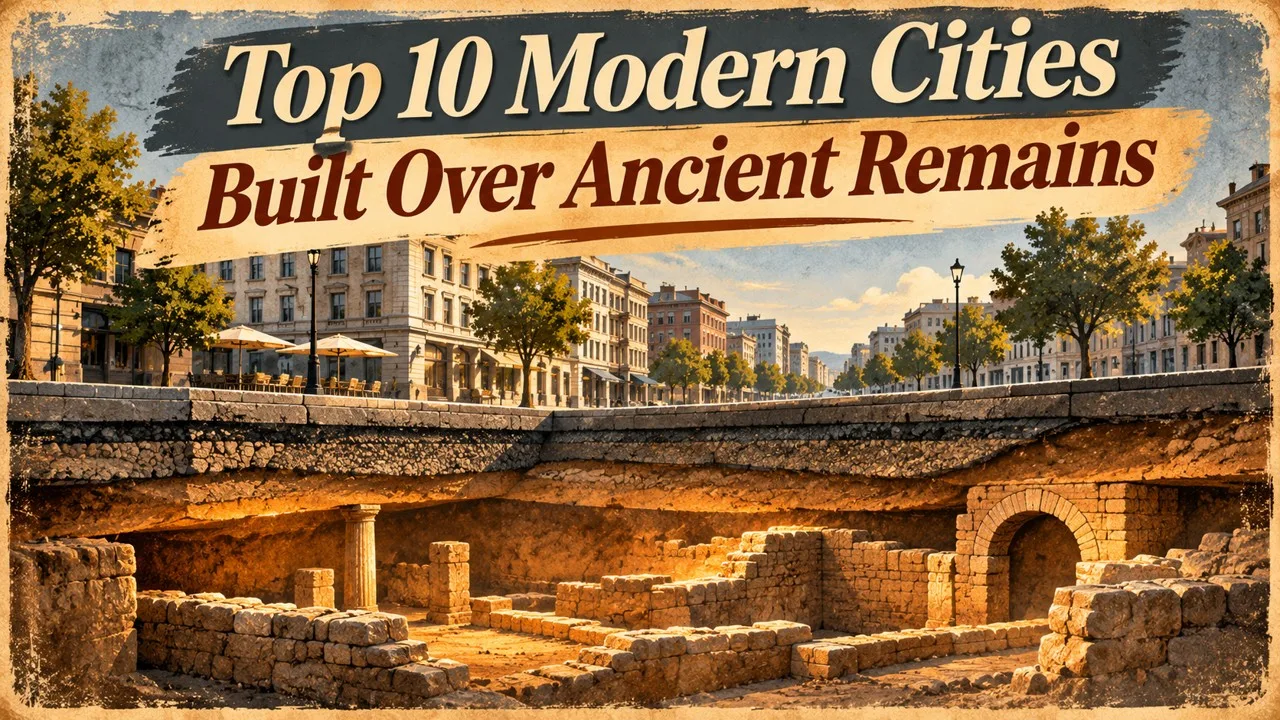
Many modern cities sit on earlier streets, temples, and houses, and the archaeology is often a few meters under the traffic.
A capital can be a palimpsest rather than a clean slate. The ten cities below are Lima, Mexico City, Rome, Istanbul, Madurai, Xi'an, Kyoto, Athens, Barcelona, and Cairo, each with a documented earlier layer that later building covered, reused, or still bumps into during a metro cut or a basement job. This is urban archaeology, not a list of drowned towns, and it does not need a flag in order to say what lies under a street.
Key Facts
| City | Earlier layer | What to keep cautious |
|---|---|---|
| 1 | Lima, with pre-Hispanic huacas still inside the modern districts | A living Andean ritual landscape, not only a colonial plaza |
| 2 | Mexico City, on the site of Tenochtitlan | The Templo Mayor and the lake bed are under and around the historic center; the city also sinks, which is a related, separate story |
| 3 | Rome, continuously inhabited, with republican and imperial levels under later streets | The 753 BC founding is a tradition, not a surveyed first day |
| 4 | Istanbul, over Byzantium and Constantinople | Harbors, cisterns, and walls are documented; the city's names are historical, not a slogan |
| 5 | Madurai, a long-lived Tamil city on the Vaigai | Temple and urban archaeology in the city, with related excavations in the wider valley |
| 6 | Xi'an, on part of the much larger Tang capital of Chang'an | The Terracotta Army is at Lintong, east of the center, not under the downtown grid |
| 7 | Kyoto, founded as Heian-kyo in 794 | More a planned capital that lasted than a city secretly perched on a single ruin |
| 8 | Athens, with the Acropolis, the Agora, and metro excavations | "Five thousand years" is a loose settlement span, not a single founding |
| 9 | Barcelona, over the Roman colony of Barcino | Roman walls and streets under the Gothic quarter, not only later modernist fame |
| 10 | Cairo, over Fustat, Roman Babylon, and later Islamic capitals | The Giza pyramids stand nearby on the west bank; they are not under the modern streets |
1. Huacas Among the Districts
Lima is a coastal capital on a desert plain, and it was already a sacred and agricultural landscape before the Spanish founding of 1535 [1]. Adobe platforms and compounds, often called huacas, still stand inside modern districts. Huaca Pucllana, in Miraflores, is a well-known Lima culture pyramid now fenced as a site in a dense neighborhood; other mounds, including Huaca Huallamarca, survive in similar company. The wider metropolitan area also includes later and earlier ritual centers, among them Pachacamac to the south [1].
The unexpected fact is how ordinary the collision is. A bus route and a pre-Hispanic platform can share a block [1]. This article will not treat the mounds as empty "ruins" with no living context, and it will not use a flag. The careful fact is a documented pre-Hispanic ceremonial landscape that the colonial and republican city did not completely erase. Archaeology here is often a matter of protecting a huaca from a new basement, or of reading a mound that a district grew around rather than over in a single night.
A desert capital can look new from a highway and still be standing on ritual earth. In Lima, some of that earth is still visible above the sidewalk.
2. A Capital on a Lake City
Mexico City occupies, at its historic core, the site of Tenochtitlan, the island capital of the Mexica, taken by a Spanish-led coalition in 1521 [2]. The cathedral and the central plaza sit close to the old ceremonial precinct. Since 1978, excavations at the Templo Mayor have brought a main temple of that precinct back into the open, a few steps from everyday traffic. The city also sits on the soft bed of former Lake Texcoco, which is why subsidence is a chronic engineering fact, already treated more fully in a separate Finepedia list [2].
The unexpected fact is how little horizontal distance there is between a subway entrance and a temple stair [2]. This article will not retell the conquest as a pageant, and it will not use a flag or a crest. The careful fact is a documented overlay: a colonial and modern capital on an island city, a excavated temple in the historic center, and a lake-bed foundation that still shapes the streets. Tenochtitlan was not a myth under a later name. It is a surveyed urban plan, now recovered in pieces.
A plaza can be a palimpsest at walking scale. In Mexico City, the earlier capital is not a metaphor. It is under the paving.
3. A City That Kept Building on Itself
Rome has been inhabited for a very long time, and the traditional founding date of 753 BC is a later story, not a field measurement [3]. What the ground does show is a deep stack of republican, imperial, medieval, and later building, with the Forum, the palatine slopes, and a long list of chance and planned excavations making the stack visible. Metro and public-works cuts regularly meet earlier streets, houses, and tombs, which is why Roman construction is also an archaeological negotiation [3].
Related: Top 10 Lost Cities That Were Rediscovered
The unexpected fact is not that Rome is old. It is how ordinary the vertical habit became: a cellar, a crypt, a sunken piazza, a road that runs above a road [3]. This article will not treat 753 as a recorded ribbon-cutting, and it will not use a banner. The careful fact is a continuously occupied urban site, a documented layer-cake of construction, and a modern city that still has to plan around what a shovel hits. "Eternal" is a nickname. The stratigraphy is the evidence.
A new line on a map in Rome is often an argument with an old wall. The argument is the city's basic archaeology.
4. Harbors and Cisterns Under a Crossroads City
Istanbul occupies a site that was Byzantium, then Constantinople, then the Ottoman and now the Turkish city on the same peninsula and the same strait [4]. The layers are not a slogan. They are harbors, cisterns, churches reused as mosques, land walls, and, in recent decades, large excavations such as the Theodosian-era harbor work at Yenikapı, which produced ships, cargo, and a deep prehistoric as well as historic sequence during metro and tunnel projects [4].
The unexpected fact is how much of the earlier port was still there, wet and buried, until a commuter project opened it [4]. This article will not choose a single sacred name for the city as a political banner, and it will not use a flag. The careful fact is a documented urban sequence at a crossing of seas and continents, with waterworks and harbors among the most informative buried remains. A cistern is a Roman or late-antique machine that later centuries kept, admired, or forgot until a visitor's walkway arrived.
A city between seas is also a city over harbors. In Istanbul, some of those harbors were under the depot and the rail yard.
5. A Tamil City with a Long Street Memory
Madurai, on the Vaigai River in Tamil Nadu, is one of South India's long-lived urban centers, a temple city already famous in early Tamil and in later travelers' accounts [5]. The great Minakshi-Sundareshvara temple complex is the monumental core of the living city, not a ruin in a field. Excavations in and around Madurai, and in the wider Vaigai valley, including the well-publicized work at Keeladi a short way downstream, have added a material record of urban and craft life that is earlier and thicker than a "temple town" postcard suggests [5].
The unexpected fact is the partnership between a still-used sacred center and a buried ordinary town [5]. This article will not collapse Keeladi into the street under the temple, and it will not use a flag. The careful fact is a continuously important Tamil city, a documented temple and bazaar landscape, and regional archaeology that has widened the early urban story of the valley. Madurai is not built on a single lost capital that later people forgot. It is a place that kept its name and its river while the ground under the shops accumulated.
Related: Top 10 Oldest Surviving Buildings on Earth
A temple that never became only a monument is still surrounded by archaeology. In Madurai, some of that archaeology is a walk away, and some of it is under the next renovation.
6. A Modern Grid on a Vaster Tang Capital
Xi'an, in Shaanxi, is one of China's historic capitals, known earlier as Chang'an, and it was the eastern end of routes later called the Silk Road [6]. The Tang city was far larger than the later, Ming-walled rectangle that still defines the recognizable center. Modern Xi'an sits on part of that earlier plan; excavations have followed palace precincts, wards, and gates, while the standing walls are mainly a Ming reconstruction on a smaller footprint [6]. The Terracotta Army of the First Emperor lies at Lintong, to the east of the urban core. It is part of the region's archaeology, not a basement under the Bell Tower.
The unexpected fact is the change of scale. A visitor can walk a complete Ming circuit and still be inside only a piece of Tang Chang'an [6]. This article will not place the clay army under the downtown avenues, and it will not use a flag. The careful fact is a documented overlay of capitals, a shrinking and shifting of the walled city, and a modern metropolis that keeps hitting Tang and earlier remains when it digs. Neolithic Banpo, likewise, is in the metropolitan area, not under the central grid.
A famous nearby tomb field can steal the map. The city itself is the Chang'an story, measured in wards and in later walls.
7. A Planned Capital That Remained a City
Kyoto was founded in 794 as Heian-kyo, a planned imperial capital on a Chinese-inspired grid, and it remained the seat of the emperors for more than a thousand years [7]. Unlike Rome, it is not primarily a city piled on a republican forum. It is a designed capital whose streets, temple grounds, and palace relocations left a plan that later Kyoto still partly follows, even where gardens, fires, and modern building have erased the first palaces [7].
The unexpected fact is how much of the "ancient remains" here is a street pattern and a set of documented palace and temple sites, some excavated, some still standing as later rebuilds [7]. This article will not treat Kyoto as a hidden necropolis, and it will not use a crest. The careful fact is a dated founding, a grid that is itself an archaeological object, and a cultural capital that kept occupying the same basin. Archaeology in Kyoto often confirms, corrects, or locates gardens and halls already named in texts. The remains are real. They are not always a surprise under a random cellar.
Related: Top 10 Mysterious Stone Circles Around the World
A planned city can be its own first layer. In Kyoto, later life was written on a 794 diagram, not only on rubble.
8. An Acropolis, an Agora, and the Metro
Athens has a prehistoric and early historic occupation on and around the Acropolis, a classical city-state at the center of later political memory, and a modern capital that still uses the same rock and the same plain [8]. The Agora, the Acropolis slopes, and the Kerameikos already make the earlier city visible. Since the late twentieth century, metro construction has added a public, underground museum habit: stations display graves, roads, and wells found during the dig, especially in the historic center [8].
The unexpected fact is how much of the newly seen city arrived because of a train [8]. This article will not date the city's birth to a round "five thousand years" as if that were a single charter, and it will not use a flag. The careful fact is a long settlement history, a classical civic landscape still in the open, and a documented rescue archaeology that commuters now walk through. Democracy is a later political story about this place. The archaeology is the wells and the graves under the ticket hall.
A metro wall can be a museum case. In Athens, that is not a metaphor for civic pride. It is a display of what the tunnel actually cut.
9. Barcino Under the Later Streets
Barcelona's fame in modern architecture sits on a much earlier colony. The Romans established Barcino, a small but walled settlement, and pieces of that colony remain in the Gothic quarter: a temple's columns, stretches of wall, and an underground museum at Plaça del Rei where streets, vats, and houses can be walked at the Roman level [9]. The later medieval and modern city grew over and against that plan, which is why a dense tourist quarter is also one of the better places in Spain to see a colony under a city [9].
The unexpected fact is how compact the Roman town was, and how completely a later capital outgrew it without erasing the first streets [9]. This article will not reduce Barcelona to a modernist postcard, and it will not use a flag. The careful fact is a documented colonial overlay, a preserved sector of Barcino in situ, and a reminder that "built on ruins" can mean a museum under a medieval palace, not only a rumor in a cellar. The colony is named in the archaeology. It is not a branding exercise.
Related: Top 10 Legendary Pyramids Around the World
A later facade can hide a Roman street. In Barcelona, the street has been opened again, a few meters down, on purpose.
10. A Capital Beside, Not Upon, the Pyramids
Cairo is a large, long-lived capital, and it is often introduced as if the Giza pyramids were in its basement [10]. They are not. The Giza plateau stands on the west bank, a short way into the desert from the urban mass, and it belongs to the city's visual and archaeological orbit, not to the street grid of downtown or of Islamic Cairo. What the modern city does overlay is a sequence of earlier towns and precincts: the Roman fortress of Babylon in Old Cairo, the first Islamic foundation at Fustat, and later Fatimid and subsequent cores [10].
The unexpected fact is how much more interesting the accurate map is than the postcard collapse of "Cairo equals Giza" [10]. This article will not put Khufu's pyramid under a traffic flyover, and it will not use a flag. The careful fact is a documented Islamic and late antique urban history under and inside the living city, plus a world-famous royal necropolis nearby. Excavations at Fustat, and conservation in Old Cairo, are the downtown story. Giza is the western horizon.
A city can be built near a wonder and still have its own buried towns. Cairo has both, and they are not in the same hole in the ground.
Conclusion
The ten cities above are Lima's huacas, Mexico City on Tenochtitlan, layered Rome, Istanbul's harbors and cisterns, Madurai on the Vaigai, Xi'an on a piece of Chang'an, Kyoto's Heian plan, Athens and its metro finds, Barcino under Barcelona, and Cairo over Fustat and Babylon, with Giza kept on the correct bank. Each is a modern city with a documented earlier layer.
A fair urban list keeps the nearby wonder, if there is one, in its actual place, and it treats a metro cut or a protected mound as evidence, not as a flag.
- ^ [1] Archaeological and municipal accounts of pre-Hispanic huacas in Lima, including Huaca Pucllana and related sites in the metropolitan area. Britannica: Lima UNESCO: Historic Centre of Lima
- ^ [2] Historical and archaeological accounts of Tenochtitlan and of the Templo Mayor excavations in Mexico City's historic center. Britannica: Mexico City Britannica: Tenochtitlán
- ^ [3] Accounts of Rome's long occupation and of the stacked republican, imperial, and later levels encountered in the historic city and in public works. Britannica: Rome Britannica: Roman Forum
- ^ [4] Historical and archaeological accounts of Istanbul's earlier cities, including harbor excavations at Yenikapı and surviving cisterns and walls. Britannica: Istanbul Britannica: Constantinople
- ^ [5] Historical accounts of Madurai as a long-lived Tamil city, and of archaeology in the city and the wider Vaigai valley, including work at Keeladi. Britannica: Madurai Britannica: Minakshi-Sundareshvara Temple
- ^ [6] Accounts of Xi'an and of Tang Chang'an, with the Terracotta Army located at Lintong rather than under the modern center. Britannica: Xi'an Britannica: Chang'an
- ^ [7] Historical accounts of Kyoto's founding as Heian-kyo in 794 and of the planned grid that later precincts still partly follow. Britannica: Kyoto UNESCO: Historic Monuments of Ancient Kyoto
- ^ [8] Accounts of Athens' long settlement history and of excavations, including finds displayed in metro stations, around the Acropolis and Agora. Britannica: Athens Britannica: Acropolis
- ^ [9] Archaeological accounts of Roman Barcino under Barcelona's Gothic quarter, including in situ remains around Plaça del Rei. Britannica: Barcelona MUHBA: Barcelona History Museum
- ^ [10] Historical and archaeological accounts of Cairo's earlier cores at Fustat and Old Cairo, with the Giza plateau treated as a nearby west-bank necropolis, not as a basement of the modern city. Britannica: Cairo Britannica: Al-Fusṭāṭ




















Discussion
Log in with