






 By
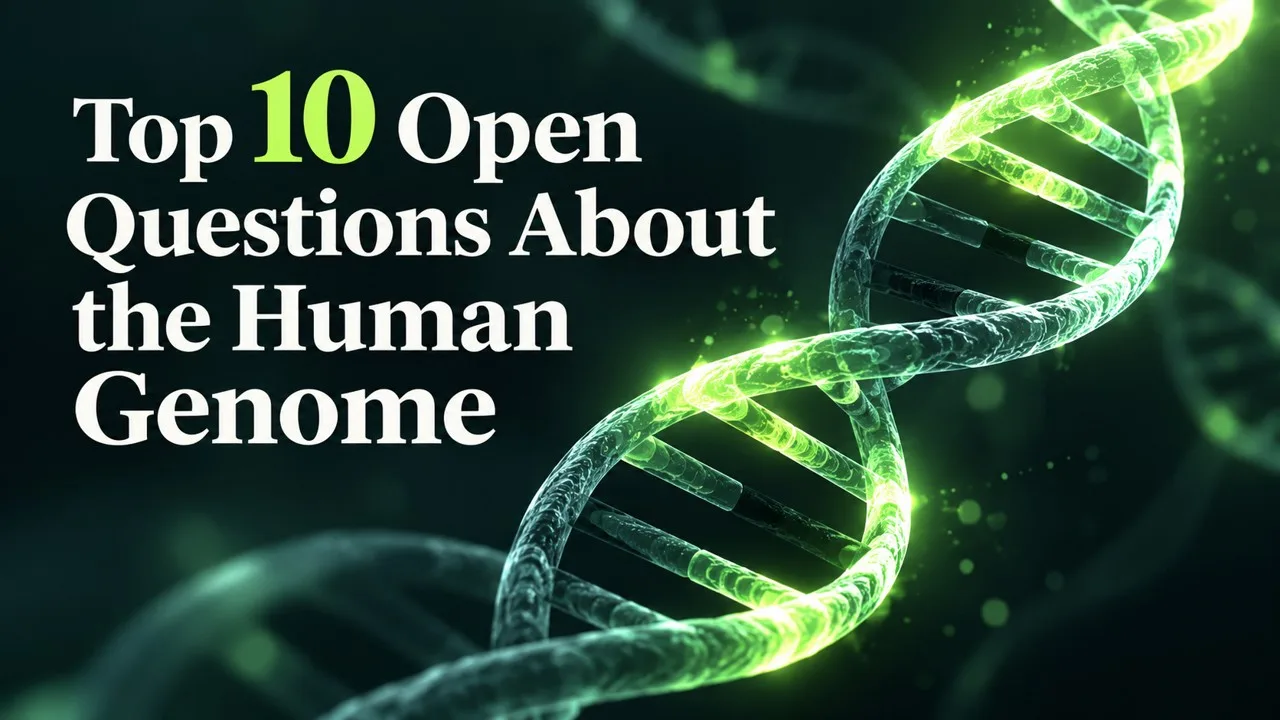
Open questions about the human genome include stretches that do not code for proteins and genes whose jobs are still poorly ranked.
The ten questions below concern the large noncoding portion of the genome, the weak link between gene number and organismal complexity, the Y chromosome, human accelerated regions, additional archaic ancestry sometimes called ghost lineages, de novo genes, gene duplications, genes of still-unknown function, sequences and functions lost on the human line, and epigenetic regulation. The tone is high-level. This article will not give medical advice, and it will not describe gene-editing, enhancement, synthesis, or pathogen work.
Key Facts
| Question | The careful present state | A limit |
|---|---|---|
| 1 | Most of the human genome does not code for proteins; some of that remainder is regulatory or structural, and some is still poorly assigned | "Junk" and "all functional" are both too neat |
| 2 | Gene number does not scale simply with everyday ideas of complexity; regulation and other layers matter | A wheat plant can have more annotated genes than a person |
| 3 | The Y chromosome is not a genetic desert; recent complete assemblies have made its structure clearer | It does recombine with the X in limited regions; popular "weirdness" should not become a character story |
| 4 | Human accelerated regions changed unusually quickly after the split from other apes; many seem to affect regulation | A rapidly changed stretch is not, by itself, an explanation of a trait |
| 5 | Neanderthal and Denisovan ancestry are documented in many people; additional unsampled "ghost" groups are inferred in some models and are still tested | This is population history, not a ranking of anyone now living |
| 6 | Some genes appear to have arisen from noncoding sequence; the extent and the functions are still argued | A new gene is not a recipe, and cognition claims should stay modest |
| 7 | Gene duplications can free a copy to change; a few human-lineage duplicates are well studied | Duplication can also create medical risk; this is not a diagnosis list |
| 8 | A large set of genes still has little functional annotation, a gap sometimes organized as an "unknome" | Unknown is a research status, not a mysterious power |
| 9 | The human line has lost or inactivated some genes retained in other species, and has lineage-specific deletions | Round popular counts should be treated with care |
| 10 | Chemical marks and packaging can change how genes are used without changing the DNA letter sequence | Lifestyle slogans often outrun the human evidence, and this is not advice |
1. The Noncoding Majority Is Not a Single Verdict
Only a few percent of the human genome codes for proteins [1]. The remainder, sometimes called a "dark genome" in popular writing, includes regulatory DNA, structural sequences, repeats, and elements such as transposons, as well as stretches whose jobs are still poorly assigned. An older habit of calling all of that "junk" was too blunt. A later habit of claiming that almost all of it must be functional, in a strong sense, was also too blunt. Surveys have found biochemical activity in much of the genome; activity is not the same as a selected function. The open question is not whether noncoding DNA exists. It is how to sort the parts that matter for the organism from the parts that are tolerated, leftover, or still unread [1].
The unexpected fact is that a genome can be mostly "not a gene" and still be full of work [1]. This article will not treat transposons as a tool. The careful fact is a documented small protein-coding fraction and a documented, mixed remainder. Darkness is a metaphor. Annotation is the actual job.
A letter string can be silent as a protein recipe and still have been, in some neighborhoods, a switch, a spacer, or a question mark.
2. Why Gene Number Is a Poor Score of Complexity
Some plants, including wheat, have been annotated with far more protein-coding genes than humans, who have about twenty thousand [2]. The mismatch with everyday ideas of "complexity" is an old puzzle, sometimes called the G-value paradox. Later work has emphasized that an organism's repertoire depends on more than a headcount: regulation, alternative splicing, protein domains, and the timing of expression all multiply what a smaller gene set can do. The numbers themselves also move with annotation methods, so a precise plant total should not be treated as a fixed trophy. The open question is how to talk about complexity without using a gene catalog as a scoreboard [2].
The unexpected fact is that a farm crop can "beat" a person on a naive gene count and still not be a paradox in the living plant [2]. The careful fact is a documented, modest human protein-coding set and documented reasons that a count is not a ranking. Sophistication is a loose word. Regulation is a tighter one.
A genome can be smaller in gene number and still have been, in development, a more elaborate schedule.
3. The Y Chromosome, Newly Read, Was Never Only Empty
The Y chromosome was long described, even in textbooks, as a degraded leftover with little to do beyond a sex-determining switch [3]. That picture is too thin. The chromosome does not recombine with the X along most of its length, which has made it hard to assemble and has shaped its peculiar internal palindromes and gene conversion. It does recombine in limited pseudoautosomal regions. Recent complete assemblies have filled in large, repetitive stretches that older methods skipped. The open questions are about its long-term evolution, the functions of some of its genes, and how to talk about it without turning a chromosome into a story about character. This article will not do that [3].
Related: Top 10 Most Bizarre Phobias: Strange Fears That Exist
The unexpected fact is that a "desert" can be, once it is properly read, a difficult but occupied landscape [3]. The careful fact is documented unusual recombination, documented later complete sequences, and documented genes beyond a single switch. Difficulty of assembly was real. Emptiness was the over-claim.
A chromosome can be small and awkward and still not have been, except in a shorthand, a blank.
4. Regions That Changed Fast, with Functions Still in Progress
After the human line split from other apes, some short stretches of DNA changed far faster than the mammalian background [4]. These human accelerated regions, or HARs, often lie near genes and seem to affect regulation rather than to add a brand-new protein. A few have been studied in detail; many have not. A rapid change is a clue, not a finished explanation of speech, walking, or any other popular trait. The open question is which of these stretches do something important in development, and how to test that without a story that runs ahead of the assay [4].
The unexpected fact is that a small, quickly rewritten patch can matter more than a new gene [4]. This article will not offer a trait list as if it were proved. The careful fact is a documented class of fast-changing regions and documented later work on regulation. Speed is the signature. Function is the unfinished chapter.
A sequence can be nearly unchanged for a long time, then shift, and still not have told us, by the shift alone, what it is for.
5. Archaic DNA, and Inferred Groups Still Being Tested
Many living people carry small fractions of ancestry from Neanderthals, and some carry ancestry from Denisovans, a result of documented ancient mixing [5]. Some later papers also infer additional, unsampled archaic groups, sometimes called ghost lineages, including possible extra ancestry in parts of West Africa and in other regions. Those inferences depend on models and on how well the existing ancient samples represent a past that was more crowded than a two-name story. They are a live research question, not a closed census. This article will not rank anyone now living, and it will not treat a percentage as a character [5].
The unexpected fact is that a genome can contain, in a statistical shadow, a people who have not yet been found as a fossil [5]. The careful fact is documented Neanderthal and Denisovan contributions and documented, still-tested claims of further unsampled groups. Mixture is part of the history. A ghost is a model until a bone, or a better model, arrives.
Related: Top 10 Oldest Buildings in the World
A fragment can be real in a living genome and still not have been, for an inferred extra group, a finished identification.
6. Genes That May Have Started as Noncoding Sequence
Most genes are relatives of older genes. A smaller class, called de novo genes, appears to have arisen from sequences that were not genes before, a route that was once thought rare [6]. The evidence is stronger in some cases than in others, and later reviews have urged caution about large catalogs and about swift claims that such genes explain human cognition because some are expressed in particular tissues. The open question is how often this route is used, how many of the candidates are genuine, and what the durable ones actually do. This article will not treat a new gene as a tool or a recipe [6].
The unexpected fact is that a stretch of "unused" DNA can be, in a careful case, on its way to becoming a gene [6]. The careful fact is a documented research program and documented debate about extent and function. Novelty is possible. A headline about the brain should wait.
A gene can lack an old family and still not have been, except in a modest paper, a key to a mind.
7. A Spare Copy, and the Chance to Change
When a gene is duplicated, one copy can sometimes keep the old job while the other is freer to change [7]. A few duplications on the human lineage have been studied as possible contributors to later traits, and some also sit near medical risk, because extra or unstable copies can be harmful. The open questions are which human-specific duplicates did something important, and how to tell a selected new function from a noisy extra copy. This article will not name a disease as a personal warning or offer a test [7].
The unexpected fact is that a "spare" can be both an evolutionary opportunity and a medical liability [7]. The careful fact is documented duplication as a process and documented later study of some human-lineage copies. Redundancy is the first gift. Function is the later, optional one.
Related: 10 Sikh Gurus: The Pillars of Sikhism Who Shaped Faith, Equality, Courage, and Humanity
A second copy can be a start of something new and still not have been, in every case, an improvement.
8. Genes Whose Jobs Are Still Poorly Ranked
Even after two decades of annotation, a substantial set of human genes still has little reliable functional information [8]. Researchers have sometimes organized that gap as an "unknome," a way of ranking how little is known, so that neglected genes can be studied on purpose. Popular percentages move with the database and the date. The open question is not a mystical remainder. It is a practical one: which of these genes can be understood with current tools, and which will wait for a better assay. Unknown, here, is a score, not a power [8].
The unexpected fact is that a famous genome can still have, in its parts list, thousands of thin cards [8]. The careful fact is documented later annotation gaps and documented efforts to prioritize them. Ignorance is a research status. It shrinks, unevenly, when someone looks.
A gene can be named and still not have been, in any satisfying sense, explained.
9. What the Human Line Has Lost
Evolution is not only addition. The human line has inactivated or lost some genes that other mammals still use, and it has lineage-specific deletions that remove regulatory or other DNA still present in other apes [9]. A few of those losses have reasonably well-supported effects; many are still just differences. Popular round totals should be treated with care, because catalogs depend on which species are compared and on how a "lost gene" is defined. The open question is which losses mattered, and which were merely tolerated. Absence can be as informative as a new gene, and it is easier to over-interpret [9].
The unexpected fact is that becoming human may have involved throwing things away as well as writing new lines [9]. The careful fact is documented inactivations and deletions, and documented caution about large, tidy counts. Loss is a fact of the tree. A morality of "more DNA is better" is not.
Related: Top 10 Tallest Buildings in the World
A species can be defined, in part, by what it no longer carries and still not have been, in every deleted stretch, improved.
10. Marks That Change Use, Not the Letter Sequence
Cells can change how genes are used by adding or removing chemical marks and by repackaging DNA, without rewriting the underlying sequence [10]. That regulation is central to development, and some marks can be influenced by environment. Popular writing often turns this into a slogan about diet, stress, or "toxins" as a second heredity that the reader can easily steer. In humans, many such claims, especially about what is stably passed across generations, outrun the evidence. The open questions are which marks matter in which cells, how stable they are, and how much of the popular story will survive careful measurement. This article will not give health advice [10].
The unexpected fact is that a genome can be, in a cell, a script with pencils in the margin [10]. The careful fact is documented epigenetic mechanisms and documented later over-claim in lifestyle talk. Regulation is real. A personal program is the part this list will not sell.
A mark can change an expression level and still not have been, in a magazine sense, a new kind of destiny that a person can shop for.
Conclusion
The ten questions above concern a mostly noncoding genome, a paradox of gene number, a chromosome that was never empty, fast-changing regulatory stretches, archaic and possibly extra unsampled ancestry, genes that may have started from scratch, spare copies, a residual unknome, losses on the human line, and marks that change use rather than letters. A gap in knowledge is a reason to measure. It is not a recipe for an intervention.
A genome can be fully sequenced and still not have been, in the only sense that matters for understanding, fully read.
- ^ [1] Genomic accounts of the small protein-coding fraction of the human genome and of the mixed regulatory, structural, repetitive, and still-unassigned remainder, avoiding both "junk" and "all functional" as total verdicts. https://www.britannica.com/science/human-genome https://www.genome.gov/
- ^ [2] Accounts of the G-value paradox and of why gene number is a poor score of organismal complexity, including regulation and annotation limits, without a brittle exact plant total. https://www.britannica.com/science/gene https://www.ncbi.nlm.nih.gov/
- ^ [3] Genomic accounts of the human Y chromosome, including limited recombination, later complete assemblies, and genes beyond a single switch, without character stories. https://www.britannica.com/science/Y-chromosome https://www.genome.gov/
- ^ [4] Accounts of human accelerated regions as rapidly changed, often regulatory, stretches whose functions are still being tested, without a finished trait list. https://www.britannica.com/science/human-evolution https://www.genome.gov/
- ^ [5] Population-genetic accounts of Neanderthal and Denisovan ancestry and of later, still-tested inferences of additional unsampled archaic groups, without ranking living people. https://www.britannica.com/topic/Neanderthal https://www.britannica.com/topic/Denisovan
- ^ [6] Research accounts of de novo genes as a debated origin route, with modest claims about extent and function, and without any recipe. https://www.britannica.com/science/gene subjects in evolutionary genomics
- ^ [7] Accounts of gene duplication as a source of later change, including later study of some human-lineage copies, without a personal medical list. https://www.britannica.com/science/gene-duplication https://www.genome.gov/
- ^ [8] Accounts of later annotation gaps and of efforts to rank poorly known genes, including the "unknome" framing, treating unknown as a research status. https://www.britannica.com/science/human-genome https://www.ncbi.nlm.nih.gov/gene
- ^ [9] Accounts of gene inactivation and lineage-specific deletions on the human line, with caution about popular round totals. https://www.britannica.com/science/pseudogene https://www.genome.gov/
- ^ [10] Accounts of epigenetic regulation as a change in use rather than in letter sequence, with a warning against lifestyle over-claim, and without medical or diet advice. https://www.britannica.com/science/epigenetics https://www.genome.gov/about-genomics/fact-sheets/Epigenomics-Fact-Sheet





















Discussion
Log in with