






Leonardo DiCaprio: Life, Films and Climate Activism
 By Dhiraj Sharma · Published
· Updated
Share Post
Loading…
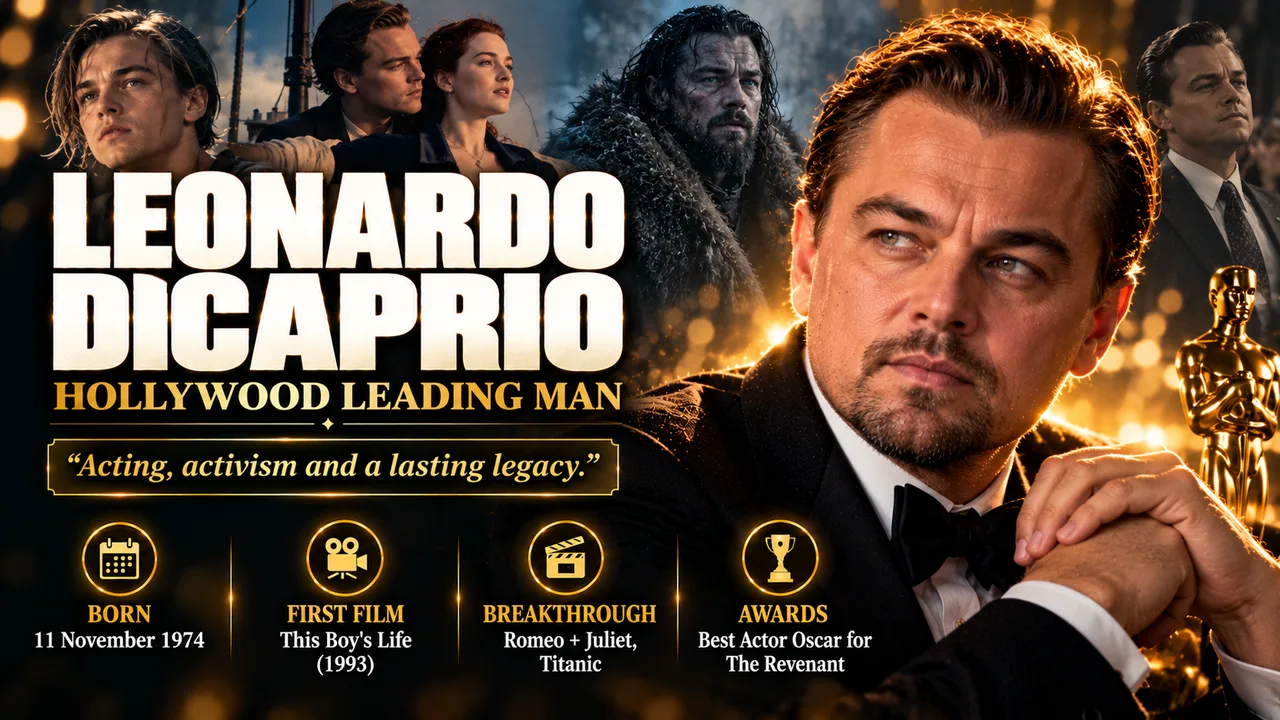
Leonardo DiCaprio (born Leonardo Wilhelm DiCaprio on 11 November 1974) is an American actor and film producer, regarded as one of Hollywood's defining leading men.[1] His work spans character-driven cinema and major blockbusters, often exploring ambition, corruption and moral decline, and his accolades include an Academy Award, a BAFTA Award, an Emmy Award, a Silver Bear and three Golden Globes.[1] His starring films have grossed $7 billion worldwide, and he has placed eight times in annual rankings of the world's highest-paid actors.[1] He became a global star with Romeo + Juliet and Titanic, built a long partnership with Martin Scorsese, and won the Academy Award for Best Actor for The Revenant.[1][5] Off screen he is one of the most visible celebrity voices on climate change, as founder of the Leonardo DiCaprio Foundation and a United Nations Messenger of Peace.[1] This Finepedia biography covers his life, films and climate activism using only facts that can be traced to the sources listed at the end.
| Item | Details |
|---|---|
| Full name | Leonardo Wilhelm DiCaprio |
| Born | 11 November 1974, Los Angeles, California, United States |
| Parents | Irmelin Indenbirken and George DiCaprio |
| Occupations | Actor, film producer |
| First major film | This Boy's Life (1993) |
| First Oscar nomination | What's Eating Gilbert Grape (1993), at age 19 |
| Global breakthrough | Romeo + Juliet (1996), Titanic (1997) |
| Academy Award | Best Actor, The Revenant, 88th Academy Awards (2016) |
| Main collaborator | Martin Scorsese |
| Production company | Appian Way Productions |
| Foundation | Leonardo DiCaprio Foundation, established 1998 |
| UN role | Messenger of Peace with a focus on climate change, from September 2014 |
Sources: Leonardo DiCaprio,[1] The Revenant,[5] Appian Way Productions.[9]
Early life
=== Family === Leonardo Wilhelm DiCaprio was born on 11 November 1974 in Los Angeles, California.[1] He is the only child of Irmelin Indenbirken, a legal secretary from Germany, and George DiCaprio, an American underground comix artist and distributor, who met at college and moved to Los Angeles after graduating.[1] His father's paternal grandparents were Italian, and his mother's father was German.[1]
He got his name because his pregnant mother first felt him kick while she was looking at a Leonardo da Vinci painting in the Uffizi museum.[1] When he was a year old his parents divorced, but to raise him together they moved into twin cottages with a shared garden in Echo Park, Los Angeles.[1] He later moved with his mother to other neighbourhoods, including Los Feliz, and has described his parents as "bohemian in every sense of the word".[1]
=== Actor or marine biologist === As a child DiCaprio wanted to become either an actor or a marine biologist.[1] He chose acting because he enjoyed imitating people and seeing their reactions to his impressions, and he was also motivated when his stepbrother's appearance in a television commercial earned $50,000.[1] The early interest in the natural world is part of the background to the environmental work that later defined his public life.[1]
=== Agents, auditions and commercials === Early on he struggled to find an agent, and when he found one the agent suggested he change his name to Lenny Williams to appeal to American audiences, which he refused.[1] He went a year and a half without work despite about 100 auditions and was close to giving up before his father persuaded him to continue.[1] After a talent agent recommended him to casting directors, he landed roles in about 20 commercials.[1]
By the early 1990s he was acting regularly on television, with a part in the pilot of The Outsiders and an episode of the soap opera Santa Barbara, followed by the series Parenthood.[1] That work earned him two nominations at the 12th Youth in Film Awards.[1]
Film career
=== Early films and Growing Pains, 1991 to 1993 === DiCaprio made his film debut in 1991 in the low-budget horror sequel Critters 3, a part he later called "possibly one of the worst films of all time".[1] Later in 1991 he joined the sitcom Growing Pains as Luke Brower, a homeless boy taken in by the show's central family.[1]
In 1992 Robert De Niro picked him from a shortlist of 400 young actors to co-star in This Boy's Life, adapted from Tobias Wolff's memoir, with DiCaprio as the teenager Toby opposite Ellen Barkin and De Niro.[1] He then played the developmentally disabled brother of Johnny Depp's character in What's Eating Gilbert Grape (1993).[1] To prepare, he studied children with similar impairments, and director Lasse Hallström let him build the character from his own research.[1] At 19 he earned a National Board of Review Award and nominations for a Golden Globe and the Academy Award for Best Supporting Actor, making him the seventh-youngest Oscar nominee in that category.[1]
=== Rising star, 1995 to 1996 === His first role of 1995 was in Sam Raimi's western The Quick and the Dead; when Sony doubted his casting, co-star Sharon Stone paid his salary herself.[1] He played the teenage Jim Carroll in The Basketball Diaries and starred in the drama Total Eclipse, directed by Agnieszka Holland.[1]
He then starred opposite Claire Danes in Baz Luhrmann's Romeo + Juliet (1996), a modernised version of Shakespeare's tragedy that kept the original dialogue.[1] The film established him as a leading Hollywood actor, and at the 47th Berlin International Film Festival in 1997 he won the Silver Bear for Best Actor.[1][10]
Related: Tom Hanks: From Humble Beginnings to Hollywood Stardom
=== Titanic and Leo-mania, 1997 to 2001 === DiCaprio turned down a role in Boogie Nights to star opposite Kate Winslet in James Cameron's Titanic, as members of different social classes who fall in love aboard RMS Titanic.[1] He played Jack Dawson, a poor, itinerant orphan from Chippewa Falls, Wisconsin.[11] With a production budget of more than $200 million, Titanic was the most expensive film in history at the time.[1] It became the highest-grossing film at the time, earning more than $2.1 billion worldwide, and won 11 Academy Awards, the most for any film, including Best Picture.[1]
Titanic turned him into a superstar, and the adoration it drew became known as "Leo-mania".[1] He sought to move away from the teen idol image and chose to reduce his workload.[1] In 1998 he played the dual roles of King Louis XIV and his twin brother Philippe in The Man in the Iron Mask, which grossed $180 million against a $35 million budget.[1] He left an early version of American Psycho to star in The Beach (2000), which earned almost three times its $50 million budget but was negatively reviewed.[1]
=== Scorsese, Spielberg and producing, 2002 to 2009 === DiCaprio turned down the role of Anakin Skywalker in Star Wars: Episode II.[1] In 2002 he played the con man Frank Abagnale Jr. in Steven Spielberg's Catch Me If You Can, which was shot in 147 locations in 52 days and grossed $355 million against a $52 million budget.[1] That year he also began his partnership with Martin Scorsese in Gangs of New York, playing Amsterdam Vallon, the young leader of an Irish-American gang; with a $103 million budget it was the most expensive film Scorsese had made, and it earned $193 million worldwide.[1]
He reunited with Scorsese for The Aviator (2004), a biopic of the aviation pioneer Howard Hughes that he co-produced through his company Appian Way.[1] The role brought him his first Golden Globe for Best Actor in a drama and nominations for the Academy Award, BAFTA and Screen Actors Guild Award.[1] Appian Way has since released Academy Award-winning films including The Aviator and The Revenant.[9]
In 2006 he starred in Scorsese's The Departed as Billy Costigan, an undercover state trooper inside the Irish Mob in Boston, a remake of the 2002 Hong Kong film Infernal Affairs.[2] He gained 15 pounds of muscle for the part, and the film grossed $291 million against a $90 million budget.[1] At the 79th Academy Awards The Departed won Best Picture, Best Director, Best Adapted Screenplay and Best Editing.[2] In the same year he played a Rhodesian diamond smuggler in Blood Diamond, spending six months in Africa to prepare and drawing notice for his South African accent.[1]
In 2007 he produced, co-wrote and narrated The 11th Hour, a documentary on the state of the natural environment.[1] Appian Way then produced Greensburg (2008 to 2010), about rebuilding Greensburg, Kansas, sustainably after the 2007 tornado.[1] In 2008 he reunited with Kate Winslet in Sam Mendes's Revolutionary Road, playing one half of a failing 1950s marriage.[1]
=== Inception and high-profile directors, 2010 to 2013 === In 2010 he played a U.S. Marshal in Scorsese's Shutter Island, based on Dennis Lehane's novel.[1] The same year he starred as Dom Cobb, an "extractor" who enters other people's dreams, in Christopher Nolan's Inception.[1] Inception grossed $839 million worldwide, the fourth-highest-grossing film of 2010, and won four Oscars.[3]
He played J. Edgar Hoover in Clint Eastwood's J. Edgar (2011) and a villainous plantation owner in Quentin Tarantino's Django Unchained (2012), which earned him a Golden Globe nomination for Best Supporting Actor and grossed $425 million on a $100 million budget.[1] In 2013 he played Jay Gatsby in Baz Luhrmann's The Great Gatsby, winning the AACTA Award for Best Actor.[1]
Related: Arnold Schwarzenegger: From Bodybuilding Champion to Hollywood Icon
His fifth Scorsese film, The Wolf of Wall Street (2013), was based on the 2007 memoir of the stockbroker Jordan Belfort, played by DiCaprio.[4] DiCaprio had won a bidding war against Brad Pitt and Paramount for the rights to the memoir in 2007.[1] The film received positive reviews for Scorsese's and DiCaprio's work together.[1]
=== The Revenant and the Oscar, 2015 === In 2015 DiCaprio produced and starred as the fur trapper Hugh Glass in Alejandro G. Iñárritu's survival drama The Revenant, based in part on Michael Punke's 2002 novel about Glass's experiences in 1823.[5] For the role he ate a raw slab of bison liver, slept in animal carcasses and learned to shoot a musket, build a fire and speak two Native American languages, Pawnee and Arikara.[1] Made on a $135 million budget, the film earned $533 million worldwide.[1]
The film received 12 Academy Award nominations, more than any other film at that ceremony.[5] At the 88th Academy Awards on 28 February 2016, DiCaprio won Best Actor, his first win after five previous nominations, while Iñárritu won Best Director and Emmanuel Lubezki won Best Cinematography.[5]
=== Later career, 2019 to present === After a four-year break from acting he starred as Rick Dalton, an ageing television actor, opposite Brad Pitt in Tarantino's Once Upon a Time in Hollywood (2019).[1] To help the film's financing, he and Pitt each took a pay cut to $10 million.[1] In 2021 he starred with Jennifer Lawrence in Adam McKay's Don't Look Up, as two astronomers trying to warn humanity about an extinction-level comet, a film DiCaprio saw as an analogy of the world's indifference to the climate crisis.[1]
Killers of the Flower Moon (2023), his sixth feature with Scorsese, is set in 1920s Oklahoma and follows a series of murders of Osage people after oil was discovered on tribal land.[6] DiCaprio was first signed to play the FBI agent Thomas Bruce White Sr. but insisted on playing the murderer Ernest Burkhart, leading to extensive script rewrites, and he received another Golden Globe nomination.[1]
He then starred in Paul Thomas Anderson's One Battle After Another (2025), alongside Sean Penn and Regina Hall, as a washed-up former revolutionary, earning his seventh Academy Award acting nomination.[1] After its premiere on 8 September 2025 the film was released by Warner Bros., and at the 98th Academy Awards it won Best Picture among six awards from 13 nominations.[7] In December 2025 DiCaprio confirmed a role in Michael Mann's planned sequel to Heat, and as of February 2026 he had begun shooting What Happens at Night with Scorsese, Jennifer Lawrence and Mads Mikkelsen.[1]
Climate activism
=== The Leonardo DiCaprio Foundation === DiCaprio believes global warming is the world's "number-one environmental challenge".[1] In 1998 he established the Leonardo DiCaprio Foundation, a non-profit devoted to promoting environmental awareness, which produced the short web documentaries Water Planet and Global Warning and has funded debt-for-nature swaps.[1] In July 2016 the foundation donated $15.6 million to protect wildlife and the rights of Native Americans and to mitigate climate change.[1] It donated $100 million in December 2018 to fight climate change, and in May 2021 DiCaprio pledged $43 million for conservation work across the Galápagos Islands.[1]
Related: Daniel Radcliffe: A Journey from Harry Potter to Broadway
=== United Nations Messenger of Peace === In September 2014 UN Secretary-General Ban Ki-moon designated DiCaprio a United Nations Messenger of Peace with a focus on climate change.[1] Later that month he gave an opening statement to the UN Climate Summit, a speech estimated to have reached one billion people worldwide.[1] He had earlier chaired the national Earth Day celebration in 2000, where he interviewed Bill Clinton about plans to deal with global warming.[1]
=== Documentaries === Beyond The 11th Hour, DiCaprio was an executive producer on Virunga (2014), about people protecting the last mountain gorillas, which brought him a Primetime Emmy nomination.[1] He produced, hosted and narrated Before the Flood (2016), a documentary directed by Fisher Stevens that covers the effects of climate change around the world and discusses climate change denial.[1][8] He also produced and narrated the 2019 global warming documentary Ice on Fire.[1]
=== Campaigns and criticism === In 2016 he met Pope Francis to discuss environmental issues, criticised slash-and-burn forest clearing for palm oil in Indonesia, and joined Mark Ruffalo in supporting the Standing Rock tribe against the Dakota Access Pipeline.[1] In April 2017 he joined the People's Climate March.[1] He has owned electric-hybrid vehicles, but his use of private jets and large yachts has been criticised as hypocritical because of their carbon footprints.[1]
=== Formula E === In December 2013 DiCaprio co-founded the Venturi Racing team, one of the ten founding teams of the FIA Formula E championship.[1] In October 2015 he was named chairman of the Formula E Sustainability Committee, and he produced And We Go Green, a documentary about the 2017 to 2018 season released in May 2019.[1]
== Philanthropy == In 1998 DiCaprio and his mother donated $35,000 for a computer centre at a library in Los Feliz.[1] In 2009 he and Kate Winslet donated $20,000 towards the nursing home fees of Millvina Dean, a survivor of the Titanic.[1] He donated $1 million to Haiti earthquake relief in 2010, $1 million through his foundation for Hurricane Harvey relief in 2017, and his foundation gave $3 million to Australian bushfire relief in 2020.[1]
== Acting style and reputation == DiCaprio is regarded as one of the finest actors of his generation, and in a 2022 Empire readers' poll he was voted one of the 50 greatest actors of all time.[1] Empire praised his willingness to "go to the ends of the earth (often literally)" for his characters.[1] He often plays real people in specific historical periods and has named Robert De Niro and James Dean as his biggest influences.[1] In 2005 he was made a Commander of the Order of Arts and Letters in France, and in 2016 Time named him one of the 100 most influential people in the world.[1]
- Born: 11 November 1974, Los Angeles.[1]
- Starring films' worldwide gross: $7 billion.[1]
- First Oscar nomination: age 19, What's Eating Gilbert Grape.[1]
- Titanic: more than $2.1 billion worldwide and 11 Academy Awards.[1]
- Inception: $839 million worldwide.[3]
- The Revenant: $533 million on a $135 million budget; 12 Oscar nominations.[1][5]
- Academy Award: Best Actor, 28 February 2016.[5]
- Acting nominations: seven, the latest for One Battle After Another.[1]
- Scorsese features: six by Killers of the Flower Moon.[6]
- Foundation: established 1998; $100 million climate pledge in 2018.[1]
- UN Messenger of Peace: since September 2014.[1]
Frequently Asked Questions
=== How did Leonardo DiCaprio get his name? === His mother first felt him kick while looking at a Leonardo da Vinci painting in the Uffizi museum.[1]
=== Which film won DiCaprio his Oscar? === The Revenant, in which he played the fur trapper Hugh Glass. He won Best Actor at the 88th Academy Awards in 2016, after five previous nominations.[5]
Related: Amitabh Bachchan: Life, Films and Legacy
=== Was DiCaprio nominated for Titanic? === No. Titanic won 11 Academy Awards, including Best Picture, but DiCaprio did not receive a nomination.[1]
=== How many films has DiCaprio made with Martin Scorsese? === Six features, from Gangs of New York to Killers of the Flower Moon, and he has begun shooting What Happens at Night with him.[1][6]
=== What roles did DiCaprio turn down? === He turned down Boogie Nights for Titanic, left an early version of American Psycho for The Beach, and turned down Anakin Skywalker in Star Wars: Episode II.[1]
=== What is the Leonardo DiCaprio Foundation? === A non-profit he founded in 1998 to promote environmental awareness. It has funded conservation projects and climate work, including $100 million in 2018.[1]
=== Is DiCaprio a UN ambassador? === Yes. Since September 2014 he has been a United Nations Messenger of Peace with a focus on climate change.[1]
=== What climate documentaries has he made? === The 11th Hour (2007), Before the Flood (2016) and Ice on Fire (2019), along with executive producer credits on films such as Virunga.[1]
- ^ [1] "Leonardo DiCaprio". Wikipedia. Wikipedia
- ^ [2] "The Departed". Wikipedia. Wikipedia
- ^ [3] "Inception". Wikipedia. Wikipedia
- ^ [4] "The Wolf of Wall Street (2013 film)". Wikipedia. Wikipedia
- ^ [5] "The Revenant (2015 film)". Wikipedia. Wikipedia
- ^ [6] "Killers of the Flower Moon (film)". Wikipedia. Wikipedia
- ^ [7] "One Battle After Another". Wikipedia. Wikipedia
- ^ [8] "Before the Flood (film)". Wikipedia. Wikipedia
- ^ [9] "Appian Way Productions". Wikipedia. Wikipedia
- ^ [10] "Romeo + Juliet". Wikipedia. Wikipedia
- ^ [11] "Titanic (1997 film)". Wikipedia. Wikipedia
Content adapted from Wikipedia (Leonardo DiCaprio: Life, Films and Climate Activism). Licensed under CC BY-SA.
Source
Portions of this article are adapted from the Wikipedia article 'Leonardo DiCaprio', licensed under CC BY-SA 4.0. (revision 1382012625)





















Discussion
Log in with