









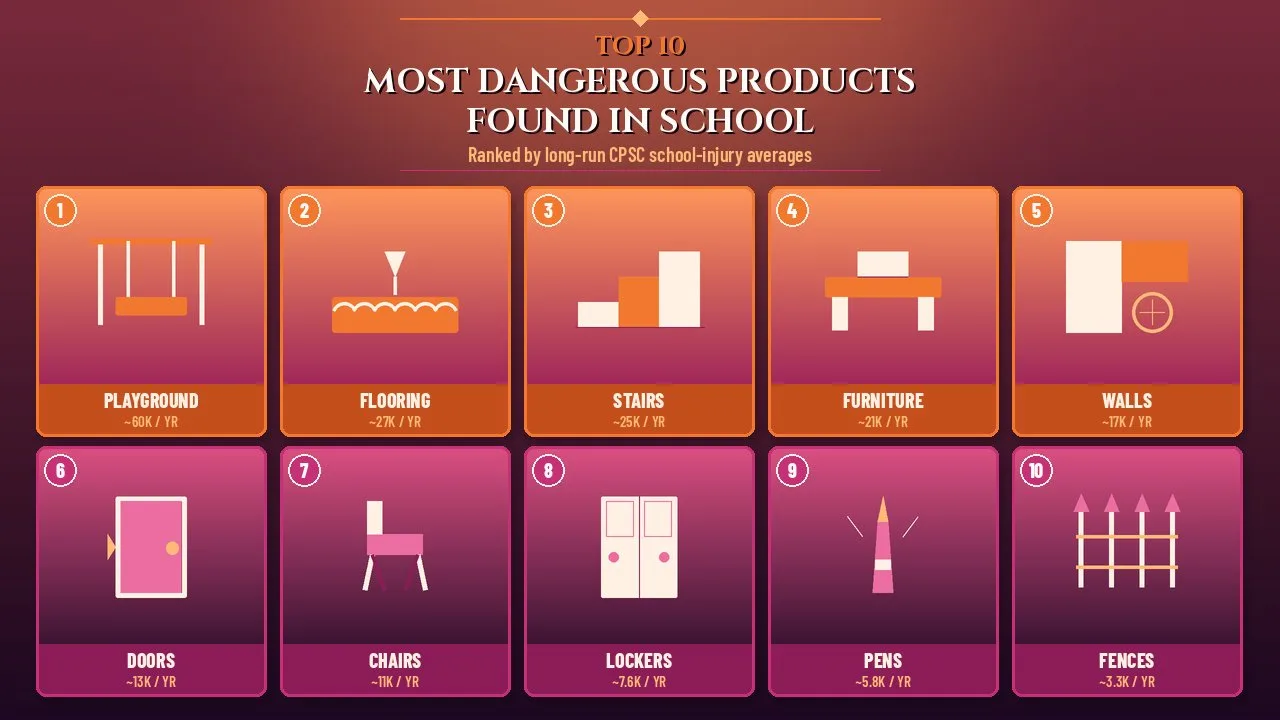
Most dangerous products found in school include playground gear, floors and stairs, tied to tens of thousands of American child injuries each year. Classrooms, hallways, labs and yards are full of ordinary fixtures that look harmless until someone trips, falls, collides or gets a finger caught. This Finepedia list ranks ten of those hazards by how often they show up in school-coded injury data, then explains what typically goes wrong and how schools cut the risk.
The ranking draws on multi-year averages of U.S. Consumer Product Safety Commission (CPSC) National Electronic Injury Surveillance System (NEISS) estimates for injuries that occurred at school, as compiled in a HealthGrove analysis covering roughly 1997 through 2014. Those figures are long-run averages for non-sports school injuries, not a single recent calendar year, and they should be read as order-of-magnitude guides rather than exact 2026 counts. Broader CPSC and CDC reporting still places playgrounds and falls among the leading reasons children visit emergency departments, so the pattern remains relevant even when year-to-year estimates move.
Sports fields and organised athletics are left out on purpose. The focus here is everyday campus products and fixtures: play structures, flooring, stairs, furniture, doors, lockers, writing tools and fences. Prevention tips favour practical steps schools and parents can take without specialised equipment.
How This List Was Ranked
Items are ordered by the HealthGrove school-injury averages described above, highest first. Where two products sit close together, the higher average wins. Newer national playground and fall statistics from CPSC and CDC are cited for context, but they do not replace the school-location averages used for ranking.
| Factor | What it means | Why it matters |
|---|---|---|
| School-coded injury volume | Estimated average annual emergency-department cases linked to the product at school | Shows which fixtures generate the most recorded harm |
| Typical injury type | Fractures, sprains, lacerations, crush injuries, eye wounds or chemical exposure | Guides which safety rules matter most |
| Where it happens | Playground, hallway, classroom, stairwell, locker bay or perimeter | Helps target inspections and supervision |
| Preventability | Whether design, maintenance, rules or adult supervision can cut risk | Separates unavoidable bumps from fixable hazards |
At a Glance: Most Dangerous Products Found in School
| Rank | Product or fixture | Approx. avg. annual school injuries (HealthGrove / CPSC NEISS, ~1997–2014) | Main risk |
|---|---|---|---|
| 1 | Playground equipment | About 60,000 | Falls from climbers, slides and swings |
| 2 | Carpets, rugs and flooring | About 26,800 | Slips, trips and hard landings |
| 3 | Stairs and steps | About 24,500 | Falls on stairs and landings |
| 4 | Other furniture (desks, tables) | About 20,700 | Pinched fingers, collisions, tip-overs |
| 5 | Walls and ceilings | About 16,600 | Running into fixed surfaces |
| 6 | Doors (excl. garage doors) | About 13,400 | Crushed fingers and impact injuries |
| 7 | Chairs and couches | About 10,700 | Tip-backs, falls and broken chairs |
| 8 | Lockers | About 7,600 | Struck-by and pinch injuries |
| 9 | Pens and pencils | About 5,800 | Puncture and eye injuries from horseplay |
| 10 | Fences | About 3,300 | Cuts and falls from climbing |
Averages are rounded. They come from the same HealthGrove CPSC compilation widely cited in school-safety round-ups; independent single-year school-only updates for every product are not published in one public table, so the article treats these as historical ranking anchors and pairs them with newer all-ages playground and fall context where available.
1. Playground Equipment
| Attribute | Details |
|---|---|
| Typical school setting | Elementary and middle-school yards; some high-school fitness areas |
| Approx. school injury average | About 60,000 per year (HealthGrove / CPSC NEISS school-coded average) |
| Broader U.S. context | CPSC and CDC-linked summaries put playground-related ED visits for children well above 200,000 annually across all locations |
| Common injury types | Fractures, contusions, lacerations, sprains; rising attention to concussions |
| Highest-risk gear | Climbers and monkey bars, swings, slides |
Origins and History
Metal jungle gyms and hard asphalt underfoot were once common on U.S. school yards. Over decades, standards from ASTM International and the CPSC Public Playground Safety Handbook pushed schools toward resilient surfacing, age-appropriate equipment zones and regular inspections. Climbers still account for a large share of recorded playground injuries because height plus awkward landings produce fractures of the arm and wrist.
School recess concentrates many children into short outdoor blocks, which raises exposure compared with a quiet neighbourhood park. Seasonal peaks often line up with warmer months and the return to class in autumn, when equipment use jumps after a break.
Key Features
- Climbing structures place children several feet above the ground, so fall height and surface quality decide severity
- Swings create moving mass; collisions happen when children walk through the arc or when freestanding seats are left in walkways
- Slides cause injuries from falls off the side, pile-ups at the exit and hot metal or plastic burns in strong sun
- Older equipment may lack progressive challenge zones that separate preschool and school-age users
- Protective surfacing depth and coverage under fall zones must match equipment height
Significance
Playground gear tops every serious ranking of most dangerous products found in school because volume, not exotic failure modes, drives the count. Most incidents are falls during ordinary play. That makes supervision, surfacing and equipment choice more important than banning recess. Districts that audit fall zones, replace worn mats and retire noncompliant climbers usually cut the worst fractures without removing the social and fitness value of outdoor play. District maintenance schedules should treat play structures like any other capital asset. Loose bolts, cracked slides and compacted mulch under swings turn minor stumbles into fractures. Many districts now use written inspection checklists aligned with the CPSC handbook and document repairs before the next recess cycle. Parent or volunteer workdays help with mulch top-ups, but structural defects need certified maintenance staff.
Interesting Facts
- National analyses of playground injuries often find a large share of cases among school-age children, not only toddlers
- Public playgrounds (schools and parks together) account for most equipment-related ED visits, according to CDC-cited summaries
- Upper-extremity fractures are among the most common serious outcomes on climbers
- Concussion reporting on playgrounds has drawn more research attention even as overall injury totals have fluctuated
- Girls and boys both appear frequently in playground injury data; older claims that one group dominates should be checked against the specific study year and setting
2. Carpets, Rugs and Flooring
| Attribute | Details |
|---|---|
| Typical school setting | Hallways, classrooms, libraries, gyms with mixed surfaces |
| Approx. school injury average | About 26,800 per year |
| Main mechanisms | Trips on loose edges, slips on polished or wet floors, falls onto hard underlay |
| Common injury types | Sprains, contusions, fractures, dental and head impacts from forward falls |
| High-risk moments | Passing periods, rainy days, after mopping, when rugs curl |
Origins and History
Schools mix carpet, vinyl composition tile, polished concrete and gym finishes in the same building. Each surface behaves differently when wet or crowded. NEISS product codes for carpets, rugs and flooring capture many school falls because the floor is the last thing a running student hits. HealthGrove’s long-run average placed flooring just behind playground equipment among school hazards.
Modern facility standards emphasise low-profile transitions, slip-resistant finishes in wet zones and quick cleanup after spills. Those basics matter more than brand of carpet.
Key Features
- Loose rug corners and wrinkled runners create predictable trip lines in busy corridors
- Highly polished halls look tidy but can be slick when tracked-in rain or spilled drinks appear
- Hard floors under thin carpet transfer more force in a fall than thicker cushioned systems
- Uneven thresholds between rooms catch backpacks and untied shoes
- Crowded passing periods leave little reaction time when someone stops suddenly ahead
Significance
Flooring ranks second among most dangerous products found in school because nearly every student crosses large floor areas many times a day. Injury severity is often lower than a high playground fall, yet the sheer number of slips and trips keeps the total high. Simple habits — no running indoors, prompt spill cleanup, taped rug edges and visible wet-floor signs — reduce cases without expensive rebuilds. Facility managers can map slip incidents from nurse logs onto hallway diagrams and find the same wet entry mats or polished corners appearing each rainy week. Once those spots are known, anti-slip treatments, longer walk-off mats and earlier mop responses pay for themselves in fewer sprains. Students with mobility devices also benefit when transitions between floor types stay flush and brightly marked.
Interesting Facts
- Teachers’ classic “walk, don’t run” rule maps directly onto flooring injury patterns
- Rainy mornings and snowmelt days spike corridor slips in many climates
- Area rugs in reading corners need low-profile edges or tape so they stay flat
- Gym-to-hallway transitions are common stumble points when shoes change grip
- Flooring injuries are under-counted if students never reach an emergency department
3. Stairs and Steps =
| Attribute | Details |
|---|---|
| Typical school setting | Multi-storey academic wings, stadium steps, portable-classroom ramps |
| Approx. school injury average | About 24,500 per year |
| Main mechanisms | Missed steps, crowding, carrying loads that block sight of the tread |
| Common injury types | Ankle and wrist sprains, fractures, head and facial injuries from falls |
| Aggravating factors | Poor lighting, worn nosings, missing handrails, rushing between bells |
Origins and History
Stairs concentrate gravity, speed and people into a narrow path. Building codes require handrails, consistent riser heights and slip-resistant nosings, yet older schools still have uneven repairs and dim stairwells. The HealthGrove average of roughly 24,500 school stair injuries per year placed steps just behind flooring and far ahead of most classroom supplies.
CDC indicators for child injury continue to list falls as a leading reason for emergency visits in school-age groups, which aligns with stair and floor patterns even when datasets are not school-only.
Key Features
- Crowding on dismissal makes students take two steps at a time or skip the rail
- Backpacks and instrument cases change balance and block the view of treads
- Worn or painted-over nosings reduce the visual edge of each step
- Single broken handrail sections leave one side of a stair unprotected
- Exterior steps ice over or collect wet leaves, creating short seasonal spikes
Significance
Stairs sit high on any list of most dangerous products found in school because a short fall can still mean a broken wrist or a concussion. Unlike playground height, stair risk is present every day for secondary students who change floors between classes. Maintenance of rails and lighting, plus staggered dismissal on narrow stairs, are among the highest-return safety investments a campus can make. Secondary schools with short passing periods face a special squeeze: students try to gain seconds by skipping steps. Extending the interval by even one minute, or opening an extra stair tower when one wing is congested, often lowers fall reports more than another poster campaign. Night events and theatre dismissals need the same planning, because unfamiliar visitors do not know which rails are sturdy.
Interesting Facts
- Taking stairs “cautiously and slowly” is still the core behavioural advice for a reason
- Landings and the top and bottom steps see many incidents when attention drifts
- Carrying trays, art projects or stacks of books multiplies missteps
- Portable classroom ramps and temporary steps deserve the same inspection as permanent stairs
- Stadium bleacher stairs add another peak during assemblies and games
4. Other Furniture (Desks, Tables and Cabinets)
| Attribute | Details |
|---|---|
| Typical school setting | Classrooms, labs, libraries, offices adjoining student areas |
| Approx. school injury average | About 20,700 per year (furniture excluding beds and chairs) |
| Main mechanisms | Pinched fingers in lids and drawers, collisions while rearranging rooms, tip-overs |
| Common injury types | Crush injuries, contusions, lacerations, crushed toes |
| High-risk moments | Classroom resets, after-school clubs, moving heavy tables alone |
Origins and History
Desks with lift lids, rolling cabinets and folding tables are workhorses of school life. HealthGrove’s CPSC-based averages ranked furniture other than beds and chairs fourth for school injuries, ahead of doors and chairs when those categories are split. That placement surprises many parents who picture scissors or chemicals first, yet dense furniture layouts and constant rearrangement explain the volume.
Modern purchasing guides favour rounded corners, stable bases and hardware that soft-closes where possible. Older stock often stays in service for decades.
Key Features
- Lift-lid desks trap fingers when a lid drops or a neighbour bumps the seat
- Folding tables pinch hands at hinge points during setup for events
- Unsecured tall cabinets can tip if students climb them for supplies
- Narrow aisles turn a chair scrape into a shin collision
- Rolling carts loaded with books or instruments gain momentum in halls
Significance
Furniture is one of the most underestimated items among most dangerous products found in school because it feels static and familiar. Risk rises when rooms are rearranged quickly or when students move heavy pieces without adult help. Clear traffic lanes, two-person lift rules and retiring broken hinges cut injuries more effectively than posters alone. When classrooms convert from rows to group pods, furniture moves multiply. Teachers who keep a simple layout map and assign student helpers under adult direction avoid last-minute dragging of heavy tables. Broken drawer slides and missing glides should trigger a work order the same week, because a desk that sticks invites forceful slamming and more pinched fingers.
Interesting Facts
- Furniture categories in NEISS shifted over time, so long averages smooth coding changes
- Library book trucks and AV carts belong in the same hazard family as desks
- After-school set-ups for concerts and fairs create temporary obstacle courses
- Soft-close hardware and rounded corners are quiet upgrades with measurable value
- Lab benches with overhanging edges catch hips and thighs in crowded periods
5. Walls and Ceilings
| Attribute | Details |
|---|---|
| Typical school setting | Corridors, gyms, classrooms with low-hanging fixtures |
| Approx. school injury average | About 16,600 per year |
| Main mechanisms | Running into walls, striking protruding fixtures, objects falling from height |
| Common injury types | Contusions, facial injuries, dental trauma, occasional lacerations |
| High-risk moments | Chase games indoors, ball sports near walls, crowded corners |
Origins and History
Walls and ceilings are permanent, so they rarely appear on parents’ mental safety checklists. Yet HealthGrove’s school averages put them fifth, with roughly 16,600 injuries a year. Students collide with corners, fire-extinguisher cabinets, protruding coat hooks and low-hanging projectors. Gymnasiums add wall impact during indoor sports when padding is thin or incomplete.
Building renovations that add glass sidelights, soft corner guards and adequate gym wall pads address a hazard that pure behaviour rules cannot erase.
Key Features
- Sharp corridor corners punish players who cut too close at speed
- Unpadded gym walls turn a missed layup into a face or shoulder impact
- Low-mounted shelves and hooks catch shoulders and heads of taller students
- Objects stored on top of cabinets can fall when doors slam
- Blind corners near restrooms and stair entries concentrate collisions
Significance
Including walls and ceilings keeps this list honest: the most dangerous products found in school are not only toys and tools. Fixed architecture shapes how injuries happen. Districts that map collision hotspots with nurse-office data often find the same three corners appear again and again. Gymnasiums deserve their own padding audit. Basketball and indoor football drills send bodies toward walls at speed, and incomplete pad coverage leaves concrete or brick exposed at exactly the height of a falling shoulder or head. Schools hosting community sports after hours should insist visiting teams face the same padded boundaries students do during the day.
Interesting Facts
- “Struck by or against” ranks high among child ED injury mechanisms in CDC summaries, which fits wall collisions
- Foam corner guards are inexpensive relative to dental injury costs
- Ceiling-mounted projectors need secure mounts and cable management
- Mirror walls in dance rooms change depth perception for new students
- Outdoor courtyard walls see similar impacts during free play
6. Doors
| Attribute | Details |
|---|---|
| Typical school setting | Classroom, corridor, stair and exterior doors; many are heavy fire-rated units |
| Approx. school injury average | About 13,400 per year |
| Main mechanisms | Fingers crushed in hinge or latch side, impact when a door opens into a path |
| Common injury types | Crush injuries to fingers, contusions, facial impacts |
| Design notes | Life-safety and fire-rated doors are heavy by necessity |
Origins and History
School doors must meet fire and egress codes, which often means substantial mass and strong closers. That weight protects against fire spread and forced entry, yet it also raises the energy available to slam a hand. HealthGrove’s average of about 13,400 school door injuries per year placed doors sixth among campus products.
Finger-guard strips, delayed closers and vision panels reduce both crush and collision injuries. Older door sets without those features remain common in wings that have not been renovated.
Key Features
- Hinge-side gaps can trap small fingers when a door swings shut
- Latch-side slams crush fingertips against the frame
- Doors that open into corridors create sudden obstacles for runners
- Closers set too fast leave little time to clear a hand
- Exterior doors catch wind and slam harder on gusty days
Significance
Doors illustrate why most dangerous products found in school include infrastructure, not only supplies. A single crushed fingertip can mean surgery and weeks of limited writing. Retrofit finger guards and staff habits — hold the door, never put hands in the jamb — are proven mitigations. Elementary classrooms benefit from adult door holders during busy line-ups, especially when younger children still place hands on frames for balance. High schools can add reminder stickers on the latch side without decorating fire-rated doors in ways that violate code. Any retrofit must preserve the door’s rated function; safety hardware vendors list listed finger-protection products for that reason.
Interesting Facts
- Fire-rated doors should not be propped open with wedges that defeat the closer
- Vision panels help people see someone on the other side before pushing through
- Automatic operators on accessible doors need regular obstruction testing
- Restroom doors in elementary schools see frequent hand injuries during play
- Door stops placed incorrectly can become trip hazards of their own
7. Chairs and Couches
| Attribute | Details |
|---|---|
| Typical school setting | Classrooms, libraries, counselling offices, teacher lounges students visit |
| Approx. school injury average | About 10,700 per year |
| Main mechanisms | Leaning back until the chair tips, broken frames, falling while kneeling on seats |
| Common injury types | Head and back impacts, wrist injuries from bracing a fall |
| Behaviour link | Rocking on the rear legs remains a classic classroom risk |
Origins and History
Chairs feel too ordinary to rank among most dangerous products found in school, yet HealthGrove’s average near 10,700 school injuries a year puts seating seventh. Tip-backs dominate the narratives: a student rocks onto the rear legs, the chair slips or the frame fails, and the head or elbows hit the floor. Soft classroom couches add tip and fall risks when several students pile on.
Sturdier four-leg designs, tip-resistant classroom chairs and clear no-rocking rules address most of the pattern.
Key Features
- Rear-leg rocking raises the centre of gravity until balance is lost
- Damaged welds or loose screws turn a normal sit into a collapse
- Rolling chairs on hard floors roll out from under standing students
- Soft seating invites overcrowding that spills people onto the floor
- Stacking chairs incorrectly creates unstable towers that tip when bumped
Significance
Chair injuries are highly preventable because the dominant behaviour — leaning back — is visible and coachable. Replacing broken seats promptly matters almost as much as the rule itself. Nurse-office logs that tag “fell from chair” help schools know when a particular room’s furniture is failing. Classroom furniture budgets often prioritise student desks over teacher and aide seating, yet adult chairs that fail can injure staff who then cannot supervise. A whole-room seating check each term — wobble test, screw check, tip test — takes minutes and catches failures before a dramatic collapse during a lesson.
Interesting Facts
- A coding change in early-2000s product categories produced spikes in some furniture charts; long averages help smooth that
- Lab stools without foot rings see more fidget-related tip events
- Beanbags and floor cushions shift the hazard from tip-back to trip-over
- Teachers modelling upright seating still influences younger grades
- Auditorium seats with spring returns can pinch fingers in the hinge
8. Lockers
| Attribute | Details |
|---|---|
| Typical school setting | Secondary-school corridors and changing rooms |
| Approx. school injury average | About 7,600 per year |
| Main mechanisms | Walking into open doors, slammed fingers, falling objects from top shelves |
| Common injury types | Facial contusions, finger crush injuries, scalp lacerations |
| Peak times | Passing periods and after physical education |
Origins and History
Metal lockers line many middle and high school halls. Open doors stick out into traffic at face and shoulder height for shorter students. HealthGrove’s average of about 7,558 school locker injuries a year placed lockers eighth — ahead of pens and fences — which is why this Finepedia list includes them even though some short round-ups skip them.
Sloped tops that discourage climbing, recessed handles and rules against leaving doors open cut collisions. Crowded locker bays still need adult presence during peak minutes.
Key Features
- Open doors create a metal edge at head height in a moving crowd
- Slammed doors pinch fingers at the latch
- Overstuffed top shelves drop bags or bottles onto people below
- Students standing on bottom shelves to reach the top risk falls
- Combination lock drama slows traffic and raises bump rates
Significance
Lockers show how corridor design shapes injury counts among most dangerous products found in school. Widening aisles, staggering locker times by grade and teaching students to close doors immediately are low-cost controls. Replacing sharp-edged damaged doors prevents lacerations that look dramatic in nurse logs. Some campuses are removing corridor lockers entirely in favour of classroom storage to calm hall traffic. Where lockers remain, painting bright open-door edges or adding soft edge guards makes leftover doors more visible in a crowd. Coaches who release PE classes in waves reduce the spike of simultaneous locker use that drives collisions.
Interesting Facts
- Film clichés about locker collisions exaggerate romance and understate finger injuries
- PE changing-room lockers see wet floors plus metal doors — a double hazard
- Magnetic door holders that keep doors shut help in older banks of lockers
- Clear height limits for what may be stored on top reduce falling-object cases
- Locker banks near stair entries compound two high-risk zones
9. Pens and Pencils
| Attribute | Details |
|---|---|
| Typical school setting | Every classroom and exam hall |
| Approx. school injury average | About 5,800 per year |
| Main mechanisms | Puncture wounds from horseplay, running with a sharp point, falls onto a pencil |
| Common injury types | Soft-tissue punctures, occasional eye injuries |
| Prevention focus | No running with writing tools; points capped when not in use |
Origins and History
Pens and pencils look trivial next to playground towers, yet HealthGrove’s average near 5,786 school injuries a year keeps them on every serious list of most dangerous products found in school. Most cases involve horseplay or a fall onto a sharpened point rather than ordinary writing. Eye injuries are rarer than hand and limb punctures but account for disproportionate worry and medical cost.
Schools rarely ban pencils; they ban unsafe behaviour around them and prefer rounded or retractable tips where age-appropriate.
Key Features
- Sharpened graphite and plastic pen tips concentrate force on a small area
- Students who gesture or chase while holding a pencil create moving puncture hazards
- Falling onto a pencil that is pointing upward can drive the tip into soft tissue
- Broken leads and snapped plastic create secondary sharp edges
- Shared cups of pencils on desks spill easily during bumps
Significance
Writing tools remind families that injury volume is not the same as product “evil.” Pens are essential, so the control is culture: walk, keep points down or retracted, and never throw writing instruments. Art and design rooms may need extra rules when craft knives sit beside pens.
Interesting Facts
- Many pencil injuries never reach an ED and therefore sit outside NEISS estimates
- Mechanical pencils reduce some sharpening hazards but still puncture
- Exam halls see fewer horseplay injuries but more stress-related fidget mishaps
- Eye-protection rules in labs should extend to any activity with projectile risk
- Teachers confiscating thrown pens are practising injury prevention, not just discipline
10. Fences
| Attribute | Details |
|---|---|
| Typical school setting | Perimeter fencing, playground boundaries, athletic field barriers |
| Approx. school injury average | About 3,300 per year |
| Main mechanisms | Climbing, cuts on sharp tops, falls from the top rail |
| Common injury types | Lacerations, puncture wounds, fractures from falls |
| Design notes | Spear-point or sharp-top fencing raises severity when climbed |
Origins and History
Fences keep campuses secure and separate play areas from streets and parking. They also tempt climbers. HealthGrove’s average of about 3,318 school fence injuries a year places fences tenth on this list — lower volume than playground gear, but often more intentional risk-taking. Climbing to retrieve a ball, to take a shortcut or on a dare drives many cases.
Modern school fencing guidance favours designs that discourage climbing and avoid spear tips adjacent to student play zones, while still meeting security needs.
Key Features
- Sharp finials and cut wire ends lacerate hands and legs
- Chain-link mesh gives easy toeholds for climbing
- Falls from the top of a fence combine height with awkward landings
- Gates with closing springs can strike or pinch
- Gaps under or beside fences invite crawling that snags clothing
Significance
Fences close the ranking of most dangerous products found in school because they sit at the edge of campus life — both geographically and behaviourally. Clear rules against climbing, prompt ball-retrieval help from staff and fence designs without inviting toeholds reduce incidents without opening the perimeter. Security teams and physical-education staff should share one message about fences: retrieve balls through gates, not over the top. When a fence line borders a busy road, climbing risk becomes a traffic risk too. Periodic walks to file down cut wire ends and replace damaged mesh keep minor lacerations from becoming a weekly nurse-office theme.
Interesting Facts
- Athletic field foul-ball retrieval is a recurring reason students approach fences
- After-hours trespassing adds injuries that still may be coded to school locations
- Padding or covers on sharp tops near playgrounds lower laceration severity
- Gate hardware needs the same finger-guard thinking as corridor doors
- Signage alone rarely stops climbers; design and supervision matter more
Comparison: Injury Patterns Across the Top 10
| Product | Dominant pattern | Best first-line prevention |
|---|---|---|
| Playground equipment | Falls from height | Surfacing depth, age-zoning, supervision |
| Flooring | Slips and trips | No running, spill control, flat rugs |
| Stairs | Falls on steps | Handrails, lighting, staggered traffic |
| Furniture | Crush and collision | Stable layout, two-person moves, soft-close lids |
| Walls and ceilings | Impact with fixed surfaces | Corner guards, gym pads, clear sight lines |
| Doors | Finger crush and swing impact | Finger guards, vision panels, slower closers |
| Chairs | Tip-backs | No rocking, replace broken seats |
| Lockers | Open-door strikes | Close doors, stagger access times |
| Pens and pencils | Punctures from horseplay | Points down, no throwing or running with tools |
| Fences | Climbing injuries | No-climb design, staff help retrieving balls |
Frequently Asked Questions
What are the most dangerous products found in school according to injury data?
Playground equipment leads long-run school-coded CPSC averages compiled by HealthGrove, followed by flooring, stairs, other furniture, walls, doors, chairs, lockers, pens and fences. Exact yearly counts change, but built-environment fixtures dominate over scissors or chemicals in that historical ranking.
Are the injury numbers in this article from 2026?
No. The per-product school averages come from a HealthGrove analysis of CPSC NEISS data spanning roughly 1997–2014. They are used here as ranking anchors. Newer CPSC and CDC figures confirm that playgrounds and falls still drive large numbers of child emergency visits nationwide.
Why are scissors and chemicals not in the top 10 here?
Some popular lists include scissors, cleaning chemicals or bicycles. Those products still cause school injuries, but the HealthGrove averages for furniture, walls and lockers were higher, so this Finepedia ranking prioritises the larger campus fixtures and notes supplies in the FAQ and conclusion instead.
How many children are hurt on playgrounds each year in the United States?
CPSC and CDC-linked summaries commonly cite well over 200,000 emergency-department visits a year for playground-related injuries among children across all locations, not only schools. School yards are a major subset of public playground exposure.
What is the single best way to cut school product injuries?
There is no single fix. The highest return usually comes from pairing maintenance (surfacing, handrails, door guards, stable furniture) with supervision and simple behaviour rules such as no running in halls and no rocking on chairs. Nurse-office tracking helps schools see which locations repeat.
Do denser carpets make schools safer?
Carpet can soften some falls compared with bare concrete, but loose edges, wrinkles and wet fibres create trips and slips. Flat, well-secured flooring with prompt spill cleanup matters more than carpet thickness alone.
Should parents worry more about pens than about stairs?
Stairs and floors affect far more students every day and sit higher in school injury averages. Pens matter mainly when horseplay starts. Parents can reinforce both messages: use handrails, walk indoors, and never run or gesture with a sharp pencil.
Conclusion
The most dangerous products found in school are mostly ordinary fixtures used at high frequency: play structures, floors, stairs, furniture, walls, doors, chairs, lockers, writing tools and fences. Long-run CPSC school-injury averages place playground equipment far ahead of the rest, while newer national data still flag playgrounds and falls as major reasons children reach emergency care. Schools that inspect surfacing and stairs, retrofit door and furniture hazards, and enforce calm corridor behaviour address the largest share of preventable harm without stripping campuses of play or learning tools. Parents can reinforce the same habits at drop-off and in conversations at home: walk indoors, use handrails, keep fingers clear of door jambs and never climb perimeter fences. Used together, design upgrades and everyday behaviour change keep ordinary school products from generating extraordinary injury totals.
- U.S. Consumer Product Safety Commission (CPSC), National Electronic Injury Surveillance System (NEISS) overview and playground injury reports
- CPSC, Injuries and Investigated Deaths Associated with Playground Equipment (2009–2014 report) and Public Playground Safety Handbook
- HealthGrove / Graphiq school-product injury averages (CPSC NEISS, approx. 1997–2014), as summarised in contemporaneous news features such as WTVR / Tribune Media Wire (2015)
- Centers for Disease Control and Prevention (CDC) / ChildStats injury indicators; WISQARS nonfatal injury data; CDC-cited playground injury summaries
- Peer-reviewed and clinical summaries of playground epidemiology (including emergency-department trend studies through recent years)
- Reference overview used for topic selection only: 10MostToday article on school product hazards (March 2020)

















Log in with