









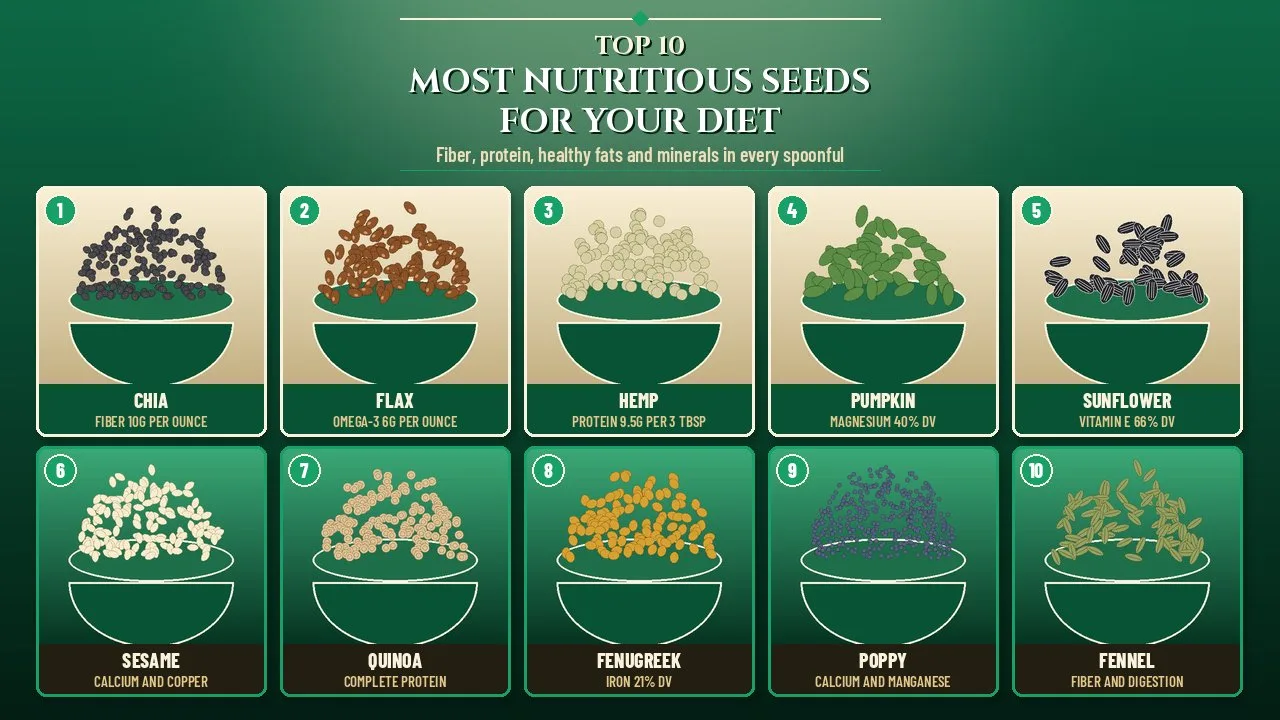
The most nutritious seeds for your diet are chia, flax, hemp, pumpkin and sunflower, which pack fiber, protein, healthy fats and minerals into a spoonful.
Seeds are the part of a plant built to start new life, so each one carries a concentrated store of energy, protein, fats, vitamins and minerals. That is why a small handful can add more nutrition to a meal than almost any other food of the same size. This Finepedia guide ranks ten everyday seeds, explains where each one comes from, lists what it actually contains and shows simple ways to eat it.
All nutrition figures come from the United States Department of Agriculture (USDA) FoodData Central database and are rounded. Percentages of the Daily Value (DV) use the reference amounts set by the U.S. Food and Drug Administration for adults. Seeds are rich in calories, so portions here are realistic ones, usually about 28 grams (one ounce) or one tablespoon.
How This List Was Ranked
A seed earns its place by how much useful nutrition it delivers in a normal serving, not in a 100-gram pile nobody would eat. Spice seeds such as fenugreek, poppy and fennel are eaten in smaller amounts, so they are judged by what a tablespoon adds to a dish.
| Factor | What it measures | Why it matters |
|---|---|---|
| Fiber | Grams of dietary fiber per serving | Supports digestion, fullness and steady blood sugar |
| Protein quality | Grams of protein and its amino acid mix | Helps plant-based eaters meet daily needs |
| Healthy fats | Omega-3 ALA and unsaturated fat content | Linked with heart health |
| Key minerals | Magnesium, zinc, iron, calcium and others | Many adults fall short on these |
| Ease of use | How simply the seed fits into daily meals | A seed only helps if you actually eat it |
At a Glance: Most Nutritious Seeds
| Rank | Seed | Typical serving | Standout nutrient |
|---|---|---|---|
| 1 | Chia seeds | 28 g (about 2.5 tbsp) | Fiber, about 10 g |
| 2 | Flaxseeds | 28 g (about 4 tbsp ground) | Plant omega-3 ALA, about 6 g |
| 3 | Hemp seeds (hulled) | 30 g (3 tbsp) | Complete protein, about 9.5 g |
| 4 | Pumpkin seeds (pepitas) | 28 g | Magnesium, about 40% DV |
| 5 | Sunflower seeds | 28 g | Vitamin E, about 66% DV |
| 6 | Sesame seeds | 28 g whole | Calcium, copper and iron |
| 7 | Quinoa | 1 cup cooked (185 g) | Complete protein and fiber |
| 8 | Fenugreek seeds | 1 tbsp (11 g) | Iron and soluble fiber |
| 9 | Poppy seeds | 1 tbsp (9 g) | Calcium and manganese |
| 10 | Fennel seeds | 1 tbsp (6 g) | Fiber and digestive comfort |
Every seed on this list is a whole food rather than a supplement. Extracts and oils, such as grape seed extract or sesame oil, behave differently and are covered only briefly at the end.
1. Chia Seeds
| Attribute | Details |
|---|---|
| Plant | Salvia hispanica, a member of the mint family |
| Native region | Central and southern Mexico and Guatemala |
| Per 28 g serving | About 138 calories, 4.7 g protein, 9.8 g fiber |
| Standout nutrients | Fiber (35% DV), plant omega-3 ALA (about 5 g), calcium (14% DV) |
| Best way to eat | Soaked in liquid as a pudding, or stirred into oats and smoothies |
Origins and History
Chia was grown across Mesoamerica long before Europeans arrived, and Aztec tribute records list it among the crops that conquered towns had to send to the capital. The seeds were eaten, pressed for oil and used in offerings. Cultivation faded after the Spanish conquest and only returned to world markets in the 1990s, when growers in Latin America and later Australia began producing it commercially. Many people first met the plant through the Chia Pet, a novelty planter that sprouted green hair.
Key Nutrients
- About 9.8 g of fiber per ounce, more than a third of the daily target
- Around 5 g of alpha-linolenic acid (ALA), the plant form of omega-3
- Calcium, magnesium and phosphorus for bones
- Polyphenol antioxidants that help protect the oils from going rancid
Why It Matters
Most adults eat far less fiber than the 28 g a day used for food labels, and chia closes much of that gap in one spoonful. Much of its fiber is soluble, which forms a gel in water and slows digestion. That gel helps meals feel more filling and can soften the rise in blood sugar after eating. The ALA content also helps people who do not eat oily fish reach the adequate intake of 1.1 to 1.6 g a day.
How to Eat It
Mix three tablespoons with a cup of milk or plant milk, leave it in the fridge for a few hours and you have chia pudding. The seeds also thicken jam, bind veggie burgers and replace eggs in baking. Always let dry chia soak before eating a large amount, because the seeds swell quickly and have caused swallowing problems when eaten dry and washed down with water.
Interesting Facts
- Chia can absorb many times its own weight in water.
- The name comes from chian, a word in the Nahuatl language of the Aztecs.
- Chia has almost no flavour, so it takes on the taste of whatever it is mixed with.
2. Flaxseeds
| Attribute | Details |
|---|---|
| Plant | Linum usitatissimum, also called linseed |
| Native region | Domesticated in the Fertile Crescent of the Middle East |
| Per 28 g serving | About 150 calories, 5.1 g protein, 7.6 g fiber |
| Standout nutrients | ALA omega-3 (about 6.4 g), lignans, magnesium (26% DV), thiamin (38% DV) |
| Best way to eat | Freshly ground, stirred into cereal, yoghurt, dough or smoothies |
Origins and History
Flax is one of the oldest crops people have farmed, grown for thousands of years both for its oily seed and for the fiber in its stems. That stem fiber is spun into linen, the cloth used to wrap Egyptian mummies. The Latin name usitatissimum means most useful, a fair description for a plant that gave the ancient world food, oil and clothing. Today linseed oil is still used to treat wood and make traditional oil paints.
Key Nutrients
- The richest common food source of ALA omega-3
- Lignans, plant compounds with antioxidant and mild estrogen-like activity
- A mix of soluble and insoluble fiber
- Good amounts of thiamin, magnesium, copper and phosphorus
Why It Matters
Flax is the best-studied seed for heart health. A Canadian trial published in 2013 gave people with peripheral artery disease 30 g of milled flaxseed a day for six months, and their blood pressure fell noticeably compared with a placebo group. Its soluble fiber can also help lower LDL cholesterol. No food is a cure, but flax is an easy, cheap way to improve the fat and fiber profile of a diet.
How to Eat It
Whole flaxseeds often pass through the gut undigested, so grind them first in a coffee or spice grinder. Ground flax goes stale faster, so keep it in a sealed jar in the fridge. A tablespoon of ground flax mixed with three tablespoons of water makes a flax egg for vegan baking.
Interesting Facts
- Flax flowers are a soft sky blue and open for only a single day.
- The oil made from flax is called linseed oil when used for paints and wood finishes.
- Brown and golden flaxseeds have very similar nutrition.
3. Hemp Seeds
| Attribute | Details |
|---|---|
| Plant | Cannabis sativa, food varieties grown as industrial hemp |
| Native region | Central Asia |
| Per 30 g serving (3 tbsp hulled) | About 166 calories, 9.5 g protein, 14.6 g fat |
| Standout nutrients | Complete protein, magnesium (50% DV), zinc (27% DV) |
| Best way to eat | Sprinkled raw on salads, bowls and yoghurt, or blended into milk |
Origins and History
Hemp has been farmed in China for thousands of years for rope, cloth, paper and food. The hulled kernels, often sold as hemp hearts, became a mainstream health food in the 2000s, first in Canada and then elsewhere. In the United States, the 2018 Farm Bill removed hemp with very low THC levels from the controlled substances list, which opened the door to wider farming and sales.
Key Nutrients
- All nine essential amino acids, making it a complete plant protein
- Linoleic acid (omega-6) and ALA (omega-3) in a ratio close to 3 to 1
- Magnesium, zinc, iron and phosphorus
- Very little carbohydrate compared with other seeds
Why It Matters
Hemp hearts are the protein champion of this list, giving about 9.5 g in three tablespoons, roughly what a large egg and a half provides. Because the protein is complete and easy to digest, hemp is a favourite with vegans and vegetarians. Its magnesium content is also unusually high, which matters because many adults eat less magnesium than recommended.
How to Eat It
Hulled hemp seeds are soft and nutty, so they can be eaten straight from the bag. Scatter them over salads, rice bowls or avocado toast, or blend them with water and a date to make a quick hemp milk. Heat damages some of their delicate fats, so add them after cooking.
Interesting Facts
- Food hemp contains only trace amounts of THC and does not cause a high.
- Botanically, each hemp seed is a tiny dry fruit called an achene, with its own hard shell.
- Hemp seed oil is green and best kept for cold dressings.
4. Pumpkin Seeds (Pepitas)
| Attribute | Details |
|---|---|
| Plant | Cucurbita species, including pumpkins and squash |
| Native region | Mexico and Central America |
| Per 28 g serving (hulled) | About 157 calories, 8.5 g protein, 13.7 g fat |
| Standout nutrients | Magnesium (40% DV), zinc (20% DV), phosphorus, iron (14% DV) |
| Best way to eat | Toasted as a snack, or scattered over soups, salads and granola |
Origins and History
Squash was one of the first plants domesticated in the Americas, and archaeologists have found squash seeds in Mexican caves that are around 10,000 years old. Early farmers likely valued the seeds as much as the flesh. The name pepita comes from Mexican Spanish and usually means the green, shell-free kernel. In Austria, a hull-less pumpkin from the Styria region gives a dark green seed oil that is famous across central Europe.
Key Nutrients
- One of the best food sources of magnesium
- Zinc, which supports immunity and wound healing
- Iron, phosphorus and manganese
- Tryptophan, an amino acid the body uses to make serotonin and melatonin
Why It Matters
An ounce of pepitas covers around 40% of an adult's daily magnesium, a mineral involved in muscle and nerve function, blood sugar control and bone health. They are also one of the most practical plant sources of zinc, which is useful for people who eat little meat or shellfish. Their high protein makes them more filling than many snack foods.
How to Eat It
Toast pepitas in a dry pan for three or four minutes until they puff and pop, then add a pinch of salt or chilli. They are a classic topping for Mexican dishes and soups. Seeds scooped from a carving pumpkin can be rinsed, dried and roasted in their shells, which adds extra fiber.
Interesting Facts
- Pumpkin seeds roasted in the shell are a popular Halloween snack.
- Pepitas are a key ingredient in Mexican green mole, called pipián.
- A handful of hulled seeds is naturally gluten-free.
5. Sunflower Seeds
| Attribute | Details |
|---|---|
| Plant | Helianthus annuus, the common sunflower |
| Native region | North America |
| Per 28 g serving (kernels) | About 163 calories, 5.8 g protein, 2.4 g fiber |
| Standout nutrients | Vitamin E (66% DV), copper (56% DV), selenium (27% DV), thiamin |
| Best way to eat | Unsalted kernels on salads, in bread or as sunflower seed butter |
Origins and History
Indigenous peoples in what is now the United States domesticated the sunflower thousands of years ago and used its seeds for flour, oil and dye. Spanish explorers took it to Europe in the 1500s, where it was first grown as an ornamental flower. It became a major oil crop in Russia in the 1800s, partly because sunflower oil was not on the list of foods banned during Orthodox fasting periods. Ukraine and Russia remain the giants of sunflower farming today.
Key Nutrients
- Vitamin E, an antioxidant that protects cell membranes
- Selenium and copper, two trace minerals many diets miss
- Thiamin (vitamin B1) and folate
- Mostly unsaturated fats
Why It Matters
Sunflower seeds are the easiest way on this list to meet the vitamin E target, with an ounce of kernels covering about two thirds of the daily amount. Vitamin E is fat-soluble and found mainly in nuts, seeds and plant oils, so people on low-fat diets can fall short. Sunflower seed butter is also a common peanut-free spread for schools with nut bans.
How to Eat It
Choose unsalted or lightly salted kernels, because roasted seeds in the shell are often coated in a lot of salt. Add them to salads, trail mix, muffins and multigrain bread, or spread sunflower seed butter on toast. Store them somewhere cool, as their oils can turn rancid.
Interesting Facts
- Young sunflower heads turn to follow the sun across the sky, a habit called heliotropism.
- Sunflower seed butter can turn green in baking, a harmless reaction between chlorogenic acid and baking soda.
- Shelling sunflower seeds with the teeth is a popular pastime at baseball games.
6. Sesame Seeds
| Attribute | Details |
|---|---|
| Plant | Sesamum indicum |
| Native region | Domesticated in the Indian subcontinent |
| Per 28 g serving (whole) | About 160 calories, 5 g protein, 3.3 g fiber |
| Standout nutrients | Copper (over 100% DV), calcium (21% DV), iron (23% DV), magnesium |
| Best way to eat | Toasted on stir-fries and breads, or as tahini |
Origins and History
Sesame is one of the oldest oilseed crops in the world, and charred seeds found at Harappan sites show it was grown in the Indus Valley more than 4,000 years ago. From there it spread to Mesopotamia, Egypt and China. The phrase open sesame, from the tale of Ali Baba, is often linked to the way ripe sesame pods burst open to scatter their seeds. In India, sesame (til) has a special place in winter festivals such as Makar Sankranti.
Key Nutrients
- Copper, which helps the body use iron and build connective tissue
- Calcium, iron and magnesium, found mostly in the outer hull
- Sesamin and sesamolin, lignans unique to sesame
- Mostly unsaturated fat
Why It Matters
Whole, unhulled sesame is one of the richest plant sources of calcium, which is helpful for people who avoid dairy. There is a catch: most of the calcium sits in the hull, and hulled white sesame and many tahini brands contain far less. Sesame is also a common food allergen. In the United States it became the ninth major allergen that must be named on food labels from 1 January 2023.
How to Eat It
Toast the seeds in a dry pan until golden to bring out their nutty aroma, then scatter them over noodles, salads or steamed greens. Tahini, a sesame paste, is the base of hummus and baba ganoush. Indian til ladoo and chikki combine sesame with jaggery for a classic winter sweet.
Interesting Facts
- Sesame plants are very drought-tolerant and can grow where many crops fail.
- Black sesame has a stronger, slightly bitter flavour than white.
- Gomashio, a Japanese seasoning, is made from toasted sesame and salt.
7. Quinoa
| Attribute | Details |
|---|---|
| Plant | Chenopodium quinoa, a relative of spinach and beets |
| Native region | The Andes of Bolivia and Peru |
| Per 1 cup cooked (185 g) | About 222 calories, 8.1 g protein, 5.2 g fiber |
| Standout nutrients | Manganese (52% DV), magnesium (28% DV), folate (20% DV), iron (15% DV) |
| Best way to eat | Rinsed and boiled like rice, then used in salads, bowls and porridge |
Origins and History
Quinoa has been grown around Lake Titicaca for thousands of years and was a staple of Andean peoples, who called it the mother grain. It is eaten like a cereal but is botanically a seed, which is why nutritionists call it a pseudocereal. Demand outside South America soared in the 2000s, and the United Nations named 2013 the International Year of Quinoa to highlight its role in food security.
Key Nutrients
- Complete protein containing all nine essential amino acids
- Manganese, magnesium, phosphorus and folate
- More fiber than white rice
- Naturally gluten-free
Why It Matters
Quinoa earns its place because it is eaten in much larger portions than other seeds. A cup of cooked quinoa gives about 8 g of complete protein and more than 5 g of fiber, making it a strong swap for white rice or refined pasta. It suits people with coeliac disease, as long as the pack is certified free from cross-contamination.
How to Eat It
Rinse quinoa in a fine sieve before cooking to wash away saponins, natural bitter coatings that protect the seed from birds and insects. Cook one part quinoa in two parts water for about 15 minutes, until the little white tails appear. Use it in salads, stuffed peppers, breakfast porridge or as a side dish.
Interesting Facts
- Quinoa comes in white, red and black varieties.
- Its leaves are also edible and taste similar to spinach.
- Bolivia and Peru grow most of the world's quinoa.
8. Fenugreek Seeds
| Attribute | Details |
|---|---|
| Plant | Trigonella foenum-graecum, known as methi in India |
| Native region | The Mediterranean, western Asia and South Asia |
| Per 1 tbsp (11 g) | About 36 calories, 2.5 g protein, 2.7 g fiber |
| Standout nutrients | Iron (21% DV), soluble fiber called galactomannan, manganese |
| Best way to eat | Tempered in hot oil for dals and curries, or soaked overnight |
Origins and History
Fenugreek has been used as a food, fodder and folk remedy since ancient times, and its Latin name means Greek hay because it was grown to feed animals. India is the world's leading producer, with much of the crop grown in Rajasthan. The seeds are a key part of many curry powders and of panch phoron, the Bengali five-spice blend.
Key Nutrients
- High iron content for a spice
- Galactomannan, a soluble fiber that thickens in water
- Protein, manganese and copper
- Sotolon, the aroma compound behind its maple-like smell
Why It Matters
Fenugreek is one of the most studied spices for blood sugar. The U.S. National Center for Complementary and Integrative Health notes that some research suggests it may help lower blood sugar in people with diabetes, though studies are small. It is traditionally used to support breast milk supply, but evidence is limited. Large amounts are not considered safe during pregnancy.
How to Eat It
Fry a teaspoon of seeds in hot oil until they darken slightly, then build a dal or vegetable curry on top. Soaking seeds overnight softens their bitterness, and the soaked seeds or water are a common morning habit in Indian homes. Sprouted fenugreek adds a crunchy, bitter note to salads.
Interesting Facts
- Eating a lot of fenugreek can make sweat and urine smell like maple syrup.
- Fenugreek extract is used to make artificial maple flavouring.
- The fresh leaves (methi) and dried leaves (kasuri methi) are also cooked as herbs.
9. Poppy Seeds
| Attribute | Details |
|---|---|
| Plant | Papaver somniferum, the opium poppy |
| Native region | The eastern Mediterranean |
| Per 1 tbsp (9 g) | About 46 calories, 1.6 g protein, 1.7 g fiber |
| Standout nutrients | Calcium (10% DV), manganese (26% DV), copper, magnesium |
| Best way to eat | Baked into breads and cakes, or ground into Indian gravies |
Origins and History
Poppies have been cultivated since prehistoric times, and the seeds have been eaten across Europe, the Middle East and South Asia for centuries. Central European bakers fill strudels and kolaches with sweet poppy seed paste. In India, white poppy seeds, called khus khus or posto, are ground to thicken kormas, and posto dishes are a beloved part of Bengali cooking.
Key Nutrients
- Calcium and manganese in a small spoonful
- Copper, magnesium, zinc and iron
- Linoleic acid, an omega-6 fat
- A good share of fiber for their size
Why It Matters
Poppy seeds are mostly a flavour and texture ingredient, but a tablespoon still adds about 127 mg of calcium and a quarter of the day's manganese. The seeds themselves contain only trace opiates, picked up from the pod. Even so, eating poppy seed bread or cake shortly before a drug test can cause a positive opiate result, so it is wise to tell the tester.
How to Eat It
Sprinkle blue poppy seeds over bagels and bread rolls before baking, or stir them into lemon cake and salad dressings. For Indian dishes, soak white poppy seeds in warm water, then grind them into a smooth paste for gravies. Keep them cool, as their oil turns rancid within months.
Interesting Facts
- Poppy seeds are among the smallest seeds used in everyday cooking.
- Blue and white poppy seeds come from the same species.
- Aloo posto, potatoes cooked in poppy seed paste, is a classic everyday dish in Bengal.
10. Fennel Seeds
| Attribute | Details |
|---|---|
| Plant | Foeniculum vulgare, a member of the carrot family |
| Native region | The Mediterranean |
| Per 1 tbsp (6 g) | About 20 calories, 0.9 g protein, 2.3 g fiber |
| Standout nutrients | Fiber, manganese (17% DV), calcium, iron, anethole |
| Best way to eat | Chewed after meals, brewed as tea, or toasted in curries and breads |
Origins and History
Fennel was well known to the ancient Greeks and Romans, who ate it as a vegetable and used it as a medicine. Its seeds travelled along trade routes to India and China, where they became a standard kitchen spice. In India, fennel (saunf) is served in small bowls after meals as mukhwas, often mixed with sugar-coated seeds, to freshen the breath and settle the stomach.
Key Nutrients
- Over 2 g of fiber in a single tablespoon
- Manganese, calcium, iron and magnesium
- Anethole, the compound behind its sweet liquorice flavour
- Flavonoid antioxidants such as quercetin
Why It Matters
Fennel seeds are eaten in small amounts, but they are popular for a reason: many people find them soothing after a heavy meal. Fennel tea is a traditional remedy for bloating and wind, and its fiber content is high for a spice. It is also a key part of Chinese five-spice powder and Indian panch phoron, so it adds both flavour and nutrition to everyday cooking.
How to Eat It
Chew half a teaspoon after a meal, steep a teaspoon of crushed seeds in hot water for fennel tea, or toast them before adding to curries, sausages and breads. Lightly crushing the seeds releases more aroma.
Interesting Facts
- What we call fennel seeds are really the dried halves of the plant's tiny fruit.
- Fennel and anise taste alike because both contain anethole.
- Florence fennel, the bulb vegetable, belongs to the same species.
Seeds That Nearly Made the List
Several other seeds are worth knowing about even though they did not make the top ten.
- Basil seeds (sabja) swell in water like chia and are a cooling ingredient in falooda and summer drinks.
- Nigella seeds (kalonji) add an onion-like flavour to naan and pickles.
- Watermelon seeds, when sprouted and shelled, are a high-protein snack.
- Grape seeds are rarely eaten whole, but grape seed extract is sold as an antioxidant supplement. Supplements are not covered here, as they are concentrated products rather than foods.
Comparison: Top Five Seeds Per 28 Grams
| Seed | Calories | Protein | Fiber | Best for |
|---|---|---|---|---|
| Chia | 138 | 4.7 g | 9.8 g | Fiber and fullness |
| Flax (ground) | 150 | 5.1 g | 7.6 g | Omega-3 ALA |
| Hemp (hulled) | 155 | 8.8 g | 1.1 g | Protein |
| Pumpkin (pepitas) | 157 | 8.5 g | 1.7 g | Magnesium and zinc |
| Sunflower kernels | 163 | 5.8 g | 2.4 g | Vitamin E |
How to Add Seeds to Your Diet Safely
Seeds are healthy, but they are also dense in calories, so a little goes a long way. One to two tablespoons of a few different seeds each day is a sensible target for most adults.
- Start slowly with high-fiber seeds such as chia and flax, and drink plenty of water.
- Grind flax and soak chia so your body can use their nutrients.
- Choose unsalted versions to keep sodium in check.
- Store seeds in airtight jars away from heat and light, or in the fridge.
- Check for allergies, especially to sesame, before serving seeds to children or guests.
- Talk to a doctor before taking large amounts of fenugreek or flax if you take blood-thinning or diabetes medicines.
Frequently Asked Questions
What is the most nutritious seed?
Chia seeds are often named the most nutritious seed because one ounce gives nearly 10 g of fiber, about 5 g of plant omega-3 and useful calcium. Hemp seeds lead for protein and flax for omega-3, so the best choice depends on what your diet lacks. Mixing several seeds gives the widest range of nutrients.
How many seeds should I eat a day?
For most healthy adults, one to two tablespoons of seeds a day, or roughly 15 to 30 g, is a sensible amount. That adds fiber, protein and minerals without too many extra calories. If you are new to high-fiber seeds, start with a teaspoon and build up while drinking more water.
Is it better to eat seeds raw or roasted?
Both are healthy. Raw seeds keep slightly more of their delicate fats and vitamins, while light roasting improves flavour and crunch with only a small loss of nutrients. Avoid seeds roasted in a lot of oil or salt. Flaxseeds should be ground rather than eaten whole, whether raw or toasted.
Which seeds are highest in protein?
Hulled hemp seeds lead with about 9.5 g of protein in three tablespoons, followed closely by pumpkin seeds with about 8.5 g per ounce. Both are good for vegetarians and vegans. Hemp and quinoa also provide complete protein, meaning they contain all nine essential amino acids your body cannot make.
Can seeds help with weight loss?
Seeds are high in calories, but their fiber, protein and fat help you feel full, which can make it easier to eat less overall. Chia and flax are especially filling. They support weight loss only as part of a balanced diet, so measure portions rather than eating seeds straight from the bag.
Are there any seeds people should avoid?
Most edible seeds are safe for healthy people in normal amounts. People with a sesame allergy must avoid sesame and check food labels. Large amounts of fenugreek are not advised during pregnancy, and poppy seeds can affect drug tests. Apple, cherry and apricot kernels contain compounds that can release cyanide and should not be eaten.
Conclusion
The most nutritious seeds for your diet are small, cheap and easy to use. Chia and flax are the fiber and omega-3 stars, hemp and pumpkin seeds bring protein and minerals, and sunflower seeds lead for vitamin E. Sesame, quinoa, fenugreek, poppy and fennel round out the list with calcium, complete protein and flavour.
You do not need all ten. Pick two or three that fit the way you cook, keep them in jars on the counter and add a spoonful to breakfast, salads or curries. Over time, that small habit can make a real difference to the fiber, protein and mineral content of your diet. For more food guides, see the Finepedia articles on vegan facts, keto diet risks and the most unhealthy foods.
- U.S. Department of Agriculture, FoodData Central (fdc.nal.usda.gov): nutrient profiles for chia seeds, flaxseed, hulled hemp seed, pumpkin and squash seed kernels, sunflower seed kernels, sesame seeds, cooked quinoa, fenugreek seed, poppy seed and fennel seed.
- U.S. Food and Drug Administration, Daily Value on the Nutrition and Supplement Facts Labels.
- National Institutes of Health, Office of Dietary Supplements: Omega-3 Fatty Acids, Magnesium and Vitamin E fact sheets.
- National Center for Complementary and Integrative Health: Fenugreek and Flaxseed and Flaxseed Oil.
- Rodriguez-Leyva D. et al., Potent antihypertensive action of dietary flaxseed in hypertensive patients, Hypertension, 2013.
- U.S. Food and Drug Administration, Food Allergies: sesame labeling under the FASTER Act.
- Food and Agriculture Organization of the United Nations, International Year of Quinoa 2013.
















Log in with