


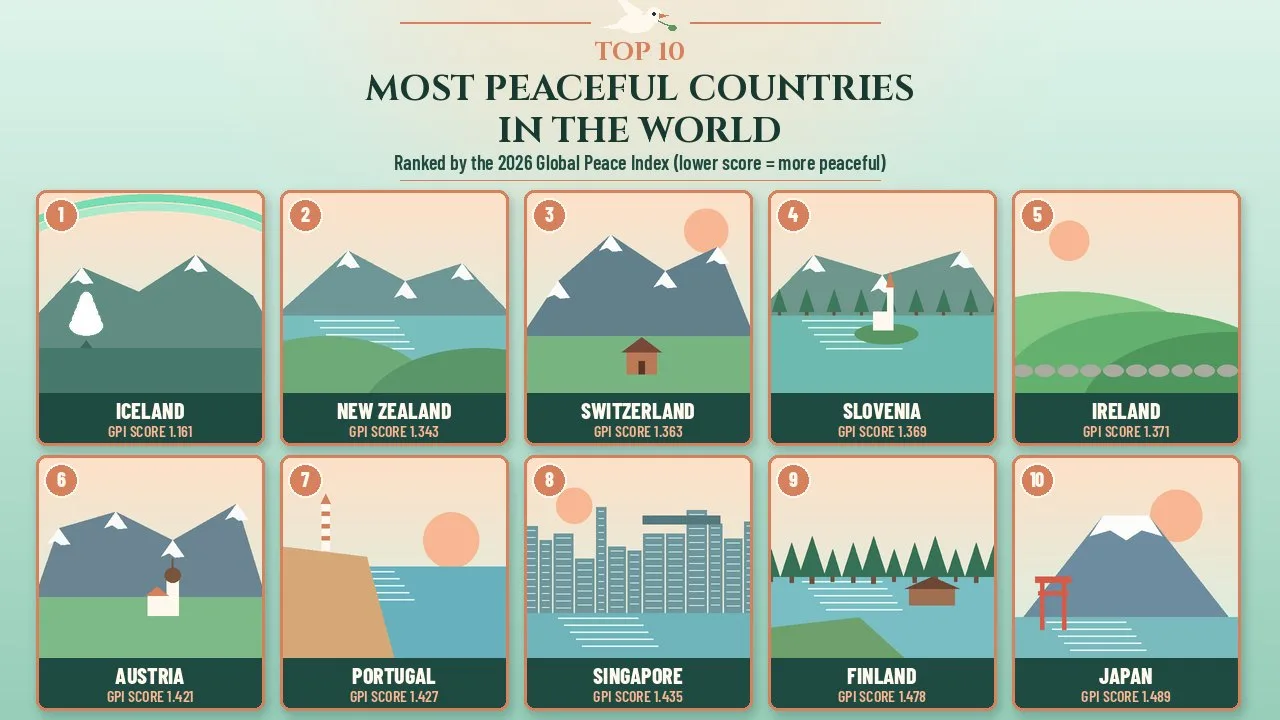
Iceland tops the 2026 Global Peace Index as the most peaceful country in the world for a 19th straight year, ahead of New Zealand and Switzerland. Slovenia completes the top four. The rest of the top 10 is made up of Ireland, Austria, Portugal, Singapore, Finland and Japan, a mix of small European democracies and wealthy, tightly governed Asia-Pacific states.
This ranking follows the 20th edition of the Global Peace Index (GPI), published in June 2026 by the Institute for Economics and Peace (IEP), an Australia-based think tank. The index scores 163 independent states and territories, covering 99.7 per cent of the world's population, on 23 indicators of safety, conflict and militarisation. Lower scores mean more peace, and every country below is shown with its official 2026 score.
The backdrop matters. The 2026 report found that average global peacefulness fell by 0.7 per cent over the past year, the 12th decline in a row, and that 99 countries became less peaceful while 62 improved. Against that trend, the countries on this list stand out for low crime, stable politics, good relations with their neighbours and, in several cases, very small or purely defensive armed forces.
How This List Was Ranked
The list uses the overall 2026 GPI rank with no adjustments, so the order matches the official index exactly. The GPI groups its 23 indicators into three domains, and a country must do well across all three to reach the top 10.
| Domain | What it measures | Example indicators |
|---|---|---|
| Societal Safety and Security | How safe daily life feels and is | Homicide rate, violent crime, perceptions of criminality, political instability, violent demonstrations, refugees and displaced people |
| Ongoing Domestic and International Conflict | Whether a country is fighting, at home or abroad | Deaths from internal and external conflict, intensity of internal conflict, relations with neighbouring countries |
| Militarisation | How heavily armed and war-ready a country is | Military spending as a share of GDP, armed services personnel, weapons imports and exports, nuclear and heavy weapons |
Each indicator is scored from 1 (most peaceful) to 5 (least peaceful). Internal peace carries 60 per cent of the weight and external peace 40 per cent, which is why a country with almost no crime can still slip if it imports large amounts of weapons or takes part in conflicts overseas.
At a Glance: The 10 Most Peaceful Countries in 2026
| Rank | Country | 2026 GPI score | 2025 rank | Region |
|---|---|---|---|---|
| 1 | Iceland | 1.161 | 1 | Western and Central Europe |
| 2 | New Zealand | 1.343 | 3 | Asia-Pacific |
| 3 | Switzerland | 1.363 | 2 | Western and Central Europe |
| 4 | Slovenia | 1.369 | 6 | Western and Central Europe |
| 5 | Ireland | 1.371 | 4 | Western and Central Europe |
| 6 | Austria | 1.421 | 5 | Western and Central Europe |
| 7 | Portugal | 1.427 | 8 | Western and Central Europe |
| 8 | Singapore | 1.435 | 7 | Asia-Pacific |
| 9 | Finland | 1.478 | 10 | Western and Central Europe |
| 10 | Japan | 1.489 | 13 | Asia-Pacific |
Seven of the 10 are in Western and Central Europe, which the IEP again rates as the most peaceful region on Earth. The other three are in the Asia-Pacific, the second most peaceful region. Japan made the biggest jump inside the top 10, climbing three places, while Slovenia rose two.
1. Iceland
| Attribute | Details |
|---|---|
| Capital | Reykjavík |
| Population | About 394,000 (1 January 2026) |
| Area | 103,125 square kilometres |
| 2026 GPI score | 1.161 (rank 1 of 163) |
| Peace record | Ranked first every year for 19 consecutive editions |
Background
Iceland was settled by Norse and Gaelic arrivals in the ninth century, and its national assembly, the Althing, first met in 930, which makes it one of the oldest parliaments still operating. The island became a fully independent republic on 17 June 1944. Five years later it joined NATO as a founding member, even though it has never kept an army of its own.
That unusual arrangement still defines its security today. Iceland relies on its NATO membership and a 1951 defence agreement with the United States, while the Icelandic Coast Guard handles search and rescue, fisheries patrols and maritime policing. The American air base at Keflavík closed in 2006, leaving the country with no permanent foreign garrison.
What Keeps It Peaceful
- No standing military, which gives Iceland the best Militarisation score in the world at 1.027
- Very low violent crime and a population small enough that communities stay closely connected
- An Ongoing Conflict score of 1.101, the joint best in the index alongside Mauritius and Uruguay
- Political stability, a strong welfare state and high trust in public institutions
- Geography: the nearest neighbours are hundreds of kilometres away across the North Atlantic
Significance
The IEP describes Iceland as the most peaceful country in the world "by a significant margin", and the numbers back that up. Its score of 1.161 is almost 0.2 points clear of second-placed New Zealand, a larger gap than the one separating second place from ninth. In 2026 it even improved by about two per cent, helped by a 42.9 per cent improvement on the violent demonstrations indicator.
Iceland matters to the debate about peace because it shows how far a country can go without armed forces. Critics point out that its remoteness and alliance guarantees do a lot of the work, but its domestic record, with rare violent crime and calm public life, is strong by any measure.
Interesting Facts
- Iceland has held the number one spot in every GPI edition since 2008.
- Most Icelandic police officers do not routinely carry firearms on patrol.
- The country has topped the World Economic Forum's Global Gender Gap Index for more than a decade.
- Almost all of its electricity comes from hydropower and geothermal energy.
2. New Zealand
| Attribute | Details |
|---|---|
| Capital | Wellington (largest city: Auckland) |
| Population | About 5 million (4,993,923 at the 2023 census) |
| Area | 263,310 square kilometres |
| 2026 GPI score | 1.343 (rank 2, up from 3rd) |
| Regional standing | Most peaceful country in the Asia-Pacific |
Background
Modern New Zealand traces its founding to the Treaty of Waitangi, signed between the British Crown and Māori chiefs on 6 February 1840. The country built a reputation for progressive firsts early on: in 1893 it became the first self-governing country to give women the right to vote in national elections.
Its stance on peace hardened in the 1980s. After French intelligence agents bombed the Greenpeace ship Rainbow Warrior in Auckland harbour in 1985, New Zealand passed its Nuclear Free Zone, Disarmament and Arms Control Act in 1987, banning nuclear-armed and nuclear-powered vessels from its waters. More recently, after the Christchurch mosque attacks in March 2019, Parliament banned most semi-automatic firearms within a month.
What Keeps It Peaceful
- The lowest Ongoing Conflict score in the Asia-Pacific, at 1.119
- Strong Safety and Security results, with a domain score of 1.497
- A modest defence force and falling weapons imports, which improved its Militarisation domain by 3.3 per cent in 2026
- Stable parliamentary government and long-standing anti-corruption institutions
- Island geography far from any active conflict zone
Significance
New Zealand climbed back to second place in 2026, swapping positions with Switzerland. Its overall score improved by about 0.4 per cent, almost entirely because it imported fewer weapons. That makes it the only non-European country in the top three, and the clear leader of a region that also contains China, North Korea and Myanmar.
The country's rapid response to the 2019 attacks is often cited as an example of how a peaceful society protects that status. Rather than treating violence as inevitable, lawmakers moved quickly to reduce access to the weapons used.
Interesting Facts
- New Zealand police officers are generally unarmed, with firearms kept for specialist situations.
- Māori and New Zealand Sign Language are both official languages.
- The country has been nuclear-free by law since 1987.
- Its nearest large neighbour, Australia, is roughly 2,000 kilometres away across the Tasman Sea.
3. Switzerland
| Attribute | Details |
|---|---|
| Capital | Bern (federal city; largest city: Zurich) |
| Population | About 9.15 million (2026 estimate) |
| Area | 41,291 square kilometres |
| 2026 GPI score | 1.363 (rank 3, down from 2nd) |
| Languages | German, French, Italian and Romansh |
Background
Switzerland traces its origins to the Old Swiss Confederacy, traditionally dated to 1291. Its permanent neutrality was recognised by the European powers in 1815, at the end of the Napoleonic Wars, and the country has not fought a foreign war since. It stayed neutral through both world wars and did not join the United Nations until 2002, after a national referendum.
Neutrality does not mean an unarmed country. Switzerland keeps a militia army based on compulsory service for men, and many citizens take part in regular training. What makes it different is that this force is built purely for home defence, and the country avoids military alliances.
What Keeps It Peaceful
- A 200-year tradition of armed neutrality and no involvement in foreign wars
- An Ongoing Conflict score of 1.144, among the six best in the world
- Direct democracy, with national votes held several times a year so disputes are settled at the ballot box
- A federal system that gives its cantons and language communities real autonomy
- High incomes, low unemployment and very low violent crime
Significance
Switzerland's influence on peace reaches far beyond its borders. Geneva is home to the International Committee of the Red Cross, founded in 1863, and the first Geneva Convention was signed there in 1864. The city also hosts the UN Office at Geneva and dozens of international organisations, and it is a favourite venue for peace talks because both sides can trust its neutrality.
The country dropped one place in 2026, and its weakest area is Militarisation, where its score of 1.564 trails most of the top 10. Even so, its excellent conflict and safety results keep it in the top three this year.
Interesting Facts
- Switzerland has no single official capital in law; Bern is described as the federal city.
- The Swiss vote on national issues on several fixed dates each year.
- The country is not a member of the European Union, though it is part of the Schengen area.
- Geneva hosted the 1985 summit where Ronald Reagan and Mikhail Gorbachev first met.
4. Slovenia
| Attribute | Details |
|---|---|
| Capital | Ljubljana |
| Population | About 2.14 million (2025 estimate) |
| Area | 20,272 square kilometres |
| 2026 GPI score | 1.369 (rank 4, up from 6th) |
| Memberships | European Union and NATO since 2004 |
Background
Slovenia declared independence from Yugoslavia on 25 June 1991. A short conflict with the Yugoslav People's Army, known as the Ten-Day War, followed, and it ended with the Brioni Agreement in July 1991. That brief clash spared Slovenia the long wars that tore through other parts of the former Yugoslavia during the 1990s.
The country then moved quickly into Western institutions. It joined both the European Union and NATO in 2004 and in 2007 became the first former communist state to adopt the euro, the same year it entered the Schengen area.
What Keeps It Peaceful
- A small, professional army and a Militarisation score of 1.308, the third best in the top 10
- Low crime and a Safety and Security score of 1.452
- Stable relations with all four neighbours: Italy, Austria, Hungary and Croatia
- A compact, mostly rural society with strong local communities
- Membership of the EU and NATO, which anchors its security without large defence spending
Significance
Slovenia was one of the big movers of 2026, rising two places to fourth and overtaking Ireland and Austria. Its overall score improved by 0.032 points, the largest gain anywhere in the top 10. That makes it the highest-ranked country from Central and Eastern Europe, and proof that a young state can build a very peaceful society within a single generation.
The country is also a reminder that peace is not only about wealth. Slovenia's income levels are lower than those of Switzerland or Ireland, yet its safety and conflict results put it ahead of most richer nations.
Interesting Facts
- Ljubljana was named European Green Capital in 2016.
- Forests cover more than half of Slovenia's territory.
- Lake Bled, with its tiny church on an island, is the country's best-known landmark.
- Slovenia has a short Adriatic coastline of less than 50 kilometres.
5. Ireland
| Attribute | Details |
|---|---|
| Capital | Dublin |
| Population | About 5.46 million (April 2025 estimate) |
| Area | 70,273 square kilometres |
| 2026 GPI score | 1.371 (rank 5, down from 4th) |
| Defence policy | Military neutrality; not a NATO member |
Background
Ireland won independence from the United Kingdom through the Anglo-Irish Treaty of December 1921, and it has followed a policy of military neutrality for most of its history since. It stayed out of the Second World War and has never joined NATO, although it works closely with the European Union, which it joined in 1973.
Instead of alliances, Ireland has put its small Defence Forces into United Nations service. Irish troops have served on UN peacekeeping missions continuously since 1958, including a long deployment in southern Lebanon since 1978. On the island itself, the Good Friday Agreement of 1998 largely ended three decades of conflict in Northern Ireland known as the Troubles.
What Keeps It Peaceful
- Military neutrality and a very small defence budget, giving a Militarisation score of 1.339
- An Ongoing Conflict score of 1.22, with no external wars and a settled peace process on the island
- Stable democratic politics and strong social institutions
- Mostly unarmed police, with firearms limited to specialist units
- Close economic ties with its neighbours through the EU
Significance
Ireland slipped one place in 2026, mainly because Slovenia improved faster, but it remains firmly in the top five. Its weakest domain is Safety and Security, where it scores 1.525, reflecting crime and perceptions of safety in its larger cities rather than any armed conflict.
Ireland's peacekeeping record gives it an influence on global peace well beyond its size. Thousands of Irish soldiers have served under the UN flag, and the country has sat on the UN Security Council several times as an elected member.
Interesting Facts
- Most members of An Garda Síochána, the national police, do not carry guns.
- Irish is the first official language under the constitution, alongside English.
- Ireland stayed neutral during the Second World War, a period known locally as "The Emergency".
- Irish peacekeepers have served in Lebanon, Cyprus, the Congo and many other missions.
6. Austria
| Attribute | Details |
|---|---|
| Capital | Vienna |
| Population | About 9.22 million (2026) |
| Area | 83,879 square kilometres |
| 2026 GPI score | 1.421 (rank 6, down from 5th) |
| Neutrality | Declared on 26 October 1955 |
Background
Austria regained full independence through the Austrian State Treaty of 15 May 1955, which ended a decade of occupation by the four Allied powers after the Second World War. Months later, on 26 October 1955, its parliament passed a law declaring permanent neutrality. That date is now Austria's National Day.
The country joined the European Union in 1995 but has stayed outside NATO. Its neutrality turned Vienna into a natural meeting point during the Cold War, and today the city is one of the four main United Nations office locations, alongside New York, Geneva and Nairobi.
What Keeps It Peaceful
- Permanent neutrality written into law since 1955
- A Militarisation score of 1.336, helped by modest defence spending
- An Ongoing Conflict score of 1.245
- Political stability and a strong social partnership between employers and unions
- High living standards and reliable public services
Significance
Vienna hosts the International Atomic Energy Agency, the UN Office on Drugs and Crime, the Organization for Security and Co-operation in Europe and OPEC, which places Austria at the centre of global talks on nuclear safety, security and energy. The city is also regularly ranked among the most liveable in the world.
Austria fell one place in 2026, and its score worsened by 0.044 points, the biggest decline among the top 10. Its Safety and Security score of 1.622 is the second weakest in the group, so its high ranking rests mainly on its neutral foreign policy and limited militarisation.
Interesting Facts
- Austria's National Day on 26 October marks the neutrality law, not a military victory.
- Vienna's UN complex is known as the Vienna International Centre.
- More than 60 per cent of Austria is covered by the Alps.
- Austria is one of a handful of EU members that are not part of NATO.
7. Portugal
| Attribute | Details |
|---|---|
| Capital | Lisbon |
| Population | About 10.3 million (2021 census); later estimates are higher |
| Area | 92,225 square kilometres (including the Azores and Madeira) |
| 2026 GPI score | 1.427 (rank 7, up from 8th) |
| Memberships | Founding NATO member (1949); EU member since 1986 |
Background
Portugal is one of Europe's oldest nation states, with mainland borders that have changed very little since the 13th century. It also holds the oldest alliance in the world still in force, with England, dating back to a treaty of 1373. In the 20th century it spent decades under the Estado Novo dictatorship, which ended with the Carnation Revolution of 25 April 1974, a military coup that was largely bloodless.
Since then Portugal has built a stable democracy. It was a founding member of NATO in 1949 and joined the European Economic Community in 1986. In 2001 it became one of the first countries to decriminalise the personal possession of all drugs, treating use as a health issue rather than a crime.
What Keeps It Peaceful
- A Militarisation score of 1.231, the third best in the world after Iceland and Malaysia
- An Ongoing Conflict score of 1.254, with no hostile neighbours
- Low levels of violent crime by European standards
- Stable politics and peaceful transfers of power since 1976
- Only one land neighbour, Spain, with which it has long-settled relations
Significance
Portugal moved up one place in 2026, improving its score by 0.020 points. Its weakest area is Safety and Security, where it scores 1.669, the lowest of the 10, but its very low militarisation more than makes up for it.
The country's story shows how quickly a society can change. Little more than 50 years ago it was a dictatorship fighting colonial wars in Africa; today it ranks among the safest and most welcoming places to live in Europe.
Interesting Facts
- The red carnation became the symbol of the 1974 revolution after people placed the flowers in soldiers' rifle barrels.
- The Anglo-Portuguese alliance dates from 1373.
- Portugal's territory includes the Atlantic archipelagos of the Azores and Madeira.
- Lisbon is one of the oldest capital cities in Western Europe.
8. Singapore
| Attribute | Details |
|---|---|
| Capital | Singapore (a city-state) |
| Population | About 6.11 million (2025) |
| Area | About 744 square kilometres |
| 2026 GPI score | 1.435 (rank 8, down from 7th) |
| Independence | 9 August 1965 |
Background
Singapore became fully independent on 9 August 1965, when it separated from Malaysia after two years as part of the federation. With no natural resources and a mixed population of Chinese, Malay, Indian and other communities, its early leaders made social harmony and security national priorities from the start.
That approach still shapes daily life. Laws are strict and firmly enforced, public spaces are closely managed, and national service has been compulsory for male citizens since 1967. The result is one of the lowest crime rates of any major city in the world.
What Keeps It Peaceful
- An Ongoing Conflict score of 1.119, tied with New Zealand for the best in the Asia-Pacific
- A Safety and Security score of 1.341, the sixth best in the world
- Strict, consistently enforced laws and very low violent crime
- Policies that promote harmony between ethnic and religious communities
- Diplomatic ties with all major powers, which lets it act as a neutral host
Significance
Singapore is the clearest example of how the GPI balances different kinds of peace. Its streets are among the safest anywhere, but its Militarisation score of 2.095 is by far the weakest in the top 10, because it keeps a large, well-funded and well-equipped armed forces for a country of its size. Without that domain, it would rank even higher.
The city-state also plays an outsized role in regional diplomacy. It hosts the annual Shangri-La Dialogue, Asia's leading defence and security conference, and it was the venue for the first meeting between a sitting US president and a North Korean leader in June 2018.
Interesting Facts
- Singapore and Japan are the only Asian countries in the 2026 top 10.
- The sale of chewing gum has been restricted since 1992.
- The country has four official languages: English, Malay, Mandarin and Tamil.
- Its whole territory is smaller than many large cities elsewhere in the world.
9. Finland
| Attribute | Details |
|---|---|
| Capital | Helsinki |
| Population | About 5.65 million (2025) |
| Area | 338,455 square kilometres |
| 2026 GPI score | 1.478 (rank 9, up from 10th) |
| Memberships | EU since 1995; NATO since 4 April 2023 |
Background
Finland declared independence from Russia on 6 December 1917. Its early decades were hard: a short civil war in 1918, then the Winter War of 1939 to 1940 and the Continuation War against the Soviet Union. After 1945 it chose a careful policy of neutrality between East and West, and in 1975 Helsinki hosted the summit that produced the Helsinki Final Act, a landmark of Cold War détente.
Finland joined the European Union in 1995. After Russia's full-scale invasion of Ukraine in 2022, it ended decades of military non-alignment and became NATO's 31st member on 4 April 2023, a major shift for a country that shares a long land border with Russia.
What Keeps It Peaceful
- The second best Safety and Security score in the world, 1.287, just behind Norway
- Very high trust in police, courts and government
- Low corruption and a strong welfare state
- A well-prepared defence system based on conscription, focused on deterrence rather than foreign wars
- Strong social equality and education
Significance
Finland's ranking shows how the GPI separates domestic peace from the security environment. Inside the country, life is exceptionally safe and orderly. Its overall position is held back by the Ongoing Conflict domain, where it scores 1.547, and by Militarisation at 1.717, reflecting its border with Russia and its large reserve army.
Finland has also contributed to peace abroad. Former president Martti Ahtisaari won the Nobel Peace Prize in 2008 for decades of mediation work, including the 2005 peace agreement in Aceh, Indonesia.
Interesting Facts
- Finland has topped the World Happiness Report for nine years in a row.
- The country climbed one place in the 2026 GPI, from 10th to 9th.
- Finnish and Swedish are both official languages.
- Martti Ahtisaari's peace work covered Namibia, Kosovo and Aceh, among others.
10. Japan
| Attribute | Details |
|---|---|
| Capital | Tokyo |
| Population | About 122.95 million (1 January 2026) |
| Area | 377,975 square kilometres |
| 2026 GPI score | 1.489 (rank 10, up from 13th) |
| Constitution | Article 9 renounces war (in force since 1947) |
Background
Japan's modern commitment to peace dates from its post-war constitution, which took effect in 1947. Article 9 renounces war as a sovereign right and the threat or use of force to settle international disputes. The Self-Defense Forces were created in 1954 as a strictly defensive military, and for decades Japan kept its defence spending low by international standards.
The memory of the atomic bombings of Hiroshima and Nagasaki in August 1945 remains central to Japanese attitudes. In 2024 Nihon Hidankyo, a nationwide organisation of atomic bomb survivors, was awarded the Nobel Peace Prize for its campaign against nuclear weapons.
What Keeps It Peaceful
- A Safety and Security score of 1.296, the fourth best in the world
- Very low rates of homicide and violent crime, and strict gun laws
- A dense network of neighbourhood police boxes, known as koban
- Strong social order and low public disorder
- A constitution that limits the use of force abroad
Significance
Japan was the biggest climber in the 2026 top 10, rising three places. The IEP credits a 6.3 per cent improvement on the Ongoing Conflict domain, including a 25 per cent improvement on the intensity of internal conflict indicator. It is the only country of more than 100 million people in the top 10, which makes its safety record especially notable.
The picture is not entirely positive. Japan's Militarisation domain worsened by 3.6 per cent because of its ongoing defence expansion. In 2025 the government approved a record defence budget of about US$55 billion and launched a Joint Operations Command to coordinate all branches of the Self-Defense Forces.
Interesting Facts
- Japan has one of the lowest gun death rates in the world.
- The Hiroshima Peace Memorial, the ruined Genbaku Dome, has been a UNESCO World Heritage Site since 1996.
- Japan's population has been shrinking for more than a decade.
- The country moved from 13th in 2025 to 10th in 2026.
Domain Scores Compared
The table below breaks each country's result into the three GPI domains. Lower is better, and the best score in each column among these 10 countries is noted in the text below.
| Country | Safety and Security | Ongoing Conflict | Militarisation |
|---|---|---|---|
| Iceland | 1.288 | 1.101 | 1.027 |
| New Zealand | 1.497 | 1.119 | 1.409 |
| Switzerland | 1.433 | 1.144 | 1.564 |
| Slovenia | 1.452 | 1.302 | 1.308 |
| Ireland | 1.525 | 1.220 | 1.339 |
| Austria | 1.622 | 1.245 | 1.336 |
| Portugal | 1.669 | 1.254 | 1.231 |
| Singapore | 1.341 | 1.119 | 2.095 |
| Finland | 1.287 | 1.547 | 1.717 |
| Japan | 1.296 | 1.503 | 1.794 |
Finland has the best Safety and Security score of the group, Iceland the best Ongoing Conflict and Militarisation scores, and Singapore the weakest Militarisation result. The table also shows two distinct paths to the top: European countries that score well on all three domains, and Asia-Pacific countries such as Singapore and Japan whose very safe societies offset heavier militaries.
Just Outside the Top 10
Several countries came close. Denmark, which ranked ninth in 2025, fell to 11th, and the gap between 10th and 17th place is less than 0.08 points.
| Rank | Country | 2026 GPI score | Change since 2025 |
|---|---|---|---|
| 11 | Denmark | 1.504 | Down 2 |
| 12 | Malaysia | 1.513 | Down 1 |
| 13 | Czechia | 1.517 | Down 1 |
| 14 | Canada | 1.525 | Up 1 |
| 15 | Hungary | 1.538 | Down 1 |
| 16 | Bhutan | 1.546 | Up 2 |
| 17 | Netherlands | 1.566 | No change |
Where Major Nations Rank
Large and powerful countries rarely appear near the top, because they are more likely to be involved in conflicts abroad and to keep large militaries. The 2026 GPI ranks the world's most populous nations as follows.
| Country | 2026 GPI rank (of 163) |
|---|---|
| Germany | 28 |
| United Kingdom | 39 |
| Indonesia | 69 |
| France | 99 |
| China | 118 |
| Brazil | 124 |
| India | 127 |
| United States | 134 |
| Nigeria | 142 |
| Pakistan | 152 |
| Russia | 163 (least peaceful) |
Poland was the most improved country of 2026, rising 23 places to 22nd, while Nepal recorded the largest deterioration after the Gen Z protests of September 2025. The United States fell to 134th, mainly because of a sharp rise in political instability.
What the Most Peaceful Countries Have in Common
Looking across the top 10, a few patterns stand out.
- Size: apart from Japan, every country in the top 10 has a population of roughly 11 million or fewer.
- No recent wars: none has fought a major external war in the past 50 years, and several are formally neutral or have no army at all.
- Strong institutions: all score highly on trust, low corruption and the rule of law.
- Wealth and welfare: most have high incomes and broad social safety nets, which reduce the pressures that drive crime and unrest.
- Geography: islands and mountain states such as Iceland, New Zealand, Japan, Switzerland and Austria benefit from natural barriers or distance from conflict zones.
Criticism and Limitations
The GPI is the most widely cited measure of peace, but it has critics. Some researchers argue that it measures negative peace, meaning the absence of violence, rather than positive qualities such as justice and cooperation. Others note that eight of its 23 indicators are qualitative assessments made by analysts, which makes the results hard to reproduce independently.
The timing of the data also matters. The 2026 report states that many conflict indicators stop at the end of 2025, so the full effects of the Iran war that began in late February 2026 are not yet captured. Readers should treat the ranking as a careful snapshot of the recent past rather than a live measure.
Tips for Visiting or Moving to a Peaceful Country
- Check official travel advice before you go, since even very safe countries have local risks such as extreme weather, volcanic activity or earthquakes.
- Expect a high cost of living in places like Iceland, Switzerland and Singapore.
- Learn the local rules: Singapore's strict laws and Japan's social etiquette are part of what keeps those societies orderly.
- Research residence and work permits early if you plan to relocate, as many of these countries have selective immigration systems.
- Remember that peaceful does not mean risk-free; ordinary precautions against petty theft still apply in big cities.
Frequently Asked Questions
What is the most peaceful country in the world?
Iceland is the most peaceful country in the world according to the 2026 Global Peace Index, with a score of 1.161. It has held first place for 19 consecutive years. Iceland has no standing army, very low crime and strong social cohesion, and the Institute for Economics and Peace says it leads the world by a significant margin.
How is the Global Peace Index calculated?
The Global Peace Index scores 163 countries on 23 indicators grouped into three domains: Societal Safety and Security, Ongoing Domestic and International Conflict, and Militarisation. Each indicator is scored from 1 to 5, with lower scores meaning more peace. Internal peace carries 60 per cent of the weight and external peace 40 per cent.
Which is the most peaceful country in Asia?
Singapore and Japan are the most peaceful countries in Asia on the 2026 Global Peace Index, ranking eighth and 10th in the world. If Oceania is included, New Zealand leads the wider Asia-Pacific region and ranks second globally. Malaysia, at 12th, and Bhutan, at 16th, are the next most peaceful Asian countries.
Where does the United States rank on the Global Peace Index?
The United States ranks 134th out of 163 countries on the 2026 Global Peace Index. Its score deteriorated by four per cent over the past year, driven mainly by a 38.5 per cent worsening in political instability and a substantial increase in violent demonstrations. Its large military and involvement in conflicts abroad also weigh on its score.
Where does India rank on the Global Peace Index?
India ranks 127th out of 163 countries on the 2026 Global Peace Index. Among the world's seven most populous nations, it sits behind Indonesia, China and Brazil and ahead of the United States, Nigeria and Pakistan. Some Indian commentators have criticised the index for not adjusting its results for population size or for democracies facing terrorism.
Which is the least peaceful country in the world?
Russia is the least peaceful country in the world on the 2026 Global Peace Index, ranking 163rd. Sudan, the Democratic Republic of the Congo, Ukraine and Israel complete the bottom five. These countries are affected by active wars, high conflict deaths, large numbers of displaced people or heavy militarisation, which push their scores towards the bottom of the scale.
Conclusion
The most peaceful countries in the world in 2026 are led once again by Iceland, followed by New Zealand, Switzerland, Slovenia and Ireland, with Austria, Portugal, Singapore, Finland and Japan completing the top 10. They follow different paths, from Iceland's lack of an army to Singapore's strict but safe society, but all combine low crime, stable politics and no active wars.
At a time when global peacefulness has declined for 12 years in a row, these countries show that peace is built and maintained through strong institutions, careful diplomacy and trust between citizens and the state. For more country rankings, see our guides to the happiest countries in the world, the most powerful countries in the world, the richest countries in the world and the most walkable cities in the world.
- Institute for Economics and Peace, Global Peace Index 2026: Measuring Peace in a Complex World (June 2026), visionofhumanity.org
- Global Peace Index, Wikipedia (2026 ranking table and methodology)
- Wikipedia country articles for Iceland, New Zealand, Switzerland, Slovenia, Ireland, Austria, Portugal, Singapore, Finland and Japan (population, area and history)
- Reference topic: 10mosttoday.com, 10 Most Peaceful Countries in the World
















Log in with