









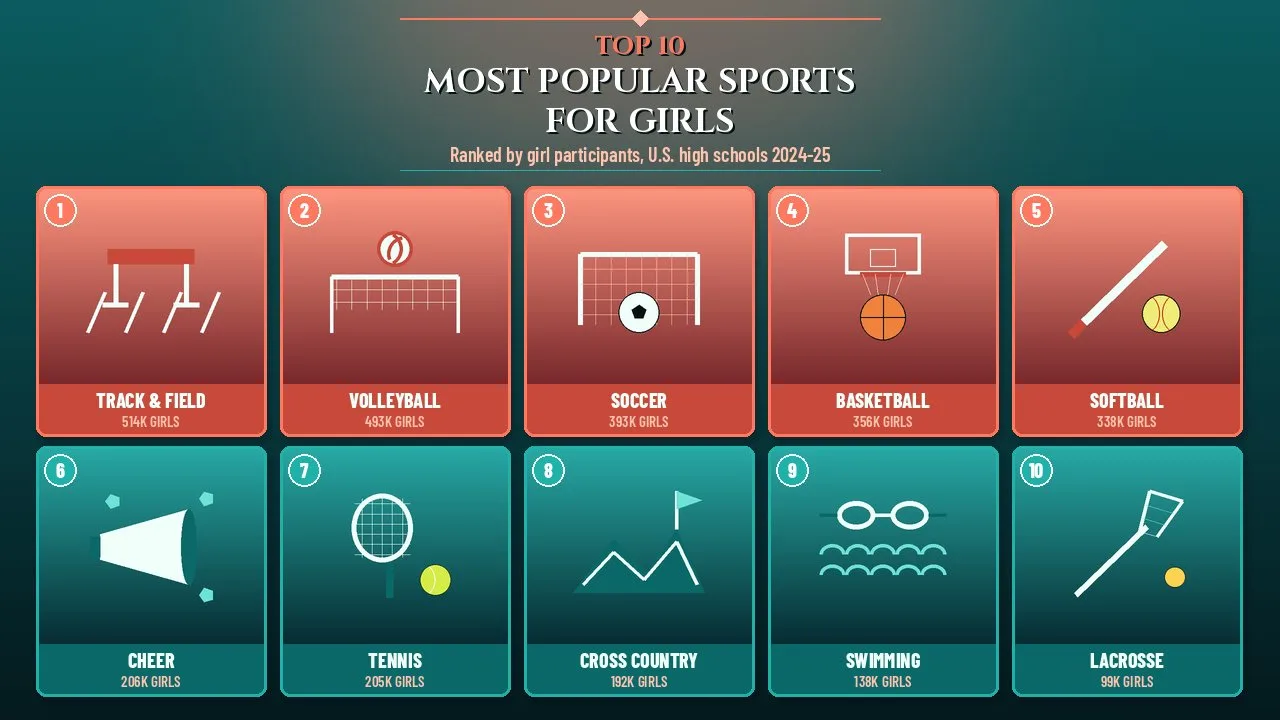
The most popular sports for girls are track and field, volleyball, soccer, basketball and softball, based on record 2024-25 American high-school figures. More girls now play organised sport than at any point in history, and the choice goes far beyond the handful of options their grandmothers had. This Finepedia list ranks the ten sports with the most girl participants, then explains where each one came from, what it demands, the skills it builds and the facts that make it worth a try.
The ranking uses the National Federation of State High School Associations (NFHS) High School Athletics Participation Survey for the 2024-25 school year, the largest annual count of school sport in the United States. That survey recorded 3,539,596 girls taking part in high-school athletics, a record total, across 51 state associations including the District of Columbia. School numbers are a useful proxy for wider popularity because they measure girls who actually train and compete, not just people who say they like a sport.
Global context is added where it helps. Football (soccer), volleyball, athletics and basketball are also among the biggest sports for women and girls worldwide, while competitive cheer and lacrosse are more concentrated in North America. Figures are as published by NFHS in 2025 and are rounded in places.
How This List Was Ranked
Each sport is placed by its number of girl participants in the NFHS 2024-25 survey, highest first. Where the NFHS news release and the full survey table show slightly different numbers, the table figure is used and the difference is noted. The number of schools that offer each sport is shown as a second measure of how easy it is for a girl to find a team.
| Factor | What it measures | Why it matters |
|---|---|---|
| Girl participants | Girls on a school roster for the sport in 2024-25 | The main ranking measure |
| Schools offering | High schools sponsoring a girls team | Shows access and availability |
| Year-on-year change | Growth or decline from 2023-24 | Signals which sports are rising |
| Global reach | Olympic status and international competition | Shows the pathway beyond school |
At a Glance: Most Popular Sports for Girls
| Rank | Sport | Girl participants (NFHS 2024-25) | Team or individual |
|---|---|---|---|
| 1 | Track and field (outdoor) | 513,808 | Individual and relay |
| 2 | Volleyball | 492,799 | Team |
| 3 | Soccer | 393,048 | Team |
| 4 | Basketball | 356,240 | Team |
| 5 | Softball (fast pitch) | 338,315 | Team |
| 6 | Competitive spirit (cheer) | 206,262 | Team |
| 7 | Tennis | 204,721 | Individual and doubles |
| 8 | Cross country | 191,733 | Individual with team scoring |
| 9 | Swimming and diving | 138,303 | Individual and relay |
| 10 | Lacrosse | 99,292 | Team |
Together, these ten sports account for well over 2.9 million of the 3.5 million girl participation slots in U.S. high schools. Many girls play more than one sport, so the totals count participations rather than unique people.
1. Track and Field
| Attribute | Details |
|---|---|
| Girl participants (NFHS 2024-25) | 513,808, the most of any girls sport |
| Schools offering | 17,373 high schools |
| Main events | Sprints, hurdles, middle and long distance, relays, jumps and throws |
| Olympic debut for women | Amsterdam 1928 |
| Core skills | Speed, power, endurance and technique |
Origins and History
Running, jumping and throwing are the oldest contests people know, and organised athletics grew out of school and club meets in nineteenth-century Britain and the United States. Women were kept out of Olympic athletics until the 1928 Games in Amsterdam, when a small programme of five events was added. Since then the women's programme has grown to match the men's almost event for event, including the steeplechase, pole vault, hammer and the marathon.
In U.S. schools, outdoor track and field has become the largest girls sport partly because it welcomes almost every body type. A tall girl might high jump, a powerful one might throw the shot put, and a girl with endurance might run the 3,200 metres, all on the same team.
Key Features
- Dozens of events under one team, so most girls can find a specialty
- Clear, measurable progress through times and distances
- Low entry cost: running shoes and a team kit cover most events
- Relays add a team element to an otherwise individual sport
- Indoor and outdoor seasons let athletes train for much of the year
Significance
Track and field teaches girls to set goals and chase personal bests, which makes it a strong first sport. Because no one sits on the bench in the usual sense, girls get real competition time from their first season. Schools also find it easy to add athletes without cutting anyone, which helps explain its huge roster numbers.
Interesting Facts
- Counting boys and girls together, outdoor track and field has more U.S. high-school participants than any other sport
- Women's Olympic athletics began with only five events in 1928
- The women's Olympic marathon was first held in 1984 in Los Angeles
- Girls track numbers grew again in 2024-25 and remained the top girls sport
2. Volleyball
| Attribute | Details |
|---|---|
| Girl participants (NFHS 2024-25) | 492,799, up 2.85 percent from the year before |
| Schools offering | 17,027 high schools |
| Players per side | Six indoors, two in beach volleyball |
| Invented | 1895, by William G. Morgan in Holyoke, Massachusetts |
| Olympic debut | Indoor in Tokyo 1964; beach in Atlanta 1996 |
Origins and History
William G. Morgan, a YMCA physical director in Holyoke, Massachusetts, created the game in 1895 as a gentler indoor option than basketball for older members. He called it mintonette at first, and the name volleyball soon replaced it because players volleyed the ball back and forth over the net. The sport spread through YMCA networks to Asia and Europe within a few decades.
Women's indoor volleyball joined the Olympic Games in Tokyo in 1964, the same year as the men's event, and Japan's women won the first gold. Beach volleyball followed at the Atlanta Games in 1996. In NFHS records, girls volleyball has been a steady top-ten sport for decades and reached an all-time participation high in 2024-25.
Key Features
- Matches use rally scoring, so a point is won on every serve
- Sets are usually played to 25 points, with a deciding set to 15
- Specialist roles include setter, libero, outside hitter and middle blocker
- Players rotate positions, so all-round skills matter
- Knee pads, a ball and a net are the main equipment
Significance
Volleyball rewards communication more than almost any other team sport, because no player may hit the ball twice in a row and teams get only three contacts. That forces constant talking and trust. It is also low-contact, played indoors in all weathers and easy to learn at a casual level, which makes it attractive to girls who are new to sport.
In Popular Culture
Beach volleyball is one of the most watched events at the Summer Olympics, and college volleyball in the United States now draws record crowds. A 2023 outdoor match at the University of Nebraska set a world attendance record for a women's sporting event, with more than 92,000 fans.
Interesting Facts
- Volleyball was invented only four years after basketball, a few miles away in Massachusetts
- Volleyball sits second among girls sports in the United States by participants
- The libero wears a different coloured shirt and is a defensive specialist
- Girls volleyball is among the sports offered by the most U.S. high schools
3. Soccer
| Attribute | Details |
|---|---|
| Girl participants (NFHS 2024-25) | 393,048, up 2.38 percent |
| Schools offering | 12,516 high schools |
| Players per side | Eleven, including a goalkeeper |
| First FIFA Women's World Cup | China, 1991 |
| Olympic debut for women | Atlanta 1996 |
Origins and History
Women played football in Britain as early as the 1890s, and during the First World War factory teams such as Dick, Kerr Ladies drew very large crowds. In 1921 the English Football Association banned women's matches from its members' grounds, a restriction that stood for 50 years and held back the women's game across much of Europe.
The modern era began with the first FIFA Women's World Cup in China in 1991, won by the United States. Women's football entered the Olympics at Atlanta in 1996. The tournament has grown fast, and the 2023 Women's World Cup in Australia and New Zealand featured 32 teams and was won by Spain. Brazil will host the 2027 edition.
Key Features
- Builds lower-body strength, speed and endurance
- Needs only a ball, shin guards and boots to start
- Positions suit different strengths, from goalkeeper to striker
- Small-sided games make it easy to play informally
- Played on every continent, with strong club and school pathways
Significance
Soccer gives girls a clear route from neighbourhood games to school teams, clubs, college scholarships and professional leagues. It is one of the few sports where girls can follow a women's world championship that rivals the men's for global attention. Its constant running also makes it one of the best all-round fitness sports on this list.
Interesting Facts
- The English FA ban on women's football lasted from 1921 to 1971
- The United States won the first Women's World Cup in 1991
- Spain became world champions for the first time in 2023
- Soccer is the third most popular girls sport in U.S. high schools
4. Basketball
| Attribute | Details |
|---|---|
| Girl participants (NFHS 2024-25) | 356,240 |
| Schools offering | 18,208 high schools, the most of any girls sport |
| Players per side | Five |
| Invented | December 1891, by James Naismith in Springfield, Massachusetts |
| Olympic debut for women | Montreal 1976 |
Origins and History
James Naismith invented basketball in December 1891 at a YMCA training school in Springfield, Massachusetts. Within months, Senda Berenson, a physical education teacher at Smith College, adapted the rules for women, and the first women's college game was played there in 1893. Early women's rules split the court into zones to limit running. Women's college basketball moved to the full-court five-player game in 1971, although some states kept six-player girls basketball in high schools for much longer.
Women's basketball joined the Olympics in Montreal in 1976. In the United States, the Women's National Basketball Association (WNBA) was founded in 1996 and played its first season in 1997. College stars have brought record television audiences to the women's game in recent seasons.
Key Features
- Fast pace with constant changes between attack and defence
- Develops coordination, upper-body strength and quick decisions
- Needs only a ball, a hoop and good shoes
- Can be played alone, one-on-one or in full teams
- Indoor winter season in most school calendars
Significance
Basketball is the girls sport that the most U.S. high schools offer, so access is excellent even in small towns. The game rewards skill practice, since shooting and dribbling can be trained alone in a driveway or park. It also has one of the clearest professional pathways for women, through college and the WNBA.
Interesting Facts
- Senda Berenson adapted basketball for women within a year of its invention
- Early girls rules often limited players to one zone of the court
- More high schools offer girls basketball than any other girls sport
- Basketball ranks fourth among girls sports by U.S. participants
5. Softball
| Attribute | Details |
|---|---|
| Girl participants (NFHS 2024-25) | 338,315 (survey table; the NFHS news release gives 331,306) |
| Schools offering | 15,726 high schools |
| Players per side | Nine |
| Origin | 1887, at the Farragut Boat Club in Chicago |
| Olympic history | 1996 to 2008, Tokyo 2020, and Los Angeles 2028 |
Origins and History
Softball began on Thanksgiving Day in 1887 at the Farragut Boat Club in Chicago, where George Hancock and friends improvised an indoor game with a boxing glove and a broom handle. It moved outdoors and spread across the United States as a safer, smaller-field cousin of baseball, and it became especially popular with women and girls.
Fast-pitch softball, the version played in high schools, joined the Olympics in 1996 in Atlanta and stayed until 2008. It returned for Tokyo 2020 and is on the programme for Los Angeles 2028. The United States and Japan have dominated the Olympic event.
Key Features
- The pitcher throws underhand, often with a windmill motion
- Games usually run seven innings
- A larger ball and shorter distances than baseball make reactions very quick
- Needs a bat, a glove, a ball and helmets for batters
- Spring season in most U.S. school calendars
Significance
Softball suits girls who like bursts of action rather than nonstop running. It builds hand-eye coordination, throwing strength and tactical thinking, since every pitch is a small contest. Strong college programmes and its Olympic return give talented players a long pathway.
Interesting Facts
- The first softball was reportedly a boxing glove tied into a ball
- The United States won Olympic softball gold in 1996, 2000 and 2004, and Japan won in 2008 and at Tokyo 2020
- Fast-pitch softball is the fifth most popular girls sport in U.S. high schools
- Softball will be part of the Los Angeles 2028 Olympics
6. Competitive Spirit (Cheer)
| Attribute | Details |
|---|---|
| Girl participants (NFHS 2024-25) | 206,262, up nearly 14 percent |
| Schools offering | 8,465 high schools |
| What it includes | Competitive cheer and spirit routines judged on stunts, tumbling, jumps and dance |
| International body | International Cheer Union (ICU) |
| IOC status | Provisional recognition in 2016, full recognition in 2021 |
Origins and History
Cheerleading began on the sidelines of American college football in the late nineteenth century, and for decades it was seen as support for other teams rather than a sport of its own. From the 1980s onward, competitive cheer grew into its own world of judged routines, with teams training for months to perform short, packed sequences of stunts, pyramids, tumbling and dance.
NFHS lists these teams under competitive spirit, separate from sideline cheer squads. The International Cheer Union governs the sport worldwide and received full recognition from the International Olympic Committee in 2021, a step that makes future Olympic inclusion possible but not guaranteed.
Key Features
- Routines are scored by judges for difficulty and execution
- Combines gymnastics, strength, flexibility and dance
- Stunting builds deep trust between bases, flyers and spotters
- Strict safety rules govern which stunts each level may attempt
- Year-round training is common at competitive levels
Significance
Competitive spirit was the fastest climber in the girls top ten in 2024-25, jumping to sixth place with a gain of nearly 14 percent. It suits girls who love performance and athletic skill in equal measure. Because every member has a role in every stunt, it builds a strong sense of shared responsibility.
Interesting Facts
- Competitive spirit overtook tennis and cross country to rank sixth among girls sports
- The ICU was granted full IOC recognition in 2021
- Flyers, bases and back spotters each need different strengths
- Competition routines are short, often around two and a half minutes, yet take months to perfect
7. Tennis
| Attribute | Details |
|---|---|
| Girl participants (NFHS 2024-25) | 204,721, up more than 4 percent |
| Schools offering | 12,175 high schools |
| Formats | Singles and doubles |
| Olympic debut for women | Paris 1900 |
| Equipment | Racquet, balls and court shoes |
Origins and History
Modern lawn tennis took shape in England in the 1870s, and the first Wimbledon women's singles championship was held in 1884. At the 1900 Paris Olympics, Britain's Charlotte Cooper won the tennis singles and became the first woman to win an individual Olympic title in any sport.
The women's professional game changed in 1973, when Billie Jean King led the creation of the Women's Tennis Association and the US Open became the first major to offer equal prize money. Wimbledon followed with equal pay in 2007. Women's tennis is now among the best-paid and most watched women's sports in the world.
Key Features
- Can be played by just two people, so it is easy to arrange
- Builds agility, footwork, hand-eye coordination and focus
- Scoring by points, games and sets rewards mental toughness
- High-school teams combine singles and doubles matches into a team score
- A sport many people keep playing well into adult life
Significance
Tennis gives girls an individual sport with a team setting at school. It involves less continuous running than soccer or basketball but plenty of short sprints, so fitness gains are real. Public courts in many towns keep costs manageable once a girl has a racquet.
Interesting Facts
- Charlotte Cooper's 1900 win made her the first female individual Olympic champion
- The US Open has paid equal prize money since 1973
- Girls tennis grew by more than 4 percent in 2024-25
- Tennis ranks seventh among U.S. girls sports by participants
8. Cross Country
| Attribute | Details |
|---|---|
| Girl participants (NFHS 2024-25) | 191,733 (survey table) |
| Schools offering | 15,836 high schools |
| Typical race | About 5 kilometres over grass, trails and hills in most U.S. high schools |
| Team scoring | Places of the top five finishers are added; the lowest total wins |
| Season | Autumn in most school calendars |
Origins and History
Cross country running grew out of English school games such as hare and hounds in the nineteenth century, in which runners chased a trail of paper across open country. It became a formal competition in Britain and spread to the United States through colleges. The sport was part of the Olympic Games only from 1912 to 1924, and only for men.
Today cross country is a major autumn sport in U.S. high schools, and it is offered by more than 15,800 schools for girls. Internationally, the World Athletics Cross Country Championships include senior and under-20 women's races.
Key Features
- Courses vary, so every race feels different
- Each runner's place counts toward the team score
- Requires only running shoes, often with light spikes
- Builds aerobic endurance and mental resilience
- Teams usually train together, which builds strong friendships
Significance
Cross country is one of the most welcoming sports for girls who are new to competition. There are no cuts on most teams, and every finisher can help the score by passing one more runner. It also pairs naturally with spring track, so many girls run both.
Interesting Facts
- The sport started as a paper-trail chase called hare and hounds
- A perfect team score in a dual meet is 15, when one team takes the first five places
- Cross country left the Olympic programme after 1924
- More than 15,800 U.S. high schools offer girls cross country
9. Swimming and Diving
| Attribute | Details |
|---|---|
| Girl participants (NFHS 2024-25) | 138,303 |
| Schools offering | 8,357 high schools |
| Strokes | Freestyle, backstroke, breaststroke and butterfly |
| Olympic debut for women | Stockholm 1912 (swimming and platform diving) |
| Equipment | Swimsuit, cap and goggles |
Origins and History
Competitive swimming grew in nineteenth-century Britain, where indoor pools and swimming clubs made racing practical. Women's swimming and diving entered the Olympic Games in Stockholm in 1912, where Australia's Fanny Durack won the 100 metres freestyle. Since then the women's programme has expanded to cover every stroke, relay and distance up to the 1,500 metres freestyle and the open-water 10 kilometres.
U.S. high schools usually combine swimming and diving into one team, with divers scoring points on the one-metre springboard alongside swimmers in the pool.
Key Features
- Low-impact, full-body exercise that is easy on joints
- Individual events plus relays for team spirit
- The individual medley tests all four strokes in one race
- Diving rewards body control, flexibility and courage
- Water safety skills last a lifetime
Significance
Swimming is often described as a sport for life because the fitness and safety benefits continue well beyond school. It suits girls who enjoy measurable progress through race times. Access depends on pools, which is why fewer schools offer it than track or basketball.
In Popular Culture
Swimming is one of the most watched sports at every Summer Olympics, and champions such as Katie Ledecky have become household names in the United States.
Interesting Facts
- Fanny Durack won the first women's Olympic swimming event in 1912
- The individual medley order is butterfly, backstroke, breaststroke and freestyle
- High-school diving is usually held on the one-metre springboard
- Swimming and diving is ninth among U.S. girls sports by participants
10. Lacrosse
| Attribute | Details |
|---|---|
| Girl participants (NFHS 2024-25) | 99,292 |
| Origins | Indigenous peoples of North America, including the Haudenosaunee |
| First women's game | 1890, St Leonards School, St Andrews, Scotland |
| Players per side | 12 in standard women's field lacrosse |
| Olympic status | Sixes format at Los Angeles 2028 |
Origins and History
Lacrosse is one of the oldest team sports in North America. Indigenous nations, including the Haudenosaunee, played it for centuries before European contact, often with spiritual meaning, and many still call it the Creator's Game. French missionaries gave it the name lacrosse.
The first recorded women's game was played in 1890 at St Leonards School in St Andrews, Scotland. Women's lacrosse developed different rules from the men's game, with less body contact, and protective eyewear is required. Lacrosse will appear at the Los Angeles 2028 Olympics in a fast six-a-side format.
Key Features
- Fast running game with sticks, passing and quick shots
- Less physical contact than boys lacrosse
- Needs a stick, protective eyewear and a mouthguard
- Builds speed, stamina and stick-handling skills
- Strong club and college pathways in the eastern United States
Significance
Lacrosse rounds out the girls top ten and has strong roots in schools on the U.S. East Coast. Its Olympic return in 2028 gives the sport a new global stage. For girls who like the running of soccer and the hand skills of basketball, it can be an ideal mix.
Interesting Facts
- Lacrosse was played by Indigenous nations long before European arrival
- The first women's game was held at a Scottish girls school in 1890
- Lacrosse sixes will feature at the 2028 Los Angeles Olympics
- Girls lacrosse had 99,292 high-school participants in 2024-25
Rising Fast: Sports Close to the Top 10
Several girls sports are growing quickly and could break into the top ten within a few years.
| Sport | Girl participants (NFHS 2024-25) | Trend |
|---|---|---|
| Golf | 85,385 | Offered by 11,116 high schools, the eighth most of any girls sport |
| Wrestling | 74,064 at about 8,100 schools | Up from 11,496 girls ten years earlier; 40 states now hold girls championships |
| Flag football | 68,847 | Up 60 percent in one year, with nearly 1,000 more schools; on the Los Angeles 2028 Olympic programme |
Girls wrestling has become one of the great growth stories in school sport, and women's wrestling has been part of the Olympics since Athens 2004. Girls flag football, backed by professional football leagues and state associations, is spreading even faster.
Comparison: Which Sport Suits Which Girl?
| Sport | Contact level | Main fitness focus | Starting cost |
|---|---|---|---|
| Track and field | None | Speed, power or endurance | Low |
| Volleyball | Minimal | Jumping and agility | Low |
| Soccer | Moderate | Endurance and leg strength | Low |
| Basketball | Moderate | Agility and coordination | Low |
| Softball | Low | Throwing, batting and reaction | Moderate |
| Competitive spirit | Low, high skill risk | Strength and flexibility | Moderate to high |
| Tennis | None | Footwork and hand-eye coordination | Moderate |
| Cross country | None | Aerobic endurance | Low |
| Swimming and diving | None | Full-body endurance | Moderate, needs pool access |
| Lacrosse | Low to moderate | Speed and stick skills | Moderate |
Why Sport Matters for Girls
The World Health Organization recommends that children and adolescents aged 5 to 17 get an average of 60 minutes of moderate to vigorous physical activity a day. Organised sport is one of the easiest ways to reach that goal, and it adds benefits that solo exercise often lacks.
- Fitness: stronger bones, muscles and heart health during the years when bone density builds fastest
- Confidence: setting goals and seeing progress builds self-belief
- Teamwork: shared training and competition teach communication and trust
- Resilience: losing, recovering and trying again is a skill that carries into school and work
- Friendship: teams give girls a ready-made social circle
The Women's Sports Foundation has long reported that girls drop out of sport at higher rates than boys during adolescence, so access, good coaching and a wide choice of sports matter. The strong growth of volleyball, competitive spirit, wrestling and flag football suggests that giving girls more options keeps more of them playing.
Frequently Asked Questions
What is the most popular sport for girls?
In U.S. high schools, outdoor track and field is the most popular girls sport, with 513,808 participants in the NFHS 2024-25 survey. Volleyball is a close second at 492,799, followed by soccer at 393,048. Worldwide, football (soccer) is usually named the biggest team sport for women and girls.
Which girls sport is offered by the most schools?
Basketball. According to the NFHS 2024-25 survey, 18,208 U.S. high schools sponsor a girls basketball team, more than any other girls sport. Outdoor track and field is close behind at 17,373 schools, with volleyball third at 17,027. That wide availability makes basketball one of the easiest sports to join.
Which girls sport is growing fastest?
Flag football grew fastest in 2024-25, rising about 60 percent to 68,847 girls, with nearly 1,000 more schools offering it. Inside the top ten, competitive spirit grew by nearly 14 percent and climbed to sixth place. Girls wrestling has also surged, reaching 74,064 participants at around 8,100 schools.
How many girls play high school sports in the United States?
The NFHS counted 3,539,596 girl participants in 2024-25, a record high, out of 8,266,244 total participants. Because many girls play two or three sports, this number counts participation slots rather than individual athletes. Both the girls and the overall totals were the highest the survey has recorded.
What is the best sport for a girl who is new to sport?
Track and field and cross country are often the easiest starting points, because most teams do not cut players and every athlete competes. Volleyball and swimming are also friendly for beginners. The best choice is the sport a girl enjoys enough to keep practising, so trying two or three is wise.
Are these sports also played by women at the Olympics?
Yes, nearly all of them. Athletics, volleyball, football, basketball, tennis, swimming and diving are regular Olympic sports for women. Softball and lacrosse are on the Los Angeles 2028 programme, and cross country running appears at world championships but not at the Olympics. Cheer has full IOC recognition but is not yet an Olympic event.
Conclusion
The most popular sports for girls today mix old favourites with fast risers. Track and field, volleyball, soccer, basketball and softball lead U.S. school participation by a wide margin, while competitive spirit, tennis, cross country, swimming and diving and lacrosse complete the top ten. Golf, wrestling and flag football are knocking on the door. With record numbers of girls now playing, and more choices each year, almost every girl can find a sport that fits her strengths, schedule and interests.
- National Federation of State High School Associations (NFHS), 2024-25 High School Athletics Participation Survey (full tables and top-ten summaries)
- NFHS news release, Participation in High School Sports Hits Record High with Sizable Increase in 2024-25 (2025)
- NFHS article, Record Participation Numbers Indicate Importance of High School Sports in Students' Lives (2025)
- International Olympic Committee, Olympics.com sport histories for athletics, volleyball, football, basketball, softball, tennis, swimming, lacrosse and wrestling
- FIFA, FIFA Women's World Cup tournament history
- World Health Organization, Guidelines on Physical Activity and Sedentary Behaviour (2020)
- Women's Sports Foundation research on girls' sports participation
- Reference used for topic selection only: 10MostToday article on popular sports for girls

















Log in with