









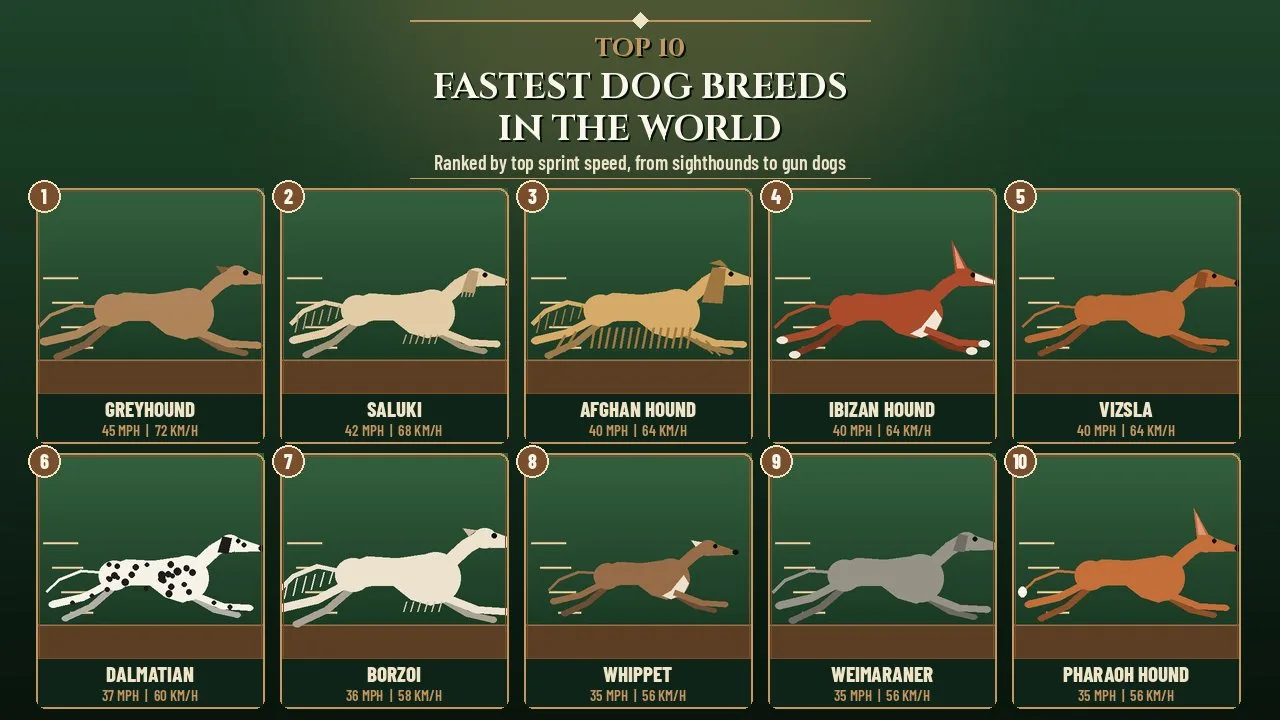
The Greyhound heads most rankings of fastest dog breeds in the world, sprinting at about 45 mph (72 km/h), with the Saluki and Afghan Hound close behind. Most of the speediest dogs are sighthounds, an ancient family of hunters that spot prey by eye and run it down in open country, but a few gun dogs and one famous spotted coach dog also make the cut.
This guide ranks ten breeds by the top sprint speed most often quoted for them in breed guides and racing literature, then checks every figure against real timing data from the American Kennel Club (AKC) Fast CAT programme, a timed 100-yard dash open to every breed. The two sets of numbers rarely match exactly, and the gap between them says a lot about how dog speeds are measured.
Speed figures for dogs are approximate. They vary with the individual animal, its age and fitness, the surface, the weather and the method used to time it, so treat each number as a typical peak for a fast, fit member of the breed rather than a guarantee for every dog. The information here is current as of October 2026.
How This List Was Ranked
Every breed on the list had to pass two tests. First, its top speed had to be quoted in at least two independent breed guides. Second, the fastest dogs of that breed had to be clocked at 30 mph or more in AKC Fast CAT records, so that no breed earns a place on reputation alone.
| Criterion | What it measures | How it was used |
|---|---|---|
| Commonly cited top speed | Peak sprint figure quoted for the breed in breed guides and racing literature | Main ranking factor |
| Second source check | Whether at least two independent guides quote a similar figure | Required for inclusion |
| Measured Fast CAT speed | Best AKC Fast CAT average (three fastest runs) recorded by a dog of the breed | Required to be 30 mph or more; also used to break ties |
| Breed background | Origin, original job and body design | Explained in each entry |
| Record evidence | Guinness World Records and AKC Invitational results where they exist | Quoted where available |
Several breeds share the same quoted figure, especially at 40 mph and 35 mph. In those cases the breed whose fastest dogs have run quicker at Fast CAT events is placed higher. Popular breeds with inflated speed claims that the timing data does not support, such as the Jack Russell Terrier, appear in the Honourable Mentions instead.
Fastest Dog Breeds in the World at a Glance
| Rank | Breed | Commonly cited top speed | Best Fast CAT average (lifetime list) | Origin | Originally bred for |
|---|---|---|---|---|---|
| 1 | Greyhound | 45 mph (72 km/h) | 40.22 mph (64.7 km/h) | Ancient sighthound type, developed in Britain | Coursing hare, deer and other game |
| 2 | Saluki | 42 mph (68 km/h) | 33.50 mph (53.9 km/h) | Fertile Crescent, Middle East | Hunting gazelle, hare and fox |
| 3 | Afghan Hound | 40 mph (64 km/h) | 34.07 mph (54.8 km/h) | Afghanistan | Hunting in rocky mountain terrain |
| 4 | Ibizan Hound | 40 mph (64 km/h) | 33.65 mph (54.2 km/h) | Ibiza, Balearic Islands, Spain | Hunting rabbits in packs |
| 5 | Vizsla | 40 mph (64 km/h) | 31.65 mph (50.9 km/h) | Hungary | Pointing and retrieving game birds |
| 6 | Dalmatian | 37 mph (60 km/h) | 31.58 mph (50.8 km/h) | Dalmatia, Croatia | Running beside horse-drawn carriages |
| 7 | Borzoi | 36 mph (58 km/h) | 38.60 mph (62.1 km/h) | Russia | Coursing wolves, foxes and hares |
| 8 | Whippet | 35 mph (56 km/h) | 40.99 mph (66.0 km/h) | Northern England | Rabbit catching and straight racing |
| 9 | Weimaraner | 35 mph (56 km/h) | 34.22 mph (55.1 km/h) | Weimar, Germany | All-purpose gun dog work |
| 10 | Pharaoh Hound | 35 mph (56 km/h) | 32.08 mph (51.6 km/h) | Malta | Night hunting of rabbits |
The Fast CAT column shows the quickest dog of each breed on the AKC lifetime ranking, which averages each dog's three fastest timed runs. Data was read from the AKC Fast CAT Top 20 rankings on 12 October 2026.
1. Greyhound
| Attribute | Details |
|---|---|
| Origin | Ancient sighthound type, developed as a breed in Britain |
| Originally bred for | Coursing hare, deer and other game; later track racing |
| Commonly cited top speed | About 45 mph (72 km/h) |
| Fastest timed record | 41.83 mph (67.32 km/h), Star Title, Wyong, Australia, 1994 |
| Size (AKC) | 27 to 30 inches tall, 60 to 70 lb |
Origins and History
The Greyhound is often called the oldest hunting dog type still in use. Lean, long-legged hounds that look strikingly like it appear in Egyptian tomb art, and the AKC traces the earliest known depiction to the Tomb of Amten in the Nile Valley, dated to roughly 2900 to 2751 BC. Over the centuries the type spread across the Mediterranean and into Europe, where it became a symbol of nobility and appeared on Greek vases, Flemish tapestries and Italian paintings.
In Britain the breed was refined for coursing, where two dogs chase a hare across open ground, and later for track racing behind a mechanical lure. The AKC recognised the Greyhound in 1885. Commercial racing has shrunk sharply in recent decades, including in the United States after Florida voters approved a ban in 2018, and thousands of retired racers now live as pets through adoption groups.
Key Features
- Long, narrow head that cuts through the air, with a deep chest that houses a large heart and lungs
- A very flexible spine that bends and stretches like a spring with every stride
- The double suspension gallop, in which all four feet leave the ground twice in each stride
- The highest share of fast oxidative-glycolytic (Type IIa) muscle fibres of any breed, plus higher red blood cell levels than other dogs
- Hind leg muscles make up more than 18 per cent of body mass
- Life expectancy of about 10 to 13 years, according to the AKC
Significance
The Greyhound is the benchmark every other fast dog is measured against. The 45 mph figure is widely repeated, but the best verified record is slightly lower. Guinness World Records lists Star Title as the fastest Greyhound ever timed, at 67.32 km/h (41.83 mph) over 400 yards on the straight track at Wyong, New South Wales, on 5 March 1994. Typical winning speeds in modern races are around 36 to 38 mph.
Fast CAT data tells the same story. The 2026 season leader, a Greyhound called Fritsch (call name Fritz), averaged 38.76 mph over his three fastest runs by 12 October 2026, and Fritz also won the top height division at both the 2025 and 2026 AKC Fast CAT Invitationals.
Interesting Facts
- The AKC says a running Greyhound can spend up to 75 per cent of its time in the air.
- Despite its speed, the AKC notes that a Greyhound is often content to spend much of the day lounging on the couch.
- Greyhounds process some barbiturate anaesthetics more slowly than other breeds, so vets familiar with sighthounds are recommended.
- Greyhounds have lower platelet levels than most breeds and can bleed more after surgery, another reason to choose a sighthound-savvy vet.
2. Saluki
| Attribute | Details |
|---|---|
| Origin | Fertile Crescent, Middle East |
| Originally bred for | Hunting gazelle, hare, fox and jackal with nomadic tribes |
| Commonly cited top speed | About 42 mph (68 km/h) |
| Best Fast CAT average | 33.50 mph (53.9 km/h), lifetime list |
| Size (AKC) | 23 to 28 inches tall (males), 40 to 65 lb |
Origins and History
The Saluki is one of the oldest sighthound types on record. Pottery from Susa in southwest Iran, around 6,000 years old, shows slim running dogs with long narrow bodies, and Saluki-like hounds turn up in art from Mesopotamia, ancient Egypt and even a 1427 painting by the Xuande Emperor of Ming China. It has been known by many names, including the gazelle hound, the Arabian hound and the Persian greyhound.
Nomadic hunters in the desert used the breed to run down fast game. Some hunters carried the dog on camelback and released it at speed for a running start, while others teamed Salukis with falcons that distracted the prey. The first Salukis reached England in 1840, the Kennel Club recognised the breed in 1923 and the AKC followed in 1929.
Key Features
- Slim, long-legged build with a deep chest and narrow waist
- Heavily padded feet that absorb impact and help the dog run for long periods
- Two coat types, smooth and feathered, the latter with silky fringes on the ears, legs and tail
- Strong independent streak, typical of hounds bred to hunt far ahead of their owners
- Life expectancy of about 10 to 17 years, one of the longest ranges on this list
Significance
The Saluki earns second place because of its strong record over distance. The Guinness Book of Records listed a Saluki as the fastest dog in 1996, at 68.8 km/h (42.8 mph), and that figure is the source of the 42 mph often quoted today. Breed experts generally agree that the Greyhound is faster in a short sprint of up to about 800 metres, while the Saluki holds its pace better over longer courses.
At Fast CAT, which only times a 100-yard sprint, Salukis are quick but not exceptional, with the best lifetime average at 33.50 mph. That gap is a useful reminder that a stamina specialist will not always shine in a short dash.
Interesting Facts
- Some sources link the name to the ancient Arabian town of Saluq, although the true origin is disputed.
- The breed is the official mascot of Southern Illinois University Carbondale.
- A 2003 British Veterinary Association survey ranked the Saluki joint lowest of all breeds for hip dysplasia.
- The Saluki is genetically one of the closest relatives of the Afghan Hound.
3. Afghan Hound
| Attribute | Details |
|---|---|
| Origin | Mountains and plains of Afghanistan |
| Originally bred for | Hunting deer, hare, gazelle and other game over rough ground |
| Commonly cited top speed | About 40 mph (64 km/h) |
| Best Fast CAT average | 34.07 mph (54.8 km/h), lifetime list |
| Size (AKC) | 25 to 27 inches tall, 50 to 60 lb |
Origins and History
Known locally as the Tazi, the Afghan Hound developed in the cold, rocky highlands of Afghanistan, where its thick coat protected it from harsh winters. Genomic studies place it among the oldest dog breeds still in existence. British army officers brought several long-haired sighthounds home from British India in the 1800s, and a dog named Zardin, imported in 1907, became the model for the first breed standard in 1912.
Two main bloodlines formed the modern breed. The Bell-Murray strain, brought to Scotland in 1920, came from the lighter-coated desert type, while the Ghazni strain, shipped from a kennel in Kabul in 1925, was the heavier-coated mountain type. Most Afghans in the United States descend from the Ghazni line.
Key Features
- Long, silky coat with a distinctive topknot on the head and a short-haired saddle on the back
- Huge paw pads that worked as shock absorbers on stony slopes
- High hip bones and a tail that ends in a small curled ring
- Aloof and dignified with strangers but playful and clownish at home
- Life expectancy of about 12 to 18 years, according to the AKC
Significance
Behind the show-ring glamour sits a serious athlete. Breed guides consistently put the Afghan Hound at around 40 mph, the same figure as the Ibizan Hound and the Vizsla. It takes third place on the tie-break because its fastest timed dog has averaged 34.07 mph at Fast CAT, the best of the three. Long, powerful legs and a flexible spine are the keys to its speed on uneven ground, a vital asset when chasing agile prey through broken mountain country.
In Popular Culture
An Afghan Hound appeared on the cover of Life magazine in November 1945, and the breed won Best in Show at the Westminster Kennel Club Dog Show in 1957 and 1983. Pablo Picasso said that his famous 1967 sculpture in Chicago's Daley Plaza was based on the head of his Afghan Hound, Kabul.
Interesting Facts
- In 2005 an Afghan Hound named Snuppy became the first cloned dog in history.
- Psychologist Stanley Coren ranked the breed last for obedience in his book The Intelligence of Dogs, which owners put down to independence rather than a lack of brains.
- The coat needs regular brushing and bathing, making this the highest-maintenance sprinter on the list.
4. Ibizan Hound
| Attribute | Details |
|---|---|
| Origin | Island of Ibiza, Balearic Islands, Spain |
| Originally bred for | Hunting rabbits in packs by sight, scent and sound |
| Commonly cited top speed | About 40 mph (64 km/h) |
| Best Fast CAT average | 33.65 mph (54.2 km/h), lifetime list |
| Size (AKC) | 22.5 to 27.5 inches tall, about 45 to 50 lb |
Origins and History
The Ibizan Hound takes its name from Ibiza, where it has long been used to hunt rabbits for the table. A popular story says Phoenician traders brought Egyptian hounds to the island around 3,000 years ago, and the AKC repeats that account. Modern DNA studies, however, suggest the breed as it exists today was formed relatively recently from related Mediterranean hounds, so its ancient roots are better treated as tradition than proven fact.
Local hunters in the Catalan-speaking parts of Spain and France often ran these dogs in mostly female packs, since females were considered the better hunters. The AKC fully recognised the breed in 1979, and in the United States it now competes in lure coursing, straight racing and oval track racing.
Key Features
- Very large, upright ears that are broad at the base, a hallmark of the breed
- Amber eyes, with a light tan nose, ears, eye rims and paw pads
- Two coat types, smooth and wire, both usually red and white
- An exceptional vertical leap from a standstill
- Life expectancy of about 11 to 14 years
Significance
The Ibizan Hound is unusual among sighthounds because it hunts with all its senses, tracking by scent, listening for movement in thick cover and then sprinting on sight. Its quoted top speed of about 40 mph is matched by solid timing data, with the breed's best lifetime Fast CAT average at 33.65 mph. Its springy, ground-covering stride and agility on rough terrain make it as much a gymnast as a sprinter.
Interesting Facts
- The AKC notes that an Ibizan can easily clear a 5-foot fence, so owners need tall, secure boundaries.
- Owners often describe the breed as an escape artist that can open gates and climb out of crates.
- Like the Greyhound, it can be sensitive to barbiturate anaesthesia.
- In Spanish it is called podenco ibicenco, and in Catalan ca eivissenc.
5. Vizsla
| Attribute | Details |
|---|---|
| Origin | Hungary |
| Originally bred for | Pointing and retrieving game, on land and in water |
| Commonly cited top speed | About 40 mph (64 km/h) |
| Best Fast CAT average | 31.65 mph (50.9 km/h), lifetime list |
| Size (AKC) | 21 to 24 inches tall, 44 to 60 lb |
Origins and History
The Vizsla, also called the Hungarian Pointer or Magyar Vizsla, has been prized by Hungarian hunters for centuries. The earliest written reference appears in the Illustrated Vienna Chronicle, compiled for King Louis I of Hungary in 1357. Legend links its ancestors to the Magyar horsemen who settled the Carpathian Basin, and the breed needed real pace to keep up with mounted hunters.
The Vizsla survived the Turkish occupation, two world wars and several near-extinctions. In the 1800s imported English Pointers and German Shorthaired Pointers almost replaced it, and after World War II only a small number of pure dogs remained. Dedicated breeders rebuilt the population, and today the Vizsla ranks 35th of 210 breeds in AKC popularity.
Key Features
- Short, sleek golden-rust coat that needs very little grooming
- Lean, muscular frame that is lighter than the similar-looking Weimaraner
- A natural pointer, tracker and retriever, at home in fields and water
- Extremely people-focused and affectionate, often staying close to its owner all day
- Life expectancy of about 12 to 14 years
Significance
The Vizsla is the fastest dog on this list that is not a hound. Breed guides commonly quote it at about 40 mph, putting it level with the Afghan and Ibizan Hounds, though its best timed lifetime average at Fast CAT is a little lower at 31.65 mph. Its real strength is the combination of speed and stamina, which lets it quarter a field for hours at a fast pace.
Interesting Facts
- The quickest Vizsla on the 2026 Fast CAT list so far is registered with the fitting name "Zero To 60 With No Off Switch".
- The American breed standard calls for a docked tail, while the UK allows a natural one, and many vets oppose cosmetic docking.
- A 2024 UK study found an average life expectancy of 13.5 years for the breed.
- The Vizsla makes a superb running or cycling partner once fully grown.
6. Dalmatian
| Attribute | Details |
|---|---|
| Origin | Historical region of Dalmatia, Croatia |
| Originally bred for | Running beside and guarding horse-drawn carriages |
| Commonly cited top speed | About 37 mph (60 km/h) |
| Best Fast CAT average | 31.58 mph (50.8 km/h), lifetime list |
| Size (AKC) | 19 to 24 inches tall, 45 to 70 lb |
Origins and History
The Dalmatian takes its name from Dalmatia on the Adriatic coast of Croatia, although its exact ancestry is still uncertain. It became famous in Britain and later in the United States as a coach dog, trotting for miles beside horse-drawn carriages and guarding them when they stopped. In the 1800s Dalmatians also ran alongside horse-drawn fire engines, which is why the breed is still linked with firehouses today.
That history shaped a dog built for steady, long-distance running rather than a brief sprint. It also made the breed a household name after the 1956 novel The Hundred and One Dalmatians by Dodie Smith and the 1961 Disney animated film it inspired.
Key Features
- White coat with black or liver spots that usually start to appear within about 10 days of birth
- Muscular, balanced frame with excellent endurance
- Spots keep developing until the dog is around 18 months old
- A known risk of deafness, found in roughly 16 to 20 per cent of tested dogs in European studies
- Life expectancy of about 11 to 13 years
Significance
The Dalmatian is the endurance runner of the list. Several breed guides credit it with a top speed of about 37 mph, and its best lifetime Fast CAT average of 31.58 mph comfortably clears the 30 mph test. In practice its greatest gift is the ability to keep moving at a brisk pace for hours, exactly what a carriage dog needed.
Interesting Facts
- Dalmatian puppies are born plain white.
- The breed has an unusual way of processing uric acid, which makes some dogs prone to bladder and kidney stones, so diet and water intake matter.
- The fastest Dalmatian on the 2025 Fast CAT list had already earned an FCAT10 title, meaning thousands of points from timed runs.
- Dalmatians rank 48th of 210 breeds in AKC popularity.
7. Borzoi
| Attribute | Details |
|---|---|
| Origin | Russia |
| Originally bred for | Coursing wolves, foxes, boar and hares in packs |
| Commonly cited top speed | About 36 mph (58 km/h) |
| Best Fast CAT average | 38.60 mph (62.1 km/h), lifetime list |
| Size (AKC) | 26 inches and up (females), 28 inches and up (males), 60 to 105 lb |
Origins and History
The Borzoi was developed in Russia from around the 16th and 17th centuries by crossing Saluki-type and other sighthounds with thick-coated Russian dogs that could cope with the cold. It was known in English as the Russian Wolfhound until 1936. For generations the breed belonged to the aristocracy, and for long periods a Borzoi could not be bought at all, only received as a gift from the Tsar.
Grand Duke Nicholas Nicolaievich bred huge numbers of the hounds at his Perchino estate, and great hunts with packs of Borzoi were a feature of noble life. After the 1917 revolution the breed was linked to the old regime and almost disappeared in Russia. It survived because many dogs had already been exported to Western Europe and the United States.
Key Features
- Tall, elegant frame with a curved topline and a long, narrow head
- Silky, flat or wavy coat with a soft undercoat that thickens in winter
- Large size combined with surprising acceleration
- Calm and quiet indoors but quick to chase anything that moves outdoors
- Life expectancy of about 9 to 14 years
Significance
The Borzoi is the clearest case of a breed that is faster than its reputation. Breed guides usually quote 36 mph, yet the quickest Borzoi on the AKC lifetime list has averaged 38.60 mph over three timed runs, a figure beaten only by the fastest Greyhounds and Whippets. Its place on this list follows the quoted figure, but on measured evidence it is one of the three fastest breeds in the world over a short sprint.
Interesting Facts
- The Russian aristocracy hunted with Borzoi in packs, pursuing fox, boar, hare and wolves.
- The breed's Russian name is usually translated as "swift" or "fast".
- Two Borzoi placed sixth and seventh in the top height division at the 2026 Fast CAT Invitational, both at 29.89 mph.
- At the 2025 Invitational a Borzoi named Caster ran 31.56 mph, the best final run by any purebred apart from the Greyhounds and Whippets.
8. Whippet
| Attribute | Details |
|---|---|
| Origin | Northern England |
| Originally bred for | Catching rabbits and straight-line racing |
| Commonly cited top speed | About 35 mph (56 km/h) |
| Best Fast CAT average | 40.99 mph (66.0 km/h), the highest of any breed on the lifetime list |
| Size (AKC) | 18 to 22 inches tall, 25 to 40 lb |
Origins and History
The Whippet looks like a Greyhound in miniature, and that is roughly what it is. Small greyhound-type dogs were kept in England for centuries, and in the Victorian era working people in the north, especially in Lancashire, Yorkshire and the Midlands, developed the modern breed for catching rabbits and for weekend races. That earned it the nickname "the poor man's racehorse", and it was sometimes called the snap-dog for the way it snapped up prey.
The name comes from an old 17th-century word meaning to move briskly. The AKC recognised the Whippet in 1888, three years before The Kennel Club in Britain did in 1891. The breed reached the United States with English mill operators, and the first American populations were established in Massachusetts.
Key Features
- The fastest running speed of any dog in its size and weight range
- Believed to have the quickest acceleration from standing to full speed of any breed
- The same double suspension gallop as the Greyhound
- Gentle, affectionate and quiet in the house, with very low grooming needs
- Life expectancy of about 12 to 15 years
Significance
On paper the Whippet sits eighth, because breed guides usually credit it with 35 mph. On the clock it is a different story. The fastest Whippet on the AKC lifetime list has averaged 40.99 mph, the highest of any breed, just ahead of the best Greyhound at 40.22 mph. At the 2025 Fast CAT Invitational a Whippet called Bodhi ran 36.30 mph, missing the overall win to the Greyhound Fritz by just 0.15 mph, Bodhi had won that division outright in 2024, and a Whippet named Newt finished second at the 2026 event.
The likely reason is acceleration. Over a short 100-yard dash, the Whippet's light frame lets it reach top speed almost instantly, while a bigger Greyhound needs more distance to show its full pace.
Interesting Facts
- A Whippet won Best in Show at Westminster in 1964 and at Crufts in 1992, 2004 and 2018.
- Whippets also compete in lure coursing, agility and flyball.
- A 2024 UK study gave the breed an average life expectancy of 13.4 years.
- With a fine coat and little body fat, many Whippets wear a jacket in cold weather.
9. Weimaraner
| Attribute | Details |
|---|---|
| Origin | Weimar, Thuringia, Germany |
| Originally bred for | All-purpose gun dog work: tracking, pointing and retrieving |
| Commonly cited top speed | About 35 mph (56 km/h) |
| Best Fast CAT average | 34.22 mph (55.1 km/h), lifetime list |
| Size (AKC) | 23 to 27 inches tall, 55 to 90 lb |
Origins and History
The Weimaraner is named after the city of Weimar, in what was then the Grand Duchy of Saxe-Weimar-Eisenach. Silver-grey hunting dogs appear in paintings by Anthony van Dyck in the 17th century, but the documented history of the breed only begins in the late 1800s. For a time it was registered as a grey variety of the German Shorthaired Pointer, before being recognised as a breed of its own in 1891.
Numbers fell close to extinction around World War I, and the breed was rebuilt from a small surviving population. German breeders still treat it first as a working gun dog, and the breed club there states that it belongs in the hands of hunters.
Key Features
- Sleek, short silver-grey coat
- Large, athletic body built for speed, stamina and a strong nose
- High energy and intelligence that need daily outlets
- In Germany, registration depends on passing a working trial
- Life expectancy of about 10 to 13 years
Significance
The Weimaraner combines the size of a large gun dog with the pace of a sighthound. Breed guides commonly quote 35 mph, and the best Weimaraner on the AKC lifetime list has averaged 34.22 mph, one of the closest matches between claim and measurement on this list. It ranks above the Pharaoh Hound on that measured tie-break.
In Popular Culture
The American photographer William Wegman made the breed famous through decades of witty portraits of his Weimaraners, which have appeared in books, magazines and galleries around the world.
Interesting Facts
- The fastest timed Weimaraner on the lifetime list also holds agility and obedience titles, showing the breed's versatility.
10. Pharaoh Hound
| Attribute | Details |
|---|---|
| Origin | Malta |
| Originally bred for | Hunting rabbits at night over rocky ground |
| Commonly cited top speed | About 35 mph (56 km/h) |
| Best Fast CAT average | 32.08 mph (51.6 km/h), lifetime list |
| Size (AKC) | 21 to 25 inches tall, 45 to 55 lb |
Origins and History
In Malta this graceful hound is called the Kelb tal-Fenek, meaning "rabbit dog", and it has been part of rural island life for centuries. Its English name comes from a long-held belief that it descends from the hounds shown in ancient Egyptian tomb paintings, and the AKC says Phoenician traders brought such dogs to Malta about 2,500 years ago. Recent DNA studies question that ancient link, so the romantic origin story remains unproven.
Malta declared the breed its national dog in 1974. The first litter born outside the islands arrived in the United Kingdom in 1963, the same year the Fédération Cynologique Internationale accepted the breed as the Pharaoh Hound.
Key Features
- Glossy tan or chestnut coat, often with a white tail tip
- Large, upright ears and amber eyes
- A unique "blush", when the nose and ears turn deep pink or red with excitement
- Uses scent and hearing as well as sight when hunting
- Life expectancy of about 12 to 14 years
Significance
The Pharaoh Hound completes the top 10 as a nimble sprinter built for rough, stony terrain. Breed guides quote about 35 mph, and its best lifetime Fast CAT average of 32.08 mph comfortably clears the qualifying bar. It ranks just behind the Weimaraner on the measured tie-break. In traditional Maltese hunts, pairs of dogs work at night, with the smaller, more agile female usually leading the chase.
Interesting Facts
- Malta featured the breed on a coin issued by its Central Bank in 1977.
- It is the only Maltese dog breed with international recognition.
- The Pharaoh Hound is rare in the United States, ranking 185th of 210 breeds in AKC popularity.
Measured Speeds: What the AKC Fast CAT Data Shows
AKC Fast CAT, short for Fast Coursing Ability Test, is a timed 100-yard dash in which one dog at a time chases a lure. The time is converted into miles per hour, and any dog can take part, purebred or mixed breed. Since 2018 the AKC annual rankings have averaged each dog's three fastest runs of the year, and the lifetime list averages each dog's three fastest runs across its career.
| Breed | 2025 season leader (avg of 3 best runs) | 2026 season leader to 12 Oct | Lifetime list leader |
|---|---|---|---|
| Whippet | 36.81 mph | 38.00 mph | 40.99 mph |
| Greyhound | 37.93 mph | 38.76 mph | 40.22 mph |
| Borzoi | 33.53 mph | 31.83 mph | 38.60 mph |
| Weimaraner | 28.88 mph | 28.66 mph | 34.22 mph |
| Afghan Hound | 32.06 mph | 29.32 mph | 34.07 mph |
| Ibizan Hound | 32.81 mph | 29.36 mph | 33.65 mph |
| Saluki | 33.46 mph | 31.88 mph | 33.50 mph |
| Pharaoh Hound | 32.08 mph | 28.90 mph | 32.08 mph |
| Vizsla | 29.80 mph | 31.43 mph | 31.65 mph |
| Dalmatian | 29.92 mph | 29.30 mph | 31.58 mph |
Why Measured Speeds Look Lower
The measured figures are almost always lower than the famous speeds quoted in breed guides, for three main reasons.
- Fast CAT reports an average speed over the full 100 yards, while breed-guide numbers describe a momentary peak.
- Many popular figures come from older estimates, track reports or single records rather than repeatable timing.
- Event dogs are pets and show dogs as well as athletes, running on grass in all kinds of weather, rather than track-trained racers on a prepared surface.
The AKC itself uses rough reference points in its rules, describing a fast Greyhound as running about 40 mph and a fast Whippet about 35 mph. Even so, the data shows that the true top tier is the Greyhound, the Whippet and the Borzoi, followed by a closely bunched group of sighthounds and athletic working breeds.
The Fast CAT Invitational
Each year the AKC invites the top five dogs of each breed to a national Fast CAT Invitational. In 2025, held in Wilmington, Ohio, the Greyhound Fritz won the main height division at 36.45 mph, with the Whippet Bodhi just behind at 36.30 mph. In 2026, held in Branson, Missouri, from 18 to 21 September, Fritz won again at 36.04 mph, ahead of the Whippet Newt at 35.60 mph.
What Makes a Dog Fast: The Anatomy of Speed
Fast dog breeds share a body plan refined over thousands of years of selective breeding. Sighthounds in particular are lightly built, with long, well-angled hind legs, very little body fat, defined muscles and deep chests that leave room for a big heart and lungs.
The secret weapon is the double suspension rotary gallop. In each full stride the dog is airborne twice, once with its legs fully stretched out and again with them bunched together underneath its body. A flexible spine acts like a spring, adding length to every stride. Cheetahs use the same basic gait, though their longer legs and back give them an even bigger stride.
| Feature | How it helps |
|---|---|
| Flexible spine | Coils and uncoils with each stride, lengthening it |
| Deep chest | Holds a large heart and lungs for oxygen delivery |
| Long, angled hind legs | Provide powerful push-off |
| Fast-twitch muscle fibres | Deliver rapid, explosive contractions for sprinting |
| Narrow head and light frame | Reduce air resistance and weight |
| Tough, well-padded feet | Absorb impact at high speed |
Research summarised by Whole Dog Journal shows that Greyhounds usually have fewer than 20 per cent slow-twitch muscle fibres, the type used for endurance, while Dachshunds average more than double that share. This helps explain why sprint breeds burst into action, then happily rest for much of the day.
How Fast Dogs Compare with Other Animals
| Animal or athlete | Top recorded or typical speed | Notes |
|---|---|---|
| Cheetah | 93 to 104 km/h (58 to 65 mph) | Fastest land animal; 104 km/h is the highest reliable measurement |
| Thoroughbred racehorse | 70.76 km/h (43.97 mph) | Guinness record by Winning Brew over two furlongs, 2008 |
| Greyhound | 67.32 km/h (41.83 mph) | Guinness record by Star Title, 1994 |
| Whippet (Fast CAT) | 66.0 km/h (40.99 mph) | Best three-run average on the AKC lifetime list |
| Usain Bolt | About 45 km/h (almost 28 mph) | Peak speed of the fastest human sprinter, as cited by the AKC |
A fast Greyhound and a top racehorse are remarkably evenly matched over a short burst, with the horse holding a slight edge in their record speeds. Both remain well behind the cheetah, although cheetahs can only hold their top speed for a few hundred metres.
Honourable Mentions
These breeds are often included in speed lists but did not qualify for the top 10, either because their quoted speed sits below the cut-off group or because the timing data does not support the claim.
| Breed | Speed often quoted | Best Fast CAT average (lifetime) | Why it missed out |
|---|---|---|---|
| Belgian Malinois | Rarely quoted in speed lists | 35.50 mph | Fastest working breed on the clock, but few breed guides list a top speed |
| German Shepherd Dog | 30 to 39 mph | 32.16 mph | Guides disagree widely; most settle on about 30 mph |
| Border Collie | About 30 mph | 32.03 mph | Quick and agile, but its quoted speed is below the top group |
| Doberman Pinscher | About 32 mph | 31.18 mph | Fast guardian breed, just below the 35 mph group |
| Sloughi | Rarely quoted | 31.79 mph | North African sighthound with too few published speed figures |
| Jack Russell Terrier | 25 to 38 mph | About 28 mph (Russell and Parson Russell Terriers) | Widely repeated 38 mph claim is not supported by timing data |
| Irish Wolfhound | Up to 40 mph in one guide | 28.96 mph | Fastest timed dogs fall short of the 30 mph test |
Mixed-breed dogs deserve a mention too. At the 2026 Fast CAT Invitational, two large All American Dogs, the AKC term for mixed breeds, finished fourth and fifth in the top height division at 32.55 mph and 32.23 mph, ahead of every purebred except the Greyhounds and the Whippet.
Living with a Fast Dog: Care and Exercise Tips
Sharing your home with one of these record-setting sprinters is rewarding, but it brings particular responsibilities.
- Use secure fencing. Many sighthounds can jump or climb, and the Ibizan Hound can clear a 5-foot fence.
- Keep them on a lead in open areas. A sighthound that spots a rabbit or cat may ignore recall commands and run into traffic.
- Give them a safe place to sprint. Fenced fields, lure coursing clubs and Fast CAT events let fast dogs run flat out.
- Warm up and cool down. Short walks before and after sprints reduce the risk of muscle and toe injuries.
- Watch the weather. Thin-coated breeds such as Whippets, Greyhounds and Pharaoh Hounds feel the cold, while all dogs can overheat in hot sun.
- Avoid heavy exercise straight after meals, because deep-chested breeds are at higher risk of bloat.
- Find a vet who knows sighthounds, since several of these breeds react differently to some anaesthetics.
If you are choosing a dog for a busy household, compare speed with temperament and cost. Our guide to the best dog breeds for companionship and the list of cheapest dog breeds to own are good places to start.
Frequently Asked Questions
What is the fastest dog breed in the world?
The Greyhound is the fastest dog breed in the world. Breed guides usually quote about 45 mph (72 km/h), and the fastest Greyhound officially timed by Guinness World Records, Star Title, reached 41.83 mph (67.32 km/h) in 1994. Modern AKC Fast CAT data also places it at or near the top.
Is a Whippet faster than a Greyhound?
Over a long sprint the Greyhound is faster, but over a short dash the Whippet can match it. The fastest Whippet on the AKC Fast CAT lifetime list has averaged 40.99 mph over 100 yards, slightly ahead of the best Greyhound at 40.22 mph, thanks to its explosive acceleration.
How fast can an average dog run?
There is no single figure, but AKC Fast CAT results give a good guide. Many medium and large breeds, such as Akitas, Beagles and Australian Shepherds, clock roughly 24 to 28 mph over 100 yards, while toy and short-legged breeds often run 13 to 20 mph. Only sighthounds and a few athletic working breeds regularly top 30 mph.
Can a Greyhound outrun a horse?
Not quite, although the two are closely matched over a short sprint. The Guinness record for a Greyhound is 41.83 mph, set by Star Title in 1994, while the record for a racehorse is 43.97 mph, set by Winning Brew over two furlongs in 2008. Neither comes close to a sprinting cheetah.
Is the Jack Russell Terrier really one of the fastest dogs?
Many lists repeat a top speed of 38 mph for the Jack Russell, but there is little evidence for it. The fastest Russell and Parson Russell Terriers on the AKC Fast CAT lifetime list average about 28 mph, and Whole Dog Journal puts the breed at about 25 mph in short bursts.
Which fast dog breeds make good family pets?
Greyhounds, Whippets and Vizslas are often recommended for families because they are gentle and affectionate at home. Greyhounds are surprisingly calm indoors, Whippets are quiet and low-maintenance, and Vizslas love company. All need daily exercise, secure fencing and supervision around small pets.
Conclusion
Speed in dogs is a story of form following function. The Greyhound keeps its crown, with a verified record of 41.83 mph and modern Fast CAT data that still places it at the top, while the Saluki, Afghan Hound, Ibizan Hound and Vizsla round out the leading group by reputation. The timing data adds a twist: the small Whippet and the elegant Borzoi are even faster over a short dash than their quoted speeds suggest.
Whatever the breed, speed comes with a responsibility to give these dogs safe space to run and the care their bodies need. To explore more about dogs and other animals, read our general knowledge facts about dogs, learn which foods dogs should never eat, check the houseplants toxic to dogs, discover the animals with the most extreme hearing, or browse more lists in Top 10 Facts.
- American Kennel Club, Fast CAT Top 20 Fastest Dogs by Breed rankings (2025, 2026 to date and lifetime lists, read 12 October 2026): apps.akc.org/apps/fastcat_ranking
- American Kennel Club, 2025 Fast CAT Invitational Best of Breed results and press release, and "Winners Crowned at 2026 AKC Fast CAT Invitational" (28 September 2026): akc.org
- American Kennel Club, Fast CAT regulations and programme overview: akc.org/sports/coursing/fast-cat
- American Kennel Club breed pages (height, weight, life expectancy, popularity) and "Greyhound Facts You May Not Know": akc.org/dog-breeds
- Guinness World Records, Fastest Greyhound and Fastest speed for a racehorse: guinnessworldrecords.com
- Whole Dog Journal, "How Fast Can Dogs Run?" (26 January 2026): whole-dog-journal.com
- Dogster fastest-breeds guide (updated 4 July 2026) and WorldAtlas fastest-breeds ranking (2020), used to confirm commonly quoted speeds: dogster.com, worldatlas.com
- Wikipedia articles on each breed and on the cheetah, used for history, health studies and record context
- Topic reference: 10mosttoday.com, fastest dog breeds list (March 2020)

















Log in with