










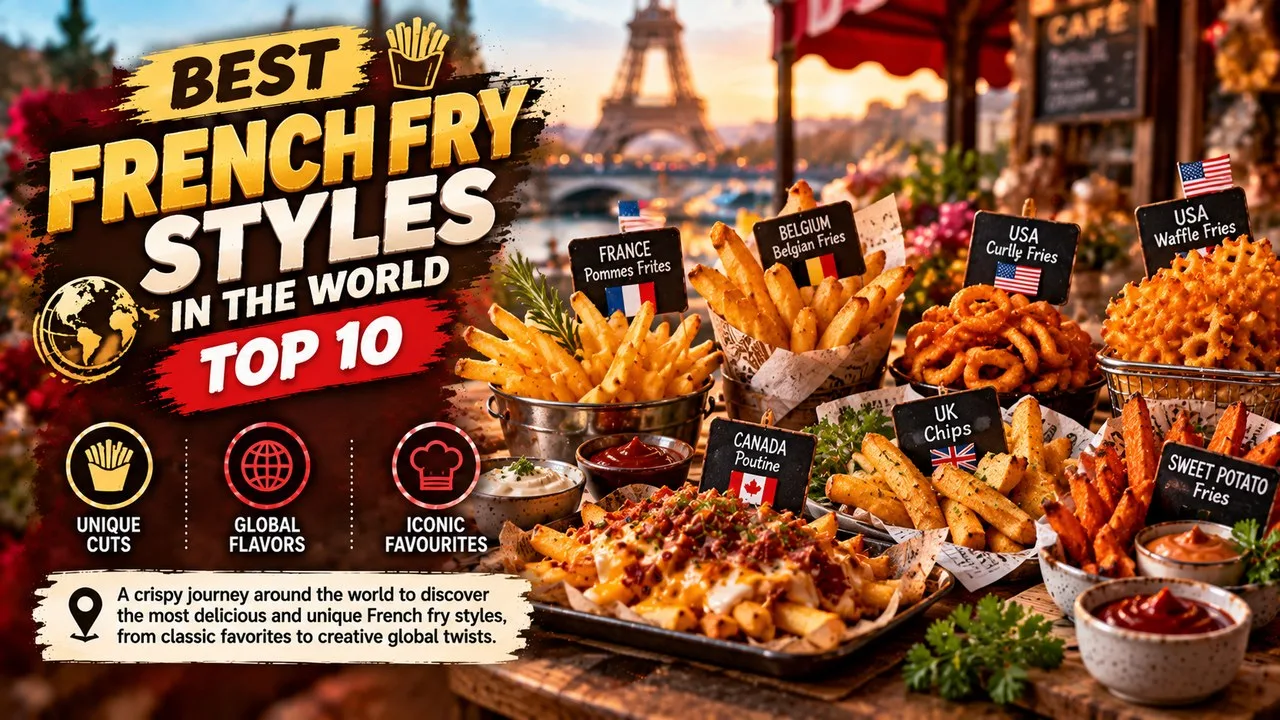
The best French fry styles in the world run from Belgian double-fried frites to Quebec poutine, ranked here by texture, flavour, sauce range and reach.
Fried potatoes are among the few foods that cross almost every border without a passport. India calls them finger chips, Britain calls them chips, France and Belgium say frites, the Netherlands says patat or friet, and North America says fries. Behind those names sits a surprising variety of cuts, fats, frying methods and toppings, each shaped by local potatoes, street-food habits and, more recently, global fast-food supply chains.
This Finepedia guide is an editorial ranking, not a taste poll. It compares ten widely recognised styles using a public five-factor scorecard, so readers can see why a style lands where it does and disagree with the reasoning rather than with a mood. Origin stories are presented as historians and food writers actually report them, which often means listing competing claims side by side. Brand names appear only where a verified fact needs them, such as the year a chain introduced a shape.
Fast-food context lives in Biggest Fast Food Chains in the World: Top 10, and the health trade-offs of deep-fried snacks are covered in Most Unhealthy Foods: Top 10 to Limit and Better Swaps. Readers who enjoy shape-by-shape food guides can also compare Popular Pasta Shapes: Top 10 Types and Best Sauces, and anyone planning a full menu can finish with Most Popular Desserts in the World: Top 10.
How We Ranked the Best French Fry Styles
Each style was scored out of 50 points. Texture carries the most weight because the contrast between a crisp shell and a soft centre is what most people mean by a good fry.
| Factor | Max points | What we measured |
|---|---|---|
| Crispness and texture balance | 15 | How well the style delivers a crisp exterior with a fluffy, fully cooked interior |
| Flavour and potato-to-crust ratio | 10 | Depth of potato flavour, the effect of fat and seasoning, and whether the cut gives a satisfying mix of crust and centre |
| Versatility with sauces and toppings | 10 | How many dips, sauces and toppings the shape carries well, from mayonnaise and vinegar to gravy and cheese |
| Heat and texture holding | 7 | How long the style stays hot and crisp after leaving the fryer, including takeaway conditions |
| Global popularity and availability | 8 | How easy it is to find the style across countries, from street stalls and chip shops to chains and supermarket freezers |
Ties are broken by the texture score. The ranking describes styles at their best, made with suitable potatoes and fresh oil, rather than any single restaurant. Scores are editorial judgements built on the technique and history facts cited in each entry; they are not laboratory measurements.
Best French Fry Styles at a Glance
| # | Style | Home region | Score /50 | Signature trait | Main weakness |
|---|---|---|---|---|---|
| 1 | Belgian frites | Belgium | 45 | Double fry, often in beef fat, served in a paper cone | Best eaten on the spot |
| 2 | Classic straight-cut fries | France and worldwide | 43 | The default stick that suits almost every meal | Quality varies widely between kitchens |
| 3 | British chip-shop chips | United Kingdom | 41 | Thick, fluffy chips with salt and vinegar | Softer crust than thinner cuts |
| 4 | Waffle fries | United States | 40 | Lattice shape with huge dipping surface | Needs a special blade |
| 5 | Poutine | Quebec, Canada | 40 | Fries, squeaky cheese curds and hot gravy | Gravy softens the crust by design |
| 6 | Crinkle-cut fries | United States | 39 | Ridges that grip salt and sauce | Often a frozen-only product |
| 7 | Shoestring fries | France (allumettes) and worldwide | 38 | Maximum crunch from very thin sticks | Cool and go limp quickly |
| 8 | Curly fries | United States | 37 | Spiral cut with seasoned coating | Coating can mask potato flavour |
| 9 | Pommes Pont-Neuf | Paris, France | 36 | Thick batons with a creamy centre | Mostly found in bistros |
| 10 | Sweet potato fries | Americas and worldwide | 33 | Naturally sweet, deep orange flesh | Hard to keep crisp without a coating |
1. Belgian Frites
| Attribute | Details |
|---|---|
| Home region | Belgium, with close cousins in northern France and the southern Netherlands |
| Finepedia score | 45 of 50 (texture 14, flavour 9, versatility 9, holding 6, popularity 7) |
| Typical potato | Bintje is the traditional choice; other floury varieties are also used |
| Frying fat | Traditionally beef fat (blanc de boeuf); vegetable oil is common too |
| Served with | Mayonnaise and a long list of other sauces, in a paper cone |
Origins and History
Belgium and France both claim the fried potato stick, and nobody has settled the argument with a single document. A Belgian story says villagers in the Meuse valley fried potatoes in the 1680s when the river froze and fish were scarce; it is widely repeated, including in BBC Travel coverage, but it rests on tradition rather than solid records. The Flemish heritage inventory takes a careful line: the exact origin of the friet is unclear, fries were being cooked and eaten at Belgian fairs by around the middle of the 19th century, and the first permanent fry stands date from the 1880s.
What is beyond dispute is how deeply the frietkot, or roadside fry shack, belongs to Belgian daily life. In January 2014 Flanders added Belgian frietkot culture to its list of intangible cultural heritage after the national fry-shop association, Navefri, gathered more than 20,000 signatures on a petition. The listing covers the craft of frying as well as the social ritual of queuing at a local stand.
Key Features
- A two-stage fry: a first, gentler cook to soften the centre, a rest, then a hotter second fry to crisp and colour the outside
- The FrietMuseum in Brussels describes the classic method as about 6 to 8 minutes at 130 to 140°C, then 2 to 3 minutes at 170°C, depending on thickness
- Beef fat is the traditional frying medium, which adds a savoury depth; vegetable oil is used for a vegan version
- Bintje potatoes, a floury Dutch variety bred in 1905 by Frisian teacher Kornelis Lieuwes de Vries and named after one of his pupils
- Served in a paper cone with a generous spoon of mayonnaise or one of many other sauces
Significance
Belgian frites rank first because they deliver the clearest version of what the scorecard rewards: a shell that shatters, a fluffy centre and a flavour boosted by the fat. The double fry is not just tradition. Food science writers such as J. Kenji López-Alt at Serious Eats explain that the first fry builds a starch-reinforced layer around each stick, and the second, hotter fry dries that layer into a crisp crust.
Across the border, the Dutch serve their own patat or friet with a similar sauce culture, including patatje oorlog ("war fries"), topped with mayonnaise, peanut satay sauce and raw chopped onion. That cross-border sauce habit is part of why Belgian-style frites score highly on versatility.
Interesting Facts
- The Flemish heritage file notes that, outside the border regions of northern France and the southern Netherlands, frietkoten are hardly found abroad
- Brussels has a FrietMuseum that explains potato choice, beef fat and the double fry to visitors
- A popular but unproven story says American soldiers in Belgium during World War I called the fries "French" because the local army spoke French; Britannica lists the claim as disputed
- Navefri brought a working fry stand to the minister's office in Brussels when it delivered its heritage petition
2. Classic Straight-Cut Fries
| Attribute | Details |
|---|---|
| Home region | France (pommes frites), now universal |
| Finepedia score | 43 of 50 (texture 13, flavour 8, versatility 9, holding 5, popularity 8) |
| Typical cut | French culinary schools commonly teach sticks of about 5 mm by 5 mm, 5 to 6 cm long; fast-food versions vary |
| Typical potato | Starchy, high-solids varieties such as Russet Burbank in North America |
| Served with | Ketchup, mayonnaise, salt, burgers, steak frites and countless sides |
Origins and History
The straight-cut stick is the version most people picture when they hear the word fries. French food historians quoted by The Independent and Le Parisien point to street vendors selling fried potatoes on the Pont Neuf in Paris soon after the 1789 Revolution, while noting that early versions were probably rounds or rough pieces rather than modern sticks. By the 1830s and 1840s, Parisian sellers had shifted towards the baton shape.
The dish reached the United States through several routes. Monticello, the historic home of Thomas Jefferson, notes that Jefferson returned from France with a recipe for "pommes de terre frites a cru en petites tranches", or potatoes deep-fried while raw in small cuttings, and that his notes from the President's House contain perhaps the earliest American reference to the food. National Geographic adds that the related recipe published by his relative Mary Randolph used round shavings rather than sticks, so Jefferson's fries were not quite today's shape.
Key Features
- A medium stick that balances crust and fluffy interior without needing a special blade
- Best results come from blanching, drying and double frying; Serious Eats recommends simmering cut potatoes in water with a little vinegar so they hold together and form a blistered crust
- Russet Burbank, a russet-skinned sport of a potato Luther Burbank selected in the 1870s, became the leading processing potato for frozen fries in North America
- Endlessly adaptable: plain with salt, alongside steak, under chili or cheese, or tossed with herbs and garlic
- Widely sold frozen, which makes the style available almost everywhere
Significance
The straight-cut fry wins on reach. It is the shape that fast-food chains, school canteens, bistros and home cooks share, and it works with nearly any sauce. In 1988 the Los Angeles Times reported that about 79 percent of American restaurants served French fries, according to a 1986 survey, which shows how standard the side had become long before today's global chains.
It ranks below Belgian frites because quality depends heavily on the kitchen. A carefully double-fried stick can rival the best frites, while a soggy one from tired oil is one of the most disappointing foods on a menu. That variability costs it texture and holding points.
Interesting Facts
- The Canadian Food Inspection Agency lists Russet Burbank as excellent for baking and French frying, with French-fry processing among its chief markets
- Britannica notes that Russets are generally preferred for fries, though many varieties can be used
- Many chains stopped using frying oils containing trans fats in the early 21st century, according to Britannica
3. British Chip-Shop Chips
| Attribute | Details |
|---|---|
| Home region | United Kingdom and Ireland |
| Finepedia score | 41 of 50 (texture 12, flavour 9, versatility 8, holding 6, popularity 6) |
| Typical cut | Noticeably thicker than fast-food fries, often cut by hand or machine on site |
| Typical potato | Maris Piper, introduced by Cambridge's Plant Breeding Institute in 1966 |
| Served with | Salt and vinegar, battered fish or curry sauce |
Origins and History
British chips owe their fame to the partnership with fried fish. Fried battered fish was probably brought to London in the 1500s by Sephardic Jewish refugees from Portugal and Spain, according to the London Museum, and fried potatoes were common street food among London's poor by the 19th century. Who first sold the two together is disputed.
One claim credits Joseph Malin, a Jewish immigrant who opened a fish and chip shop in East London around 1860; in 1968 the National Federation of Fish Friers presented his shop with a plaque calling it the oldest fish and chip business in the world. A rival claim from the north credits John Lees, who sold fish and chips from a wooden hut at Mossley market and moved into a shop around 1863. Historians quoted by BBC Travel say several shops appeared in the 1860s and no one can say for certain who was first. By 1920, the London Museum notes, there were around 25,000 fish and chip shops across Britain.
Key Features
- Thick cut, which gives a softer, more potato-forward bite than thin fries
- Maris Piper is prized for a golden outside and fluffy, creamy middle
- Traditionally seasoned with salt and vinegar, though curry sauce has become a popular partner
- Served as part of a meal rather than only a side snack
Significance
Chip-shop chips show that crispness is not the only route to a great fry. Their larger cross-section holds more fluffy potato, and vinegar adds a sharp contrast that many people find more satisfying than ketchup. The thicker build also keeps them warm longer in paper, which helps them score well on holding.
They place third rather than first because the softer crust gives up some texture points to the thinner Belgian and classic cuts. Global availability is lower too, since the full chip-shop experience is rooted in Britain and Ireland, though chippies now operate in many countries.
Interesting Facts
- The Maris Piper arrived while British growers battled the potato cyst nematode, and it proved resistant to the most common potato pests
- More than 19,000 hectares of Maris Piper were grown in the UK in 2012, according to the Cambridge Phenomenon project
- Charles Dickens mentioned a "fried-fish warehouse" in Oliver Twist in 1838, as the London Museum points out
- Chips in Britain mean fries; British crisps are what Americans call potato chips
4. Waffle Fries
| Attribute | Details |
|---|---|
| Home region | United States |
| Finepedia score | 40 of 50 (texture 13, flavour 7, versatility 10, holding 5, popularity 5) |
| Typical cut | Lattice slices made with a wavy blade, rotating the potato 90 degrees between passes |
| Typical potato | Russet-type potatoes, often cut with the skin on |
| Served with | Dipping sauces, cheese, chili and loaded toppings |
Origins and History
French cooking already had pommes gaufrette, waffle-patterned potato slices fried crisp like chips. The thicker American waffle fry turned the idea into a side dish. Chick-fil-A says it first rolled out its Waffle Potato Fries in 1985, and the company describes them as the most ordered item on its Canadian menu today.
At home, cooks make the shape on a mandoline fitted with a wavy or crinkle blade. Each slice is cut, the potato is turned 90 degrees, and the next slice is cut so the ridges cross and leave a grid of small holes.
Key Features
- A grid pattern that creates thin crisp edges and thicker soft points in every piece
- Very high surface area, which grabs salt, seasoning and sauce
- Flat, sturdy pieces that act like scoops for dips and cheese sauce
- Mostly produced by large potato processors, since the cut needs precise equipment
- Often served with a little skin on, which adds an earthy note
Significance
Waffle fries take the top versatility score on this list. The lattice works like a built-in dipping tool, which is why the shape suits sauce-heavy menus. The mix of crunchy edges and soft centres also earns a strong texture score.
Waffle fries tie with poutine at 40 points and take fourth place on the texture tie-break. They give up points on flavour, because the thin sections can taste more of crust than of potato, and on global availability, since the shape is far more common in North America than elsewhere.
Interesting Facts
- Chick-fil-A says today's waffle fries keep the same shape customers have known since 1985
- The French word gaufrette means a wafer, and pommes gaufrette are the crisp, lattice ancestor of the waffle fry
- The thicker pieces at the ends of a potato often show more skin, a feature some fans seek out
5. Poutine
| Attribute | Details |
|---|---|
| Home region | Centre-du-Québec, Canada |
| Finepedia score | 40 of 50 (texture 11, flavour 10, versatility 7, holding 6, popularity 6) |
| Core parts | Fresh-cut fries, fresh cheese curds and hot gravy |
| First appeared | Rural Quebec snack bars in the late 1950s, with competing origin claims |
| Famous variants | Italian, veggie, Montreal smoked-meat and foie gras poutine |
Origins and History
Poutine is a dish built on fries rather than a cut, but it has become one of the world's most recognised fry styles. Britannica, drawing on the Canadian Encyclopedia, places its birth in rural Quebec snack bars in the late 1950s, helped by nearby cheese makers producing fresh curds. Several towns claim it. In Warwick, Fernand Lachance said he first added curds to fries at a regular customer's request in 1957, later adding gravy to keep the plate warm. In Drummondville, Jean-Paul Roy said he created the dish at his drive-in, Le Roy Jucep, in 1964, after customers began adding curds to his fries with sauce.
The name is commonly linked to the English word pudding, and in Quebec slang poutine means a mess. The dish reached Quebec City in 1969 and Montreal in 1983, then spread nationwide through chains. McDonald's added it to Quebec menus in 1990, and by the 2000s chefs such as Martin Picard of Au Pied de Cochon were serving gourmet versions, including foie gras poutine in 2002.
Key Features
- Fresh cheese curds that squeak when bitten, a mark of freshness for purists
- Hot gravy poured over the top, which warms the curds until they soften at the edges
- Sturdy fresh-cut fries that can stand up to sauce without collapsing at once
- Endless regional and restaurant variants, from smoked meat to mushroom sauce
- Served in a paper bag in the Lachance account, later on plates and in sturdy containers
Significance
Poutine earns a perfect flavour score: salty curds, savoury gravy and fried potato make one of the most satisfying combinations in comfort food. It also holds heat well, which was part of the reason gravy was added in the Lachance account.
The same gravy keeps poutine out of the top three. The scorecard rewards crispness, and soaking fries in sauce trades crunch for comfort on purpose. It ties with waffle fries at 40 points and takes fifth on the texture tie-break. Its cultural weight is enormous, though, and Britannica notes it has become a symbol of Quebecois and Canadian cuisine.
Interesting Facts
- Jean-Paul Roy reportedly had to travel to Toronto to find containers strong enough to hold the dish
- A similar dish called disco fries, made with shredded mozzarella, appeared in New York and New Jersey by the 1970s
- The first chain to sell poutine was the short-lived Quebec franchise Frits in 1985
6. Crinkle-Cut Fries
| Attribute | Details |
|---|---|
| Home region | United States |
| Finepedia score | 39 of 50 (texture 12, flavour 7, versatility 8, holding 6, popularity 6) |
| Typical cut | Corrugated sticks made with a ridged blade |
| Typical potato | Russet-type processing potatoes |
| Served with | Burgers, hot dogs, ketchup, cheese sauce and diner meals |
Origins and History
Crinkle-cut fries are made with a corrugated blade that leaves ridges and grooves along every stick. The style is a familiar frozen and fast-casual product in the United States, and the Los Angeles Times listed crinkle cuts among the familiar fry shapes in a 1988 report on the industry.
Few fry shapes have inspired such loyalty. In 2013 Shake Shack switched from frozen crinkle-cut fries to fresh hand-cut fries. In August 2014, Nation's Restaurant News reported, chief executive Randy Garutti announced the crinkle cuts would return in November without the artificial ingredients used before, saying the hand-cut fries had remained inconsistent. The announcement was greeted with open celebration on social media.
Key Features
- Ridges that add surface area and therefore more crisp edges per bite
- Grooves that hold salt, seasoning and sauce
- A thicker cross-section than shoestring fries, with a soft centre
- Strongly associated with frozen and fast-casual menus
- Easy to make at home with an inexpensive crinkle cutter
Significance
Crinkle-cut fries earn their place through structure. Tasting Table, citing Shake Shack's culinary director, reports that the shape stays crunchy for longer and gives ketchup more to cling to. That shows up in this ranking as a good holding score and solid versatility.
They fall behind waffle fries because the ridges add less dipping surface than a full lattice, and behind poutine on flavour. Many crinkle cuts are also bought frozen, so quality depends on the processor more than on the cook.
Interesting Facts
- Shake Shack's 2014 open letter admitted that cutting, soaking and double frying thousands of potatoes in-house was hard to keep consistent
- Crinkle-cut fries are offered by chains including Arby's, Del Taco and Raising Cane's, according to Tasting Table
- When it opened in 2004, Shake Shack tested shoestring, waffle and thick-cut fries before settling on crinkles, according to Tasting Table
7. Shoestring Fries
| Attribute | Details |
|---|---|
| Home region | France (pommes allumettes and pommes paille), now global |
| Finepedia score | 38 of 50 (texture 14, flavour 6, versatility 7, holding 4, popularity 7) |
| Typical cut | Pommes allumettes are about 2 to 3 mm thick and about 7 cm long |
| Cooking note | Very thin sticks need a gentle pre-cook so they do not overcook before crisping |
| Served with | Steak, burgers, tartare and as bar snacks |
Origins and History
French kitchens have long named potato cuts by size, and the thin end of that scale includes pommes allumettes (matchsticks) and pommes paille (straw). Behind the French Menu, a guide to French menu terms, describes allumettes as about 2 to 3 mm by 2 to 3 mm and around 7 cm long, and notes that this cut is often called straw or shoestring fries in the United States.
In bistros, shoestring fries are a classic partner for steak or beef tartare. In fast food, thin fries sit close to the shoestring end of the scale; in 1988 the Los Angeles Times even referred to McDonald's fries as its famous shoestrings.
Key Features
- The highest crust-to-centre ratio of any cut on this list
- A light, crunchy bite that is easy to eat by the handful
- Serious Eats suggests a low-temperature water "blanch" for shoestrings, since a normal boil overcooks such thin pieces
- A double fry, first to drive off water and then to crisp, followed by immediate salting
- Very quick cooking time in the final fry
Significance
On pure crunch, shoestring fries match Belgian frites with a texture score of 14. They lose ground elsewhere: there is little fluffy potato inside each stick, so flavour depends heavily on salt and fat, and the thin pieces cool and soften quickly once out of the fryer.
That makes shoestrings a style for eating immediately, ideally at the table. They are excellent beside rich dishes such as steak, where the potato acts more as a crisp contrast than as the main event.
Interesting Facts
- Serious Eats warns that very wet, thin potatoes added to hot oil can froth up, so batches must stay small for safety
- Some French references treat pommes paille (straw potatoes) as an even finer cut, while others use the name interchangeably with allumettes
- Letting the first-fried strings cool fully before the second fry helps the surface starch set and crisp
8. Curly Fries
| Attribute | Details |
|---|---|
| Home region | United States |
| Finepedia score | 37 of 50 (texture 12, flavour 8, versatility 6, holding 5, popularity 6) |
| Typical cut | Long spirals made by a rotating or angled cutting blade |
| Coating | Often a light seasoned batter with spices such as paprika, garlic and onion |
| Served with | Sandwiches, burgers and dipping sauces |
Origins and History
Curly fries are spiral-cut potatoes, usually lightly battered and seasoned. Spiral potato shavings have a long history; the Jeffersonian-era recipe described by National Geographic recommended cutting potatoes in rounds as if peeling a lemon. The modern fast-food curly fry, however, is a product of industrial spiral cutters.
Arby's helped make the shape a menu staple. In November 1988 the Los Angeles Times reported that the chain had recently introduced the Curly-Q Fry, cut in a spiral shape and seasoned, and that an executive said it was selling as well as the regular fry.
Key Features
- A continuous spiral that gives each portion a mix of thin crisp edges and thicker centres
- A seasoned coating that adds flavour and helps the exterior stay crunchy
- Usually par-fried and frozen at the factory, then fried again before serving
- Difficult to make at home without a spiral cutter
Significance
Curly fries rank on character. The seasoning gives them more flavour on their own than many plain fries, and the coating helps them stay crunchy. Chowhound explains that restaurant curly fries are typically spiral-cut by machine, dredged in a light batter, part-fried and frozen, then fried again for service.
They lose versatility points because the seasoning steers the flavour, and long spirals are less practical for heavy toppings than flat waffle fries. The potato itself also plays a smaller role than in plain cuts.
Interesting Facts
- Chowhound notes that a fry cut from a large potato can stretch well over a foot when pulled straight
- Arby's curly fries are produced by the potato processor Lamb Weston, according to Chowhound
- Mary Randolph's 1824 recipe, linked to Jefferson's household, already favoured round shavings rather than sticks
9. Pommes Pont-Neuf
| Attribute | Details |
|---|---|
| Home region | Paris, France |
| Finepedia score | 36 of 50 (texture 12, flavour 9, versatility 7, holding 5, popularity 3) |
| Typical cut | Thick batons, about 1 cm square in Escoffier's classic description |
| Cooking method | Blanched in moderately hot fat, cooled, then crisped in hotter fat |
| Served with | Steak, roast meats and bistro dishes |
Origins and History
Pommes Pont-Neuf are named after the Pont Neuf, which despite its name ("New Bridge") is the oldest standing bridge in Paris. Saveur explains that the name comes from the bridge where fried potatoes were said to be sold, and French historians cited by The Independent describe contemporary accounts of street vendors selling fried potatoes there soon after 1789.
French culinary references describe the Pont-Neuf cut as a baton about 1 cm thick, and the French radio station Europe 1 gives a recipe of 1 cm batons blanched at 150°C and finished at 190°C. Today the name is used on bistro menus for thick, carefully cooked fries.
Key Features
- Thick batons with a creamy, almost mashed-potato centre
- A crisp, golden shell from a classic two-stage fry
- Floury potatoes and beef fat in the Europe 1 recipe, which uses Bintje
- Served today as a restaurant side rather than street food
- A direct link between Paris street history and modern French cooking
Significance
Pont-Neuf potatoes offer one of the best potato-to-crust balances on this list, with a rich interior and a firm crust. They score well on texture and flavour.
Their low position comes from availability. Outside French bistros and fine-dining kitchens, the name is rarely used, so the style scores only 3 of 8 for global reach. It earns a place in the top ten as a reminder that fries were serious food long before fast-food chains.
Interesting Facts
- Escoffier's Guide culinaire describes the 1 cm baton as the fundamental type of fried potato, according to the culinary dictionary Gastronomiac
- Le Parisien reports that early Pont Neuf sellers were often women working as street traders
- Food historians quoted by Le Parisien say the stick shape replaced sliced rounds in Paris around the 1830s, partly because rounds stuck together in the fat
- The Pont Neuf crosses the Seine at the western tip of the Ile de la Cite
10. Sweet Potato Fries
| Attribute | Details |
|---|---|
| Home region | Americas (the plant) and worldwide (the fry) |
| Finepedia score | 33 of 50 (texture 8, flavour 8, versatility 7, holding 4, popularity 6) |
| Botanical name | Ipomoea batatas, in the morning glory family, not closely related to the common potato |
| Cooking challenge | More sugar and moisture than regular potatoes, so they brown fast and soften quickly |
| Served with | Spiced salt, chipotle mayonnaise, aioli and burgers |
Origins and History
Sweet potato fries are made from a different plant from every other entry here. The sweet potato, Ipomoea batatas, belongs to the morning glory family (Convolvulaceae), while the common potato, Solanum tuberosum, belongs to the nightshade family, so the two are distinct crops. Sweet potatoes are also different from true yams, despite the names being mixed up in some markets.
As a fry, sweet potato became a popular alternative on restaurant menus and in supermarket freezers. Its deep orange colour and natural sweetness make it stand out on a plate, and it pairs well with spicy or smoky seasonings.
Key Features
- Natural sweetness that caramelises quickly in hot oil
- A softer interior than most potato fries
- Often coated in starch or batter to help the outside crisp
- Pairs well with chilli, cayenne, garlic and smoky sauces
- Widely available frozen and in casual restaurants
Significance
Sweet potato fries add colour and a sweet-savoury contrast that regular potatoes cannot match. They score respectably on flavour and versatility.
Texture is the weak point. America's Test Kitchen notes that most sweet potato fries go soggy seconds after leaving the oil, so its recipe dips them in a cornstarch and club soda batter to create a starchy coating similar to the one that forms on regular fries. Without such help, the style struggles to stay crisp, which places it tenth.
Interesting Facts
- America's Test Kitchen's coated sweet potato fries need only a single fry at 375°F (about 190°C), instead of the double fry used for regular fries
- The club soda in that batter helps stop the cornstarch from clumping
- Cut sweet potatoes can brown in the air, so recipes often advise cutting them just before frying
Fry Techniques Compared
The cut sets the balance of crust and soft potato; the cooking method decides how crisp that crust becomes.
| Technique | Used by | What it does | Source |
|---|---|---|---|
| Double fry (low, then high) | Belgian frites, Pont-Neuf, classic and shoestring fries | First fry cooks the centre and builds a starchy layer; second fry crisps it | FrietMuseum Brussels; Serious Eats |
| Vinegar water par-boil | Classic thin fries at home | Helps sticks stay intact and form a blistered crust | Serious Eats |
| Low-temperature water blanch | Shoestring fries | Seasons and sets very thin strings without overcooking | Serious Eats |
| Batter or starch coating | Curly and sweet potato fries | Adds a crisp shell and seasoning that stays crunchy longer | Chowhound; America's Test Kitchen |
| Soaking before frying | Many cuts | Can lower acrylamide formation during cooking | FDA |
| Topping with gravy and curds | Poutine | Trades crunch for heat retention and flavour | Britannica |
Health and Safety Notes
Fries are a treat rather than a health food. Britannica notes that frying makes them high in fat and that salt adds further concerns for heart health. For exact calorie, fat and sodium values, the USDA FoodData Central database lists many specific fry products, and values differ widely by cut, coating and portion size.
Acrylamide is another point to understand calmly. The US Food and Drug Administration explains that it forms in some plant foods, including potatoes, during high-temperature cooking such as frying. The European Food Safety Authority concluded in 2015 that dietary acrylamide potentially increases cancer risk, while noting that evidence from human studies is limited and inconclusive. The FDA's practical advice for cut potato products is to cook them to a golden yellow rather than brown colour, to soak raw slices for 15 to 30 minutes before frying, and to store potatoes outside the refrigerator.
| Tip | Why it helps |
|---|---|
| Fry to golden yellow, not dark brown | Brown areas tend to contain more acrylamide (FDA) |
| Soak cut potatoes, then dry well | Lowers acrylamide formation and prevents dangerous splattering (FDA) |
| Store potatoes in a cool, dark place, not the fridge | Cold storage can raise acrylamide during cooking (FDA) |
| Keep portions modest and watch the salt | Fries are high in fat and often heavily salted (Britannica) |
Frequently Asked Questions
What are the best French fry styles in the world?
On Finepedia's editorial scorecard, Belgian frites rank first, followed by classic straight-cut fries, British chip-shop chips, waffle fries and poutine. Crinkle-cut, shoestring, curly, Pommes Pont-Neuf and sweet potato fries complete the top ten. The ranking weighs texture most heavily, then flavour, sauce versatility, heat holding and availability.
Were French fries invented in France or Belgium?
Nobody knows for certain. French historians point to street vendors selling fried potatoes on the Pont Neuf in Paris soon after 1789, while Belgium cites a long fry-stand tradition and a popular, unproven story about the Meuse valley in the 1680s. Britannica describes the origin as uncertain and the source of the name as disputed.
Why are fries fried twice?
The first, lower-temperature fry cooks the inside and builds a layer of starch-reinforced cells around each stick. After a rest, a hotter second fry drives off moisture and turns that layer into a crisp crust. Serious Eats and the FrietMuseum in Brussels both describe this two-stage method as the key to crisp fries.
Which potato is best for French fries?
Starchy, high-solids potatoes work best. Russet Burbank is a standard choice in North America, Maris Piper is the classic chip potato in Britain, and Bintje is the traditional Belgian variety. Waxy potatoes hold their shape but usually give a less fluffy interior and a weaker crust.
Are sweet potato fries healthier than regular fries?
Not automatically. Both are deep-fried, so fat and salt depend largely on the cooking method, coating and portion size. Sweet potato fries also often carry a starch or batter coating to help them crisp. For exact numbers, compare specific products in the USDA FoodData Central database rather than assuming one style is better.
Where did poutine come from?
Poutine came from rural Quebec snack bars in the late 1950s. Fernand Lachance of Warwick said he first combined fries and cheese curds in 1957, while Jean-Paul Roy of Drummondville said he invented the dish in 1964. Britannica notes that several towns and families still claim it.
How can I reduce acrylamide when making fries at home?
The FDA suggests soaking raw potato pieces for 15 to 30 minutes, drying them well, frying to a golden yellow rather than brown colour, and storing potatoes outside the refrigerator. EFSA considers acrylamide a public health concern, but these steps are simple ways to lower exposure.
Conclusion
The best French fry styles in the world show how much a simple potato can change with a different knife, fat and topping. Belgian frites take first place on this Finepedia scorecard thanks to their double fry, fluffy centre and deep sauce culture. Classic straight-cut fries win on reach, British chips on comfort and vinegar, waffle fries on dipping power and poutine on flavour. Crinkle-cut, shoestring, curly, Pont-Neuf and sweet potato fries each bring a distinct strength, from staying crisp to sweet contrast. Whatever the favourite, the same rules apply: choose a starchy potato, fry in clean oil, aim for golden rather than brown, and eat them while they are hot.
- Britannica, French fries: https://www.britannica.com/topic/French-fries
- Britannica, Poutine: https://www.britannica.com/topic/poutine
- Monticello (Thomas Jefferson Foundation), 4 Foods Jefferson Helped Popularize in America: https://www.monticello.org/stories/4-foods-jefferson-helped-popularize-in-america
- National Geographic, Are French Fries Truly French?: https://www.nationalgeographic.com/culture/article/are-french-fries-truly-french
- Immaterieel Erfgoed Vlaanderen, De Belgische frietkotcultuur: https://www.immaterieelerfgoed.be/nl/immaterieel-erfgoed/de-belgische-frietkotcultuur/
- Flanders in the UK, Frietkoten recognised as cultural heritage (2014): https://www.flandersintheuk.be/en/frietkoten-recognised-as-cultural-heritage
- FrietMuseum Brussels: https://www.frietmuseum-brussels.be/en/home
- Historiek, Bintjes named after a Frisian schoolgirl: https://historiek.net/bintjes-vernoemd-naar-ijverig-schoolmeisje/69711/
- Serious Eats (J. Kenji López-Alt), Perfect Thin and Crispy French Fries: https://www.seriouseats.com/perfect-french-fries-recipe
- Serious Eats, Why Double Fry French Fries?: https://www.seriouseats.com/the-burger-lab-why-double-fry-french-fries
- Serious Eats, Shoestring French Fries: https://www.seriouseats.com/shoestring-fries-5217430
- Canadian Food Inspection Agency, Russet Burbank: https://inspection.canada.ca/en/plant-health/potatoes/potato-varieties/russet-burbank
- Bethke et al., History and Origin of Russet Burbank (American Journal of Potato Research, 2014): https://bethke.horticulture.wisc.edu/wp-content/uploads/sites/26/2014/12/Am-Potato-J-2014-BethkeHistory-and-Origin-of-Russet-Burbank-Netted-Gem-a-Sport-of-Burbank.pdf
- Los Angeles Times (20 November 1988), Potato Redux: https://www.latimes.com/archives/la-xpm-1988-11-20-fi-357-story.html
- London Museum, How London got hooked on fish and chips: https://www.londonmuseum.org.uk/collections/london-stories/how-london-got-hooked-on-fish-chips/
- BBC Travel, Chipping away at the history of fish and chips: https://www.bbc.com/travel/article/20130409-chipping-away-at-the-history-of-fish-and-chips
- Cambridge Phenomenon, Maris Piper potato: https://cambridgephenomenon.com/showcase/maris-piper-potato/
- Chick-fil-A Canada, What to know about our Waffle Potato Fries: https://www.chick-fil-a.ca/stories/what-to-know-about-our-waffle-potato-fries
- Nation's Restaurant News (August 2014), Shake Shack brings back crinkle-cut fries: https://www.nrn.com/food-trends/restaurant-menu-watch-shake-shack-brings-back-crinkle-cut-fries
- Tasting Table, The gastronomic purpose of crinkle cut fries: https://www.tastingtable.com/1184016/the-gastronomic-purpose-of-crinkle-cut-fries/
- Chowhound, How restaurants make curly fries: https://www.chowhound.com/1833615/how-restaurants-make-curly-fries/
- Behind the French Menu, French cuts for fruits and vegetables: https://behind-the-french-menu.blogspot.com/2022/01/les-decoupes-de-fruits-et-legumes.html
- Saveur, Pommes Pont Neuf: https://www.saveur.com/article/recipes/parisian-fried-potatoes/
- The Independent, French battle Belgians over invention of les frites: https://www.independent.co.uk/news/world/europe/french-battle-belgians-over-invention-of-les-frites-8437398.html
- Le Parisien, L'incroyable saga de la frite (2021): https://www.leparisien.fr/societe/lincroyable-saga-de-la-frite-on-a-tranche-le-batonnet-de-patate-est-parisien-17-07-2021-IJJJGM2ZGRDOHDFC7GP5QU7NSQ.php
- Europe 1, Les pommes de terre Pont-Neuf: https://www.europe1.fr/emissions/delice-in-extremiste/les-pommes-de-terre-pont-neuf-4000503
- Gastronomiac, Pommes Pont-Neuf: https://www.gastronomiac.com/lexique_culinaire/pommes-pont-neuf/
- SBS Food, Dutch war fries: https://www.sbs.com.au/food/article/dutch-war-fries-provide-a-battleground-of-tastes/zr2hwznd1
- NC State Extension, Ipomoea batatas: https://plants.ces.ncsu.edu/plants/ipomoea-batatas/
- America's Test Kitchen, Crispy Sweet Potato Fries: https://www.americastestkitchen.com/recipes/4279-crispy-sweet-potato-fries
- US FDA, Acrylamide and Diet, Food Storage, and Food Preparation: https://www.fda.gov/food/process-contaminants-food/acrylamide-and-diet-food-storage-and-food-preparation
- EFSA, Acrylamide in food is a public health concern (2015): https://www.efsa.europa.eu/en/press/news/150604
- USDA FoodData Central: https://fdc.nal.usda.gov/
- Topic prompt only (order, wording and opinions not copied): https://10mosttoday.com/10-best-french-fries-based-on-deliciousness/
















Log in with